

We did a shootout, oh, well over a year ago now, comparing power-strips and this adapter here:
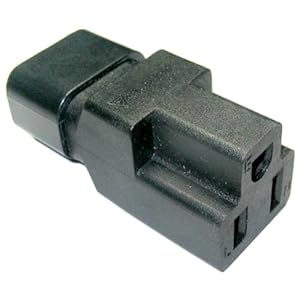
This adapter allows you to plug in one audiophile power cord into another. In our tests we plugged an Nordost Odin PC into an Elrod PC – the length of the Odin PC not being sufficient. This shootout allowed us to do this exact same thing with confidence in the sonic result at RMAF 2010 when one of the Odin PCs did not reach the Emm Labs XDS1 player.
For $11.52 at Amazon with super-saver shipping (and you can get it for $4 elsewhere if you are not in a hurry and do not mind paying shipping costs) this solution beats power-strip solutions costing upwards of $2500.
Like I said last time [let’s hope I do better this time!] I would like to purchase more of these kinds of adapters to determine if, say, a ‘Y’ adapter allows us to plug 2 PCs into another PC and have it ALSO sound much better than the standard audiophile-grade power-strips out there.
Relativism is the name given to the idea that whether a thing is good or bad is entirely dependent on a person’s point of view.
That there is no Absolute better and worse, no Absolute good and evil.
Relativism is most often used by people who are trying to push their particular point of view in order that they can make more money and gain more power. [it is my opinion that good people resort to relativism only because they are insufficiently schooled at rhetoric and are unable to argue the case convincingly – no matter if their case is Absolutely right].
Relativistic reviewers feel justified recommending every single piece of equipment as the ‘best’ saying that it will be the best for ‘somebody’ out there, so why not. The fact that they think it stinks means nothing, its just their personal preference.
OK. Some examples:
JV: arc-ref-610-vs-vtl-siegfried-800
And I quote:
“I’m not quite sure what is irrelevant about pointing out that even back in the day there was no single best, which is the point i was making about the VTL and the ARC amps. Let’s say, for the sake of argument, that i got the VTL Siegfrieds and compared them to the ARC 610Ts. You already know how I feel about the 610Ts–I prefer their neutrality, their luminousness, their bloom, their naturalness to any other tube amp I’ve heard in my home or at shows. For the sake of argument, let’s say that I continued to prefer the ARC 610Ts’ presentation to that of the VTL Siegfrieds, at least on Magico and MartinLogan loudspeakers, my question is: So fucking what? Who appointed me King of the Audiophiles? Who appointed Pearson King? or Cordesman? “
Besides the fact that luminousness and bloom is just not the ARC’s forte, ARCs are better amps than VTL for everything but the ultimate “I don’t care about anything else but raw nuclear-strike level macro-dynamics” Boy Toy systems.
Based on JVs comments in that thread, and the rooms he likes at RMAF 2010, I would say that he prefers a cross between Boy Toy and Practical systems [i.e. big loud systems that you can kind of casually listen to music on].
From the relativistic point of view, JV is off in his own personal universe and his preferences mean nothing to anybody else but him.
From the absolutist point of view, he currently prefers a particular type of categorizable system and his preferences are completely valid for all other people looking for that kind of system, as well as to those off us who can write off his preferences because we are NOT interested in that type of system. In fact, the more he talks about his preferences and what he likes, the MORE useful it is for absolutists.
Another example:
Jacob Heilbrunn: vtl-siegfried-power-amplifier-75-series-ii-preamplifier
A couple of quotes:
“It was wide open, passing a tremendous amount of information—the most that I have heard from any preamplifier, excepting the Messenger, which passes a pinch more. Once again the VTL trademarks were there: an extremely dynamic, transparent, and fast sound. No part of the frequency spectrum was unduly emphasized, but the presentation was far from the traditional tube one. Lovers of a more romantic sound will find the 7.5 to be too stark and neutral. I didn’t. The verve and zest, the dynamic power and scale with which it reproduced music made it hard to fault”
I am not familiar with Jacob’s writing. Some of this is reviewer CYA speak, some of it is [sometimes I think deliberate] inexperience.
“the most I have heard from any preamplifier” – this is Absolutist-speak but using relativism to cover his ass. Does the casual reader know just what preamps Jacob HAS heard? [No. They interpret this as an absolute comparison with the ENTIRE WORLD of preamps – this is a reviewer for gawd sakes, they know and have heard everything! – this pre has the mostest].
Jeez, a treasure trove of reviewer-speak here:
“Lovers of a more romantic sound will find the 7.5 to be too stark and neutral. I didn’t.”
The first sentence is vacuously true for any amp: Lovers of a more romantic sound than what amp X is able to provide will find amp X too stark and neutral. The ‘hint’ is that the VTL is stark and neutral. The “I didn’t” is to move the statement from any absolutest conclusion into the relativist’s personal preference domain. He, the all-knowing all-powerful reviewer writing the review did not find the amps too start and neutral, which tends to call out lovers of more romantic sounds as having personal preferences that are somewhat ‘abnormal’.[this is reiterated and confirmed later on in this review where he also later devolves into referencing the trumped up small tube / large tube/ solid state wars].
Not picking on Jacob in particular; this is how 99% of reviewers absolve themselves of any responsibility for describing what things really sound like and moving all observations firmly from any tint of absolutism over into the subjective relativism domain.
In fact, the VTL is NOT overly stark and neutral. Their sound has a dark veil over the harmonics [maybe that is what stark means?], little or no micro-dynamic capability, has difficulties with note decay and other things that are off-putting to lovers of these other, critical, parts of the music. It is not their use of any particular technology, which so many relativists would have you believe, that is off-putting to people who do not favor these amps over some others.
“There are few other tubed amplifier in production that can challenge its dynamic sweep.”
Now, this statement in the concluding paragraph goes the other direction. Making an absolutist statement, but coaching it in so many qualifiers that it is near useless.
I think one can safely say that “This amp is currently lord of macro-dynamics.” [referring only to home audio amps and not the monsters at, say, the Stone’s concerts!]. Just tell people what it sounds like. This way, if someone really wants macro-dynamics above all else, they can get these amps and be very, very happy. Dealers are happy, the reviewer is happy, VTL is happy. But with these reviews obfuscating the situation with his personal preferences this, and your personal preferences that and referencing tube vrs solid-state wars and etc. the review is just confusing to most people who are trying to figure out what amp to buy.
The point here is then that personal preferences can be categorized into just a few absolute kinds of system sound [a simplification, yes but a very useful simplification, like many, many other models of reality we use everyday], and equipment can be described using language that refers to its absolute good better best for each [limited set of] attributes of sound, and with respect to the kinds of system(s) that the equipment is targeted at.
Sound clips from RMAF that Audiogon (mostly Arnie, I think) recorded in some rooms.
The buffering algorithm sucks – so you have to let the sound sputter and die several times and then reload the page and then play it again if you want to hear more than about 5 seconds of music at a time [at least that’s how it was for me].
You CAN hear the character of the rooms, depending on the quality of your computer speakers. It will be not as stark as real life, but I think it is VERY much like going to the show.
I would suggest using standard Show Protocol. If, after some amount of time the sound in one room makes you feel like going postal… DON’T. If you have no reason WHY you want to go postal all of a sudden – don’t worry about it – just STOP trying to figure it out and go to (click on) a different room / sound clip.
I thought these all showed very clearly what we have been talking about except the Walker room, which, at least on my speakers, took more serious listening effort to hear the issues with the sound than just the ‘Do I Want To Break Something’ test.
Audio Federation Sound Clip at RMAF 2010
We did not get to choose what music we wanted to play when Arnie came in the room. In hindsight, he took some time to set up, and we could have quickly chosen something else… but what? We usually only play the 1st track on this CD, it is one of the more complex and interesting, but we figured it would be bad to change anything, CD or volume, since Arnie had already adjusted his recording volume and so here you hear the 2nd track on the CD [Neli and I kind of looked at each other, using hand signals and stuff as we agreed that doing nothing to the CD or volume was probably the best choice. Its not like Arnie *told* us he was going to do this :-)]. Sounds pretty good – certainly kind of hints at the quality of playback the system was capable of.
Too bad they did not get a sound clip of our Audio Note room. THAT would have been interesting.
YG Acoustics / Soulution Sound Clip at RMAF 2010
[Significantly more bass than the other systems]
Magico / Spectral Sound Clip at RMAF 2010
Both this and the Walker room are playing more challenging music. That first cut on Santana Abraxus *is* one of the more complex pieces of rock and roll out there, but… not quite up to the complexity of the tracks being played in the Magico or Walker rooms]
Walker / TAD / Technical Brain Sound Clips at RMAF 2010
One of the mental tricks I use when evaluating a new sound is to imagine myself having just paid a bundle for a new system that was making the new sound – me RELAXING [NOT concentrating on the sound] in my own room listening to it and trying to enjoy it. Would I be happy? Would it drag me into the music? Would I turn it off?
Anyway, interesting to hear what people think. My computer sound system is somewhat better than average, but not audiophile quality by any means.
Does Love == Micro-dynamics?
No.
Well, maybe I should not speak for the rest of you on that point…
I think micro-dynamics is one of the more obvious things you hear on a system that is able to render the fine details of individual notes.
Uh Oh. I feel a couple of Photoshop picture graphs coming on…
But before we have to go there…
Is the ability to render fine details of individual notes REQUIRED for a drug-like sound? I.E. we should ask ourselves whether they are truly Necessary, and whether they are Sufficient.
The answer to whether it is sufficient is, I think no, not entirely, based on the idea in previous comments that there must be some amount of ‘truth’ in at least some part of the music that sounds real enough to get the rational part of the mind to shut up about how stupid all of this is. Like Jim says “Something that takes your attention away from what is wrong and to focus on what is right”.
We see this all the time: people HAVE to have lots of realistic dynamics, or soundstaging, or imaging, or harmonics. That is THEIR particular thing that their brain demands [assuming they are being truly introspective and not just parroting something they read in a forum]
The idea is to give the rational part of our brain something to chew so it will allow us to then tailor the rest of the music for our more imaginative part of the brain – stuff that the brain can start free-associating with [and generate interesting and transformative ‘experiences’]
I think micro-dynamics are just slightly more well-defined inner-details. I think that these fine details ARE necessary for transformative experiences because I think it is in the complex patterns and messages of music that all the magic lies.
First, fine details of a note are found in its harmonic transitions, frequency transitions and dynamic transitions – and it is these complex transitions that communicate Information, and of course, we then can add all the information created by the interplays between these things within the note – and all the interplays with all the other notes….
For example, think of a word in a song sung by Neil Young, or Sinead O’Conner, or any expressive singer. Or any child. The fine details of the word, as it is spoken, transmit TONS of information to us [we learn to hide this as we grow older, not wanting to publicly broadcast what we are really thinking this way.]
If our systems cannot reproduce a sufficient level of fine detail, then all singers sound like politicians… fake. [and some singers always will anyway, they are just not all that good at this].
Second: A lurker on this blog [hi F! :-)] talked to Neli today about how quiet backgrounds were synonymous, necessary, or at least related to micro-dynamics [Hey, she’s my wife. You can never get a clear concise message from your spouse. It’s a law ;-)]. I thought about F’s speakers and realized that lower noise floors do help on those, and, looking at the extreme cases of lots of noise and no noise, a lower noise floor helps on all speakers.
Given any system then, a lower noise floor will help us to better hear any micro-dynamics that the system is capable of. For some systems this might be all that is required. Their design is sufficiently adequate that it may only take a slightly better cable to lower the noise floor enough to bring out quite a bit of fine details. However, other systems may never have appreciable micro-dynamics because there are just too many design decisions in that system that are going in the other direction – mostly amp designs that try to hide detail because they think some people will see it as ‘bright’ because detail on solid state is often bright, or because they just suck at their job [I Love the ’50 First Dates’ movie :-)] and speakers designs that are way too hard to drive with cones that just can’t respond to such subtle changes within notes, they can barely respond to the massive ones without requiring a billion watts to do it.
So.
The greater the ability to render fine details of notes, the greater the number complex patterns that our mind can use to our benefit. The lower the noise floor the better we will be able to hear those fine details.
Next… pictures?
Next… the various kinds of ‘messages’ found in the complex patterns of music
Can’t find the previous post on this topic, several years ago, but I did find our ‘coming out’ story on our experiences with the Marten Coltrane Supreme speakers at CES 2006…

A funny thing happened on planet Abraxas
and a description of a related more ephemeral experience:
More on Number 4 Setup of the Powercord Shootout
The background idea is that our brain organizes things using relationships between these things and that all these billions of relationships form lots of patterns. The music we listen to also has lots of patterns, and when these two patterns resemble each other enough, the patterns in the brain are ‘excited’. We perceive the excitation of these brain patterns in various ways, and some of these are what I think is the ‘drug-like’ experience we get from music.
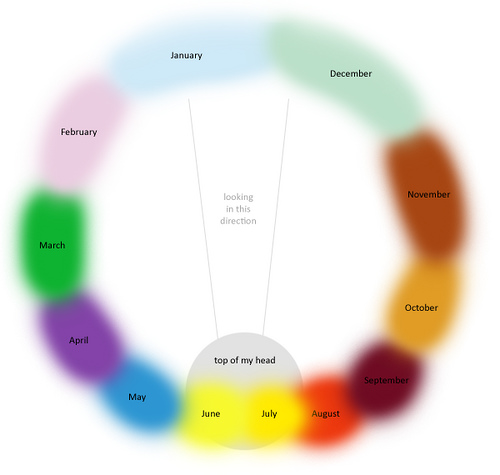
A visual pattern for the months of the year.
I think we all organize the world into patterns; patterns in 2D [heights of family members in an atomic family] and 3D space [mountains are larger than molehills], of color, texture, sound, … moving things,… using various values of attributes that we are familiar with through our 5 senses [bright versus dim, red versus orange,. sharp versus dull….]. Studies of extreme debilitating versions of this is apparently called Synesthesia.
[For myself, the colors of the calendar here are pretty close – but colors do not play a large part in my mental patterns for months (but my patterns for various people does use colors). However, for me, the months are rectangular, like a sidewalk; my head is also close to the current month, facing slightly ahead of the current week, and I think there is a characteristic note (of a specific frequency and duration) associated with each month, I just haven’t worked out quite what it is yet since I never really thought about it until now].
The point here is that the patterns in the brain do NOT have to be sonic patterns in order to resonate with the patterns in music, they just have to be related in some structural way. Our brains are good at matching patterns that are similar but not exact matches for each other, as in ‘you look just like this other bloke I know’ [but of course he does not look exactly like the bloke you know, he only ‘reminds’ you of him, otherwise you would ask him what the hell is he doing here at this Justin Bieber concert too?].
… hear that it is stinking up Denver [now THAT’S a switch :-)]
They were using helicopters yesterday to dip buckets into the new lake on the backside of the ridge our house is on (can’t see it from here because of all the trees)

You can see our front porch gutter silhouetted in the foreground. For awhile I did not know what was up, and wondered if this was an air rescue copter ferrying someone to the emergency room [we get those periodically, and since we are on the top of a ridge, we get to kind of experience a lot of airborne traffic first hand]. Then I saw that slight stream of water coming off the bucket…

Yes, they are flying directly above our house. [They are back at it this morning, and are taking various routes, not all of which are directly above the house].

This is why I started taking photos of the copter: the water droplets from the bucket ‘leaking’ water was catching the sunshine and leaving a long trail that looks like smoke. Increased the humidity here a little [good] countered by the smell of diesel fuel exhaust [oh bad]
[This is the only show report which we have found, over several years, to have any in-depth content.]
I will only talk about rooms we both saw that he commented on.
The link to his report is here:
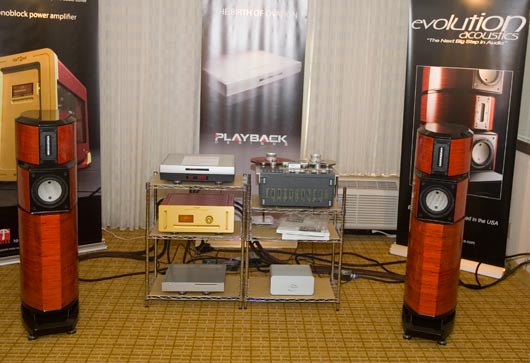
=== Evolution Acoustics / darTZeel ===
I was originally going to cover this in our show report, but, even though I made an attempt to get back to this room – and got really, really close, I only heard it once. Neli also heard this room and I will take her observations into consideration with respect to my comments here.
I think we all agree that this was the best sounding EV / dartZeel room at a show in years. I heard the R2R only, and I did NOT hear any “slight edge in upper mids”. What I heard was a nicely fleshed out sound [as opposed to a somewhat midrangy sound at previous shows]. What I also heard, and Neli seemed to as well, was a highly separated sound that did not seem to congeal into a whole. I spent my time there trying to determine if it was the fault of the R2R, but Neli heard the Playback Designs digital and had the same experience. This is often a symptom of sitting too close to the speakers – which in these small hotel rooms is not all that uncommon.
=== Magico ===
Well, surprise surprise JV is on the Magico bandwagon in spite of the “There was just a trace of dryness and sterility” comment.
One has to wonder what the spectacular Magico marketing budget has been this year – and other speaker manufacturers, all kinds of audio manufacturers in fact, must be wondering if such an all-out effort may be worth it or not. Depends on the eventual backlash I guess – usually campaigns like this are staged so that they unfold over years.
We’ve already talked this room to death, lets just say that this year’s cheerleader system, the Magico / Spectral system is Waaaaay better than last year’s cheerleader YG Acoustics / Soulution system, and that both speakers, although good, are not very useful for our purposes because they cannot generate sufficient micro-dynamics, in large part because they are so darn hard to drive, requiring very large [and to date] inferior amps to drive them with.
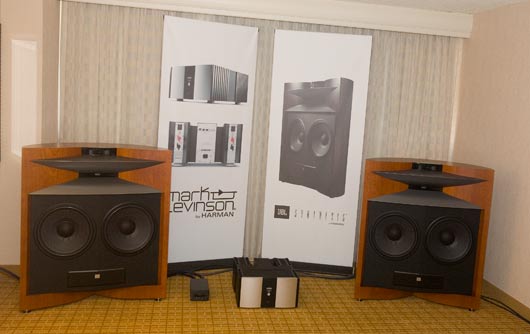
=== JBL / Levinson ===
[I did take pictures of all these rooms, maybe I’ll insert them in here…]
[[Oh look! I did!]]
JV says “very dynamic, … and maybe a slight edginess in the upper mids.” Hmmmmm… I guess this could be described that way. The sound of the Levinson electronics came through clear as … it came through very clear. Levinson, which we’ve owned plenty of, is somewhat dull-sounding when it is not being somewhat edgy. The JBL speakers are dynamic horn-like speakers [wanted to hear these speakers last year on the Pass Labs… but considering the Pass Labs [excluding the First Watt amps] is somewhat similar to the Levinson, maybe not.
=== Walker / Technical Brain / TAD ===
“lightning quick on transients and nearly dead-neutral in midrange balance, without a smidge of the darkness, phony warmth, sibilance, or spittiness”
… yes, yes, TAD speakers do dynamics, not sure what he means by midrange balance unless he means overall balance of things in the midrange region. He seems to be talking about perfectly neutral in terms of warmth versus coldness… and I guess I would not argue with that. But
“Absolutely phenomenal when it came to low-level detail,”…
Say what? JV should be very familiar with the Walker sound, he may even still own one, so I am not sure where this is coming from since almost no low-level detail was present during my visit on the last day.
Perhaps
“slight brightness and dryness of the tiny room”
explains the problem – if he heard this room early in the show, and they did something to ‘fix’ the brightness, then perhaps they removed the low-level detail as well…? Because I heard no brightness in this room.. and no real dryness beyond what is kind of expected for solid-state systems.
Then again, “dryness” versus “phony warmth” versus “dead-neutral” ? Not sure that this isn’t just a tad confusing…. JV tries to say something good and then gets down to business about what he really thinks [when he is not prohibited from doing so by commercial realities].
So he really found it “bright and dry with good low-level detail and midi-dynamics” and we found an “extreme lack of low-level detail and micro-dynamics with good midi-dynamics”. Somewhat of a disagreement on the ability of that system to render the details that were no doubt coming off the Walker like water from a firehose.
=== Big YG / Soulution room ===
Don’t really disagree with any of his impressions except that my conclusions are very different. With all the problems that he notes with the sound, this system from my point of view is unable to produce sound that goes much beyond the “Plays Loud with Disappearing Speaker Act” that Boy Toy systems seem so very, very proud of.
=== Venture / FM Acoustics ===
“… exceptional resolution of low-level detail and very good recovery of ambience. However, I thought I detected a trace of brightness in the midrange, which also sounded a little forward in this room;…”
Ah, we reviewed this room, and a pattern is forming here 🙂
1) there was a lack of low-level detail here – and in fact these speakers are not known for their low-level detail [they are known for being beautiful to look at, laid back, hard to drive and pleasant sounding].
So, obviously, we are looking for a LOT more low-level detail in our playback than JV, which in some large sense is related to micro-dynamics and inner-detail etc. This is where the emotion and skill of the musicians and type of violin etc. are found. I can now see that he might not actually HATE the Soulution, not looking for all that much low-level detail in his music these days.
2) Brightness in the midrange…? [uh oh, deja vu] This system was not bright. We were chatting in the middle of the room, and one of their guys cranked up the sound on us to try and tell us to shut up [didn’t work 🙂 But I was talking to Darrin, the owner of the room, so there :-)]. I am sensitive to brightness [don’t need anything to make me MORE irritable than I already am dammit :-)] . It wasn’t bright and hung together fine at the higher volume.
=== Big TAD / Walker, Technical Brain ===
All I can say is that isn’t capitalism grand? And bosses suck.
=== Our room: Marten / Audio Note / Emm Labs ===
“little bright and lacking in body (those farchachdat hotel rooms, again), the Coltranes were nonetheless extremely lovely to listen to—a sound very reminiscent of the better Kharma loudspeakers”
JV was in our room and I think it was the first hour of the show. [I’m ignoring the ceramic driver praise and slap – he is just setting us up for his real opinion]. They were indeed a little bright. They were also a little thin as well [I would say ‘reticent’ more than thin, due to the drivers not moving as freely as they should because they are not broken in, but let’s not quibble. Of course, they were also very clean with incredible micro-dynamics and musical content – unlike anything anything else people have heard before, and that is a fact that would be news in other hobbies not so dominated by adv. $ … What hobby would that be, you might ask? I’ll let you know…]. This of course got quite a bit better as we broke them in – and JV no doubt understands that the sound would be better in a day or two, but was presumably unable to get back to us later in the show. [Funny, he says to me something like “I’ll try and come back later”… which is just what I say to people when I know I SHOULD come back, but all the while knowing that there is like ONE percent chance of it happening at a large show like this with so much to do. 🙁 Seriously, our lines do not command large advertising budgets, and our rooms do not draw reviewers because they are looking to help their magazines keep in business etc. So it was nice of JV to stop by in spite of all the reasons he had not to]
Oh! I almost forgot. Now, about that Kharma comment… 🙂 these speakers are as different as Wilson and Sonus Faber, but because they both use ceramic drivers [Kharma only for mids and tweets] people think they are the same. We carry both speakers, and they are both excellent speakers, but to compare them like that … I understand it is probably a compliment, but … first, it is likely to cause an international incident, and second, Kharma could NEVER sound like that. Kharma is exuberant sounding, incredibly involving and with very high midrange resolution [and rarely thin sounding]. Marten is incredibly transparent to the upstream components – it can be whatever you want [after it is broken in]. See? Different.
OK.
Anther year, another RMAF. CES and T.H.E. Show(!) is just around the corner. Can’t wait!
Tone Publications reviewed the Loricraft in their latest issue, although their actual conclusion was more like “At Least As Good, Quieter, Cheaper” 🙂

We meet the nicest people through the Loricraft. And now we’ve met Jeff Dorgay, who also seems quite nice, of Tone Magazine at RMAF – though every time he would say Hi! I would turn around to see who it was and BAMM he was already gone – like that Star Trek episode where some people are moving WAY faster than everybody else [though in actual fact it was me moving WAY slower than everybody else, which is, in fact, my goal, so I can concentrate on what I am hearing – and apparently I am quite good at this being slow stuff ;-)]
We plan on doing a lot more coverage of the Loricraft record cleaners. Different cleaning fluids and strategies, the efficacy of using forward and/or reverse, putting the Loricraft on HRS Nimbus and M3x platforms to further reduce vibration during cleaning…
… a whole BUNCH of fun things. Shootouts are a little difficult with cleaning machines, since every LP is different… but we’ll try!
[There was another fire about a mile south of us again today. The wind, blowing East, caused evacuations and, I imagine, difficulty breathing as it swept toward Boulder this time and not us. It appears to be out as I write this]
In order to make progress here, I will go out on a limb and just start listing things *I* think are present when I have experienced large does of Drug-like sound in the past:
* Decent to excellent Micro-dynamics
* Very High resolution
* Good, often vivid harmonics
* Good continuousness, sometimes even good PRaT
SUSCEPTIBILITY
Personally [and all of this is personal, but hopefully there will be consensus as you all reflect upon your experiences], I am often ‘lulled’ by the music [sometimes assisted by being tired from overwork on my part] into a dream-like state before ‘waking up’ and experiencing some really cool mind-blowing experiences.
So let us assume that there is an extreme comfort with the sound [and the situation] required as a prerequisite for us to even appreciate a drug-like sound.
It is this lulling into a susceptible, dream-like state that I think requires a sound that the listener is very comfortable with, a sound that matches their preferences quite well. I think tiredness can help us ignore some harshness and sound that is NOT exactly to our tastes [but being this tired is not all that much fun, let me tell you :-)].
I think, also, that no matter what your preferences, a decent, perhaps vivid harmonic content is of value to assist the lulling… it’s guarantee of approachable sweetness is comforting.
INGREDIENTS
For me, it seems to be the swirling change of the mathematical relationships between various melodies [which appear to evoke corresponding patterns in the thinking side of the brain. We talked about this several years ago] which kind of occupy and lead my thinking brain places …COMBINED with extreme harmonic color and/or purity [which often sounds extra-vivid during the experience, perhaps because the thinking (distracting) part of the brain is occupied elsewhere] that kind of satiates the emotional ‘heart’ part of the brain.
So…. 🙂 …. *if* we use this as a template for what is required/ happens for / during drug-like music experiences, then we need:
* Decent to excellent Micro-dynamics [and separation, to be able to hear and differentiate the melodies and their relationships to each other]
* Very High resolution [increases the number of melodies – there are beautiful, evocative relationships between the transitions between various harmonics in every tiny note. You can hear this on very big notes like, say, Roy Buchanan “The Messiah will come again”]
* Good, often vivid harmonics [To lull us into a susceptible state and to please and entertain our emotional side during the drug like music experience. In some sense this is the ‘engine’ that keeps us from burning out on too much detail and complexity in the micro-dynamics and high resolution. Note that this does NOT necessarily require tubes, that very good solid-state has a natural purity that tubes must work hard to achieve (but they CAN achieve it!)]
* Good continuousness, sometimes even good PRaT [the melodies are sequences of notes in time, if there are no flowing marching sequences – then there is no melody and one just has a hodgepodge of distinct notes appearing all over the place in the soundstage]
