Pursuing the Ultimate Music Experiences

Audio Federation High-Fidelity Audio Blog

Boy Toys and Industry Poop

Uh Oh.

I accidentally read a paragraph or two in a review a few minutes ago.

Accidentally because I know it is just trash, and life is too short to waste on reading trash when there are such wonderful content out there to experience and enjoy. But it mentioned a few a cables that I am familiar with, on a system I am familiar with, and it caught my eye.

Essentially several magazines, and their reviewers, feel that it is their duty to say whatever they can to promote the current product under review, regardless of the obvious (to a casual observer not trying to pump up the industry thinking it will just wither away and die otherwise) and complete lack of ethics, moral integrity, basic sense of honesty, and compassion for the people who read their trash.

Perhaps the obviousness of the lies in some of these types of reviews indicates that it is their complete and utter incompetence [and that of their editors]. Don’t really care and I do not see as how it matters. The result is the same. Utter confusion by people trying to learn what sounds like what and choose what to buy.

[Perhaps I should explain. While searching for a price I found this review. Skipping all that fluff in the top 90%, I came to the data I needed. What I also found was the declaration that his $60K system, populated with components that I am familiar, with good resolution to less than average resolution, had the most resolution of any system, at any price, that he, or his friends have heard, now that it uses the cables under review. This is a ‘reputable’ magazine and the review is by one of their more ‘reputable reviewers’.

This is like a principal reviewer at Road & Track declaring that he and all his friends agree that his Practical Nissan Sentra, with the $1K each tires under review, are not only way better handling than the $3K tires most people regarded as top-of-the line, but that his 626 now has the best handling of any car they have ever driven – at any price.

Problem is that most people reading that high-end audio review are not as familiar with his equipment as they are with the Sentra versus, say, Porsche. They may not know that this guy goes to shows and has heard many systems of very high resolution. They do not know that the editor of the magazine knows all the same things I do, but lets this kind of review in their magazine all the time.

So what happens when your average reader, a potential audiophile, finally finds all this stuff out? They will think our entire industry is populated with charlatans and that high-end audio must be nothing but high-tech snake oil.]

Reading reviews to select your components is no better than throwing a pair of loaded dice, throwing a dart in the ocean, or saying you want to only get components that start with the letter ‘A’ [which hardly reduces the choices at all, does it? 🙂 … (about half of the brands out there start with the word ‘audio’. Well, it sure SEEMS that way, anyway)].

And I propose that THIS is what is causing the shrinkage of our industry. People who want to spend a minimal amount of time selecting equipment and maximal amount of time listening to it – end up buying something that ends up not at all pleasing to their sensibilities, nor their spouses nor their friends. And these people tell THEIR friends, and they tell THEIR friends. And buying high-end audio gear ends up being a big joke.

Boy Toy systems, by definition [since we are the ones going to do the defining] are large systems designed from the get go to produce massive bass, a very loud midrange and, sometimes, some large amount of what sounds like detail in the showroom. They are also usually designed to transfer a significant amount of cash from one person [aka buyer] to another [aka seller].

That’s it.

This is NOT about systems designed to produce music at life-like scale and dynamics. However this is what Boy Toy system marketing staff would have us believe we are buying.

What are some obvious differences between the two?

As we have been talking about for several months now, micro-dynamics is one indicator, a major indicator, of a systems ability to generate the subtle details that communicate everything from emotion to the difference between an electric guitar and piano.

No micro-dynamics? Then you are just hearing a very, very large and expensive clock radio [no not boom boxes. Boom boxes sound better than a lot of these systems do].

Why do manufacturers make such large clock radios?

Because it is easier to throw together lots of big drivers, heavy cabinets, machine a thick aluminum chassis, solder together lots of MOSFETS or tubes, and stick a megabuck price tag on it that it is to design and manufacture something that actually works well. So, manufacturers being people, lazy bums like myself, there are an awful lot of these kinds of products on the market.

Why do reviewers say nothing, and often actively promote such equipment?

To some extent I think it is inertia and path of least resistance. “Everybody else is saying good things about the Y speakers with the S amps, so it will just be easier if I say the same thing”. Some of it is that reviewers get good to great deals from many of these types of manufacturers if they say something good [aka corruption. It is a reason why many other manufacturers avoid reviews like the plague; i.e. you are known by the company you keep]. There is a lot of pressure on reviewers to not say anything bad about anything [as we know from personal experience here on the blog] BUT an honest diligent reviewer doesn’t ever have to say anything bad – they COULD just describe the purpose of a piece of equipment, what it sounds like, and how it is different than its closest competitors.

Why do people buy this equipment?

Because they are inundated with all this money-backed misinformation [yes, JUST like politics] including co-promotion deals between speaker manufacturers and amp manufactures, and with the reviewers of course, and finally there are testimonials from honest owners who THINK their system sounds great because their dealer told them so and they never ever got to hear what a real Practical or Drug-like system sounds like.

So, essentially, the industry is screwed until another person like HP comes along [who has a large system that is indeed designed to be listened to – based on testimonials and just looking at what he uses, but who has kind of run out of energy this last decade or so (just read something he wrote 10 or 15 years ago)] who can transform people’s idea of what we should all be caring about when it comes to designing a system. At one time it was all about measurements. Then it was about how maybe we should use our ears a little and if it did not sound anything like real-life music [aka the absolute sound] then maybe we should not buy it, no matter how well it measures.

Until that time, we will try and create an oasis here for people to talk about building [often, but not always, large and expensive over-the-top] systems that are designed to be listened to and enjoyed in ways that significantly impact our lives in a very positive manner.

But expect some disconnects if you venture out and read some of the ‘mainstream’ industry poop. Argh. I keep hoping it is going to get better.
Drug-like Systems I Have Known

I thought it might be useful to list some systems that I found drug-like, and you are invited to as well, and see if there are some commonalities.

If there are commonalities, then we should be able to retrofit existing systems so that they, too, can have that little extra mind altering something that is so inspirational, transformational and, dare I say it, orgasmic.

We are going to assume that a system first has to be, not just Enjoyable, but Emotional – and mildly drug-like even during the normal course of listening.

Going back in time, … back…. back… to the dim recesses of my memory.

… about 7 years ago.

Tenor OTL 6C33C-tube based amps on various Kharma speakers. Audio Aero and Emm Labs as digital sources. These had extreme micro-dynamic detail and very good midi-dynamics as well. Very exhilarating and can make a person giggle. Not aware of drugs like this [well, I’m not! :-)] but maybe it is like someone you are interested telling you they feel likewise. Slightly on the mind side of the Mind-Heart spectrum.

Joule Electra OTL 6C33C-tube amps on Talon speakers, Elrod power cords, Audio Aero Capitole CD player, probably HRS rack. Forget the cabling. Lots of harmonics and PRaT. Very good micro-dynamics. Very engaging and warm, like a quick glass of wine or a shot of Bourbon. Way on the heart side of the Mind-Heart spectrum.

Lamm ML2.1 amps on Marten Coltrane speakers, Jorma Prime cables, various power cords, HRS MXR rack and platforms everywhere. Very good midi- and micro-dynamics and nice color. Hypnotizing and engaging. I don’t know, kind of looking up at the stars where there is no light pollution for the first time. Slightly on the mind side of the Mind-Heart spectrum.

Audio Note Kegon amps on the Acapella Trilon speakers, Jorma Prime cables, various power cords, HRS platforms. Very open, harmonics, and great midi-dynamics. Kind of like being King (or Queen) of the world. Slightly on the heart side of the Mind-Heart spectrum.

Bladelius amps and pre and CD player on Marten Coltrane Supreme speakers. All Jorma Design Prime cables. Extremely detailed and accurate. Neli and I both found this system to be extremely hallucinogenic [we wrote about this extensively in the CES 2003? 2004 show report]. Somewhat on the mind side of the Mind-Heart spectrum.

Audio Note Ongaku on Marten Coltrane speakers, wired directly from an Emm Labs player with Nordost ODIN interconnects and power cords. Jorma Prime speaker cable, HRS or Acoustic Dreams platforms. [This is our show system at RMAF 2010 this year, and an evolution of the Lamm ML2.1 system above]. Very pure, very quiet background, extreme micro-dynamics, good midi-dynamics. Like a breath of fresh mountain air after living in the city for a year – clears the mind and makes you feel like things might make sense after all [yeah. right. Just trying to communicate a little about what I think the drug-like effect is, as bizarre as this is turning out to be]. Slightly on the mind side of the Mind-Heart spectrum.

Lamm ML3 amps and L2 Reference pre on the Marten Coltrane Supreme speakers. HRS everywhere, Jorma Design Prime and AN PALLAS cables. This is a very high resolution system [the RMAF 2008 system]. Very good micro-dynamics and mini-dynamics. This is like finally understanding Calculus [:-)]. Slightly on the mind side of the Mind-Heart spectrum.

Audio Note Gaku-On amps, M9 Phono pre, DAC 5 Signature, S9 stepup on the Marten Coltrane Supreme speakers. HRS everywhere, Nordost ODIN powercords and interconnects, Jorma Design Prime and AN PALLAS cables. This system is significantly better than any system we have heard, here or anywhere. Resolution not as high as the Lamm ML3 version, but extreme midi- and macro-dynamics, extreme harmonic truth, very good micro-dynamics. Really have not been able to grok this system yet. This is like taking a hotrodding spin in the Space Shuttle. Somewhat on the heart side of the Mind-Heart spectrum.

And a special note about 100% Audio Note systems setup correctly [we do not have corners here, which they require to perform at their peak, and most rooms in hotels have things in the corners, like air conditioners, etc]. These systems have excellent midi- to macro-dynamics, very good micro-dynamics, great harmonics and PRaT. These are mostly fun and playful, but can quickly turn into one being awestruck, then into an adrenaline high, then into numerous other mind-bending states. Definitely on the heart side of the Mind-Heart spectrum.

————————-

I know, some of these descriptions of how these systems make me feel belong more in the humor category. 🙂

As you can see, they are very different systems, some are only medium resolution, some are not very accurate, some do not have perfect bass, some are expensive and some are not so much.

But there are obvious commonalities:

* Very good to great Micro-dynamics

* They are also fairly accurate, so that we can suspend our sense of disbelief.

* They have something(s) special going for them, something extreme: midi dynamics, or harmonic color or harmonic truth, or extreme accuracy or detail. Perhaps something that is hard to hear even with live music, for all the reasons that make the sound of live music not quite perfect.

As I remember some of the most transformative experiences I have had, it seems to me it helps to be a little tired and worn out [not a problem these days, I imagine, for most of us :-)].

So what do you all think? Any of this resonate with your own personal experiences?

Perhaps I’ll describe the actual experiences we/ I had with these systems… Certainly are fun to remember! But here I really wanted to point out the variety of systems that I found to be at least somewhat Drug-like

RMAF 2010: Wrapup

We came, we saw, we listened, we reported, we come away a little smarter.

We are now dividing systems into categories based on their purpose:

* Boy Toys: systems that are designed to make loud noises

* Gee Whiz: systems that amaze through their use of new technology

* Practical: systems that make music, no fuss no muss

* Drugs: systems that expand the soul and take us to wonderful new worlds

[have to work on the mixed plural and singular cases here]

Previously we have categorized personal basic preferences as points on a linear scale:

* Heart < -----> Mind

And previously we have also categorized system sound as a combination of [more or less linearly independent] flavors:

* Impressive, Natural, Real/Accurate, Emotional, Sweet, Sophisticated and Magical.

We talked about Soul and how many of the ‘touted’ systems at the show were soulless [100% Mind] or Boy Toys.

================================

Next we will talk about:

* Why the industry pushes Boy Toys to the almost complete exclusion of the other 3 types of systems.

* The relationships between the Soulful/Emotional aspect of a system, Heart/Mind preferences and Drug-like systems

(interestingly, there may be no relationship. Emotionally communicative systems tuned to our Heart-Mind preferences may just be there to keep us happy with our system between Drug-like Magical experiences that reveal the deep beauty and mystery of life [kind of like spouses and friends :-)]. In this characterization, good systems are like glasses of wine that are periodically, but infrequently, spiked with something a lot more powerful. For me, this is much more manageable a characterization than systems that are always powerfully Drug-like. Opinions?)

* Methodologies we can use to create Drug-like systems

[and can they be made affordable?

Are they addictive (yes. Doesn’t everybody get the shakes when looking for that new album that will really thrill us, and failing to find it time after time, as the months go by… making us more and more desperate and frustrated? Maybe it is just me…)

Do we need more and more powerful (likely expensive) Drug-like equipment over time? (I think no, thankfully(!) because we can change the music we listen to, perhaps radically, to shock us out of our familiarity. But we need more tests and more test subjects :-))]

* The categorization of small tube amps into various lists based on their performance characteristics (one of which is how well they drive typical speaker loads)

* The categorization of equipment and cables in terms of their usefulness in making Drug-like systems

* The categorization of Drug-like systems

(into beer, wine, whiskey, and other drugs none of us is supposed to be familiar with. Well, we will just all have to pretend we are familiar with these drugs, OK? 😉 In some sense our system at RMAF was like a marathon runners high(?). I have never run a marathon, so I am pretending, extrapolating from the feeling I get after lots of exercise. Similarly we shall invite all of you to help us describe the kind of experiences that you want, and those that you have experienced in the past, while listening to music)

Well, ambitious but really fun topics, I think…

Next show: CES 2011!

Shootouts CAN be Dangerous

You know, I was thinking about how dangerous these shootouts are becoming.

We do them in the evening, and sometimes we order out some food [usually Vietnamese] and we draft somebody [Neli. :-)] to go pick up it and bring it back.

We then consume mass quantities and listen to a CD or LP kind of casually and chat about how cool it would be to have X, Y or Z for the next shootout.

Then it is back to the shootout proper: listening, going up to the system and switching cables, powercords, whatever back and forth. More listening.

Ponying up to the system, my tummy being overly full to the point of me whining about it to everybody who will listen [that would be, as it always is, nobody] I then had this terrible waking nightmare:

The button pops off my shorts, goes sailing through the air like a button who really hated being under extreme pressure all these years, and strikes one of the tubes on the most lovely sounding, exquisite, amps we have ever heard.

And the tube *explodes* from the impact. Glass is everywhere. Sparks are flying. The lights in the kitchen are flashing off and on.

I start wondering if Neli is going to kill me with knife or pistol.

Then an extremely unlikely and not very nice event occurs. The exploding tube generates some kind of freak surge and the dying amp takes out not one but both speakers. Drivers are now sailing across the room in cannonball like trajectories.

One lands in the bowl of Red Curry Stew with extra Tofu, and splashes Red Curry Stew with Extra Tofu all over the stack of LPs we had brought upstairs for the demo.

The other hits the floor and starts rolling across the room like the old Bridgestone Tire commercials, continues until it encounters the stairs going down to the other listening room – which it then starts plopping down ‘plop’ ‘plop’.

It then continues to go ‘plop”plop’ down the stairs in the now very, very quiet listening room as I look at everybody else in the room and present them with the stupidest grin I can come up with.

All this to say that I am resolving to be on the safe side and eat less take out at our shootouts from now on.

[Even though that take out *is* really, really yummy… Hmmmm, maybe I’ll just walk up to the system sideways, facing any buttons AWAY from the system.]

YG Acoustics at RMAF 2010

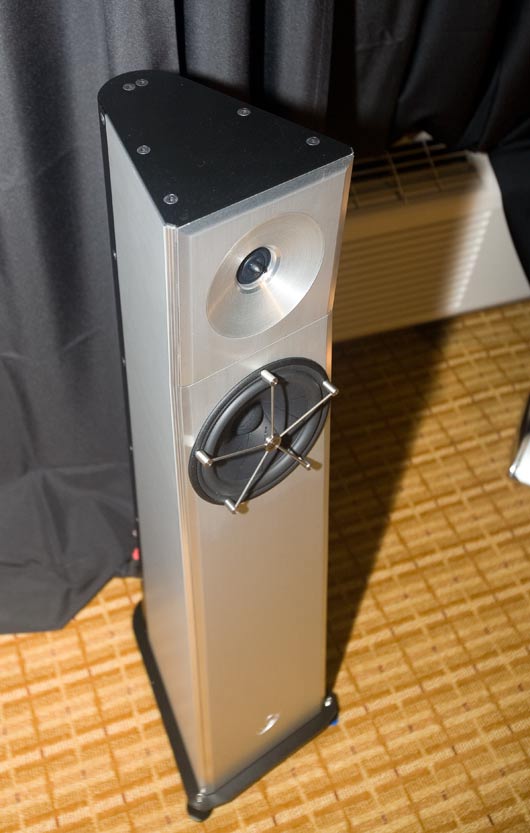
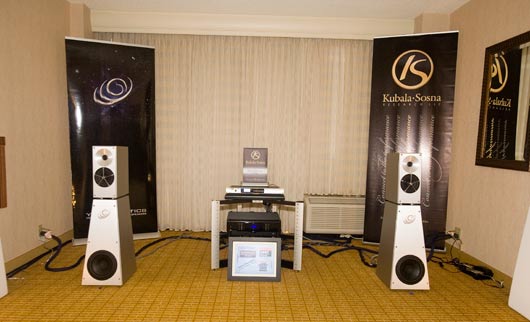
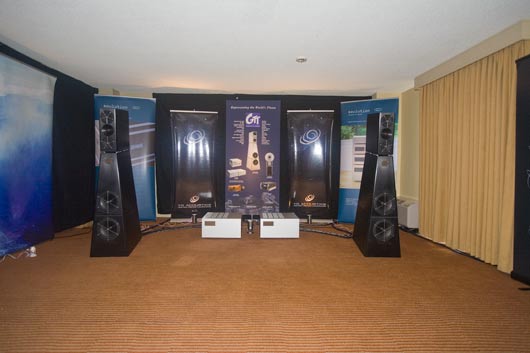
YG Acoustics speakers of various sizes were found in 3 different rooms [at least].

There are a few interesting things to say about these rooms, I think, but in the future we will likely not talk much at all about YG Acoustics because they, or the rooms and people that use them, are too often just going for Practical or Boy Toy systems – and these just do not interest me, no matter if the speakers are worthy of much more [as many other speakers are as well].

At their best [on big old Krell amps, which I heard them with several years ago and I hear they ran them with again at the Dagogo show], these are speakers with a very linear response. Not perfect in all aspects, but speakers very worth listening to. Put something soulful up front [instead of the Krell Pre and dCS they usually use] and a person could well achieve a Drug-like intoxicating soul-expanding sound.

None of these rooms gave any indication that the speakers might be able to do this. Kind of like Wilson in that respect; if you were to go by the sound in most rooms that use Wilson speakers at most shows [and I guess most if not all dealer showrooms], you’d think they were a bad sounding, in-your-face, its-all-about-marketing speaker.


ROOM 1: This was the best sounding room with the YG Acoustics if you value musicality, listenability, and to a large degree accuracy and true-to-the-source realness.

The MBL integrated amp used in this room was relatively modest [100 – 150watts range if I remember correctly], and the fallout from this choice in amplification (a choice made in order to keep this a modest, balanced system [but there is no law that says the amps can’t be larger and several times as expensive as the speakers :-); MBL makes many beefier and very heavy amps which would be very interesting to hear on these little speakers]) was that the dynamics of the midrange was quite a bit less … dynamic… than that of the self-powered bass. So there was a disconnect between the mids and bass and it was much like a satellite speaker with a very tightly controlled subwoofer [subwoofers with aluminum cabinets like these… now THAT is subwoofering :-)].

One of the more interesting things at the show this year was the source in this and the next YG room. They recorded LPs [a few scratches and pops too :-)] onto digital and were using this pre-recorded digital music as their source.

It 1) DID retain some of the analog magic and 2) the ways in which it was not exactly like the original analog showed exactly how far digital recording and playback has yet to go if it is going to be at all convincingly like the music it is recording.

The quality of the pre-recorded LP playback is way better than the iPod playback components (which I saw NONE of this year – hurray! – and we instead saw a lot of reel-to-reel tape decks [Yay! but is this cheating? How many people have R2R in their systems?]). The LP playback was not as good as good CD playback, but it did manage to reproduce a little of the natural bloom and some of the PRaT [not exactly what I mean. There was a dynamic flow between the notes that was LPish, but there was also a stark discontinuousness that was unlike CD or LP] and a little of that harmonic richness that is found on [most] LPs.


ROOM 2: This was the GTT Audio room with big YG Acoustics and Soulution electronics and the LP-on-digital source we talked about above.

This system was much the same as last year, with the exception of the source now having pre-recorded LPs instead of… pre-recorded CDs(?) last year. This is your standard Boy Toy system [as we talked about many times before, amps like the Soulution, despite its name, are not useful outside of the Boy Toy type system because of their lack of micro-dynamics etc.].

Maybe someday we will rank these but for the present they are not all that interesting to me. Sure am curious why SO MANY of these types of systems are foisted on us – it is like as a group the high-end audio industry has decided that only Boy Toy-loving audiophiles want big dynamics, or perhaps it is that most have decided that ALL audiophiles are looking for Boy Toys, and those that have limited funds get small Boy Toy systems and those that are more wealthy get BIG Boy Toy systems.


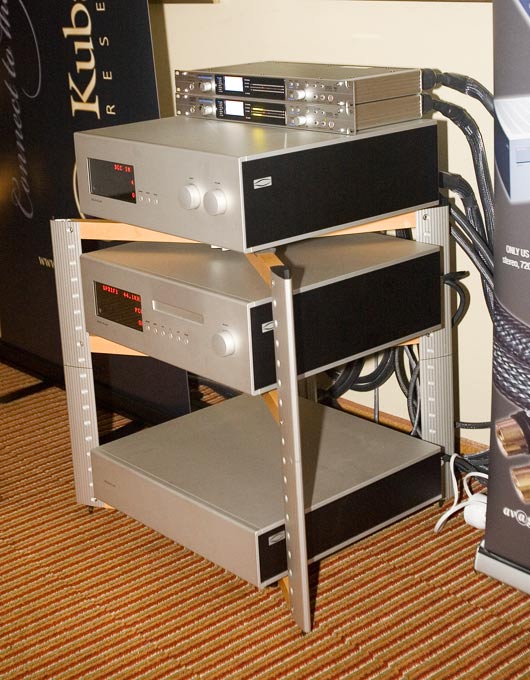
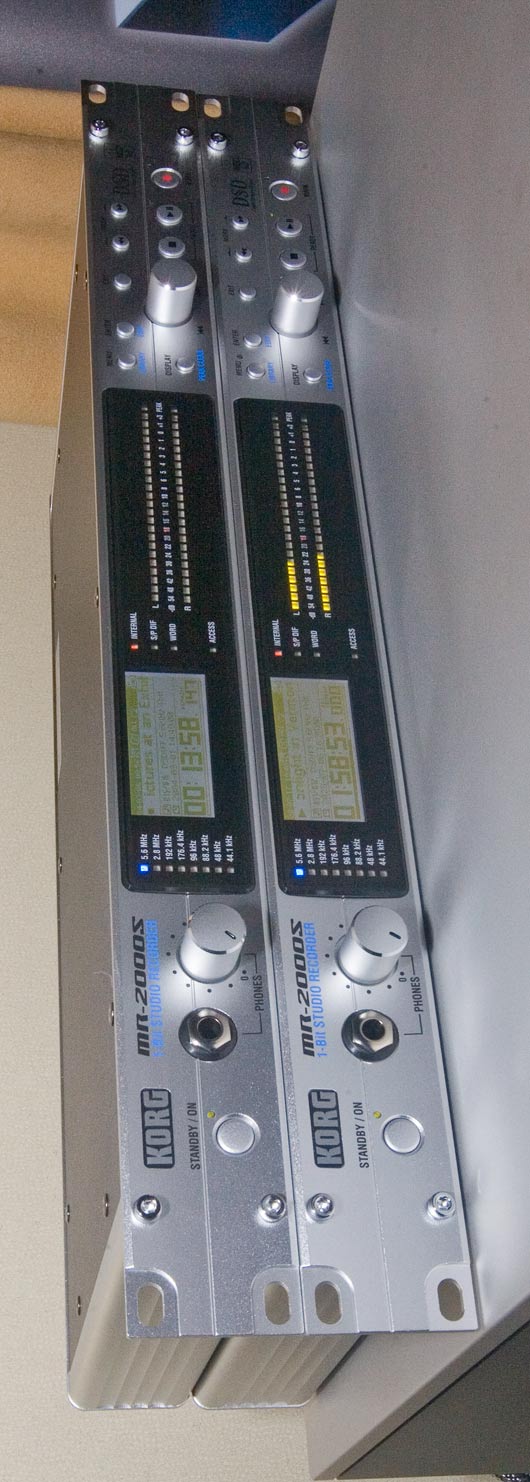
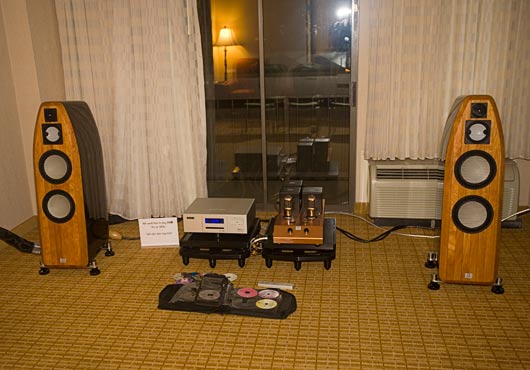
The Soulution front end.


The equipment used to record? and playback the pre-recorded LPs


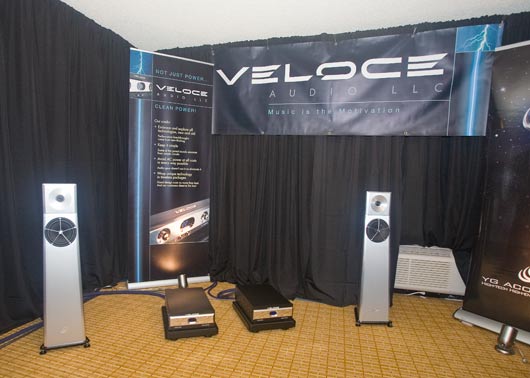
ROOM 3: The Veloce room also had small YG Acoustics speakers.

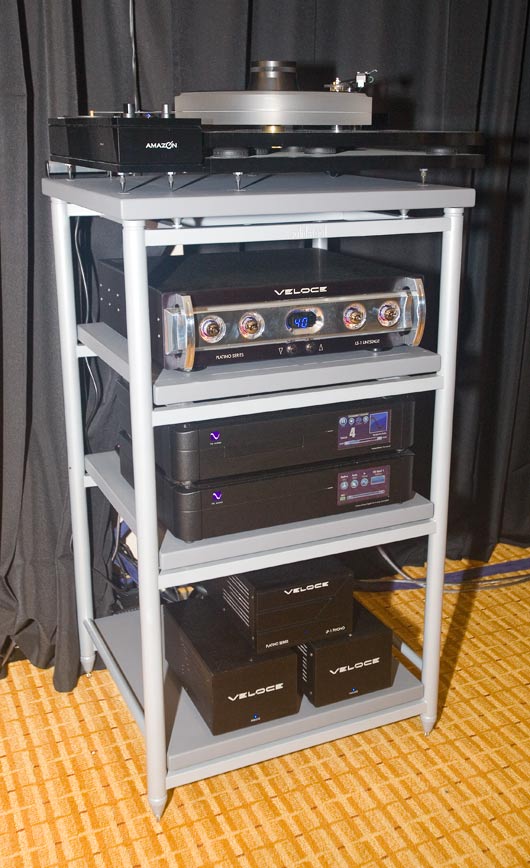
The Veloce electronics has a sweet, pleasant family sound. What was interesting, to me, here was that the sound was so … ordinary… by which I mean it sounded like your typical room at the show. Much of the linearity and resolution of these speakers was not in evidence [I believe many of the people who favor Practical systems think that this is probably a good thing].


Close up of the equipment rack.


Close up of the little YG Acoustics speakers.

Audio Aero LaSource CD/SACD player: part 2

SOUND.

The first thing we did was to hook up the player to the Edge NL Reference ‘pyramid’ amplifiers.

We noticed several things. That the sound was warmer and more approachable than it had been with the solid-state Emm Labs player [more on this shortly]. We also noticed a high noise floor between notes. We thought nothing of this, really, since we had just come from RMAF and a system that had the lowest noise floor of any system we know how to build. But it was kind of ‘Oh Jeez, well, this is kind of too bad’ but we had a lot to do and we just let the player warm up for the rest of the evening and into the next day – playing this and that CD in the background – doing careful listening every so often – but no shootouts or anything.

From our past experience with the Audio Aero Capitole and Prestige, we know that using HRS Nimbus underneath the players helped lower the noise floor and increase definition. From my office the sound was sounding ‘out of tune’ [it is often easier to hear this off-axis or in another room, for me anyway]. So I finally badgered Neli [yeah, spouses need to be badgered about 99.9% of the time if you want them to do something when YOU want them to do it] into helping find 3 sets of Nimbus and slide them under the player while I lifted it. It was then that we noticed that the factory-supplied feet looked like Stillpoints and not the standard BDR cones. Regardless, we slid them under [these medium height ones are just tall enough to lift the player off of the feet]. And pressed play.

It was an ENTIRELY different player. My first statement was, ‘Oh no, we just wasted a *day* and have to start our listening impressions all over again’ . Listening from my office revealed that timbre was back into the normal range we hear with most gear. Closer listening revealed that there was now plenty of space between the notes. The only negative, if you want to call it that, was that the sound was not quite as overtly ‘warm’, which was apparently just a lot of notes decaying noisily into the start of other notes. [more about this below].

SHOOTOUT

We did the shootout with the LaSource taking on the Emm Labs CDSD-SE / DCC2-SE CD/SACD player with linestage.

Why is this a good comparison and why is it bad?

Good: They are both CD/SACD players with line stages

Bad: the LaSource costs twice as much as this Emm Labs pair.

Bad: The Emm Labs player we are using in the shootout is a few generations behind the newest Emm Labs players [the shootout SHOULD be between the LaSource and the XDS1 player + new Emm Labs PRE2 linestage – both because the prices would then be approximately equal and because these are their latest and greatest products].

Good: (and this is the real reason) The rap against tubed players [actually this is a solid-state player with a tube linestage – but almost everyone will use the linestage – so bear with me here] is that they are fuzzy, and lack detail, and are inaccurate. So what better test than to compare it with one of the best 4 or 5 solid-state players [the others being mostly other Emm Labs players :-)]. The CDSD/DCC2 is detailed but not overly detailed, accurate and predictable. Whether you respect these players as much as we do or not, you have to admit that they are a great representative of solid-state player competence with which to compare the new LaSource upstart against.

OK. We had Kevin assist us as he does with many of our shootouts here [thanks Kevin!] Kevin is able to listen carefully and talk about what he is hearing. His preferences are slightly to the ‘Heart’ side of neutral, Neli slightly to the ‘mind’ side of neutral, and me, I think I am in the middle somewhere.

Our test tracks were [we had 4 this time instead of our usually 3, which was good and bad: more test tracks is good, the longer periods between hearing the track on one configuration versus another is bad]:

Sailing to Philadelphia (Knopfler, Taylor; title track [this is wearing a hole in our brains too, but it allows us to immediately compare each player to 100s of other systems, as well as to the other player, and also helps keep us from getting things into a weird state and not knowing it)

Nelson’s Mass (Haydn; King’s College Choir (decca legends) track 1)

Amnesiac (Radiohead; track 2 [track 1 is wearing a hole in my brain, so we are now using #2])

Tumbleweed Connection (Elton John, SACD, track 6 ‘Where to now St. Peter?’)

We ran both players through their internal linestages into the Audio Note Ongaku [yes, 2 linestages in the chain – but it worked wonderfully well]. We put Elrod powercords on the Emm Labs and an Acrolink Mexcel powercord on the Audio Aero. The idea was to kind of assist them in sounding more like the other player: the LaSource will now tend to sound more detailed and the Emm Lab more relaxed and open – i.e. the characteristic sound of these two brands of power cords. We also put HRS Nimbus Couplers under the Emm Labs CDSD transport and DCC2 DAC/linestage to match those under the LaSource.

[Jim P., if you are reading this, this is the same demo you heard except for the power cord changes and the HRS under the Emm Labs – which did make them sound much more alike – but which we do not think in anyway invalidates your choices, but in fact make us more confident you made the right choice for your particular preferences]

IMPRESSIONS

First, we were all amazed at how close the players were to each other. The EMM Labs is much more musical than one might think, given that it is solid-state, and the Audio Aero LaSource had a lot more detail and a quieter background than one might think from hearing their earlier players or looking at their design [aka It Has Tubes!].

We all agreed that the LaSource is a remarkable achievement. It’s a huge step forward from their previous generation top of the line CD/SACD player, the Prestige.

In some sense the ultimate goal, the holy grail [from our point of view] is for the LaSource to sound like an Emm Labs player [aka the best solid-state player] with a little [some amount anyway] of that vacuum tube warmth and soul. To a large extent this is what it sounds like Audio Aero may be attempting to do with the LaSource.

I will transcribe the notes I took of the shootout – in order – so you can get a feeling for the evolution of our analysis of the LaSource sound. We pretty much discussed and agreed to each of these points.

LaSource: Sweet sounding (Haydn). Slightly less air causing voices to be ever so slightly compressed generating a more solid image of the singers (Sailing to Philadelphia). Slightly less micro-dynamics causing some notes to be the tiniest bit more strident, and others to be richer sounding.

EmmLabs: More clarity and voices easier to understand. Again, imaging not quite as solid, less vibrato on the voices and instruments. Surprisingly, only *slightly* less rich. The PRaT here was equal but different [the smaller notes carrying much of the drive of the song on the Emm Labs and the stronger notes driving the song on the LaSource (Sailing and Radiohead)]

The LaSource was complemented here on how fast it loads CDs – much faster than the Prestige [most new SACD players now are quite a bit faster than the older SACD players]

The EmmLabs has less bloom. Soundstage depth was greater (Haydn) [I think that the soundstage depths are differently formed, EmmLabs separated out each violin, the LaSource grouped things together more, but still had depth].

On the Haydn [everything really] the EmmLabs was more real but it could also be a little less engaging [though we HAD heard most of these tracks about, literally, 50 times on EmmLabs in the last 3 weeks :-/]. It depends on how you are listening. The LaSource is easy to listen to [I was going to say more approachable, but my notes has us agreeing that voices were more approachable on the EmmLabs because they were more articulate and easier to understand. Yet, on the LaSource, the voices were more solid and present]. I hope you can start to see how close these are to each other, and also how they are different and in what ways they are different. Perhaps it is more about just how deep do you want to be ABLE to listen and about how deep you USUALLY listen.

Elton John. There was a stark difference here and we all agreed that 1) that Elton track is jaw-droppingly magical, 2) that the magic dust must be in the very subtle details because the EmmLabs picked it up and the LaSource did not [but see note on using the Nordost Odin power cord on the LaSource below], 3) I shock myself thinking about buying a CD, the first in several years [I usually want to get the LP first, and then later get the more expensive CD if I really like it. Besides, we have 4 – 5000 CDs, seems stupid to buy more when there are some here I have not heard for decades. Luckily Kevin left the CD here for us to drench ourselves in]

RadioHead. The EmmLabs picked up the subtle background information [swirlies] that the LaSource did not (+1 for Emm). The voices were more solid and present on the LaSource (+1 for LaSource). The foreground effects [big swirlies :-)] were more solid and present and tonally rich with the LaSource (+1 for LaSource). So the vote [we listened to all of these several times and had the same discussion every time :-)] was +2 to +1 in favor of the LaSource in terms of how much fun it was to listen to this track.

Haydn, Sailing to Philly: We never brought these two to a vote, but hopefully from the above, you will understand that there are pluses and minuses depending on how you look at music and how you listen. Since we all listen differently at different times, this can get somewhat confusing – and in some sense that was what we had to deal with when looking at the differences.

A few notes on extracting the last bit of low level detail with this player. Although we had a very good power cord on the player, the Acrolink 7100 series (about $2500) we did try to keep shootout fair. We COULD have used the Nordost Odin power cord to extract MUCH more low level information.

The Audio Aero LaSource, then, is a very good DAC combined with a tube linestage that adds a slight spice of warmth, bloom and soul to the music. It is extremely tasteful in its restraint – just adding enough to ‘sweeten’ but not ‘overwhelm’.

People who like the Audio Aero sound will LOVE this player. {{Neli says: It’s got the classic Audio Aero voicing, with better everything — PRaT, detail, extension, lower noise floor. And it’s got one of the big Esoteric drive mechanisms, built like a tank — so we all hope that the transport issues that plagued the Prestiges are over. forever.}}

People who like their system to ALWAYS be fun to listen to, and yet still hear almost the same level of detail as one of the worlds best solid-state players, will LOVE this player.

We will be shipping a free set of three HRS Nimbus, to use instead of the factory-supplied feet, with every player we ship.

Audio Aero LaSource CD/SACD Player w/ linestage: Part 1

[We’ll get back to RMAF 2010 in a bit.

We only have this player here for a limited time, and we are so very curious about this, their new flagship player, that we just HAD to take it to the Audio Federation gym [listening room] and make it do a few bench presses [play some Redbook CDs], and few chin-ups [SACD CDs] , squats [run it directly into some solid-state amps], … [the workout metaphor is running out of steam here…] and see what it can do. Part 1 will have mostly photos, Part 2 will detail the sound and the shootout we had last night]

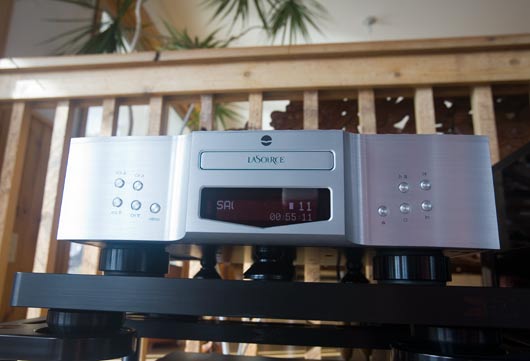
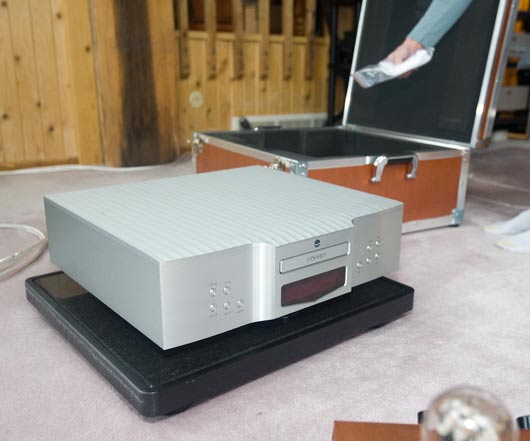
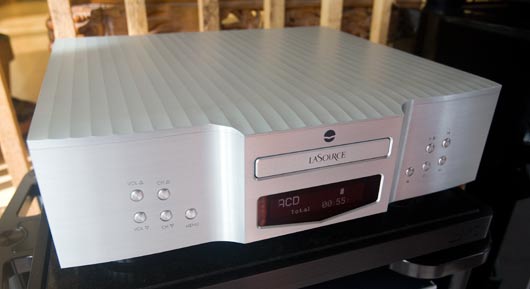
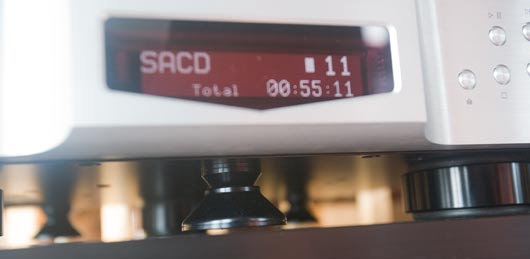
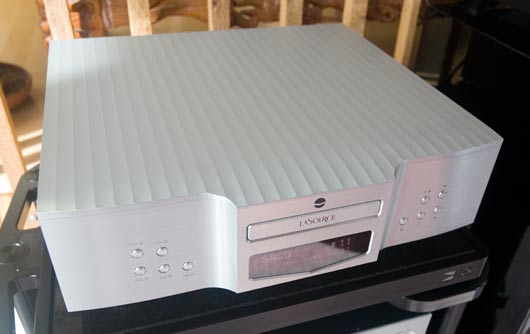
The LaSource is Audio Aero’s new CD/SACD player with a built in tube linestage. It lists for $44K. It uses the 2nd best Esoteric transport made. Front to back, top to bottom, Audio Aero has shown that it is not messing around with this player: fit and finish is impeccable. [There is also some great news for current Audio Aero Prestige owners forth-coming]


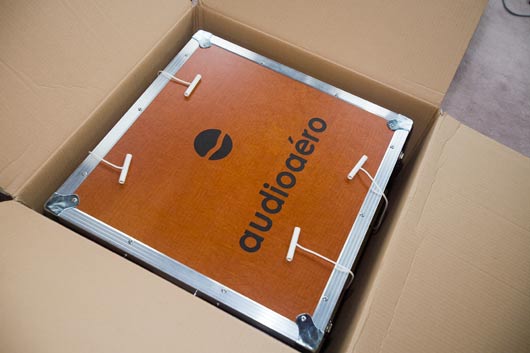
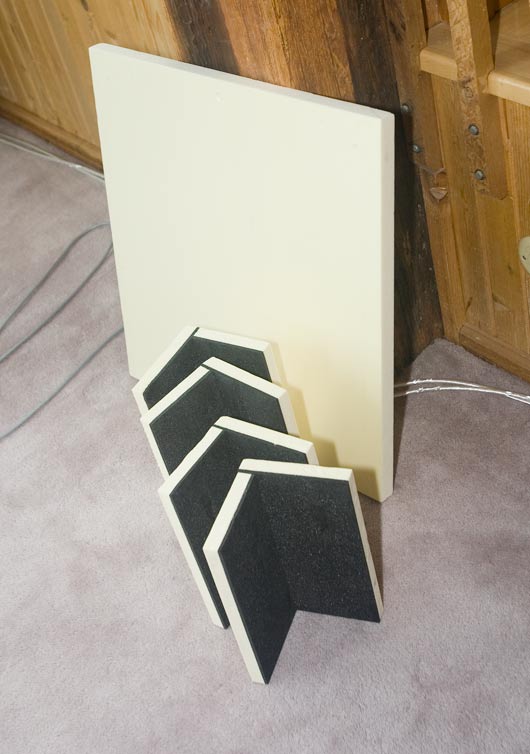
The player comes in a very large, very heavy [70-80lb] standard cardboard box. Inside is a nuclear war-proof suitcase.


The top and side bracing between the suitcase and the inside of the cardboard box.


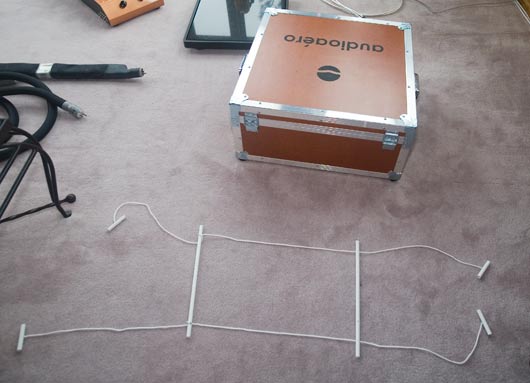
The rope and handles are used to lift the suitcase up out of the card board box. It is a tight fit and the suitcase, with the player inside, is heavy.


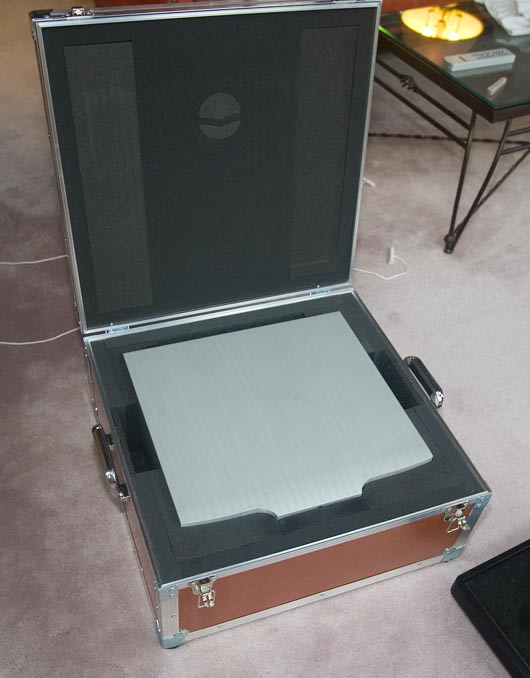
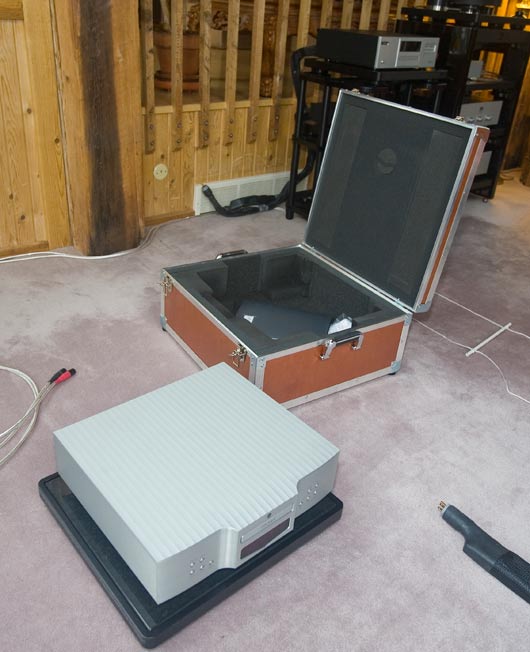
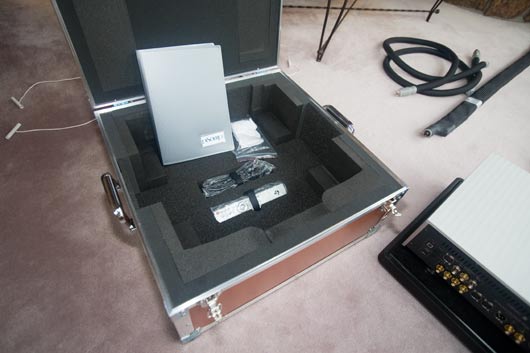
The player is packed very securely and snugly in the suitcase. The two slots on each side there are very convenient to get the player up and out of the suitcase.


The player has been gotten up and out of the suitcase. 🙂


Neli is putting the things back in the suitcase because, although this is indeed more fun than a pile of Birthdays, she has to wait until Mike photographs everything before she opens all of the toys.


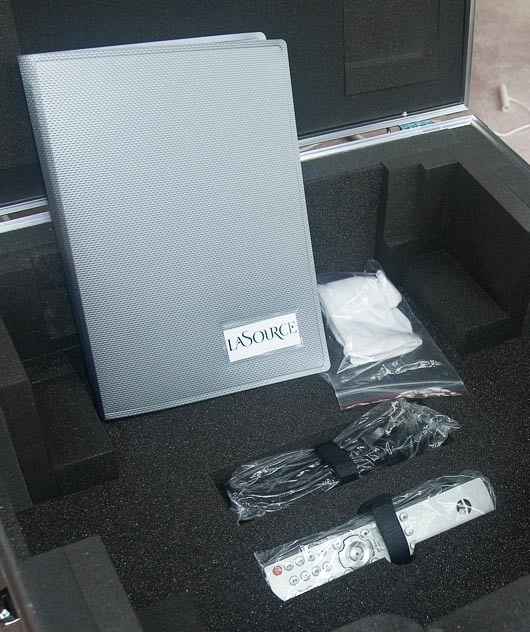
Oh, look Neli, the case has cool stuff in the bottom in little cutaways.


Closeup of the cool stuff in the bottom: remote control, gloves, manual, the d’rigor non-audiophile approved power cord. [Neli turned the remote control over so that you all can see it].


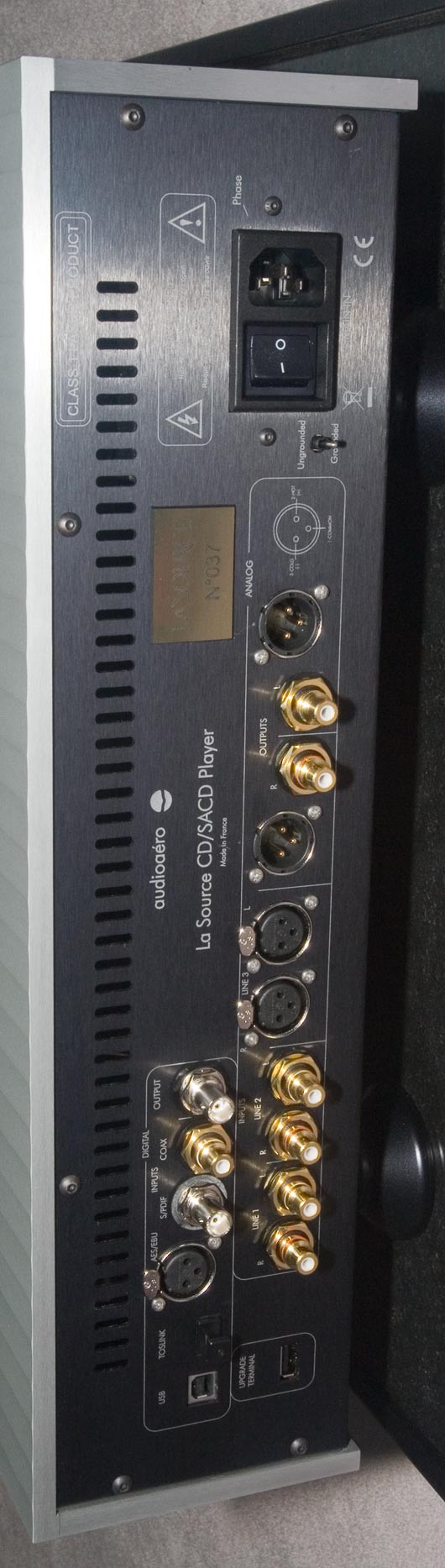
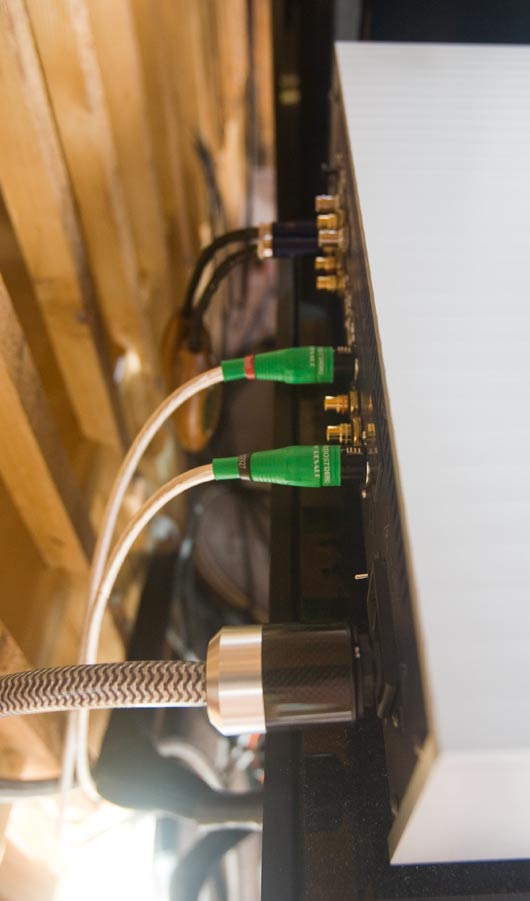
The back panel [we’ll have better photographs soon]


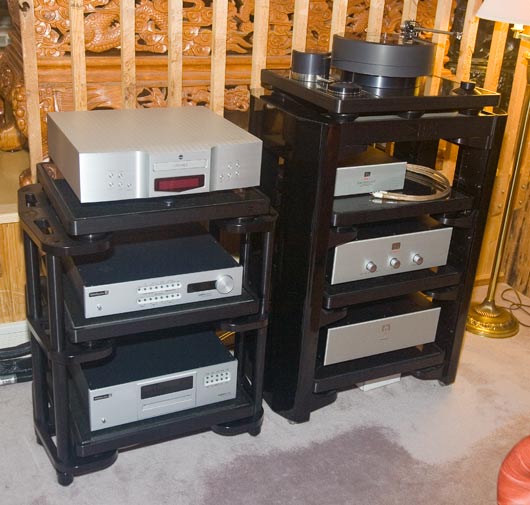
The LaSource on the top left of the HRS rack.


The LaSource as most people will see it day-to-day


Underneath the LaSource player. It comes with stock feet that look unfamiliar [instead of the Black Diamond Racing cones that the other players come with], but upon further investigation are not.

Uh. Do not use these unless you like all the voices on the music you play to sound a little like Prospector Pete on Bugs Bunny cartoons and for there to be a lot of fuzz between each note. Here we see HRS Nimbus Couplers holding up the player and the stock feet levitated. More in part 2]


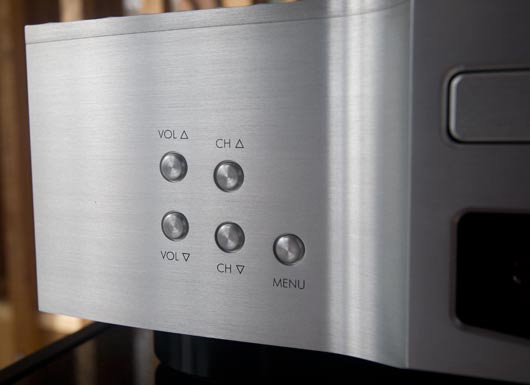
The buttons on the left side of the player


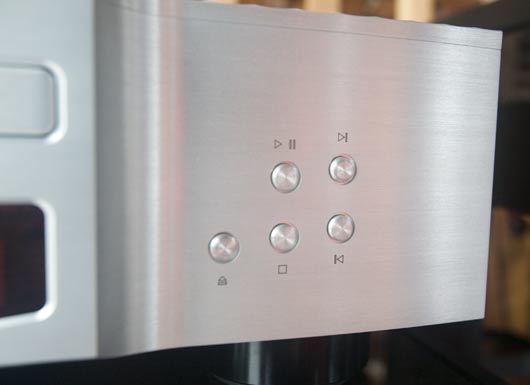
The buttons on the right side of the player


From above.


From below.


From behind

RMAF: Venture / FM Acoustics (Audio Limits)

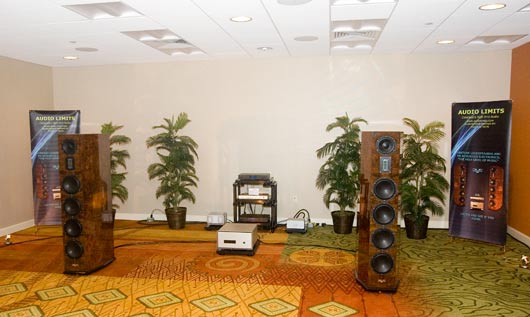
Venture speakers

This is the best sound Audio Limits has had for a few years, since their show system with the Acapella Campaniles speakers (also on FM Acoustics, I believe). However, this is not like that system in several key ways.

The Venture speakers are laid back and ultimately very polite [and very attractive] speakers. They are also reasonably hard to drive. The vast majority of the systems we have heard them in the speakers have sounded very under-powered [which we can live with if there are other, redeeming aspects to the sound. But in these cases there weren’t].

These are the largest Venture speakers we have heard (Venture Reference III) and in this system the FM Acoustics woke them up. The sound was big, macro-dynamic, well-separated, accessible, and under no strain at very loud volumes in a very, very large room.

However, the sound was also lacking micro-dynamics to some extent, lacking air to some extent, and sounded a little dense and slightly compressed. These sonic characteristics are predictable given the family sound of this line of speakers.

What is neat about this system, and why I thought it was interesting, is that it is on the border between a Boy Toy system, a Practical system and a Drug-like system. Most Boy Toy systems are aggressively unlistenable [my spell checker suggests ‘untenable’. That is a good description too :-}]. This system is listenable.

Does this system have a Drug-like sound? Can this system be pushed further into the Drug-like sound category? Hard to tell. Right now it is a little laid back and missing a lot of color. Not sure what cables were in here but everything else in this small system is in the A+ to B+ kind of quality [HRS, Weiss, Sound Applications, ISOTEK].

Right now, I would say this system, at its best, might be akin to a 12oz bottle of Guinness Stout. With a lot of work [mostly trying to preserve micro-dynamics at each step in the signal chain] one should be able to get it to a glass or two of heavy red wine [some large amount of hand waving here – this is the first time I thought these speakers were at all interesting and we know very little about their behavior in this kind of system. For example, what they sound like at a much lower volume on beefy amps like this].

For those interested in more powerful drug-like sounds [like me!], I wonder if speakers that are on the hard to drive side of the ballpark, and almost as a side-effect micro-dynamic limited, will be able to satisfy our hunger.

Walker / Technical Brain, (small) TAD room

This is the 2nd Walker room that I visited. The first, with the larger TAD speakers, had too much uncontrolled bass and was not interesting.

This room here, however, WAS interesting. [and not just because this was where Lloyd Walker was hanging out :-)]

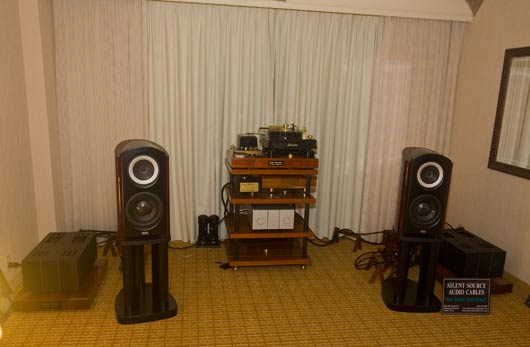
Walker at RMAF

The smaller TAD speaker’s sound was filling the room quite well without overloading it. Lloyd was playing an LP with the famous track from the Burmester CD about the diamond mine trains in Africa. OK. We’ve all heard this track like a million times, right? The singer’s voice is a combination of showman, stylized story telling and real [spooky] anguish sometimes slips through.

Well, not with this system. There was hardly any micro-dynamics or inner-detail – hardly any note attack and decay at all. There was NO emotion to the voice. You could understand the words, but not much was accessible beyond that.

This is much more interesting to me because we are very familiar with most of the components of this system.

The Walker turntable is one of the, if not THE [which I can argue I think convincingly], highest resolution turntables in the world. No problem with micro-dynamics here.

The AirTight PC-1 Supreme cartridge, Neli tells me, is highly regarded and retails at the $9,000 range.

The Silent Source cables we used to carry here, and we are somewhat familiar with them. In addition, recently [well, this year some time] we did a shootout here with their speaker cables. They are not bad at all [they seem to like to be warmed up a little, more than most cables, so if you do a shootout, play some music through them before the shooting begins], and in the same stadium as, say, the Nordost Valhalla. Perfectly capable of decent micro-dynamics.

But there was like NONE in this system.

[I am ignoring the rack and amp stand.. even the most terrible micro-dynamic-absorbing but quite popular racks and amps stands could not do THIS much damage to the micro-dynamics… and they would do it in an uneven fashion across the freq spectrum, causing tonal anomalies but leaving micro-dynamics alone at various frequencies for us to hear, for the most part]

So we are down to the Technical Brain TBC Zero Pre-Amplifier and a Technical Brain amp… and the TAD speakers. One of these two brands is INcapable of rendering micro-dynamics, and I would say, incapable of rendering any fine detail at all.

Which one is it?

Don’t know for sure, but let’s look at both for a second. We heard Technical Brain electronics at CES in the big Magico room. This is inconclusive because that system had a lot of problems – and close listening [beyond gross evaluations] did not seem to be of interest given the limited time available at these shows.

We’ve heard TAD speakers at these shows many, many times. But I’ve just realized in the last few days that I’ve never heard them on anything but muscle amps – designed to produce loud impressive noises. Never with an amp designed to reproduce music in its entirety [see list below for possible candidates if we must stick with solid-state i.e. because the speakers need a lot of power].

My guess is that it would be hard for a speaker to be designed to have no micro-dynamic capability, esp. speakers that are so lovingly designed [I do not hold for that “TAD is just a Pioneer” talk, anymore than I do for Lexus being just a fancy Toyota or Esoteric being a fancy Teac.].

On the other hand, it is in fact quite common for amps to only be capable of the brute force, “let’s go for the note magnitude and none of its structure” approach.

So we are going to put Technical Brain amps [and Levinson by special request :-)] into our list, last found in the thread at:

https://audiofederation.com/blog/archives/656

// MICRO DYNAMICS < - less .... more ->
VTL – Soulution – Technical Brain – McIntosh – BAT – Levinson – CAT – ARC – Pass – Boulder – Krell – FM Acoustics – Spectral – Halcro – MBL – Ayre – Sanders – Goldmund – Edge – Vitus

Again, this is somewhat inexact; we are stereotyping an entire brand, which means it is more or less true but that there are probably exceptions – and you could probably swap any 2 or 3 adjacent slots in the list with each other and still be more or less on the money.

Let’s talk about what Micro-dynamics is so that everybody knows what we are talking about. Micro-dynamics is related to inner detail which is related to fine detail. It is how we can listen to a voice and hear what kind of feelings they are trying to communicate…. peevishness, loss but hope for the future, love with hope for passion someday… simple and complex emotions like these are communicated through very subtle voice [and instrument cues by the best musicians] – and are an integral part of real music.

It would be my guess that most people who buy high-end stereo systems want this – and I know for sure that very few get it. The muscle systems they are sold instead are great for keeping the more sensitive spouse out of the listening room, and great for showing off to people who do not have to buy or listen to the system day in and day out.

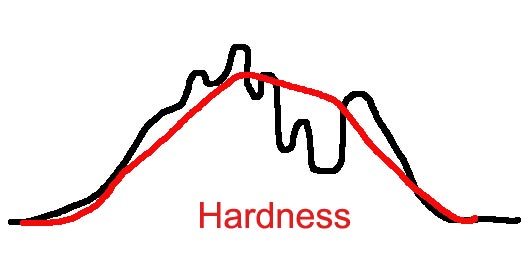
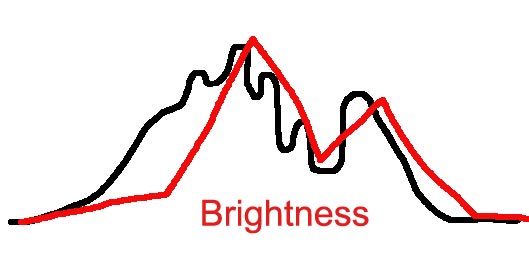
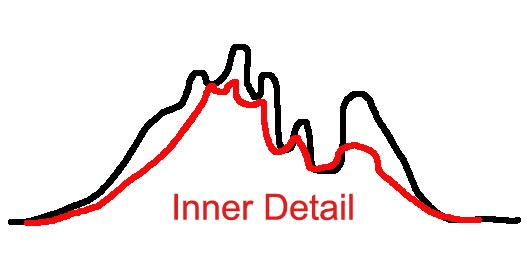
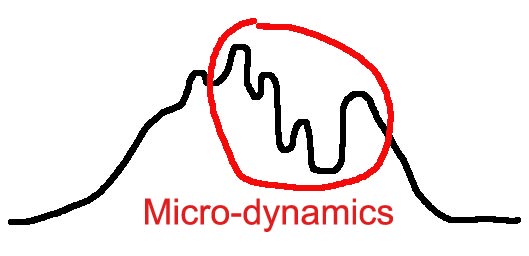
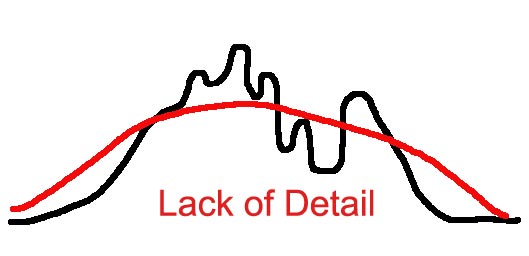
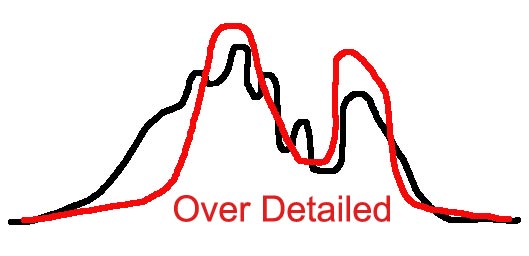
Here are some graphs I drew in photoshop. They look like poop but they, hopefully, help illustrate what we are talking about


The original note in all its glory [OK. I know. But use your imagination :-)]


Hardness: a loud note that does not have enough micro-dynamics to relieve the impact of pressure on the ear drum. [I think what we call shrill, Jim, is hardness at high frequencies]. Note that to avoid shrillness, most amps without micro-dynamics are rolled off severely in the higher frequencies.


Brightness: too sharp of note transitions, especially in the upper frequencies.


Inner Detail: We will define this as micro-dynamics that has too little magnitude [i.e. just a hint of micro-dynamics] [agree? disagree?]


Micro-dynamics: The actual way notes appear in the wild, with lots of bumps [abrupt changes in magnitude – and other things like freq and related freq (harmonics) all with lots of bumps]


Lack of detail: note transitions too rolled off, soft, rounded,…


Too much detail: note transitions too abrupt [but not sharp], note envelopes rise and decay too quickly.

As these charts indicate [well, they TRY to indicate] micro-dynamics is really all about accuracy.

The fact that the industry describes ‘accuracy’ as having the measured magnitude [the top point? or weighted average most likely] of a reproduced note being within a few dB of the original note – is a wildly gross simplification that causes no end of grief to people who want their reproduced music to sound like music, and not simple sin waves [which have no bumps, hence no need to think about micro-dynamics]

Concluding… this system is a Muscle output section on a wonderfully high-resolution, perhaps Magical, front end. Lowest common denominator rules in system design, and the overall result is a Muscle system.

Audio Federation Rm 557 pt. 2

Marten, Audio Note, Emm Labs at RMAF

Marten Coltrane speakers, Audio Note Ongaku integrated amp, EMM Labs XDS1 CD  / SACD player, Jorma Prime speaker cables [and sometimes integrconnect) and Nordost Odin interconnect and power cords, Elrod power cord, HRS amp stands.

SOUND

The sound was very high resolution, very clean, very harmonically rich and very pure.

OK.

Done with the ‘very’ies. But keep them in mind because they do describe and define the core of this system’s sound.

The sound was filling the room and we had good room pressurization going on. The bass was present and fairly well-dampened and we did not have significant problems with room nodes. The sound was quite musical, if not quite riveting [by Wednesday it would have been riveting :-)]. Frequency response and dynamics were even-handed top to bottom [a little less authority on the bottom, this is a relatively small speaker], a natural amount of micro-dynamics, a natural amount of separation [notes perfectly separated but still part of the whole]….

This system handled complex music just about as well as it handled simple notes – there was no sense of added confusion as the music transitioned from simple harmonies into complex harmonies [complex passages in better recordings do resolve better, however].

Similarly, the high resolution and harmonic detail – and our willingness to play opera attacted a number of people with their opera CDs. The voices, instead of sounding shrill as they often do when there is not enough resolution or harmonic color – were wonderfully involving and hypnotizing.

I talked about playing rock and roll in the last post, and I could now talk about how each component [and we always include cables and cords in these discussion as if they were components] handles its responsibilties in the musical chain – but because each component did its job so very well, I think it might be hard for everybody to believe that each component is really as important as every other component. So we will move on to the next post [Uh, I am writing this section last, sorry] where it will become obvious what happens when a piece or two does NOT do its job.

ISSUES

I promised to talk about the 3 1/2 days of breakin of the Marten ‘Coltrane’ speakers.

The LACK of being broken in had several clearly audible signatures:

1. Brightness and sibilance in the treble (the occurrence of this was reduced to about half, say, by the 3rd day)

2. A stiff, unrelaxed sound, all-too-quick decays, ‘cold’ kind of sound (this was much improved by the 3rd day – but this is an asymptotic kind of break in, taking months to get to 95% and always getting better and better the more it is played)

3. A rare ‘tizz’ in the low treble that sounds like a metal bee got caught in the speaker (this was gone by the 3rd day. Whew!)

4. Exaggerated percussive transients that makes things like symbols and drum whacks etc. more prominent than normal (here this is caused by #2, above [which happens for all speakers] but #4 is somewhat more prominent on ceramic driver speakers. Again, the longer the speaker is played, the more natural this becomes) [this aberration is very prominent on several horn speakers (not Acapella BTW) and never seems to go away (or maybe, of the dozens of different versions of these speakers – I have never heard a broken-in pair)]

What did we do? What we did (besides fret and worry) was to

1) play an ocean waves disc at night, and the louder we played it at night the more it seemed to have improved by morning.

2) play Whos Next quite loud. Later Aerosmith Toys in the Attic. These [I think both were the SACDS versions] have lots of detail – revelatory for me, like the 1st time hearing the SACD version of the Moody Blues albums. Lots of energy in the treble – helped the speakers get to the next plateau

3) Tried to keep the volume down to a reasonable level. This was almost impossible [we tried to do the Lamm room thing, keeping things mellow, but I guess our hearts just weren’t in it]. We invite everybody to play their own CDs, and most want to hear them at a specific volume: loud. We rarely went past 4 [which was quite loud], out of 10, on the Ongaku – this system CAN go LOUD.

Mike Latvis did convince innocent ole me 🙂 to turn the volume up to 5.5 on Bela Fleck (track 4 on the CD) and the bass on that track was pretty darn impressive [not sure how else to describe it] at that volume. Let’s just say that the Ongaku drove those [89dB] speakers to very high SPL, controlling each note perfectly from birth to death, without straining.

4) We pointed the speakers down at the seated listeners. It was determined early on that this helped reduce the negative effects of un-broken in tweeters. Usually this hardly matters and we point the speakers midway between a standing person’s ears and a seated person’s ears [more or less]

5) Worry and fret.

——————————————

Like I said in the previous post, we were happy with the result. However, this happiness is somewhat the result of coming to a realization about how stupid and foolish we were to expect miracles from a more-or-less brand new speaker – and being relieved that we were able to navigate the treacherous waters of un-broken-in-hood lane and come out the other side alive.

SETUP:

After much advice and after many different positions we finally placed the speakers about 2.5 feet from the front walls and facing almost perfectly straight ahead.

The 2.5 feet was Neli’s idea. I thought that they should go closer to the front wall, Martens like that, but the draperies were absorbing way too much energy and generating a dull confused presentation. We pulled them out another 1/2 inch on Saturday morning – the breaking in was loosening up the speakers and causing it to interact negatively again with the drapes [maybe. But it did sound better after that 1/2 inch move].

The straight ahead idea was mine, sort of. Somebody pointed out that the soundstage was still kind of narrow, and I remembered how we used to set these speakers up straight ahead sometimes. The final test was to sit in the chairs left and right of center, in the front row, which were almost directly in front of one of the speakers, and see if there was a soundstage – see if whether the speaker right in front of us would disappear or not. It did.

We put the paper posters on both sides of the room at the 1st reflection point (for most seats) and that added about 5% more clarity to the separation etc.

The 13x19feet room is much easier to setup than the big 19×30? [I think the audiofest website is wrong] rooms. Optimally I would like a 16 x 25 room, I think, for shows. Easy to setup and fill with music but with a lot of seating.