
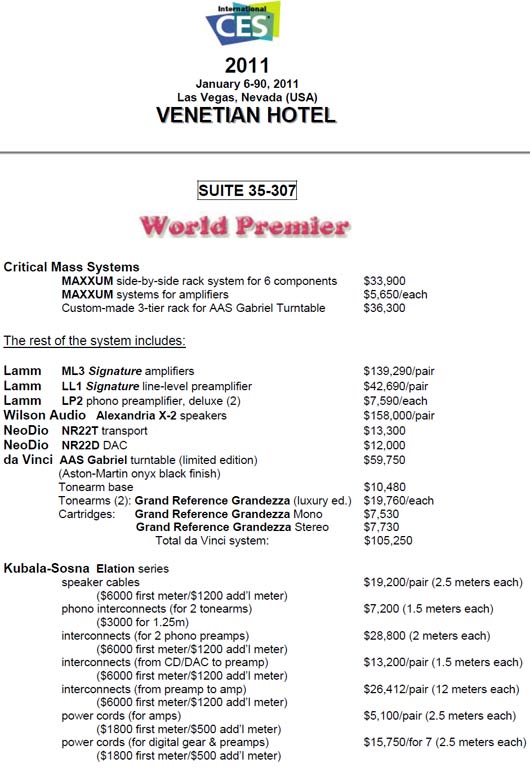
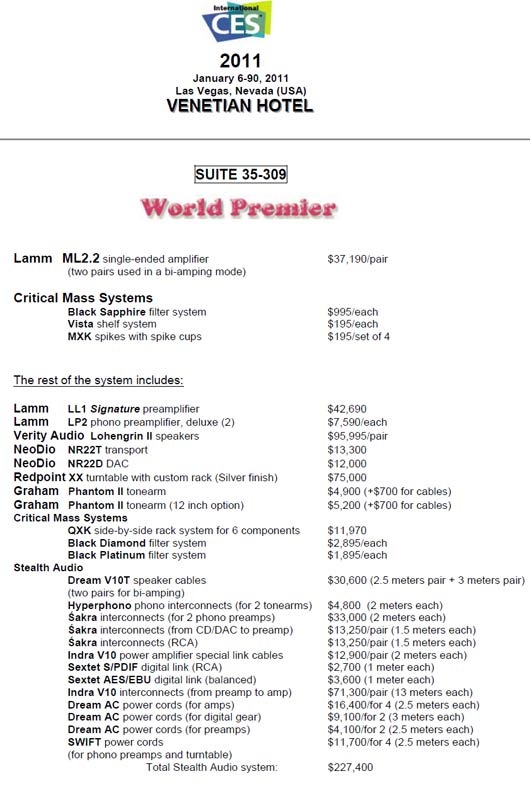
We’re back from an on-site optimization of a Wilson Alexandria X2 / Audio Note Ongaku system. Didn’t really have time to post anything here on the blog while we were there. Sorry about that – really need to get a iPad-like thing so I can post while Neli drives.
It was fun listening to the X2’s for a few days. Not quite as even top-to-bottom as the Marten and not quite as much resolution as the Kharma [and somewhat harder to drive than either], but we enjoyed them very much.
I have always thought it strange how in our industry there are competitors to the dominant player in a particular component, in this case speakers and the player is Wilson, that cost more but are inferior. This is especially true of something like the Wilson Sophia. You are supposed to cost more and be significantly better, or you are supposed to cost less. [all you who judge Wilson after hearing Krell, VTL and ARC etc. on them, well, you haven’t heard the speakers].
The Ongaku sounded very good on the X2, and drove them to reasonably loud [for most people in most rooms] SPLs [i.e. you have to shout pretty loud to be heard – but you CAN be heard. We measured 104dB on one passage].
There was a, I would say, good amount of resolution, good amount of micro-dynamics [and midi-dynamics and macro-dynamics too, but these will be better, no doubt, as soon as the speakers are spiked, I think, but we did not get to do this in the time allotted], good harmonics. In other words, it was good in a balanced way across all the categories of sound quality measurements we have been talking about here.What the X2’s also do, though, is they do this at a large scale. Very few speakers can do both large-scale and this balance at the same time.
If you are going to spend the, now $165K I think, on the X2, you just might want to hear them sound their best. Or, put another way, stop making them sound like poop. Put a really great amp on them, like the Ongaku [or the Audio Note Gaku-On. I’m on a mission to try and get us the Gaku-On here on a permanent basis – might take awhile though *sigh*… or should that be… *pant* :-)]. Lamm will be also be putting their ML3 on the X2 at CES [see next post].
The X2, like any decent speaker, needs an amp that A) provides music to the speakers [micro-dynamics etc.] and B) controls the speaker well enough so that this music gets to our ears [yes, we are planning on adding a list that lists just how well each major tube amp does this in a future post. BTW, the Ongaku is 2nd or 3rd on the list, which is why we tote the thing around like it was… like it was *insert suitable metaphor here* (all I can come up with now are either extremely stupid or X-rated :-))].
Marten has announced the new ‘Coltrane 2’ loudspeaker which will be debuted at CES 2011 this next January in Las Vegas. We’ve only known about this a few days… and are we ever anxious to hear them!
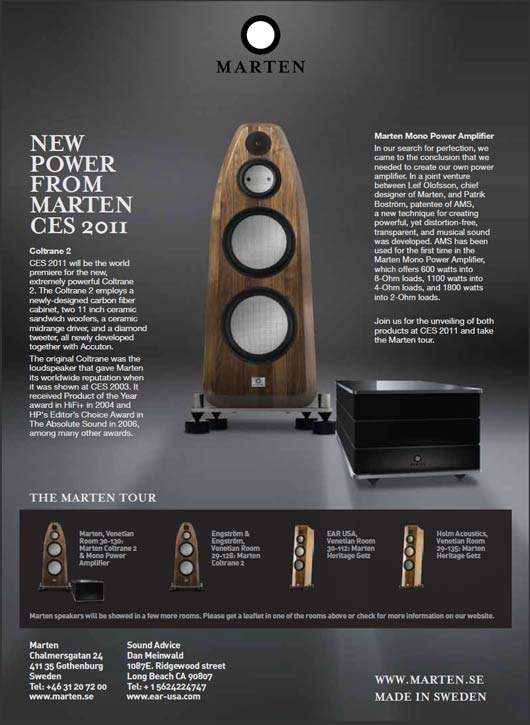
The most visible change is the two 11 inch woofers replacing the two 9 inch woofers on the previous Coltrane (which we have enjoyed very much and displayed in the Audio Federation room at RMAF 2010)
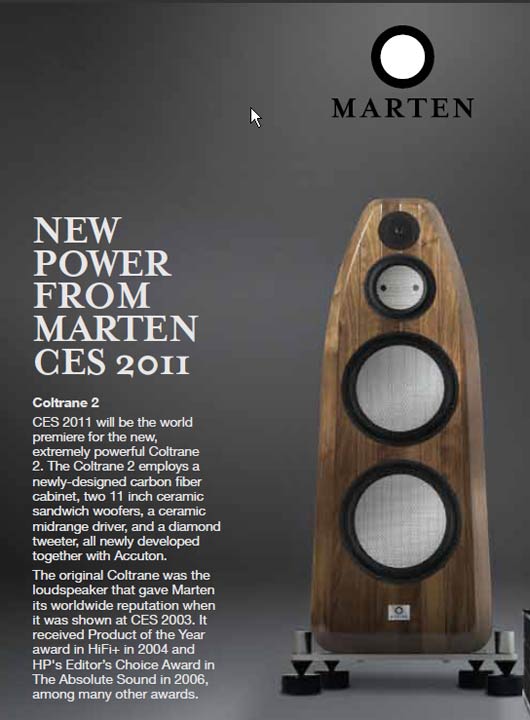
A closeup of the announcement. The price is expected to be around $85K a pair (the previous Coltrane was $70K).
[The demo pair of cherrywood Coltrane speakers we played in our room at RMAF 2010 to such wonderful effect are still available at a decent discount *hint* *hint* :-)]
The Coltrane 1 is one of the best loudspeakers, if not THE best, at its size in the fricking world [and we are ALWAYS looking for other speakers that can do what these speakers do – i.e. get completely out of the way of the music].
These changes will obviously give the Coltrane 2 more bass and a somewhat larger scale with respect to their overall presentation.
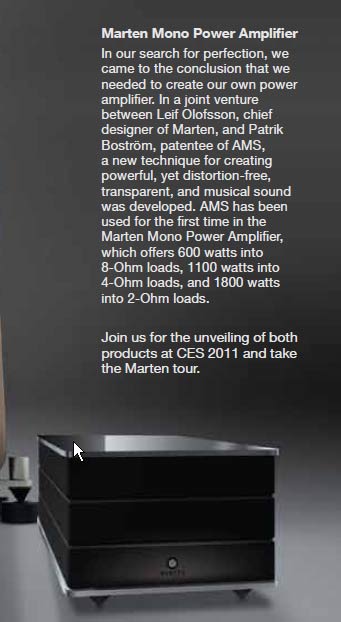
Marten has also announced a hefty 600 watt amplifier. It will be about $45K a pair.
We’ve been talking a lot here about the dearth of high-quality solid-state amplifiers – i..e those able to reproduce micro-dynamics at scale. It will be interesting to see what these sound like 🙂
1) We all know that one’s emotional state can affect how one feels about the sound of their system. This state can increase or decrease the likelihood of having a druglike sound experience.
2) We also know, or have read about, how alcohol and various drugs can affect how one feels about the sound of their system and can similarly increase or decrease the likelihood of having a druglike sound experience.
3) There are other things, both internal and external, that can also affect (increase) the probability of a druglike experience.
Artificially inducing strong emotions (1), like anger [got fired, for example] or exuberance [got hired], just to have a druglike sound experience seems a little on the ‘needs therapy’ side of the fence. (2) can be hard on the body and or brain cells. (3) however, if we can enumerate several relatively sane and healthy techniques, would seem to be the approach of choice.
Things that [may] affect the probability of a druglike experience:
A) Mood lighting. Bright light seems to be of no help at all, but dim light, the glow of vacuum tubes, city lights or Christmas tree lights all seem to increase the chance of a druglike sound experience
B) Comfortable seating, in my experience, does NOT affect the probability of a Druggish experience
C) Going from a good to a great quality sound / recording does increase the probability of this experience. Perhaps one can artificially arrange to closely listen to, first, a medium quality recording then a high quality one, esp. of the same music, JUST to create one of these experiences?
D) Casual chitchat during the music almost always reduces the probability to zero.
E) Being tired, but not so relaxed that you are falling asleep, in my experience, increases the probability.
F) Good company, whether friends or strangers, increases the probability. Hostile people, or just people in a bad mood, people reduces the probability to near zero.
Other things to think about: aroma, clothing, ambient temperature, time of day. Others?
I’ve wanted to put the Jinro through its paces for a loooong time, ever since the Jinro integrated amplifier came to this country at last year’s CES, where I was impressed with its sound and its low cost. Like the bigger Ongaku, combining a very high quality stereo amplifier with a very high quality preamp in one chassis saves on power cords, interconnects, and amps stands/rack space. This allows one to achieve price-performance ratios unheard of in here in our Extreme High-end part of the audiophile hobby. Essentially, it allows you to get close to the Extreme high end at ‘slumming it’ prices.
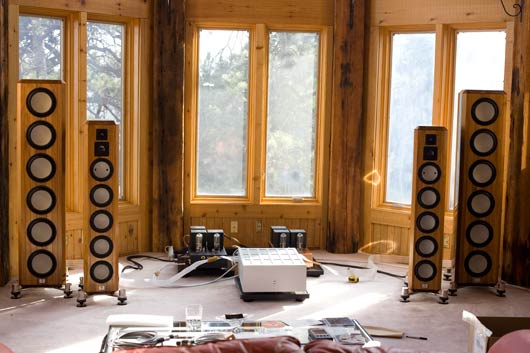
We performed a shootout between the $20K Audio Note U.K. Jinro, in black, and the $95K Audio Note U.K. Ongaku, in copper. As you can see, they are very similar externally, and are using the same brand of 211 tubes. Internally the Jinro is wired with copper and uses copper-wound transformers as opposed all silver inside the Ongaku. They both weigh about 60 pounds or so and put out about 25 watts. Kevin O., Neli and I were in attendance.
The system was the Marten Coltrane Supreme speakers, Emm Labs digital, Nordost Odin interconnects and power cords, Jorma Design Prime speaker cable and HRS platforms. We will also do another, similar shootout on the All Audio Note system downstairs with Steve G., Neli and I doing the finger pointing at that time.
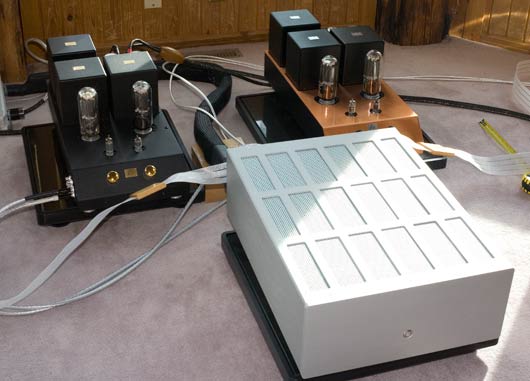
We played the Jinro first using our 3 test cuts: Gloria Esteban, Elton John and a short but complex Mozart piece.
It was great: good details, lots of good separation, dynamic, good color. The Elton was not quite as magical as we remembered it, but maybe we had exaggerated the magicality in our minds over the last few weeks. Certainly did not hear anything that didn’t sound great.
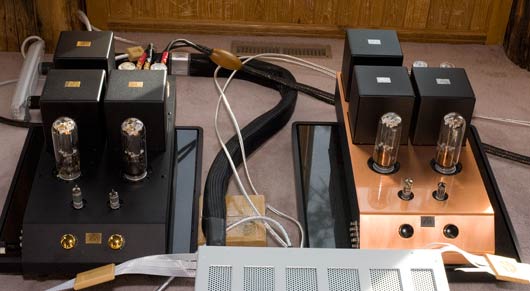
We then played the 3 cuts on the Ongaku. Kevin kept bringing up Mike Tyson, so I will put it like he did: It was like me, Mike Davis, and Mike Tyson going into the boxing ring. It wouldn’t take anybody very long to figure out who was the winner [me being the first, in that scenario :-)].
The Ongaku has a LOT more stuff happening between the notes, which allowed it to have a lot more resolution and the harmonics to be much more vivid. We went through the motions and played all 3 cuts – the Elton piece was as amazing and drug-like as we had remembered it being [more so in fact – hearing a song be ‘great’, and then soon after be ‘OMFG great’ has its own special kind of drug-like effect. More later on this].
As a shootout this was somewhat worthless – but we did learn a few valuable things nonetheless.
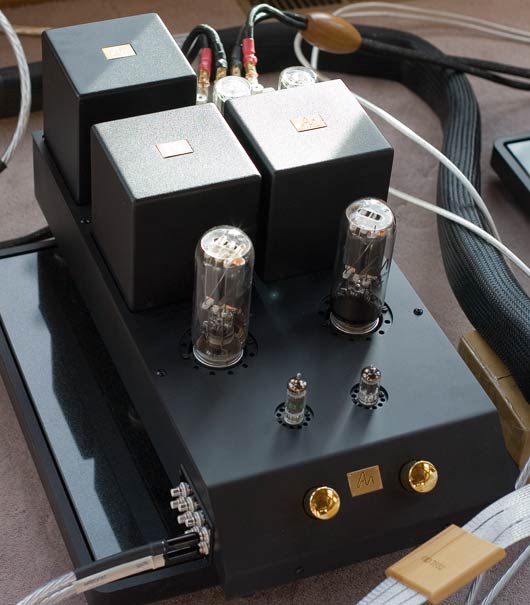
The $20K Jinro did a great job on this 1/2 million dollar system. Without hearing the Ongaku, many people would never know what they would be missing and would be very happy campers.
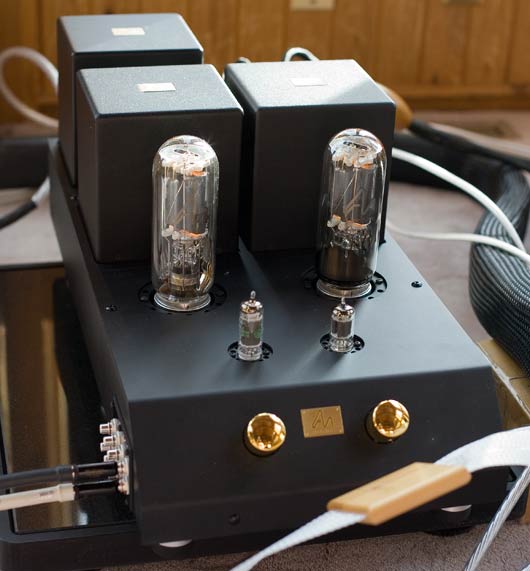
Is the Jinro as magical and drug-like as the Ongaku? No. But that is not saying much, as only very, very few other amps are.
But the system around a Jinro can be designed so that the Jinro doesn’t have to do ALL the heavy lifting [our test system is pure straight-line high resolution components and cables counting on the Ongaku do all the drug-like magic]. For such a Jinro-centric drug-like system, the Jinro will be able to supply very high-quality dynamics, separation, phenomenal note control, and harmonic purity…. and quite a lot of resolution (esp. compared to most amps).
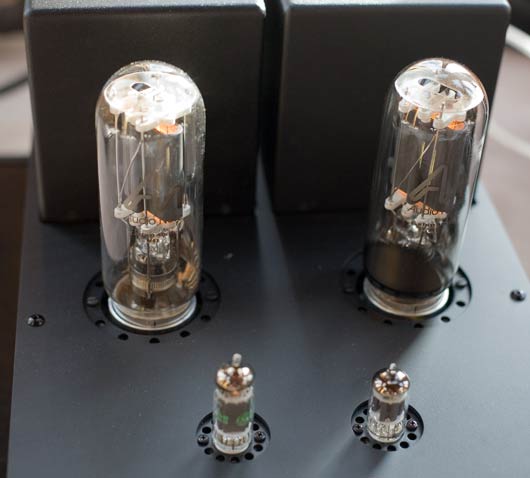
Our next step here will be to put the Jinro on a system with a Audio Note digital front end, on Audio Note speakers, and see – I mean hear – how it compares once again to the Ongaku [we really do like the Jinro, a lot(!), even though we are putting it up against impossible odds against the Ongaku in these shootouts]. This shootout will then tell us how they compare on a very musical front end.
After that we will proceed to try and build, hopefully several, reasonably-priced drug-like Jinro-centric systems from the components we have lying around here.
I guess we should try and define some of these terms and then [I should] try even harder to stick to using them correctly.
*Harmonic Purity is analogous, in my mind to a tuning fork. A ‘ringing’ purity with all subharmonics intact and appropriately long decays. The opposite to harmonic purity is ‘blanched’ [i.e. washed out. Anyone else use a different term?]
*Color is how much subharmonics are present at all frequencies and SPLs and dynamics, especially in the smaller, more subtle notes. The opposite to having lots of color is Leanness.
*Harmonic Vividness is the cross product (multiplication) of Harmonic Purity and Color – when they are both present the music harmonics are very brightly colored – very real [or better than real since many live performances have lots of soft people around you absorbing various harmonics]. Harmonic Vividness is the real goal here with respect to harmonics.
*Harmonic Resolution is how many different harmonic tones are audible within a single major note. The lack of harmonic resolution [no term for this yet] is for example a middle ‘C’ note where all you can hear is the one frequency, growing loud then soft. With lots of harmonic resolution that same note has audible delineatable harmonics in the related octaves, as well as some harmonics at freq a little above and below [if this is a real world instrument] and all of which decay at different rates – and sometimes reinforcing and/or diminishing each other- lending a fullness and richness and character to the note.
From a recent deranged comment (of mine :-)):
“McIntosh can be said to have color, but it is low on harmonic purity and ‘vividness’. I do not see this as a particularity good thing. There is this Visual Color I see when I hear equipment. Valhalla is bluish silver. Jorma Prime is orangish brown [more like a burnished orange, actually]. McIntosh… is uneven, kind of like a faded-in-some-areas worn plaid pastel shirt. The Ongaku is…”
[as I continue to think about the mental colors I associate with things that I like the sound of…]
… like sunlight on a bar of gold [a lot of bright colors on a background that is slightly gold]. The AN DAC 5 Signature was as close to a pure rainbow (or prism, think Dark Side of the Moon album cover) as I have heard.
Sometimes colors are hard to pin down (for me, anyway). The Nordost Odin power cord is white. The Odin interconnect is slightly grayer than the Odin PC. The AN PALLAS is a smallish rainbow [actually, 100s of smallish prisms. and the Lamm ML3 is millions of smallish prisms]. The Lamm ML2.1 is purplish grayish white.
I do not see a mental color when I think of speakers, or rather I see the actual color of the speaker itself in my mind, which is *so* boring 🙂
Anyone else have colors they associate with equipment?
This task, to determine which small tube amps will have the greatest chance to be able to produce a drug-like sound, is very dependent on the speakers being used. But each amp does have general characteristics that we can try and talk about on a ‘generic’ speaker.
As a generic speaker, let’s just imagine we did a melting together of the following [we are leaving out extremely hard to drive speakers and those that have issues] $12K to $25K speakers: Kharma 3.2, Avantgarde Duo, Marten Getz, Marten Miles, Wilson Sophia, Quad, the small Gershwin, Audio Machina, and all of the many Audio Note speakers in this price range… [I am trying to think of all the speakers that had micro-dynamics – and therefore a chance to be drug-like – when I have heard them driven by small tube amps in this price range. I know I am forgetting a few. There are also quite a few above $25K].
Others in this price range I have heard have good micro-dynamics driven by good solid-state: Avalon Opus/Indra, SoundLab, …
This is a really funny exercise for me… for example, a lot of these speakers often have so-so [or worse] Boy Toy amps on them at most shows and sound, you guessed it, so-so [or just bad]. Many more speakers might do fine with small tube amps – but there is so much pressure to create that Boy Toy sound at shows [we feel this pressure ourselves when we exhibit at shows], that exhibitors [and no doubt your average dealers] take the path of least resistance and put a big Boy Toy amp on the speakers.
Why is there this pressure to show Boy Toy sound?
Anyway… [including Joule Electra and Atma-Sphere here with the small amps, being OTL and all. Lars is by Engström & Engström. VAC is here because… it has more of a small amp sound]
Micro-Dynamics =>
Jolida – Rogue – Cary – Art Audio – Pathos – Atma-Sphere – Manley – ASL – Air Tight – Tri – Joule Electra – Conrad Johnson – Audio Valve —> Mastersound – Nagra – WAVAC – VAC – Zanden – Berning OTL —> Lars – Audio Note – Lamm
Micro-Harmonics / Harmonic Purity =>
Pathos – Rogue – Atma-Sphere – Jolida – WAVAC – Cary – Air Tight – Manley – ASL – Art Audio – Tri – Conrad Johnson – Nagra —> VAC – Berning OTL – Mastersound – Joule Electra —> Lars – Zanden – Lamm – Audio Note
[This is just a VERY general categorization, it REALLY depends a LOT on the speakers you are using – though less so with the amps with very-high-quality output stages like Audio Note and Berning or beefier outputs like VAC, Joule-Electra.
TBD: Shindo have not been heard with equipment of known decent quality – i..e their sound has not impressed but the associated equipment could have been the potential culprit. Have not heard Jadis in a long time (but they will be at CES 2011)
—> indicates a wider gap. Elsewhere one could, arguably, perhaps, swap an amp with its neighbor amp or two.
Mixing Micro-harmonics and Harmonic purity like this in the same list was convenient but might be a mistake although I believe both contribute to a drug like complexity to the sound].
OK. Comments?
Hopefully the examination and categorization of small tubes amps will bridge the gap between everything we’ve talked about with respect to identifying drug-like sound characteristics and actually building systems that produce drug-like sounds.
As a little refresher [I think as much for me as you all]:
We are classifying things into 4 different kinds of systems:
Boy Toy systems: make loud noises
Gee Whiz systems: use really cool technology
Practical systems: are easy to listen to music on
Drug-like systems: evoke intense musical experiences
Drug-like sounds require three things:
1) A significant complexity [which perhaps triggers latent similar patterns of associations in the brain] which can be in the dynamic, harmonic, timing [we have experienced amazing effects with delays, and there is of course PRaT, as well as melodic interplay between threads of a melody], and detail domain: micro-dynamics, micro-harmonics [or very rich and/or pure harmonics], extremely fine timing, micro-details… Anything which adds [likely fractal-like] complexity
2) Something for our practical mind to focus on so it can ignore all the things that are wrong with the sound
3) No significant bad behavior
I want to say [to make our model as simple as possible] that 2) is largely personal preference and 3) is an absolute [for our purposes here]. So, for example, people who absolutely MUST have realistic dynamics [or deep soundstages, or whatever] in their system [which is fine], will never achieve a drug-like sound if they build a system that has insufficient harmonic integrity [we are not talking lean, we are talking Sahara desert].
Most people [if they are lucky!] build systems around 2) [personal preferences – what their practical mind demands] and then continually adjust cables and components to address the resultant 3) bad behavior caused by the way they built their system [unlucky people never even get to 2)]
[We see a lot of, dare I say it, weird 2) personal preferences [absolute MUST HAVE requirements] for just ONE of the following, strangely ignoring EVERYTHING ELSE about the sound: Soundstage width, soundstage depth, punch, room pressurization, air, bass detail, soundstage behind the speakers, soundstage in front of the speakers, absolutely no room interaction, etc. And every single person thinks that their personal preference is so obviously the most important thing about the sound and that everybody is trying to dupe them into thinking it is not :-). It was this observation that inspired much of the agnostic approach in the, for example, speakers guides in the Audiophile’s Guide to the Galaxy].
One approach to system building, which we do for a lot of people who are either like us [we pretty much want everything across the board to be equally great up to the point of unaffordability] or who do not know what their personal preferences are, is to build a system that satisfies what a REASONABLE person’s preferences should be for 2), with no bad behavior 3) up front, and then tune a single piece of equipment to be awesomely rich and transparent and provide the complexity [or is at least complexity capable] for drug-like sounds.
OK, getting to the small tube amps…
In order to build affordable drug-like systems the idea is to examine the range of small tube amps and the speakers they will drive [perhaps including some of the better solid-state amps as options for some speakers] and pick one. This will take care of most of the requirements of most people for 2) with minimal bad behavior 3). Then we will figure out how to add that extra special something [or preserve what is already there if the amp or speaker is the thing with the ‘special sauce’] to get the system from being Practical to being Drug-like.
… to be continued…
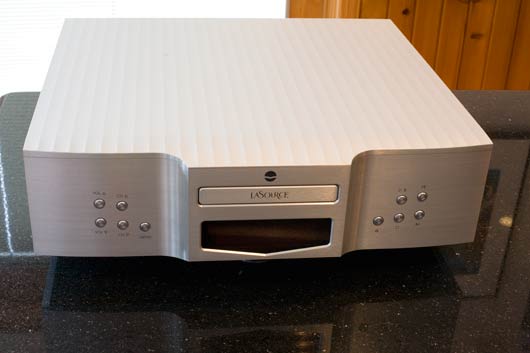
The player is upwards of 50 lbs and very, very solid.
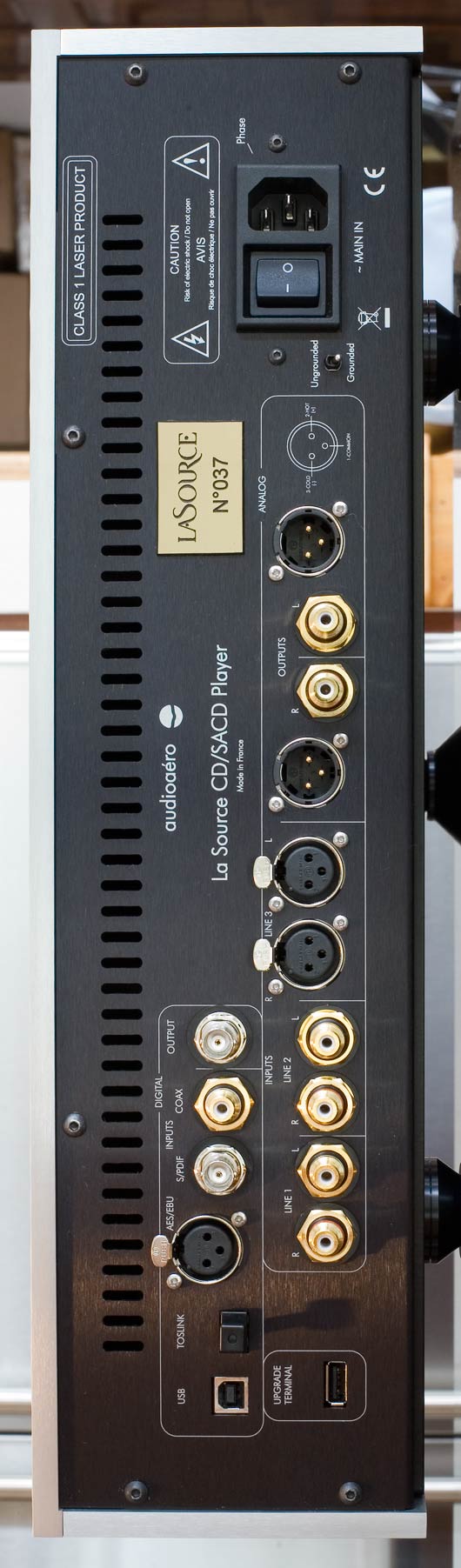
Closeup of the rear panel
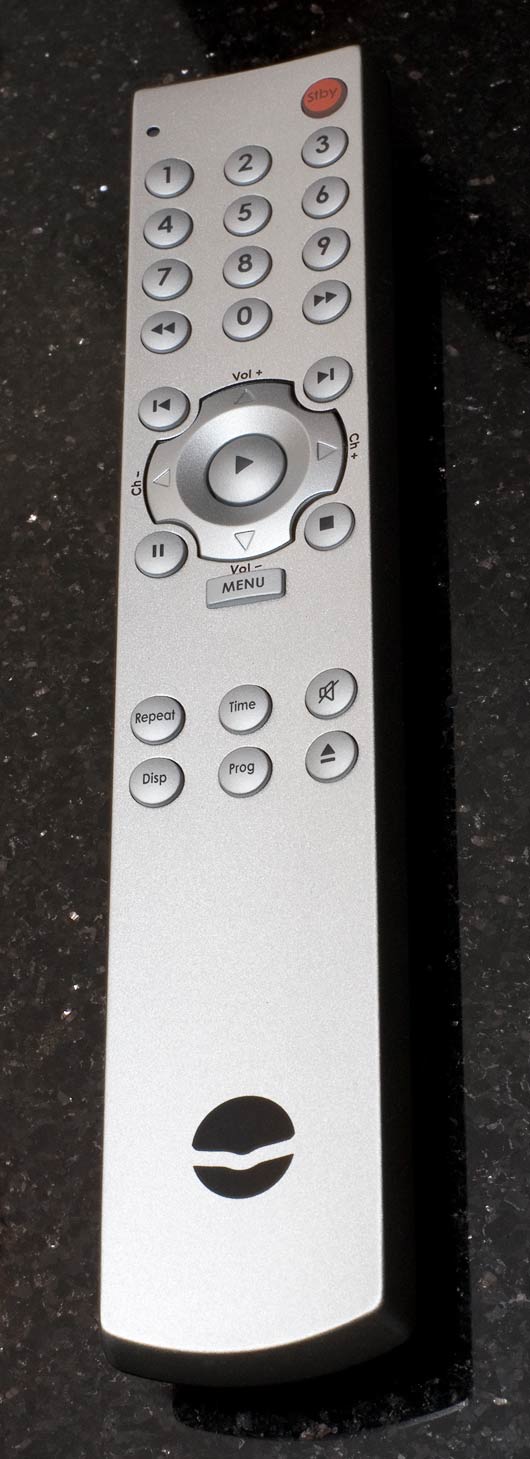
Closeup of the remote control. The remote is not one of those massive metal remotes – which here in a cold climate, I am grateful for, personally.
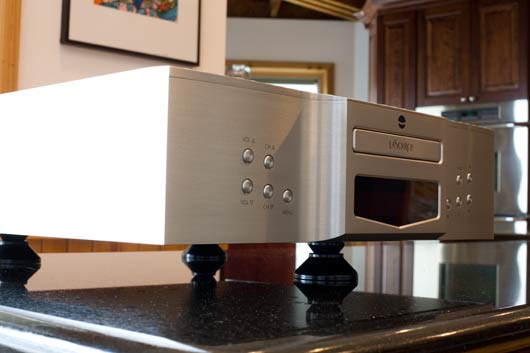
The player does retain some of the classic Audio Aero styling.
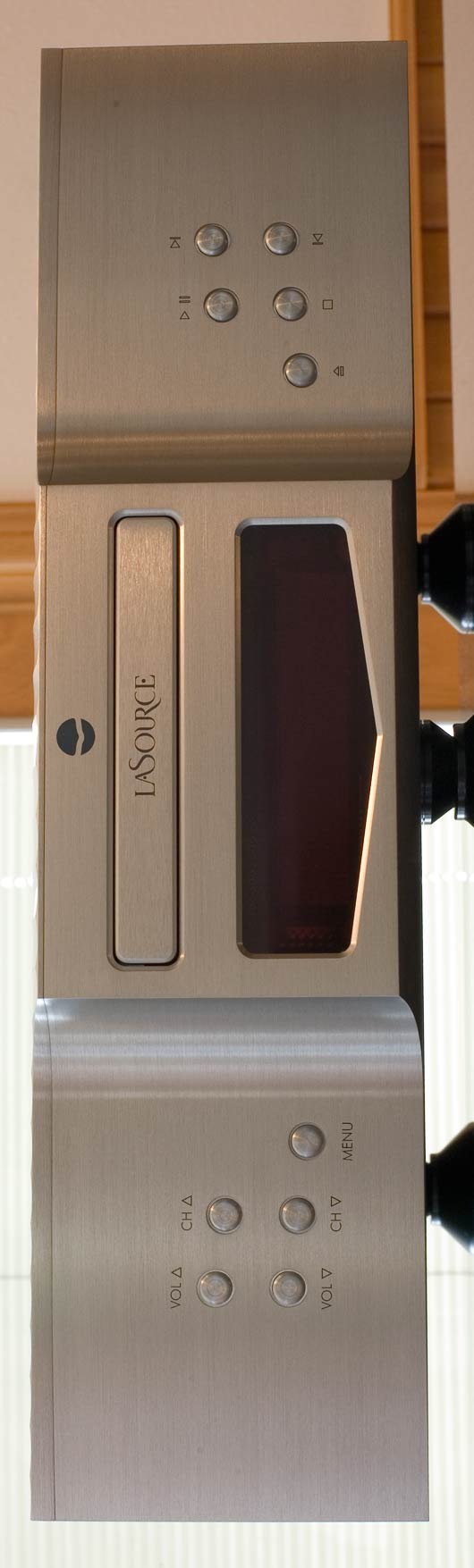
Closeup of the front panel
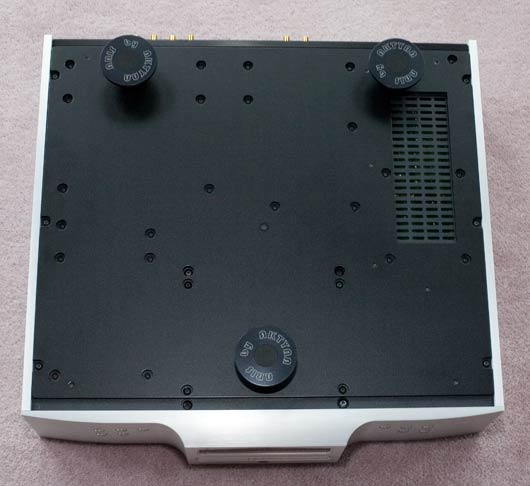
The bottom of the player. Note that there is a small amount of ventilation there, but otherwise the thick metal of the chassis itself acts as a heat sink.
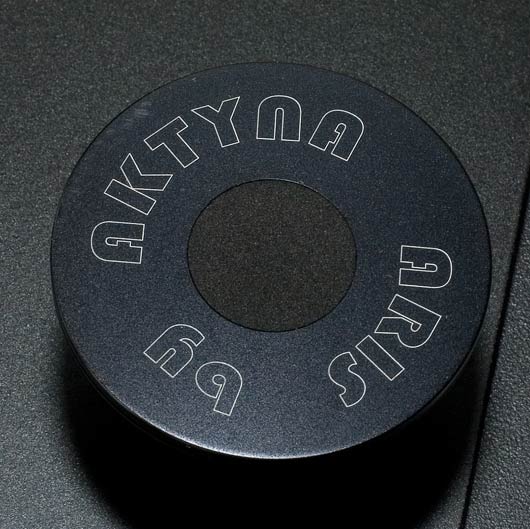
We wondered in the review whether these might be Stillpoints. Obviously they are not.
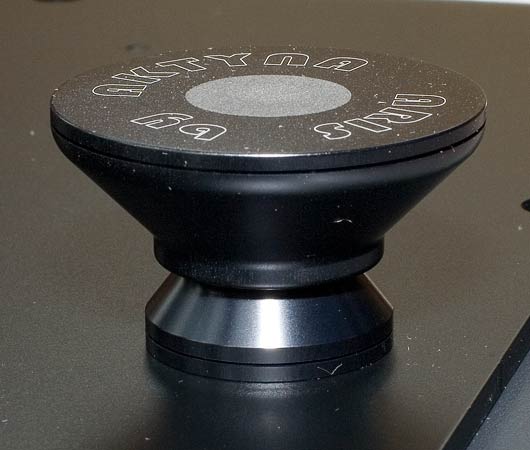
We recommend using different feet if you want to hear what this player actually sounds like [yes, extreme words but the shootout revealed there to be an extreme difference when we used 3 HRS Nimbus positioned underneath the chassis, and will send along a free set with every player we sell]
[Sorry about the peek-a-boo with the last post. We should be able to repost it any day now – certainly before CES :-)]

Here is our silly picture of a note once again, in all its pure pristineness
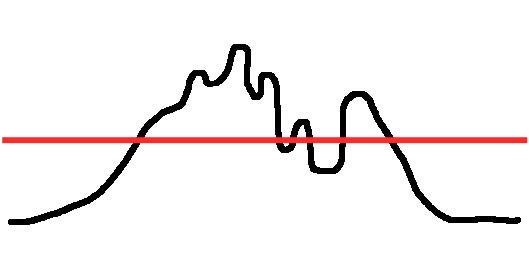
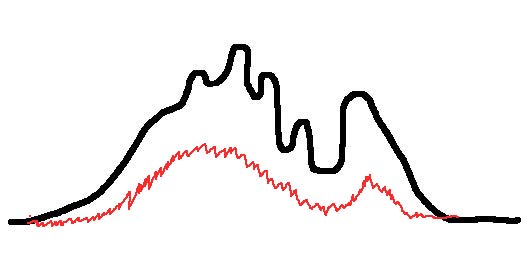
This is persistent background noise, like tape hiss.
This is background noise that gets louder as each note gets louder.
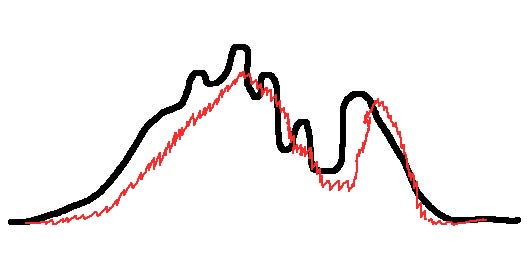
The is background noise that is about 3dB, say, below the average volume of the notes, along with a little delay. Notice how this eats into the micro-dynamics. The delay could be caused by everything from slow discharging electronics to room echos.
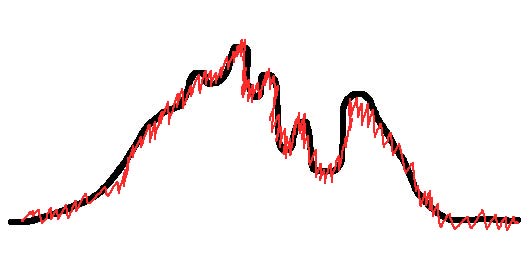
This is yet another kind of noise that just kind of throws a lot of garbage into each part of the note, making it sound less distinct and pure than it should.
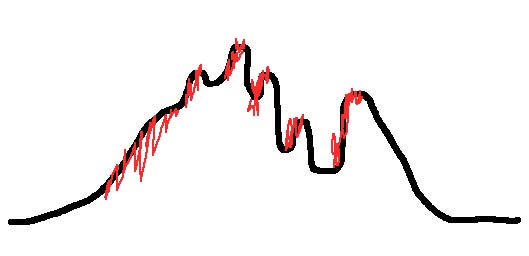
This is another kind of noise that appear on steep leading edges of notes.
We’ve all certainly heard all these types of noise, and more.
One thing we can say for certain about all these types of noise is that they are annoying [that’s why we call it NOISE :-)] and distracts from any drug-like effect we are trying to achieve.
We talk about the importance of micro-dynamics to achieve any drug-like effect – but as we can see [kind of] the absence of many types of noise is often required before we can even begin to HEAR micro-dynamics [assuming we have any to hear].
In other words, in order for any micro-dynamics to even show up against the background sound, we need the music to be fairly well-behaved: not too much noise, not bright and edgy, not rolled off, not drowned out by bass, delays not too long that they interfere with the micro-dynamics of the other notes, delays not too short that they distract our ears – acting like faux micro-dynamics in themselves., etc.
This kind of rules out a lot of systems from being drug-like contenders.
But it also rules in quite a few components.
As a wild-eyed [or sleepy-eyed] guess, I’d say:
40-60%? of speakers should be flat enough in the midrange and not extremely terrible in the outer freq to qualify as well-behaved
40%? or so of small tube amps as well
5%? of large tube amps
10%? of solid-state amps
20%? of preamps
20%? of CD players
90%? of turntables
20%? of cables
The rest are too bright or blurred, frequency shifting, compressive, too much NOISE, or whatever…
[Note that it is important, as always, to match amp to speaker. Incorrectly matched amp/speaker pairs will have a much smaller chance of achieving a drug-like sound. I would say ZERO chance except in the (not uncommon) case where a small tube amp – say a 2A3-tube based amp – is paired with a good but not terribly efficient speaker in order to get the drug-like effect in a very narrow freq range – the rest of the freq being out to a very long lunch.].
