Pursuing the Ultimate Music Experiences

Audio Federation High-Fidelity Audio Blog

Audio Note CDT-5 transport and Fifth Element DAC

[Sorry about the poor quality of the photos. My rechargeable flash batteries are dying one by one. Need to get a bevy of new ones before CES, that is for sure. I’ll use the tripod next, which obviates the need for flash].
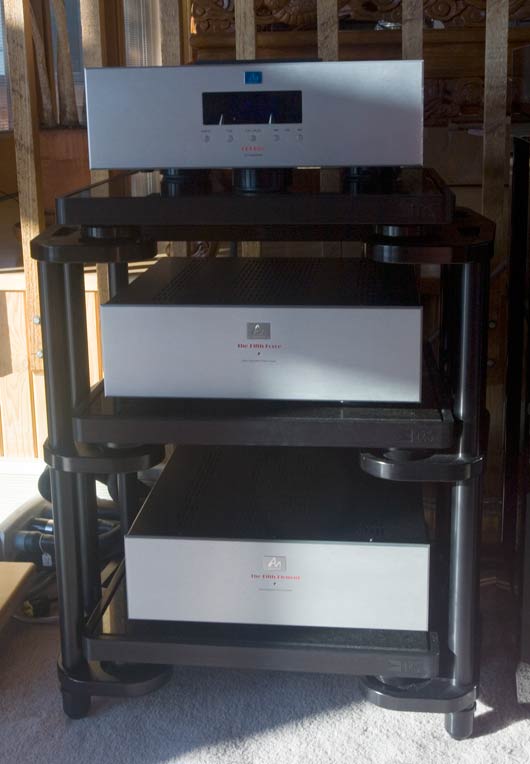

The Audio Note U.K. CDT-Five transport, Fifth Element DAC and its Fifth Force power supply. We do not have a price, but expect it to be in the $175K – $180K range for the entire stack. These are going to be shown at CES (T.H.E. Show at the Flamingo).

Brand new. Cold, pressing play less than 60 seconds after turning it on. Running through the little preamp in the Emm Labs DCC2 (which we have been using quite a lot lately as the upstairs preamp – the big Audio Note M9 Phono preamp being down on the Audio Note system downstairs).

First impressions? [Mark Knopfler – Sailing to Philadelphia]

“Wow, that is really DIFFERENT.”

“Oh, the VOICES…!” [Hard to describe… We talk about being able to hear the emotion in voices – and how difficult most systems have with this. How important this is if the music is not an instrumental – how we have millions of years of training, wired into our brain’s DNA, on how to listen for and communicate using emotion in voices.

Well, this does that, all right. But it is not like two strange men [Mark Knopfler and James Taylor] telling you a story with some modicum of emotion, it is like your Dad sitting next to you, late at night, talking to you about something important when you were a young-in. [that is what I flashed on at the time. Now I will TRY to explain why this was so different. A little waving of the hands here] There is a presence, a solidity, an intimacy, to hearing the voice come not just from the mouth, but from the chest; that there is some amount of authority that comes from a large adult talking to a small child. That real people, real professional singers anyway, have a vocal authority that does not come across the reproduction barrier in our systems.

“Wow, there is a LOT more bass”

We remembered how the DAC 5 Signature [the DAC right below the Fifth Element] was very close to analog – as dynamic as [and even better harmonics than] LP.

Dynamic bass is something that analog has always done well. As far as I can tell, this stack does bass much better even than that – very, very articulate and there is more of it, but it is IN PROPORTION TO WHAT IS IN THE MUSIC [otherwise we can just turn down the gain on bass towers of the Coltrane Supreme speakers].

—————–

On further listening, the entire frequency spectrum is more dynamic, which we expected – but remember we are still running this when it is new [not as cold anymore] and thru a modest but very nice little, say $3-5K, preamp. In some ways I just wanted to see if this particular digital stack could shine in a non-perfect setup *. Obviously it can.

[* much more later about the cases where we are running into where there is a component, usually a speaker, that can almost totally obscure various different types of changes made to the upstream system]

The PRaT [the pressure for one to tap their toes, or start dancing, or just start moving around in a spastic fashion to the music (which is a fairly accurate description of what I tend to do)] is very good and I think we need to add descriptions for ‘inner PRaT’ or perhaps micro-, midi- and macro-PRaT. There are inner melodies that I was feeling drawn to in this way, as well as primary melodies. It’s ALL good – there is so much to listen to and enjoy in each song.

There is more – but I think our next step is to run the Fifth Element DAC to the Lamm L2, and then straight to the M9 Photo preamplifier [the perfect pre for this stack] upstairs, or the Ongaku integrated downstairs [which is the show system, with the AN/E SEC Signature speakers, and this should be very intense].
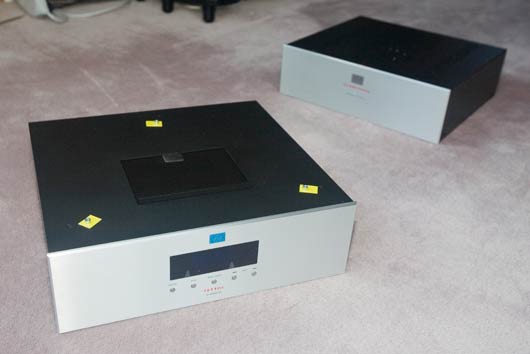

The top of the CDT-Five with the mounting screws still attached
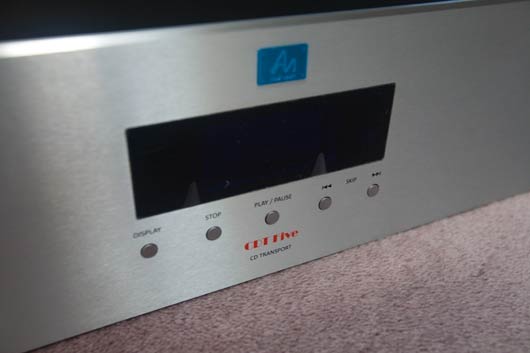

The front of the CDT-Five CD Transport, with the plastic protectors still on.
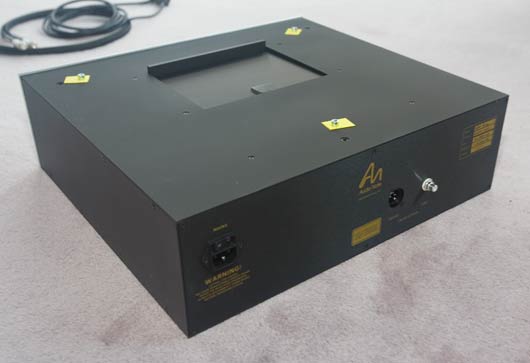

The rear of the CDT-Five CD Transport
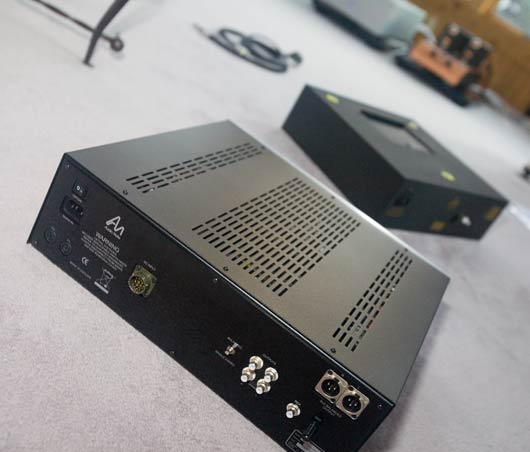

The back of the Fifth Element DAC with the CDT-5 in the background, and Audio Note Ongaku integrated way, way in the background.
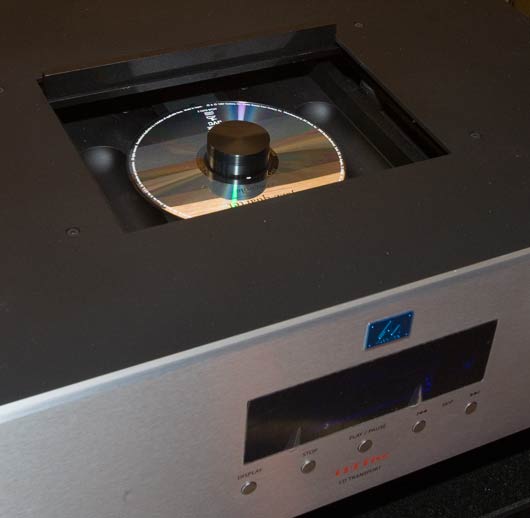

The Audio Note CDT-5 Transport with the drawer open
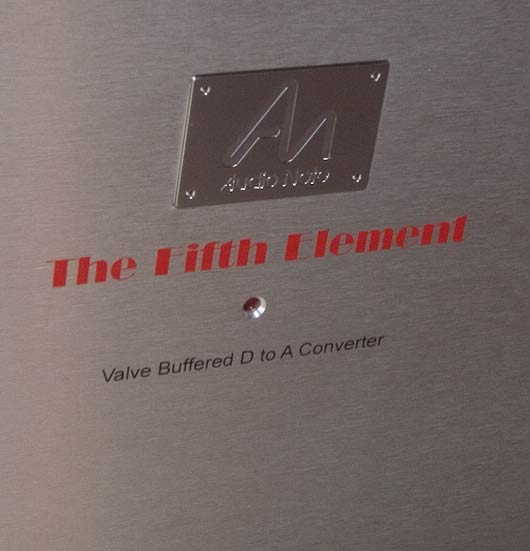

The Audio Note Fifth Element DAC
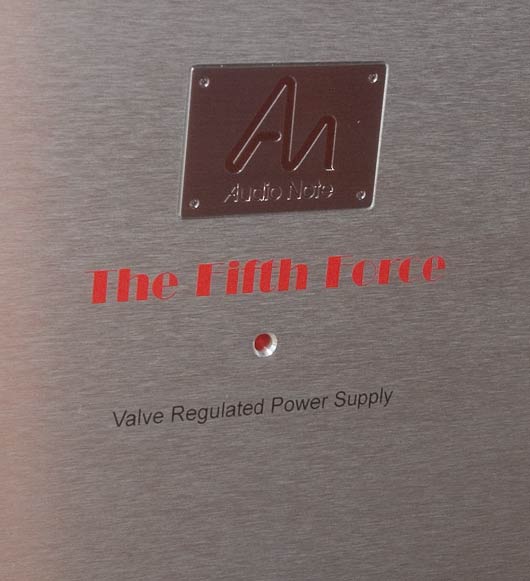

The Audio Note Fifth Force power supply for the Fifth Element DAC

Winnowing the list of high-end speakers

We get a lot of questions about this or that speaker when people are thinking about spending the big bucks on an ‘ultimate’ speaker.

First, if the manufacturer makes cables, or equipment racks, or a couple of amps, or whatever AND then decides more or less out of the blue to come out with a $100K+ speaker, why oh why should a person take this seriously? Designing and building good speakers is HARD. Just because they make it big and put a large price tag on it, is hardly a reason to take it seriously.

OK. That eliminates about 30% of all speakers. [Yes. There are maybe one or two exceptions. But as a general rule, this is a good one].

Second, if the speakers they make at $10K suck, and those at $50K suck, then why of why do people think the $150K speakers they make just ‘have got to be great’? It is more likely that it will suck, just with a bigger suck. The larger the speaker is, the harder it is to design. 2-ways are the easiest… if they can’t get this right, then there is no hope.

OK. This eliminates about, say, 30% [or more :-)] of the megabuck speakers out there.

Then there is the purpose of the speaker. Lump this together with drivability and placeability and even appearance. When deciding whether a megabuck speaker is ‘good’ one has to think about how they want to use that speaker. On a small SET amp? In a very large room or very small one? Is it going to be in front of something you want to see out of once in awhile? Are you going to want it placed close to a wall? Do you want it to sound musical [and various other attributes which we focus on here quite a bit], or be a loud Boy Toy, or just play decent music once in awhile or, perhaps, just be an awesome example of modern technology and it doesn’t matter much how it sounds?

This should eliminate, say, 30% more and leave you with about 10% or less of the megabuck speakers left to consider – probably about 2 to 4.

Now the fun starts 🙂

Almost Famous

I’ve watched this movie a few times in the past, but just recently found that I had somehow purchased the DVD in a bargain bin so watched it again, twice, just this week.

I really like this movie, for both the flavor of the early 70s and the music: mostly Led Zepplin, Neil Young, Elton John, and some Yes, Dylan and Jimi, etc. The way people grip and throw around their vinyl in this movie is atrocious, but at least they play music. Back in the day, that is what kids did – play music. They visited their friends houses and played LPs. I Have No Idea what kids do these days when they get together, but they rarely have anything on which to play music bigger than a cigarette pack, so I do not think they play music.

Cameron Crowe [Jerry McGuire] wrote and directed this movie. It is about a young teen who interviews rock stars for the Rolling Stone magazine in the early to mid 70’s. Apparently this is semi-autobiographical. Cameron Crowe’s actual articles are here, which he wrote, mostly for the Rolling Stone, starting when he was 15 years old:

Cameron Crowe: 1972-1978 Rock & Roll Mega-Band Interviews

It makes for fascinating reading.

CES 2011 – The Plan – Venetian Towers

Wherein we examine the floor maps in detail to get a kind of feel for what this year will be like.

[New. the rooms in the 200s]

[Please pardon us while we get this all to work…] [Yyyyy… OK. We wanted this to work like it does on Amazon… and it turns out that the electronics store and the DVD store at Amazon do it different ways. So, here, we are going to make it so you can popup a single window so people can see the larger photo(s) in one window and read whatever comments we have in this one. Like the Amazon Electronics store.]

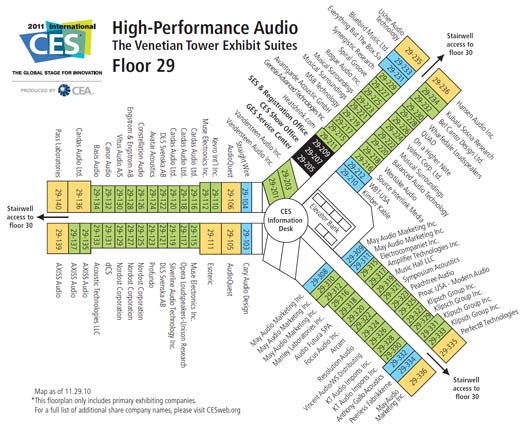
This is the map of floor 29.

Looking at the 100’s hallway… StraightWire AudioQuest, Cardas, … these are mainly about their cable displays. Avatar Acoustics is an importer, been showing with Rethm speakers lately.

Let’s see, Engstrom & Engrstrom make the Lars amps and will be showing with the Marten Coltrane 2 speakers, I believe. So 2 reasons to go there and spend some time. [I’m skipping rooms that are new and/or unknown to me – or I just don’t have much to say about].

Next we have Vitus audio – hope to hear something here that helps me figure those amps out in greater detail – i.e. they do microdynamics, but what are their other signature strengths and limitations?

[Yes, I am going down just one side of the hallway, just like in real life ;-)]

Next is Basis turntables. Not usually much to listen to here. Could stop and argue some more about whether Acrylic platters are the ‘best’ material for platters or not [me: there is no ‘best’ material]… but that gets boring quick.

Finally we have Pass Labs in a big room with a pile of their cool looking amps in the main vestibule. Lots of suits doing business and nicely setup but the sound has never impressed.

Across the hall now we have AXISS, an importer of many things: some years they have the statement Transroter turntable [on static display. love to hear it one of these years]. They also have Accuphase and a few other lines.

Always check out dCS. They are always nice and they keep busy making new things all the time – so usually something is new here. Hard, though, to get a sense of what they going for here – usually it is better to hear their stuff elsewhere at the show.

Nordost is next. 3 rooms! They will be doing some scheduled presentations as always, no doubt. Usually they have a strange mix of electronics and an under-performing rack, but with small speakers that are quite detailed and dynamic [often Eben / Raidho]. This is more a room to learn things about how to listen and hear differences in cables than to listen to music in.

Silverline is more cables…

Opera loudspeakers with Unison… this will be interesting. Not expecting greatness as much as an opportunity to learn more about Unison Research [which we hear is basic good-sounding gear].

Esoteric usually sets up a room that is a little too much Esotericness for my taste – being 100% Esoteric equipment and cables [not that they are not high-quality gear by themselves, they are]. Also hard to see what is new because they have so MUCH gear on display and/or in the equipment racks.

And then Cary at the end. The last 2 years they have had Marten Coltrane speakers in there. I forget [bad me] if they are to do so again this year.

===========================================

OK, still 2 more hallways to do on this floor, and at least one major floor left to do. This might be faster to actually be there walking thru the rooms than write about them … 😉

To be continued…. OK, we’re back. The 200’s hallway:

We have Kimber Kable (and WBT, distributed by Kimber) which are just rooms with cables and parts displays up front and maybe some kind of business meeting in the rear of the room.

Westlake Audio makes big, hulky box speakers although their rooms are rarely setup for boy toy-like sound. Not sure what kind of sound these guys are going for.

The BATs in the Bat room will often be driving a pair of Wilson’s, probably a Sasha or something. They rarely do something bold here – they’re probably just focused on business and trying to cement the connection between Wilson and BAT in people’s minds.

Musical Surroundings, an importer, has 3 rooms. One is usually dedicated to the static display of a dozen or so Clearaudio turntables. Sometimes they pick up a new line, or pair their stuff with an interesting speaker, say [now that they no longer distribute Vivid speakers], so one of these rooms is often interesting to me from a “it’s not likely to be the exact same thing as last year” point of view.

Volent makes speakers that are somewhat expensive yet still has a following as I understand it on Audio Circle.

Another room I listened to intently at RMAF, using the little YG Acoustics speakers, and feel less of a need to listen here now.

On a Higher Note is an importer, of things like the Brinkmann and, lately, Audio Aero. So I will take more photos here just in case there is something that we are supposed to know and don;t know it – looking at the detailed photos later helps answer a lot of questions about gear we do not have right here right now.

QUAD… always check out the QUAD room… SOMETIMES they have good sound, though recently they use only QUAD electronics to drive their famous, somewhat newly redesigned, speakers.

Wharfdale has usually just a token system, if any, and a lot of static displays of their speakers – and lots of people in suits.

Kubala-Sosna usually has their name on a room with an interesting system. Says nothing on their website, so I guess it’ll be a surprise. These kinds of surprises are fun.

Hansen… last year they brought their statement speakers – which didn’t go over all that well. Hopefully this year they bring something else, and pair it with something decent. Now that Wes is not their distributor, their setups have been disappointing the last several shows. We like these speakers, but they need a decent amount of high-quality power, and a decent front end. Unless there is a miracle. Miracles just do not happen at shows.

Usher. Decent speakers at an affordable price. They might have a potential for drug-like sound, and they do sometimes put decent [commensurate] equipment on their speakers at shows.

Bluebird imports Chord and usually sets up a nice sounding small system, and musical for a solid-state system, too. But they are really going for a Practical Sound, not a drug-like sound here.

Synergistic Research – no doubt with their stupid ball on a post tweak [stupid because if you listen to the system there during their demo – the tweaks make things sound worse, and brighter, and edgier. This is the demo that sparked the discussion a few years ago about just what are we as audience members supposed to do in a case like this – and how we all behave so nicely and nod our hears along with the presenter’s. ]

Spiral Groove. Nice medium expensive turntable and speakers. This room can be quite decent – though it usually lacks… something. Enough to not make it on my best of show lists.

One year Rogue Audio did have their new statement amp, which was decent. Otherwise, this room takes an approach to low cost tube amp sound that perpetuates the stereotype of tube map sound as being very veiled as compared to solid state, but without the warm glow that is usually the reward for such a sacrifice in clarity.

MSB… Cool looking gear… more focused on making Gee Whiz system components than Drug-like or Practical sound.

Avantgarde… now selling direct from Germany to their customers… guess they NEED to be at this show. Will be very interesting in hearing what they do here – no doubt with their horn speakers and amps but who knows what else.

Vandersteen in the middle of the Triskelian. One room will be just for HRS and I’ll say hello to Mike Latvis and take photos here [yes, some of this is entirely too predictable after all these shows]. The other room is different each year. Probably Vandy 7 speakers. Probably Aesthetix electronics. Sometimes a different amp. Sometimes a cool turntable – one year it was the Clearaudio Statement [which allowed me to understand much more about both the table and the Aesthetix gear sounds].

=================================================

OK. Taking a break before we go on to the 300’s rooms

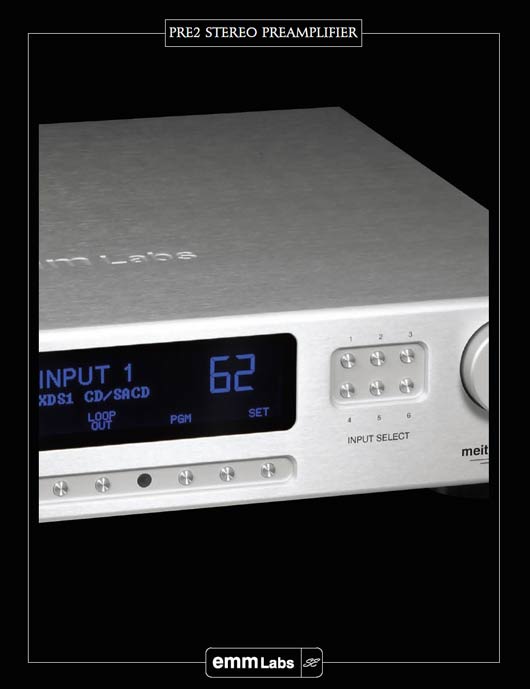
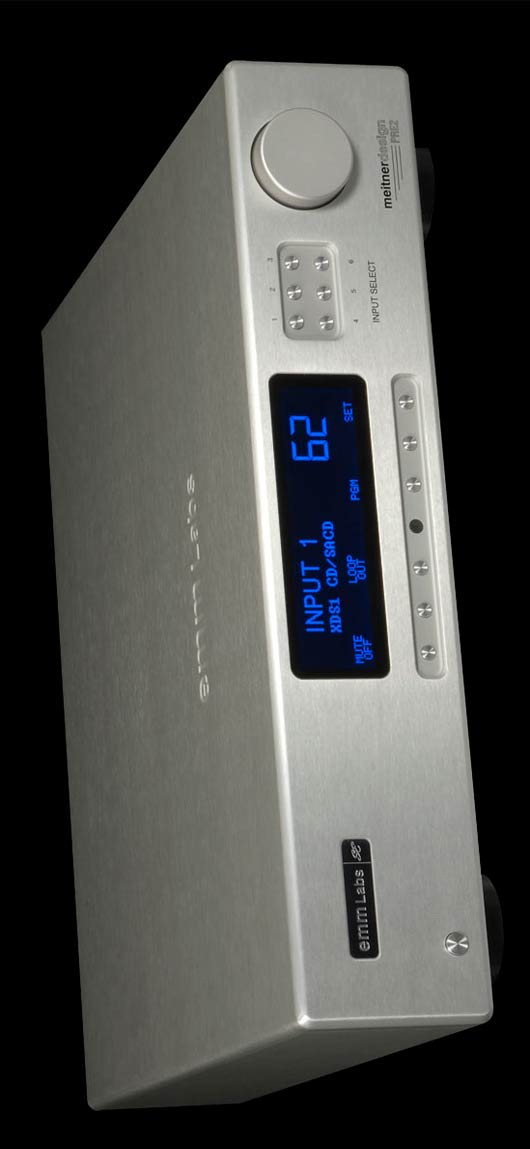
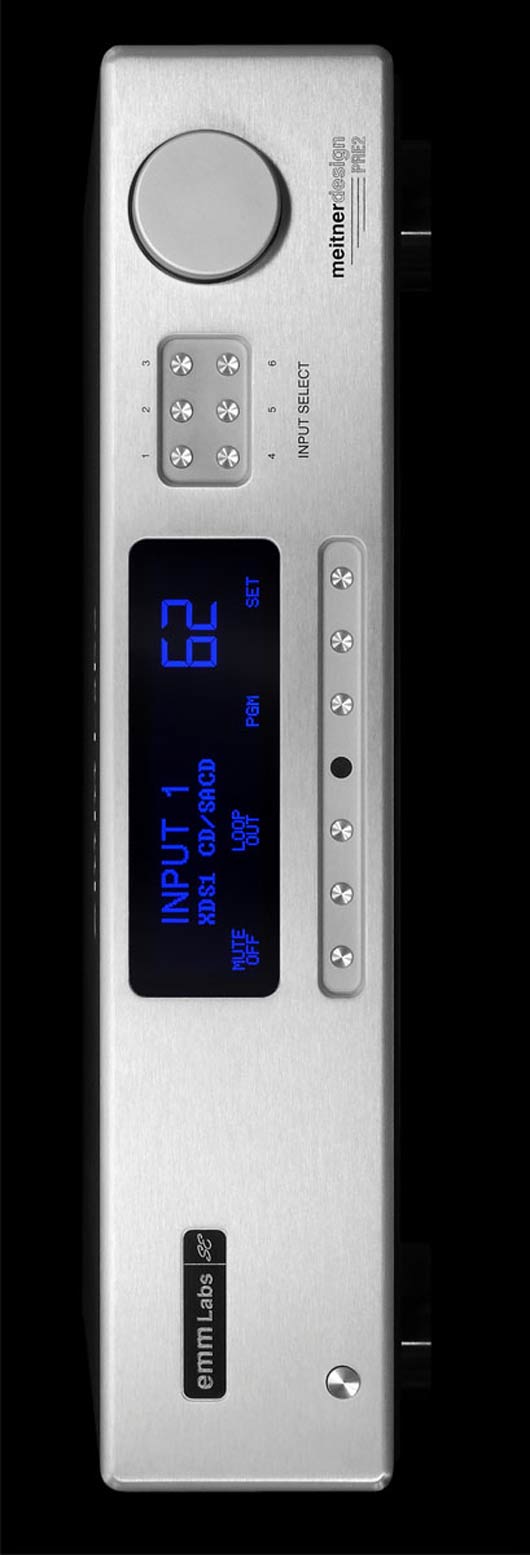
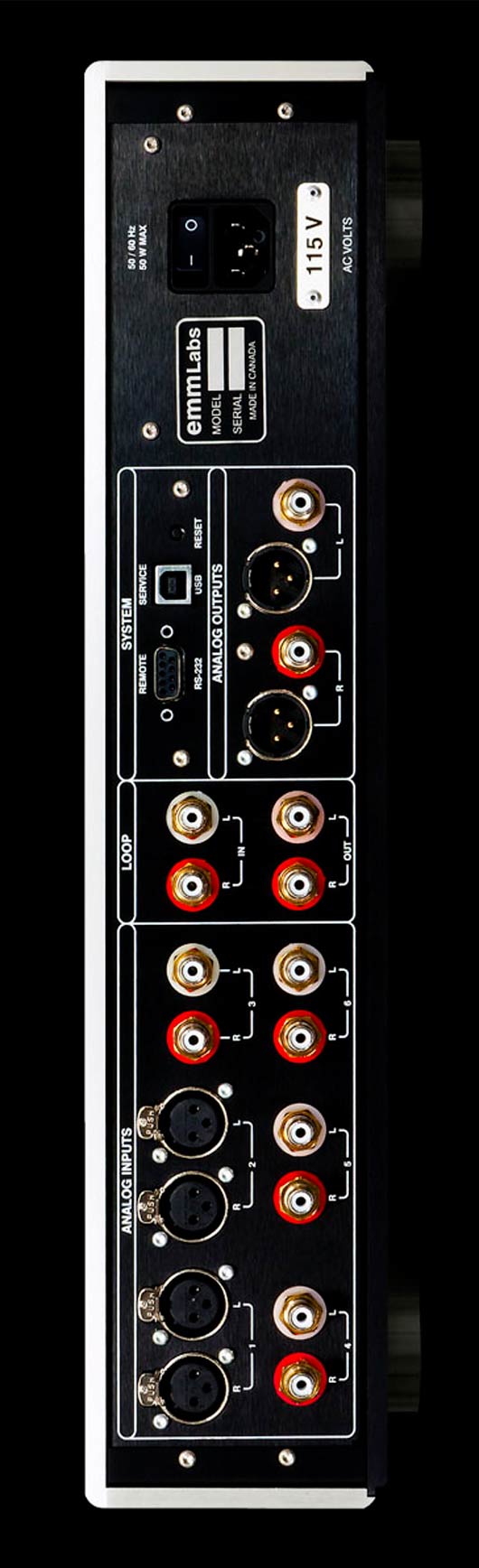
Emm Labs PRE2

[I know this has been out a few months, obviously, but we haven’t posted the specs here yet. So here they are :-). Emm Labs has had the Switchman preamp for awhile, and the preamp inside the DCC2 DAC, which we use here all the time. Obviously, they are kicking it up a notch.]

[… and I quote…]

“The PRE2 embodies our recognition that the analog
preamp at the heart of every music system deserves the
very best treatment because it handles every sound your
system makes.

Built on the heritage of the famous PA6i Meitner preamp,
the PRE2 SE updates Ed Meitner’s classic to take a place
at the forefront of 21st century preamp performance.
Eminent recording and mastering engineer Tom Jung
explains: “Ed Meitner is the only guy on the planet who
has an equally good understanding of both digital and
analog circuitry.”

The PRE2 features six analog inputs, a recording loop,
infrared remote control and, most importantly, stunning
transparency. Due, in no small part, to the op-amp-free
dual-balanced audio path, the extraordinarily sophisticated
contactless switching system, and the (completely
proprietary) volume control system.

The PRE2 also extensively features our aerospace-grade
composite laminate circuit boards. These provide several
performance advantages over conventional boards:

  • Copper traces are microscopically smooth on top and
    bottom, making our boards sound more like discrete
    OFC wiring.
  • Naturally damped sandwich construction offers
    superior strength and vibration resistance.
  • Lower dielectric losses and superior heat conduction
    ensure a more uniform temperature gradient across the
    circuitry, increasing stability and longevity.

All of this makes the PRE2 the most sophisticated
solid-state analog preamp ever created. Use it in your
audio system and you’ll be able to control everything.
Except, of course, your enthusiasm.

KEY FEATURES:

  • Two sets XLR balanced Inputs
  • Four sets RCA un-balanced inputs
  • One set RCA un-balanced Recording Loop
  • Stereo XLR balanced output
  • Stereo RCA un-balanced output
  • 100% contactless dual-balanced discrete audio paths
  • Proprietary software-based analog volume control
  • Exclusive aerospace-grade composite laminate circuit
    boards
  • Precision machined infrared remote control
  • Large display with brightness control
  • Newly designed intuitive control system featuring programmable input naming, settings recall and
    many additional features.
  • RS232 serial port for wired remote control and
    multi-system control.
  • Sculpted, brushed aluminum chassis available in
    silver or black.

Power Supply:

  • Proprietary High-isolation resonant mode power supply for silent, green operation
  • Factory set to 100V or 115V or 230V, 50/60Hz
  • Power consumption: max. 40 W

Specications:

  • S/N ratio: 110dB (A-weighted)
  • THD: 1kHz <0.01%; 20kHz <0.01%
  • Frequency range: 0Hz-100kHz
  • Gain control range: Better than 62dB
  • Maximum output level: +/- 11V p-p (+26 dBu)
  • Maximum input level: +/- 7V p-p (+22 dBu)
  • Input impedance: balanced XLR – 10k,
  • un-balanced RCA – 20k
  • Output impedance: balanced XLR – 300,
  • un-balanced RCA – 150
  • System gain: +6db

Dimensions W x D x H: 435 x 400 x 92mm
Weight: 12kg

CES 2011 Show Report

[Seriously, it is NOT 2011. Time can’t be passing this fast. Last time I checked my watch it was 2002. Oh. Yeah. I don’t have a watch anymore…]

Spintricity is still not going to be ready by CES [for you techies, it requires a port to Rails 3.x and / or a larger / different server, and some database optimizations wouldn’t hurt either]. So…

The RMAF 2010 approach worked pretty well, but there are a lot more new equipment shown at CES than RMAF, and a lot more statement level equipment – and I don’t want to miss any of it.

So the current plan is to visit every room, in the traditional fashion around here. Probably skipping the main conference center – or maybe just peeking in at the new 3D video stuff.

Since I have to visit every room anyway – making sure I do not miss anything interesting – I will go for taking one photo of the entire room for each room, with extra photos taken of things like the open chassis Lamm ML2.2. But the primary focus, like RMAF, is to focus on the more in-depth aspects of the sound of the best / most interesting rooms.

OK.

So… what to do with these photos. I’m bored with the old show report formats here on Audio Federation. I think we did about 14 that way. So I am thinking that I will post the photos here on the blog, one per room perhaps, and have a fancy way, a magnifying glass or something like Amazon, where we can click to see the photo in a larger size than the standard size here on the blog. NOT like Audiogon where they pop up a whole new window with the slightly larger photo that you gave to go and close later.

Thoughts?

Not sure I will say ANYTHING about most rooms. Certainly not the marketing babble that other show reports excrete about every room being the Best Room Ever. And I got some friendly feedback that saying, more or less, ‘I don’t remember hearing anything remarkable here in this room’ was coming across as a wee bit negative. Besides, 200+ rooms is a lot to say things about – and in general we here are only really interested in the handful that really do something special anyway. 🙂

A comment on calling these 'Drug-like' systems

As a side note: It is not just [the better] drugs that do this to us [minus not so nice side-effects], of course, but things like seeing a new born baby [unless you are a pediatrician or something], love making, probably sky diving for the first time :-), and a whole host of things that occur in life [on TV anyway ;-)]. All these are wonderful life experiences that are so powerful that they leave us little room to say anything but ‘wow’. Instead of calling the stereo systems that do this to us ‘drug-like’ sounding systems we could call them ‘sex-like’, or ‘near-death-experience like’, or ‘life-affirming-like’ …

Drug-like Experiences at Shows

We’ll get back to the Drug-like component discussion shortly, but I was writing about our Audio Note room this upcoming CES and got to thinking about whether I could expect people [aka you all] to experience drug-like experiences in the AN room, in which room I expect there to be a very drug-like sound.

i.e.

“Does the ambient stress and presence of strangers and their talking Decrease, or perhaps even Increase, the chances of a Drug-like experience in a room with Drug-like Sound?”

In my observations at shows, the experience can definitely be affected SIGNIFICANTLY by the show itself (this is all just from my point of view. Other people may have other triggers):

Negative Show Vibes:

* Somebody yacking loudly about pricing or other business matters [this tends to activate my practical brain which just loves kill any kind of enjoyable experience for me :-)]

* Somebody commenting about how they “don’t get it” or other downer comments about the sound [this activates my “what is the world coming to” brain. OMG this part of my brain is working overtime these days]

* The exhibitor in the room talking to me about the technical aspects of this and/or that. [this activates my “WTF you talking about?” part of the brain. However… based on numerous comments on Forums about shows, this seems to enable many people to be convinced that what they would hear if the exhibitor was not actually, in fact, talking to them at the time would be great]

Positive Show Vibes:

* Friends and/or acquaintances in the room [perhaps grooving to the tunes, which, in our culture here in the U.S., means they are not getting up and leaving. Since just about every room has a friend or acquaintance for me these days, this is a big advantage. These people make me able to relax a bit and not worry so much about nutcases coming up to me demanding an explanation for why I gave their system last year with the speakers on the floor and their components piled on top of the speaker a less than positive review]

* A well setup system [I like to see that the components were chosen and setup with some attention paid to how it is going to sound. This communicates to me that they care about my musical experience in their room. There is a whole continuum of how well these rooms are setup. (Maybe I should rate rooms ONLY based on this aspect of their system? Acoustic Zen would rate very well. Merlin would do pretty well – unless we rate them for whether they dust their components from year to year :-)). Many high-end systems pay little attention to vibration control or use racks that are much worse than putting things on the floor. In general many choose components from vendors that are inferior to what they are primarily trying to exhibit. This tells me that they are not focused upon providing me a drug-like experience. ]

* Somewhat less detail than I normally insist upon [my ears are raw from listening to many not-very-good systems and the ability to relax to a more laid back sound helps me be receptive to any drug-like sound the system may have.]

No Vibes:

* Room appearance [I have no memory of any room whose appearance affected how receptive I was to a drug-like sound … except… mattresses leaning up against the wall is kind of icky… and the NFS (Not For Sale) room with their light show and 24 hour party and heavy drinking and warm welcome and all makes me have a drug-like experience even when, no PRIMARILY when, they are not playing any music. ;-)]

I’ll try to think of other things that affect whether or not people may have a drug-like experience at a show. It is hard, for me, to have one in my own exhibit room, even after hours surrounded by new and old friends, because I am so worried and stressed at some level about how it sounds and am I forgetting something and what if we did this or that etc.

Audio Note at CES 2011

Somewhat preliminary… but this is very likely what we will be showing (all by Audio Note U.K.):

o AN/E SEC Signature speakers
o Ongaku 211 integrated amplifier
o DAC 5 ‘Fifth Element’ two-box DAC with ‘Fifth Force’ power supply *U.S. debut*
o CDT-5 transport *U.S. debut*
o SOGON and SOOTTO and PALLAS cabling

For all of us who like drug-like sound THIS will be the best room at CES.

Easily.

Just the Ongaku by itself would make this room an odds-on favorite. Just the one-box DAC 5 Signature with the lowly CDT-3 that we heard here would make this a shoo-in [sorry, but I am having fun with all the sports cliches here :-)]. But with the new statement level ‘Fifth Element’ and the statement level CDT-5 … AND the Ongaku? OMFG [ran out of sports cliches… darn! … but couldn’t think of one that communicated what I feel the druggish potential is here].

Announcement: Lamm ML2.2

LAMM INDUSTRIES, INC.

ML2.2 single-ended power amplifier

ML2.2 single-ended power amplifier is a proud successor in a line of the ML2 series (the original ML2 and its replacement, ML2.1) and represents a new generation of single-ended power amplifiers with regulated power supply employing a unique high current low impedance power vacuum tube triodes 6C33C in both output stage and power supply. Implementation of these triodes allowed to create an output transformer with a very low turns ratio and, as a consequence, extended (as compared even to the most advanced modern vacuum tube amplifiers) frequency decade factor, as well as dramatically reduced leakage inductance. Chosen by the Design and Engineering Committee to receive the Innovations Award at the International Consumer Electronics Show in Las Vegas as the most innovative product of the year in the “specialty audio” category, the ML2 was a first single-ended amplifier on the market capable of reproducing a full range of audio frequencies and recreating the original spectral balance and harmonic structure of the recorded material with almost 100% accuracy. The designer’s unique vision and nuanced grasp of audio electronics has created an amplifier capable of capturing the essence of your favorite music like never before.

The ML2.2 proudly continues this tradition. Whereas both – the ML2 and the ML2.1 – were completed products perfectly capable of functioning to the full of their potential without upgrades or modifications, it became the designer’s drive to expand the limits of this topology and introduce some features of the ML3 Signature into the ML2.1 design.

The sonic result is a most seamless fusion of the ML2.1 and ML3 Signature that leaves the listener totally immersed in the music performance as well as pleasantly surprised at the palpable breathing presence of the music material. The ML2.2 is an amplifier that sonically is much closer to the ML3 Signature while pricewise is closer to the ML2.1. The meticulous build quality, high quality of parts and materials along with innovative topology make the ML2.2 a truly prized possession of any music lover.

The output stage with its high-current voltage regulator section grows out of that in the ML2.1 and implements certain changes that relate specifically to the use of most recently introduced parts of higher quality.
In contrast to the output stage, the input stage has been totally redesigned and is based on that of the ML3 Signature amplifier. This innovative front-end topology was incorporated because of specific characteristics of the output tube. It brought about a dramatic step forward in sound quality while keeping the cost within the price category of the ML2.1.

Single-ended tube amplification has the greatest potential of reproducing music with maximum fidelity to live sound. Because of several inherent limitations of the format, most SE tube amplifiers recreate a beautiful midrange but shortchange the low and upper frequencies. The ML2.2 overcomes these limiting factors to reproduce the thrilling sound of live music.

The ML2.2 along with the ML3 Signature are the only single-ended tube amplifiers that reproduce the entire spectrum in the audio frequency range. A midrange to die for supports a superbly natural and extended bass along with exquisite upper frequencies. The amplifier’s innovative circuitry allows one to hear the original spectral balance and harmonic structure of the recorded material without loosing the smallest of detail and nuance.

Another unmatched feature of the ML2.2 is the breathtaking, transparent, three-dimensional soundstage it throws seemingly without boundaries or limitations. The ML2.2 brings you a very natural and engaging sound.

Advanced technical solutions are used in the design of the ML2.2. Custom-made output transformer of very high quality and unique front-end and output stages, plus the sophisticated power supply, free the ML2.2 to drive most real-world-load speakers yielding effortlessly dynamic sound.

In a nutshell, the ML2.2 features the following upgrades and modifications as compared to the ML2.1:

• New power transformer
• Input stage totally redesigned and based on that of the ML3 Signature amplifier.
• Five filter chokes (compared to two in the ML2.1)
• Plate fuse holder located on top of the amplifier’s chassis for greater customer convenience
• Utilization of a much higher quality pc-board, and parts and materials that have become available in recent years
• Introduction of an option to turn the amp on/off remotely

Each ML2.2 is handcrafted of the finest materials and top quality parts like military-grade DALE metal-film resistors, PRC wire-wound resistors, CADDOCK power-film resistors, BOURNS multi-turn potentiometers, CORNELL DUBILIER and UNITED CHEMI-CON electrolytic capacitors, ELECTROCUBE and ROEDERSTEIN film capacitors, HAMMOND chokes, gold-plated NEUTRIC connectors, gold-plated binding posts, and military-grade low-noise long-life vacuum tubes.

The power and output transformers have no mechanical contact with either the transformer cover or the chassis; they’re suspended in a special encapsulant material that almost completely absorbs residual mechanical vibrations. This feature plays a significant role in assuring the unique clarity and micro resolution during sound reproduction.
Two multi-turn trimming potentiometers accessible through special openings in the amplifier’s chassis, along with two sets of test points, allow the user to adjust and measure the nominal value of plate voltage and plate current of the output tube by using an external voltmeter.
In conceiving and executing the overall design of the ML2.2, the goal was to utilize modern technology and processes while recreating a look reminiscent of the long-gone vacuum tube era.

The ML2.2 functions on around-the-world AC line voltages (100/120/220/230/240 V).

U.S. retail: $37,190/pair