Pursuing the Ultimate Music Experiences

Audio Federation High-Fidelity Audio Blog

We got our Audio Asylum YoYo Tweaks…

… a few months ago.

Two bright red AA yoyos

I am not, we are not, good enough yoyo’ers to do much with these guys. The body is too lightweight and the string is too wide and has too much friction.

But, duh, that was before we figured out they were not supposed to be palyed with but were serious tweaks!

Our first clue was discovered after closely examining the other sides of the yoyos:

Two bright red AA yoyos

Rod, the Audio Asylum bored member who signs these yoyos, writes:

“Thanks! Rod”. Yes, really. That’s what they say.

Now, those of you who are of the more intelligent variety of audiophile will have no doubt already noticed that there is an obvious message here about how these yoyos are supposed to be used.

Here, we will examine this closer for those who are a little slower among us:

One hand-signed bright red AA yoyo

Another hand-signed bright red AA yoyo

Now do you see?

No???????!!

OK, then. *sigh* Look at the ‘o’ in Rod. Do you see how one is filled in and the other left open?

Ah, now I see the light bulbs going off!

Exactly!

The round, unfilled donut-like ‘o’ is obviously supposed to be put on top of a transport (just like we all know from way back in the 80s that CDs are really flat yoyos, pressed into service as digital media because so many of them were made and few people could even walk-the-dog with them. Geez, schools really sucked back then, huh?). The yoyo with the filled ‘o’ is obviously the complement of the other yoyo and will go on top of the DAC.

So here are pictures of the tweaks in action.

First, on the Emm Labs CDSD Signature transport:
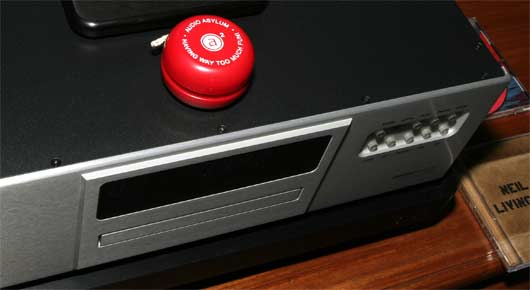
The transport yoyo precisely positioned on the transport

OK, here is a closer view, I want to point out a few things that only became obvious after 100,000s of hours of testing:
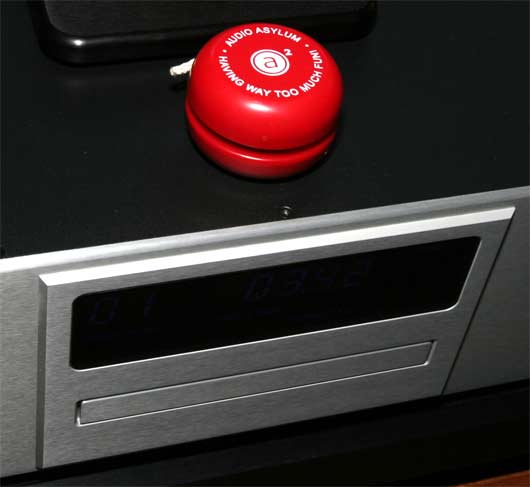
The transport yoyo precisely positioned on the transport

See how the yoyo is PRECISELY positioned such that the text faces EXACTLY toward the front of the transport? This is very important. Otherwise, harsh, ugly, distorted pig ‘oinks’ and grunts appear at random in all discs we played except Pink Floyd’s Animals CD (just like the Teac players do without the yoyo … just kidddddding :-)).

No, for those of you who do not get it yet, the string has no impact at all. Why should it. It is just a string.

When positioned like this, the flatness of the yoyo mimics the flatness of the spinning CD and helps it spin a lot easier, exactly as if the CD was massless.

Now, for a look at the Emm Labs DCC2 Signature DAC:
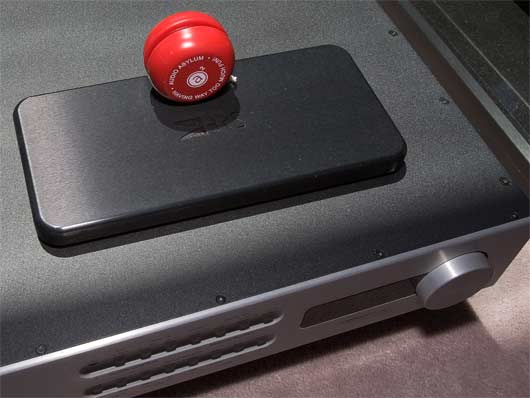
The DAC yoyo precisely positioned on the DAC

You will of course notice how the yoyo is positioned in the classical, ‘Upright DAC YoYo Position’ which has the yoyo face due Magnetic North.

Looking at the setup more from the front, you can see that the angle of the yoyo is slightly tilted:

The DAC yoyo precisely positioned on the DAC

We have found that it is very important for the angle of the top of the text to track the sun as it coasts over head during the day. This may be obviosu to many of you experts, but it took us months to figure this out.

And at night? Yes, it sounds soooo much better when the yoyo continues to track the sun as it winds its way upriver on the other side of the planet.

Luckily, I can just assign the yoyo adjustjing duties to Neli – cause heck if I know where the sun is exaclty in the middle of the night – and luckily our significant others will do anything if you just explain how important it is.

Anyway, sorry if I was a little bit rough on you noobies, but hopefully this will help you utilize the most important tweak since Edison invented electricity.

We spent so much time on this, and no one told us anything about how we were supposed to use these things. It was like a big secret or something. Geez. How are we supposed to get new blood into this hobby if everyone keeps the YoYo tweaks classified?

Now, we can all hope that the Asylum sends out green yoyos, which we hear mate very well with red, next so that we can start stacking them in totem poll like fashion.

!yojnE

;-))))))))))))))))))))))))))))))))))))?

First Blush: Emm Labs CDSD And DC2 Signature Editions

We moved the new Emm Labs transport and DAC upstairs where the old pair sat for just about a year and a half. [They had just spent its first week on the system with the Kharma Mini Exquisite speakers – which are nearly, but not quite, broken in].

I let it settle in some and then played some test CDs.

Swtiching back and forth between the multichannel and 2-channel version of Dark Side of the Moon, it was so obvious that the 2-channel version sounded quite a bit less strident in the midrange, more relaxed, uncompressed, unconfused during complex passages… i.e. it is starting to break in!

In comparison so our previous Emm Labs pair, this pair already had more resolution and a lower noise floor. The combination of these two is serving to increase the transparency even beyond the state-of-the-art industry-leading transparency we had experienced with the older version.

It has been a week since we have been playing it – but it is just starting to relax, which was another major, for me, feature of the Meitner pair: Startling transparency in this casual not-even-trying manner (which derives from, I think, the resolution, especially in the midrange, coming fron naturally formed details, as opposed to the popular lotsa details where notes rise and fall faster than is real).

The trademark purity of tone was immediately apparent from the get-go, after 10 seconds of playing time.

This transparency and purity… it is something no other digital we have heard is able to challenge. Yes, the others may have more detail, or slam, or a rounder sound more able to mate with unforgivning electronics located somewhere else in the system. But if you want a ‘straight wire with gain’ kind of sound… this is it.

But… you… have… to… let… it… break… in.

24 x 7 by, say, 6 weeks or more…

OK?

And break in each path through the player that you are going to use: redbook, SACD, preamp analog output, and analog input if necessary… I am not sure the unit gain output needs breaking in too if you are going to use that. But it can’t hurt…

OK.

One great thing Monster Cable has done for all of us…

There was a letter to the editor in this month’s The Absolute Sound that was a little off center (Nothing new, that. Magazines like bizarre letters – it entertains readers and attracts attention to their magazine… like this Blog entry :-)).

One of the things this letter decried was that there were ads for $K cables in high-end audio magazines and this might turn off newcomers to our little hobby here.

Well, for one, ads do not often list prices – and I am sure most readers not familiar with our little eccentricities would think cables go for around $100 – $500 or so.

Why?

Because in every audio store from here to there a Monster Cable exhibit proudly displays what most people think is the best cable in the world. Monster Cable has worked hard to condition people to accept that they can pay a little more and get a better (Monster) cable. I think there are very few people anymore (outside some audiophile loonie bins) that think lamp cord is the best that can be done these days.

So, see?

That is what they have done for us. Made us all seem a little less weird to normal folk.

Oh, and I like this quote from the letter:

“These people are trying to sell me power cords for hundreds of dollars ”

Yeah. Right. If only.

Most of the TAS letters to the editor, along with responses by the TAS glitterati, are posted on the web.

“Life. Nature’s way of keeping meat fresh”. A quote from tonight’s new Dr. Who. [Shades of Douglas Adams, whut?]

Stereophile's 2006 Home Entertainment Show Audio Federation Discount

Stereophile has graciously offered our readers a $5 off deal on tickets to the HE 2006 show. To save the 5 bucks, go to Home Entertainment 2006 to register and enter the super secret passcode “audiofederation” when you sign up for tickets online.

Photoshop'd super-sized and a little melted HE 2006 logo

While checking out the location of the hotel, it appears to be right next to the airport…

PRO: We will be able to get to the hotel, from the airport, in finite time, i.e. before the show is supposed to be over

CON: The cultural amenities near most airports is necessarily, uh, minimal.

PRO: We will likely be able to locate the hotel just fine, even in the midst of one of the biggest cities in the world

CON: Depending on wind direction, it will either smell of airplane exhaust or we will hear the music only between airliner take offs (Hey! Shades of Alexis Park at CES in Las Vegas, may she rest in peace).

OK, I exaggerate.

I think.

Just being a small town boy, myself, these big cities are both more intimidating and more exciting than they are for many people who are more used to them.

The VTV Small High-end Audio Show

TRELJA did a great show report for the VTV Show last week in New Jersey:

TRELJA almost In New York, 2006

I always like Trelja’s show reports even though after reading them for a number of years I find I disagree with what he hears as often as not (we go to a lot of the same shows) – he at least says what he likes and doesn’t like and tries to explain why.

Anyway, we didn’t make it to this show and we really appreciate reading about what was there and what was not there. Well, we knew Audio Note was there because we carry Audio Note U.K., but really had no idea what else was going on – like the fact that there were about 20 rooms this year. There were about 60 in FSI 2006 in Montreal, about a 100 at RMAF 2005 in Denver, about 200-300 at CES 2006 in Las Vegas, and we expect about 70-80 at HE 2006 in Los Angeles.

Kind of helps to put things in perspective, size wise, by counting the number of hotel rooms occupied by exhibitors at the shows – although Montreal had a lot more stuff on static display (i.e. not plugged in) than is typical of the other shows, which should count towards overall size as well.

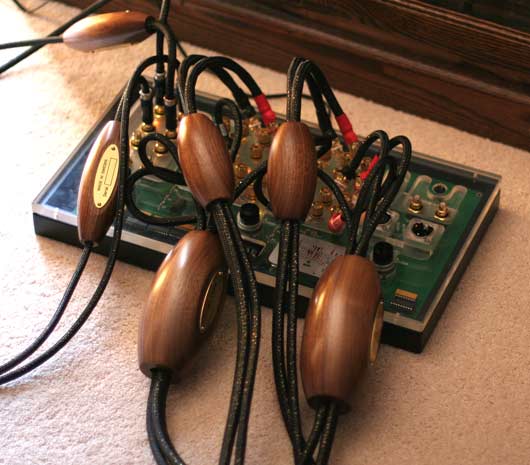
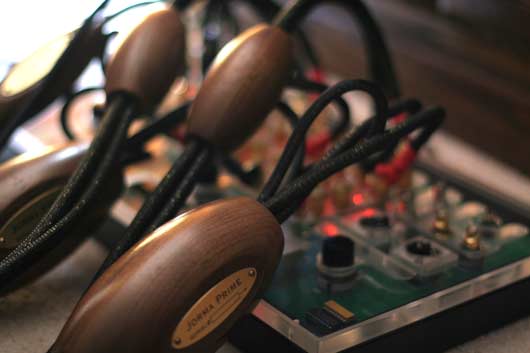
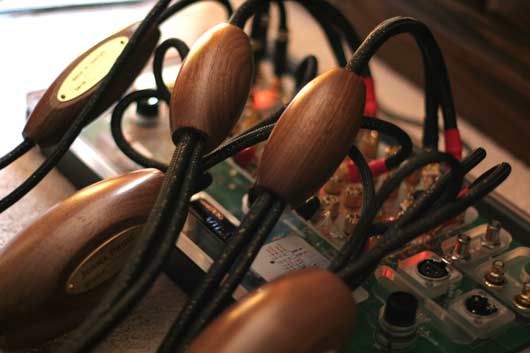
Jorma Design 'Prime' Speaker Cables

She likes it!

Hey Mikey! She likes it!

Uh, yes, Neli likes the speaker cables. Mike likes them too.

After 10 days on the Nordost Vidar cable burner, the caveats I noticed when we first heard these cables, the tiniest bit of midrange leaness and compression, are… gone. As suspected, the cables just weren’t completely broken in yet.

The Jorma Prime cables break new ground in the resolution department. Nordost Valhalla cables are usually considered to have very high resolution. But, well, this is a whole new ballgame. Heck, it is a whole new season.

On the Marten Design Coltrane speakers driven by the Lamm ML2.1 amplifiers, which are very high resolution themselves, what with ceramic drivers and a diamond tweeter, these speaker cables just shine. Shine a light on the music, is what.

OTL-like dynamics. Combined with the wonderful pacing this is just plain fun, happy, wow! to listen to.

Super-subtle voice intonations – where lots of the previously unheard nuances are freed, nuances that communicate more of the emotion and substance and individuality and humanity of the voices and instruments.

Voices? Even on day one the voices were enough to just grab you and throw you down in the nearest seat – or, depending on your personality, make you stand up and drench yourself in it all.

Transparency…

You remember how, the first time you heard a high-end system, you thought “Oh, so that is what was on that CD (or LP) this whole time?!!!”

Deep dish harmonics. Harmonic intent that was previously locked behind a dirty display case is now presented to the listener on a silver.. and gold… platter.

Separation, presence, … resolution.

Reso-f***ing-lution.

These cables were paired with the Marten Design Coltrane Supremes in the Swedish Statement room at CES, with their 2″ diamond midrange and 3/4″ diamond tweeter – No wonder we started hallucinating.

New ballgame? This is a whole new universe to explore.

OK. Whew! So, well, the cables are doing their part. Yep. Let’s just put a nice big check mark in that box….

Next!

The metal facets in the Jorma Prime speaker cables twinkle like streams of magical musical electrons

The Emm Labs 'Meitner' DCC2 Signature and CDSD Signature

DCC2 Signature and CDSD signature and remote on kitchen countertop
The updated Meitner DAC and transport arrived today.

For those of you unfamiliar with the digital equipment from Emm Labs, these are the widely acknowledged current state-of-the-art in CD and SACD players. They are so well-respected among the cognesceti that you can read many places about this component and that component, at every price point imaginable, which are defintiely better than the Meitner. Not because they are better, but because they all wish they were better. It has become ‘The One to Beat’.

Our previous pair, with the gloss finish and the transport with the fancy metal drawer, are headed out the door, so we won’t be able to compare the pre-signature and signature versions side by side… you know, play a CD track on one then the same track on the other – but those types of shootouts don’t tell the whole story anyway.

Besides, the Meitner takes a good month to break-in. A good lonnnnng month.

And this includes playing lots of ordinary everyday redbook CDs and not just SACDs.

Why?

To break-in the upconversion hardware and who knows what else that is unique to the redbook playback hardware. Otherwise redbook CDs sound harsh and bright just like….like the player hadn’t been broken in yet….This is why some people on the net talk about ordinary CDs not sounding as good as SACDs. On our older Meitner it was very hard to tell the difference between redbook and SACDs – usually we had to look at the box or the front of the transport to see which it was. SACDs have a little more detail and resolution, a little more separation. In fact, it is my experience that redbook CDs sound less harsh and less digital when compared to SACD.

DCC2 Signature and remote on kitchen countertop
This also includes using the analog output stage during the entire break-in process.

Why?

Because the Meitner output stage is amazingly pure – but it doesn’t sound amazingly pure until it is broken in. I often feel that people who prefer to use a preamplifier with the Meitner (or Prestige for that matter) either have not broken in the output stage or are looking for a little tube warmth in their overall system configuration – which is fine, but does not have anything to do with the Meitner per se, but the system temperature as a whole.

Of course, before any break in happens we need to plug the things in and find somewhere to put them (or the other way around…). Hopefully we will get that going tonight…

Then we can talk about first impressions – but that is all they will be until we get some solid playing time on these puppies…

There are some pictures, of course, in the meantime 🙂

Emm Labs CDSD Signature CD / SACD Transport

Emm Labs DCC2 Signature DAC

Enjoy!

How to read and understand ludicrous equipment reviews

It has been our experience that most people who claim to not be audiophiles do ‘have ears’, as they say. From all walks of life, all sexes, they all can hear warmth and digititus and detail and everything ‘we’ hear.

So why can’t we say as much about self-declared audiophiles? What’s up with statements like this that appear daily on the net (and, lest we forget, similar nonsense from print magazines)?

    “I found the less expensive Consumer Brand X at a fraction of the price to be indistinguishable from the Megabuck Deluxe”

If one steps back, one can see how ludicrous this is, given the realities of both this being a capitalist economy and the fact that audiophiledom is just not, unfortunately, a playground of the rich and famous. A $20K CD player is not a status symbol – it is bought by people expecting and demanding very high-performance, not a fancy emblem to show off to their friends.

Here is the top ten list of reasons the poster/reviewer might say something like this.

10. An axe to grind with someone associated with Megabuck Deluxe
9. They own Consumer Brand X and want to feel good about it
8. They can’t afford Megabuck Deluxe and do not want to feel bad about it
7. They listen with their mind and their mind tells them that Megabuck Deluxe shouldn’t sound better than Consumer Brand X, so it does not sound better.
6. They listen with their emotions and they like someone associated with Consumer Brand X and so they like the way it sounds.
5. They listen with their emotions and they do not like someone associated with Megabuck Deluxe and so they do not like the way it sounds.
4. They listen from the point of view of the existing marketplace and its internal politics to decide what sounds good or not
3. They desire the popularity that comes from attacking the product at the top
2. The room/system which they are doing the listening with is so unbalanced and/or has insufficient resolution that nothing can be determined about the relative qualities of these two products
1. They quickly compare products that take more than a few minutes to warm up and sound the way they are supposed to
0. They omit the ancillary tweaks that most people likely to own the products will likely be using.
-1. Their ears are not used to the subtle differences of products of this calibur that may take weeks in not longer to explore
-2. They are one of the few who really do not ‘have ears’.
-3. They gain commercial advantage from attacking Megabuck Deluxe and/or promoting Consumer Brand X

Geez, 10 wasn’t enough.

[Personally, I try and give people the benefit of the doubt and assume #2 is the reason they say things like this. And keep saying things like this.].

There are so many reasons for posters and reviewers to post erroreous information, how can anyone believe what they read about how something sounds?

It is certainly a question that has plagued us, both as audiophiles, shocked when we heard both how good and bad things REALLY sound, and later as a dealership and high-end audio show reviewers, as we try to communicate what we hear.

How do we not get drowned out by the sea, nay ocean, of missinterpretations out there about what things do, can and should sound?

Use the ears, Luke!
All we can say is: “Use the ears, Luke!”

Oh, and if you are an audioophile, don’t forget to make sure you calibrate those ears once in awhile using a worthy system, Luke.

The most important component in a system is…

… the loudspeaker / amplifier pair. [OK, yes, this is really the two most important components…:-]

Like Laurel and Hardy. Abbot and Costello. Arnold and his body…

You get this pair right and the supporting cast: sources, preamplifier, cables etc. can be customized to fit individual taste… or used to optimize, highlight, support the amplifier / loudspeaker team.

OK. Fine.

The kicker here is that good teams are hard to find. Really hard.

And without a team such as this, the results are almost always boring at best, distressing at their worst. [Martin and Lewis both went on to make good movies without each other, IMHO, so there are exceptions…:-]

This is why we are so happy, exuberant even, about how well the Lamm ML2.1 amps team up with the Marten Design Coltrane speakers. The EDGE Signature One worked really well, but some people just have to have a tube amp. The high-gain Audio Note Kegons work fantastic, but they work fantastic with everything and they cost $50K. The ML2.1 at $30K are a lot cheaper and have a nice synergy going – unexpected really. I originally poo poo’ed the idea of even trying the two together.

Our Sound Lab Ultimate 1 speakers sound way, WAY better than any U1 speakers that we have ever heard at shows, no matter how many accolades they get from reviewers and show attendees – but I feel we still have not hit upon the great amp for these speakers yet (but we did find great speaker cables for these speakers: the Pranawire Cosmos speaker cable).

Now we have to try lots of amps with the Kharma Mini Exquisite speakers. We expect the ML2.1, which sound so right with the smaller and harder to drive Kharma 3.2 speakers, will work very well on the Minis – but you never know these things until you try them.

That is part of what makes it so hard, finding these super-synergistic amp-speaker teams – each combination has to be tried and tested.

Oh, yeah, one more thing. Something that many, many people seem to ignore, at least the way I read things:

The associated equipment: source, preamplifier and cables, powercords, and rack – cannot suck… or you will never hear if the amp and speakers are performing beautifully.

Even a great team can’t overcome a plot, script and director who just really are not up to the task. Such a team will remain forever in obscurity.