Pursuing the Ultimate Music Experiences

Audio Federation High-Fidelity Audio Blog

RMAF 2013 Show Reporter Cheat Sheet

For those of you who are, you know, actual people, you may interested in seeing the cheat sheets that show reporters use to decide what to say about the sound in a room.

Now, when choosing a description to use from the cheat sheet, and although a pair of dice is acceptable, it is considered, by the reporter cognescenti, to be somewhat gauche and, instead, it is consider much more professional to use a roulette wheel (if in Vegas, else use a simulated wheel from a online game), tea leaves, horoscopes [if you know the date each product was launched], or, for the uber refined members of the fourth estate, smashing ones fingers on the number pad on your keyboard immediately after downing a shot of Herradura.

Cheat sheet for new Show Reporters

1. Sounds great
2. Sounds great
3. Sounds great
4. Sounds great
5. Sounds great
6. Sounds great

Cheat sheet for seasoned Show Reporters

1. Sounds great
2. Sounds awesome
3. Best I’ve ever heard
4. Wanted to stay here for hours
5. Best of show contender
6. Sounded really good
7. Something special
8. Absolutely heavenly
9. Uncanny
10. Magic
11. Lovely
12. Say nothing at all about the sound

Cheat sheet for underground Show Reporters

1. Caused several people to spontaneously fall asleep, causing several head injuries
2. Causes blindness, infertility and occasionally epilepsy
3. Damaged my hearing forever and all I can hear now is the theme to Daniel Boone
4. Female voices sounded just like Elton John’s piano on one of his early albums
5. Now considered to be a class one WMD and all our photos have been seized by the FBI
6. Hand made by 2 year old boy in his sleep using 100 year old rail ties, costs only $10, and f’n blows away all the $M dollar systems the audiofools love

Anyway, hope this helps make reading all those show reports much more fun and entertaining ;-).

BTW our other show report is slowly coming along here:

RMAF 2013 show report

RMAF 2013: Show Report – Our Favorites

[The photos are coming along for the Ultimist RMAF 2013 Show Report . Slowly. Got about half the first day done, several hundred photos but not several thousand – this year we are trying to be a wee bit more slightly sane.]

The show report is back by popular demand. We’ll try for a positive overview of the show – trying not to describe exactly and in excruciating detail why each particular system, most of them in fact, failed to reproduce something that sounds like music – instead focusing on the positives and comparisons.

[But we’ll see what happens in our rejoinder to JV’s report of the rooms with $20+ speakers – a forth-coming post. If his report is totally off-the-wall wrong about most of the rooms then we will just punt until next time. If his report is spot on then we will just do a ‘what he said’ congratulatory post. If, however, his report just mucks up the description of a few rooms, well, we might just feel obliged to write what our impressions were, kind of balancing the books a little and letting people hash out what to think for themselves from the two contradictory impressions.]

There were a lot of rooms this year with that fake, artificial ‘sounds-like-a-stereo’ sound of the 80s and 90s that one could find at most dealerships. Even exhibitors with lots of financial resources [so it seems from the outside, anyway] have taken this approach to system building at this show, and presumably in their showrooms. You know what I mean, right? Kind of a tinka-tinka-tinka decay-free, harmonic-free midrange, often quite compressed, along with a boom-boom-boom bass also harmonics free and often compressed into 35-40Hz. We are really quite taken aback by this development. It seems too prevalent to be ‘accidental’.

We’re going to try something new here, and rate each room’s sound using the Heart/Mind rating system, assigning a number from 0 to 10 to indicate how much the sound was targeting the intellectual / mental mind of the listener (sophisticated, high-resolution sound) and how much the sound was targeting the heart (emotional, involving sound). Hopefully this will communicate more to a person reading this than vapid descriptions of how tight the bass was, for example, on an unknown track in these rooms walled with thin paperboard drum membranes. The ratings are just to give you an idea of the sound and are not really necessarily all that precise [but they should be accurate enough that one should be able to predict the favorites of various reviewers out there based on their quite strong preferences they have shown over the years for one or the other of these types of system sounds].

No ratings will be given for the systems where one or the other rating might be equal to zero as they are apparently appealing to as yet unrated aspect of human desire [oh! oh! Horshack says we should add a rating for Bling! and Style. and Machismo. and Technical Wizardry. Although we should be wary of these as they are all fashion-centric and subject to change as high-end audio fashion changes, unlike the heart- and mind-centric ratings, which should be timeless].

Favorites [heart, mind] (see overviews of these rooms in previous posts):

The EMM Labs / Sony / IsoMike room [8, 8]
The PranaFidelity room [6, 4]
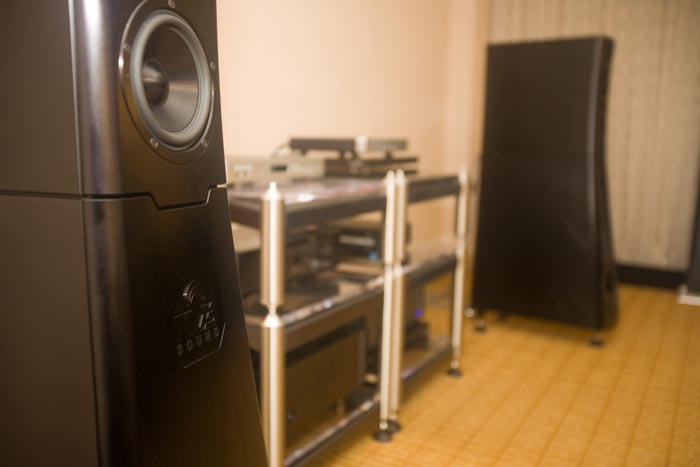
The NVS [modified YG Acoustics, McCormack] room [4, 7]
The Magico S1 / Krell room [4, 5]
The Zu Speakers, Peachtree room [6, 2]

=== Neli’s favorites (but my ratings, for consistency’s sake) ===
The EMM Labs / Sony / IsoMike room [8, 8]
Rockport speaker on Absolare electronics [3, 6]
Tidal speakers and Audio Power Labs [3,7]
Vivid speakers, Luxman amp and Brinkmann turntable [2, 5]
The PranaFidelity room [6, 4]
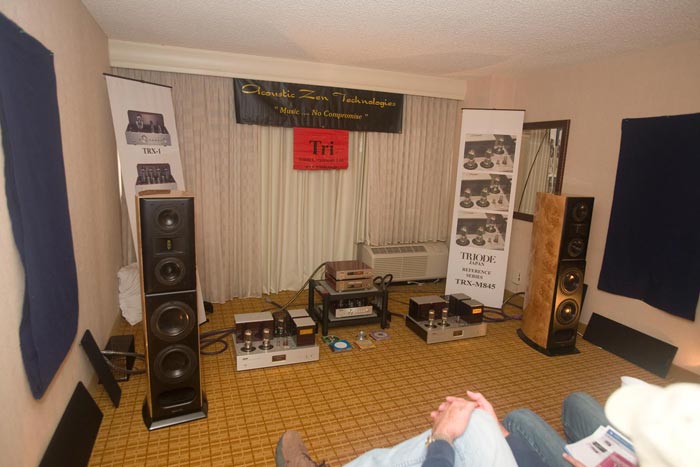

The Acoustic Zen room was good as always, and really belongs in the middle of the list – well, probably second – but it wasn’t quite as good as last year, I think, and so we’ll give the list a rest as Acoustic Zen / Triode Corp has been on the list for the last many, many years… [6, 5]
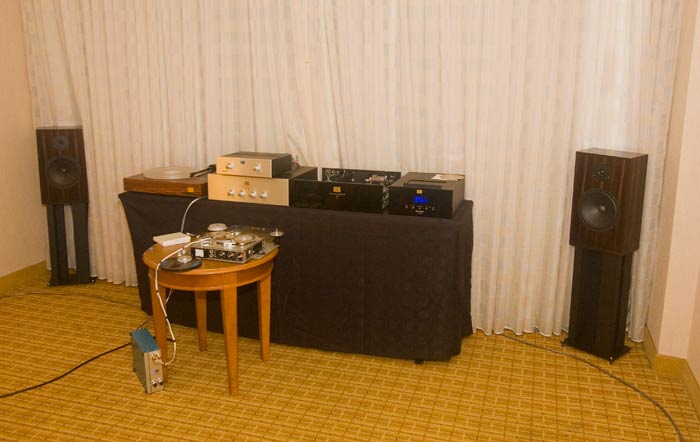

Similarly the Audio Note room had good sound and I spent several hours there enjoying the music – but I just want more bass. Unfortunately putting the speakers deep in the corners where they belong generated too much bass with the paper-mache-like walls. The bigger AN/E speakers really do a better job here – even though my first impressions were to the contrary. So we’re giving the list a break from this room too – or you can mentally tack it on if you want. Not going to stop you. [6, 2]
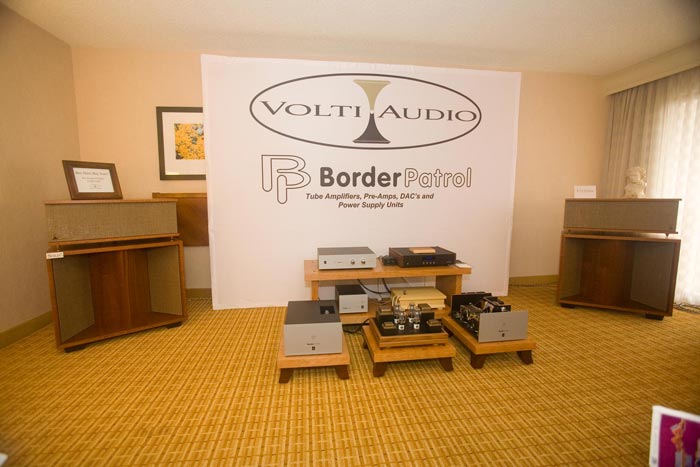

The room with the Vittora [old-fashioned looking horn speaker with the sold sign on it] and Border Patrol electronics did sound pleasant – and would probably be on the list if I had paid just a little more attention. [7, 3]
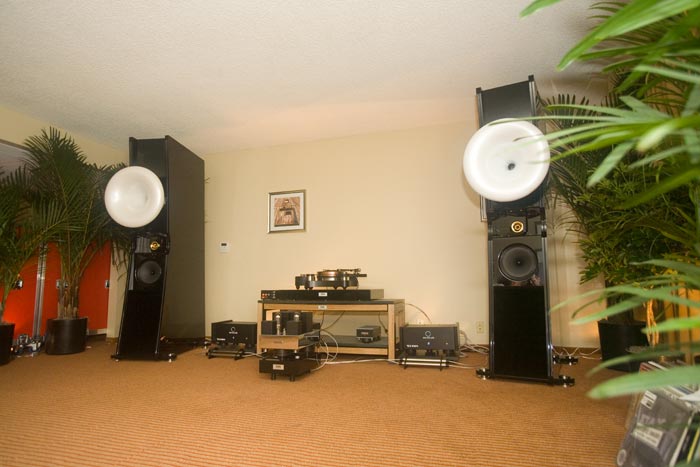

The big Cessaro horns in the High Water Sound room did not seem to have those wonderful dynamics one expects from horn speakers, which put me off the sound here [although our good friend in crime Kevin O. had one of his most wonderfully emotional listening experiences of the last few years here on Sunday]. [6, 2]

Now for some of Neli’s favorites. She often enjoys a more polite, sophisticated sound than I do – and in general a more mind-centric sound whereas I prefer a more balanced mind- and heart-centric sound [although I do enjoy over-the-top unbalanced mind- and over the top unbalanced extreme heart-centric sounds as well].
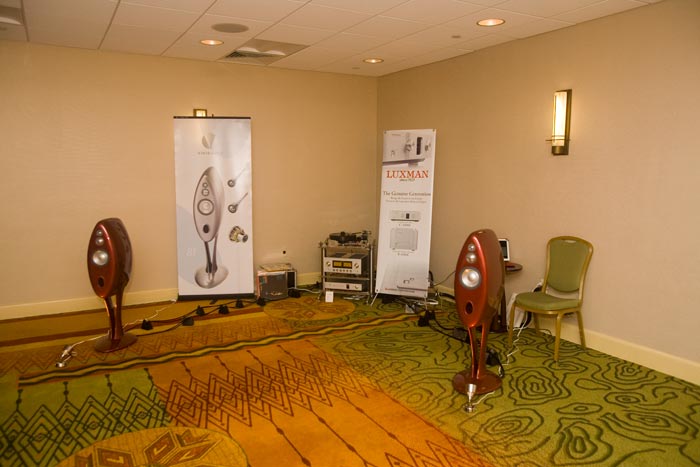

Neli liked the Brinkmann turntable, Luxman amp and Vivid speakers room. [2, 5]
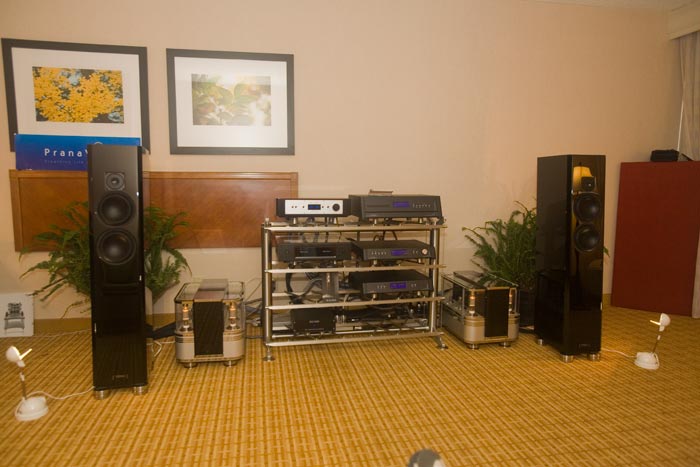

Neli also liked the Tidal speakers and Audio Power Labs amp room. [3, 7]
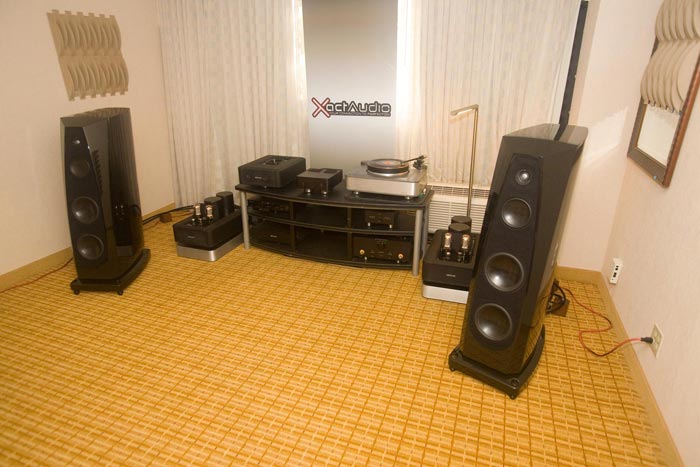

Neli liked the Rockport speaker on Absolare electronics room, too – [I do think it sounded better here than in their room at THE Show at CES 2013 – this sound being a little tighter and deft sounding – and in a much smaller room!]. [3, 6]
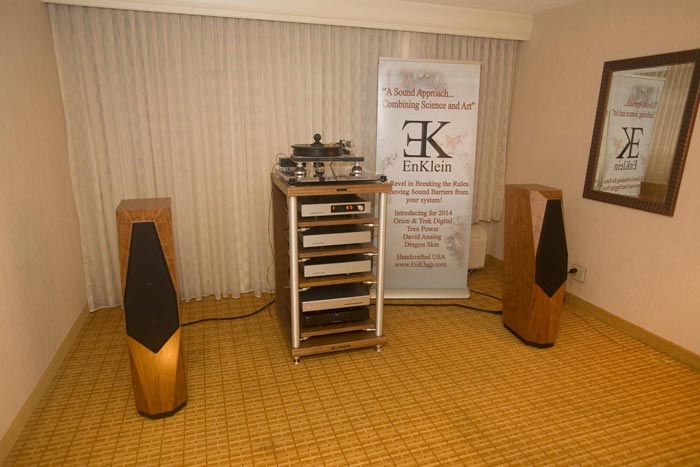

There were fewer attempts at the upper reaches of the high-end this year at RMAF. The big Magico speakers weren’t here. The big YG Acoustics speakers were being driven by a modest amp and front-end. Kharma hasn’t been here for years. Acapella wasn’t here. Avalon just brought Eidolons [or Eidolon-ish-sized speakers] but they were also driven by a modest front-end.

The rooms at the Hyatt, including the Scaena speaker, Vapor speaker, and Wilson speaker rooms, although attempting to reach the higher reaches of the high-end, were not in my top … 20 [or 30?].
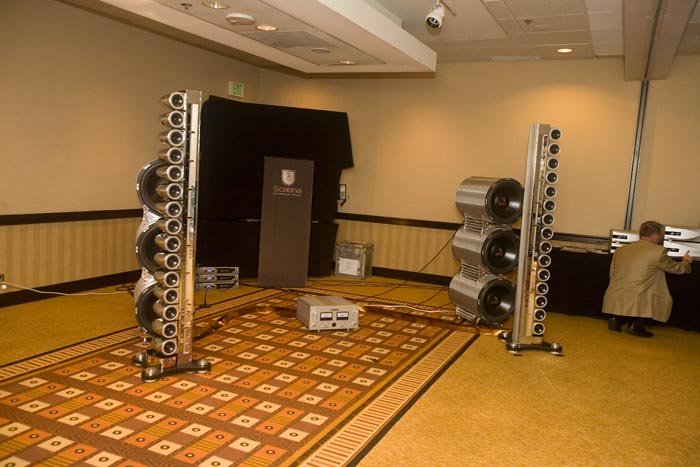

Scaena speakers and Audio Research amplifier
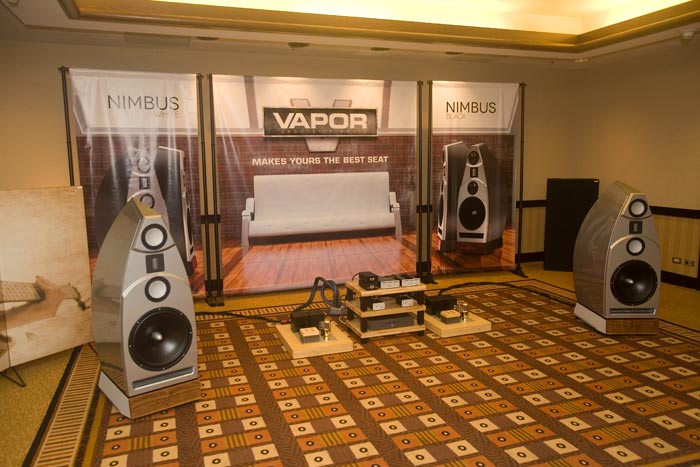
Vapor Nimbus speakers
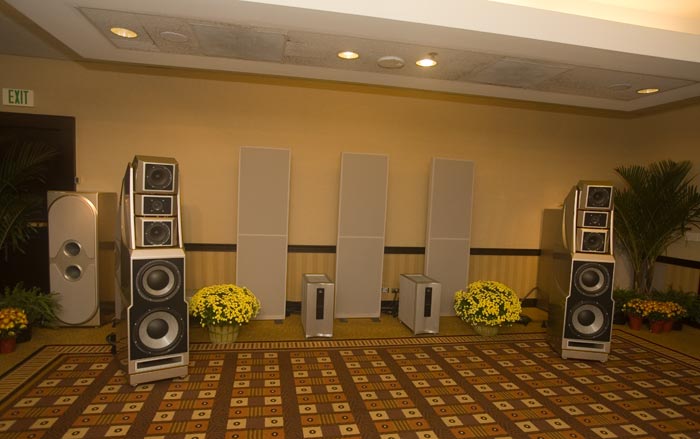
Wilson Alexandria XLF speakers on VTL Siegfried amplifiers
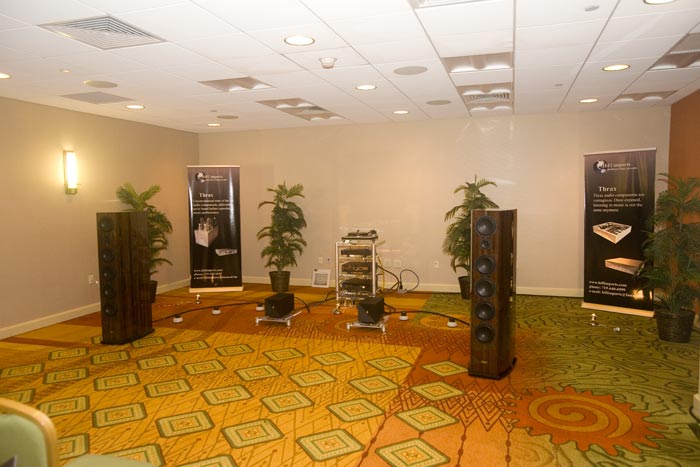

I didn’t get to hear the big Venture speaker system being driven by their analog rig [doh!] – and the sound with the digital source is too digital for me.

Nola brought really quite small speakers for their quite large room. Same with MBL.
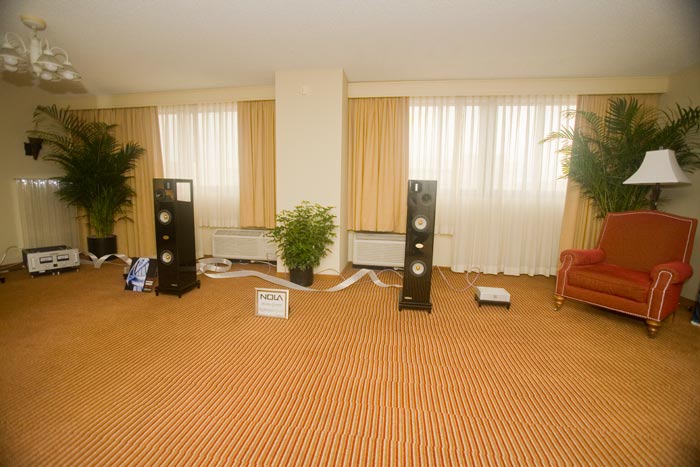

Smaller NOLA speakers on Audio Research amps and Nordost Odin cables in a very large room. [2,4]
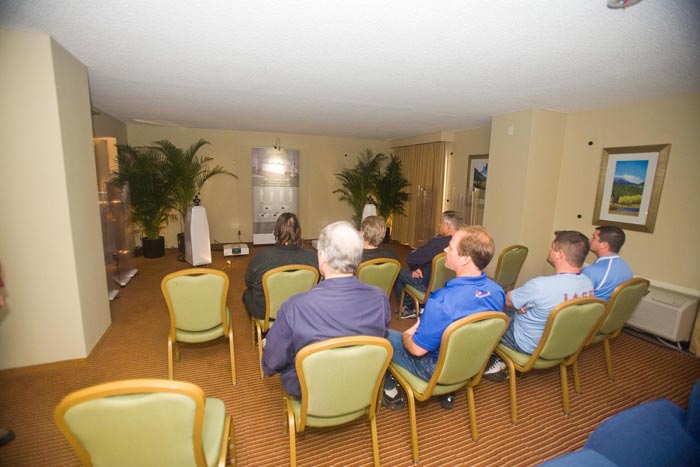

The MBL room with smaller MBL speakers in a very large room [5,3]
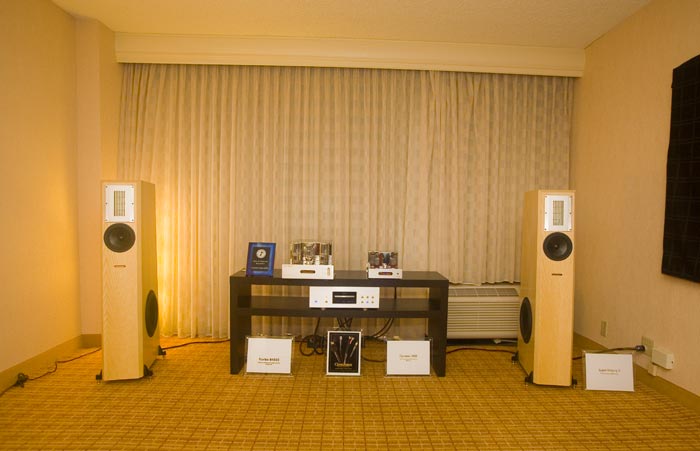

Coincident’s room sounded good this year: dynamic and clear sounding, decent separation [4, 5]. I listen closely to this room every show – but this year they were noticeably one of the better rooms.

Let’s see. There were more unlistenable systems here than at the last few RMAFs. Perhaps it helps to get away from shows a little bit, as we have lately, to be able to put the relative historical quality of things into perspective.

Mainstays like Merlin were not here. Didn’t see Revel either [though JBL / Levinson was here]. The Esoteric room was not here, although various instances of their gear was. Evolution Audio was not here. Occasional exhibitors like Avantgarde and Quad weren’t here. As for high-end analog sources: the Walker turntable wasn’t here. The Continuum turntable wasn’t here. The big Clearaudio turntable wasn’t here.

Rooms, in general, weren’t as loud this year as they usually are. A good thing, I think.

We did enjoy this show way more than we thought we would. Before the show it was like UGH! another show. We have shown at the first 7 or 8 and attended all of them and this is getting old. But we really enjoyed seeing all our friends and tuning up our ears – hearing just what can go wrong is unfortunately as important as hearing wonderful technological leaps into the future of music reproduction – all of which so far share a common approach: herding inherently lazy electrons to modulate magnetic fields in order to vibrate various kinds of very thin membranes [taking poetic licence and excluding the two plasma tweeters at the show, of course :-)]
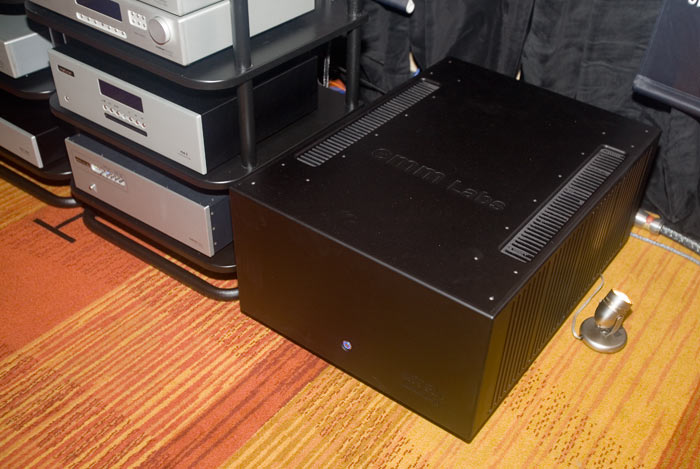

The big hit, for us, were the EMMLabs MTRX amps in the IsoMike room. Think thick, fresh, juicy icing on a slightly stale cake of a show with lots of friends around who are just as crazy as you are. That was this show.

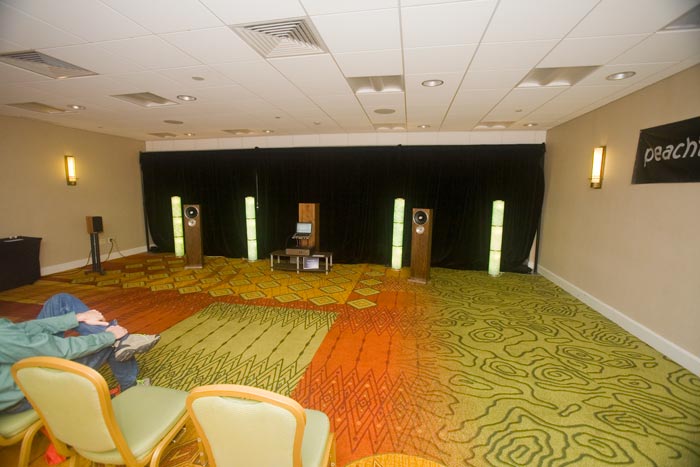
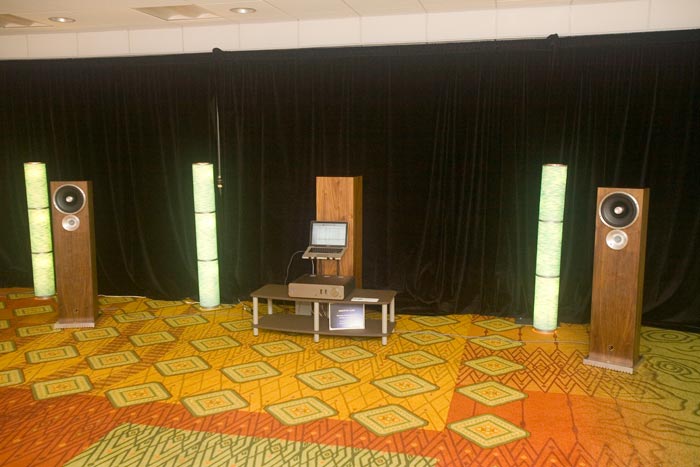
RMAF 2013: Peachtree and Zu Audio


This is another inexpensive system, like the PranaFidelity system, but where that system had few faults, and filled a small room with wonderful music, just lacking the ultimate spit and polish of the higher end, this system had plenty of faults, but was fun, exuberant, and filled up a very, very large room with music.

I think, in the end, they pushed this system too far – it was loud in a space where few systems have ever been able to fill with music. It was even more or less effortless, except where it was not: those predictable places where the music crested in a complex manner, or there was a sudden amount of energy.

But this was wake-your-dorm-up, play-frisbee-in-the-park-to-the-dead loud – the way you want to play your system when the mood and the beat and the fever strikes just right [which may be everyday when you are younger and not quite so often as that as you get older. Well, unless you are neli :-)]. When those difficult to render energy peaks arrived, the music degraded in a predictable and not overly harsh manner – and there was never any sense that something might ‘blow up’; it was all done with a relative feeling of aplomb.

Make no mistake, this was not your traditional high-end audiophile-grade hi-fi. There were issues. But this was a system to play music on, to enjoy music on, and to rock out when the occasion demands it – and it wasn’t stupidly expensive [well, not too outrageous anyway. The speakers are the $5200 Druid Mk. V. and $4K Submission subwoofer].

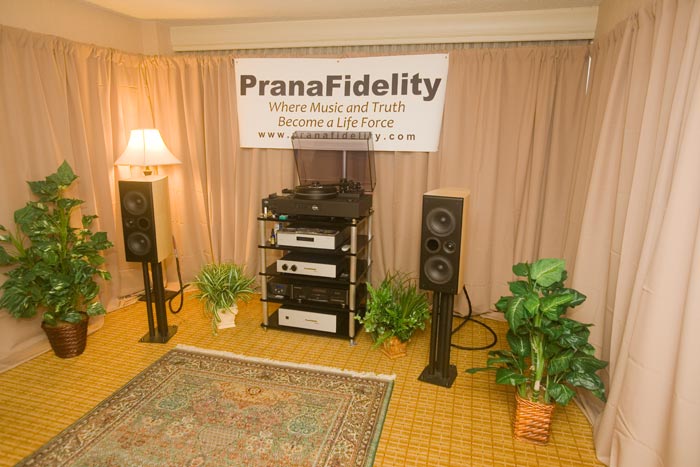
RMAF 2013: PranaFidelity

We talked a long time ago about the path from silence to a perfect reproduction. Every point along the path has no bad behavior, the sound is imperfect only in that it lacks the ultimate resolution, bass response, and dynamics that the Real Thing requires. Everything off the path has nasty side-effects; the further from the ‘path’ the component lies, the worse the side-effects.

The sound in this room with the modestly priced $3950 PranaFidelity Fifty90 speakers was spot on The Path.

The sound in this room, these speakers, are only lacking those things that more money, a LOT more money, would provide. But all too often, in fact the vast majority of the time, those extra funds would bring along with several improvments the misery of unpleasant side-effects: a muddiness in the midrange or bass at soft volumes, perhaps, or a sharpness in the treble, or a myriad world of other audiophile speaker gotchas.

These do everything AOK, at ungodly SPLs [well, me, I rarely listen this loud], in terms of just presenting listenable and enjoyable music. Not too sweet, not too raw, not too warm, not too cold… these are Goldilocks speakers.

With a little gold trim, or mahogany inlay, these speakers could easily go for $10K, or $20K in today’s marketplace. And this is what I personally recommend that they do – so you might want to get your way-under-priced Fifty90s before then. Just sayin’.

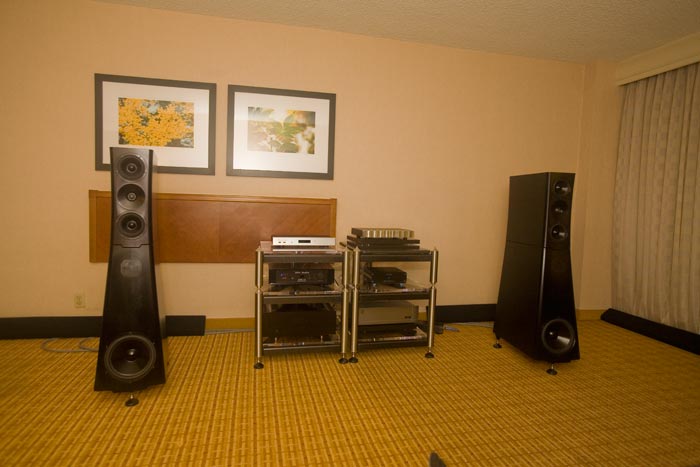
RMAF 2013: NVS Sound, YG Acoustics, McCormack

NVS Sound makes cables.

They are also working with YG Acoustics to make a custom version of the YG Acoustics speaker. The modification I remember is the addition of silver binding posts, but there are others.
[neli]: Along with the binding posts, NVS re-wires the loudspeakers with their own internal cabling, paying an extreme amount of attention to the wiring connections. They also change the spikes.

They are also working with Steve McCormack to customize a McCormack amplifier for use with the NVS Sound-modified YG Acoustics speaker.

Both the speaker and amp were prototypes and under development.

The Notes

This is all of interest because the notes generated by this system were quite good and quite an advance for solid-state, in my opinion.

The attack was decent.

The peak was a bit flattened [I think this was a 160 watt amp. More power is required apparently].

The end of the note was the most surprising. The part after the maximum peak is reached but before the decay starts. It was rounded and controlled, ending like real notes end. This was shocking for a solid-state amp and seriously unbelievable on the supremely hard-to-drive YG Acoustics speakers.

And the decay? It was average.

So, two points:

1. This system drove the modded YG Acoustics better than any system I have heard them with, and

2. The note formation was better than I think I have ever heard from a solid-state amp

But there were also severe problems as well. When I got to play something familiar: Comfortably Numb – there were occasionally some issues with various resonance frequencies somewhere in the chain – creating way, way too much energy. There was also confusion during complex passages [not too many in that song, but some].

So as a finished product this failed. But as a research project this kicked ass.

Not sure exactly where the innovation is. I know a lot of people are fanatical about of Steve McCormack gear – but we did a shootout several years ago with a $10K Edge NL10 and the Edge was much better in every way except bass slam. So we are much more cautious in our assessment where the innovation is here – maybe it is the cables, which have been getting rave reviews in Japan. Who knows – but something was definitely happening that I hope gets developed further.

RMAF 2013: EMM Labs MTRX amplifier


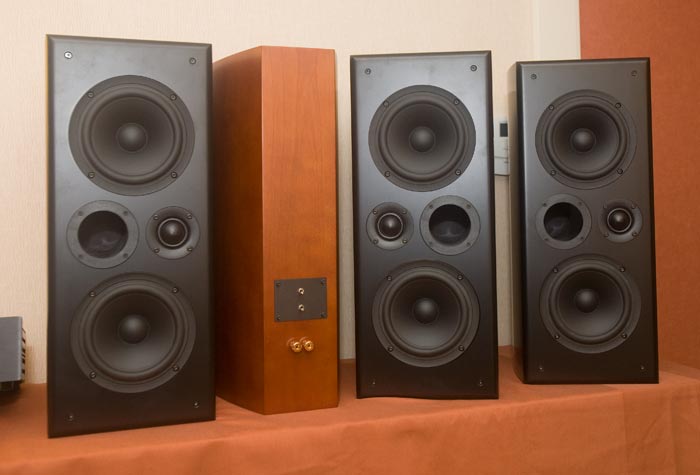
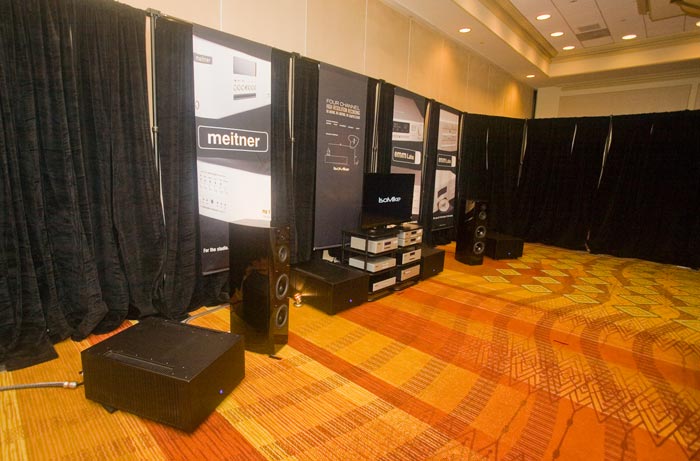
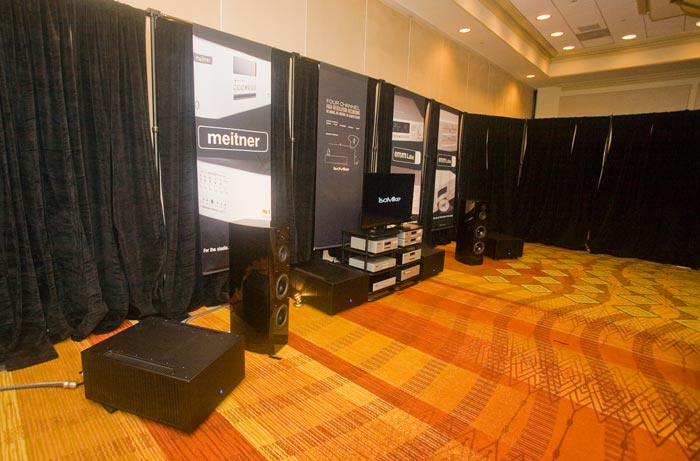
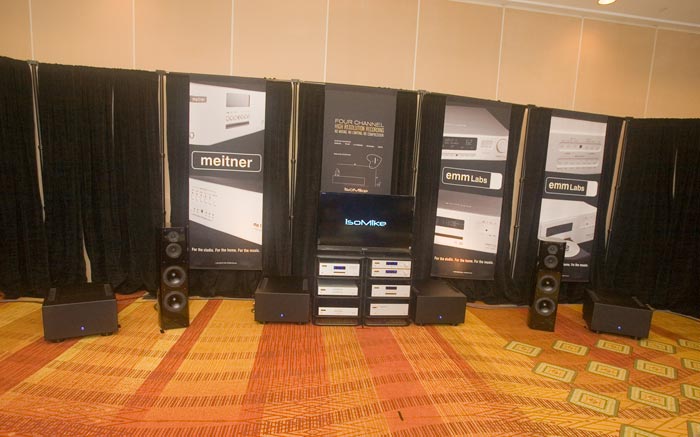
Prototype EMMLabs MTRX amplifier on Sony speakers with EMMLabs digital and Pre2 preamp, and Kimber cables.

The 1500 watt $100K Emm Labs MTRX amplifiers in the EMM Labs, Sony, Kimber, IsoMike room

In many ways this was the perfect way to introduce an amplifier at a show.

We have all, all of us show goers, heard this same system, with the Pass Lab amps, many times over the last several years. We all know what this system sounds like. It is shown at CES and RMAF each year.

Oh, there have been minor changes: A little more musical when the EmmLabs PRE2 was inserted in the system. Then a bigger dose of musicality when the final version of the PRE2 was inserted in the system at CES a few years ago.

So most people who actually listen to the sound in the rooms at these shows had a pretty good idea of what to expect when they walked into the room this year. An EMM Labs amp inserted into the system? Probably going to be somewhat more musical / music-like.

And there was a definite increase in the EMM Labs sonic signature – that purity of tone – which is found in all their digital gear and their preamp.

But….

That was relatively minor compared to the difference in openness, in ease, in the way the notes could just hang there in space. It didn’t seem to control the speakers with an iron fist the same way the best tube amps do – but it didn’t just smack the drivers around with power like a lot of the big solid-state and big tube amps do, either.

[neli]: One of the room co-exhibitors described the effect of the amp on the speakers as “cheerful obedience”. I love this description.

Obviously we are still trying to figure out just what these amps do. And these particular amps are just prototypes – the finished products are supposed to be lighter, around 200+ pounds [yay!], smaller, and in a finish similar to their other gear… and are supposed to sound as good or better [we have already expressed our personal desire that this be so – several times now :-).]


Prototype EMMLabs MTRX amplifier on Sony speakers with EMMLabs digital and Pre2 preamp

But…

A few anecdotes.

1. I heard this system for the second time right after we walked back from the Wilson Alexandria XLF / VTL / dCS / Transparent demo at the Hyatt. Somehow this all-solid-state system sounded warmer and more involving [and timbrely correct and much more stable imaging for that matter] than the tube-based system at that demo. It was not a close thing. [VTL already hates me, but to their defense, there were many contributors to the overall sound at the Wilson demo, although you can rule out the speakers – we know the speakers well enough and they are in-general more musical and involving than the Sony speakers in this EMM Labs room]

[neli]: this was really not subtle. Made me want to hear these electronics with the XLFs. Much more involving. Much more dexterous. Real sense of effortlessness and ease. Proper timbre. Good harmonic response. Very clean, but not too lean.

2. They play the IsoMike-recorded music in this room. It is usually fairly calm stuff. But against this background of calm easy to listen to music was a more complex arrangement where lots of instruments were playing at once. There was quite some confusion and collapsing of the soundstage during this passage and it was readily obvious that it was the speakers were having a problem with this passage. The amps were so able to handle issues like this that the sound was not horrible or anything – it just casually revealed a flaw in the speakers against the background of the flawlessness rendering of everything else.

Ugh. Not sure that was clear. The point is how casual this all was. Often speakers and amps fight at times like these [in fact, many speaker-amp couples fight almost all the time 🙂 … the amp struggling to make the speaker do what it wants it to, and the speaker struggling to show that Newtons 1st law, 3rd law, all 3 laws in fact but lets just say ‘inertia’, are the law of the land. This fighting is actually audible, unfortunately]. The Sony speaker was not able to put up much of a fight against the MTRX – presumably due to the overwhelming force of 1500 watts and whatever else they are doing in those giant boxes – and this lack of fighting was a sonic relief for the listener.

3. It is rare to hear such a clear difference like this. Everybody could hear a difference – not just experienced listeners. Between the Pass Labs and the Emm Labs amps. We often heard these kinds of improvements between the Walker turntable and other turntables [the Walker has issues, like many turntables, and many small manufacturers, but excellence of playback is not one of them] and we used this fact to quantitatively determine that the Walker was more than a little better than the competition. If we extend this argument to amps, one has to conclude that these amps are significantly better than the Pass Labs, and by extension [by years of hearing Pass Labs compared to other amps] most other amps as well.

You all know we are as demanding of solid-state amps as we are of tube amps. The early Edge amps had a sophisticated mind-centric sound [like Ayre, Goldmund, MBL] with few bad side-effects and with enough inner detail / micro-dynamics to convey a sense of emotion [i.e. have some amount of heart-centric capabilities]. The big old $125K [back when $125K amps were unheard of] Edge NL Reference [pyramids] did most of this and with 800 watts it had some of the ease with speakers we see in the EMMLabs MTRX amps. These amps are acceptable [we don’t hate them] but they do not do half the things that the music demands, things that many tube amps are able to do.

Most other solid-state amps are just giant show pieces, or technical tour-de-forces, or just plain electronic hammers to beat speakers [and ears] over the head with [guess that metaphor ran out of steam there]. Nothing wrong with these other types of amps – they are just another way to have fun, after all.


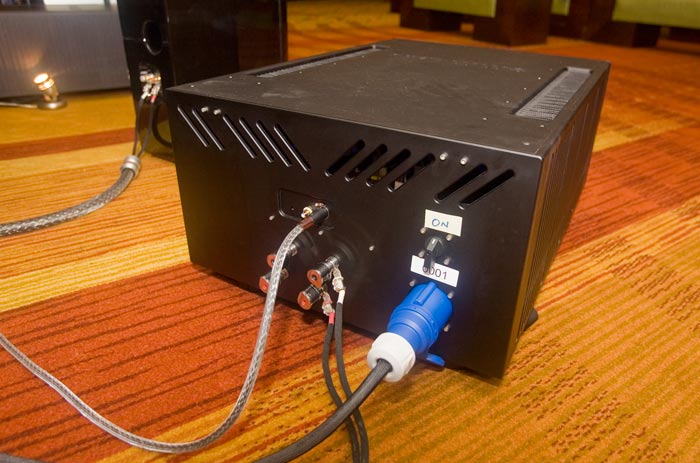
Prototype EMMLabs MTRX amplifier rear

So where does the MTRX fit in?

Right now I think the MTRX is fairly balanced in terms of heart- and mind-centric capabilities. We don’t know if this new MTRX amp is just an amp at the top of the solid-state amp category – or something new. But in either case, it is welcome – and should be welcomed by everyone who assigns a high value to their system actually sounding like music. [Or if you happen to really like giant show pieces. Or if you like technical tour-de-forces. But not so much the electronic hammer thing :-)].

We have anticipated these amps for years, expecting some kind of nice, tuneful amps that don’t suck and which can replace the hole left by the increasingly problematic / then sold / then dealerless / finally defunct / now not-defunct Edge Electronics amps we used to carry.

But these MTRX amps – they are more than just worthy replacements for state-of-the-art solid-state amplifiers. They are an advancement of the art. They are one of the few components out there that will generate newer, better kinds of results – not just a different flavor – on our over-worked playback systems. They will be used to explore the frontier of just how good can things get, to hear just how good things can really sound.

Or, [lightening up a bit here :-)], they are just a new really fun toy to play with that will take us places we haven’t been before.

RMAF 2013: Magico S1 and Krell

[I hear that JV has his show report up, so I better get a move on here. I write my impressions before I read anybody else’s impressions; otherwise, if I see an impression with which I happen to agree, then I just lose momentum and incentive to write anything at all. ].

First, I am partial to the Magico S1 speaker. In fact, I like all the Magico speakers [don’t listen to Alon, he doesn’t understand me :-)], I just think the systems they usually show them with are deeply flawed. I liked the S5 speakers on the Luxman amps. And we have both liked what we have heard of the S1 speaker.

The S1 is well-priced, and is capable of good timbre and reasonable dynamics, is not incredibly difficult to drive [apparently], and is able to handle complex material.

And I liked this modest Krell system.

I heard well-rounded, well-separated notes with a good, accurate timbre. Fairly dynamic. Fairly open sounding.

At this show, this year, a sound like this is a home run.

Given the relatively low price of both the S1 and Krell gear and the strength of the brands, this is a system that I hope lots of audiophiles paid attention to.

About these RMAF 2013 show reports…


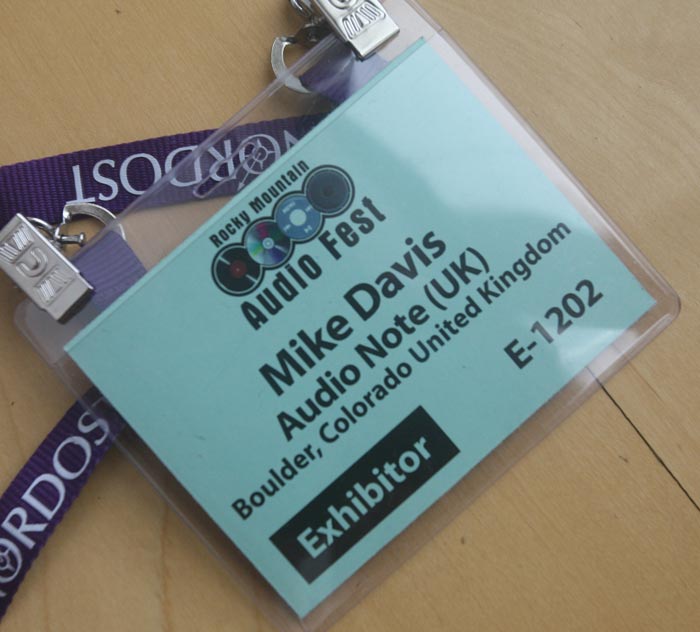
My badge for the show. Was kind of incognito. Nice.

Well folks, it looks like we are going to do two show reports.

The show report on Ultimist will have all the photos [about a 1000], and we’ll talk about everything but the sound. A lot of fun things happen at a show. Many things that are really not at all related to the process of listening closely and determining the quality of the reproduction of the music being played.

The show report here on the blog will talk about the sound, focusing mainly on the rooms that we liked. It will be relatively short. There wasn’t much that was really high-end, or even pretended to be really high-end.

In fact, a lot of it was old-school, and sounded like early 90’s stereo systems. We just hope people went to other rooms besides these and heard how there have been advances in the last decades – mostly in not sounding not quite so fake and artificial.

We will also talk here about the industry and various trends.

Heck, might as well talk about them now since I am thinking about it now and who knows where the brain will stash this stuff over the next few days as we move away from ‘Show’ mode and on to normal life.

Trends

Predatory dealers – These are dealers that exhibit at shows far away from their store, attempting to steal audiophiles away from the local dealerships. There just used to be one or two, and now there are at least 5 or so. Manufacturers are increasingly looking the other way when it comes to geographical restrictions. It is a free-for-all out there, but luckily for us, we are pretty safe being one of the very few who actually care about what things actually, you know, sound like. Most dealers are just box pushers and having remote dealers come into their territory at shows like this is going to cause one heck of a fuss.

Pricing is getting weird – hard to put my finger on exactly what is going on, but I am frequently shocked at how much or how little various pieces of gear are being priced at. This is not sticker shock but audaciousness. Again, at both the high and low ends. It is like target marketing segment and/or target demographics determine prices now, not performance and the relative price of competing gear.

CD Players are disappearing – I’ll have to double check the photos, but there is the requisite turntable for rooms who care about sound, and a laptop / music server for those who care about selection and convenience, and sometimes, sometimes a CD player for those rooms that are willing to play people’s CDs they bring to the show.

Old fashioned bad sound – For those that just include a laptop and some of the more mainstream gear, it seems really easy to create a sound that is reminiscent of early 80s sound. Bright. Tinny. Artificial transients. Incorrect Timbre. It really was shocking how far the sound in some rooms has regressed.

Far fewer show goers this year – and I, for one [not being an exhibitor this year], liked it. Calmer. More focused listening. More couples. Fewer young people unfortunately. Most rooms had people in them most of the time [as subjectively calculated from my traversal of all the rooms] as opposed to the other extreme in previous years where the hallways and a few rooms, lemming fashion, would be quite crowded and some rooms would be completely empty. Why is this? Brand name penetration dilution due to the internet being a more level playing ground than magazine advertisements? Smarter audiophiles willing to look beyond the major brands? Audiophiles who had already heard the major brands at local dealers and want to see what else is out there? More fit audiophiles who are willing to walk a ways to see what else is happening? [I do think people are more fit this year, now that I think about it].

Fewer photographers / reporters – I saw Albert Porter [thanks Albert! He loaned me a memory card the first day] taking official photos for the show. And maybe one other photographer who looked serious [he seemed to be taking as many photos as I was. Although this year, I myself was keeping a handle on things]. I saw Mike Fremer, JA, Clement Perry, Larry Borden, Constantine Soo and JV, but few other reporters. Usually they are all over the place, and every other person I look at their badge and see they are from Positive Feedback, Enjoy the Music etc.

Lots of new / unknown gear out there – I see this all the time on the front page of Ultimist. New brand after new brand goes by. Some top gear. Some affordable gear. Some imported, some domestic. This year’s show had a number of new brands showing their stuff. This is a golden age for high-end audio – too bad the economy isn’t better.

We can’t think of too many more trends. Continuing reduction in of the major manufacturers [which gives the show a more homey, down-home feel, which I like. But fewer attempts are exceptional sound, unfortunately]. Perhaps a few more importers than last year. Neli mentioned that there was more heterogeneity / diversity of gear: very few brands had gear in more than two rooms.

OK. This is long enough.

RMAF 2013 Day 3 highlights

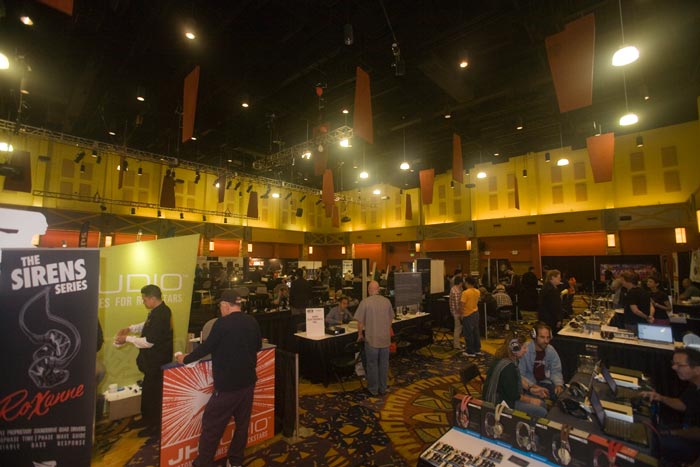
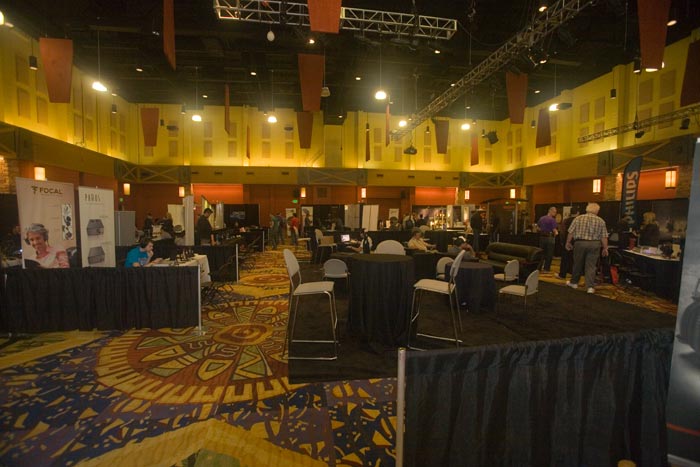
Day 3 is a shorter day, ending at 4:00 pm and after I took photos of the CanJam headphone area I wandered around some.


CanJam from the main entry door


CanJam: the middle aisle.

On the way to the show everyday driving in takes about an hour, and we would listen to music on the Jazz station (KUVO) and Classical station (KVOD), pre-packaged shows on (KUNC), and our local anything goes local station (KGNU). It was fund-raising time so we switched stations a lot.

And we realized that we hardly heard any of this kind of music at a show. And if they weren’t playing music that people usually listen to in the Real World ™, just what were they playing?

So I did a survey. Did not make it through the whole show, unfortunately, but here are some preliminary statistics.

20% were playing quiet classical music and opera (Some rooms were playing classical that was heavy on the organ to show off their bass capabilities – so this may count more as ‘traditional audiophile music’)

56% were playing traditional audiophile music. Soft rock. Female vocals. Often overly peppered with weird percussion noises.

6% were not playing music [not counting those that were ‘between songs’. I just hung out in these room until I could hear what they were going to play next]

6% Alternative rock, classic rock, modern pop

12% Jazz (about half of which was aggressive ‘straight ahead’ jazz, the other half easy to reproduce 4 or less piece jazz)

On the radio we usually listen to difficult classical [up-beat marches, Stravinsky, etc] as well as medium classical [like Beethoven, Brahms, etc], and quiet classical [like much of Mozart, some Bach, etc. mostly 1 – 4 musicians]. Also alternative rock [but not so much the seemingly ever present country flavored bar-band rock], opera, bluegrass, classic country, techno and new and classic rock and hip-hop and reggae and some modern pop and all kinds of jazz [but mostly difficult jazz as the rest reminds us too much of hi-fi show jazz].

So this leaves us with the problem that only about 12% of the music is what ‘real’ people [people who still listen to broadcast radio, that is, so maybe that is just people older than 30], in general, listen to. And probably even a lower percentage for people who listen mostly online.

In a large sense, classic rock is loved by most people, and by all ages, except by those who hate it. 😉 And this is really what people should be playing at shows [oh, I can hear the screaming from the what-about-tradition audiophiles even up hear on the mountain :-). For the, oh, 10% who hate classic rock, make sure you have a good collection of traditional classical and jazz available].

If a system can’t play the music people want to hear, you know, because it ‘sounds bad’ – well, then that is kind of a problem, isn’t it.