Pursuing the Ultimate Music Experiences

Audio Federation High-Fidelity Audio Blog

RMAF 2013 Day 2 highlights

Yesterday I took the elevator up to the 11th floor in the tower and visited and took photos of all the rooms except our wonderful old room 9030 [too… let’s just say depressing], the old jtinn room [long boring story], and the VTL room [they do not want me photographing their room] on floors 11,10,9,8, 2 and 1. Used the stairs on the way down, of course 🙂 [see previous post a few days ago]. Neli did floors 4 and 5 over at the atrium.

Today we immediately walked over to the 3 rooms in the Hyatt. The rooms had a little bit more of an upscale vibe over there, but spent most of our time at the Wilson Alexandria XLF demo. Then back we walked and after a little farting [for like an hour?] around I visited and photographed all the room on floors 4 and 5 over at the atrium and most of the Mezzanine – and this time it was Neli who searched the tower for good music and good sound.

Whereas yesterday there were two rooms I kind of enjoyed:

The EMM Labs / Sony / IsoMike room
The Magico S1 / Krell room [I Knoooow!?]

Today I enjoyed a few more:

The NVS [modified YG Acoustics, McCormack] room
The PranaFidelity room
The Zu Speakers, Peachtree room

Taking price into account [of course] I thought these rooms had high performance/price ratios.

The theme this year for me was reasonably good sounding solid-state. How weird is that? 🙂

As Thom Mackris (Galibier turntables) sagely mentioned, almost anybody can make a decent sounding tube amp. But it takes real effort and skill to make a decent sounding solid-state amp.

Traffic at this show i.e. the number of audiophiles attended seems to me to be quite a bit less than last year [my guess is half, though most people I talked to were more cautious about the number], but of a higher quality / more interested in actually listening to things as opposed to quickly surfing rooms.


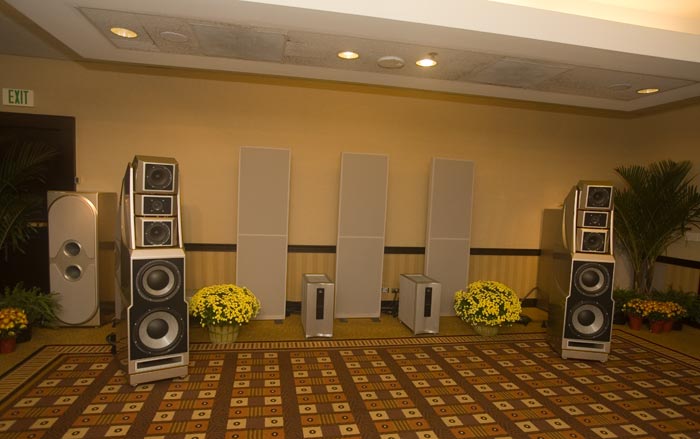
Wilson Alexandria XLF speakers with a pair of their Thor’s Hammer subwoofers on VTL, dCS, and Transparent over at the Hyatt.


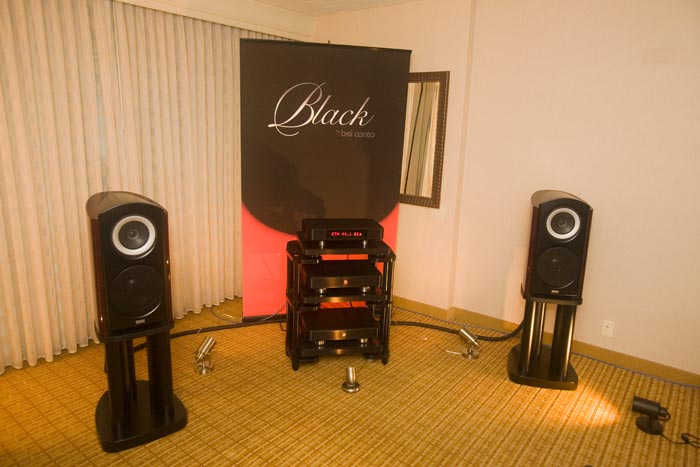
Endeavor Audio Engineering, YFS, CL Audio with Dean Peer as guest in room 545.


I like the all black look. There is something to be said for the gear always looking its best.


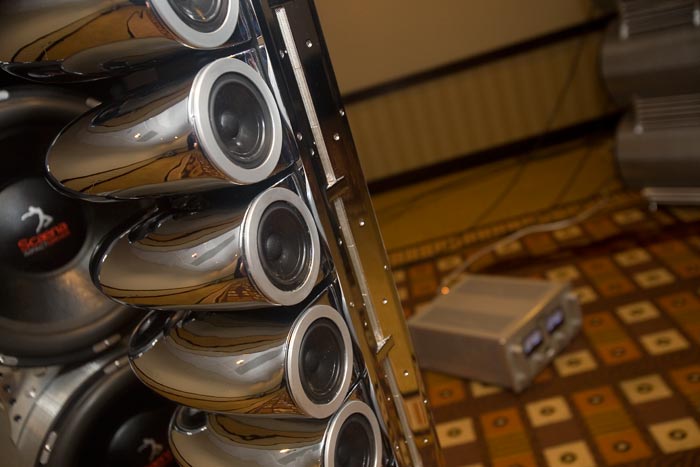
Scaena speakers on ARC amplifier over at the Hyatt. Just a cool photo.


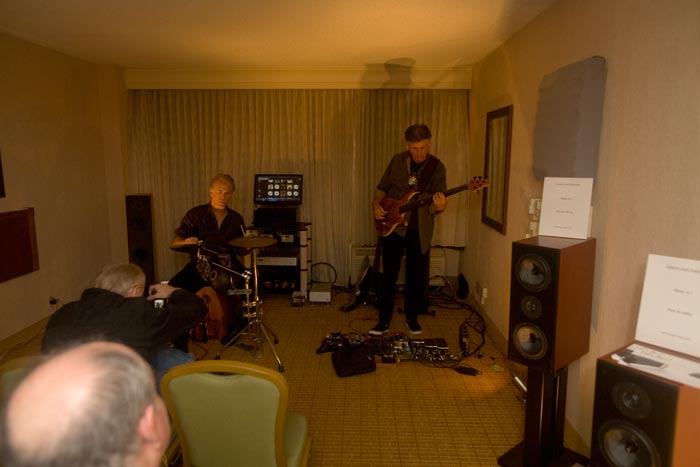
Live music sponsored by Ray Kimber.


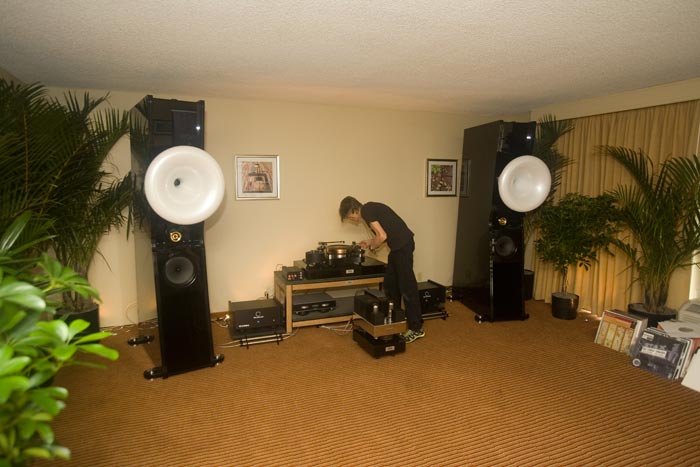
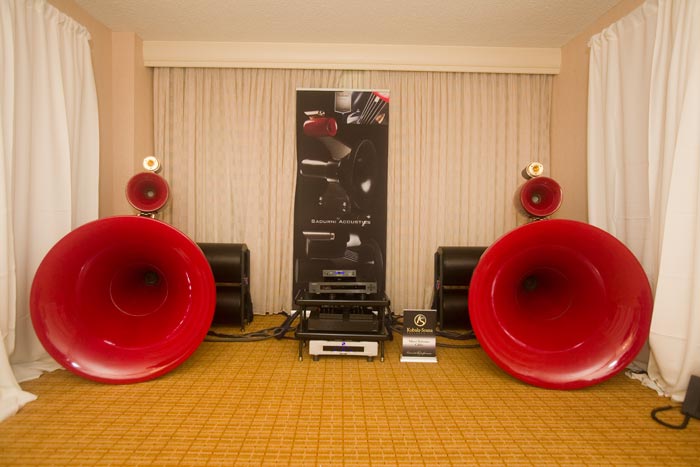
High Water Sound brought a pair of large Cessaro horn speakers and put them in room 589. There were several horn speakers at the show this year.


Sadurni speakers in room 538


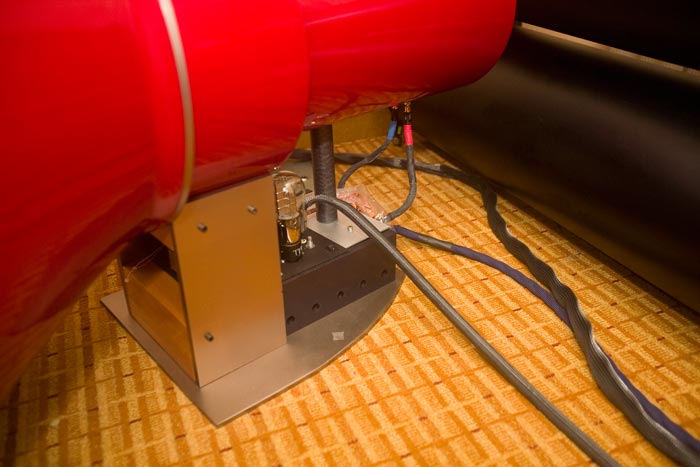
The Sadurni speakers have a built in flea watt 300B amplifier.


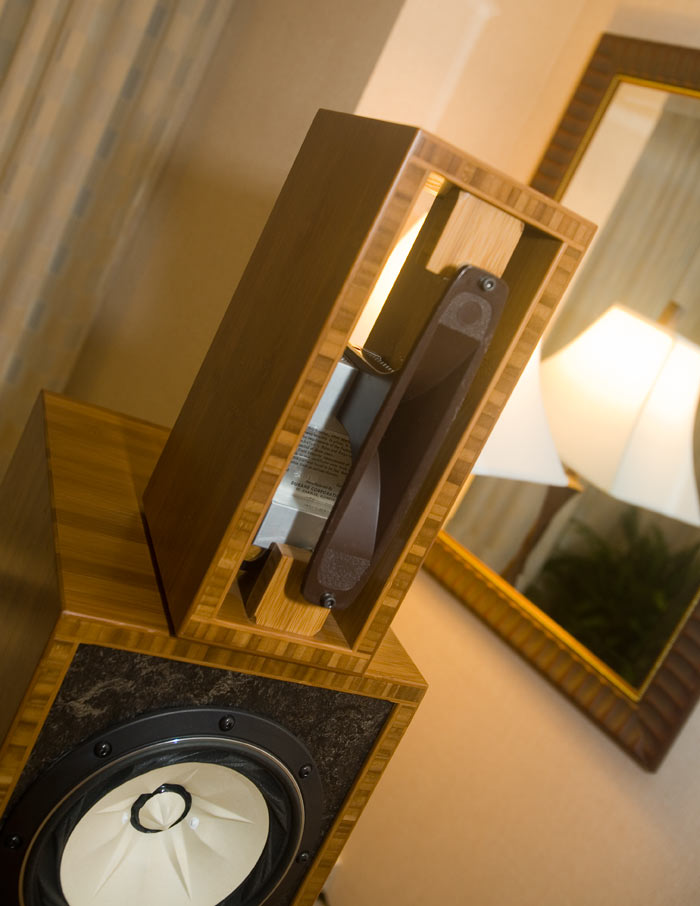
SW Speakers in room 453.

RMAF 2013 Day 1 highlights

Much thanks go out to Albert Porter for loaning me a memory card after I somehow in a characteristic display of raw and fearsome intelligence forgot to bring mine to the show.

We’ll put the whole show up on Ultimist. But for now, some highlights.


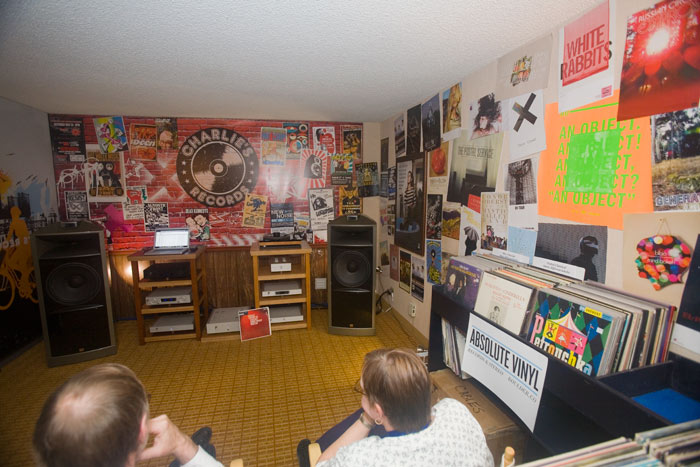
Room 9002 – The Ayre Room. The Ayre guys setup a full-immersion record store time-warp in their room, called it Charlie’s Records, and transported a demonstration hi-fi system right into the middle of it. This is a real store [although LPs are from Boulder’s own ‘Absolute Vinyl Records & Stereo ‘] and there are lots of nice used vinyl here folks.


Vaughn Speakers. Room 9007. Plasma tweeter.


Dail speakers with U.S. flag. Room 8020.


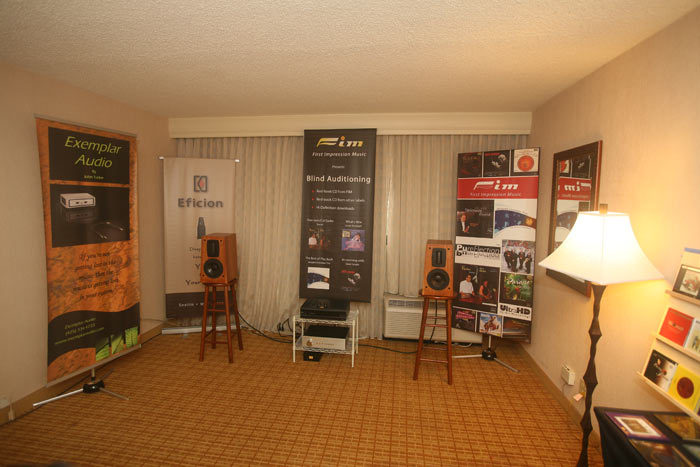
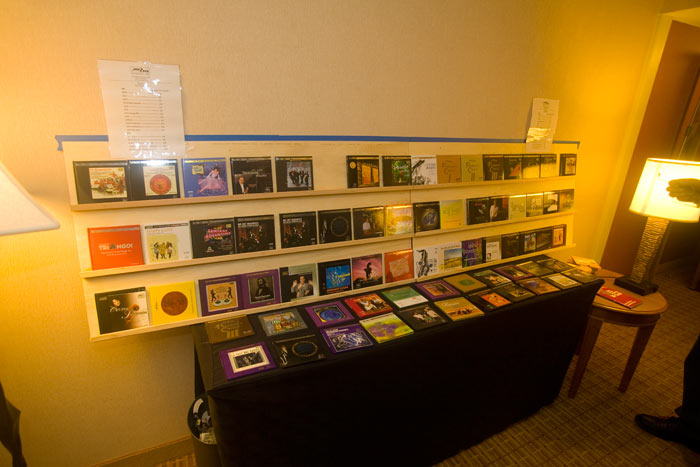
FIM CDs for sale in the First Impression Music room in 2004

More tomorrow morning… OK. It is morning… and here’s more.


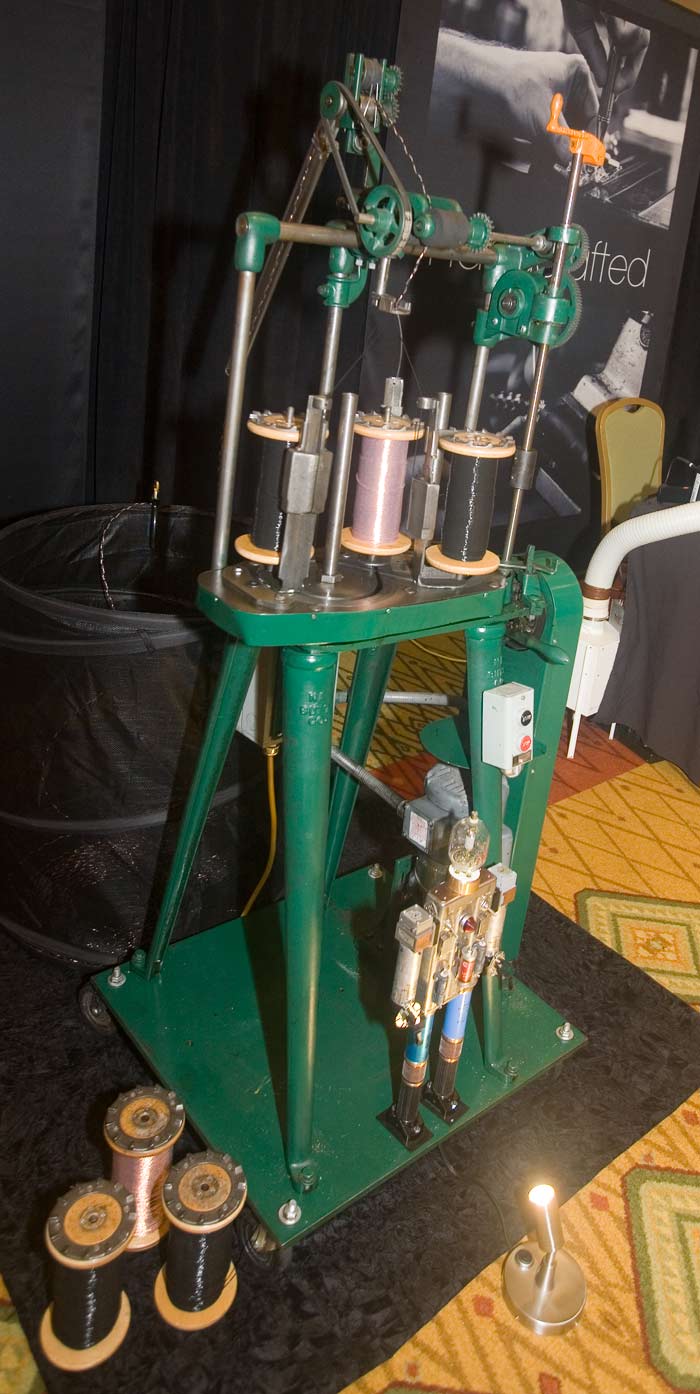
A 3-conductor cable weaver in one of the IsoMike / Kimber rooms.


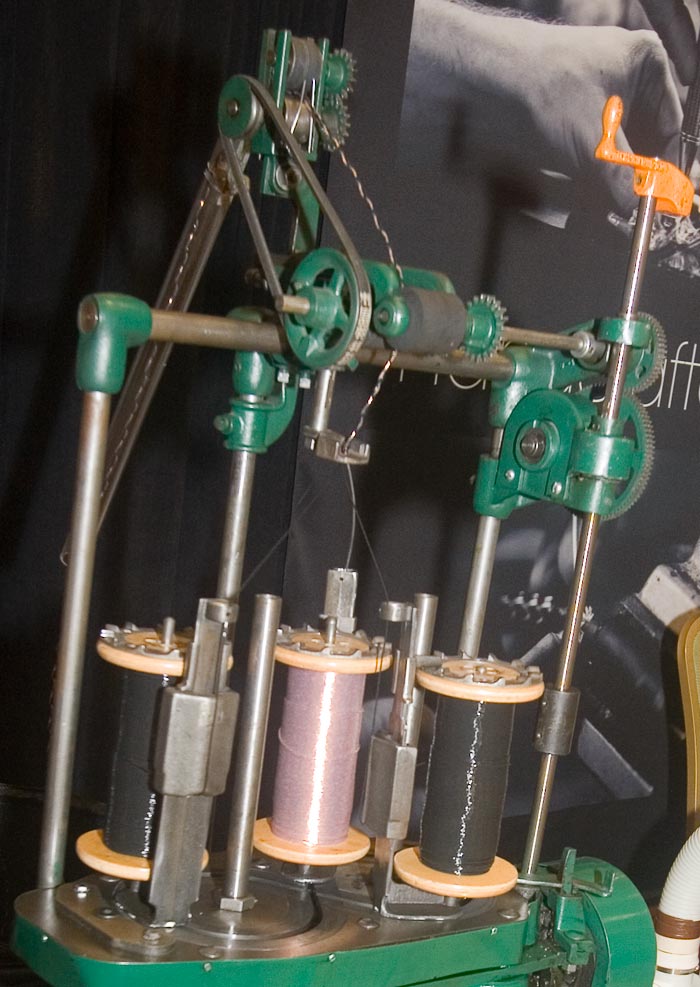
A closeup of the cable being weaved and the 3 spools of conductor. Looks like there is room for 5(?) conductors on this weaver.


The Kimber Kable mascot [I think that is what it is. I forgot what Ray Kimber called it. Doh!]


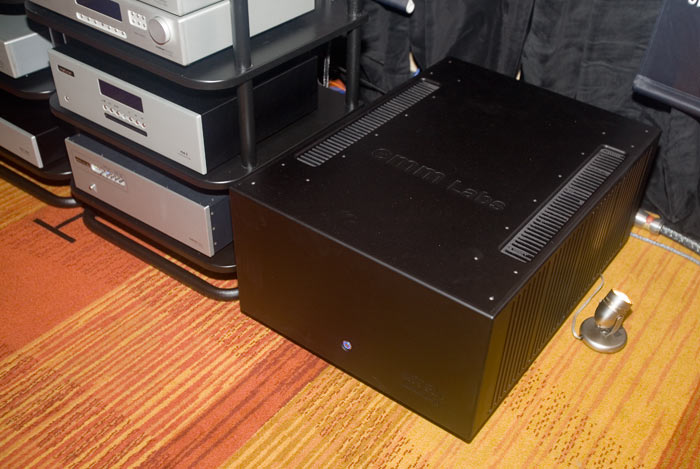
A prototype 1500 watt 220V amplifier from EmmLabs. Effortlessness. Surprisingly truly significantly different from the big Pass Labs amps of years past on these Sony speakers. In the big IsoMike room.


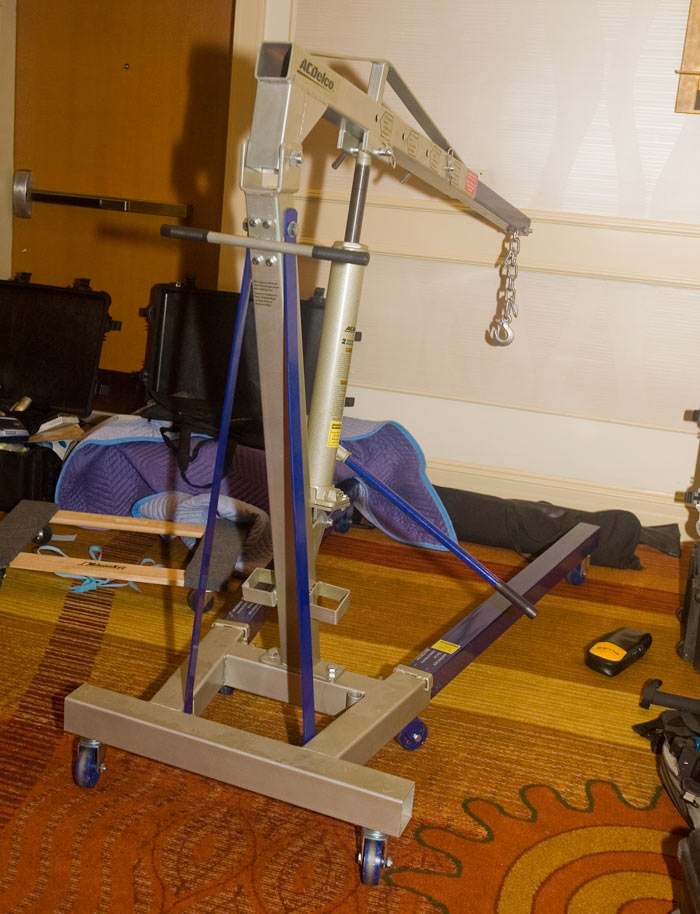
The crane used by EmmLabs to lift the 400 lb amps out of their crates. We want one. My arms and back feel better just looking at it. 🙂


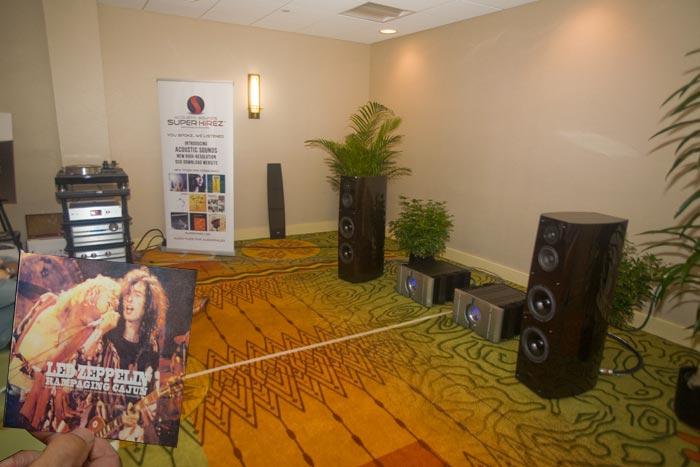
Acoustic Sounds in the Bluebell room [far side of the first floor] was playing good music.


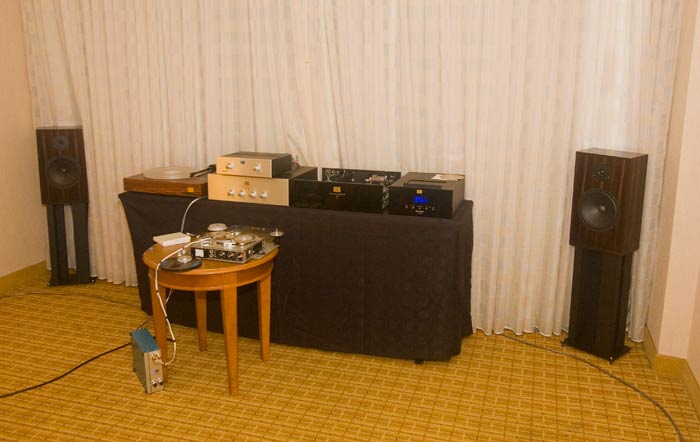
The Audio Note U.K. room number 566 was showing an older version of their smaller ‘K’ speakers [$3000-ish]. We all listened to some reel-to-reel fabulousness at the end of the day. The Beatles, for me, was exceptional [way better than the commercial releases, though I have not heard the latest re-mastered re-released re-pressings].

Heart and Mind Ratings of Common High-end Audio Gear

[UPDATE Sept. 07, 2017]

[Most of the scores for major gear remain untouched 4 years later. I removed many items which are no longer being made or whose companies have gone out of business :-(. I also updated some of the values as I have become to appreciate that the level of detail offered by some of the better tube gear comes a lot closer to that offered by solid-state these days and it is often those subtle details that help entertain the Mind – ergo higher mind scores. 

Going through these numbers again – and yes, I have many more items to add, but – it seems apparent that for long term enjoyment one might consider choosing well-balanced vis-a-vis mind vs. heart components or at least design well-balanced systems from a mix of less-balanced components.

Realize also that Boy Toys, whose only claim to fame is that they do BIG, and GeeWiz Wonders whose only claim to fame is cool gadgetry, are not  represented well by the Heart vs. Mind scores, since their appeal does not have to do with how they sound… BUT it still might be useful to rate them on a similar table, or in this table, so people can figure out just why someone is raving about X and whether it has any relevancy to what you, personally, are looking for at all]

In order to help describe what we think are the key differences between the Audio Note U.K. Gaku-On and Lamm ML3 amplifiers we came up with semi-subjective rating that has to do with how much the characteristic sound of the amp appeals to one’s mind versus how much it appeals to one’s heart.

We will now try our hardest to apply this same approach to all sorts of other gear. However, it seems like perhaps a change might be useful here. Instead of just rating things based on a simple HEART < —– > MIND scale we will instead try and rate Heart and Mind separately, on a scale from 0 to 10.

One reason why these kind of ratings may be really useful is that people who like the quality of the sound to affect their Heart really hate sound directed at their mind. And visa-versa. Really hate. Spending lots of time to let everyone know how much they hate a particular component or system when what they are really saying is that they do not like the fact it is Mind-centric (or visa-versa).

Mind-centric sound is often called ‘sophisticated’, or ‘high resolution’ or having ‘lots of inner detail’. This is completely UNRELATED to the possibility of the sound being ‘cold’.

Heart-centric sound is often called ’emotional’ or ‘involving’. This is completely UNRELATED to the possibility of the sound being ‘warm’.

[NOTE: real world values are very fuzzy and depend heavily upon the music played and system the component / cable is in, and, for Audio Note components, the tubes used]

Name Heart Mind
———– amps ———–
Audio Note U.K. Gaku-On amp 10.0 7
Lamm ML3 amp 7 10.0
EMM Labs MTRX amp 6 9
Audio Note U.K. Kageki 2A3 amp 9 6
Audio Note U.K. Kegon Balanced amp 8 7.5
Audio Note U.K. Kegon amp 9 6
Lamm ML2.2 amp 7 7
Acapella LaMusika [top-of-the-line smooth, tonally correct solid state w/ micro-dynamics] amps 5 8
———– speakers ———–
Acapella Apollon speakers 8 8
Acapella Triolon Excalibur speakers 8.5 7
Marten Coltrane Supreme I speakers 4 10.0
Kharma Mini Exquisite speaker 8 6.5
Wilson Alexandria II, XLF speakers 6 8
Wilson MAXX III speakers 5 7
Acoustic Zen Adagio speakers 6 4
Audio Note AN/E SPe HE speakers 8 5
Audio Note AN/E SEC Signature speakers 7 7
Sonus Faber Stradivarius speakers 7 4
Sonus Faber Extrema speakers 7.5 4
———– cd players ———–
Emm Labs XDS1 CD player 7 8
Esoteric K-01 CD player 4 8
Audio Note Level 5 digital 11 8
Audio Note Level 4 digital separates 8 7
———– cables ———–
Nordost ODIN interconnects 7 9
Nordost ODIN speaker cables 7 8
Tara Labs the Zero GOLD 7 7
Nordost ODIN power cords 8 9
Nordost Valhalla interconnects 6 6
Audio Note Sogon cables 8 4
Audio Note brown PALLAS interconnect 7 9
Audio Note black PALLAS interconnect 7.5 4
Stealth INDRA 4 7.5
ELROD classic (average) 6.5 4
ELROD new (average) 7.5 6
Pranawire (average) 9 4
———– preamps ———–
Audio Note M10 preamp 9 7
Audio Note M9 preamp 8 6
LAMM LL1 preamp 5 7
LAMM L2 preamp 5 6
———– phono preamps ———–
Audio Note M9 phonostage with S9 step-up transformer 10 8
Lamm LP2 phono preamp 6 6
———– turntables (neutral cartridge) —-
Walker Proscenium Gold turntable 7 11
Brinkmann Balance turntable 6 7
Audio Note TT2 turntable 8.5 6
Clearaudio Statement turntable 6 9
Spiral Groove SP1 turntable 8 8
TECHDAS Air Force One turntable 7.5 9.5

UPDATE: 1/1/2018 Turntables. I have heard many tables many times [though the Clearaudio just 2 or 3 times – but it made an impression]. The tables listed above are rated based on their CONSISTENT sound – they almost ALWAYS have the above sonic characteristics. If the vast majority of tables sound more or less the same [a strong statement, I know], the vast majority of their sound ultimately coming from the tonearm and cartridge used, more or less like the Brinkmann, say, then one should choose the table based on ease-of-use and ease of setup and overall engineering quality. Again, why we liked the Brinkmann, but there are now a ton of tables at a variety of price points that do these things well [or well-enough for most people]. Anyway, Mea Culpa, I find it hard to hear uniquely distinguishing characteristics of this broad swath of ‘pretty good’ tables, especially at shows.

ORIGINAL POST:

Rated 0 to 10 and we are assuming they are in a system that really shows off their capability. There are a lot more components and things we can rate, but this is hopefully a decent start.

OK. You all know this is just my Wild Eyed Opinion. But I think most people would agree that the relative values here are close and in proportion to what we experience when we listen to these things.

There are, you know, components with a value of 0,0 and we won’t point fingers but it is an interesting state of affairs for those that own them. The more educated we are about the REAL comparative performance of our gear the less chance end up with stuff that is not what we are looking for.

From this table, one can see why the Gaku-On amps on the Coltrane Supreme speakers was such a significant system. Even though the ML3 on the Supremes was awesomely intense and deeply subtle, the Gaku-On on the Supremes whacks ya, you poor defenseless listener you, over BOTH sides of the head. A roller-coaster ride to wheresoever the music takes you.

This kind of pairing of opposites works well for the most listeners, I think. Like the Edge NL10 amps driven by the Audio Aero Capitole player – it entertains both sides of the brain. On the other hand, there is something kind of special about well-balanced components, components who heart-centric rating is close to the mind-centric rating.

It seems, looking at things here, that some gear uses either some warmth and/or dynamics and/or well-integrated micro-dynamics to appeal to the Heart.

The Denver RMAF 2013 hi-fi show is next week: Part II

Stairways.

Stairways are often the quick way to get around at shows [the Flamingo / THE Show at CES being an exception].

Yeah, you will most likely arrive breathing heavily and with leaden legs when ascending floors – but this can often be more pleasant than shifting from leg to leg staring at the psychedelic carpet waiting for elevators for longer than around 5 minutes [YMMV if you have more or less patience than I. Neli almost always prefers the stairs – seizing an opportunity to burn off more calories and get more fit. Ugh. :-)]

I looked for a good map of the Marriott 1st floor layout – to no avail [though I did find out that the Great American Beer Festival is happening at the same time as RMAF this year in Denver].

So… until I find such a map: we will just have to muddle along.

The low-hanging fruit is to always take one of the two stairways when journeying between the 8th, 9th, 10th and 11th floors in the Tower area of the show and the 4th and 5th floors in the Atrium part of the show.

Now for the not-so low hanging fruit. 🙂

One can traverse the stairways between the 2nd and 8th floors. It is somewhat easier going down than up.

And one of those stairways ends up down on the ground floor taking you OUTSIDE, to the right of the main entrance and to the left of the North side entrance. This door is usually open, and people who grow impatient waiting for the main Tower elevators to return from their sojourn to Tibet could, if they would be so bold, to go out the exterior doors to the left of the elevator bank, hang a right, walk about 40 feet and through a metal exterior door and take the stairs up to 2nd, or, for the not faint of heart, the 8th.

The stairways for the Atrium side of the show also go down to the ground floor – but exterior doors are typically locked [a change they made 3 or 5 years ago]. This means that you really can’t use these stairs to go up from the ground floor to the 4th or 5th floors.

And when descending the Atrium stairs down to the ground floor, you will either find yourself outside in a hurry [and, BTW, it does rain and snow in Denver. You will need something to protect your camera and / or self] or you will find yourself in an airlock next to Audio Limits’ room and have to frantically wave at people through the locked glass doors to get them to let you back into the building [have done this many times. However, it really works much better during show hours when there are people around. Otherwise you have to exit through the exterior door and take a long walk around the hotel back to the main front entrance].

Well, those are my tips and tricks.

Perhaps somebody has some others they might want to share.

Oh, and there are also the freight elevators, which break a lot less frequently than the guest elevators for some reason – but we do not use them when we are, you know, gearless – otherwise it seems kind of rude to those that are, you know, gearfull.

The Denver RMAF 2013 hifi show is next week

RMAF

Is everybody ready?

For those are not going…. we completely understand. But here we are once again in October, so here we go once again to attend [not show, however, small rooms do not work for us.] at the Rocky Mountain Audio Fest 2013.

For those that are going: I think it is important, fun and ear-ducational for everybody to go to and try and hear each and every room.

No, I mean yes pundits say it is impossible but no, it is not. All good citizens of audiophiledom should hear as many different systems as possible. The weird. The awful. The spectacular. The clunky. The sweet. The raw. Low res, high res, turntables versus iPods, planars versus horns, everything.

In this way you take back the power from the pundits who may not have your best interests in mind.

It really is a great and fairly unique opportunity to try and understand what you like about each system and what you do not. By all means hang out for awhile in rooms that you like – and try to listen deeper to determine why it is one of your favorites.

But… still… try and not let that stop you from hearing everything else.

And be careful about spending too much time in rooms with components that you have ‘heard about’, struggling to hear why in the heck people actually like the darn thing. Sometimes, way too often, standout components, even if they really are standout, are found in a system that is not conducive to showing off that component in its best light [think unbroken-in gear and, more recently, laptop DACs or iPod sources]

There are 20 hours, and about 160 rooms, which leaves 7 and a half minutes for each room minus walking time. That is two full songs in many music genres.

And here are guidelines to help improve the amount of time for listening:

1. If the room exhibitor is talking with someone and appears to not be even close to executing that familiar slow Tai Chi-like ‘putting on music while talking to someone’ pose [and as opposed to Jet Li-style WHOOSH and ‘we are now playing the next track already thank you very much’]. Then move on, making a mental note to return to this room if possible.

2. If the room is too loud or too aggressive, save your ears. Move on making a mental note to return to this room if possible when it is quieter / sounds better.

3. If you go into a room and are attacked by rapid salespeople. This doesn’t happen all that much at hi-fi shows – but it does happen. Maybe 5% of the time? Run away as fast as you possibly can [which, you know, will not be all that fast because you are carrying a ton of LPs and a winter coat – its Denver] making a mental note to return to this room if possible when they are on their pee break [I did this a lot back-in-the-day. Now I just tell them to ‘talk to the hand’. Yeah. Right. Unfortunately I am not yet a terminator-grade show reporter. No, I let them talk to Neli, which they like way more than talking to a trouble maker like me, anyway ;-)].

4. If you go into a room and one of the famous reviewers are in there, you know, reviewing and all [and sometimes even the want-to-be famous reviewers]. The real famous reviewers are typically nice but scare the bejeezus out of most exhibitors, making for a tense listening session for you. Some of the want-to-be famous are jerks and will give you dirty looks if you breathe, also making for a tense listening session. Move on making a mental note to return to this room if possible when the there are just ordinary folks in the room [I know I am also a distraction when I am in a room taking photos with my camera with its seemingly 95dB click. But I do try to be as quick as possible and I have learned over the last 12 years or so to try and not stand in front a speaker why I am taking photos, at least, though no doubt I affect the soundstage presumably with negative effect].

[You would think watching a famous reviewer listening to a system would be educational, but they look just like some ordinary bloke who wandered off the street listening to some esoteric piece of music that they are apparently intimately familiar with but which nobody else has ever heard of before. You know. You see these people all the time. If not in the mirror, then look to your left or right. Just move on, nothing to see here.]

Reasons not to just move on. I know lots of people use the reasons below to skip a room, but I do not and wish everybody else [hint: Neli ;-). And JL. And … OK, the whole lot of ya :-)) would not either.

1. They are playing music you do not like. Hopefully the next song will be more to your liking.

2. The system is too inexpensive and will not ever be on your ‘to buy’ list. It is always instructive to see what less expensive systems can do well, and what they do not. Keep your ears in shape, make them work to identify the things that you are getting for those megabucks you spent on your more expensive gear.

3. The system is too expensive. Again, keep your ears in shape, listen and heart what can now be done with the most recent technology. Get inspired. These capabilities do trickle down to reasonably priced gear fairly rapidly [not just compared to tectonic plate movements either – if the technology CAN be trickled down at all, it is usually with a half-life of, say, 5 years (about 1/2 of the companies who are going to take advantage of the technology, are doing so after 5 years). By comparison, website technology trickles down with a half-life of about 8 months. And cars about 3 years? So at least some audio manufacturers are pretty good when it comes to adopting new technology].

4. Don’t like the exhibitor. Sometimes jerks setup a good system. Life is not always fair and often makes no sense at all.

5. Need to take a elevator / walk up stairs to get to the room (this barrier is near impassable for many reviewers and forum pundits)

6. There is nothing ‘new’ in the room – no new version of something, no new component of some sort. (I think Einstein was working on this law of the physical universe when he passed away – something to do with how ‘news’ is locally defined within a small group of people that mostly just talk to others in the small group. ;-)]

7. The seats are too comfortable [Ha! just seeing if you are paying attention]. Comfortable seating is like a super massive black hole that sucks you down and requires a supreme effort and massive amounts of energy to escape. B-E-W-A-R-E.

See y’all at Rocky Mountain Audio Fest everybody!

Evaluating Gear using the Heart versus Mind Approach

Different than Warm versus Cold Sound

Looking at gear in terms of where it lies on the Heart < --- > Mind scale is different from comparing things based on their sound’s relative warmth or coldness. For one, we are talking about the effect on the listener and not some under-defined properties of the sound [typically 2nd harmonic distortion and plentiful micro-dynamics versus overly aggressive note attacks and/or flat note tops and minimal ability to render subtleties].

For another, we are removing any assessment of the quality of the sound. Sound quality is on a whole separate scale. We can talk about high-quality and low quality components and why they are of this quality completely separate from talking about whether they primarily target the heart of the listener or their mind.

How to Assess Basic Quality

How the component performs with respect to our 3 main mental Music Processors gives us a sense of the basic quality of a component [the other, Pattern Detecting/Matching Processors help us assess the drug-like possibilities of the component]

Our Believability Helper Processor

How much effort does our mind have to exert to convince us that the sound we are hearing is actually music. Typically non-audiophiles ignore how much effort they are putting into this processor and almost all audio gear sounds believable to them.

Our Whiteout Processor

How much of the sound is so bad that we have to completely erase as it is coming into our ears. This may vary for person to person: for me it is often the beginning of each note that I mentally erase when the sound is too aggressive. Hard to do this forever [more than a few seconds :-)] though.

Our Rainbow Processor

How much of our mental energy are we having to add to make the sound sound Grrrreat.

How to Assess General Location of a Component on the Heart versus Mind Scale

This is hard to put in words.

For me, I figure out which part of me is listening to the music. If it is mostly mental: hear that awesome note, hear that tight bass note, boy those chines sound so beautiful – then you know that the sound is appealing to your mind.

If you keep getting swept into the music, having to fight to ‘maintain’ your adult [cool, calm, collected] demeanor when others are around, a feeling of wanting to smile or cry or dance, then the sound is appealing to your heart.

Some gear doesn’t appeal to either Heart or Mind. This kind of gear is unappealing and one has to rely on one’s Rainbow Processor to make it appealing in some manner.

Usually the sound of a piece of gear is a combination of Heart and Mind and depends somewhat on one’s mood to start with, and also the particular piece being played [but not as much as one might think].

Building Systems

Usually we build systems for people that balance Mind and Heart, with good doses of both, unless they really have a preference one way or another. This is kind of like balancing a warm component with a cool component, except that it works independent of how warm or cool the components are [terms which are derogatory terms to many people] – instead addressing directly what affect the listener wants to achieve. For example, one can build a Mind-centric system composed completely of what some would call warm tube gear.

Next

We apply this approach to the real-world and compare popular gear using their position on the Heart < -- > Mind scale.

Break-through amplifiers. Part II

So, lets compare the Audio Note U.K. Gaku-on and Lamm ML3 amps.

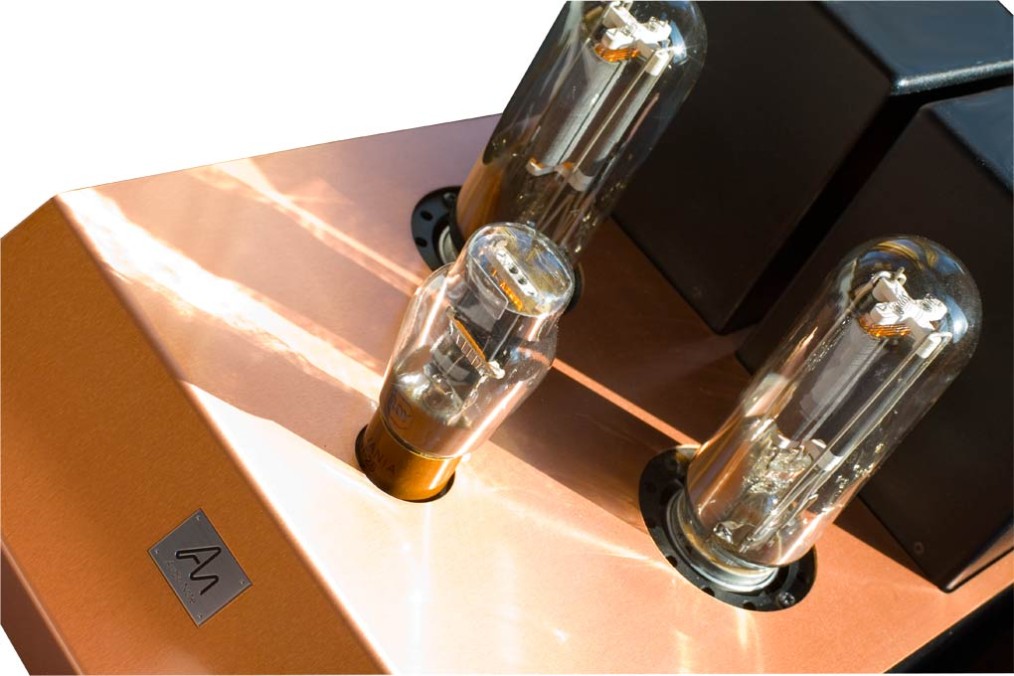
The Gaku-On is a $265,000 monoblock 211-based amp [I think of it sometimes as 2 very souped-up Ongaku amps without a volume control]

The Lamm ML3 Signature is a $139,490 monoblock GM-70-based amp [4 boxes: 2 amps plus 2 power supplies]

Technology

Though I understand just a very little about how these amps break new ground in technology and simplicity of design, I am not qualified to compare them to other designs out there and describe why these are significantly better. So, although these are pretty obviously breakthrough amps in terms of technology [just look at the circuits – it is simplicity itself], it is really the breakthroughs in terms of the listening experience that is, and what some say [including us, and many others of this blog :-)] should be, the real criteria for breakthrough-level excellence.

The technology of the Gaku-On is found in several other amps from AN including the Kegon Balanced. Some of the technology of the ML3 is found in their matching L1 preamplifier.

Audiophile Characteristics

I feel that the ML3 has more resolution than the Gaku-On, but both have more than any other amp we have heard. The Gaku-On has purer harmonics than the ML3, much purer than any other amp we have heard [especially when paired with the better AN amps and digital sources]. The ML3 has greater harmonic resolution and harmonic and dynamic linearity, again breaking new ground. The Gaku-On is more dynamic and dynamically nimble, breaking new ground here itself [live with these for awhile and you will understand in a visceral and indelible manner why most big amps and solid-state amps have real problems with the kind of dynamics found in real music]. The ML3 has a quieter, startlingly dark background although the Gaku-On is itself among the most quiet tube amps in the world.

But enough with the audiophile chatter… 🙂

Character of the Amps

These can be thought of, I think, in terms of Heart versus Mind [though it is a Yin Mind and a Yang Heart we are talking about here].

When one things of Yin amplifiers versus Yang amplifiers one might think of, say, Jadis amps versus old Krell amps. And certainly the idea that Yin represents winning us to its side through delicacy and Yang through overwhelming power… kind…of… represents the case here…

The idea is that the Lamm ML3 presents music in a very sophisticated, delicate, intricate and accurate manner – and the Audio Note UK Gaku-On in a dynamic, colorful, and enthusiastic manner.

Effect of the Amps

The effects are more similar than what one might expect, especially when you realize that the heart can be won by convincing the mind [some say we always consciously (mentally) CHOOSE who we fall in love with], and the mind can be won by convincing the heart [e.g. love is blind, all you need is love, etc.].

I feel that the Gaku-On pulls harder on the heart strings, that the dynamic swells and casual ease and rich, insidiously TRUTHFUL color overwhelms our inhibitions and forces us to fall heels over head into the music.

I feel that the ML3 pulls harder on the higher mental functions, that the dynamic and harmonic resolution and convincingness is so entrancing that the mind is unable to resist falling head over heels into the music.

Strength of the Effect

It depends

You might think that after a day of doing math homework, say, you might want… something different – something that appeals to the heartstrings to distract your tired mind from a day’s hard work? Or would you want something that is intellectual but incredibly beautiful that sneaks into the head which is already open to intellectual stimulation.

Similarly, after a day of arguing with nincompoops, you might want something refined and delicate, the best of humanity in high resolution. But, maybe you want to just blast away all remembrances and de-nincompoop the day with some beautiful, heart-rending stimulation.

Both these amps are fun. Both help distract me from the days’ travails. Both are convincing and exciting and delicious. And even if I sometimes THINK I would prefer one or the other, I am wrong as often as I am right.

But that is me. I enjoy equally well both appeals to the heart and to the mind…. just sometimes more one than the other.

Mental Pattern Matching

Now that we have described some of the basic characteristics of these amps, we can try and talk about the listening experiences in more detail.

Our Believability Helper Processor
Our Whiteout Processor

These amps, largely based on the quality of their reproduction, require previously unheard of low levels of use of our fixer-upper mental processors. They are far more believable and have far fewer annoying characteristics than other amps currently available and/or that we have heard.

Our Rainbow Processor

Our desire and ability to mentally enhance our music in a fun and exaggerated manner never flags, and with these amps there is no exception, although the need or desire to do so is lessened quite a bit.

Our Pattern Detection Processor
Our Pattern Matching Processor

Here is where we can start comparing the amps and how they differ in what they offer the listener.

[Please note I am somewhat exaggerating the differences in order to better explain what is happening to a listener. In reality there is quite a bit of overlap as both amps are able to render the all kinds of music quite well and convincingly]

The extreme resolution of the ML3 lends itself the ability to render very complex patterns. These patterns stimulate the higher cortex of the brain. [I think. Therefore I am]

The extreme purity and dynamics of the Gaku-On lends itself to render very deep, primal patterns. Patterns that stimulate our human and animal natures. [Woof!]

[I feel like I should write more here in this section. But… well… see previous posts about how the patterns in music cause matching resonances in our brains, resonances that aid us in thinking and understanding and feeling things.]

Our Emotional Contexualizer

Both amps draw out the emotional subtleties of the music. In somewhat different ways, as described above, but both are very emotional amps.

Our Beauty / Wonder / Spiritual Processor

Similar to the emotions, both can frequently provide glimmers, nay stark proof, of the beauty of the universe.

An example: these amps on the Marten Coltrane Supreme Speakers

Putting the ML3 on the Supremes is pairing like with like. They are both high resolution and capable of rendering exquisitely subtle detail. People who are looking just for music that stimulates their heart, and not their mind, will not be so pleased. Those who like both will enjoy the experience quite a bit. And those who are primarily looking for music that stimulates the mind first and foremost, these people will be flabbergasted.

We played this exact system at RMAF … 2008? … and if you read the reviews, you are able to see immediately the preferences of the reviewer. The next year we brought the Gaku-On amps in a mostly Audio Note system. This mostly ‘appealing to the heart’ system flabbergasted those who really did not like nor understand the above system, these people preferring their music to be heart-centric rather than mind-centric.

Putting the Gaku-On on the Supremes is pairing male with female, chocolate and peanut butter. The combination sounds like the perfect horn speaker: a dynamic, high-resolution, harmonically rich point source. This was a more balanced, both heart-and-mind centric sound. Systems like this are a good compromise if you, like me, like both heart-centric and mind-centric sound.

Comparison to other sounds

Mind-centric does not mean cold and unemotional. Cold and unemotional systems have insufficient resolution to render the subtleties required to communicate emotion in voices and instruments [often because the speakers are too hard to drive and small sounds just get lost as the amps struggle with the major sounds] .

Heart-centric does not mean fake or sugary sound. The often used epithet used by people who fear heart-centric sound is artificially sweet is undeserved for real heart-centric systems. If there is to be more than just one emotion communicated by a system [like cheap wine, missing is all the wonderful variety of flavors possible], it needs to be high-resolution and highly realistic.

Conclusion

For a long time I preferred the Gaku-On and neli preferred the ML3. The I’d hear the ML3 and she would hear our Kegons or something and we’d swap. We’d go back and forth, usually wanting the opposite of what the other wanted [yes, some of it due to husbandly cantankerousness, but also some of it because I really do know best and she just kept getting it wrong :-)].

I lot of the appreciation of life, for me, comes when one knows what one appreciates. Not so much from getting what one appreciates, but understanding just where one stands with respect to where quality can be found. I know which two amps I want, and this does make the world make a little more sense than back in the day when I was a fish biting on everything that came along – including all those rocks, leaves and whatnot.

Break-through amplifiers

Let’s discuss break-through amps:

What makes a break-through amplifier?

One thing one wants to see with break-through amps is that they are paired often with outstanding speakers, cables and sources. Somebody might be making a break-through $2500 amp, but if it is paired with $2500 speakers and a $2500 CD player [or laptop] then the flaws in the associated equipment will drown the performance of the potentially break-through $2500 amplifier.

Then, if the amp is indeed found paired with megabuck associated gear, the system has to sound good. Otherwise, well, what is the point? And there should be multiple systems in which the amp sounds good – to help rule out the anomalous ‘too-tired to tell good from bad’ or the much more fun – ‘was kinda buzzed and it sounded AWEsome…’ effects.

1. Simplicity of design. There are a number of amps which are very complex. Complexity [think ‘Microsoft Windows’] causes fragility and unevenness of quality across the performance spectrum.

2. New levels of performance, typically in areas people had thought were pretty well exhausted. Think ‘Google search’.

The Lamm ML3 signature amplifiers and the Audio Note U.K. Gaku-On amplifiers are two break-through amplifiers [AN also makes several other amps with the same architecture as the 211-based Gaku-On: the Kegon Balanced 300B amps for example, but lets just talk about the Gaku-Ons for a bit].

Are there other break-through amplifiers?

Historically there was the Kondo Ongaku in the early to mid-90s. Discrete components and extreme attention to each component (many of which were custom), the SET (single-ended triode) architecture, and lots of silver, especially in the custom silver-wound transformer are some of the major highlights at the time.

David Berning also made an amp or two with innovative architectures and which sounded pretty good in several systems. They never seemed to position the amps as state-of-the-art level amps, however, and the largely fickle press largely ignored them.

OK. What about, you know, NOW?

The Audio Power Labs amps are potentially break-through amps. They use some innovative techniques in their amplifier designs, and sound pretty good, although the systems they pair them with have so far had very serious flaws prohibiting any kind of ultimate determination of their quality. [and we blew an opportunity to hear them up here. Doh!]

What about solid-state amps?

Almost all amps have a cool little innovation here or there. The big EDGE NL Reference amps had a simple design and broke new ground, but Edge abandoned that approach and decided to go more for the ‘me too’ sound. The Pass Labs ‘First Watt’ amps are another potential, but in the end just reducing the output is not an innovation and break-through in-and-of-itself.

But if you take the Bryston as the baseline solid-state amp [basic, reliable amplification with a 20-year warranty] then other solid-state amps just seem to be the Bryston with more resolution, or more powerful, or heavier, or cooler looking, or smoother response but are not really letting us see deeper into the music.

So I am not sure there have been ANY break-through solid-state amps.

For those of you who have not heard all the recent over-hyped $120K – $150K solid-state amps, or have only heard these amps and no others, they are better than the $30K amps of a few years ago, but only incrementally. If you want the best solid-state, you have to plunk down the cash, but innovation is happening elsewhere [but check out the new Pivetta “Opera Only” amplifier at 160,000 watts as a possible contender. This is still really new, and are custom built-to-order, but certainly innovative. Stay tuned…].

So, 4 or 5 break-through tube amps, no break-through solid-state amps to speak of, and all this in, what 25 – 30 years?

Note we are not talking about SUCCESSFUL amps. There have been a lot of those and most ‘best of’ lists are just talking about these puppies. And we are not talking about good amps. There are a lot of those [assuming we are grading on a curve which changes every year].

I AM talking about Led Zeppelin versus U2. Zeppelin, a break-through band combining blues and amplified [metalish] music for the first time [watched some of Song Remains the Same last night. What has happened to rock? It is like everyone now acts like they are just playing on the David Letterman show (though I did like Imagine Dragons on Leno – but no break-through here, I think)], versus U2, who were successful but not a break-through band [and the Stones? Massively successful, but… I can see us spending way too much time arguing about this…. so moving on…].

Why talk about break-through amps?

Because they are cool. Because they are making a leap forward [as opposed to incremental improvements, many of which seem like just an update the make the sound reflect the fashionable sound of the day (resolution, dynamics, air, soundstage depth, SPL, amount of bass, slam, etc.)]. Because they are trend setters and there will be many copycats [sort of. This kind of imitation is WAY more common in speakers [can you even count the number of Wilson clones, or Kharma clones, or Sonus Faber clones?], and even cables, than amplifiers].

So, even though the break-through amplifier technology will be largely ignored [which says something about the type of people building amps: iconoclastic to a fault], it is teaching us listeners what we can hear if the amplifier is really, really good. It will influence the listener’s tastes more so than amplifier design, per se.

So, it influences our tastes. This is important.

It also influences our reach, our ability to look behind the reproduction, behind the music if you will, and see the deeper picture.

Because listening to live music is hardly ever leisure listening, it being hard to relax and there is certainly few musicians with a rewind feature, it is up to us listening to the music through reproductive gear to determine what is really good about a particular piece – or at least it is certainly easier for us if we can just get the reproduction to mimic the original production as well as we can. This is really fun and mind-expanding and is one of the benefits of our hobby as our systems get better and better.

I wanted this post to talk about the difference between the AN Gaku-On amps and the Lamm ML3 amps… but this is already kind of lengthy, so we’ll push it off into a future post.

Is Better really Better?

Interesting article [with a stupid title designed to appeal to Digg readers – and it worked, because that is how I found it ;-/]:

The science of snobbery

It talks about rating [essentially AB testing] fine wine, classical musicians, and Greek art. It points out that we also all have another what we would call, based on the previous posts, a mental processor that judges the sound, in our case, based on External Factors unrelated to the sound:

External Factors Processor

Price, appearance and brand quality influence some of our decision making when it comes to evaluating quality.

I also want to add that this is in addition to contextual temporal things like the ambiance and comparative level of inebriation in which we experience the playback.

[A few notes about the article.

The judges of the classical music competition did exactly the right thing. As revealed in Chia-Jung Tsay’s experiment, all sorts of people judged the quality of the playing by the top 3 contestants to be essentially equivalent – a tie. But the contestant who LOOKED like they were the best won. I ask: how else would you break a tie, if you were a judge, but to take visual flair and style of the musician into account, when the actual playing was insufficient to differentiate the contestants from each other?

Another point is that not all people are so susceptible to intuitively derived impressions of quality. If, as in the article

“In his book Thinking, Fast and Slow, he describes our two modes of thought: System 1, like the adaptive unconscious, is our “fast, instinctive, and emotional” intuition. System 2 is our “slower, more deliberative, and more logical” conscious thought. Kahneman believes that we often leave decisions up to System 1 and generally place far “too much confidence in human judgment” due to the pitfalls of our intuition described above. “

Then, it may be good for you to know, as you read this series of extremely weird posts, that many people [including Neli and I] are more primarily ‘System 2’ people [which based on our background in math, engineering and the sciences makes some amount of sense]. So when we reach opinions it is almost always after deliberate boring-ass multitudinous comparisons and geologic time-periods of fractious debate. Doesn’t mean we are right, necessarily [even though we are :-)], and it does mean I am probably, no definitely, more boring that people who make snap judgments about things then move on, but it does mean we aren’t at all easily taken in by marketing BS and personality blitzes and ‘expert’ opinions.

But, taken in by high [or low, you know who you are] price tags? Nah. Deliberative and attention to fact-based reality. You bet.

But what subsumes all of this is that we all can [and want to be! :-)] taken in by good music [which is what this blog is all about].

Music can [forcibly. the more forcibly the better] strip away all this long-winded deliberation and logic and shallow marketing-driven prejudices and counter-insurgency-like anti-marketing prejudices and reboot us in the deeper, System 3 part of the mind. The Be Here Now reality with the Pluto fly-by imaginative. To be really truly awake in a way that is just… that is just so fine and hard to achieve in any other way.

So AB tests are almost always useless for determining absolute quality [yes, for System 1-type people and also for the rest of us because the time- and ambiance-constraints are so fearsome and tend to dominate the decision-space] but they can be fun and can be good for providing the fuel to explore strange new worlds and seek out new life in this tired dried up news weary world we all got stuck in.