Pursuing the Ultimate Music Experiences

Audio Federation High-Fidelity Audio Blog

The CES Mixibitors STRIKE AGAIN

We have received a lot of email lately because of our show report, and one of the more interesting had details concerning a group called The Mixibitors.

Apparently, every year at CES, about 30 people quietly got together in the middle of the Alexis Park courtyard, late, late Saturday night.

Their plan: to hear the unhearable. Too many rooms were unsatisfactorily setup. Too many had fustratingly problematic components paired with the barely legal primo stuff. There were just too many ‘What If’ system setups that were just a few heaves and a helluvalotof ho’s away from realization, perhaps never to exist before or after this special night.

They had carefully crafted, over the previous days and evenings of the show, designs for the systems that would be carefully pieced together, existing only for a few hours, for the pleasure of a very few… for the pleasure of The Mixibitors.

Only they would experience the glory of hearing some of the most awesome and outrageous hifi systems perhaps only glimpsed before during the most hardcore audiophile’s fanatic wetdreams.

Not that the plan hadn’t had it detractors and major revisions.

The email went on to describe some details about the discussions concerning the Kondo room. The Kondo room had been particularly difficult to plan. Everyone agreed they wanted to put different speakers on the Kondo Gakuon system – but which ones? There were the ‘use small speakers and keep it in the same room contingent’.

Everyone agreed that the ‘keep it in the same room’ approach did have some appeal – especially as some of the senior members (and some are apparently very old, but just cannot bear to quit) had starting growing tired of lugging 100s of lbs of equipment across show hotels over the years, and, even more so, because they also remembered that they all had to lug all this stuff back and set it up again before the show started stirring again in the morning.

The choices were of course limited to what was on hand at both T.H.E. Show and CES – but this was not too limiting as there were a number of excellent candidates and the weather was great this year. The small speaker candidates were Audio Note U.K. speakers, the Acapella Filedio II, the Oskar Heil Kithara. The large speaker candidates were the Wilson MAXX II, the Acapella Violon, and the Cogent horns.

The optimal configuration of this and other rooms were debated long and hard. Secret hand signals had been developed over the previous years so that votes could be curried and polled inconspicously during the days as they all appeared to be just like all the other wacky audiophiles wandering in and out of rooms listening for the holy grail.

Only they knew that the Holy Grail was not here, yet was here.

Here is the list of some of the rooms they setup that night (the actual plan goes into much more detail including cables, power cords, electronically calculated speaker system positions, potential tube replacements, etc):

* All Kondo Audio Note system components, on a HRS rack and platforms purloined from the Audio Aero room, driving Coltrane Supreme speakers all installed in the very large room at the St. Tropez where the VR-7 speakers had been setup. The Continuum turntable with the Boulder phonostage from the Alexis Park were used for analog.

* The Audio Note U.K. Gakuon system, except the turntable which was replaced with the Continuum, also on HRS rack and platforms, moved to the very large Thiel room and drivng the big Cogent True-to-life horns.

* The Kharma Mini Exquisites, moved next door to the larger Kharma room, driven by the ML2.1 amps from the Lamm room and the Meitner from the VR-9 room as digital source and pre, all equipment on HRS racks and platforms

* It was decided that the big Joule Electra OTL amps from the Joule room would be put on the Wilson MAXX 2s, largely as an experiment. But the Mixibitors Charter allows this so it was agreed. They needed a larger room and decided on the large Genesis room (which wasn’t very far away). The digital front end and preamp was the Meitner.

I asked, but No, they emphatically DO NOT have any pictures.

What did these rooms sound like? I wish I knew! They did say that many Mixibitors learn to wear diapers during this evening.
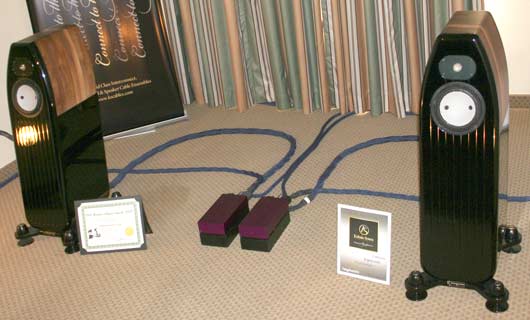
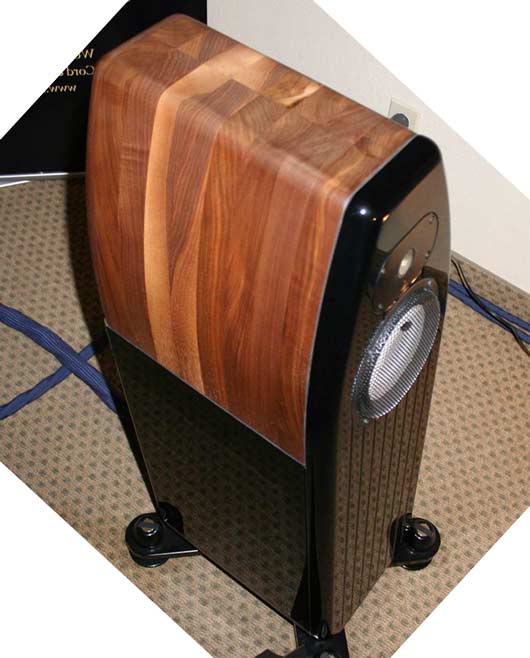
The KHARMA Mini EXQUISITES: THE EXTENDED SHOW REVIEW

This CES 2006 room review was added after the report had been published and so is available here as well.

The Kharma mini-Exquisites – like the Kharma 3.2 but with a diamond tweeter and made to look a lot like its bigger brother, the midi-Exquisites. Driven by the small Kharma amps and MBL electronics with Kubala-Sosna cables.

The Kharma room
The Kharma Mini Exquisite room at CES 2006

Very engaging, very musical in that classic, ‘what we want music to sound like this’ fashion. Not so much a ‘you are there’ presentation like the Marten Coltrane Supremes – more like a ‘you are alive and feel good about it’ kind of thing. I really loved the sound in this room – for a small scale system it really does ‘it’ for me.

We described the sound of the Midi Exquisites driven by Lamm amplification at the Home Entertainment New York show in May, HE2005, as being almost drug-like, like a magnetic force it tried to suck you into the music, and, if you let it do this, if you gave in to it, there was a rush of feeling and emotion that swept one away, flying with the music.

The ASR amps on the Midi Exquisites, at this show, did not have the same effect, on me anyway, for whatever reason, but the Mini Exquisites…now they had an interesting effect, though somewhat different, from my perspective. Instead of having to consciously ‘let it’ do its magic, the magic just ‘was’. And whereas the ‘magic’ was thick and dense, like a hot summer night with the Midi Exquisites / Lamm system, the Mini Exquisites were light and airy, like a sunny Spring day.

The Mini’s magic was less intense, but more accessible. Perhaps this was in some part attributable to the better support the Mini had for an audiophile-quality presentation compared to the Midi system – I was able to relax more because the Mini presentation was more balanced and more realistic – albeit at a smaller scale.

Lots of detail, stable imaging, good separation, a rather narrow soundstage which we blamed on the room, good dynamics, and bass was scaled nicely to the room. Based on our two, admittedly short auditions, we think these are a slam-dunk, you are going to be so happy, upgrade for people who have the similarly sized Kharma 3.2’s and have had the money for the bigger Kharmas, but not the room.

In fact, I have a sneaky suspicion that the little 2-way 3.2s may have been the best speaker, for my tastes, of any in the amazing Kharma lineup of much more expensive speakers – and that now I have found a new ‘best’ speaker, the Mini, also a 2-way, with more of the Kharma magic and more of the audiophile attributes that make the music both more realistic and enjoyable.

The associated equipment is interesting: warm, smooth, and somewhat detailed MBL into a small (sized anyway) detailed solid state amp. The system was quite detailed sounding and engaging. It would be interesting to put these speakers on something more conventional, like Lamm amps and Meitner digital. THEN, with this cross-section of equipment, we could perhaps pinpoint the location in paradise these speakers come from – or whether, after all, they are from planet earth like most other speakers.

Oops, being a little overly effusive, I am. Time to turn Effusive menu option to OFF.

Only problem is the price: $45K. At this price it is going up against the similarly-priced Wilson Maxx II, Acapella Violon, Marten Coltrane, Avalon Eidolon, and Audio Note speakers.

Let’s discuss the competition some.

The Kharma room
The Mini Exquisites are for small to medium sized spaces for people who want engaging and startlingly emotional and detailed renditions at the expense of having less detail in the low bass.

The Lamm room
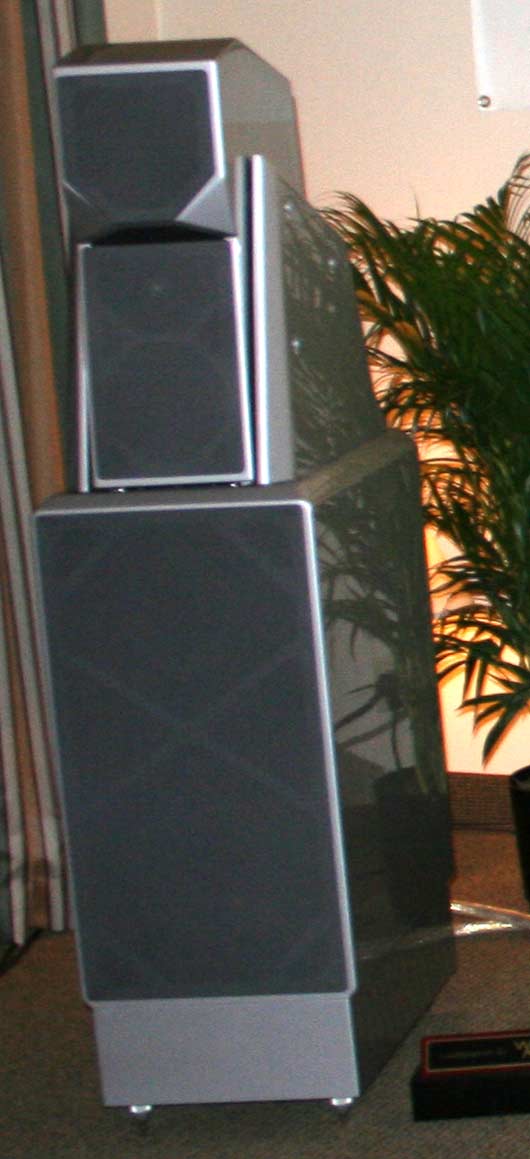
The Wilson Maxx 2 is for larger spaces, and for people who want an impressive sound: large scale soundstages, midrange and bass details, and dynamics at the expense of an almost complete lack of emotional capability and some unruly behaviors like drivability and an overly enthusiastic treble / upper midrange.

The Acapella room
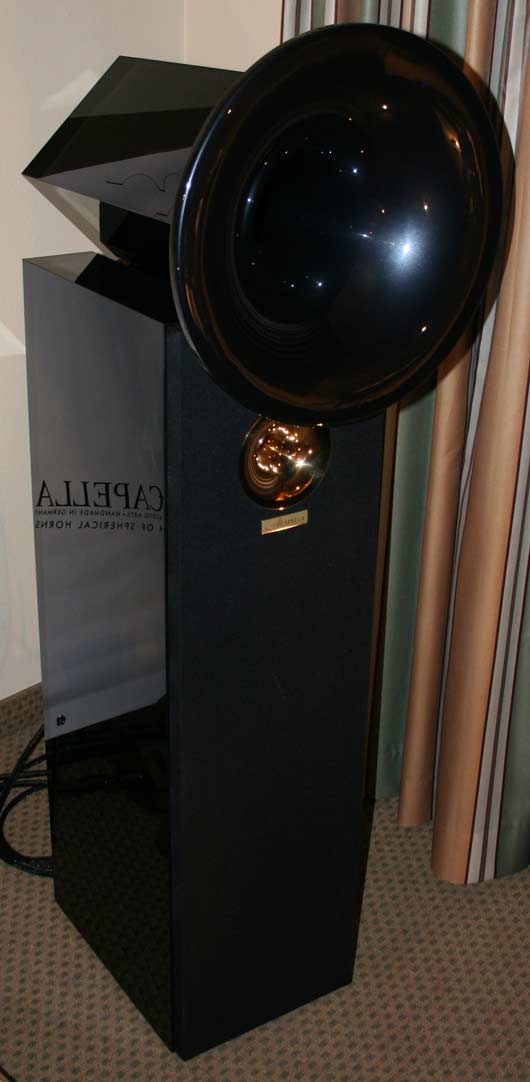
The Acapella* Violon is also for larger spaces and for people who like a very natural musical realism and large engrossing soundstages at the expense of some bottom end slam.


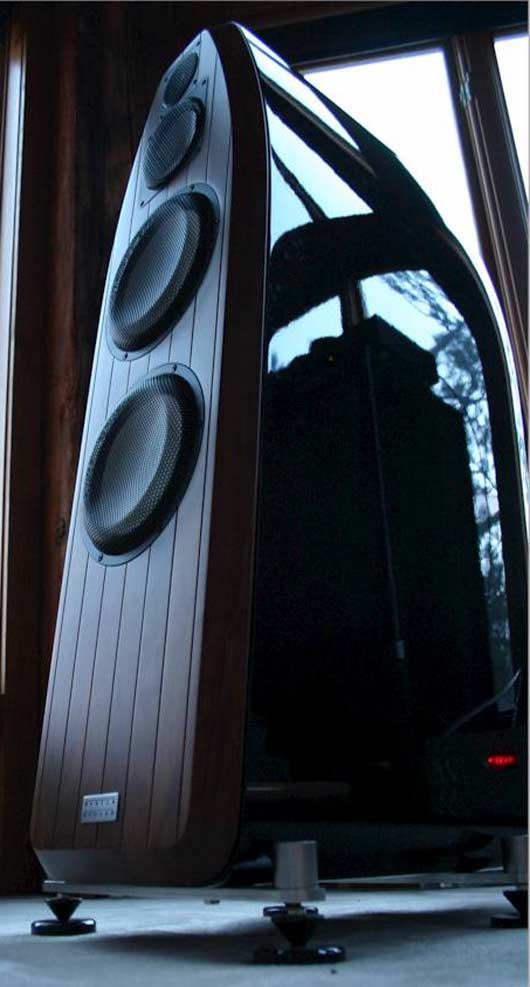
The Marten Design* Coltrane speakers are for people who like a very accurate and realistic presentation, at the expense of not having a big and open type of sound.

The Argento room
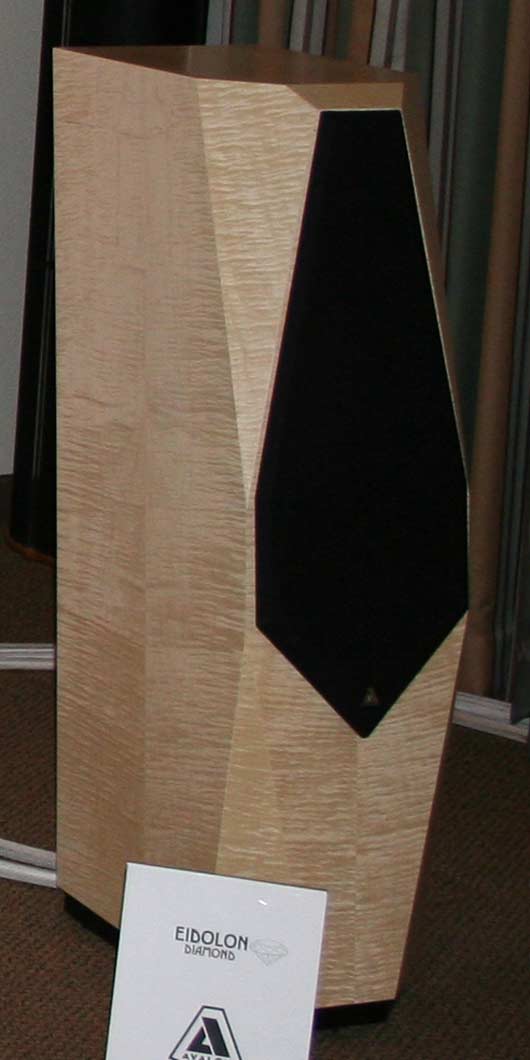
The Avalon Eidolon Diamond is also for bigger spaces and people who like emotional yet dynamic presentations at the expensive of deep bass control and drivability

The Audio Note U.K. room
The Audio Note* U.K. AN-E SEC Signature is for smaller spaces, like the Mini, and for people who want very dynamic and exciting and harmonically rich and detailed presentations, supplied by the necessary Audio Note electronics upstream, at the expense of looking at a box.

Looking at this run down – it seems that there is indeed a place for a $45K 2-way speaker, as much as this price for a relatively small speaker may make us uncomfortable. And that place is for people with relatively small rooms who still want one of the best, no compromise, musical experiences that money can buy.

The only alternative, from the perspective of this quick survey, is the Audio Note speaker, (though the Coltrane speakers are known to work very well providing a full-range experience in as small a room as 12.5 x 16 feet) and it is also an expensive 2-way speaker – albeit one that can be driven by that amazingly pure first watt of a small SET amplifier – and it does not quite have the visual presence and beauty of the Mini, but then few speakers do.

The COLTRANE SUPREMES : THE EXTENDED SHOW REVIEW

This CES 2006 room review was added after the report had been published and so is available here as well.

We spent the end of the show listening to the Marten Design* Coltrane Supreme speakers, with Bladelius electronics, Jorma Design* cables and the Power Wing power conditioner.

This system re-created the recording venue nearly as well as the Acapella Triolons here at the Audio Federation, on a smaller scale but with more resolution. Nothing else comes close in our experience to this kind of feat. Everything else creates this simulacrum, this hoax, which requires you to forcibly suspend belief to imagine that there are real ‘musicians’ out there.

On the Triolons, you don’t have to do this nearly as much, and this leaves our poor overtaxed brains much more free to ponder the quality of the musicianship, the score, the soundboard engineering, the art, the spirit, the love, the meaning of it all. To see much, much deeper into music’s other dimensions than just the physical dimension of vibrating compression waves moving through air.

This difference has had a unexpectedly intense emotional impact on our perspective of what music is, and on our lives as a whole. Seriously, this just isn’t a fucking stereo anymore.

The Coltrane Supremes gave us a taste of this. We would love to have them here and put our favorite electronics on them – and see just how far we could push them. To see just how far they could take us.

Picture from the show
One channel of the 2-channel system at the show

The Swedish Statement room presented a sonic experience that was incredibly true, but not in that in-your-face style that so many large, high-end speakers do these days. It make take a few minutes for a listener to relax and realize that the music here is not a parody: it is not pumping the bass dynamics in your face to impress, not spotlighting midrange detail to distract from a uneven frequency response (these speakers are +/- 1.5 dB up and down the scale). All aspects of the performance, EVERYTHING is absolutely top-notch in quality, and EVERYTHING is treated fairly, nothing has more tone, more jump factor, more warmth, more presence, sharper images, more stability in the soundstage, than anything else.

To be clear: very, very few speakers in the world are able to do this. I would say that just about none of them even try. They try to make something that sounds pretty damn good, pat themselves on the back, and go home.

So here you have a sonic presentation that sounds and quiets and quickens and slows just like it is supposed to, just like what our brains have been wired to expect and treat as real for millions of years. What does this do for the listening experience? It allows us to relax many of our layers of defenses and buffers and filters and shields we have built up around our listening processes to both protect us (from physical damage, from harmful and socially unacceptable psychological reactions, from headaches, from who knows what else) and to interpret for us what we are hearing.

When was the last time you heard a piano and had to think ‘that is a piano’. I challenge the listener to hear a piano on a stereo without thinking ‘that is a piano’ AFTER considerable, (and lengthy, taking perhaps up to 1/2 second, causing much of the music to be lost while we are trying to determine ‘just what the hell was that note, anyway?’) mental calculations and interpretations.

These mental gymnastics often consist of a little voice in our head that narrates a process that goes something like “that was a single note, so it has to be a guitar, piano, harp, or some kind of electronic effect”. Then we rule out things: “I didn’t hear a pluck (assuming the system is capable of rendering such a thing, stick in probability factor here that there was, in fact, a pluck), so it is not a guitar or harp. It wasn’t an open ended kind of decay, so it might be an electronic keyboard, but was there an associated sound of the echoes in the piano body? Hmmmmm… that was awhile ago now, lets see if I can pull it from the very short term aural memory…” Oops, song is over already.

The solution for most people to this dilemma, of not being able to tell what they are listening to in real-time, is to not even care. They enjoy the tune and the bombast, and do not care that they do not, and cannot, hear or understand what the musicians are actually doing. There is absolutely nothing wrong with this. You can still groove to the tune, tap to the beat, and get a smile on.

Ginevra de' Benci  - National Gallery of Art, Washington, DC

But if you, personally, think there is a difference between a snapshot of a woman’s face and a painting by Leonardo da Vinci (if you have ever seen a Leonardo painting in person, you know exactly what I mean),

if you personally want to experience the art and the majesty, the talent and the skill and the message and the emotion and the awesome delicacies and complexities of the human condition as communicated by the musicians to listeners just like you throughout the ages, then perhaps a system like this is for you.

WHY WE LIKE WHAT WE LIKE – THE SEQUEL

I think what people often want to know is the details about why we like one thing and not another.

In our report we say we do not like a particular line of amps because the sound it generates is compressed and lacks air and micro-dynamics and a sense of rhythm.

I suppose you may ask: Don’t all amps have similar problems? If it is so bad, then why oh why is it so expensive? My dealership says they sell a ton of them, if they are so bad, why do so many people buy them? The print media say they love their products and gives them ephemeral awards periodically – don’t they see and hear everything – why wouldn’t they know if it was good or not?

I will try to answer these hard questions, though to some degree the real answer to most of these questions is that people in general are not logical and often do not make the wisest or most enjoyable choices in life. Just look around when you are out driving at all the different models of cars people are buying – many of which are known to be pretty darn poor examples of engineering and safety and are really unpleasent to drive.

Don’t all amps have similar problems? The corollary is: there are always tradeoffs when you can’t buy the best, aren’t this amp’s tradeoffs valid?

No, all amps do not have similar problems. Well, yes, they do, but not in this magnitude, they are not this gross. They do not stray from the Path such a large distance. And, yes, these better amps exist, even at this price point. These other amps are just not carried by your dealer, or are not hooked up at your dealer because they are not as impressive for the customer who spends only 20 minutes to a few hours listening to a system before buying.

If it is so bad, then why oh why is it so expensive?

One reason is that, in the set of all amps that are designed to impress a customer during short listening sessions – amps that are priced less are worse and amps that are priced more are better. Dealers have a tendency to carry things that sell well. Things sell well that have good marketing and a good supply chain. This costs money. But let’s be fair, construction, materials, warehousing, offices, parts aquisition, design, all cost money. There are vrey few people in this industry getting rich.

My dealership says they sell a ton of them, if they are so bad, why do so many people buy them?

The customer who spends only a small amount of time listening to a system before buying, often with few comparisons available at the given price point, is likely to be impressed by IMPRESSIVE systems. A highly musical and realistic system will be nice and relaxing but a LOUD and agressive system with oodles of bass will often be an obvious improvement over their smaller system at home. And there will be little doubt in the customer’s mind that their (male) friends, who also will not be listening to the system overly long, will also approve of the purchuse. They in fact, may go out and based on their short yet oh so impressive listening session at their friends house, buy a set of those amps for themsleves. In this way the systems-that-are-unpleasant-to-listen-to-for-extended-periods virus spreads. This is true of other consumer products as well: it is well known that speakers that sound brighter sell better in showrooms, as do video screens that are overly bright and colorful.

The print media say they love this company’s products and gives them ephemeral awards periodically – don’t they see and hear everything – why wouldn’t they know if it was good or not?

Well, for one, most reviewer’s systems suck. The average audiophile often has as good of sounding equipment as the average reviewer. Putting a component into one of their systems, often a balancing act of bright vrs. dull, dynamic vrs.compressed components, is asking the component to particpate in this balancing act. And if the component is not ‘bright’ like the component it replaced, or compressed, like the component it replaced in the system, then the reviewer will not like it. And, realisitically, in systems like this they will not even hear the component, masked as it is by the problems in their other components.

For another one, most reviewer’s rooms suck. Well, that again make them like the rest of us.

Reviewers are also nice people, they know the manufacturers personally. It is really, really hard to say something negative about a product a friend is involved with. It makes you feel like a shit (and I should know. The only counter to this is the forlorn faces and extreme distress of the really, really upset people who save and scrimp and finally buy something that they really can’t afford, only to come to find that it sounds like hell, even though the industry and net hype led them to belive otherwise).

And finally, the real answer is: The industry lives on Hype. All consumer industries do. It is what keeps the industry (magazines, manufactureres, dealers, forums) alive between innovations.

So the short answer is: no, they do not know if it is good or not, except in a gross, it didn’t blow up, kind of way. And nobody cares.

Well some people care.

Some people are angry at this situation and want to do something about it.

We are some of those angry people. And yeah, we get some flak for saying what we say – but not all that much actually – most people are good people, even in our hobby / industry 🙂

UPDATED THE FOLLOWING SECTIONS OF THE REPORT

The MBL section was unclear and could be misinterpreted [at least, it was by Neli, but she is my wife, it is her job to missinterpret everything her husband says. But upon re-reading the section when awake, I decided, of my own free will, to improve it a minor amount :-]

The section realy addresses the ideas I have been thinking about how to get others involved in this hobby – and I have a tendency to use shorthand ‘key phrases’ which I know what I mean by but nobody else will, so…. I think it is better and clearer now. I hope.

Neli added significant content to the Cogent True-to-life horn, the Alexis Park ‘Continuum room’, the Acapella Violon room and the Globe Audio Marketing (Audio Aero) room and a number of other sections I can’t keep track of it all anymore: In a few days when google goes through the report search for “Neli says:”.

WHY WE LIKE WHAT WE LIKE

Imagine that there is a path from the most basic system that you might like to the most extravagent, perfect system.

All along this path lies systems that you like at their price – you pay a little more, you get closer to your perfect system.

This path is multi-dimensional, in that there are systems that you like that are slightly off the path, for example in the direction of having a little more bass than that which that point, that price, on the path requires. This wiggle off the path in one direction requires a wiggle away from one or more other directions, for example more bass might entail less microdynamics.

It is my beleif that the Path is the same for everyone but that the acceptable wiggles, deviations, from the path are personal, different for each person.

It is also my belief that large deviations from the path, systems that over-emphasize a particular sonic feature at the significant sacrifice of one or more others, are folly.

Examples of such follies are legion, but in abstract terms, this includes the following, common, systems characteristics:

* Over emphasis of detail at the expense of harmonics – very common in less epxensive solidstate and digital sounding systems
* Over emphasis of dynamics at the expense of continuousness and balance – very common in horn-speaker-based systems
* Over emphasis of smoothness at the expense of detail and dynamics – very common with less expensive tube amps, usually on hard to drive speakers

Our Best of Show categories in the CES 2006 show report are fuzzy descriptions of way stations along this path – every stop along the path, every category, should include all the capabilites of the previois categories. This fails for the ‘Impressive’ category because of the energy, design, and room requirements of large amounts of bass.

Our Best of Show systems list systems that seem to be along the Path, deviating, perhaps, from the path in ways that are acceptable, from our point of view.

To illustrate these points, I will describe a few syatems that we like but did not make the Best Of list, and why.

The Oskar Heil speaker system – I love the Oskar Heil speakers; for $6K or less you get a massive amount of musical detail in a very easy to drive load. The only problem is that the bass is not very detailed or all that well integrated with the rest of the frequency spectrum. This is still almost squarely on the path because of the low cost – all the extra ability to render massive amounts of detail of the Heil driver are ‘thrown in for free’.

This year, however, the amp used, presumably in order to control the bass a little better, had a little less harmonic content and continuousness/flow in the midrange – so all the detail revealed by the speakers did not provide the vision into the music that I know the speakers are capable of.

For me, this was a wggle, a deviation too far from the path in the direction of bass control at the expense of harmonics and continuousness and smoothness. But it didn’t wiggle very far so it was a difficult decision whether to put it on the Best Of Show list or not – and I am STILL pondering it.

Another example is both the Lamm / Wilson and Kharma / ASR systems:

At these price points we are very far down the path. There are a lot more stringent requirements to be on the Path at this level. Some of these are the ability to handle complex passages while maintaining separation of the individual notes (it doesn’t just collapse into a molassus of noise) and image stability (two or more instruments playing at the same time should have as solid and cohernet of an image as when they were playing solo). These two systems failed in this way.

These systems apparently traded scale and bass and impressiveness for these capabilities. But I feel these capabilities are necessary to be on the path at this level (and even at somewhat lower levels). The restriction that only simple music can be played, or that one must close one’s mental ears during complex passages is not acceptable at this level, and that to get back on the Path these capabilies need to be restored, perhaps at the expense of a little bass or adding a few more $ (for example adding vibration control platforms underneath the components or trying different combinations of cables, perhaps even the same brands, and seeing if this might do the trick).

Well, this is getting long. Hope this helps answer a few questions…

CES 2006 SHOW REPORT IS FINALLY….

… more or less done. Spelling and factual corrections will be added over time – but the jist is now there….

CES 2006 Show Report

This year we have up approximately 1000 detailed pictures – with the commentary about each room that stood out in some way right there with the picture. Finally, we have our usual ‘Best of Show’ lists in the ‘Official Report’.

Enjoy!
Mike & Neli

CES SHOW REPORT – ALL PICTURES PROCESSED AND UPLOADED TO WEBSITE

THE CES 2006 SHOW REPORT

This year we tried to get to as many rooms as possible and are putting up as many of those pictures we took as were in focus and interesting.

Each picture has to cropped, resized and, often, tweaked (the Canon Rebel XL has real problemd with dark rooms and resolving shades of gray) in Photoshop.

One thing I came away with is just how much stuff is out there and how much effort everyone puts into their room – almost everyone brings a LOT of stuff to the show.

Next is to try and annotate each photo with technical details and any listening impressions we may have had.

In general our show reports tend to be more ‘experience-oriented’ (i.e. ‘what were these people thinking?’ or ‘the soundstaging is positioned in an arch above the speakers’) rather than ‘brochure-oriented’ (i.e. ‘the price per watt exceeds the national average of MOSFET-based amplifeirs by 100,000,000.6%…’). It was my fustration with the ‘brochureware’ that was passing for show reports in Stereophile that led me to start writing these show reports in the first place.

And, yeah, I am still sick as a dog (do dogs really get so sick?) and kind of ‘out of it’ – so here is the deal:

If you disagree with what I write, then I was mad with fever when I wrote it and didn’t know what I was saying. If, however, you do agree with what I have written, then I was recovering nicely and in complete control of my mental facilities – inasmuch as one is ever in control of such a thing.

STILL AT CES AT THE ALEXIS PARK

Where is everybody? We’re here, where’s everybody else?

Due to a misunderstanding, we thought that T.H.E. Show was its usual 5 days, and that it would end on Monday, not Sunday at 6 (which was more like 4:00 as everybody was packing up early).

Oops.

Ever year we usually stay at the MGM Grand and walk to the Alexis Park and back once or twice a day… it is about a 25 minute walk each way and is only a pain if we (me) forget to bring a coat, because the show ends each day after dark, at 6:00 pm, and it cools down fast here in the desert. Then it turns into a 20 minute walk.

But after 2 days at the MGM Grand, in a tiny little room costing an embarrasingly large amount of money each day – Neli managed to find a couple of vacant rooms at the Alexis and we did the move on Saturday morning.

Anyway, so here we are, staying unwittingly a extra day for no good reason. Outside there is the ringing of pipes all day long as they tear down the tents that covered all the walkways – just in case it rains or snows or, who knows, it might get a blazingly hot 100 degrees here at CES one of these years.

And now I caught a cold (I am so happy it decded to pay me a visit AFTER CES). So I stay here in the room, coughing and wheezing – apparently working on the show report (I mean, seriously, what else is there to do when laid up with a nasty cold in a hotel room?) on this laptop (that is 10 times slower than my PC with its 4 GB of memory, Raptor disk, Radeon X1800XT 512MB video card…. argh)….and Neli goes shopping (she says she is trying not to get the same bug that has me by the throat…).

Day 4 is about done, and I am starting on Day 1. Kind of backwards, but Day 4 was fresh in my mind – and, well, we were the ones that thought the show was 5 days instead of 4 – so you just have to expect that mixups like doing Day 4 before Day 1 is to be expected here at the Belfry.

This year we tried something a little different – trying to see every single room. Didn’t make it – still missed Ray of Sound, Cabasse, and one of te Magico rooms – and who knows how many others. But we did see a LOT more than we usually do. Wow. There is a lot of interesting technologies and people at this show. Hopefully we can convey some of the color and bewildering numbers of really pretty darn good equipment that was being shown at CES ths year.

AND WE'RE OFF TO SEE THE …. 2006 CES in LAS VEGAS

The old-style HRS rack, the Audio Aero Prestige monoblock amplifiers, the prototype Audio Note transport… all have gone to the show – and we are following.

We will update our show report as often as possible during the show, and of course the full report will follow the show by a few days.

This year we are flying, using an airplane, because last year a blizzard kept us from driving, which is what we usually do. Of course, this year it is in the 50s and 60s all the way…


The LAMM ML2 monoblocks are now on the Marten Coltranes, where the Prestige amps (and later the EDGE Signature One amps) were until recently. First impression was Wow. The solidity of the images with the Lamm is just astounding – and entertaining. I feel like a kid with some of this music as it wafts back and forth between channels. Yeah, I guess I am easily amused – but not to death (seriously, I have not tried that CD yet, although it is infamous for such playful aural tennis court activities).

The pair of Valhalla interconnects you see streaking across the floor in the forground are the cables that connect the output of our phono-stage, the Lamm LP2 Deluxe, in the other equipment rack in this room to the Coltrane system.

Sometimes we like to play vinyl, either the Brinkmann Balance or the Walker, on the Coltrane system. Kind of have to avoid stepping on (or worse, tripping on) the cables, but what else can one do? You gotta get the music to where you gotta hear it – and we can’t let the SoundLabs have ALL the fun!

Anyway, packing for Las Vegas… Camera? Check. Camera accessories? All dozen of them, check. Laptop? Check. Laptop accessories? All dozen of them, I hope they work in the hotel and we don’t get too many viruses from the hotel network, ….check. Demo CDs? Ooops. Almost forgot those.

I hope something sounds good there. I know a lot of people are thinking they are just going to exhibit at the RMAF show now.

And a lot of exhibitors do not care if their rooms sound good or not – counting on their sales and marketing team to woo the dealers to carry their equipment. Kind of sucks for those of us who go there to hear things. But I guess a lot of these equipment manufacturers have dealers who take the same approach as well – wowing with jargon and sales instead of presenting their customers with a good sound. It may be a nasty thing to point out – but it seems like that is just the way it is – our industry is no different than any other in this respect.

In contrast, here, we wow people with music and smiles – Boulder does not have much use for salespeople, anyway, and we aren’t good, and don’t want to be good, at the lie-till-they-buy shtick…. Our approach works for most folks, but, amazingly enough, I think some people actually prefer the hype and confrontational hostility of your typical dealership – it is what they have come to expect. We just confuse them.

Lately though, people are starting to learn to expect something different, something new: to just click and buy…and this sea change seems to have no end in sight. So then CES, whose very existence is for manufacturers to display their products to dealers, signing up the dealers to carry these products, will have what purpose when there are no more ‘dealers’?