Pursuing the Ultimate Music Experiences

Audio Federation High-Fidelity Audio Blog

Please Don't Feel Guilty if You Decide to Buy Something Somewhere Else

[This post will make a lot more sense to our family of customers than to those of you who are our virutal guests out there].

We have met a LOT of really nice audiophiles over the years (and a lot of nice people in the industry too 🙂 )

So many people, who we have actually come to like quite a bit, whether as friends or as compatriots on the rocky road to audio bliss, call us back after awhile and feel they have to profusely apologize for not buying our X or Y and instead getting somebody else’s Z.

We appreciate the sentiment. We really, really do. Thank you.

But what we really want is for people to call back (or email) and not so much apologize (uh oh, I am starting to sound like Mal on Firefly) but tell us about how ‘Z’ sounds in their system. We can’t buy and try everything out there – and we are probably just as interested in what your experiences are as you are in ours.

Yeah, of course we would like people to buy things from us, in no small part because we think we got the really ‘good stuff’, man.

But we do not carry everything. Actually we do not carry many lines at all (and it seems like we are carrying fewer lines each day :-)). We are so very careful about each line we pick up that it seems to take us forever to find one we like.

So, if after everything is said and done you end up buying something from somewhere else, It is OK.

Really.

Or maybe you decided to hold off and not buy anything for awhile, perhaps because nothing completely bowled you over, or your monetary situation changed a little… That is OK too.

And if you decided to buy it off one of the audio auction sites – well, you know, that is OK too. We sell extra equipment on the net too and the buyer of our stuff must reside in somebody’s dealer area. If we were not dealers we would be tempted to buy some stuff off the net too. Heck, we are tempted now… some of those equipment prices up there are lower than what we can get them at.

Hmmmmm… Can I say that? Neli? 😉

But really, what I want to say is that we have come to really like a lot of you people – and we know that some of you decided… to…. buy… something…. somewhere…. else.

No worries, man.

Where No Low Powered Amps Have Gone Before

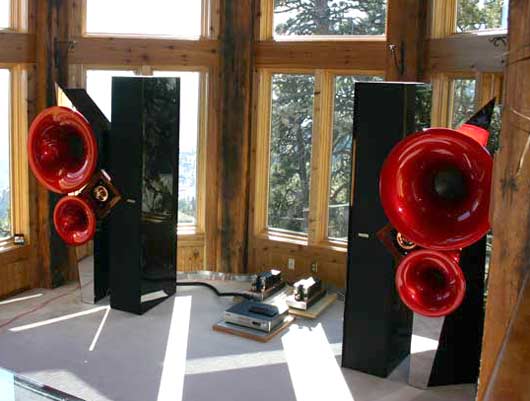
I really like the low-powered Lamm ML2.1 18 watt SET amps on the Marten Design Coltrane 89dB sensitive full-range speakers.

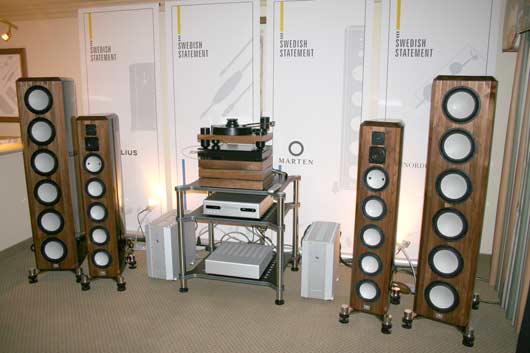
The Lamm ML2.1 on the Marten Coltrane speakers
Coltrane speakers, ML2.1 amps, Lamm L2 preamp, Audio Note CDT2 and DAC 4.1x Balanced, Nordost Thor and Valhalla cables, Shunyata power cords

I really liked the Audio Aero Prestige 40 watt amps and the Audio Note Kegon 22 watt amps on the Coltranes before that.

No, they don’t generate that adrenaline rush of a really loud presentation with chest thumping bass.

The Coltranes can do this with the right amplification. And it is really fun. In a Homeresque Whoo Hoo! kind of way.

But the little tube amps on these speakers can hold me…..

SPELLBOUNDDDDDDDDDDDDDDDDDDDD

The little amps are able to grip the speakers pretty darn well. They also show off immense amounts of harmonic detail. etc. etc. etc. etc. etc.etc. etc. etc. etc. etc.etc. etc. etc. etc. etc.

But it is not about all this analytical crap at all.

It is all, everything, completely, about the fact that the …Sound… Grips… Me.

The Lamm ML2.1 on the Marten Coltrane speakers

Yeah, It helps that the speaker has a very high resolution, a speaker with all ceramic drivers and diamond tweeters has a tendency to do this. It helps that the speakers are full range, so that whatever bass the amps put out, the listener gets to hear. And they put out a lot of bass – make no mistake – but it is analog bass, like bass in the real world, and not electronic bass (which some ever larger percentage of our music these days likes to use and here is where the little tube amps on hard to drive speakers really do take a back seat to solidstate amps).

But this is not about how the speaker or system sounds.

It is not.

This is about how the sounds affects the listener.

In the end why should I care about the sound, beyond a certain minimum standard, any more than I care about the minute contruction details of the chair I sit in, or the the type of weaving and glue the carpet underneath my feat uses? What we CARE about REALLY is how comfortable the chair is; about how pleasant the carpet is to look at and feel underneath our feet.

What if all reviews and all show reports paid attention to nothing except how the sounds …made …them …feel.

I bet the Stereophile list of Class A components would look a lot different than they do now.

El Capitan of 6MOONS to Move to Europe

Yes, head honcho Srajan Ebaen says [last paragraph. No I don’t understand exactly what he is saying in the rest of the piece, either – though some of it seems to refer to our machine-like behavior patterns, ala the Fourth Way, and how this affects our audio equipment acquisition habits. Other parts… are, uh, not so clear to me, sorry]….but he is moving himself and the 6Moon HQ to Europe, while still keeping the American staff here going on all cylinders.

6moons logo

We always got a nice warm and fuzzy feeling knowing that Srajan was close by, down in Boulder’s sister city of Taos, New Mexico (some people think Santa Fe is our sister city… but they would be mistaken 🙂 ). Taos is a scenic 7 hour drive (or 6 if Neli is driving,… 5 if Neli is driving and Mike is asleep) from Boulder, which is where we hang our hats.

Not that either of us has visited the other, or anything, lazy bastards that we are. Yeah, yeah, we are every one of us so busy these days – but when does being so busy all the time translate into just being too lazy to spend the time to better organize our lives? Uh, a very long time ago for me, but this isn’t Oprah’ s blog, so we will …just….move….on…. Thank you.

Anyway, hopefully we’ll still see Srajan zooming through the hallways at high-end audio shows here in the U.S., intensely talking to someone or another, with this pleasant expression of extreme focus that always seems to result in one of the best show reports in the world.

Keep raising that bar, Srajan!

And thanks.

-Mike & Neli

Revamping the Speakers Page in the Audiophile's Guide to the Galaxy

A lot of the Audiophile’s Guide needs a facelift – most especially the equipment racks and turntables, not to mention the categories that are still empty.

But the Speaker category is now down to 8 speaker manufacturers, and if it continues in the current direction it will be down to 6 the next time I get near it with the delete key…And one can forsee a future in which the last standing manufacturer gets the axe – all because the current approach is flawed in a number of ways:

    It does not take into account that some speakers from a manufacturer are really much better than other speakers from the same manufacturer

    It does not take into acount the different goals for a system, each separate goal possibly arriving at a different ‘best’ speaker.

    It does not take into account room size and other possible constraints that affect the choice of ‘best speaker’

The new format will try to take these things into account by:

    Listing speakers instead of just manufacturers

    Adding categories to represent the different goals systems (people) have like ‘Impressive’, ‘Emotional’ etc.

    Taking into account small, medium and large room sizes

Not sure how we are going to organize all this data yet. But we are working on it.

Then we can add manufacturers like Sonus Faber and MBL to the list of best speakers – as they do have privilaged places in the speaker world – with respect to very specific sonic goals – just not at the top of best of the ultimate.

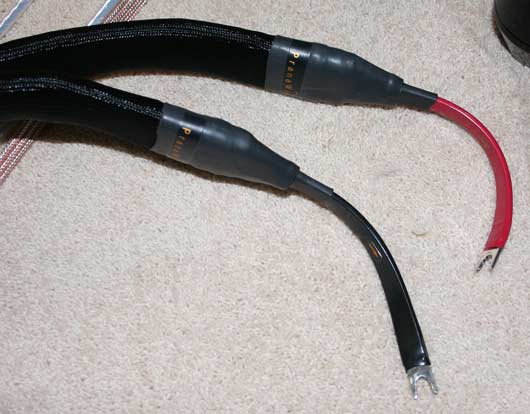
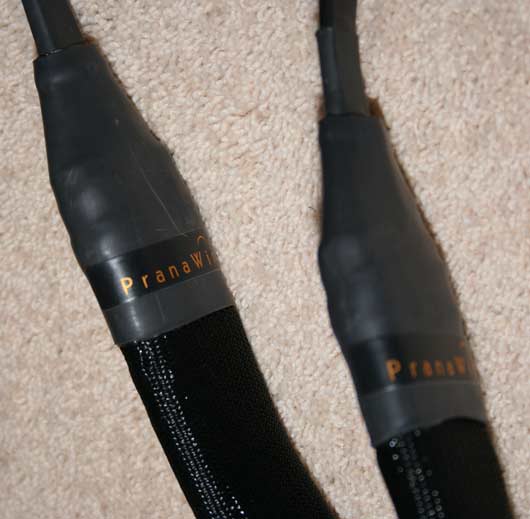
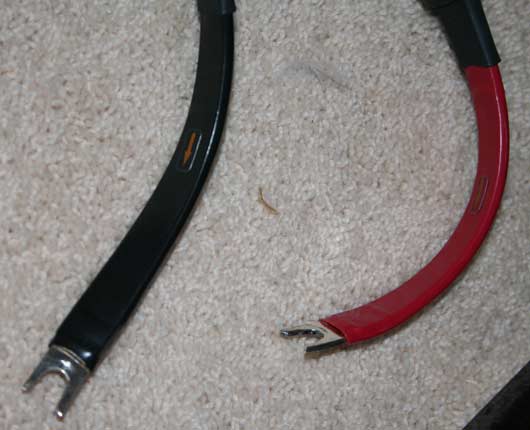
PranaWire Cosmos Series Speaker Cable

Life.

Not liveliness – which usually refers to bouncy dynamics.

Not warmth – which usually refers to 2nd harmonic distortion or rounded notes or slightly exaggerated decays of notes.

Not color, exactly – which usually refers to rich tones

Life.

It was very easy to hear, as we switched back and forth between the PranaWire Cosmos speaker cable and either Valhalla or Jorma Design No. 1 speaker cables during an audition a month or so ago. But very hard to describe.


The Cosmos speaker cable was single wire, and the Marten Design Coltranes need bi-wire, and the Acapella Triolons need tri-wire (though we still tried them on these speakers, but we were not able to determine much given the fact that the differences in the cables were causing annomolies in the speaker’s performance). But the Sound Lab speakers are single-wired and this was where we performed most of our listening.

While listening to the Sound Lab U1’s with the PranaWire, one could easily come up with description words: engaging, somewhat more dynamic – though more like a different distribution of dynamics for the various notes… no that is not right, joyful, colorful. But none of these simple description fit very well.

Colorful is a good description, but again maybe not, as people tend to use this word to describe exaggerated harmonics.

Or maybe a mix of “dynamic separation, color and a little warmth”.

nope. That’s not it.

So that is why I call it ‘life’. The music was alive. And when we took the cable off it was like we took out the music and shot it. It was like going back to watching black and white TV (for those of you old enough to remember such antiques).

The music just… died.


Not that the other cables do not do a top-notch job – we are very fond of them. They did not have any etch or glare and were not overly lean (especially with the Audio Aero Capitole driving them). The Sound Labs sound wonderfull full and detailed and dynamic with these other cables.

Yes, even with the PranaWire, there are always tradeoffs, and here the tradeoffs are a slight compression and congestion in the soundstage, especially during loud complex passages. Stuff I did not notice until the music was quite loud, and never noticed at all on very loud video soundstracks.

For various reasons we do not carry the PranaWire here at the Audio Federation at the present time, not to say that we will not someday in the future – we like Joe Cohen a lot and he seems to be able to put up with us, too.

Expensive? Definitely.

Hard to bend into position? Not so bad as you might think (and not nearly no how no way as bad as any of the higher end power cords we have here, but then again, that is setting the bar pretty low :-))

Was this just a special synergy between the Sound Labs and the PranaWire? I do not know.

But do I think about these speaker cables each time I listen to the SoundLabs? I try not to.

~sigh~

The Cogent True-to-life Horn Speakers at CES 2006

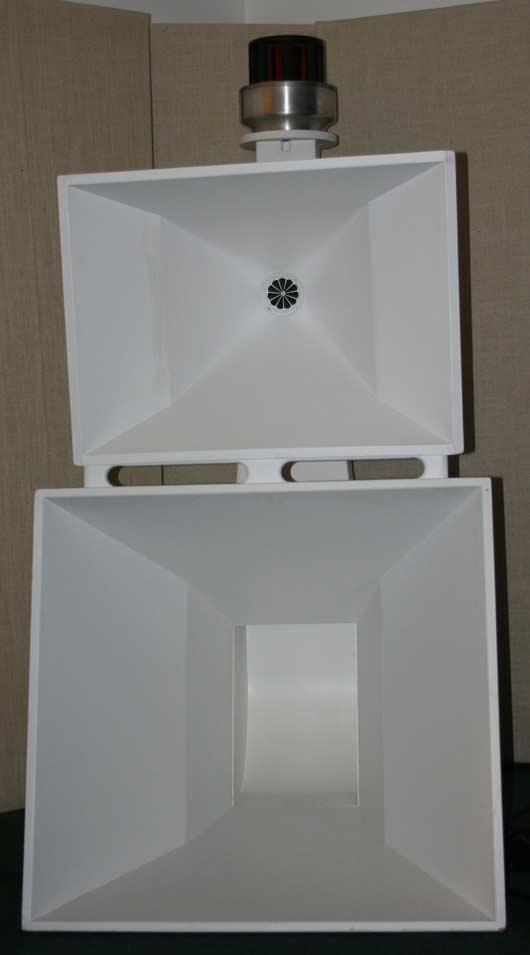
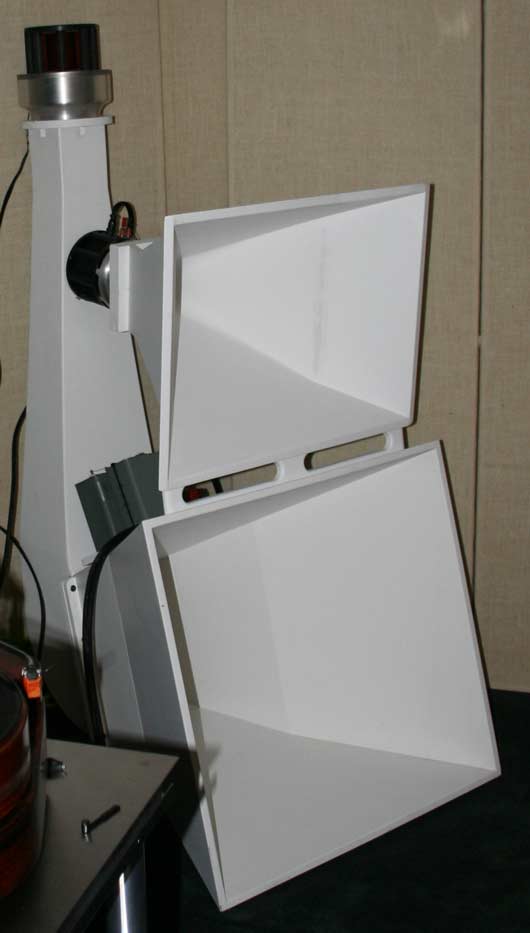
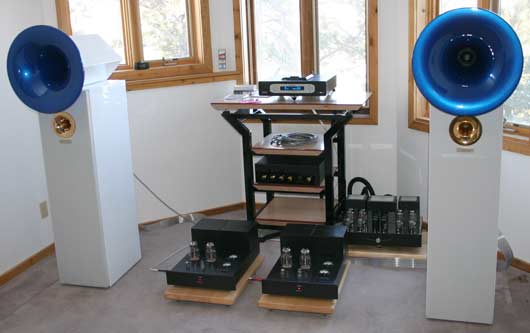
Two large white squaring horns, one on top of each other, for each speaker

Still thinking about these speakers and what their impact is going to be, both on me personally, and on our industry and audiophiles in general.

Although the speakers had numerous problems (speakers did not dissapear in any way, horn resonances and reflections along with buzzing and dullness in the subwoofer and no real highs to speak of) they did some things so very, very well that it makes me wonder…

These speakers were one of the very few (two?) horn speakers that do not have offensive, to me, horn colorations. They reproduced transients in their target frequency range effortlessly. These kind of REALISTIC (not overly exaggerated, not compressed and muffled) transient details we have heard only with the best speakers: Marten Design Coltranes, Kharma Midi Grandes (with the Tenors), and the Acapellas can do this – usually requiring very careful amplifier pairing and it comes off not quite as effortlessly – often with more of a ‘the speaker is gripped really hard by the amp’ sound. The SPACE aorund the microdynamics was awesome. The timbre was very, very rich. The sound was very big and open (somewhat an artifact of the nearfield listening position).

Two large white squaring horns, one on top of each other, for each speaker
So, did you notice that I am describing sounds and not music? Nothing about whether a piano sounds like a piano, whether sounds were properly positioned and imaged in a realistic soundstage (it was not too bad, as Radiohead Amnesiac played back well and that first track stresses this exact thing, amoung others….:-)), whether the dynamics was balanced between the quiet sections and the loud, etc. etc. etc. Whether these are done well, poorly, or excellently, I cannot answer given the extreme nearfield listening position and because I was, addmittedly, hypnotized by other aspects of the sound at the time of listening.

A Mythical Commercial-Quality Speaker Built Using Cogent Hardware and Designs

Two large white squaring horns, one on top of each other, for each speaker
Will audiophiles like and buy such speakers? Their ease of drivability with even modest sized amps and their kick-ass dynamics seems to be a win win situation. The problems as I see it are the lows, the highs, and the appearance.

The lows at CES were produced by a very large folded horn subwoofer. This configuration will just not be acceptable to most people. So integration with a common standalone subwoofer would be required. It would also be great if the Cogent speaker went down to 30 Hz. so that the speaker could stand-on-its-own without requiring a subwoofer but this may be impossible while still keeping the rest of the frequencies pristine.

The highs were absent; as I understand it everything above 10K Hz was left to the listener’s imagination. One of the numerous super tweeters, for example the Corona plasma tweeeter, could, however, be paired with the Cogent horns to provide the necessary high frequencies.

The appearance, which is already quite good and certainly better than all of the GOTO and ALE horns I could find on the net, is still not as livingroom friendly as most people would probably prefer. But a little work on the paint job, using a composite material instead of wood for the construction, a nice veneer, and perhaps adding a little curvature to both strengthen the horn to minimize resonances and to minimize those reflections of sounds off of the room back to the horn and then back to the listener’s ears.

So here we then have a speaker that uses 3 different technologies, each the best at reproducing music in its frequency range. Integrating these different technologies into a seemless whole will take work and genius. Sound familiar?

These will also be expensive. Figure a minimum of $50K for the horns (it costs $32K for the drivers alone), $5K for the subwoofer, and $5K for a super-tweeter. $60K is expensive – and a speaker this expensive will probably require a dealer network, so add some on top of the $60K for that.

So, the answer to my question – will this be really popular with audiophiles, is I do not know (I know, all this and I cop out at the end. The real answer is yes, for some audiophiles, yes. But Wilson Audio does not need to get too worried yet). There are a lot of weird speakers out there in the $60K to $100K range – with a lot less potential than this one.

Further reading on the Cogent horn speakers at CES:
Audio Asylum

A funny thing happened on planet Abraxas

The first track on Santana’s Abraxus, “Singing Winds, Crying Beasts”, is one of our test tracks.

This track has revealed some supposedly top-flight systems to be incapable of managing the etheral ‘sound angels’ flying in and out and around the soundstage.

Abraxas cover photo

While listening to the Marten Design Coltrane Supremes I was struck with the a very interesting, some might say bizarre, 3D impression of some of the notes in this song. Now, this happens to me a lot when I am falling asleep, Jazz and Classical music seems to not be ‘heard’ anymore but instead transformed into moving, interlocking 3D soundscapes that I fly around in.

Hey, those white coated fellas can just stay where they are, thank you anyway.

But in the Marten Design room at CES, I was awake! I mean it WAS the last day of the show and all, but seriously….

Triolons
O.K. First I will describe what I usually see when I hear the sounds, in this case, the tiny bells that kind of fade in and out at various places in the soundstage during this song, while listening to the Acapella Audio Arts Triolon Excalibur speakers.

What I see is this:

It is right after a fresh snow, and it is very cold so the snow is not sticking to itself or anything else, it is very fluffy but not so fluffy that it does not have a good ratio of water to size. The sun has come out and is shining on a large number of very tall pine trees. A gentle breeze comes up and sends a number of snow flakes dancing, as they are wont to do, in all directions: up down swirling bouncing gliding…As some of the 100s of flakes hit the rays of the sun that are penetrating through the bows of the trees, the flakes ‘light up’, temporarily, in a prismatic flash of dozens of pure colors alternating with pure white snowflakeshine, before they are again returned to invisiblity as they reenter the shadows to be replaced by a 100 others. These flakes are small, about 1/2 inch or smaller.

These sparkling, flashing swirling colors popping in and out of existance is what I ‘see’ when hearing these bells. This more or less seems like a normal kind of thing to ‘see’, to me, and corresponds pretty well to the ‘type’ of the sound. To me.

Supremes
But. The Coltrane Supremes….

What I ‘saw’ was weird, man.

What I saw were these aluminum things shaped like Cheeto corn chips, in kind of an unpolished silver metal color varying between 1/2 and about 2 inches long and about, I guess, 1/8 inch thick. They kind of faded into existance, moved a little bit closer then a little bit away from me, rotating a perhaps up to 45% during this time period, before they faded out again. There was a gentle diffuse white light playing on these ‘bell chips’.

I cannot let myself beleive that the resolution was so good in that room that I was ‘seeing’ the sides of the bells as the overall sound outlined their shapes as it bounced off them and into the microphone. I mean, SACD has a lot of detail, but this is crazy.

Anyway, I wonder if other people sometimes see music as ‘things’.

And I also wonder if sometimes they also experience visual musical shapes that sometimes come unbidden and are shockingly different from what they normally ‘see’. While they are awake.

The Audio Note U.K. OTO Integrated Amplifier

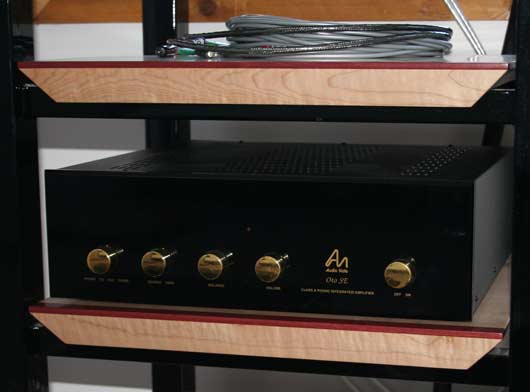
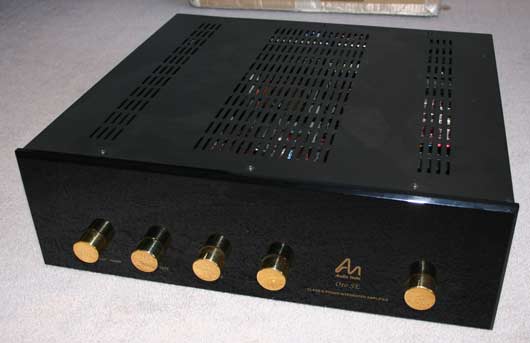
We had the Audio Note OTO SE here for a few days before it went out on audition. The OTO is a 10 watt Class A single-ended EL84-based integrated amplifier. The one we had here had a phono stage and retails for $3100.00.

So, we thought, what the hey and put it on one of our hardest to drive speakers (second only to the big Sound Lab U1 electrostatic speakers), the Acapella Violon High Sub.


Here it is on the Rix Rax driven by the Audio Aero Capitole MK II (it is not actually hooked up in this picture as we had a Violin audition and needed to show just what it was capable of and used the $20K Lamm ML1.1 mono-block amps for this purpose).


A close up of the OTO on the equipment rack.


The front of the OTO. You can kind of see the inside of the OTO here. There is a lot of stuff in this chasis, this thing is heavy! 30 lbs if it is an ounce – but that is just a guess since I had to carry it down the 45 steps.


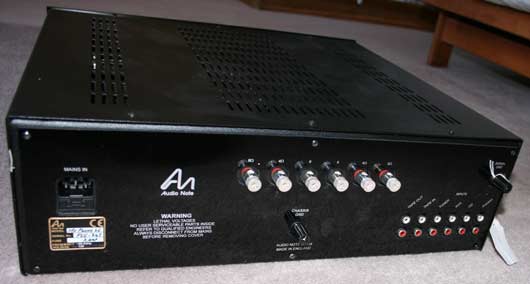
The Rear of the OTO


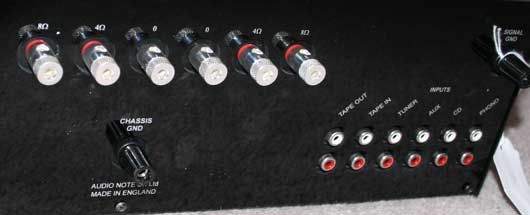
A close-up of the rear of the OTO.


A close-up of the controls of the OTO.

The OTO actually sounded pretty darn good on the Violons. We heard the OTO, driven at that time by the Audio Note U.K. CD2.1x CD player (discontinued. Only $1000 but was about $1750 new, also out on audition, so no pics, sorry), right after CES and at low volumes (it IS only 10 watts) that system was better than most, well 99.9%, of all systems we heard at CES.

Yeah, this at $52K (not including rack) , is an expensive system including $48K speakers and the rest on the OTO, CD2.1x and Audio Note cables … oops and add a couple of $K for Shunyata power cords – but is was just so pleasant and musical after the sonic hysterics of CES.

The little CD player had less bass than the Audio Aero, which kind of worked well on the Violon High Sub (with built-in isobaric subwoofer) in that small room.

There were a few tonality problems, and it ran out of steam when we got it to around 90dB or so. But if *I* had only $53K or so, and a small room, and I knew I would be able to upgrade the upstream components later and get a larger room… This somewhat lobsided system would be near the top of my list.

Maybe we should do a piece on lobsided systems – usually I think the key to the best sound is Balance Balance Balance (you Brinkmann Balance turntable fans can stop smirking now :-)).

But it seems there are always special cases.

Its ALL Technological Mumbo Jumbo

[This is a hard concept to get across. Suffice it to say that humans know very, very, very little of the science behind what makes a good sound system – and hold on to your wallet around people who imply otherwise]

Now here I go defending Reviewers, after blasting them last post. Just goes to show that things can always get worse.

Most reviewers (there are exceptions) seem to be able to avoid the ‘self-appointed technological expert’ syndrome which is for all intents and purposes almost indisinguishable from the ‘sales techno-babble daze and confuse them in buying what you are selling’ approach.

To put it simply – Whenever someone says that a product is better than another because of some technological detail – they are lying.

This is true in any technological arena – and any real expert will tell you that we as a species don’t know diddly and what we do know has so many qualifications and constraints thatr we might as well not know anything – and in the end it is all just theories and models. That is just the way science works, sorry.

So then we have the Audio Perfectionist, whose role apparently is to, well in the automobile universe it would be to berate auto reviewers for not spending their time informing their readers that the Porsche is a very badly engineered product (in comparison with the Honda and Toyota, for example) and is therefore not worth 1/10 of the asking price (i.e. the car or product should sell for little more than the cost of its constituent parts).

For example, to state that time-aligned speakers are better than non time-aligned speakers is B.S. Even saying that they are more accurate is B.S.

What is not B.S., but verging on meaninglessness, is to say “From what we know about human hearing, a time-aligned speaker will seem to image better and seem more realistically dynamic than a non-time-aligned speaker, all else being equal”.

“All else being equal” requires us to imagine two speakers that are absolutelyidentical except one is time-aligned and one is not. Of course, making the one speaker time-aligned will in actual reality cause side-effects that might render the speaker less ‘real’ and distort imaging – just those areas that time-alignment is trying to improve, so this statement means very little in the real world where you and I listen to and buy speakers.

And we can go on. Suffice it to say that ‘statements’ like the B.S. above, are only true, if they are true anywhere, in an extremely simplified imaginary view of the world. I am not sure that people really want to spend their hard earned dollars on something whose value is based on somebody else’s fantasy life,

whose only goal seems to be the evangelistic promotion of our era’s archaic definition of what accurate sound reproduction is, from spinning aluminum and vinyl disks no less.

Archaic because scientists know almost nothing compared to what they will know in decades and centuries hence – so evaluating equipment based on what is essentually voodoo may not be very smart if you are technologically minded. And things like…uh…. musicality and enjoyment do not appear anywhere in these kind of voodoo doctor proclamations of what has ‘quality’.

It just seems like a bad buying decision to me to buy something you do not like. Hey! It took me a lot of years, and a lot of cars and speakers and cables… to figure this out. Everyday we talk to people who are seriously considering products based on specifications, build quality, measured performance, reviews….people who are just like me.

That is why it is important to actually go for a test-drive and listen to something to see if you like it and not just read the specs or a reviewer’s description of the component’s construction and measured performance.

[Then we have Romy’s critique of the same Wilson MAXX II speakers, coming from a more experiential perspective, much more in the line of how we think speakers and systems need to be evaluated. Why he liked the referenced Audio Perfectionist article, I couldn’t tell ya]

*There are so many examples of this. Another is: “This amps sounds more organic BECAUSE it is using 1% Vishay resistors” B.S. Does it sound more organic? Listen to it! More organic than what? Than no-name cheap-as-dirt resistors from the Far East? Well, I guess it is nice of them to spend the extra buck. But what else is in the system that we are supposed to be listening for the sound of a few resistors in? The electrical music signal is going though a LOT of things, even inside all but the most simple of components. And the system! It is one gigantic, very, very complex technological-ecosystem; it all must work together in harmony. Each component is affected by every other component. Still trying to pin-point the sound of those resistors the saleperson is touting?

The best scientists using the biggest super-computers in the world can only partially simulate a tiny fraction of this system. And gurus, and salespeople, and manufacturers can’t tell you why it sounds exactly the way it does, either.

All you can do is listen. For yourself. It’s OK, take your time. Enjoy the music while you’re at it.

THE STEREOTIMES CES 2006 SHOW REPORT

I didn’t know they were doing a show report, so I just recently added a link to theirs along with everybody else’s on our show report’s main page.

I particularly like Frank Alles’s report. There is no link to it, because they use frames, but if you click on ‘Show Reports’ at the top of the Stereotimes site and then scroll down using the scroll bar way at the right side of your browser, then you should see a link to it. The pages load slowly so you have to be patient.

He says something about the sound of each room, and you can read between the lines in true carefully-parse-what-the-reviewer-said-to-get-the-secret-message-of-what-they-are-really-saying fashion to determine more or less what really went on. And he lists a number of favorites and runners up, …

all of which Did Actually Sound Better Than the Majority of the Other Rooms!

Well, this guy is in big trouble now, and will probably be run out of Reviewer Town for not throwing in the minimum allowable FUD factor (Fear, Uncertainty, and Doubt) that is required in each days allotment of information disseminated to the Audiophile Community in microscopic packages like some Information Age version of the legendary Chinese water torture.

I’ve never heard of this guy – which don’t mean squat but let’s pretend I do infact remember a name for longer than the refresh rate on my LCD monitor here – and maybe that is the secret. If nobody knows you, you are perceived to have no power to persuade or inform the masses – so you can say more or less describe what you actually heard (Well, he does say it in a nicer way than I do – but here in geek land, clarity of expression is valued more than in Politics and Show Reviewing).

Or maybe it is the age that is important – there are a number of younger reviewer types over at Positive Feedback – they do not appear to have soldout, or perhaps worse, to have so much at stake that they no longer hear what they listen to.

Whatever it is, there comes a time when their days as a hard-hitting reporter are over. Now the days of wine and the never-ending-auditions have arrived. All they need is the page in the thesaurus for the word ‘best’ and thick-skinned ears and they are ready for stardom. Woo hoo!

If by some chance of fate this happens to us please let us know. If there is ever a consensus (and we will be checking where the emails come from so if they all come from the folks at Stereophile it just won’t carry as much weight, sorry) that we have finally soldout to become just another cheerleader – we will shut down Hifi’ing show reports and the Blog – and contemplate the misery of our fate.