Pursuing the Ultimate Music Experiences

Audio Federation High-Fidelity Audio Blog

An Advanced Audiophile Exercise Regimen

Being an active audiohpile can be both great exercise, and at the same time requires one to be very fit.

We are talking specifically about ‘active’ audiophiles who mix things up a lot. You know, audiophiles who are on a first name basis with the FedEx guys and gals.

In order to compete against other audiophiles for the title bout in the Audiophile Strongman Competition, the following are recommended exercises:

1. Carry a 120 lb amp up and down 45 steps.[builds strong legs and biceps].

2. Now carry the 120lb amp up and down the 45 steps while it is in its crate. [builds character]

Extra bonus points: Do it while it is snowing and icy.

Extra extra points: Do it while it is very hot and humid while it is snowing and icy

3. Lean over and plug in a power cord into a hospital-grade outlet. At an ackward angle such that one cannot use your body weight to help get it in. Now un-plug it, again without using the body’s weight, and plug it back in. Do it 10 times. Do not electrocute yourself. [builds finger strength and popeye forearms].

4. Practice routing a very stiff and large power cord under a rack and up and over into a power strip. Now do it for a transport, DAC, preamp, and 2 monoblock amplifiers. [develops analytical skills and legendary patience, along with an abilty to ignore situations of disturbingly low aesthetics].

Extra points if the lightweight power strip is made to remain in its correct horizontal orientation.

5. Bend the legs and lean precariously on tip toe over $50K+ worth of delicate and very hot equipment, putting one arm around the front of a equipment rack to stablilze a component while using the other arm around the back to plug in a cable. [develops the core muscles and a nerves of steel].

Extra points if the cable has a WBT NextGen connector which requires two hands – or in this case, one hand using precisely controlled fingers that hold, stabilize, push and twist the connector, over and over again, until it is in place.

Subtract points if the component ends up cock-eyed because of imperfect stabilization technique.

Subtract more points if the WBT did not go on all the way precipitating an embarrassingly loud ground loop. Take two Advil.

6. As quickly as you can [grasshopper], Take a CD out of a top loader CD player / transport in a single movement [builds precise motor control of the finger tips] and put it into a front loader so that it sits perfectly center in the tray [develops a precise feeling for the weight and aerodynamic capabilities of a silver disc].

7. Queue up an LP while straddling a half-dozen power cords, two SET tube monoblocks, a preamplifer’s power supply and without leaving any finger prints on the equipment rack.[Develops a care-free yet zen-like appreciation of the workings of the world].

Extra points if all of the beginning of the first track on the record is prefectly audible and at the correct volume.

Subtract points if the cartridge falls off the outside of the record.

8. Route 100 cables, power cords and interconnects, of various sizes, of various robustnesses, of ridiculously high but damn well worth it cost, in and around components without scratching either the components or the equipment rack. The wiiiiide equipment rack. Witn one side of the rack blocked off by a piece of furniture that appears to allow enough room to get behind the rack but in fact does not. With minimal room lighting. While playing Led Zepelin REALLY really loud. [Develops an ability to curse with the best of them].

Subtract points if a red cable goes into a black connector.

Subtract more points if an input is connected to another input, or an output to an output, and for any cables only attached at one end.

Extra points if the lengths are such that only some cables will only reach to some components, requiring a super-computer-like capacity planning algorithm to be running in one’s head to figure out what goes where.

Extra extra points if the final arrangement of all these cables was actually the optimal one for this system.

——

Those are just a few of the exercises that many audiophiles do, every day, as they prepare for the Audiophile Strongman Competitions. I.E. modifying a typcial system on a typical day.
Amplifier Shootout – Audio Note vrs. Lamm vrs. Audio Aero vrs. Audio Note

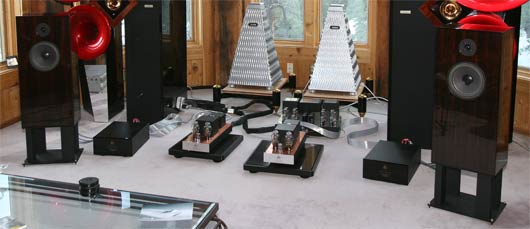
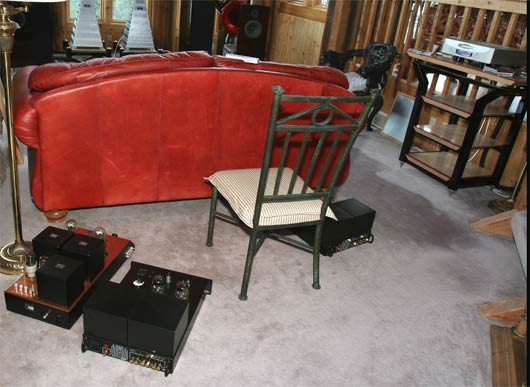
We held a shootout here a few days ago – $85K Audio Note Ongaku versus $22K Lamm ML1.1 versus $10K Audio Aero Capitole versus $9K Audio Note Conquest Silver. Prices rounded, so don’t quote me to Neli :-).

The Audio Aero Prestige as serving as CD / SACD player, and sometimes as linestage as well. The Audio Note AN/E Signature loudspekaers were serving as… speakers.

So, with the disparity in pricing – it wasn’t really a shootout. More an investigation into different sounds – how the different amps sounded, given that they are indeed so very different from each other.


We finished up with the Audio Note Conquest Silver 300B amps.

We will try to describe the *differences* between the sounds, as opposed to the sounds themselves.

Going from the Audio Note U.K. Ongaku to the Lamm ML1.1.


The Ongaku and ML1.1 amps resting behind the couch after their workout during the shootout.

The sound was not as big with the Lamm, somewhat more compressed – but perhaps more even-handed because the somewhat rolled-off deep bass [which lends the deep bass a compression-like signature], because of where the speakers were located [in front of the horns, which are out of here as soon as the snow melts. If it melts.].

The Lamm sound was more laid back, the soundstage receeding somewhat, which allows one to better appreciate the music in measured doses when desired, as opposed to being transfixed unable to move for whole CDs at a time [from this description I hope people see that we like both types of soundstaging – really depends on our mood at the time].

The Lamm harmonic color was a little grayer, and the dynamics, as mentioned above, a little less exuberant. This goes in keeping with our general interpretation of the Lamm sound as being stately and sophisticated, natural and self-consistant.

This is not to say that the Ongaku is an exuberant amp either – it is actually quite balanced, unexpectedly so from my point of view, with just a little flavor from the use of the 211 tube. We still have a lot to learn about Audio Note, but it is my current impression that as you move up in the Audio Note line, things become less colored and more accurate and therefore much more revealing of the color and subtleties of the music itself, quite unlike anything else out there. This seems different to me from the brands that, as you go up their line, you get more and more improved versions of their ‘house sound’. ‘Course, you can always tube roll the amp and get just about any sound you want – but I think the point has been made.

Going from the Lamm ML1.1 to the Audio Aero Captitole amp

The Capitole was sweet in comparison with the ML1.1. More euphonic, rounder, less resolution and transparency. For some reason, about half of the people we talk to these days are conscously steering away from high-resolution sound – so this amp, with ‘just enough’ resolution, should really be on everyone’s short list. No one really knows about it, but, especially teemed with the Capitole or Prestige CD player, you can get a really wonderful, Enjoyable and slightly Sweet, sound.

Going from the Audio Aero Capitole amp to the Audio Note Conquest Silver amps


The Audio Note Conquest Silver amps in play. The Audio Aero Capitole amp behind, resting.

Easiest to compare these to the Ongaku.

Less density. By which we mean less resolution, less micro-dynamics, less macro-dynamics, less color. Just less going on. But at the same time, note by note, it was the same: the notes were where they were supposed to be, the rose and fell like they are supposed to, they were just a little thinner sounding. OK, a lot thinner sounding.

Thinner sounding isn’t exactly ‘bad’, though, There is a lightness to the music, very similar to the experience of the $11K Kharma 3.1c versus the $45K Kharma Mini Exquisite, which I think is largely a psychological, not electro-mechanical, experience that is quite pleasant and refreshing. That sometimes a ‘lighter fare’ is as enjoyable, to a listener, as the full-featured experience.

Kind of like comparing the Simpsons [the old shows which had content] with a James Bond movie. One can enjoy both. But one generally prefers, and will actually pay more money for, the Bond movie.

Well, depends on the particular Bond movie 🙂

Current Showroom Setup

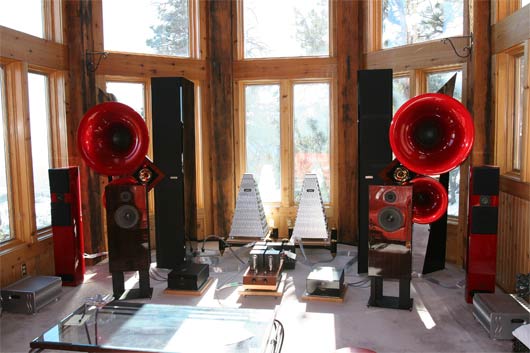
The main listening room is the same as last week, with the Audio Note Ongaku driving the Audio Note AN/E SEC Signature speakers, but with the Emm Labs CDSD / DCC2 SE digital as source replacing the Audio Aero Prestige, which has moved downstairs…

This room did experience a major amp shootout, more in the next post about that…

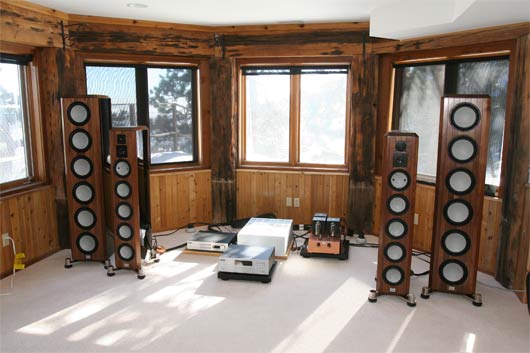
The showroom #4 is also the same, with the Kharma MP150 amps driving the Audio Note speakers, which at 98 dB are very eifficient… with the Audio Aero Capitole CD player / linestage as source, this system sounds really good. I’d like to hear any other digital amp, or most solid-state amps for that matter, do that.

Showroom 2 has seen lots of changes…


First we had the Emm Labs CD / SACD player with built-in linestage driving the Audio Note Kegons into the Kharma Mini Exquisite loudspeakers. THAT was nice…


The we moved the Meitner upstaitrs on to the Ongaku (can you say transparency? separation? purity albeit not as warm and enaging as the Audio Aero Prestige, but more convincing. So many flavors.) and did the front end with the Audio Note DAC 4.1x Balanced and CDT3 transport and M10 preamplifier.

Much more control and control and, uh, control. Everything was as it was supposed to be. Unfortunately, the 18 watt Kegons have found their first speaker that they just could not get the hang of – at loud volumes – and we’ve driven just about everything here with the Kegons except the soundlabs. The 18 watt Lamm ML2.1 also has problems with controlling the Kharma speakers at loud volumes. Based on what we have found, they really sound best, if you want them to go loud, with the Edge Signature One and Kharma’s own amps (the MP 150) if you want transparency and openness and control, and the Lamm ML1.1, a 90 watt push-pull tube amplifier, if you want tube musicality and openness and control.

We have yet to try the all powerful Ongaku at 25 watts on these though…. Maybe tomorrow?

For showroom 3, which is in the same room as showroom 2, we have…


The Soundlabs taking a break, but not the Marten Design Coltrane speakers, Lamm L2 preamp, LP2 phono stage and Brinkmann turntable / Titan cartridge. Audio Aero Prestige is performing digital source duties.


This is one of our favorite systems. However…


We had to position the Coltranes in front of the Soundlab U1. Impromtu but it seems to work pretty well. I mean, needs lots of trweaking – but we think it will work! The Coltranes like being close to the front wall, and the Soundlabs are kind of a wall…

Now Neli wants to move the Supremes over here on this side of the room [and in front of the Soundlabs!?] , as the dedicated circuits on the other side seem like they are picking up FM radio, secret transmissions from Mars, and other weirdness on several different systems that have lived down at that side of the room.

I now think it is ghosts.

But Neli, if her expression is any indicator, thinks otherwise.

Audio Note Ongaku – At Night

Just a bunch of photos tonight…

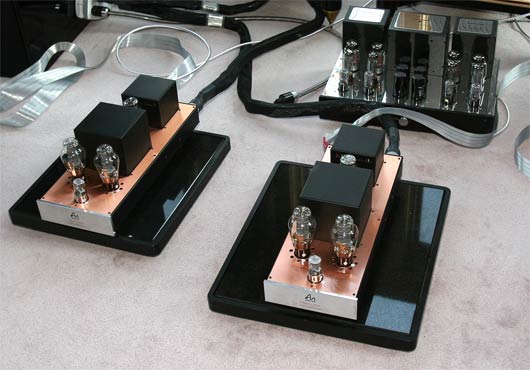
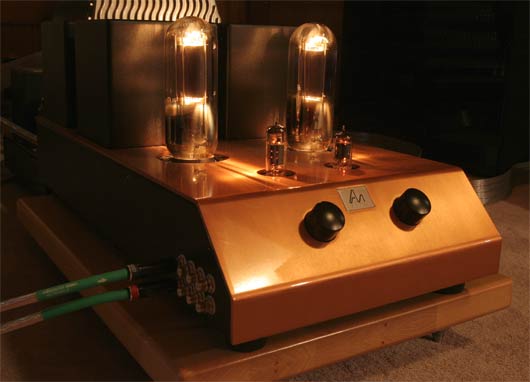
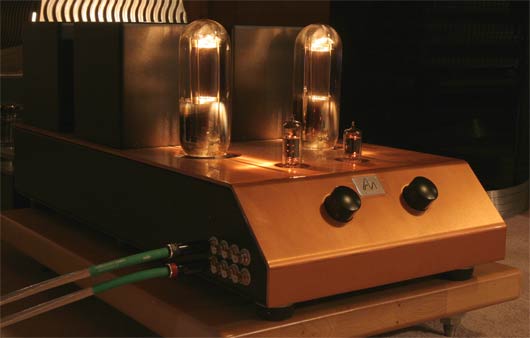
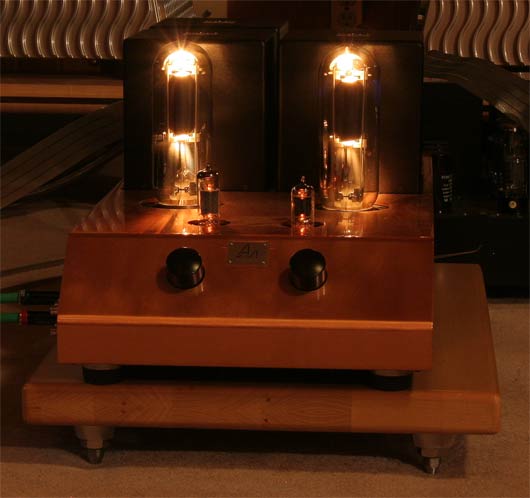
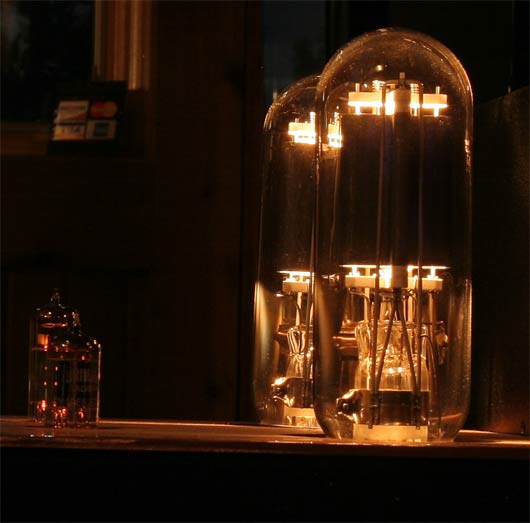
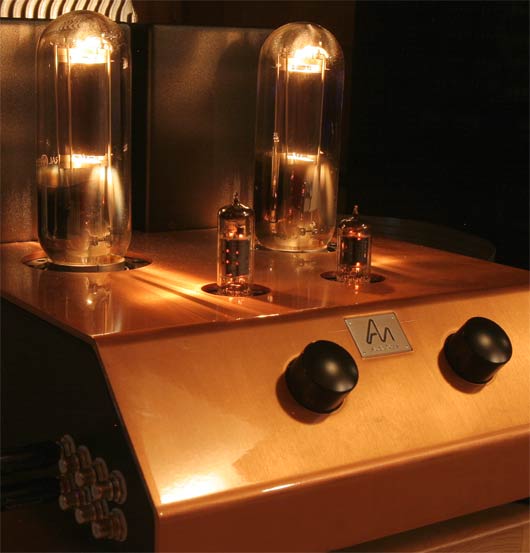
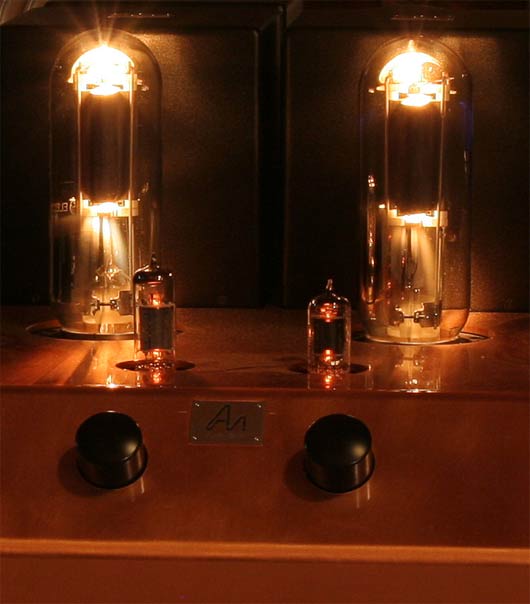
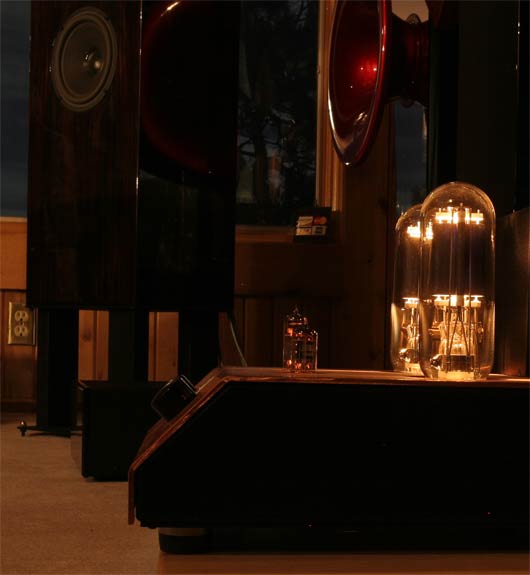
The Ongaku is an $85K single-ended triode integrated amplifier that uses two 211 tubes to generate about 25 watts of glorious sound into just about any speaker on the planet.


Audio Note U.K. Ongaku at night with 211 tubes a glowing…


Audio Note U.K. Ongaku at night with 211 tubes a glowing…


Audio Note U.K. Ongaku at night with 211 tubes a glowing…


Audio Note U.K. Ongaku at night with 211 tubes a glowing…


Audio Note U.K. Ongaku at night with 211 tubes a glowing…


Audio Note U.K. Ongaku at night with 211 tubes a glowing…


Audio Note U.K. Ongaku at night with 211 tubes a glowing…


Audio Note U.K. Ongaku at night with 211 tubes a glowing… with AN/E SEC Signature speaker in background.

Audiophile 101 – Reviewers

Reviews of audio equipment are compromised because reviewers are compromised. They cannot be trusted.

Both print and online magazines are compromised because one never knows if they are writing positive reviews in response to advertising dollars, or trying to solicit new sources of advertising dollars. One thing is proven, that bad reviews chase away advertising dollars.

Online magazines are compromised further by the fact that reviews are ‘linked to’ by the manufacturers of the equipment that was positively reviewed, increasing the magazines popularity with search engines, which attracts more traffic, which allows them to raise their advertising rates.

Reviewers also are compromised by:

1) Having to conform to the stated policies of the magazine they work for

2) If they do not write positive reviews, manufacturers will not want to lend them equipment for the next review

Dealers who write reviews are also comprimised because no one ever knows if they are saying something in order to try generate more sales.

Individuals, which includes reviews at the above mentioned magazines and dealers, are firther compromised because:

1) One doesn’t know if they are an idiot or not

2) One doesn’t know if they are a shill or not [for those that don’t know, and apparaently some do not, a shill is someone who pretends to be an individual but really works for a dealer or manufacturer]

3) One doesn’t know if they are just conforming to the natural human tendancy to praise the equipment they currently own [and disparage that which they no longer own].

4) One doesn’t know if they are just trying to praise, or disparage, a piece equipment because they like, or do not like, its particular manufacturer.

————–

The point is that all reviewers, and therefore all reviews, are compromised.

They can’t be trusted!

Or can they?

What we can trust is that some reviewers care about their reputation. How they see others see them, and want others to see them.

What we have is:

** REPUTATION-BASED TRUTH **

Both institutions (like magazines and dealers) and individuals (reviewers at those magazines) have reputations – good or bad, or just plain weird.

The argument here is that you CAN TRUST People, and Organizations to more or less behave and write reviews in accordance with their view of their reputation, based on how important that rep is to their personal views of themselves, to their personal self-worth.

——

Take, for another example, TV news reporters.

Edward R. Murrow – apparently [sorry, before my time] had a reputation based on his dedication to telling the Truth.

Some popular networks, and their reporters, have a reputation based on the consistant ridiculing of other’s political ideologies. They can be ‘trusted’ to report in a way that always conforms to this reputation they and their organzation have.

Some reporters whole reputation is built around their ability to get the next scoop, the next Big Story, not having anything to do with the truth, necessarily.

——

So, back to audio,

We have some magazines whose reputation is built on all the published reviews being positive (Positive Feedback [see this recent castigation of non-positive reviews], Inner Ear)

We have some whose reputation is closer to that of Murrow, but which is distorted by what they judge to be ‘truth, but in a responsible manner’ (Stereophile, 6moons). [Here we start entering the domain of serious reporting ethics, the necessity of having to report news without ever having ALL the facts – something too serious for this post, or this website].

[The Absolute Sound and HiFi+ seem to have a mix, there being so obvious, to me, reputation associated with the magazines as a whole, except that of this plurality of reviewers with different types of reputations].

Then you got the ‘Malcontents’, as Inner Ear called them this month [are we malcontents? I hope so :-)]. These peoples reputation vary, sometimes being just ways to publically express their need for anger management, or remedial logic 101, classes. Our rep, as I see it, is that we try to shed light on the very high end in a ruthlessly honest, but inclusive, manner – in a way that seeks ways to explain the what, how and why that the high-end is not just some morass of similar sounding components all rated ‘A+’.

You also got your netizens, who consistantly praise their own equipment as being the very, very best the world has ever seen, and disparage everyone else’s as either ‘been there done that’, or ‘being privy to a special network of only the best audiophiles [i.e. not you! :-)], I have heard that your gear sucks in comparision to my gear’. Their reputation, as they see it themselves, is built upon some variation of everyone thinking that they have the best equipment in the world.

—–

The point is, they are all behaving in accordance to what they want their reputation to be.

Some people care about their own reputation. Some not so much. The ones that care the most seem to be the more consistant reviewers: Mike Fremer, J.A., Srajan for examples.

But it is not a given that their reviews are ‘better’, or worse, than that of other reviewers. It is just that some reviews can be trsuted to be written to be within the context of the individual reviewer’s, and their organization’s, reputation.

—–

The final point, finally, is that everything DOES sound good and everything DOES sound bad.

Everything sounds good to reviewers who are not all that critical of each single aspect of the sound something produces, whose rep is based on welcoming nearly all components into the wonderful world of high-end audio.

Everything sounds bad to reviewers whose rep is based on being very critical of the sound a component produces, always comparing it to what it ‘could be’, if someone had just put a little more effort into its design and manufacturing.

The Last Few Weeks…

… have seen us iterate through a lot of different systems…


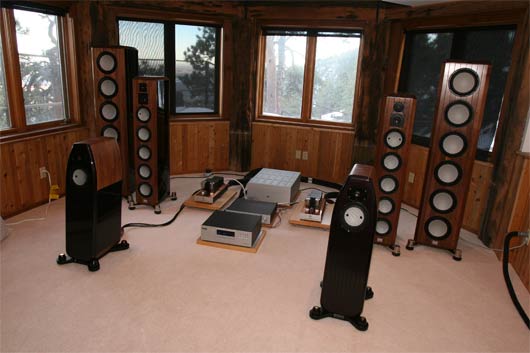
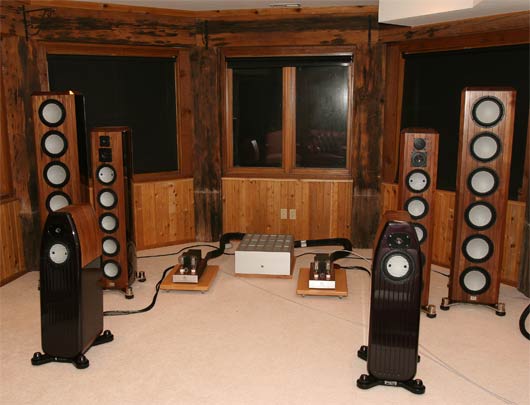
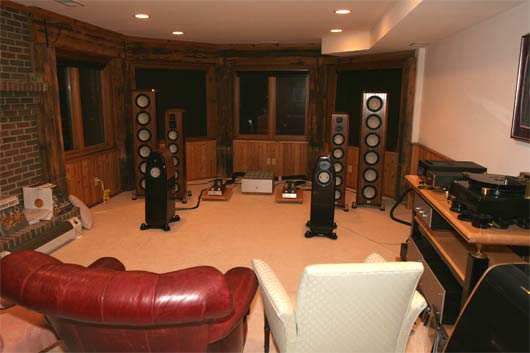
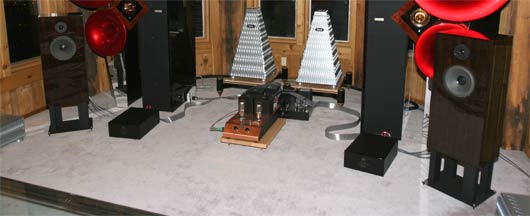
Main room with Acoustic Zen Adagio and Audio Note AN-E SEC Signature speakers and Ongaku amplifier, driven by Audio Aero Capitole


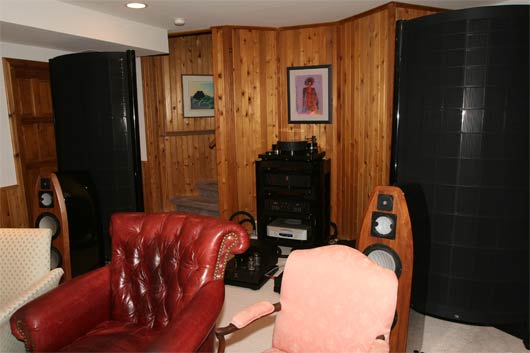
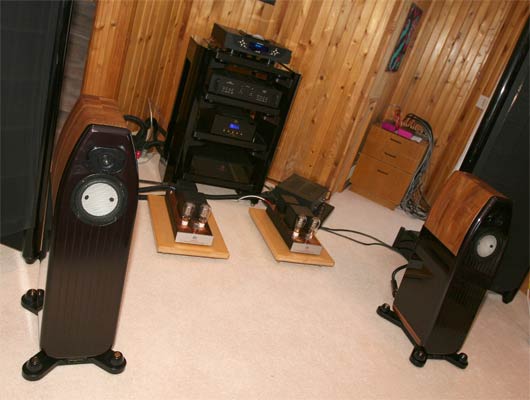
Listening room 2 with Marten Coltrane Supreme loudspeakers driven by Audio Note Ongaku amplifier and EmmLabs digital front end.


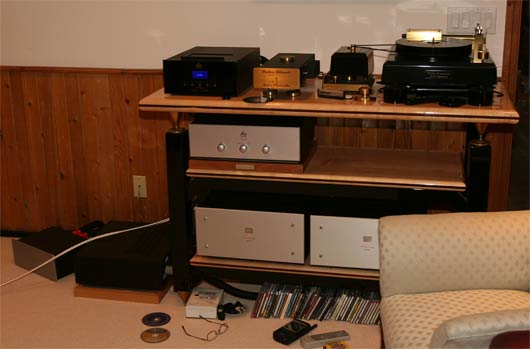
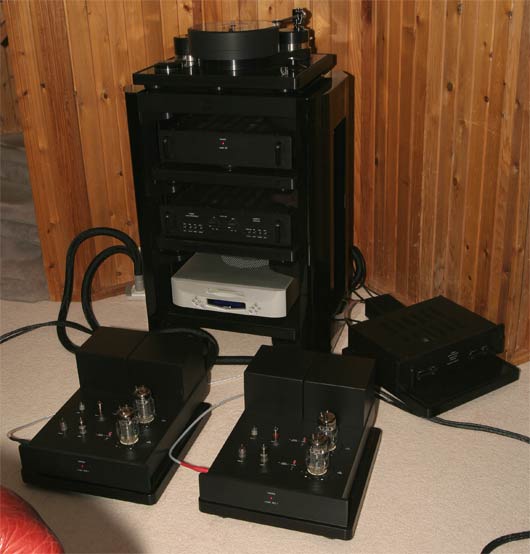
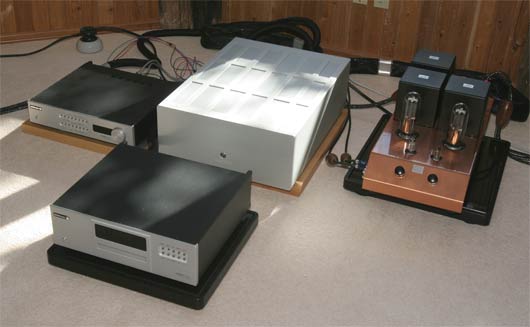
A close up of the components. This is the whole system, these 4 components. Nice and tidy for a change…

However, though this system reached a level of musicality and approached the sound that we are looking for this system have – it was too bizarre having two preamps in the loop, the preamp in the Ongaku serving to try and match the SPLs of the midrange to that of the bass amplifiers. It worked, but…. We might try this again – but for now….

… we changed this, we now have the Lamm ML1.1 push-pull amplifers on the Supremes.

… which will chaneg for an audition tomorrow, assuming they can get up the driveway and up the stairs – which is not a given anymore with this Monther of all Winters the world has on its hands.


Back upstairs again, after the unphotograhed step with the Acoustic Zen Adagios being driven by the Audio Aero Capitole amplifier…

We got the Audio Note Ongaku amplifier driving the Audio Note AN-E SEC Signature speakers, with the Audio Aero Prestige as front end this time. We spread the speakers wider apart also, to see just how wide a soundstage we could get and possibly get some reinforcement from the nearby wall and horns 🙂

But in either position, the Audio Note speakers filled the room nicely. The midrange even approached the capability of the big horns to fill the room, and the bass – once the horns are gone we can try to position the little guys much closer to the wall – the bass is decent and satisfying but does not match the 4 x 10 inch woofers in a sealed cabinet… yet.

In fact, we will likely have 3 kinds of bass in this room: the big relaxed bass of the horns [no we will not mention their brand name – they can do their own marketing for a change], the ultra accurate and ultra powerful bass of the Marten Coltrane Supremes, and the very natural sounding, horn-like bass of the Audio Notes. How cool is that!!!

We’re going to have to post sometime about how it is not about what is ‘best’, but about is most ‘insidious’, and particulary, the number of ways it can be configured to be ‘insidious’. Insidious in that it produces a sound that gets into your head and just takes over.


The Audio Note U.K. Kegons amplifiers are on the Kharma Mini Exquisites, with the Lamm L2 preamplifier and Audio Note digital front end (and Audio Aero Capitole as well, in shootout formation). We then put the Kegons on top of HRS platforms, which is how it sits tonight.

Tomorrow we may get a chance to put the Mini Exquisite speakers over on the Supreme system in an all Audio Note configuration – with the Kegons to start, and Ongaku later if our snow shoveling arms hold out.


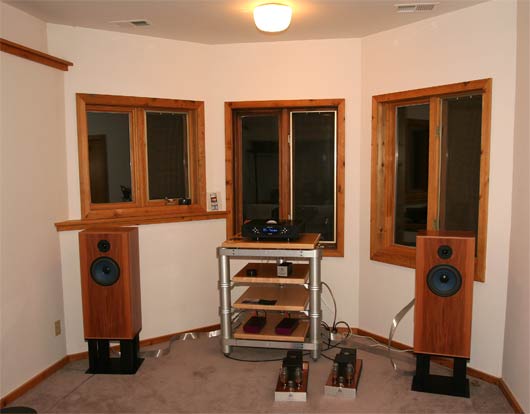
Finally, we have the system in listening room 3, area #4, with the little Audio Note speakers with the Kharma MP150 amps driving them, the Audio Aero Capitole serving as CD player and preamp.

Kind of a hodge podge system as we are in the process of breaking in the speakers – but it sounds darn good….! Neli likes it and her office is across the way. These are high-efficiency speakers and they reveal that the 1st watt of the Kharma amps is really quite good sounding, regardless of it being solid-state, digital in fact.

Audiophile 101 – The Science

We all learned in school about how, as we came out of the middle ages, instead of using superstition or religion to explain things that were happening all around us, we applied the Scientific Method:

Step 1. Observe what is going on

Step 2. Hypothesize why and how

Step 3. Come up with an experiment to test the hypothesis

Step 4. Perform the experiment to either prove or disprove the hypothesis.

Unfotunately, most people start and stop at step 2 when they hear what audiophiles do with their systems.

Everybody with a stereo system, PhD’s, Physicists, and other people who should know better rely on extrapolating from sketchy knowledge about the domain of psychoacoustics to describe why the published observations of repeatable experiments simply could not have been observed.

Put simply, they do not understand something, so they insist on shouting, pointing to their credentials, that it simply cannot happen, because THEY do not understand it.

Pushed further, their argument relies on the assumption that the scientific community, this year, now knows everything about acoustics and its affect on the human mind – that nothing exists beyond what science knows now, and, specifically, beyond what these people learned when they went to school.

Let me tell you something about scientists, PhDs, and what have you. We have worked with some of the smartest people in the country. People who do not have to tell everyone that they are PhDs, because that was so long ago in their career, and they have progessed so far beyond it, that it is like us telling people that we graduated from 1st grade.

These people, like Lawyers, Doctors, Plumbers, and Audiophiles, are just people. There are the ones who know what they are doing, …and then you got the others. People are smart in different ways. Don’t be intimidated by people who thrust their credentials in your face – you are just as smart as they are. You can perform experiements, gather results, speculate on what will happen next, and perform another experiment.

We all do it almost every day when we try out new cables, put them in different places in the system, try them in different directions, put them on break-in decices, or suspend them in air.

The only difference between an audiophile and a physicist is that we do not have adequate measuring devices. None have been built yet. We only have our ears. Perhaps if we had billion dollar budgets we could build some darn cool stuff. But we don’t.

But someday our measuring devices will improve, and we will be able to measure dynamic response continuously across input frequencies and magnitudes. We will be able to measure the impact of frequencies above 20K Hz on the frequencies below 20K Hz. And on and on.

But, more than scientists, audiophiles who put together high-end audio systems are engineers. There is the level of craftsmanship , and artistic flair that comes into play with engineering.

Bridges not only have a measurable function, they can be beautiful, or impressive. Or ugly and harsh, and unpleasant. Similarly with software and other engineering disciplines, there are humans you want to be able to enjoy the thing after it is built.

So, next time you read some guy pontificate that all cables sound the same, or some such nonsense, just realize that all young professions go through this period of dissrespect, from the lay person and intelligencia both.

But, eventually, over time, respect will come.

Audiophile 101 – Music Preferences

Audiophiles seem to be divided into two major camps:

1. Those that like to play Jazz (and light pop, new age, and percussion music like drums)

2. Those that like to play Classical and Opera music.

Those that fall into camp 1, besides appreciating the music as just great music, also appreciate the fact that it sounds really good on their system. It sounds better because it is often recorded better and it is easier for the stereo system to reproduce the music well.

Those that fall into camp 2, besides also appreciating the music as just great music, apprecatiate the difficulty of reproducing this music – it is a challenge for ANY system to make sound really good. From the other directions, a) if you love classical music you will almost certainly need some kind of good equipment to really hear it sound good and b) if you have a great system you eventually try classical music and say to yourself, ‘Hey! that ain’t half bad!’ Especially opera.

Audiophile 101

Want to start a new topic category here. Not sure if this is the right name for the category, yet…

This category will address both honest questions about, and callous attempts to ridcule, our hobby. It will also help point out how audiophiles can and should stop both unconsciously or callously attempting to ridicule non-audiophiles.

For example: The Furutech DeMAG at gizmodo:

CES 2007: Furutech DeMag Demagnetizes Your Money Away

and

and Mike L’s room article over at Digg:

Now THAT’s a Music Room

So, far be it from me to try and defend Mike’s choices in setup for his room, I disagree with many of them, but there are some key points here that we need to address:

1. Rampant ignorance about the high-end and audiophiles in general

2. Open hostility towards us and our hobby

Before we start the posts that will try to explain to people why we do what we do, and how we ourselves can be better members of the music-loving community at large, it would be good to make a quick summary of what the basic issues are:

1. In this technical age we live in, people try to extrapolate from whatever knowledge they have, things they think they understand, to reach conclusions about something they don’t understand or haven’t experienced first hand. We call this ‘listening with the mind instead of the ears’.

The more we talk about the need, and provide opportunites, to hear, to Test Drive, good systems, the more people will understand what we are all about. Whether they become audiophiles or not, after they hear a decently setup system at least they will have some basis for their opinions.

2. People perceive audiophiles as being judgemental, especially about the type of equipment that lots of non-audiophiles own and are likely very proud of. This hurts their feelings and they, in turn, lash out at us and our hobby. Some of the most vindictive and hateful posts get the highest scores on the Digg thread.

We need a way to speak very plainly about the limitations of some of the equipment out there, but without unnecessarily offending the owners of this equipment who are the exact people we want to show that there is stuff a lot better out there, at about the same price – and that working together we can force the industry to make better stuff still.

3. Audiohpiles are perceived as off in their own world. It is not quite that they think us elitist, or wacko, or suckers – but that they think of it as Us and Them. Some of this has to do with the times we live in – but some of it has to do with the way the music, over the years, sometimes takes people and audiophiles in different directions.

Those audiophiles, (like me!) who like the kinds of music most people like: Pop, Rock & Roll, Rap, Techno, Alternative, Punk, can help bridge the gap here – make no mistake, almost every sngle person on the planet loves music, this shared love of music is something that has drawn the audiophile community into the mainstream in the past – and it would be good for the audiophile community to not look down on these types of music as much as it does.