Pursuing the Ultimate Music Experiences

Audio Federation High-Fidelity Audio Blog

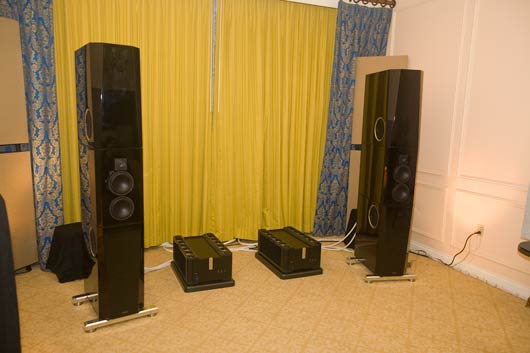
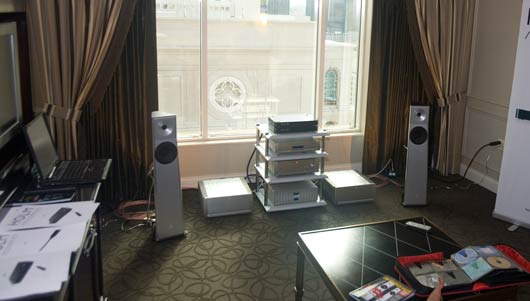
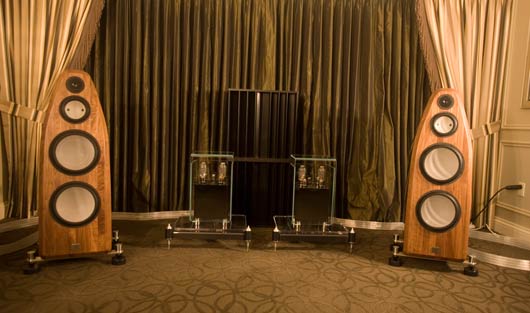
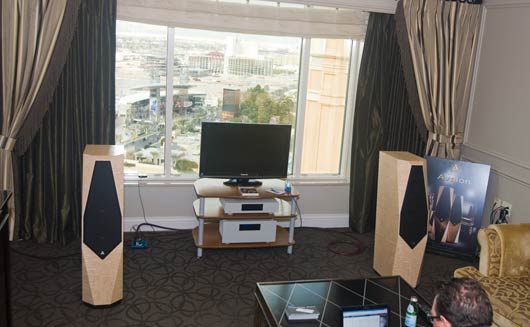
Tidal, D'Agostino, Sonus Faber, Magico

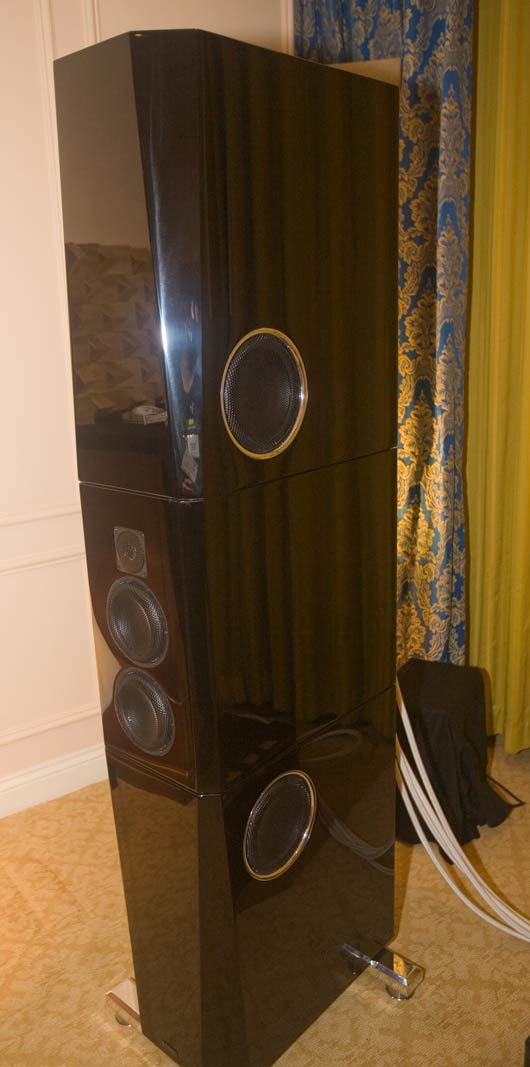
Tidal


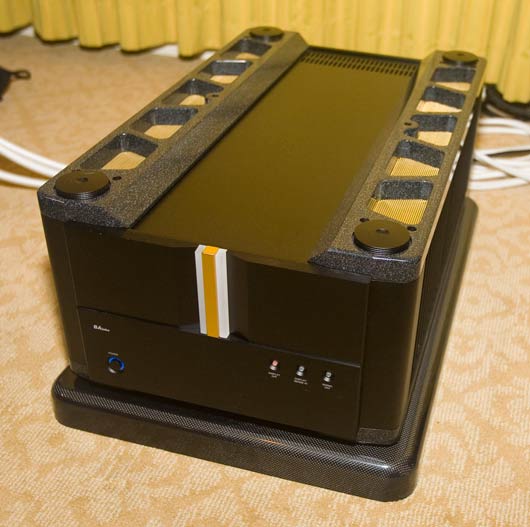
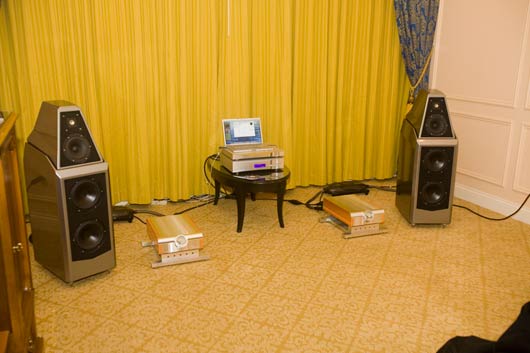
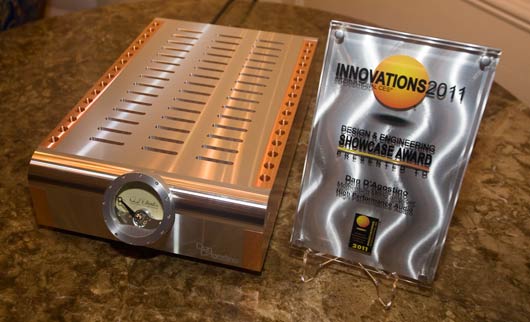
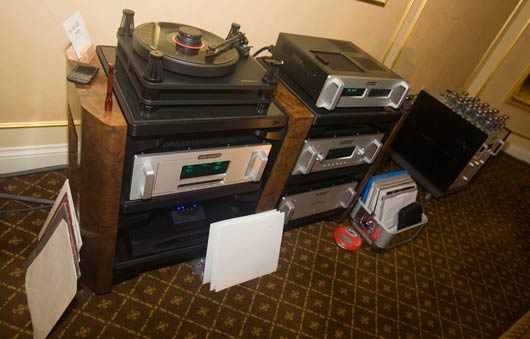
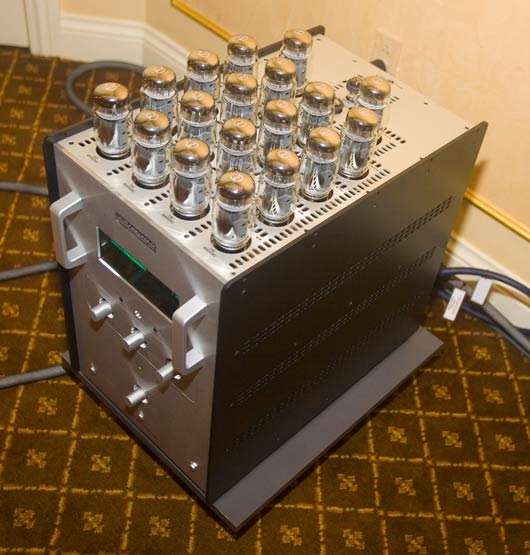
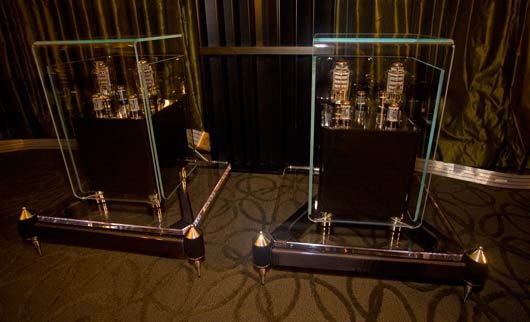
D’Agostino

A smooth, tuneful sound but lacking some midi- and micro-dynamics [the absence of which seems very popular in many of today’s very $$$ solid-state amps ]. The opposite of Krell. Very striking looking amps, as solid-state amps go – and thankfully not so much the uber-masculine look that, again, is very popular in many of today’s very $$$ solid-state amps]


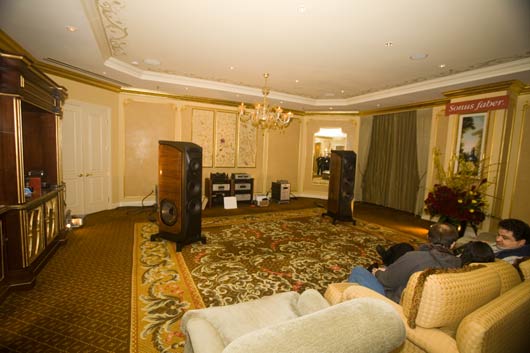
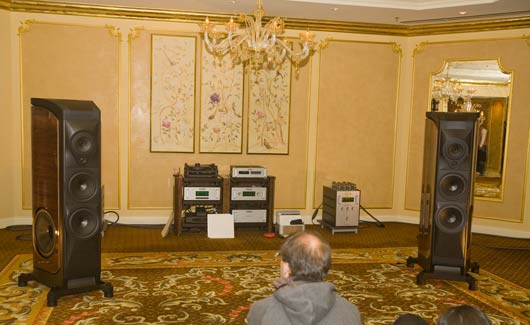
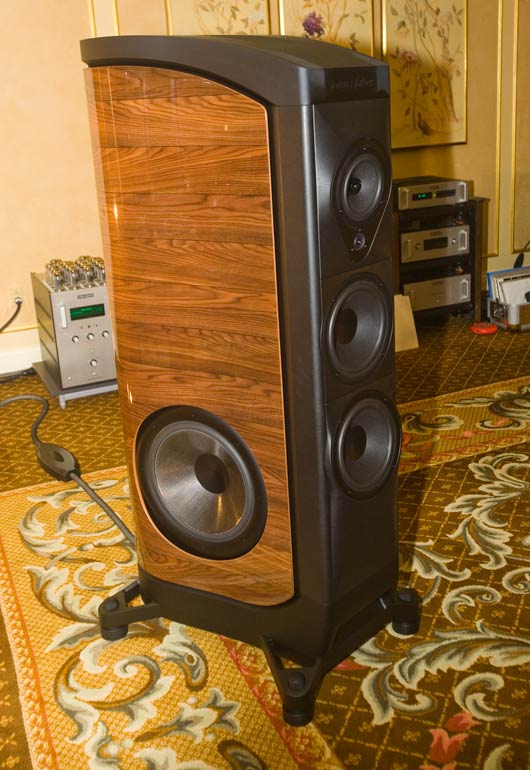
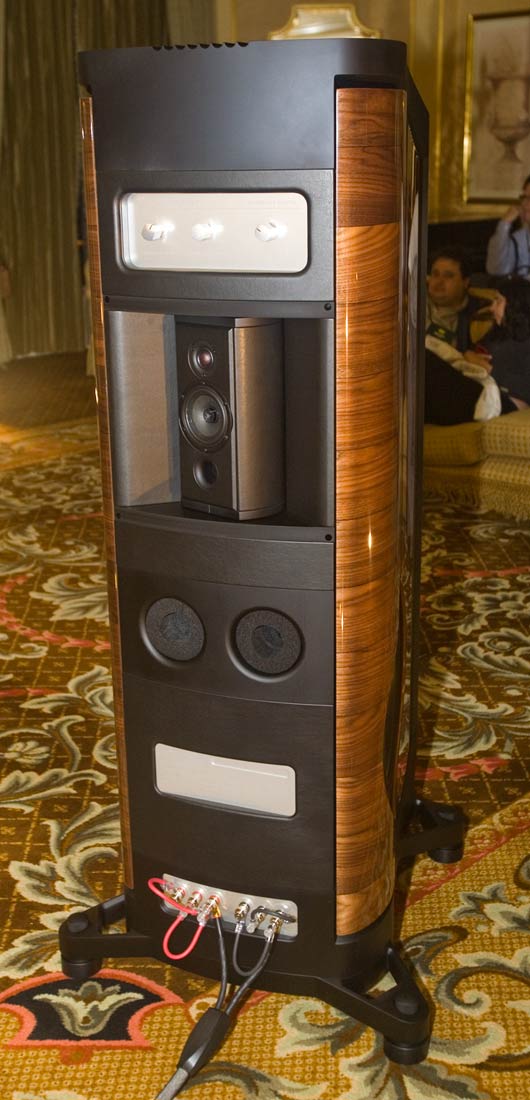
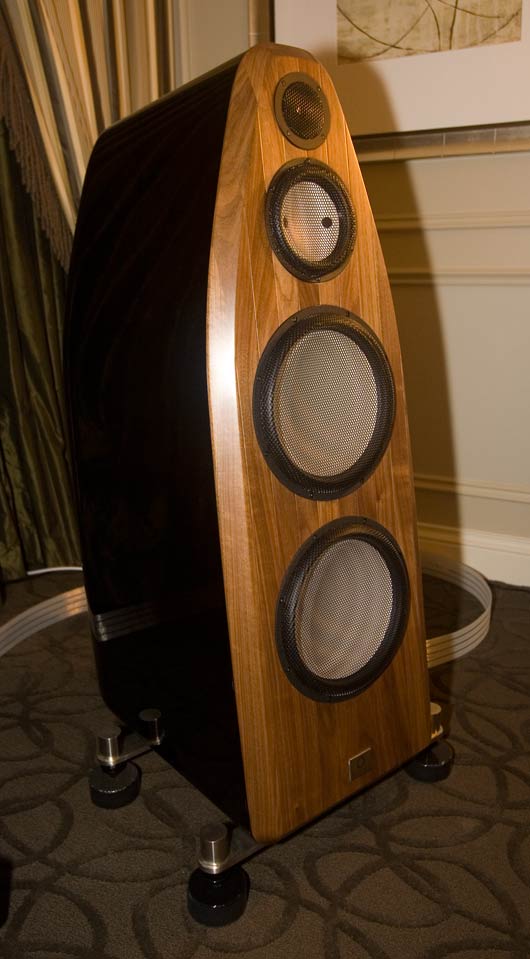
Sonus Faber

A dense, dark, congested, confused sound. The appearance of these speakers also seemed to me to not be what somebody would expect from the high-end of Sonus Faber, which are typically gorgeous works of art.


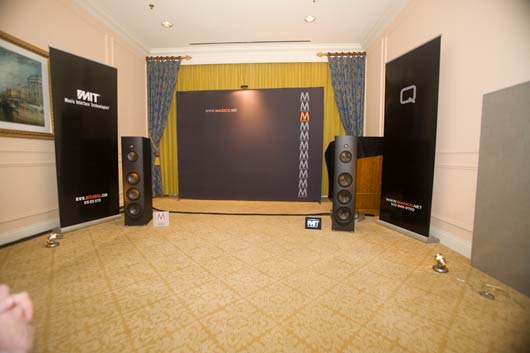
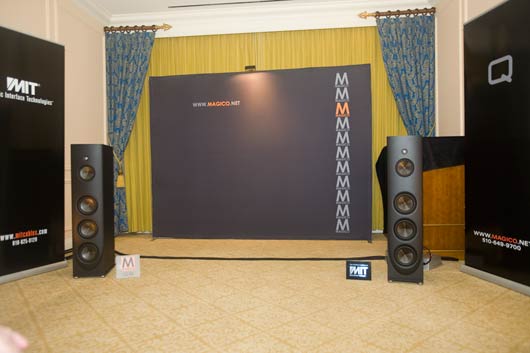
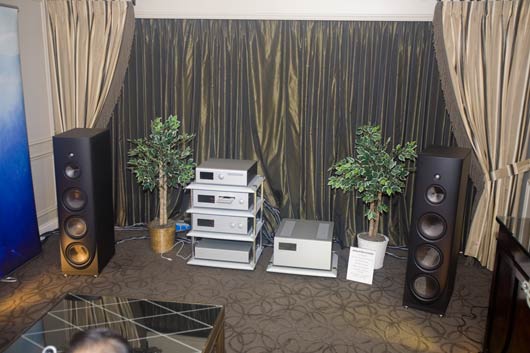
Magico

Impressive midi-dynamics, good separation, various kinds of even handedness up and down the freq spectrum but somewhat soulless i.e. everything was as expected – see previous show reports. Surprisingly the deepest bass was somewhat uncontrolled, and seemed to interact with the floor of the room [unlike RMAF 2010 where the Q5 was very (electronically) controlled]. Impressive soundstage in sweet spot, but not so great soundstaging/imaging in other seats [i.e. I would expect some people to have vastly different opinions about this room based on whether they sat in the sweet spot or not]


CES 2011 – Lamm / Verity

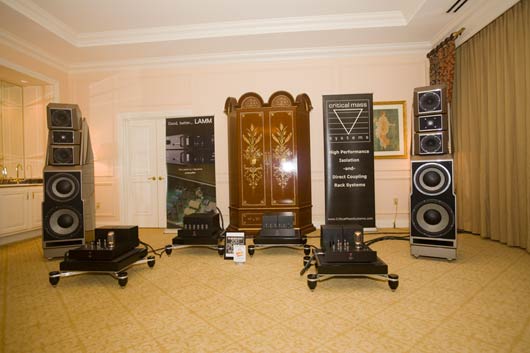
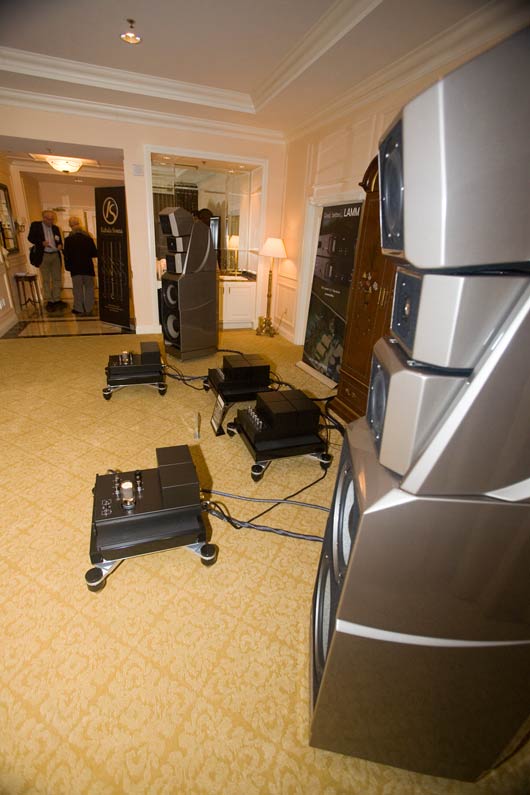
The new Lamm ML2.2 amplifiers driving the Verity Lohengrin II speakers had a polite, almost sweet sound and was quite Enjoyable . Neli was there a lot longer than I was, so if you want to know more details about the sound, you might want to call her.

As for the Lohengrin II, in about 6 weeks we should know a lot more about how the Lamm ML3 (not the ML2.2) sound on these speakers in a much more controlled environment.

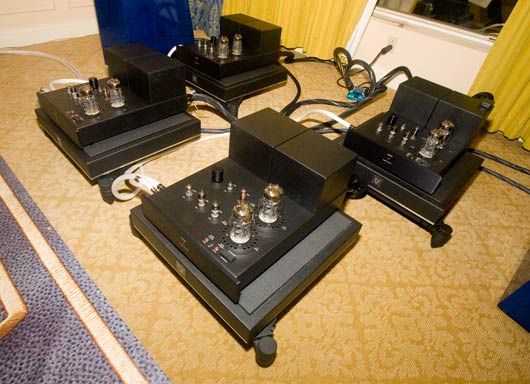
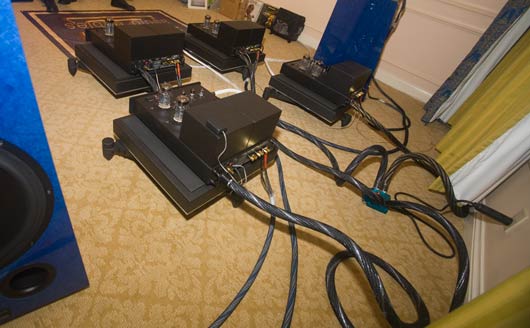
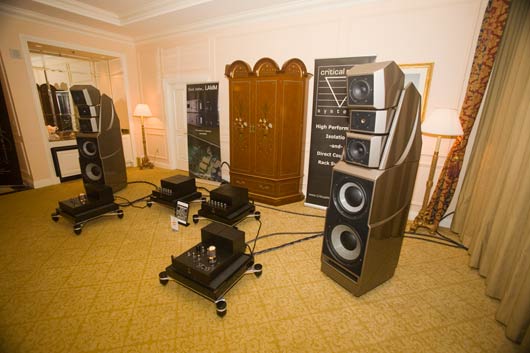
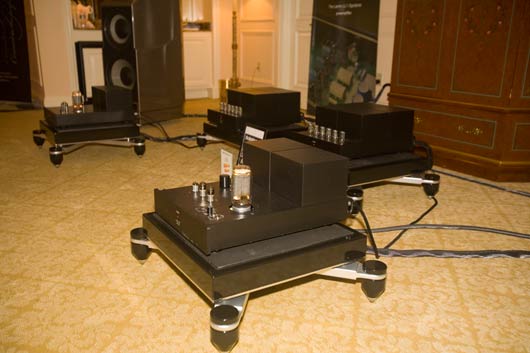
As for the new Lamm ML2.2, the replacement for the ML2.1, in this configuration two pairs were used in a bi-amp configuration to drive the speakers [see below]. There was a sense of ease to the sound – which no doubt was aided and abetted by the use of two pairs of amps instead of one.

The sound, as far as I could tell on the somewhat unfamiliar speakers and familiar but not completely understood cables and racks/amps stands – compared to the ML2.1 – is more smooth in the midrange/upper midrange and airy on top. The ML2.1 have a slight tendency to highlight some subtle details, and to be slightly diminished [as opposed to rolled off] in the very tip-top highs, and these amps appeared to have none of that. What I heard seemed to indicate – and it is something I would like to see, so perhaps I am somewhat blinded by desire – that these amps might be a blend of the best from the previous two generations: the Lamm ML2 and ML2.1 amps – along with some nice improvements [like more air on top].


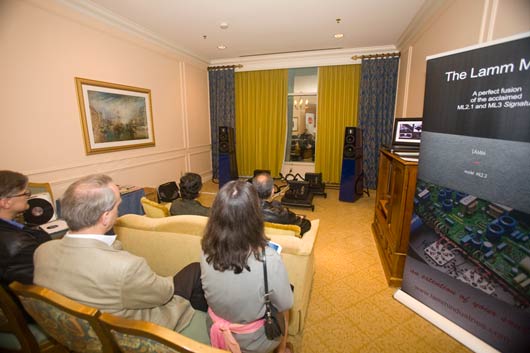
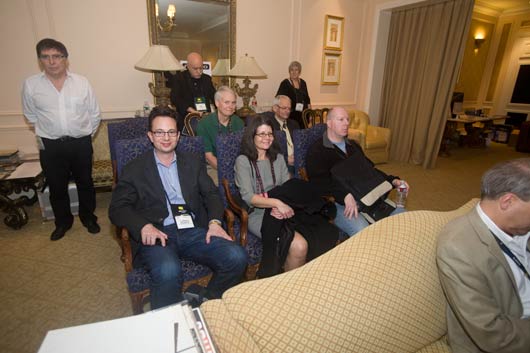
Neli and other room visitors listening intently.


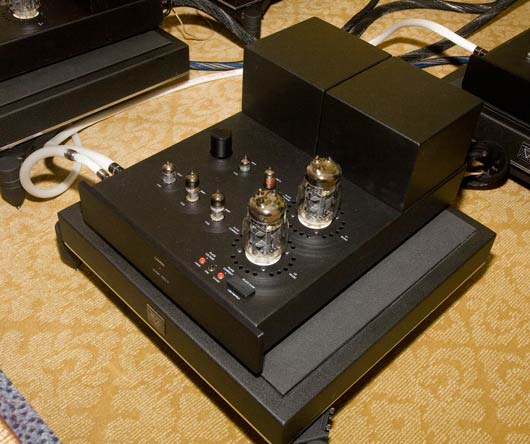
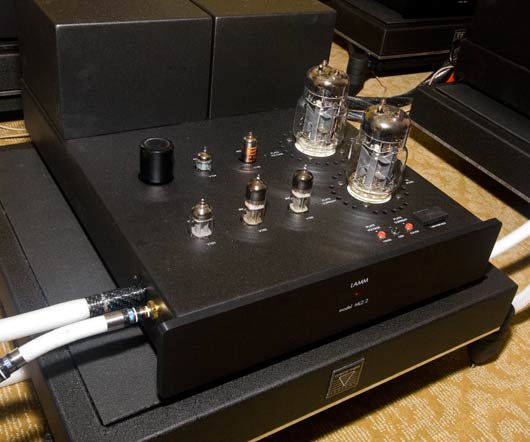
The new Lamm ML2.2 monoblock 6C33C-based SET 18 watt amplifier


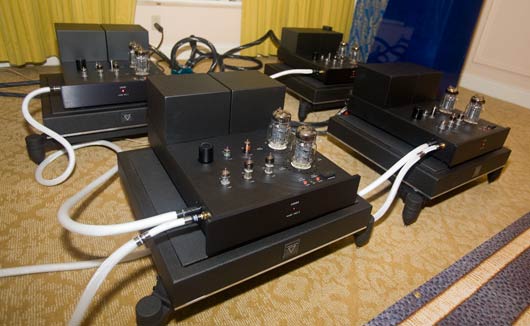
The Lamm ML2.2 in a bi-amp configuration. Interesting, huh?


The amps from behind.


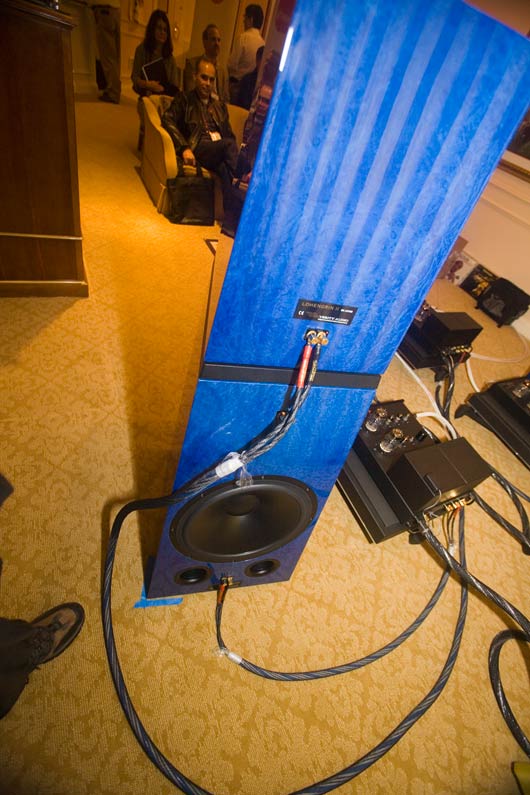
A 15 inch woofer on the back of the Verity Lohengrin, and a somewhat problematic bi-wire setup [you can use long jumpers from one binding post to the other or 2 separate single wire runs, one to each binding post, or two amps – like here – or …]


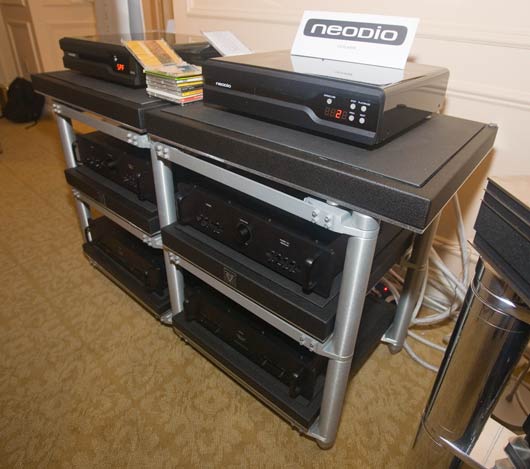
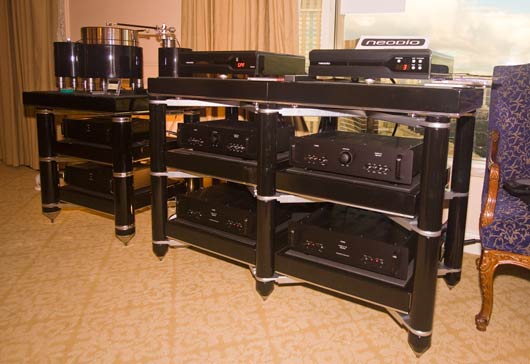
Neodio digital, Lamm L2 2-box linestage, a Lamm LP2 phono stage, and…?


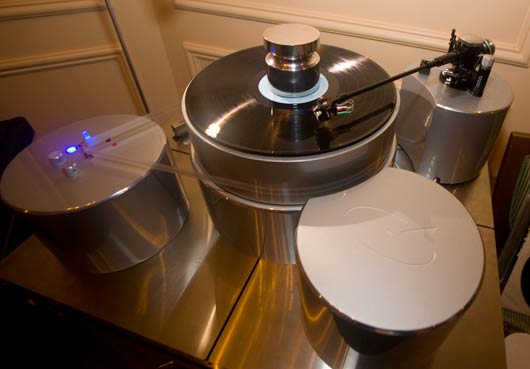
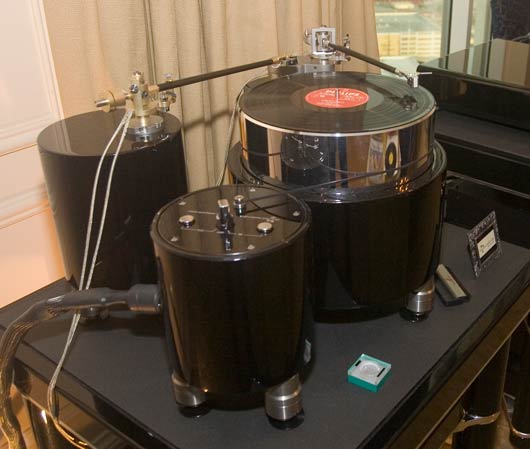
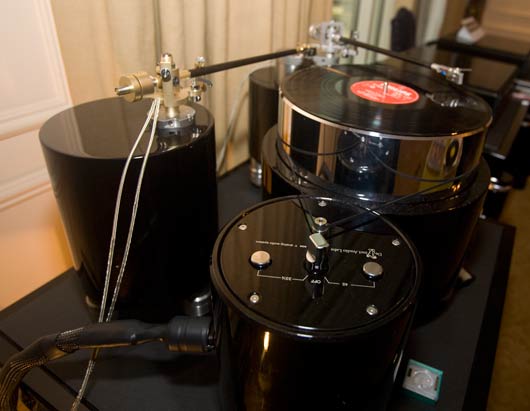
A Redpoint turntable


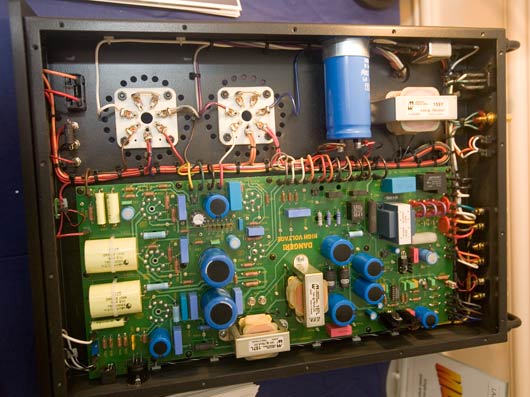
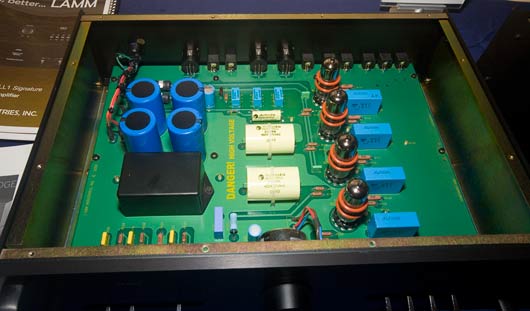
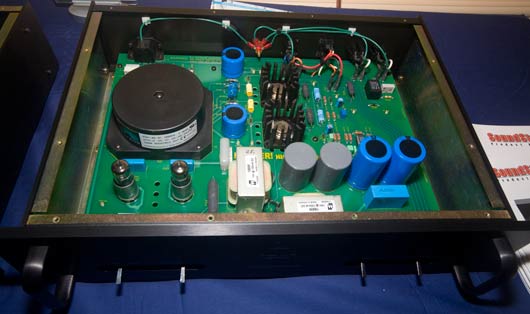
The inside of the new Lamm ML2.2 amplifier


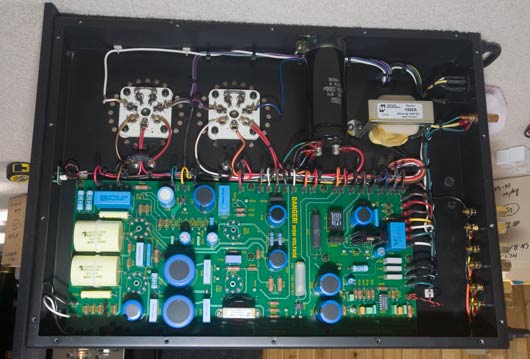
For comparison, the inside of our own previous generation Lamm ML2.1 amplifier

CES 2011 – Lamm ML3 + LL1 / Wilson Alexandria X-2

A few additional comments about the Lamm / Wilson room.

The Lamm ML3 controlled these large speakers very well – at low to high volumes. The reason I would have given this room one of the Best Of Shows, if I was giving best of shows, which I am not, is that there were few if any other rooms playing challenging music – from a real source (CD or LP) – that generated a large scale presentation with such ease, that had this kind of decent separation and top-to-bottom evenness… and in the end just a calm constant convincability.

It is typically very difficult to reproduce music that is playing in a Lamm room at a show – mostly classical, some Jazz, and some others picked seemingly at random. This makes for a very nice place to just sit and listen. Very civilized and respectful, different from your average room at an average show [many are just about stirring up hype and attracting reviewers. Ours, for better or worse, are seemingly much more of a party atmosphere where people typically talk a lot and share their favorite yet somehow strangely weird and bizarre music by playing it on our system :-)]

The sound was indeed the tiniest bit soft, as has been noted elsewhere, because [and this is based on our experience with the ML3 amps as well as with these speakers on an Audio Note Ongaku, Emm Labs XDS1 and Nordost ODIN cabled system]

1) the speakers are slightly forgiving
2) the cables are slightly more forgiving
3) these equipment racks have unpredictable effects in our experience, in this case softening effects I believe based on what I have learned over time about 1) and 2) above
4) the sound in the Lamm rooms are typically setup to be a little soft – that is the way they like to do rooms at shows [more of an oasis effect as opposed to the WWIII effect]

There was a absence of real solidity to the image between the speakers, making me think that the speakers were too far apart. Although Lamm typically does speaker setup at show, including Wilson speaker setup, this time – because of the size and weight and perhaps other reasons – the Wilson factory setup the speakers.


Neli and Florian are smiling up front. Jim (encinitas) behind in green.


Rack with 4-box LL1 linestage driven by the Neodio 2-box digital


The inside of one channel of the Lamm LL1 linestage (preamp)


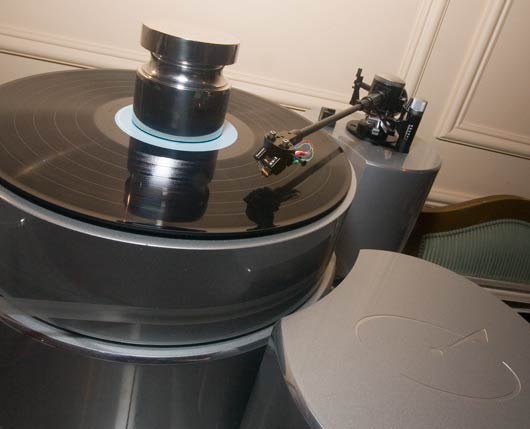
DaVinci turntable

CES is still fun

[I am preparing another blast of photos. But because these photo posts will be so long, I am letting these smaller posts simmer here for awhile.]

It seems to me that many of the people writing about CES are bored. They are tired of it. They do not enjoy it. They wish they didn’t have to go each year.

We, however, love it more than ever. It is a blast.

Why are they bored? Maybe because they are getting paid to attend? Maybe because this is just their job, not their adventure?

Why do we enjoy it so much? The people. The music. The learning process and testing what we have learned here against 100s of other systems. The excitement of entering each room hoping and anticipating something potentially GREAT: great sound, great music, great friends. It is like a giant building (a hotel) full of toy stores, and your friends are there and there are hundreds of parties going on.

What is not to like?

Report on Jonathan Valin's CES 2011 Show Report Pt. 3

The link:

JV CES 2011 Show Report pg. 6

[This is all great fun, and I hope you all are enjoying this. It is somewhat unfair, to JV, in that we always get the last word here (always counterpoint to his point) but I do try and be as balanced and as fair as I can, while still fully communicating what I heard at the shows. So if you feel I am being overly polite, or more polite than I usually am :-), then this is the reason why].

* Morel

I used to listen to these rooms carefully, but have not at the last several shows.

* Magnepan

There was some confusion in the comments about which room this was, and I am still confused. I did hear the Bryston on the Maggies, and the sound sounded just like Bryston on Maggies, not like the very impressive [and Impressive] sound at the Alexis Park of this pair several years ago. I think this room was too big – it was one of THE Show suites at the Flamingo.

… skipping ….

* Talon Phoenix / VAC

JV: “smidge on the dark side”. As I remember, this was a hodgepodge of good and bad sounding components, a delicate balance of the aggressive and the laid back, and the overall result was Enjoyable [an accomplishment in my book], but not real or transparent or drug-like etc.

* Nola Baby Grand Reference / ARC

I did not pay particular attention to this room.

* Acapella High Violoncello II

Well, we are too forthright with our opinions for the distributor of these speakers – so we do not hear these rooms. But if I was to be annoying and make a correction to JV’s semantics so that “this was the best Acapella speaker I’ve heard” should be “this is the best I’ve heard from an Acapella speaker”. [which is too bad, because the general consensus from Acapella fans was that this was not the best THEY have heard from Acapella… so keep listening JV].

… skipping ….

* Lotus Group ‘Granadas’

OK. Well, JV’s diagnosis seems to be all over the place, so let me try and see if I do not get into the same predicament.

First, these speakers were driven by very large Musical Fidelity amps and several other components that I personally would not pair with $125K speakers.

Second, although I could hear what the musical fidelity was doing [massacring] to the notes, it was not overtly offensive. The sound is tonally very pure and has a nice natural roundness to the notes that was only partially affected by the sound of the amp. This suggests a very forgiving speaker – which can be a good thing and a bad thing.

Third, I was somewhat annoyed by one of the exhibitors [the speaker designer??? not Joe] saying that this speaker was all about the digital crossover, that this was the ‘magic sauce’ [or words very similar to this]. To me, this shows a lack of perspective, a minimalistic versus holistic view of speakers and makes me wonder about the overall performance of the speaker across multiple scenarios [think room correction fans, computer audio fans, etc. These are TOOLS people, not ideologies or sledge hammers].

Anyway, someday we will bring an Ongaku and XDS1 over to Joe’s and hear what these sound like. I do like the sound at this point, and they could be really great speakers.

* McIntosh

Life is too short

* T+A

Unfortunately did not listen carefully here.

* Lamm Industries / Verity Audio

First, JV, it is ML2.2 [add that ‘L’!].

JV says nice things about this room, and not that I did not like it, but I heard something quite different. The sound was sweet, rich, controlled but soft. I would call it warm but with control… i.e. the notes start and stop OK, but are a little too round on the attack and decay. As Neli and I talk it over [she spent more time there than me] Verity may indeed be the heir apparent to Sonus Faber [the current top-selling ‘sweet’ sounding speaker].

* More about the Scaena and we are done….

JV: ‘Magico Q5s are consistently capable of this “fool-you-into-thinking-you-are-in-the-presence-of-real-singers-or-musicians” level of realism, of not hearing “where it comes from.”’

I assume that by “where it comes from.” he means the hall where the recording was recorded [he might also mean that the speakers disappear, but it seems less likely]

OK, well, hearing where it comes from means that the hall was mic’d and that your system is capable of reproducing the subtle details picked up by that mic. If it is on the recording you SHOULD hear “where it comes from”. Otherwise your system is not reproducing not only the subtle details of the hall, but not reproducing the subtle details of the music as well.

Which is, of course, my primary complaint with JV references.

It is not like this is against the law or anything, and if one really wants this sort of effect, this would be one [expensive] way of getting it. TEO cables are another [brings the melody into the foreground], and to some extent many systems and components and cables do this to a more or lesser degree.

It is just that, as we spend our time and money and effort [as do our fave manufacturers] to get the exact opposite effect, I had to comment 🙂

—————————————————

OK. That is about it. JV did not talk about the Perfect8 system [which I think he would have liked OK but it would not be on his BOS list], nor the Audio Note [which he may have liked a lot] nor Kondo [he would not have liked] systems. But he did catch most of them [and many I did not] and I love it that he spends the time to listen to and write intelligent opinions about the sound at these shows.

Report on Jonathan Valin's CES 2011 Show Report Pt. 2

The link:

JV’s CES 2011 Show Report page 3

* Trenner & Friedl

I did not get to this room. Reportedly the room sounded closed in at low volume and distortion free at very high volume, which is what I remember also from previous years with these speakers.

* D’Agostino (Krell founder) electronics / Wilson Sasha

Hmmmm… Well, this sound was what I would call overly smooth with good tone. i.e. It was lacking in midi-dynamics and micro-dynamics. Seems like this would not be JV’s cup of tea, and for me, I think in the attempt to learn from Krell’s mistakes and to differentiate themselves from the Krell sound they have gone too far. Great looks though.

* Vitus/ Wilson Sasha

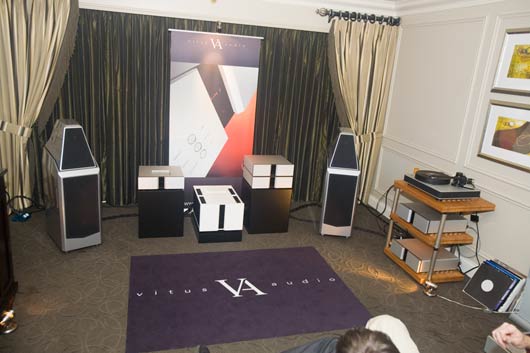
A friend really liked this sound and I was supposed to get back there – but did not [for some reason I missed hearing this room on my first pass]. Sounds like JV heard some weird room anomalies since Vitus, in general, is not far from perfectly neutral in the large scheme of things.

* TAD Reference Ones

For some reason I only paid attention to the room with the new TAD electronics. JV says “sound was a little dark (what else is new?) but very detailed and beautiful.” I do not understand the ‘what else is new?’… often rooms with TAD speakers sound aggressive and almost always Boy Toyish. But I have to agree with his assessment of this room. The sound had lots of micro-dynamics etc., but perhaps the decays were cut a little short, and there was an overall feeling of reticence and lack of ease – not in a big way, but enough to take some of the natural excitement out of the music.

* Silbatone [not Silvertone]

These large speakers were designed for a larger room [:-)] but I did listen to them carefully for a period of time. JV doesn’t really say much [though, if the bass wasn’t limited then we’d all be dead, or deaf anyway :-)]. This was a very balanced sound, not the last word in resolution or micro-dynamics [or deep bass as JV points out], or air or anything, but there was also nothing really wrong with the sound either. In a very large room I could see these speakers as sounding convincingly real. I read elsewhere [probably Stereophile] that the amps are quite expensive ($140K) as are the tubes ($5K)

* Venture / Lamm

??? I do not remember this room.

As far as side-firing woofers go… I guess we have paid more attention to this type of speaker over the years because they usually perform quite badly [even though the speaker profile is narrower, which should be a good thing]. Besides the fact that the woofer is firing at either your electronics or the side wall, it is very difficult to get the bass to be coherent [all of one piece] with the rest of the frequencies… at least to our ears across many, many brands of speakers who use this approach. But our ears are always open…

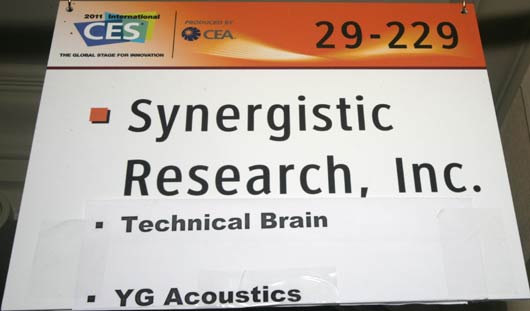
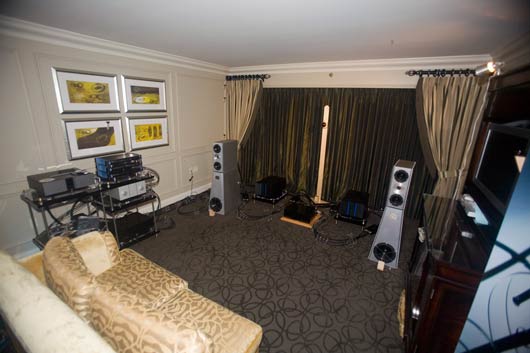
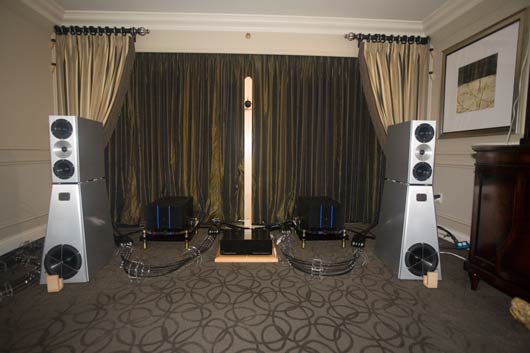
* Synergistic Research / YG Acoustics / Technical Brain

JV: “sound was little dark and the bass a little heavy”. I agree except that the sound was a lot dark and the notes were smeared etc. etc. No comment on JV’s comments about the house sound of the brands here except to say that I disagree vociferously.

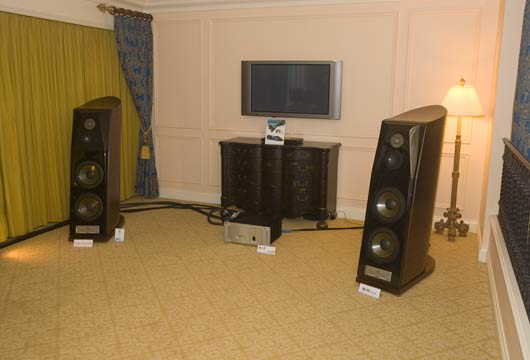
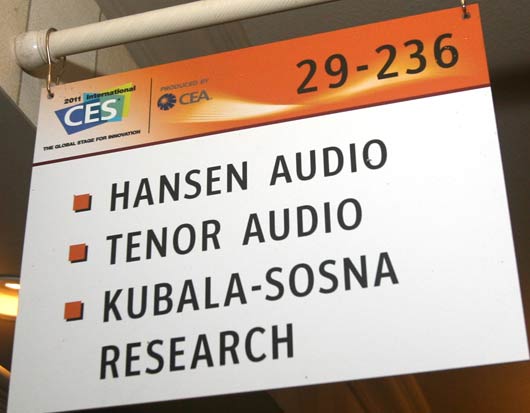
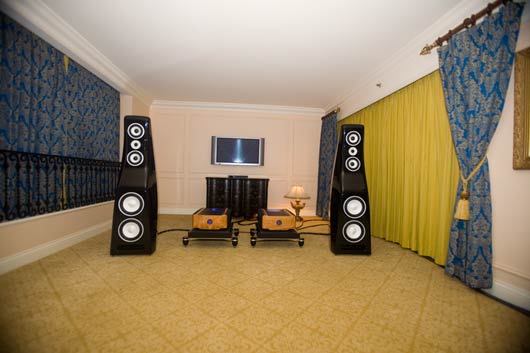
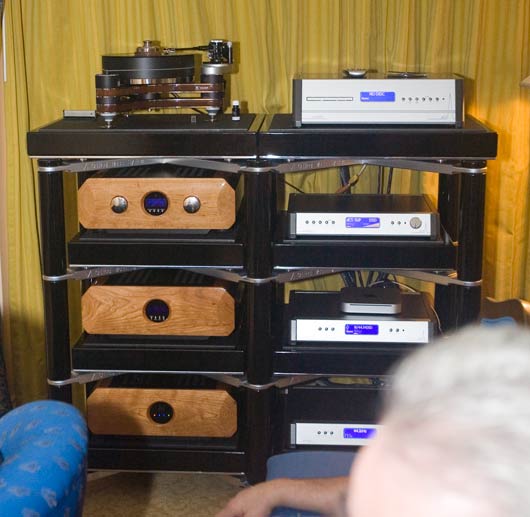
* Hansen speakers / Tenor electronics

JV mentions the word ‘gemütlich’ several times which I had to look up: “Warm and congenial; pleasant or friendly”. Hmmmm…. First, I would call this sound “a little bigger than life, a little slow, a little … how do I put this… the harmonics were a little less pure than they might be… which one might call dark, but we have reserved that word here for – more or less – rounded off midi-dynamics.

Second, calling the Hansens warm sounding…? I am trying to think of what JV is referring to exactly, if I agree, and if all of you also would use the term ‘warm’ for the house sound of these speakers. I think JV is referring to a lack of midi-dynamics ‘punch’ [fast attack and decay]. To me, ‘warm’ means forgiving, and with a inherent sound that is pleasant across all kinds of pleasant and unpleasant music. I’ve heard these speakers with a lot of different electronics; they can be punchy [when loud anyway], they can sound horribly closed in, they can sound cold and harsh. I guess the sound consistent across all this is that they perhaps blunt the leading edge of notes a little, they have strong bass, and they have a large sound. These are relatively hard to drive [but much easier than the Magico or YG Acoustics, for example] and so have some of the same problems associated with other hard to drive speakers.

Third, Tenors warm sounding…? They are slightly more round and harmonically rich than neutral, so technically yes. But they do seem to walk the fine line fairly well close to neutral [you see, the problem is that the typical amps people are using with these Boy Toy systems, the ones that are supposedly perfectly neutral – are harmonically threadbare and – these days – overly round yet bright at the same time]. I personally welcome the Tenor hybrids to this party, though Lamm hybrids, and other hybrids, are just as welcome in my book.

Otherwise, I agree with JV’s overall description of the sound here, although I do not attribute any of it to a “prominence of the bass”.

* Estelon XA / Tenor (et. al.)

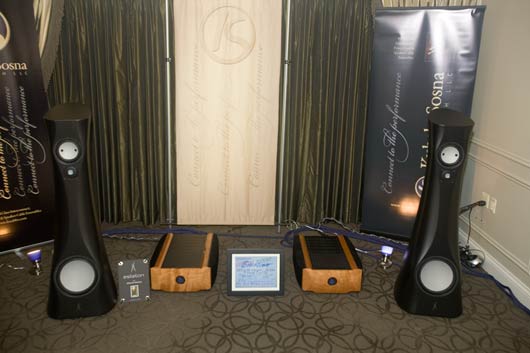
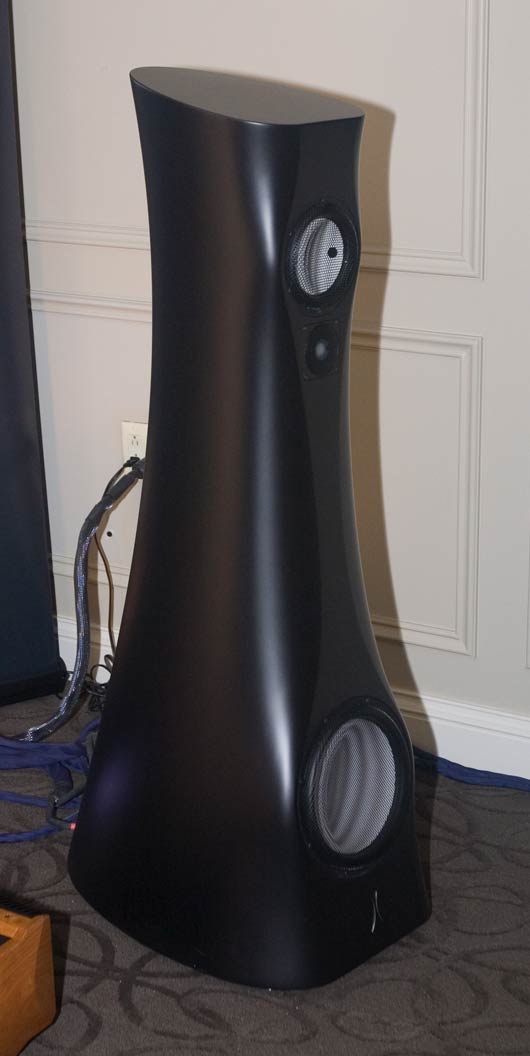
More or less agree [except about the CJ, which to my ear are colored, smeared, and whiteish sounding]. The speakers were interesting and do a good job of minimizing speaker enclosure coloration, although I found the midrange to be a little weak and, since this is where most of the music is, this may be a fatal flaw.

* Peak Consult

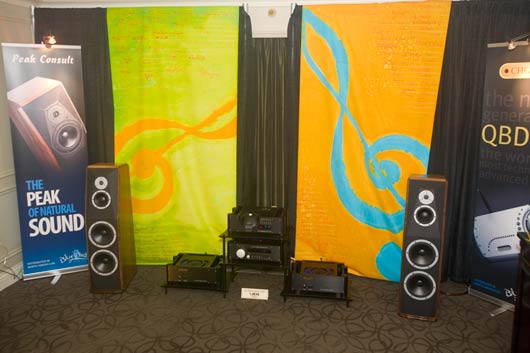
I did not think this room was interesting… i.e. there were enough problems that I did not think, in the time allotted during a show, that I would be able to learn anything useful here. Given the number of things JV starts enumerating in his report about this room, I think he must agree.

* Avantgarde’s Duo Omega

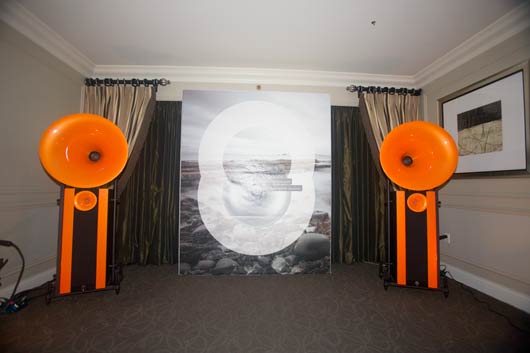
JV: “very coherent but a bit thin in the bass” … say what? I would say the bass was quite disconnected from the rest of the music [I had hoped that this problem had been addressed. I would so LOVE to love these speakers]. The bass was very present and punchy – although no doubt uneven across the lower octaves. The first problems being so egregious I did not bother to listen further. I just want to grab the manufacturers and force them to make the speaker assembly 5 to 10 times more rigid and to add supporting struts to the horn or something to make these speakers kick butt.

…skipping several low-end rooms…
* Siena speakers

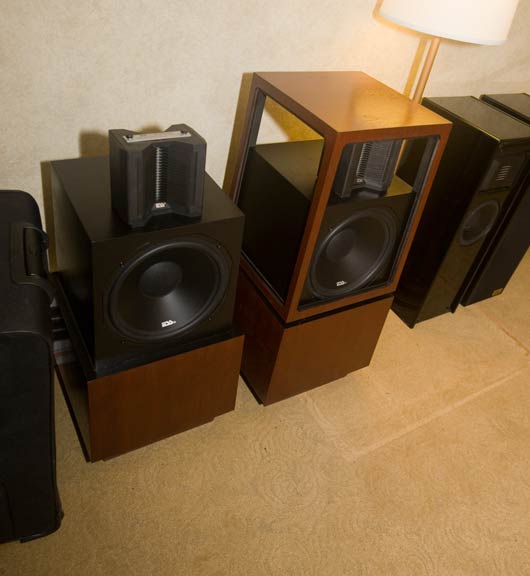
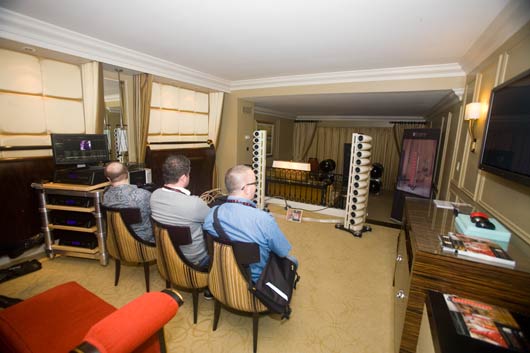
JV was obviously captivated by these speakers. I’ll try and insert a photo here so you can see what is going on. First, I cannot comment much on these speakers because every time I went by this room they were playing a drum solo. You know, I like rap and opera and country and jazz and techno but I do not like to waste any microsecond of my life listening to tracks of drum solos. It also makes me suspicious when a superbly dynamic speaker system plays drum solos… what are they trying to hide? Heck, in this room Diana Krall would strangely actually be an appropriate and illuminating piece of music to play.

My concern here, for you readers out there, is that the room setup was not horribly home-friendly [the subwoofers are way in the back of the room], and that these speakers typically have a very small sweet spot. Oh yeah, and perhaps an inability to render the subtle details associated with real music and voice [a curse of the original Pipedreams]. Even the drum solo did not sound so good out from in between the speakers – I thought it [the drum solos] sounded better in previous years…. [I say this somewhat tongue in cheek]

* Marten Coltrane II

I have discussed these speakers in detail a few posts ago, and more or less agree with JV except to say that I have less to say about “slightest hint of ceramic whiteness or enclosure grain” than he did because, for me, the room and/or associated equipment got in the way of hearing things at this minute a level.

It is funny [OK, somewhat annoying too :-)] how JV picks on ceramic drivers [and horns], and how some people pick on domed tweeters, inverted tweeters, diamond tweeters, metallic drivers, etc. i.e. some people pick some technology used by a component and use it to explain/predict a sound of a component in a system. Not that ceramic driver speakers don’t often have a touch of whiteness and box speakers a touch of enclosure effects [I do think that Marten deals with the issues associated with ceramic driver speakers better than anyone else to date to the point that they are a non-issue (and Kharma speakers are usually a hybrid of different types of drivers, some of which are ceramic, and who now makes their own custom ‘black’ ceramic drivers), and also that ceramic drivers do several important things better than other drivers: like fast midi- and micro-dynamics and rendering the delicacy of real music].

* Magico Q5 / Soulution

Somehow I missed this room?

To be continued…

Report on Jonathan Valin's CES 2011 Show Report

The link:

JV’s 2011 CES Show Report

One of the most fascinating things in doing these reports on JV’s reports is trying to figure out what kind of sound he really prefers. This is something we as dealers have to do; and as a writer, it is useful to understand why people have the opinions they do about the sound we all are, presumably, hearing [more difficult at a show, where the room sound changes day to day, and our test tracks vary wildly from each other [I’ll have to look into adding Mario Lanza :-). (we do have various CDs and LPs of Mario’s here). This year my test tracks were Radiohead, Amnesiac – which most systems fail miserably at, and Mark Knopfler, Sailing to Philadelphia – which is a polite song that most systems can deal with. So, depending on the system, I will play one or the other – or both].

Might as well make a comment about JV’s reference speakers and how that is reflected in his show report [and get myself in trouble from the get go :-)]. There were several comments about how people who did not like the Magico Q5 speakers were people who perhaps preferred a sweeter-than-life sound [or words to that effect]. Certainly that may be the case – but a more fundamental concern is that, these speakers being so hard to drive, micro-dynamics, as well as correct decay, is just too difficult for most [all?] amps to manage on these speakers – and I believe that it is these two more subtle attributes of music that give music its life and emotional content. These are real world attributes of music, not some syrupy sweetener, that are missing from the Magico rooms at these shows

The Q5 being an aluminum speaker means that there have very little of the common speaker resonance problems [there may be other resonance-type issues, however, based on the basic design of the speaker. I think the Magico is slightly better than the YG Acoustics, also aluminum speakers, in this aspect]. I personally think this lack of cabinet coloration is addictive. [Luckily I also listen extensively to Audio Note speakers, where the cabinet is designed to resonate ;-)].

Similarly with the big ARC amps, their slightly whitish edge and lack of ultimate dexterity lends itself to JV preferring a slightly aggressive, in your face dynamic sound with not so much in the way of subtle cues.

My preferences are for extreme musical subtlety [harmonic and dynamic] first [seemingly requiring easy to drive speakers with top notch drivers], and I will prefer equipment that preserves the subtleties just sitting there on most source material waiting for me to hear it (them?). This usually requires small amps, which are seemingly more capable of fine detail. Although easy-to-drive speakers with small amps. are naturally dynamic, they are not the same as dense dynamics that come with big sledge-hammer type amps on hard-to-drive speakers [though you can tune a small amp system to do this if you want – which I just learned some people actually want to do].

So with that said, it is surprising that I agree with much of what JV has to say. For example, the Wilson Alexandria room.

* Lamm ML3, Wilson Alexandria

I think I agree 100%, although I bet I have a different explanation [than his which he does not venture to share with us :-)], for why the sound was slightly soft [and I think missing not just some leading edge but subtle details as well. The ML3 amps, BTW, drove these speakers with ease, and the Lamm LL1 and Neodio player performed admirably]. More later in our actual room report. However, differing from JV, I would give this room a BOS if I was giving out BOS, which I am not.

* Magico Q3, Soulution

Uh. Maybe they are warmer than the Q5, but they still seemed to lack what it takes to be musical. ‘Course, the Soulution ain’t exactly musicality friendly either.

As for ‘group delay’ and ‘phase coherence’ … ‘harmonics seem more proportionately lifelike’ … Let’s assume for a moment that minimally resonant cabinets are beneficial in this way, and that Alon has done a reasonably good job with the crossover [which I actually do believe].

My problem is that these cables there are seriously mucking with the frequencies/harmonics and the Soulution is not the fount of harmonic goodness themselves either, not to mention the source being a hard drive. So one can hear the speakers doing well at this *despite* the upstream equipment and *despite* the fact that the sound in that room was as a result harmonically only ‘average’ [for a show]. It is fine for JV to extract details about and report on his favorite speakers – like I do mine – but just realize that the room itself did not sound like anything except a very dynamic and tight solid-state sound that offered up a kind of “gee whiz that is cool” kind of pleasure. [for example, one of our friends there was seriously impressed with the soundstaging (although I, not in the sweet spot, got no soundstaging whatsoever)].

* Tidal

Oops. My original comment was referring to a different room than the one JV was referring to. My apologies. This room I do not remember.

* Sonus Faber

This is the room where JV’s and my [our, Neli was also there] opinions are diametrically opposed. Completely. Absolutely. I believe the speakers were driven with the big ARC amps while we were there [not realizing that, according to JV, they were using various amps during the show]. The sound was dark, lifeless, colorless… i.e. big ick. Not Sonus Faberish at all. As you may not know, Sonus Faber was bought out, and by the same hedge fund that bought ARC et. al. and it was this new company that designed these speakers. Having owned and loved SF Electas and Extremas, [and lusted after many of their other speakers, back in the day], I will burn a candle to their memory. [see, I *told* you we all came away with a vastly different opinion].

To be continued…
CES 2011 – THE Show (Flamingo) Floor 4 pt. 1

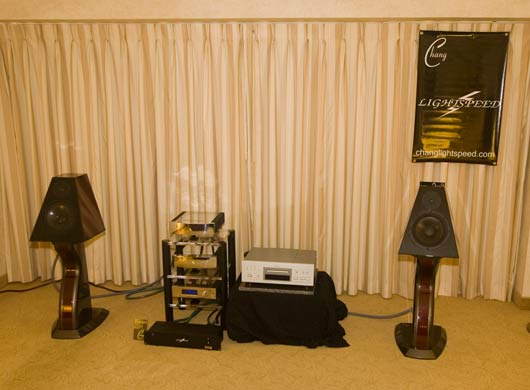
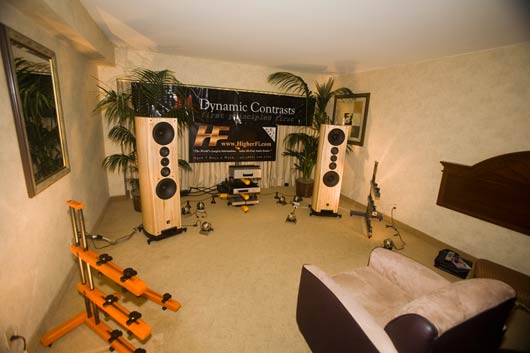
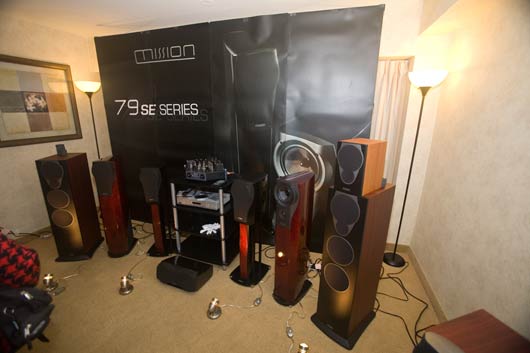
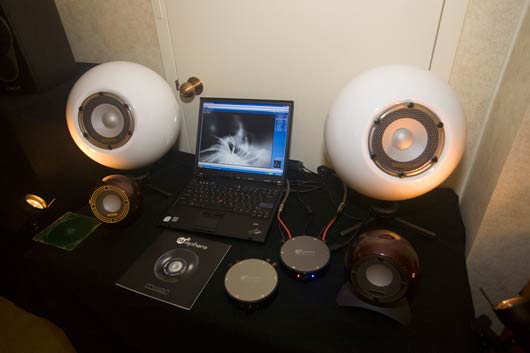
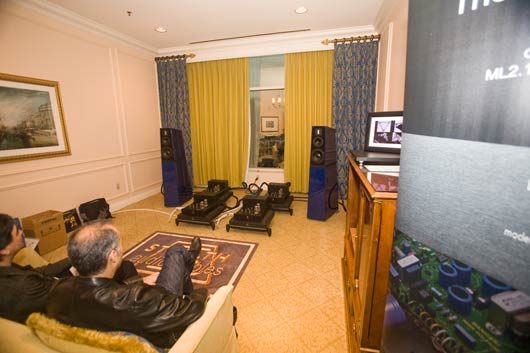
Here are the photos of the rooms on the main part of floor 4 at the Flamingo. Wasn’t going to do this but so many rooms have been overlooked by the other show reports (except Audiogon) that I felt it was important to acknowledge here, in pictures, that people spent their time and money to setup these rooms for us to take a listen to and a gander at.

I added a few comments where I had something to say.


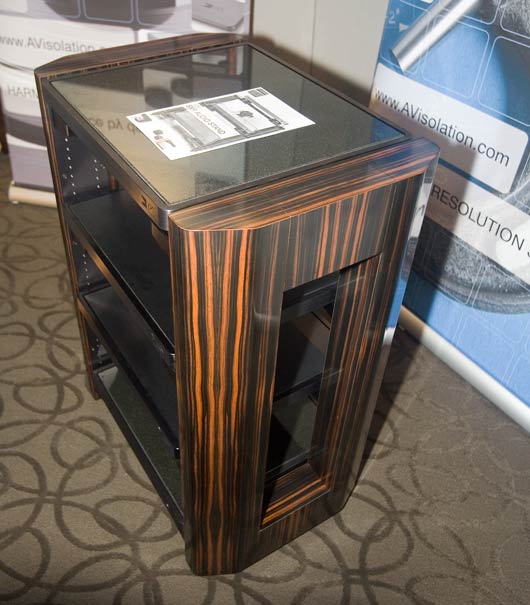
I listened to this system to see if I could hear what the racks were doing. A difficult task, to be sure, if not impossible. But the sound was indeed crisp and controlled, like a system with a good rack should be.


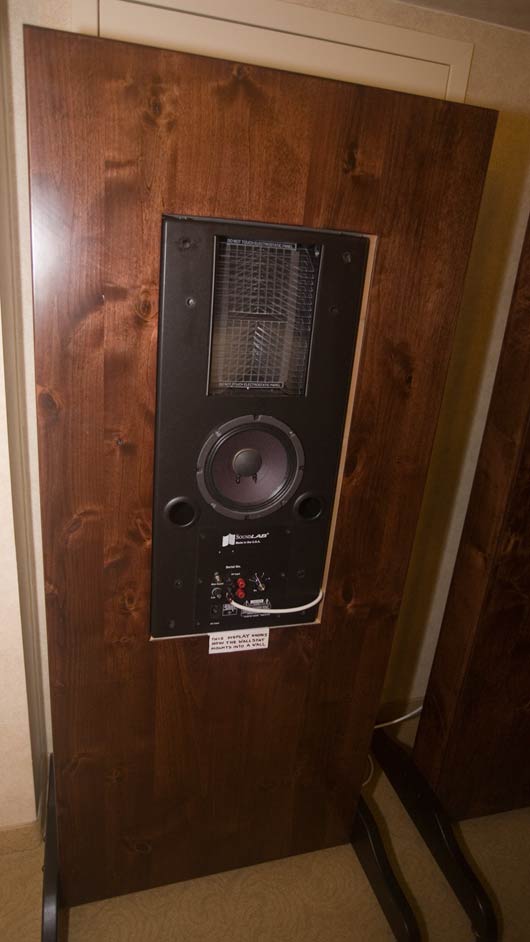
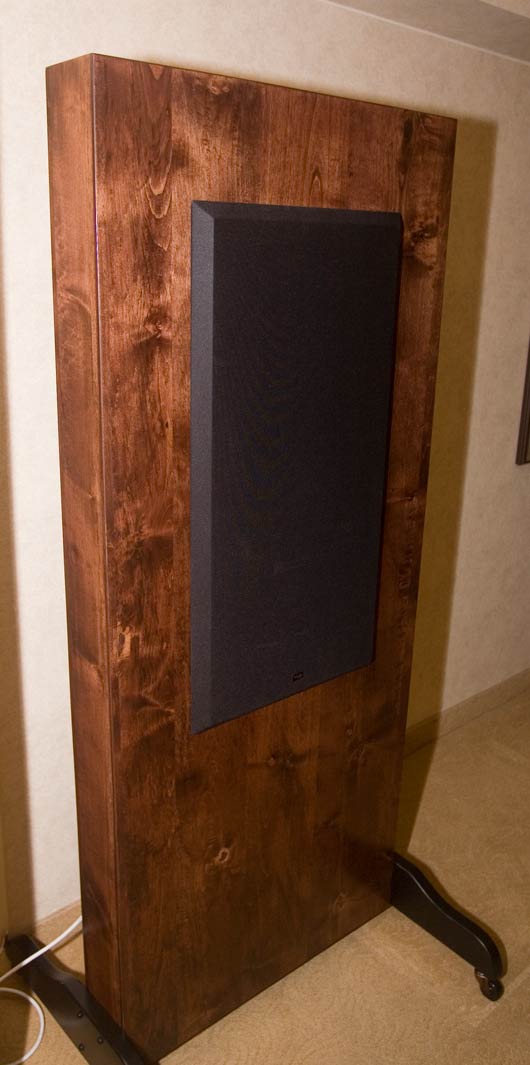
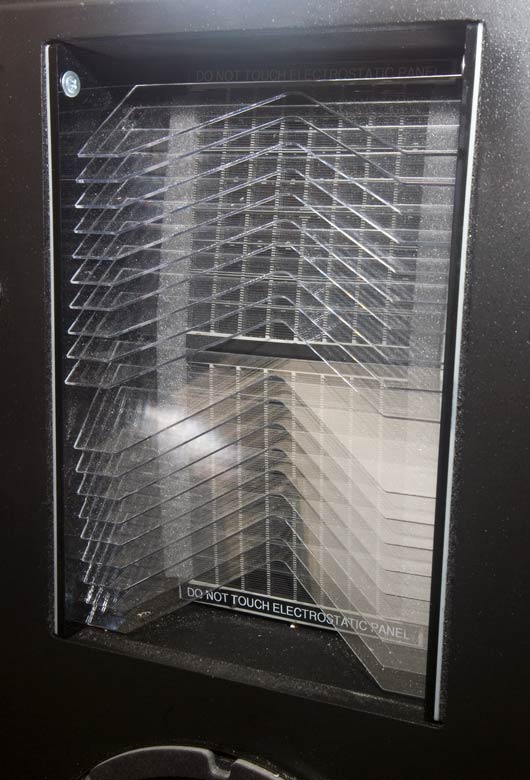
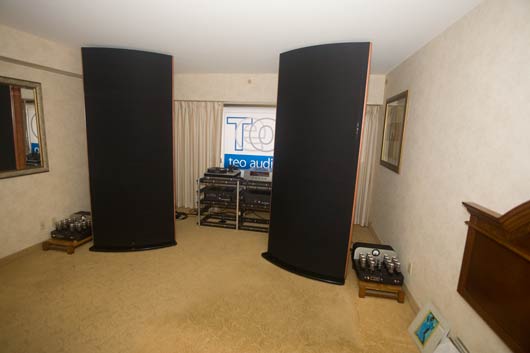
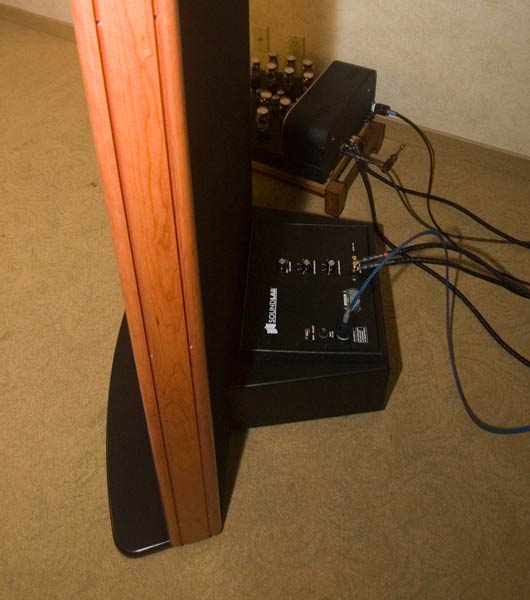
New in-wall speakers from SoundLab. Never did get back here to hear the demo, unfortunately.


Atma-Sphere amps, Teo cables, this system sounded round and powerful, especially in the bass department [they were trying to prove a point. They did].


Acoustic Zen Crescendo speakers with their grills on. This system sounded good, and I liked it better than the Tri’s on the Crescendos at the Venetian, which sounded uncharacteristically a little laid back, for some reason. I think they took the grills off later in the show.


The Playback Designs line-up of digital players now includes various options for USB input [I think this will be my generic statement for every line of digital on the planet, at this point].

I am not a good judge of $2K speakers in general, nor these here in this room in particular, and will leave it to those who specialize in these kinds of speakers to wax on their performance.


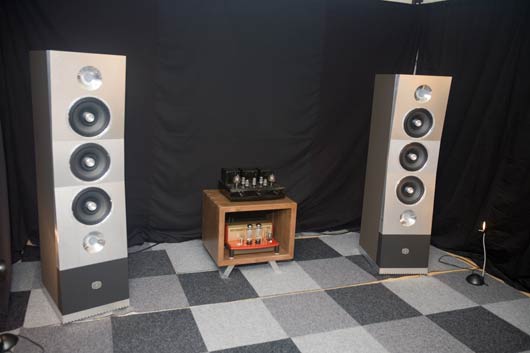
ZU Audio is continuing to innovate. There was something I liked about these speakers, but not enough, apparently, that it swayed me from my appointed rounds. Hopefully next show I will get time to play a few CDs here.


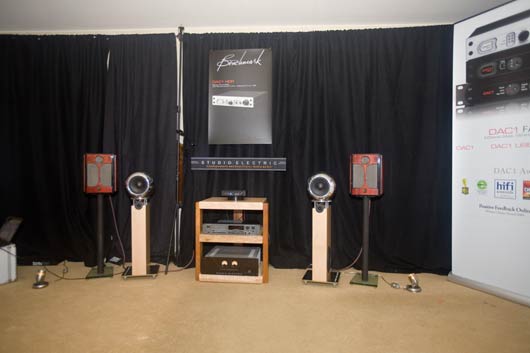
These new Studio Electric speakers packed a significant punch, and continue the more-musical-than-average orientation of their speaker line.


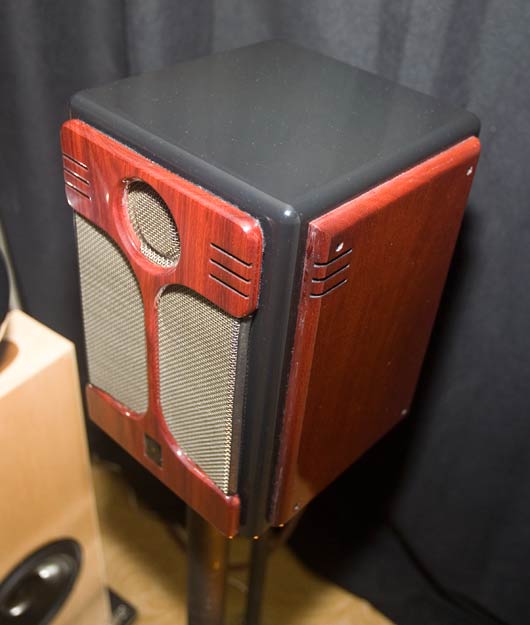
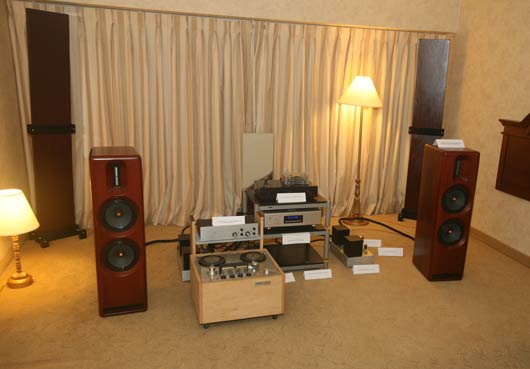
Sonist makes very musical, very high-performance per dollar speakers. They are planning to expand their offerings to include a couple of larger speakers in the near future. I look forward to hearing them.


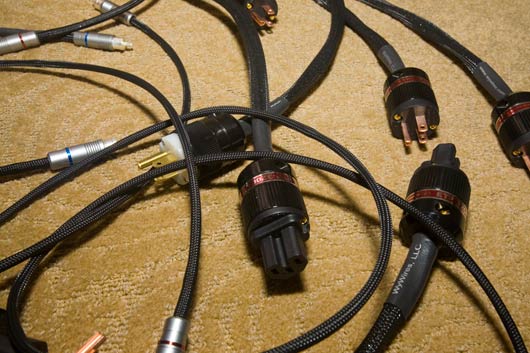
WyWire cables. We just got to talking and, well, here is a photo of their cables.


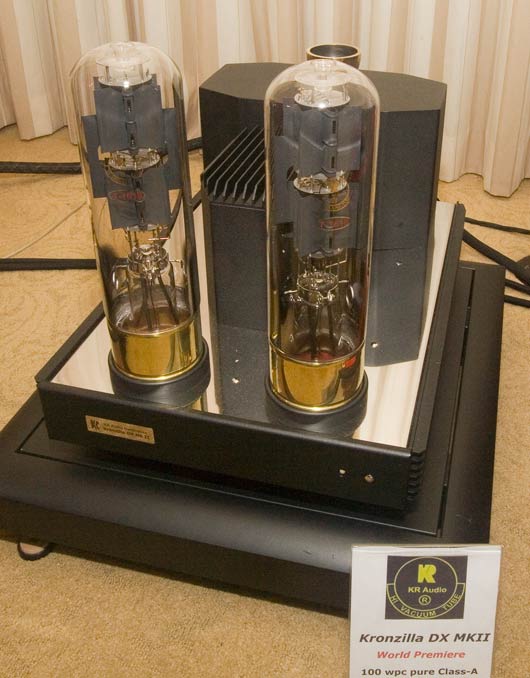
I listened to this room for awhile. High quality components (new Kronzilla mkII amps, for example), this system sounded good, but not great or drug-like or that something special was happening here.


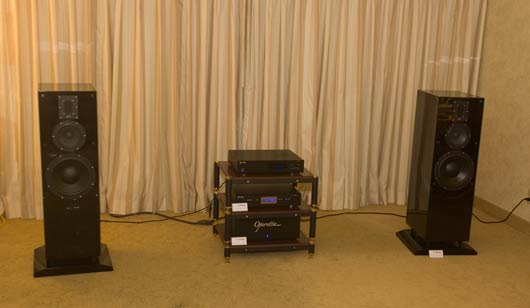
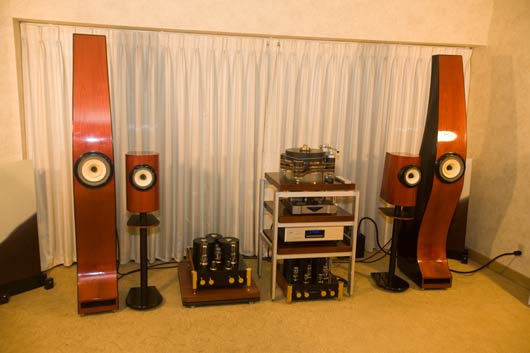
Teresonic always sounds musical and dynamic, albeit lacking the finesse and harmonic and dynamic resolution more typical of the more expensive high-end.


Clarity cable was there a day before the show, and already quietly playing music in their room as we arrived late Tuesday night. And last year they were playing music as we checked out [and maybe this year, too, though we were Bamm out of there when we finally left]. The sound was always quite Enjoyable.


The NFS Not For Sale room. Always trippy. Always a party. The sound quality *could* be better though…