Pursuing the Ultimate Music Experiences

Audio Federation High-Fidelity Audio Blog

Stereo System Configuration Optimization Techniques

In summary, then, we have:

I. Simulated Annealing – When some number of the system’s components judged the weakest get replaced.

II. Genetic Algorithms – When the system ‘mates’ with another system that sounded good and so ‘inherits’ components from that system creating a 3rd child system. (Thanks to Steve O. for this one).

and I want to add another:

III. The ‘A Star’ (often written ‘A*’) optimal path finding algorithm – in this case from the original system to a better system.

The A*Star algorithm searches for the best, most direct and cheapest path by looking at paths that appear to be in the direction of the goal. This algorithm presupposes that there is a goal in mind.

I think one of the other of these three algorithms are executed, subconscously, by people on the system upgrade path. That III is going to be more successful than II, and II than I, seems to be a truism.

—————————————————————–

It might be an interesting thought experiement to think about how, for example, a computer program that took a database with information about all known components, and, starting with your current system, could map out different systems that would improve the system, in the direction you want it improved, for each given price point.

I.E. What Neli does when you call her up (because we are comfortable recommending things we don’t sell)

This database would store information about each component, its warmth, its ability to control the bass of a speaker, its micro, midi and macro-dynamic capabilities, every sonic attribute we can think of. In effect, it would map each component’s location to a point in an n-dimensional space.

1. First the person using this computer program would type in all their current components. The program would then plot out the location of where their system is.

2. Then, the hard part, the person using this computer program, would have to pick a point in this n-dimensional space as the place they would like their system to move to eventually, how they would like their system to sound in the best of all worlds.

3. Finally, they would type in the amount of money they would like to spend, and perhaps other contraints like keeping the number of tubes below, say, a dozen, for heat reasons.

4. Then, pushing a button, they would get a graphic showing the systems that matched their monetray requirements along the path from their current system to the ultimate goal.

[Think of it as on Star Trek; with a million planets, how do they pick which one to go to for their shoreleave? They are going to need to use a program like this – can’t just go to Riisa all the time πŸ™‚ ].

In the Audiophile’s Guide to the Galaxy, we have mapped some quadrants in this space: Impressiveness, Enjoyability, Emotionality, Magic… next we have to map out the stars and planets.

Audio Trek.
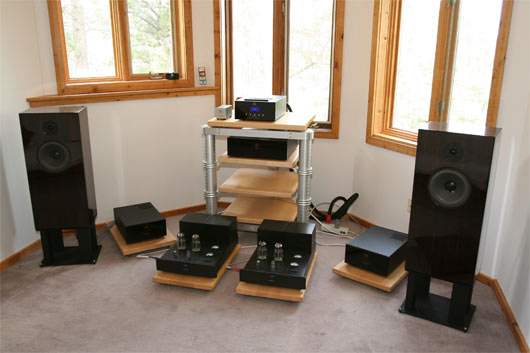
RMAF – Denver Rocky Mountain Audio Fest

15 more days.

We are spending a lot of time on the RMAF show preparations these days…

Deciding what furniture to have them take out of the room, and which to leave in

Making up a full page ad for the show directory (the booklet they hand out to attendees)

Getting our room posters made up that show the current list of product lines we carry… we added a few lately: Kharma, Elrod and Acoustic Zen (we love their Adagio speakers), and of course we lost Acapella.

Getting new business cards made up (we usually use the impetus of a show to update our business cards, if they need it).

Making up and printing out our handouts that we give everyone who comes to our room which describes each component we have in our system.

Focusing a lot at the gym on the muscles that are needed to Carry Heavy Equipment – especially those involved going up and down stairs.

Coordinating with everyone to get everything to show up on time for the show – things are looking positive lately on this front … (* W * H * E * W! *).

Creating the pages for our usual RMAF 2006 show report which are looking awfully empty right now…. The photo of the sunset was taken from our room at the show on I believe the evening of the last day of the show last year.

Drawing up the diagrams that show which components are going to go on which shelves of the equipment racks. We are taking our glossssssss black HRS ‘MXR’ rack, and HRS has graciously offered to send us out a loaner MXR rack, in silver (see pictures of a silver MXR in our photo rich HE 2006 show report).

And, of course, deciding which equipment to bring. πŸ™‚ It is tempting to bring the whole store to the show…. but not very practical, unfortunately.

Its firming up a little bit. Mostly what is changing is which manufacturers and distributors are goijng to be able to make it. I think we added 2 and changed 1 since the last post was initially written (it has been updated since).

* Marten Design Coltrane Supreme loudspeakers
* Audio Note U.K. Kegon amplifiers
* Edge Signature One amplifiers
* Audio Note U.K. M10 preamplifier
* Emm Labs DCC2 and CDSD Signature Editions CD / SACD player
* Brinkmann Audio Balance Turntable with Titan cartridge
* Lamm LP2 phonostage
* HRS MXR equipment rack and assorted M3 Isolation Bases
* Nordost Valhalla interconnect (10 meter run from preamp to amplifiers)
* Jorma speaker cable
* Shunyata power cords
* Elrod power cords

In the Audio Note / Audio Federation room, there will be:

* AN/E SEC Silver Signature loudspeakers
* Kageki amplifiers
* M8 preamplifier
* TT1 turntable with Arm Two
* Acoustic Dreams equipment rack and amplifier stands

In attendance, besides Neli and I and Steve, local customer and invaluable assistant, will be:

* Dan Meinwald – Importer for Marten Design and Jorma Design
* Laurence Blair III – Importer for Brinkmann Audio
* Leif Olofsson – Marten Design
* Jorma Koski – Jorma Design
* Dave Cope – Audio Note U.K. Answer Man (next door in the Audio Note / Audio Federation room, room 9026)
* Mike Latvis – HRS (Harmonic Resolution systems)
* Steven Norber – Edge Electronics

How does one know what sound one really, really, really wants?

The questions posed in the last post are difficult questions… well, the answers are difficult, anyway.

But there are a few guiding principles we think one can use to navigate the process of system evaluation and upgrades:

1. Recognize the absolute failure of magazine reviews and online forum consensus to consistantly recommend components of a high quality.

There are a lot of reasons behind these failures… we mentioned a few a couple of posts back.

2. Most components are good at ‘something’ – just make sure you know what that something is and how it relates to #3

3. Understand your personal preferences and trade-offs – and understand that they will change both with life maturity and as the number of your audiophile experiences increase.

Nobody is rich enough to buy the perfect system. No, even hiring a live bands won’t give one a ‘perfect sound’ [for example, Jimi and Mozart just ain’t gonna be able to make it that early in the day, sorry].

So there ARE going to be tradeoffs – things that you will have to accept which are not going to be perfect. Know which things are OK for you personally if they aren’t top-notch.

.
.
.
.
.

How does one know what sound one really, really, really wants?

Saying it is the absolute sound (of a live acoustic instrument) is a cop out. For one, many of us like amplified music – which often sounds ‘better’ in our homes than it ever did live. Second – where are we sitting at this acoustic event? A close-mic’d recording would have us sitting in Yo Yo Mah’s lap.

Besides, do we even like Cello music? At what time of day? Do we like it as loud as it is live? Louder? Do we want the player to play with experience or with passion? Do we want them to play without mistakes – or do we want to feel like the player is extending themselves and makes a few mistakes in order to reach heretofore unheard of heights of skill with their instrument?

But all this is perhaps irrelevent.

What we really want in a sound is governed by how we want it to impact us.

Sometimes we want it to stir up the adrenaline – to make us feel bold and powerful.

Sometimes we want it to remind us of the beauty that still exists in this world.

Sometimes we want it to surprise us.

Sometimes just to entertain us.

Always to make us FEEL SOMETHING.

What do we want to feel? How can we tell? Is it like food – do we need a well-balanced diet of musically-induced emotional / psychological experiences? How do these interact with /affect / get affected by / replace feelings we get from other experiences in life?

I’ll say one thing – musically-induced experiences seem to have a higher quality, a more aesthetically pleasing as well as a ‘higher consciousness’ if you will, about them than the everyday events in our lives. Well, I find that to be true in my life anyway πŸ™‚

[It is my opinion that most high-end systems and components target the listeners who they think want to be impressed by the technical aspects of an audio reproduction system – so that often a system does not induce any deep, complex responses in the listener at all – nothing except an appreciation of the technical wizardry of 21st Century humans and a latent feeling of annoyance with a dash of mild headache].

High-End Audio System Optimization Techniques… continued

Last post broke down the optimization process into three main steps:

1. Recognizing that a system needs improvement and that it cannot be improved without some radical changes
2. Choosing what those changes should be
3. Evaluating the resultant system for sound quality improvements (or lack thereof )

Hopefully after some thought we might be able to apply some of the techniques from Simulated Annealing algorithms to our dilema here.

Looking more deeply at step 1.

*** Some people are happy with what they have and no matter what other system they hear, they are able to always convince themselves that their system is ‘better’. These people should not be reading this πŸ™‚

*** Some people read the trade magazines are the online forums and hear about how just absolutely wonderful something is and this gives them an urge to upgrade. There is nothing that they can hear that is wrong with their system, but that ephemeral ‘better component’ haunts them – making them wonder if their system may not be so good after all.

How to debunk what they are reading so that they don’t feel like they need to upgrade all the time?

How to learn to differentiate between needing a system upgrade and just reviewer-inspired equipment lust?

How to stop this imagining all the time as they listen to each song about how the song would sound probably so much better if their system just had X, Y and or Z?

*** Romy [if I understand him correctly :-)], at the GoodSoundClub, thinks that a person should always have a clear idea of exactly how they want to improve their system, what property of the sound that they want more of and what they want less of, before they start upgrading.

How does one know how they want to improve their system?

How does one differentiate between infatuation with a different sound a natural preference for a particular sound?

How does one know beforehand whether a particular sound will help one grow in their depth of mucisal appreication, and what is just sugar coating that will take one into on a detour?

How does one know what sound one really, really, really wants?

*** Some people hear a system and they like something about it a lot in comparison with their system – perhaps the bass is better controlled, or more powerful, or the pacing is much more natural and engaging. Sometimes every aspect of this other system they have heard is appealing (in which case they should attempt to replace theirs with an exact copy of this other one, if they can afford it. Done, Finito.). But sometimes the other system sound also has aspects that are not as appealing.

Should they inquire further and see about upgrading their own system to get some of these positive attributes they are hearing?

They only heard this sound for a few minutes, maybe hours – what will it be like to live with? Will they learn to hate it?

How to get the good things from this other system into their own?

Which components in that other system are what is making this aspect of the sound that they are liking so much?

.
.
.
.
Well these are all hard questions.

I know that other hobbies are also so inflicted. Electric guitarists buy and sell amps and guitars like there is no tomorrow (they call it having GAS – Gear Aquisition Syndrome). Looking for that particular ‘sound’ that will both be ‘theirs’ and also be appealing to their audience. We don’t usually have much of an audience – though the ones that we do have, especially the non-audiophiles – should be listened to closely to see if we are anywhere in the ballpark of having a system that sounds enjoyable in a natural sense. Even the finest wine tastes good to a neophyte – so should our finest hifi systems sound good to the non-audiophile.

More next time on some ways to help think about maybe finding an approach that might work for some of the questions above…

For myself, the main question is and will always be:

How does one know what sound one really, really, really wants?

Or needs.

Simulated Annealing – Part One Summary

To summarize the previous, somewhat rambling, post:

There exists an optimization technique called Simulated Annealing, based on certain techniques of metallurgy, which can be applied (often unqittingly) to optimizing a High-Fidelity Audio System.

This optimization technique has a large number of problems it has been applied to, but in general it is a practical technique and every application is customized for the problem at hand.

Using this technique should get one to a better system faster than just the brute force technique of trying everything.

The optimzation process in our case consists of three steps:

1. Recognizing that a system needs improvement and that it cannot be improved without some radical changes
2. Choosing what those changes should be
3. Evaluating the resultant system for sound quality improvements (or lack thereof :-))

Gettng to step one often entails an emotional rejection of the current system, causing confusion resulting in step two being flubbed, and ending up with a system that fails at step 3 (or whose improvment is not as significant as desired). Rinse and repeat.

Simulated Annealing – The High-End Audio System Optimization Problem

A quick definition from WikiPedia.com

“The name and inspiration come from annealing in metallurgy, a technique involving heating and controlled cooling of a material to increase the size of its crystals and reduce their defects. The heat causes the atoms to become unstuck from their initial positions (a local minimum of the internal energy) and wander randomly through states of higher energy; the slow cooling gives them more chances of finding configurations with lower internal energy than the initial one.”

The idea is that a little ‘shake up’ is required to get your system out of a ‘rut’ and in so doing achieve a better sound.

Systems reach a point where they have been optimized as much as possible. Given a budget and these set of comonents: the system has got the right cables and the right speaker positioning and the amp seems to mate fairly well with the speakers andit has been pushed and coaxed. each piece has been coddled just about as much as really makes sense.

So, to get a better sound, one would have to ‘heat up’ i.e. do some serious changing to, the system.

To get the very best sound possible we would still have to try every possible component in combination with every other possible component. But if applied correctly – the simulated annealing optimization approach will get us to a ‘better’ system a lot faster.

OK, so all this is believable, and most of it is probably provable.

The problen arrises in the two human elements:

1. The human has to decide how to ‘shake up the system’ i.e. which components to replace.
2. The human has to judge whether the resulting sound of the new system is ‘better’ or not.

[There is also a ‘0th’ element: the human has to decide that the system is optmizied about as much as possible yet Needs Improvement].

We’ll look at problem #1 first. This is probably the real key psychosis-inducing gut-wrenching ‘WTF did I do that for’ kind of problem.

For one, when the typcial audiophile is finally ready to ‘heat up’ their system, to do some ch-ch-ch-change-essss, they are well past the point of calm cool logic… they are Fed Up. One is emotional. One has finally been torn loose from a loyalty to such-and-such a component that one had every reason to believe was the bees-knees.

Why did one ‘believe’ it was the bees-knees [what does that MEAN?] in the first place? We’ll get to that in a moment.

But it is this emotional storm, which no doubt provides one the support to get rid of some cherished components – which is often is so strong that, in keeping with the metallurgy analogy – one often just melts the whole system down like 3-Mile Island and liquifies the darn thing – and starts all over. Pack ’em up. Move ’em out.

But what does one get next to replace these out-of-favor components?

In this emotional state one often loses confidence. Turning to reviews on the net and in the trade mags, actually listening to salespeople and what they recommend.

Yep. This is where the trouble really starts.

Why? Because the Human Element #2, Judging whether the sound is better or not – is often forgotten during this stage and only applied AFTER the new components are bought.

You know that POS you have loved and posted about and raved about and now detest? It MAY not be so bad. It depends on WHAT YOU LIKE your sound to sound like. Maybe it is not being well-supported by the other components.

You know that person / reviewer / dealer / netizen who is recommending you spend gazillion dollahs on component X? What does THEIR system sound like? If it sucks, why won’t your system suck if you buy what they are recommending?

Look at what else they have in their system. Does it suck? Why trust a person who has sucky things in their system? Maybe they have sucky taste in sound, too.

Look at their buying and selling habits. Are they thrashing, tossing things out left and right all the time? Then why trust what they say about component X when you just know they are going to be selling it in a few weeks, at which time they can tell you all about how it sucks this and sucks that. [Maybe it sucks and maybe it doesn’t – they can’t tell because their optimization algorithm is broken and they are not getting to really ‘hear’ the piece in question – often because the associated components that they bought last week were not designed to work with component X because they had no freaking idea they were going to buy component X last week – so they did not make a nice home for it so it just puked all over everything… :-)].

[A lot of ‘sucks’ in this post, sorry]

The answer to Human Element #1, what to throw out and what to keep?

Well, one approach is taken by our dealer-agnostic component-flavor breakdowns in the Audiophile’s Guide to the Galaxy. If one knows what kind of sound you want to move towards, then this will help choose the kind of amp, preamp, CD player, and speakers to get.

How does one determine the sound that they like without trying each and every component – a pricey and lengthy proposition? [Although it has its pleasures, it is however both very addicting and immensely frustrating].

How does one improve the Human Element #2 part of the system optimizing algorithm, judging the sound they hear by comparing it against the sound they would like?

One way is to go to shows.

Another is to listen to all kinds of systems in the geographic areas you visit and inhabit, including systems that are way too expensive, as well as those that are very inexpensive.

[More in our next post .. This is getting long.]

Audio Note U.K. AN-E SEC Silver Signature Loudspeakers at the RMAF 2006 show in Denver

Last I heard these speakers will be used in the Audio Note room at the RMAF 2006 show in Denver next month – so it you get a chance to stop by their room you can hear them for yourselves (next door to ours, up on the 9th floor).

So we have until RMAF to play with the speakers here. We need to try:

* The Edge Signature One 400 watt solid-state amps on them.
* The Lamm ML2.1 amplifiers on them!
* Try them in the very large listening room #1.

Now that I start the list…Whew!

You see people, this is hard work here at Audio Federation. No… really… πŸ™‚

One you get a certain number of components, one HAS to try all the combinations. Right?

I mean its is fun. And educational. But … L Loudspeakers * A amps * S source components, where L is 6, A is 6 and S is 6 (hey, it just so happens we have 6 of each, don’t read anything nefarious into all this, OK? πŸ™‚ ) is 216 different system combinations.

Not counting different cables and power cord combinations.

And I’m ignoring preamp combinations. And the different room-sizes we have available….

Well, I guess we are lucky it all weights a fracking ton…. it keep us in shape….

;-))))

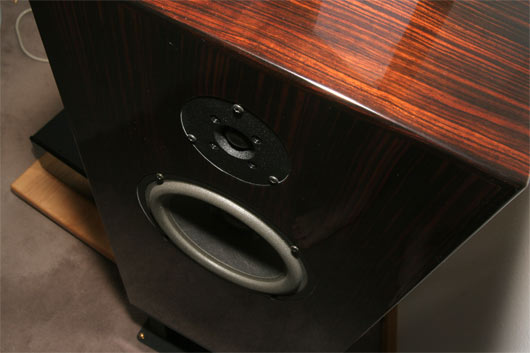
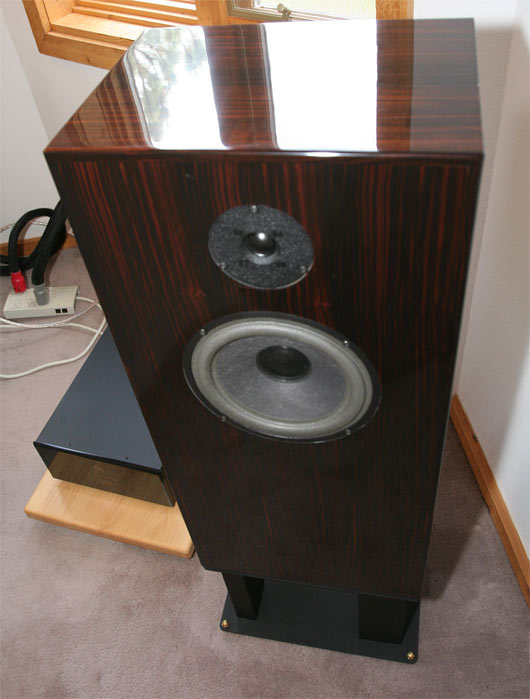
Audio Note AN/E SEC Silver Signature Loudspeakers

Audio Note Loudspeaker in system in Listening Room 3
Audio Note AN/E SEC Silver Signature Loudspeaker with external crossovers in Listening Room 3 with Lamm ML1.1 amplifiers, Andio Note CDT-3 (CDT-Three) transport and DAC 4.1x Balanced.

Nope, no preamplifier in this system at the moment. Long story… but the Lamm L2 preamplifier, that was here, is now on the Kharma Mini Exquisites in the another room (thanks Joe!), and the Audio Note M8 will be here instead any minute….riiiight Neli?

Audio Note Loudspeaker
Audio Note AN/E SEC Silver Signature Loudspeaker closeup view

It is hard to describe this speaker. We have had a number of amplifiers and source components driving it – so we are starting to get a sense of it….

It is not like the other speakers here – it does not have a laundry list of things it does ‘best’ – want the ultimate in resolution? Look to Marten Design and Kharma. Want a super flat feequency response? Look to Marten Design. Want beguiling transparency? Look to the Triolons. Want seemlessness between drivers. Well the single driver SoundLabs can’t be beat.

Even with respect to musicality – the Kharmas will have to take that gold medal…

But what these are is the most Enjoyable speaker we have ever heard.

What does that mean?

It means that the system anchored with these speakers is the one where we have to kind of urge people to get up off the couch and go hear the next system not because it is ohmygod astonishing – but because it connects us to us. This is the reason we got into this hobby in the first place. Something inside us just likes to listen to music.

This system is the one where it is just so easy to listen to music for hours and hours.

The other systems are considered ‘better’ by most audiophile-approved and -endorsed measuring sticks – but they are all also challenging in some way. Overwhelming perhaps. Or startlingly detailed. Or something that draws ones attention, one’s intellectual attention, to aspects of the music that have nothing to do with music.

Audio Note Loudspeaker and external crossover
Audio Note AN/E Loudspeaker and external crossover

Do you remember when, perhaps in your teen years (for those of you not in your teen years now) when you did not examine the music – you listened to it?

Well, even after all these long cynical years as a picky audiophile – you can listen and enjoy music that way again. Not that these speakers are cheaper than most other speakers, coming in at $40K.

But they are an end-of-the-search kind of speaker. The ‘you are done exploring what is possible in music reproduction, now is the time to start listening to music’ kind of end of the road, the ‘let’s get on with our life’ kind of beginning of the rest of your life. Or maybe it is just time to ‘get a life’?

Nahhhhhhh… hey these are just speakers – it will take more than that to get most of us ‘a life’…. πŸ™‚

Audio Note Loudspeaker
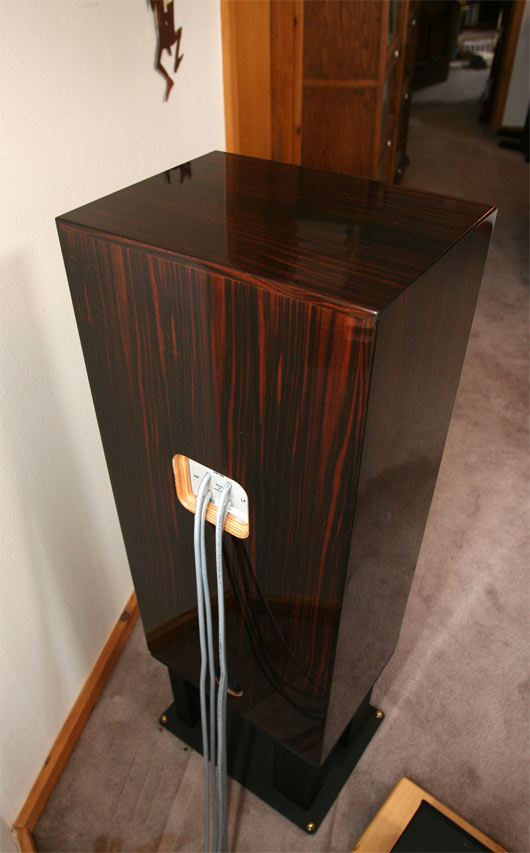
Rear of speaker, with integral Audio Note Sogon speaker cable… yummmmmy.

Audio Note Loudspeaker
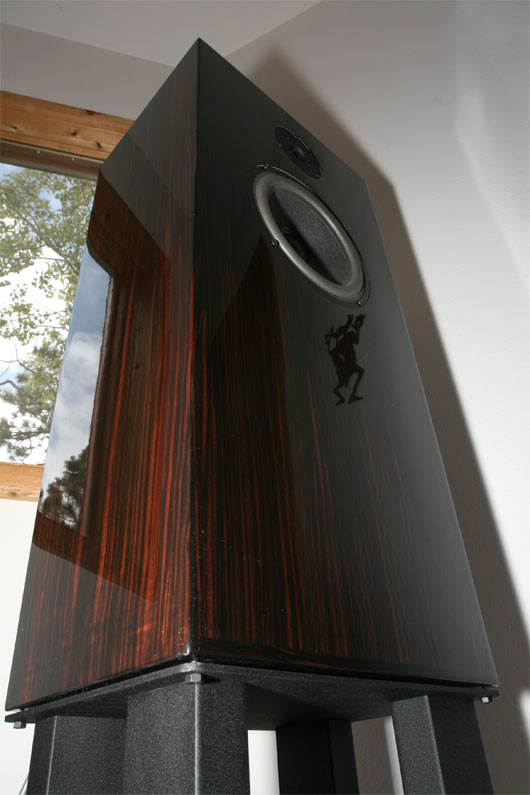
The speakers are very reflective, here you can see our light-switch cover, an artistic and autotomically correct dancing man, reflected in the speaker. Oops, well, I guess this isn’t a family blog anymore… [Hey! You can stop peering so closely now…I have more things to say below πŸ™‚ ]

Audio Note Loudspeaker
Audio Note SEC external crossover – Front view

What this says, for those who can’t read the picture, is:

“AN-E Special Edition Cobalt
Hand Calibrated Copper Foil Capacitor Crossover
Solid Silver Inductors
SilverWired Voice Coils
ALNiCo Woofer Magnet
SOGON Speaker Cable”

Audio Note Loudspeaker
Audio Note SEC external crossover – Top view

Audio Note Loudspeaker
Audio Note SEC external crossover – Rear view

Audio Note Loudspeaker
Final view of the AN/E speaker…

These are what I call my desert island speakers (actually, include the rest of the audio note electronics with it too, please). (oh, and an HRS MXR rack. This is a very nice 5-star desert island :-)).
[OK you spellers out there, I originally spelled this ‘dessert’ island – but now that I changed it, I am not so sure that dessert island isn’t a better description after all….Nahhhhh. Desserts are usually sweet but of little redeaming value otherwise. The point really is that this speaker, these systems are what one ends up at after one is done fracking around with all these fun audio toys and just wants to listen to music]

And on this desert island, I would hope that it would have normal walls – as our current listening rooms do not have any corners, nor do any of the rooms in this house (except the closets) [which is a good thing… and a bad thing…. The Audio Note loudspeakers like corners to be nearby].

And we haven’t even been able to take the full measure of these speakers yet! [See next post].

But if you are finally through with exploring the strange new worlds of the audio reproduction universe (encountering strange new systems – most likely configured in a unique way, in a unique room – boldy going where no one has gone before… only to find “its dead Jim”), then you REALLY should check this stuff out.

The Room, The Room, Boss

[Fantasy Island….]

OK, we like the custom room design folks that we have met, and they seem to be doing a thriving business, and there is nothing wrong with that….

But I feel so OFTEN like putting up an ad right next to some of the dealer et. al. ads I see that have photos of their rooms whose appearance makes them come seemingly from ‘the outer world’ [Dune, the movie]

“New High End Audio System!
* Brand new technology, works in any room of your existing home!
* No need for for remodeling, hammering, dust, construction workers, their dogs and cigarettes and trash!
* No “long stream of cost overruns” heartburn.
* No agonizing choices between Brown1, Brown2 and Brown3
* No ackward moments of senility revealed when you have to pay extra to have the bluegreen painted over that looked so good last week.
* No choices between painting over the gray that was painted over the bluegreen and Prozac in order to avoid the depression the gray is inflicting.
* No disturbingly unhealthy choices between having windows and just having a peephole.
* No need to sink your money into something that you will have to leave behind when you move.
* No need to spend Hundreds of Thousands of Dollars on something for your house that for the average buyer will actually lower its resale value!

Save some money and buy instead your dream system, and spend the rest on your significant other. Might we suggest the Marten Coltrane Supremes and Audio Note M10 pre and Lamm ML2.1 amps and Emm Labs digital and HRS MXR rack and….?”

Let’s see, if we run that in Stereophile and the Absolute Sound….what do you think the response will be? πŸ™‚ πŸ™‚

Anyway, the dedicated custom-designed room hype is here and quite strong and I am sure this will rankle some folks – as going against the prevaling winds as the experts have mapped them always does, no matter what the industry.

Sometimes, it seems like we are ‘going nowhere awfully fast’. [Scotty, Star Trek]

CEDIA EXPO 2006, CEDIA 2007, CEDIA 2008

We just learned that CEDIA 2007 and 2008 will be in Denver as well as was 2006. Wow – for some reason we just assumed that CEDIA would be traveling to another city next year like it always does…

So, expect a show report from us again next year. I noticed engadget.com is now starting to post larger pictures… but no one posts show reports like we do. They are a little hard on the computer and network, but easy on the eyes πŸ™‚

We posted a number of links to our show report in various forums:

AVS Forum in the Ultra $20,000+ section and Home Theater Forum in their special CEDIA section people seemed to enjoy it quite a bit.

On Audio Asylum no one seemed interested. On Home Theater Spot they deleted my chatty post and banned my login from the forum. No accounting for taste, I guess.

We had a good time at the show. Looking forward to next year, in fact. Just like audio shows, the demonstrations are way better than what you can get at your typical dealership.

Neli did run into someone with 2-channel envy at the ReQuest booth. After telling the guy what we did for a living, he apparently went on and on about CD-changers this and dead-SACD that… so much so that Neli just had to walk away without getting to ask any questions about their music servers. Yeah, we also think ultra high-end 2-channel audio is more fun than selling turnkey-software boxes that are running head-first into the free-open-source software-on-linux (and begrudgingly Windows) movement …. no matter how much people try to convince us (and themselves) that it aint so πŸ˜‰

Anyway, one thinmg that the show has done is infected us with a desire to upgrade our video here at AF. And even more, to set up a HT system where the sound doesn’t impinge on the enjoyment of the movie – in fact, it may even ENHANCE the enjoyment! [ironically enough, huh?].