Pursuing the Ultimate Music Experiences

Audio Federation High-Fidelity Audio Blog

CES 2009

CES is almost upon us. I finally registered and found out that they are now charging $100 for attendees registering after Halloween. Neli of course registered months ago. Maybe this $100 charge will reduce the number down from 140,000 to, oh I don’t know, zero? Maybe not, though.

This year I am again going as a member of that sneaky [you bet] subversive [I wish] group… the ‘press’… who seem to get in free. Who knew?

Will the economy keep people away? I have no idea. We are going – but I am not sure if we are going to show anything this year.

Our show report will be different this year. Well, it is different just about every year – but here is how it will be different THIS year.

The Magazine

Most of the photos will be in the magazine, in a format that is very modern in its use of web technology. At this point, we are going to have one page per room, with all their photos and with one photo super-sized to fill the window. So you people with giant 24 and 30 inch monitors, or who surf the web on your front projection system – you will get the real, sun-glasses ARE required, sensory overload impact. But you people with smaller screens won’t miss a thing either – because everything will scale down as well as up.

And hopefully we will have an intuitive zoom mode – so that we will ALL now see how to operate the buttons on the front panels of all the gear at the show ๐Ÿ™‚

The commentary will be thought-provoking, and analytical – but not detailed and critical. That part of the show report will still be on Audio Federation’s website.

Why not put the critiques of each room in the magazine’s show report?

Well, for one, yes, we want to have advertisers put ads on, and link to, their room’s page [and our ads are permanent – like real magazines – they get paid for once and they stay there – they won’t just disappear next month if the advertiser stops paying their monthly fee].

Another reason is that most people in this hobby – hate to say it – do not care all that much about the sound at shows. They have been ‘told’ that the sound at shows “can’t” be any good. Blah Blah Blah. So, a $10K system that sounds slow and dull? It is the shows’ fault. A $500K system sounds slow and dull? It’s the shows’ fault. [someday we’ll have to write something on how audiophiles have been programmed to think certain things – and by who.. or is that whom?]

The Audio Federation Show Report

…Will have one photo per room and a critique of the sound in the room – when it is worth commenting on.

As far as I know, we are the only ones, in this whole blamed world, who actually write something that gives some idea of what rooms actually sounded like [though there is Larry Borden, a little bit, sometimes, and Trelja, though mostly reaction instead of analysis]. It might actually be fun if more rooms sounded interesting….

Emm Labs CDSA + Nordost ODIN versus Emm Labs TSD1 and DAC2

The question: Does an ODIN power cord on the back of a CDSA make it the equal of Emm Lab’s new ‘black badge’ TSD1 transport and DAC2 pair?

[Thanks Steve G. for the idea for this shootout.]

Starting off with a question like that makes me think of Carrie in ‘Sex and the City’ writing her column [just got done watching the movie. Liked it but it should have been called Spoiled Women and Wimpy Men in the City. Am I right or am I right? :-)].

The question is especially relevant because the price of an ODIN + CDSA combo is about equal to the price of the TSD1/DAC2.

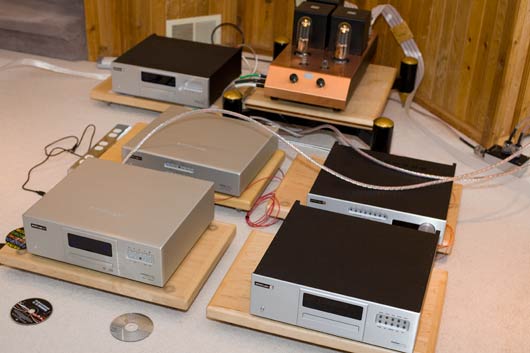
We decided to do a slightly different shootout, perhaps unfortunately, that compares the CDSA + ODIN against the TSD1/DAC2 using fairly decent power cords [Valhalla and ELROD]. At the time this seemed to make more sense – most people would put a decent PC on the ‘Black Badge’ pair [the ‘Silver Badge’ pair being the CDSD/DCC2]. And the Kimber PC that comes with the Emm Labs gear had not been broken in at all – otherwise we should have used that power cord.
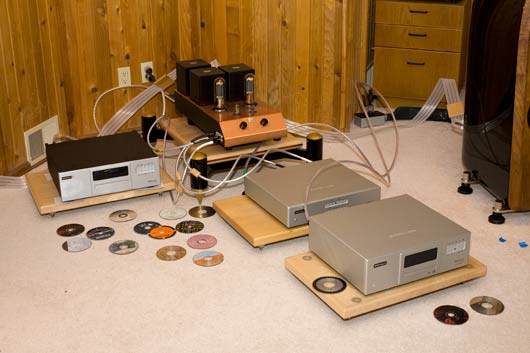
Anyway, we learned a lot from the shootout – or at least confirmed what out other – very lengthy shootouts [appearing soon in the Magazine] told us about the two players.

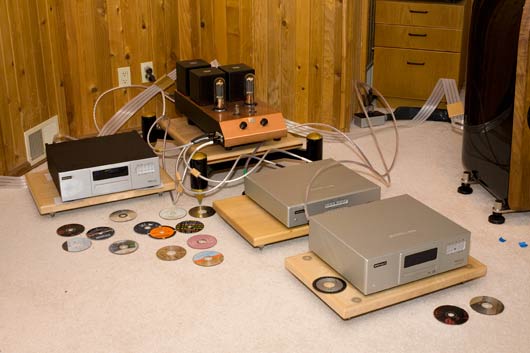
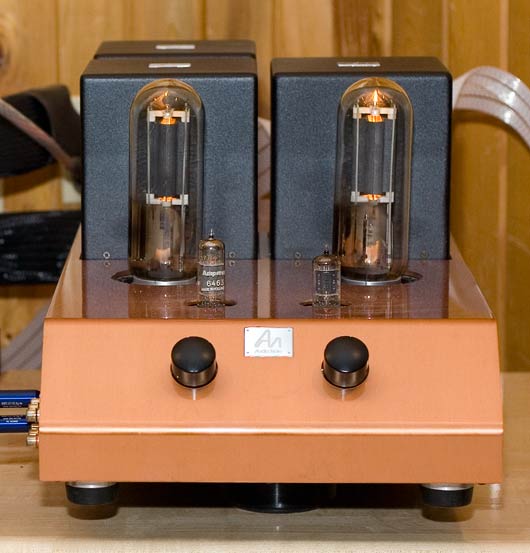
For this shootout, we were able to just switch back and forth between the two players. They were both run into the Audio Note Ongaku integrated using Nordost ODIN interconnects. The Ongaku was connected to the Marten ‘Coltrane’ loudspeakers using ODIN speaker cable. Every thing was sitting on Acoustic Dream’s amp stands.

Since we were eagerly anticipating the luxury of being able to switch back and forth between the two players in real time [usually we have to do a lot of disconnecting and connecting between listening to one component and other – trying to do it as fast as possible to keep as much aural information in short term memory as possible], we needed to find discs that we had two of. We did and they were: red book Radiohead’s Amnesiac, SACD Santanna’s Abraxus, and SACD Janis’ Rachmaninoff.

Radiohead:

The CDSA sounded a little ‘dirtier’, with a little more ‘spit’. Perhaps a little more romantic – but we later decided that the reduced separation here was more familiar, more comfortable, and more accessible. We talked about this before – how as a system gets better and we leave the old familiar problems behind – we miss them. Many people think those problems are part and parcel of the way music is supposed to sound and they [and their poor roommates] get stuck in a sonic rut, a backwater, a musical ‘hell on earth’ [but I probably exaggerate a little].

The Pair had way more separation, a much deeper [spooky] blacker background, and better purity. By purity here I mean that the notes were not more harmonically pure – they are about the same on both players – but that the black background and separation allowed notes to be heard, that they were allowed to live out there lives the way they were meant to, that – well that is what I am calling purity until I can think of a better name [I would say ‘clean’ but that is taken by people describing the lack of note attack aggressiveness. Maybe ‘spotlessness’?? Integrity??].

Anyway, I hope people can begin to see that these 3 things: separation, an incredibly black background, and purity/cleanliness/spotlessness/integrity are all related and are a major factor in the difference between the two players on this particular system. [Previously, the Pair also seemed more linear, more well-balanced, than the CDSA but the ODIN PC helped out a lot on this. It also increased resolution, separation and the ‘romantic/engaging’ aspect of the CDSA as well].

Neli: CDSA fuzzier, not quite as crystalline.

Abraxus:

The Pair: The ability for greater separation between the notes helps out a lot here. The first track is actually quite complicated – and the pair was able to separate out separate strains of the music much better than the CDSA. [there was a feeling of… wow, I didn’t even know that those were separate instruments before…]

The CDSA: Again, somewhat more accessible, but in comparison with the Pair, it sounded like things were mixed up, much more the familiar amorphous mass of cool sounds we usually hear when we listen to Abraxus.

Rachmaninoff:

The Pair: the spatial connectedness is better. The rhythm is much more life like.

The CDSA: A little harsher.

PRaT and Presence/Solidity were ….different between the two.

—————-

OK. It is time fasten seatbelts and leave the standard digital player shootout and discuss just what I think this Pair does to the digital playback universe.

First, I think that finally, digital, THIS digital pair, is now perhaps the equal of analog playback. Before you all click the back button on your browser, let me say what I mean by that.

First, it is OK, for me, that digital be *different* than analog. Why make it sound like analog, we already got analog and it does quite fine, thank you.

Second, what are the ways that analog is better than digital? Separation, midi-dynamics, and sense of rhythm [not PRaT]. It also has a harmonic distortion that many of us enjoy.

OK, in what ways does the TSD1/DAC2 pair excel? Separation. Black background [revealing the midi-dynamics in a way much like analog]. And a sense of rhythm that is not like PRaT.

So, let us talk about PRaT – which in general we can describe as a strong emphasis on the main beat of the song – resulting in an urge to perhaps do some toe-tapping. The idea here is that perhaps it is the lack of separation, causing things to collapse, both spatially and timewise, so that too many things happen at once, and too many things in one amorphous image, causing:

1. an abnormal emphasis on the main beat, and deemphasizing the natural delays between the actual notes and the interplay amongst musicians as they play off one another and which, in reality, are not exactly 100% on the beat each and every beat.

2. an abnormal collapse of the spacial image, in the soundstage, into a solid mass, that makes it seem like there is a solidity and presence there that doesn’t really exist. That in reality there is actually a guitar body, and a guitar neck, and a voice,and the voice reflecting from the microphone…. which makes ‘presence’ and ‘solidity’ more real, and more 3D. And less of a ‘lump’.

So rhythm should be what it should be: and notes should happen on the beat when they were recorded that way, and a little before or after if they were recorded that way. When the notes are smeared the least little bit – it is perhaps made up for in the mind of the listener by assigning them to the nearest ‘beat’. But when they are clearly off of the beat, they are interpreted as the natural interplay between musicians, the natural human failing of not being perfectly on time [and this is a good thing – it is how things sound like, live].

So what the pair did, on this system [and make no mistake, this is a *system*. We’ve done so many, many shootouts here lately, everything contributes: the speakers, the ODIN – the decay of the notes are unbelievably beautiful, on both players – and the Ongaku is not chopped meat either :-)], was to allow us to experience, to enjoy, the music in more ways than we have before using digital playback.

A lot of people [who have lived with audio for awhile and graduated from the impressive], say they want a richer warmer sound. That they want more PRaT. That their system is not involving enough and that adding warmth and toe-tapping PRaT is the way to fix that.

Well, that would certainly help. For awhile.

But what people really want, deep down, beyond this or that tweak or enhancement – if I can be so bold as to say it in print – is to have a convenient playback that evokes the real – that allows them to hear the wonderful interplay amongst the singers and musicians, to hear the beautiful tones and decay and care that went into every single darn note in every single darn piece of music in their music library.

Neli thinks the TSD1/DAC2 Pair is evolutionary. I think it is revolutionary. But maybe she is right. The way way black background [not like stupid power conditioners that strip away detail at the same time], and the ability to keep the different notes from collapsing into each other – is probably just evolutionary.

But there is a tipping point to things. And I think this is one of those ‘tipping point things’. [Boy, and I thought this was going to be a short post].

In this idea, suggesting that the Pair is like analog – different but equal – is the idea that it must be the depth and variety of the ways we can enjoy the two mediums that we need to compare and contrast. It is my sense that the Pair adds more ways to enjoy music – that some of these ways are similar to analog – and unlike the digital of the past – as described above, but that they get there a different way [lower noise floor versus greater dynamic response to notes at ordinary loudnesses, etc.].

More later on all that…
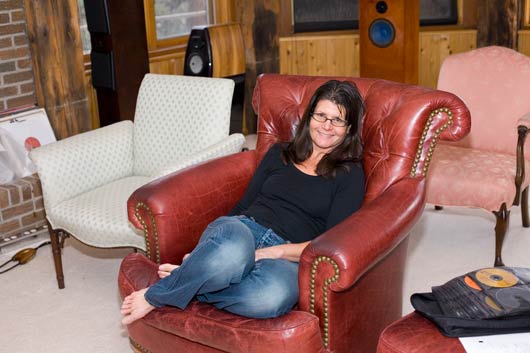

Neli with the Audio Note, Kharma and Acoustic Zen speakers in background, and Jorma Design PRIME interconnects on floor at left.

So, ๐Ÿ™‚ we went upstairs and played the same Rachmaninoff music, but on LP on the Brinkmann turntable, Audio Note M9 Phono preamplifier, Kegon Balanced amps and Coltrane Supremes. With the low-gain Lyra cartridge and a problem with noise on the line getting into the sound – it wasn’t an optimal setup by any means.

OK, OK…. But when the massed strings played over on the left, on both systems I enjoyed them, and in similar ways. I could pick out this or that guy a little louder than the others or a little too long with the note… [in some ways, it is the ability to hear the mistakes in the music that make it seem much more real :-)]. I got the same feeling of ‘wow’ that the music was trying to invoke in the audience.

I got the same feeling at being present at a concert – the conscious and subconscious cues each medium was giving me that this was REAL were different but equal.

More about THAT later too. This is all just supposition – that the TSD1/DAC2 pair can offer as convincing an experience as analog – it seems like this is something that will come to pass someday – and it seems like that is today, to me, now – but it will take a long time to verify.

Personally, we do not differentiate here between SACD and red book CDs on the Emm Labs gear. The differences between them has more to do with the recording and mastering than the medium. But lately, and maybe it is just me being lazy [and heaven knows I would love to be less of a perfectionist, it would certainly reduce our high-end audio expenses – Oh, wait, Neli would have to get lazy too] – I did not feel I had to care if we were playing CDs on the TSD1/DAC2 pair and LPs at RMAF, and that has been true here as well. Sure they are different. But all the dimensions in which I enjoy LPs I now can enjoy CDs. This was not the case with previous digital gear.

————–

So, do we still like the CDSA? ๐Ÿ™‚ We had to send our TSD1/DAC2 pair back – it was just loaned to us for the RMAF show – we had previous commitments and were not able to buy this demo pair :-(. Big unhappy frown for Neli. Big unhappy frown for me, too, but I am an optimist – or maybe just a masochist ๐Ÿ™‚ – we’ll have our own soon. And then we can think about what it will sound like putting a pair of ODIN powercords on the TSD1/DAC2 instead of the CDSA….

YES we still like the CDSA – it does almost everything as well as the Pair, and we still have the ‘silver badge’ Pair, too. But………………….. stay tuned ๐Ÿ™‚

HP reference to EMM Labs in TAS

Specifically, the reference to the, I quote “Meitner’s new Special Edition SDCD and DAE components (which had newly arrived and are his ‘statement’ versions of multichannel DSD playback gear)” in this months TAS [November 2008] ….. is actually a CDSD SE transport and DAC6e SE.

It is NOT the new TSD1 and DAC2 and it is NOT some mystical, mythical pre-release super-powered unannounced digital gear either.

We got a number of questions about these quotes in TAS over the last few months.

Also glad to read in the same paragraph that a blu-ray disc in the $239.48 Sony BDP-S300 DVD player [which is the cheap knockoff of my BDP-S1, which doesn’t image as well as the little DAC in my DELL PC – but does have fuller bass], doesn’t sound as good as SACD in the SE Meitner pair. [hopefully I do not have to say all the catty things I know all of YOU are thinking… ;-)]

Shootouts and more shootouts

We’ve had a lot of shootouts lately. Many power cord shootouts. And we’ve started several EMM Labs shootouts.

More later, but here are the upshots:

*** ODIN power cord. Simply put we have a new favorite cable.

*** ODIN power cord versus ODIN interconnect – which is the biggest bang for the buck as your first cable? The short and sweet: In this case, on this system of EMM Labs CDSA, Audio Note Ongaku and Marten Coltranes] it was [kind of] the PC that was the biggest bang – but there is an explanation why the $11K PC beat the $16K IC.

First, the SOUND was better with the IC. But the MUSIC was better with the PC and we didn’t care that the sound wasn’t as good. The explanation? My hypothesis is that the Ongaku, the amp we put the PC on, is the great contributor to the musicality of the system and costs about 8X times what the CDSA player costs. So adding the ODIN PC to it just made that more musical. The ODIN IC, as expected, let way more sound from the CDSA get to the integrated amp – and the sound had more body, more information, etc. But, again, we didn’t care. On a different system, with perhaps a less dominating amp, the IC will likely dominate the PC even more and we would elect a different winner.

*** EMM Labs CDSA versus CDSD/DCC2 versus TSD1/DAC2 [versus red badge CDSD/DCC2]. In progress [but in this system, with the ODIN and the TDS1/DAC2, we heard revolutionary amounts of separation. Each instrument was clearly defined and you could easily follow just one instrument’s sound and its decay. Just like in reality. No, really. We have NEVER heard anything quite like it. It is addicting. This whole system has become addicting. It is so pleasing to the mind [so deep, so many complex musical passages revealed], and so pleasing to the heart [so pure and the decays last exactly as long as they are supposed to and the harmonics are so lovely]. Rarely has anything excelled at both – especially on such a small scale.].

Audio Note M9 Phono Preamplifier photos

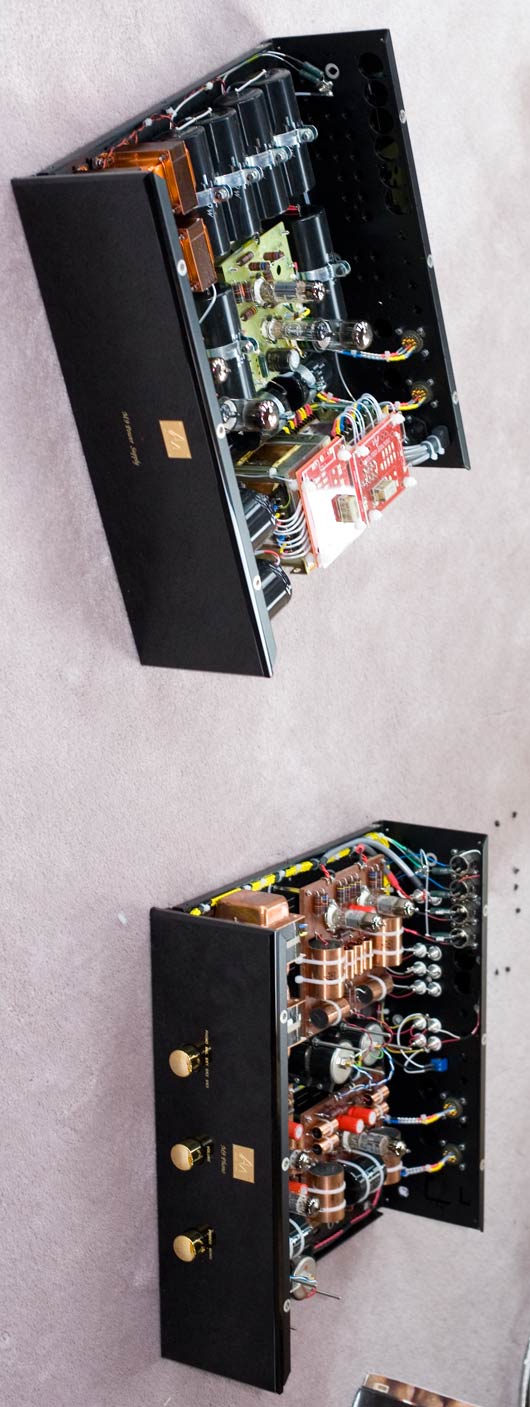
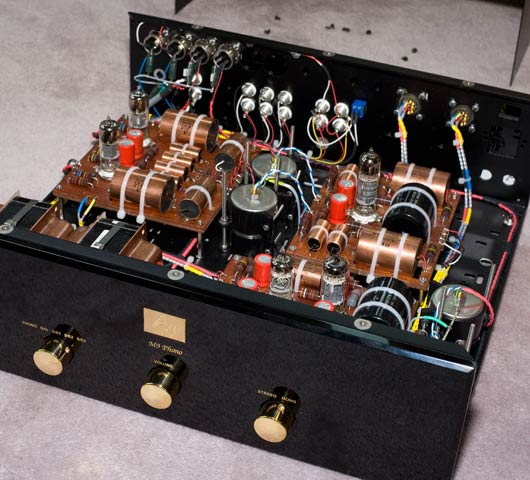
We opened up the Audio Note U.K. M9 Phono preamplifier – to reseat tubes and just to take a big peek inside [taking the cover off of new equipment is not as common in the U.S. as it is elsewhere in the world].


This is a two-box preamp, one power supply box and one linestage box.

Note how packed with components these two boxes are.


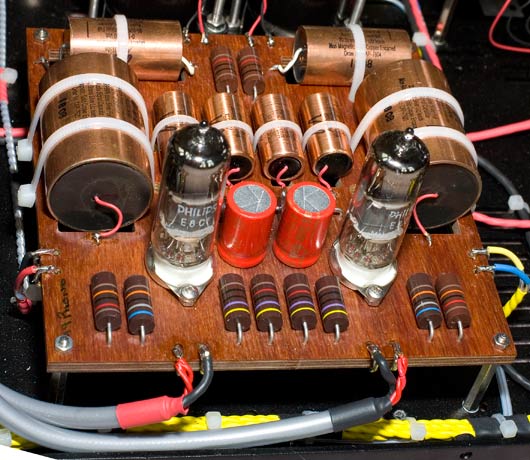
We have a ton of photos, but these are of the linestage.


Check out the wood-like composite non-resonant PC boards that the components are mounted on. Checkout the heavy silver wiring.


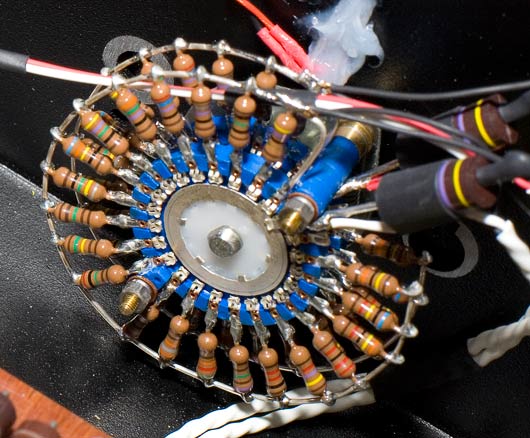
This is the volume control.

Yes, we like the way it sounds too. ๐Ÿ™‚

Needs lots more breaking in… but it is very intensely musical [whatever THAT means :-)]

A New Online Magazine

[For those of you who do not read the entire show report (no wonder why a few people got upset about the terseness of their room description, they had not gotten into the groove of the whole ‘audio noir’ thing) – specifically the main page with our list of favorites of show and pictorial index to all of the rooms – here is a copy of our pre-announcement of our new online high-end audio magazine]

A New Online Magazine

We are publishing a new online high-end audio magazine in hopefully a few weeks. This as-yet-unnamed magazine will use new technology that will allow us to do things other magazines and websites cannot. It will also be innovative in other ways in an attempt to better serve manufacturers and dealers on the one hand, and audiophiles on the other.

Why a new magazine?

Oh, there are so many, many reasons. ๐Ÿ™‚

But the primary reason is that they are all so damn boring. ‘Reviewers’ focus way too much on regurgitating cookie-cutter equipment reviews in order to get loaned more free equipment. Bo-ring. Music reviews are written in a manner that has little to do with the way audiophiles actually listen to music. Snore.

The other primary reason is that the relationship between manufacturers/distributors/dealers and the magazines is like that of lobbyists and politicians. It is inherently corrupting to both. The result is that everybody distrusts and fears everybody else.

So, yeah, we gonna do things way different. We are going to focus on the fun and excitement of being an audiophile – all those reasons why we are doing all this crazy stuff in the first place. And we are going to provide several ways for manufacturers/distributors/dealers to get their message heard – without having to compromise their sense of ethics or take out a second mortgage.

To this end, then, …

We are talking with several people about writing for the magazine. If you are interested we would like to talk with you, too. We are not looking for and will not accept [most] reviewers – we will not even have traditional reviews, per se. We are looking for people who are extremely honest and can express themselves, who can bang on a keyboard a little [the Grammar Police have left the building], or use a video camera, or snap a few photos and share their perspective on why being an audiophile is so fucking intoxicating.

We are also accepting press releases, installation experiences, overviews of technological innovations, design perspectives, industry perspectives, biographies, factory tours etc. submitted by manufacturers/distributors/dealers [preferably full-page, but we will work with you], once per month, and will publish them for free. We are looking for serious submissions, in addition to the press releases, that respect the reader’s intelligence – something a reputable manufacturer/distributor/dealer would say to someone in their store or factory. We will also accept traditional ads, preferably full-page, but any size will work, for which we will charge standard prices.

We are also looking for one or more sponsors. Perhaps someone who wants to remind their readership each month that they are proud sponsors of the magazine. Or perhaps someone who wants to take more of an ownership stake. We will be contacting some potential sponsors directly, but if any of you want to contribute to the audiophile community in this way, please contact us as soon as is convenient.

For now, send email to me at: mike@audiofederation.com

Working on reviews of the Lamm ML3, the…

…Nordost ODIN power cord, and to be followed by the EMM Labs TSD1 and DAC2 once they get a few more hours on them.

These ‘reviews’ are rather longish and will be some of the first articles to appear on our new online magazine. [More about THAT real soon].

We’ve already done about 8 hours of shootouts with the ODIN power cord [and pretty intensive shootouts at that. It is a really great way to not only learn about a component, but the sound and relative balance of an entire system. Especially when you get to hear way, way farther into the music than you have ever before… well, ever since the ML3’s left, anyway], and we forgot a few configurations that we have yet to do [mostly to determine which is the biggest bang – adding the first ODIN power cord or adding the first ODIN interconnect to a system].

A first-timer's perspective

I talked to an audiophile who is just starting out – though he seems to be a very quick study, and knows a lot of the ins and outs already. I’m afraid I wasn’t much use to him, asking him questions instead of imparting advice [not that I ever impart advice, I am more comfortable guiding people and letting them hear for themselves and discover their own preferences, not mine].

His perspective on spending 4 hours at RMAF, his first show, was the following:

* Overwhelming

* There are a LOT of brands

* There are a lot of innovative and just plain WEIRD designs

I think he enjoyed his time there, but it didn’t really bring him closer to finding which speakers he wants to get [and me asking him 20 questions didn’t help much either :-)].

Perhaps there needs to be a printed guide, dividing up the rooms into price categories… but then show goers would miss out on hearing more expensive systems that might help them refine their preferences, and less expensive systems with stellar performance.

The real answer is friends. Friends can guide other friends…

And maybe the show needs to conduct guided tours – not of any price category, but floor-by-floor say, giving people an independent perspective on what they are seeing and hearing.

The economy should be good for audio retailers…

… and here’s why: with lower gasoline prices, lower shipping prices, lower food prices, and maybe even lower import prices, it will be like $7K extra in the bank and the audio gear they buy with it will be cheaper. With commodities tanking, audio will be cheaper to make which is good for the manufacturers.

Here are the details [ aka guestimates]. An average family with 2.5 cars drives 30K miles per year, say. Gas prices will return from $4 to the $2/gallon or so they were before the current administration. At 15 miles per gallon that is a savings of $4K. an average family of 4 spends, say, $15K per year on food. If food goes back to, say, 20% cheaper then that is another $3K in savings annually. Expect shipping, plane tickets, everything gas related to go down 30%.

Assuming people still have jobs…. this will be very positive for people not heavily invested in the stock market [and who aren’t shorting this market. Next time the powers-that-be start shouting DEPRESSION! remind me to short everything in sight. I presume THEY are.].

So, chin up, maties, our hobby isn’t down and out yet. In fact, it may just have gotten a boost. Though it might take awhile for people get over the shock and awe on the news channels and realize their good fortune.