Pursuing the Ultimate Music Experiences

Audio Federation High-Fidelity Audio Blog

The Right Song at the Right Time III

This post will illustrate one metaphor, an oversimplified model, of how music kind of helps the world make more sense by reflecting its patterns back at us in a different form… a musical form.
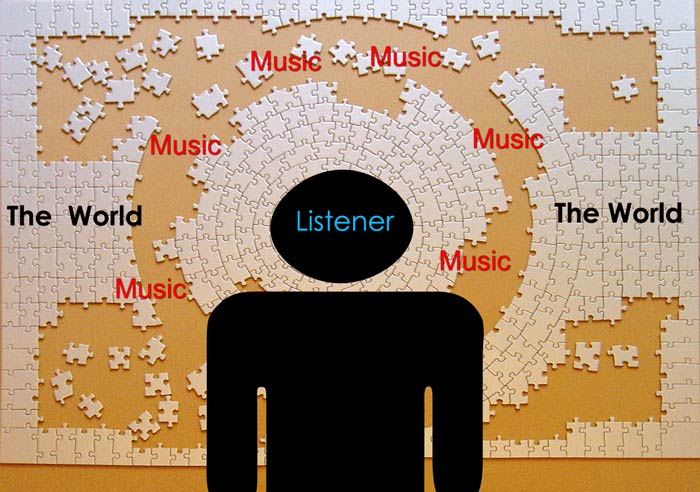

Here we are representing the world as a puzzle [ain’t it tho], and the brain trying to ‘piece it together’ but how we still have gaps between our understanding (the pieces around the listener’s head) and the puzzle of the world itself. Music here is providing some of the solutions to this puzzle.
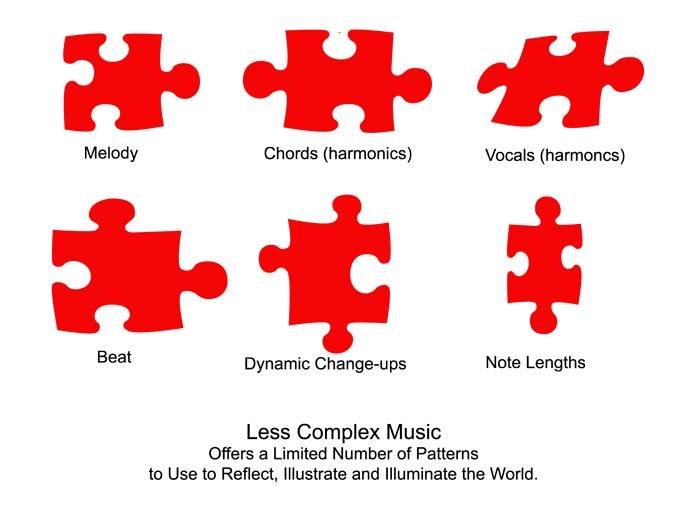

Back to hifi. As we all know, lofi stereos cannot reproduce the complex passages in music; when they try it all comes out muddled and sounds like noise and it less than worthless, it is annoying.Lofi can only reproduce the most simple of melodies and least complex music [and even so, it does not do this very well].


HiFi music systems can reproduce all kinds of music, including that with a lot of complexity, which supplies the brain with lots and lots of patterns, puzzle pieces, with which to create possible interpretations of what is going on around us in the world.

A simple, somewhat contrived example, would be a situation where you might be having difficulties working with a 4-member team, some friction between expectations versus results, say – and after listing to Beethoven’s 5th, da-da-da-DUM, your brain kicks in a you realize that 3 of the team members are quite similar, but the 4th is quite different, and needs to be treated differently, with different expectations and handling on your part [I TOLD you it was contrived :-)].

Notice that we are completely ignoring the content of the lyrics here. “You can’t always get what you want” is indeed useful in understanding the way the world works [albeit we learn this, in my generation anyway, when we were very young from our parents on a daily basis]. But these posts are talking about how music affects us, not how the spoken word affects us.

This theory can be tested, I think, by, say, playing a number of songs for people who love baseball, with some of the songs having patterns that are similar to the patterns in baseball (lots of 3s… 3 outs, 4s… 4 bases… 9s…. nine bases, etc) and see if they prefer [are more comfortable,naturally familiar with] the songs with the baseball patterns compared the songs without these patterns.

Conversely, if one is writing a song for people who love baseball, perhaps using these patterns, and several of the more complex patterns found in baseball, might be quite advantageous [more complex patterns would including the fairly regular rhythms of, say, the swish of the pitch, the crack of the bat – or that of the ball hitting the glove. The response of the crowd rising/falling in the background, etc.].
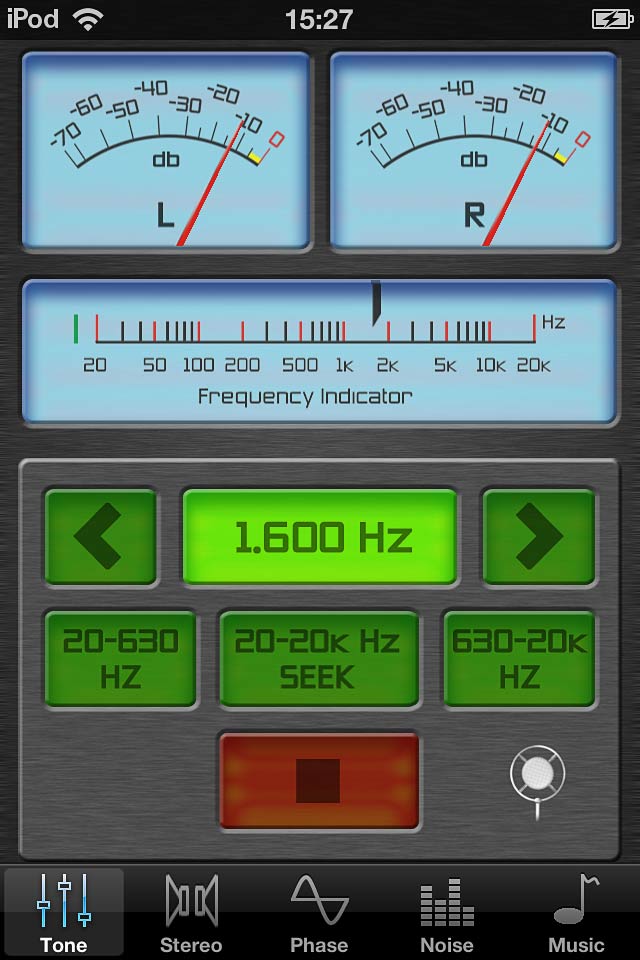
CES 2012: TigApp's Audio Audit

[Another news flash from the CES 2012 news deluge. I’m not an Apple guy anymore – but perhaps one of you might find this, currently free, app of use. It seems to me that if your only source in your system is an iThing, then this app would be invaluable. Also, if the iThing’s microphone is any good, then having a frequency analyzer with you at all times would be a heck of a lot of fun – especially at shows. English does not appear to be their native language, and I am somewhat confused by what their target use cases[s] are beyond possibly these two].

“TigApp is a young and dynamic company which develops applications for the iPhone, iPad and iPod.

This application is focused on testing different audio systems for home and professional use.

The application serves as a reference generator of sounds or records for the purpose of setting up, testing and burn-in speakers, headphones and Audio components.

This application comes to the AppStore December 23, 2011 and will be free for a limited time.”

From the TigApp website:

Frequency generator

generates sinusoidal frequency or swap sinusoidal signal for testing

Noise generator

generates white, pink, brown, human and silence noise

white noise – noise containing all frequencies in the range defined by the same volume
pink noise – containing all the audio frequencies with a defined volume falls off at 3dB per octave
brown noise – containing all the audio frequencies with a defined volume falls off at 6dB per octave
human noise – containing all the audio frequency range with a defined volume adjusted according to physiological properties of the human ear
silence noise – white noise with reduced volume
Adjusting of the stereo base

when right speaker is on the right side and left speaker is on the left side – it’s OK

Indication of inverted phase

control of the inverted phase (swap of the plus and minus cable on one speaker)

Records for testing

music with the full spectrum frequency range for testing

Microphone

for ambient testing

Detail information

“Analogue” indicators:

Peak indicator – red color (-75dB – 0dB)
RMS indicator – black color (-75dB – 0dB)
Peak and RMS indicators for the left and the right channel

Frequency generator

Sinusoidal signal of frequency (1/3 octave scale, Peak -12dB, RMS -15dB):
20Hz, 25 Hz, 31Hz, 40Hz, 50Hz, 63Hz, 80Hz, 100Hz, 125Hz, 160Hz, 200Hz, 250Hz, 315Hz, 400Hz, 500Hz, 630Hz, 800Hz, 1000Hz, 1250Hz, 1600Hz, 2000Hz, 2500Hz, 3150Hz, 4000Hz, 5000Hz, 6300Hz, 8000Hz, 10000Hz, 12500Hz, 16000Hz, 20000Hz

Swap sinusoidal signal: 20Hz – 20000Hz (logarithmic course, Peak -12dB, RMS -15dB)
Swap sinusoidal signal: 20Hz – 630 Hz (logarithmic course, Peak -12dB, RMS -15dB)
Swap sinusoidal signal: 630Hz – 20000Hz (logarithmic course, Peak -12dB, RMS -15dB)

Noise generator

White Noise: Peak -10dB, RMS -15dB, frequency range 20Hz – 20000Hz)
Pink Noise: Peak -2dB, RMS -15dB, frequency range 20Hz – 20000Hz)
Brown Noise: Peak -2dB, RMS -15dB, frequency range 20Hz – 20000Hz)
Human Noise: Peak -2dB, RMS -15dB, frequency range 20Hz – 20000Hz)
Silence Noise: Peak -55dB, RMS -96dB, frequency range 20Hz – 20000Hz)

Adjustment stereo base

Bass Drums L: left side (Peak -2dB, RMS -15dB)
Bass Drums R: right side (Peak -2dB, RMS -15dB)
Bass Drums L-R-L: transition from left to right side and back (duration 30s, Peak -2dB, RMS -19dB)
Treble Drums L: left side (Peak -1dB, RMS -16dB)
Treble Drums R: right side (Peak -1dB, RMS -16dB)
Treble Drums L-R-L: transition from left to right side and back (duration 30s, Peak -1dB, RMS -21dB)

Indication of inverted phase

Guitar-normal: phase in order (Peak -0.3dB, RMS -14dB)
Guitar-Invert: right channel inverted (Peak -0.3dB, RMS -14dB)
Cool-normal: phase in order(Peak -0.3dB, RMS -13dB)
Cool-invert: pitch channel inverted (Peak -0.3dB, RMS -13dB)

Test records

Classic: duration 30s, Peak -0.3dB, RMS -15dB
Cool: duration 36s, Peak -0.3dB, RMS -13dB
Guitar: duration 36s, Peak -0.3dB, RMS -14dB
Jazz: duration 36s, Peak -0.3dB, RMS -15dB
News: duration 38s, Peak -0.3dB, RMS -15dB
Road: duration 50s, Peak -0.3dB, RMS -16dB
Microphone

Precise graphics indicators for the both channels (from -22dB to 0dB, step by 1dB)

CES 2012: AfterShokz ear phones that do not go into the ear

[Getting a TON of news from CES this year. Very rarely is something somewhat relevant. Here is one of the ‘somewhat cool but still not exactly relevant’s]

AfterShokz is a brand new company on a mission to change the way the world listens to music on the go — with ear-free headphones that transport sound through your cheekbones. They’ve used patent pending bone conduction technology (initially developed for military special ops) to create the ultimate sports, mobile and gaming headphones. Benefits for users range from basic comfort, to long-term eardrum health, to increased safety during activity. This technologically-advanced product line will be available to the masses at everyday price points in time for CES — innovation yet to be matched. The flagship product (Sport) is currently one of the most popular semifinalists in the Last Gadget Standing competition: http://bit.ly/tLkmxA. “

The Right Song at the Right Time II

We will now look at The Right Song and how it is able to affect us so deeply from a more abstract viewpoint.

We talked some time ago about how the patterns of notes in music [especially classical] mimics the patterns in reality and how listening to music can somewhat subliminally show us patterns that are occurring in our life – some of which we may not be all that aware of – helping us experience life more deeply and sometimes even helping us solve problems by revealing patterns that make the subtle relationships between the things we are dealing with more clear.

Patterns [I think of them as weighted undirected graphs mapped into a 2D projection, because I am more comfortable with 2D than 3D. YMMV.], in this context can mean professional relationships between you and your co-workers, between the various priorities in your life, between your kids multitudinous kinds of ‘success’ in life and their overall well-being, … it can be just about anything. Perhaps you might think of these patterns as fractals [fractals have been matched to many patterns that organic life presents to us].

Back to The Right Song, and cutting to the chase, one can think of the patterns in the Right Song matching some kind of matching need for this pattern in the mind so that when the two come together, it is quite pleasurable. I think of this as two, very complex puzzle pieces, one being the Song and one being your current state of mind, and they fit together more or less perfectly. Or I think of it as two molecules, thinking back to high school chemistry, with one missing a few electrons [the brain] and one with a few extra electrons [the Song] and they come together to form a 3rd molecule [a happy brain].

In these two senses, the Right Song ‘completes me’ [back to Jerry Maguire again? And, no, I haven’t watched that movie for a year so this is NOT a Jerry Maguire inspired post. Or at least I do not THINK it is. Better go listen to some classical music… :-)].

One reason hifi works so well in making us feel good is that many more complex patterns are made audible in a given piece of music compared to what lofi reveals. With more patterns there is many more opportunities for the music to ‘fit’ the ‘holes’ the brain is producing.

We now another perspective on Druglike music:

Some high quality audio is just able to stimulate the brain in some areas and relax it enough in others enough that we experience wonderfully expansive states of mind.

The perfect song is a piece of music we are receptive to Right Now. It will have The Most Impact on us at this time.

But we also carry around with us medium term and long term patterns of receptivity [the sizes and shapes of the puzzle pieces of our mind], making us especially susceptible to enjoying certain songs and certain types of music.

So we can stimulate our minds to special states with high-quality hifi music, or we stimulate our minds with the Right Songs. Or we can do both – and at the same time.

Open questions are

A) how to determine what your Right Song is at this moment. More generally, is there a way to determine what your Right Music is at any given moment?

B) Is there a way to put yourself into a receptive state for a particular song or music? [e.g. you are going to a Stones concert. Or a rendition of Nelson’s Mass. Or you just got a new Bjorn CD]

One potential solution to A) is, maybe, to rapidly play small snippets of songs [say 2 sec each?] and have the listener stop and listen to a song when they Think it is The One, or use some kind of biofeedback so that our brains automatically pick The Song. Software that supported this feature would have as a side-effect a new kind of ‘sampling music’ where people would listen to only parts of [potentially] dozens of songs each minute they are listening. Obviously some kind of streaming or disk-based audio system would be required as the back end.

The Right Song at the Right Time

I was driving in the car a few days ago and heard a song [classical, but with a lot of trumpets and with a Latin flair] that I knew was not going a be a song that I liked… and I loved it.

At that moment.

I’ve had enough of these experiences like that to know that if I went home and looked this piece up on Amazon and played a few clips, or worse yet, bought the CD, I would not like it all that much.

I remember hearing Bolero in the car one day, loving it, and then looking up the particular piece and… could take it or leave it.

All this is to say, for sake of argument, that at any time during our lives, there is an optimal song we could/should be listening to. That we would just LOVE at the particular moment.

You see, usually we just say we like a particular piece of music, a song, a group of musicians, because on average, we enjoy listening to their work.

Maybe we have listened to them enough that we have experienced this ‘right song at the right time’ phenomena while listening to them, which is some very positive reinforcement that we have chosen the right ‘favorite thing’ to be listening to a lot.

OK. So here it is, 12:05pm the Wednesday before Christmas. What would be the optimal song for me to be listening to now?

Is there any way to actually determine what it is?


Jerry Maguire: it takes a few tries, but he finally finds his Right Song at the Right Time

At the time of the most recent experience in the car, I was kind of spacing out, kind of bored, the landscape, albeit strikingly beautiful snow-covered pines in the Rocky Mountains, was black and white and dark green and coming across my brain as forbidding and soporific. The music, on the other hand, was upbeat and kind of tongue-in-cheek and simple enough to render OK on the Bose stereo.

So, can we just examine our mood and narrow down our choices of what to listen to, thereby increasing our chances of being able to hear The Right Song?

Through experience and observation, I think one can narrow down the genre where the Right Song, on average, might be found in the following circumstances/mood (YMMV):

Drunk: George Thorogood, Elvis Costello and other bar-band music
Tipsy: Country Music, Everything!
Morning brews: Bluegrass
Morning hangover: New Age
Leisurely long-term boredom: Classical
Stoned: Reggae, Everything!
Hallucinogens: Grateful Dead
Sad: The Blues [weird, I know]
Happy: Any one of your all time favorite songs [see Jerry Maguire clip]
Angry: Heavy Metal, Rap
Energetic: Rock & Roll

Are their other ways to narrow down and quickly find the Right Song? If you have ever tried to do this, and who hasn’t, you soon realize that the very process of trying to find the right song, even listening to a few that are NOT the right song, affects us so much that the Right Song will no doubt have changed from what it was to something completely different.

When we complain about ‘there is nothing to listen to, with 5000 CDs here, and untold 100,000s of songs online, we are really saying: “I have no idea what my Right Song for this moment is, and not knowing SUCKS!” 🙂

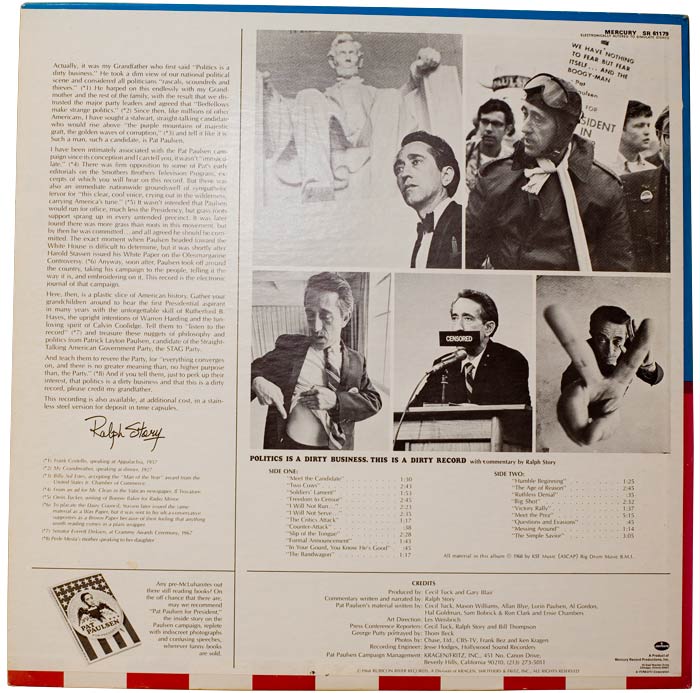
Pat Paulsen For President

I mentioned Pat Paulsen [home page] for President to Neli just a few weeks ago… and it turned out she had never heard of him. Then, just last night I found this album for a buck at the thrift store [and in good shape, too!]. And, upon reflection, I think the guy at the thrift shop, who, albeit being of the right age to be aware of Pat, ALSO was not aware of who he was [thought I was buying some kind of political memorabilia or something – and he is slightly correct, but…].

So, for all you folks who do not remember the late 60s and early 70s, Pat Paulsen [wikipedia] was a comedian on the Smothers Brother’s Show who tried to bring some humor to a stressful election by deciding to run for president of the U.S.. Several times.

Presidential campaign slogan: “If elected, I will win.”

1988 campaign…

A little dated compared to Colbert and Jon Stewart, but …

Munich Hifi Show : High End 2012 News

[This year new manufacturers, start-ups, can get free exhibit space at Munich 2012]

HIGH END® 2012

“With this brief information we would like to inform you that our HIGH END® 2012 invitation and application form was sent to the relevant industry few weeks ago.The closing date is scheduled for December 31st 2011 and we’re looking forward to see a great HIGH END 2012 next year in May.
Up from early January we will start very quickly to distribute and con-firm the attendance to the industry. Applications after the closing dates are welcome but we will be able to offer only what are available then.”

What’s new in 2012?

“New in hall 3 will be the “New-comer-Area“, where we will offer Start-up companies free of charge the chance to demonstrate their ideas, products and developments. Every new company is welcome to send us their application by E-Mail, as far they will complete the following regulations:

• The company should be not older than 15 month, counted backwards from the 1st day of the show (May 3rd 2012 which results in February 2011). We would kindly ask for a copy of the company registration, issued from the authorities in your country.

• The development / products / or ideas should be related in any case to high quality consumer electronic.

• The new company should be able to show or to demonstrate on site their developments.

• It can be done by using a computer, because we offer a flat screen on the stand to be connected.

• It can be done by presenting the product or some sample.

• The application with details regarding the product / development should be sent to the HIGH END SOCIETY until February 1st 2012 by E-Mail at: service@HighEndSociety.de

CES 2012 goes green(er)

[Some interesting factoids in this email. Sure do produce a lot of trash at these shows. Usually we keep our badge-holders and they start to pile up here after several years – so if they do make it easy for us to return them, it might make for a somewhat more spacious office here ;-/]

“New this year, attendee badge holders are made from repurposed vinyl show banners from last year’s show, and CEA will collect those badge holders at the end of the 2012 CES to recycle them again. Furthermore, CES general services contractor Global Experience Specialists (GES) will produce signs using a reusable, recyclable kraft paper honeycomb material. CEA will also seek to collect even more magnetic, vinyl and cardboard show signs for repurposing through a partnership with Repurpose America, a local nonprofit focusing on tradeshow recycling.

Last Year, Repurpose America collected roughly 18,000 pounds of magnetic signs from the 2011 CES, nearly 15,000 square feet of vinyl banners and more than 150 foam boards. In addition, CEA worked with contractors to recycle 289.6 tons of the solid waste generated at CES and increased the event’s recycle rate from 68 percent to 77 percent, several points higher than the average recycle rate of trade shows held at the Las Vegas Convention Center.

“Our green and recycling efforts at the 2012 International CES are unprecedented for the largest annual event in the western hemisphere, covering more than 1.8 million square feet and welcoming more than140,000 attendees,” said Gary Shapiro, CEA president and CEO. “We’ve worked hard to ensure that we are using the latest and greatest sustainability practices in producing CES.”

Along with the greening of the International CES, CEA also supports local green nonprofits. Last year, CEA gave $75,000 to Green Chips, a local Las Vegas charity supporting solar power installations. That money was used to install solar panels at a Las Vegas non-profit facility, resulting in substantial savings that allowed the organization to devote more money to serve those in need. CEA plans to make another donation benefiting Las Vegas and the environment at the 2012 International CES.

The International CES also allows attendees to reduce their carbon footprint by gathering in one location. With each attendee reporting an average of 12 business meetings per CES, CES participants collectively avoid more than 960 million miles in business trips that they otherwise would have to take. As a result of attending CES and consolidating trips, the estimated net savings in travel is more than 549 million miles.

For more information on sustainable materials used at the 2012 International CES and other information on the greening of CES, please go to: www.CESweb.org/green.”

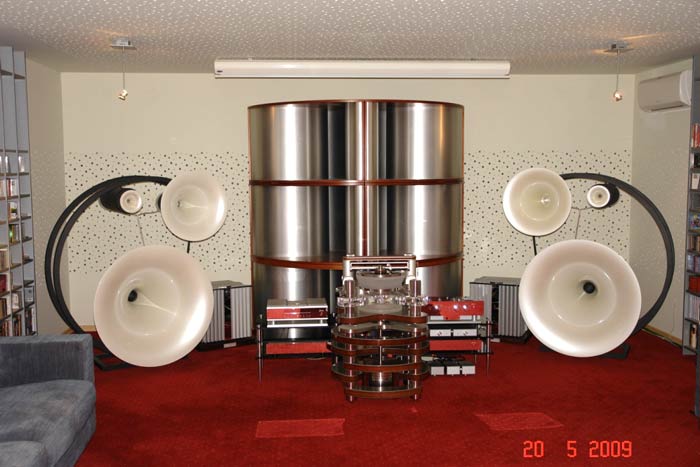
Extreme Avantgarde / Burmester System Sighting

Another cool sighting, this time on Avantgarde’s website where users can post photos of their systems.


Avantagarde Trio Classico systems

I think what makes this especially cool is the Clearaudio Statement turntable and how it is positioned right out there in front.

It looks really accessible and awesome there, and one can hope that the basshorn is a side-firing horn so that it is not blasting directly at the table itself.

Considering how dynamic the horns are combined with how extremely dynamic that table is… whoa boy, this must be something … quite dynamic… to hear [even though the electronics, Burmester, is somewhat [much] quite civilized, dynamically, compared to, I think, most other electronics out there – we had a nice Burmester pre here for many years before we decided to go nuts. But, on the other hand, the size of those girnormous Burmie amps might remove any semblance of this being in any way a civilized presentation.]

Yep, love to hear this system [reggae must be AWESOME]. But I would make sure I was holding onto something… 🙂

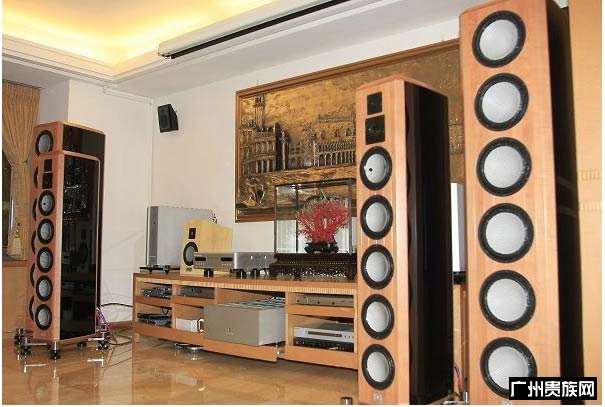
ZSHifi: Marten Coltrane Supreme / Bladelius

And here is another entry in our continual pursuit of cool Sightings, in the wild, as it were. People often point us to extreme high-end systems they run across. And here is another written up by a dealer in Taiwan [thanks to Florian for finding this].


ZS HiFi: The world’s first pair of users Marten Coltrane Supreme

Apparently the this Taiwan dealer was one of the first, if not the first, to sell a pair [or is that quad?] of Coltrane Supreme speakers.

Their customer’s system, that we see here, is running a Bladelius CD player and amp. Bladelius makes the subwoofer amp that the Supremes use and is another Swedish company.

I note how that have a video screen mounted in the ceiling behind/between the speakers. We have been wanting to do this for forever but for some husband/wife arguing about precise positioning and size issues [take that however you want :-)].

They also have a little Marten Duke monitor speaker on their equipment rack. And B&O speakers in the ceiling corners.

I love the look of the highly polished floor [wood or bamboo] and the speaker’s reflection but wonder at the sonic consequences.

I used the Google Chrome browser to translate the page, and I have to tell you, even translated it is not easy to understand much of what is being said. They run Karaoke through the Marten Dukes… OK…. but movies too? Seems like such a waste… 🙂