Pursuing the Ultimate Music Experiences

Audio Federation High-Fidelity Audio Blog

CES 2015: Audio Note U.K. Preview

CES 2015: Audio Note U.K. is contributing a few pieces of awesome gear to our Acapella Audio arts / Audio Federation room this year at the Venetian Room: 30-225).

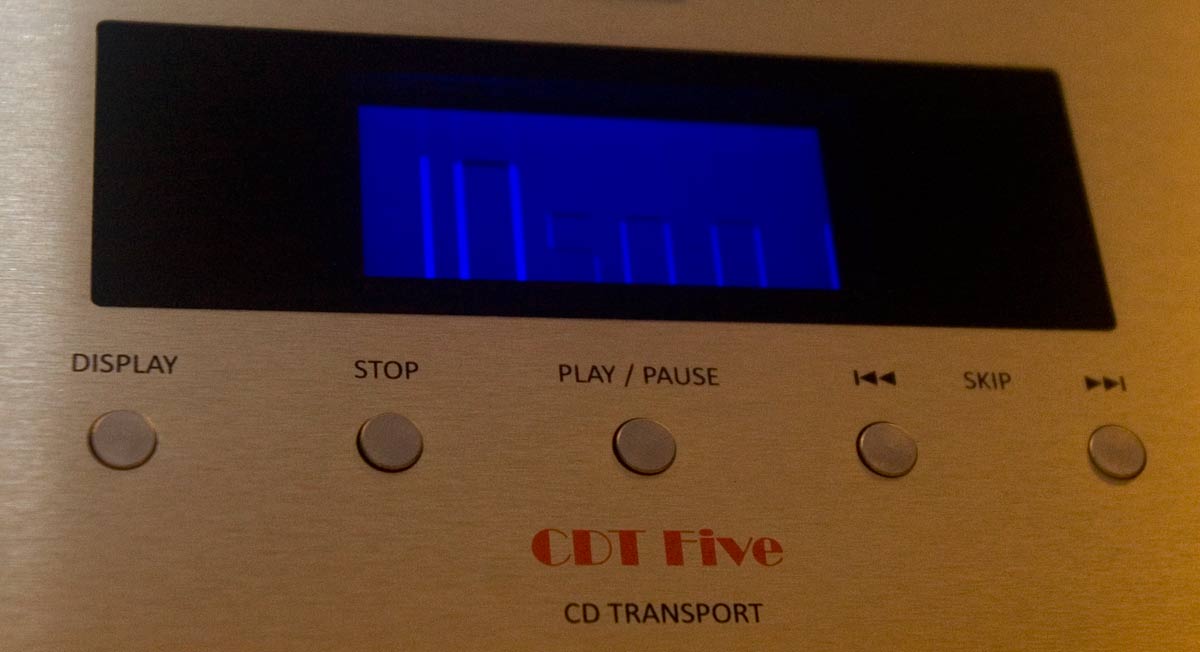
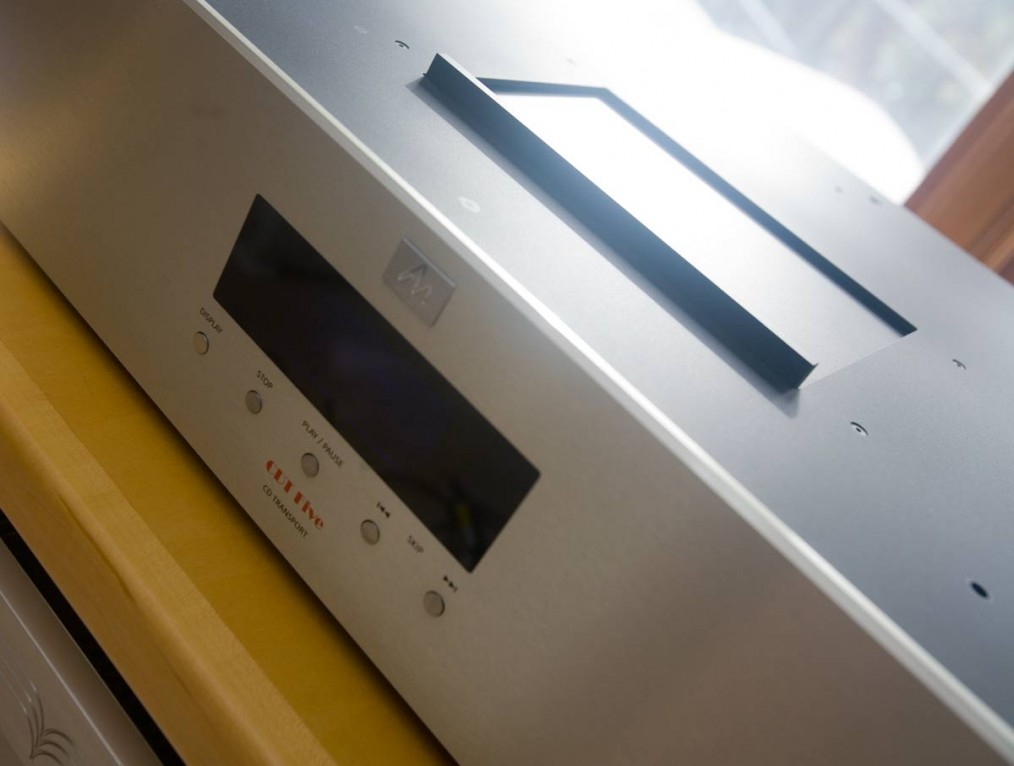
First in the chain is the mighty CDT-Five Transport (pictured above).

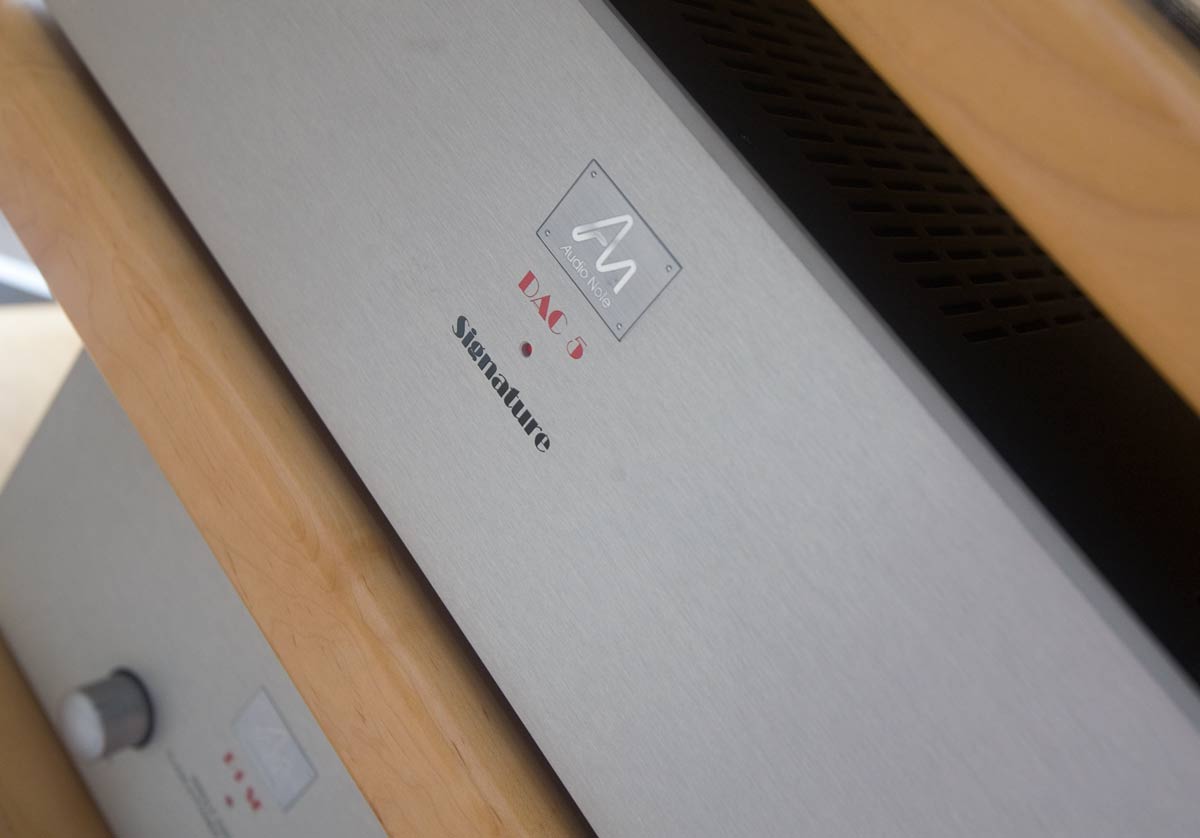
Second is the DAC 5 Signature (pictured below). This has been, and is still, the most… drug-like … DAC we have heard… and perhaps the most there ever can be. Any more and it would have to be listed as a controlled substance. 🙂

audio note dac-5 signature

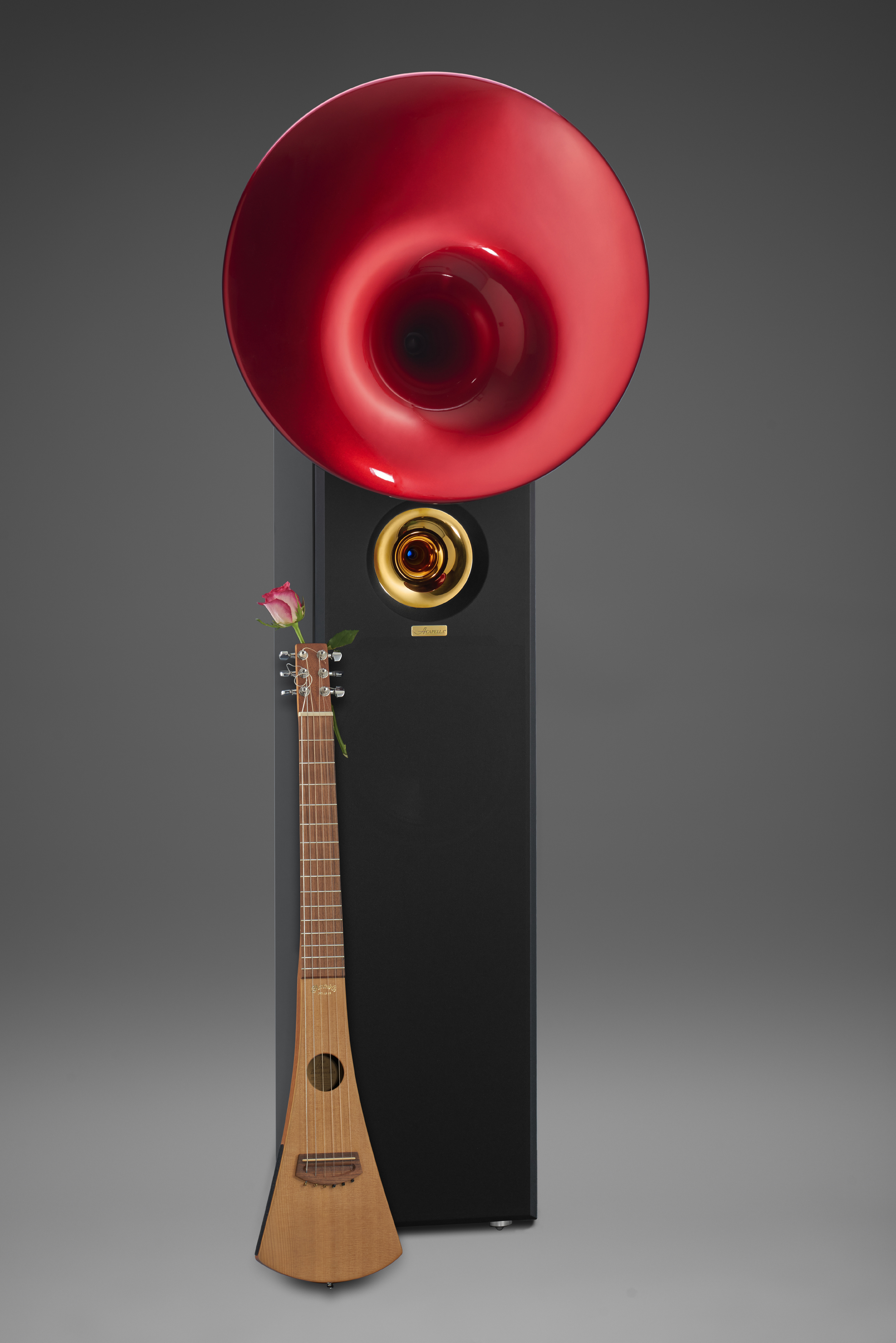
These will be driving the Acapella LaMusika integrated amplifier and Acapella Cellini speakers:

Acapella Cellini speakers

2015 UNSIGNED ONLY music competition

We thought this was worth passing on to everyone:

JUDGING PANEL ANNOUNCED

Sinead O’Connor, Alt-J, The Killers, Aimee Mann, Dustin Lynch, Rosanne Cash, and More Sign On As Judges

December 17, 2014 – Unsigned Only Music Competition revealed today its high-profile judging panel for the 2015 competition, which is now accepting entries. The renowned panel consists of iconic recording artists and journalists and will determine the winners in eleven categories representing a wide variety of commercial genres of music.

Designed for solo artists, bands, and singers who are not signed to a major label, Unsigned Only’s goal is to find an outstanding, talented performing artist: a band, singer, or solo artist. Unsigned Only gives away over $100,000 in cash and prizes, including $10,000 in cash and one-on-one mentoring by an elite group of record company executives to the overall Grand Prize winner. First and Second Place winners in each category will also be chosen. The deadline to enter is March 18, 2015. Original and cover songs are accepted in all categories except for Screen Shot which accepts original songs only.

Artists may enter into any of the following categories: Adult Album Alternative (AAA) Adult Contemporary (AC); Americana; Christian; Country; Folk/Singer-Songwriter; R&B/Hip-Hop; Rock; Pop/Top 40; Screen Shot; Teen; and Vocal Performance.

Screen Shot is a new category that has been added this year, and it is geared toward helping artists get their music in film, TV, video games, and advertising. Music execs who are looking to place music in various projects will be judging this category and will also provide advice on music licensing to the winner of the category. Included are: Michelle Bayer (Shelly Bay Music); Michelle Silverman (Modern Planet); Ani Johnson (Monomyth Media); Evan Stein (Experience Music Group); Velma Barkwell (East End Music Productions); Jen Taunton (Level Two Music); and more to be announced.

“Last year Screen Shot was a special promotion that we ran for entrants,” says Founders/Directors Candace Avery and Jim Morgan. “The response was huge and was a great success for many artists who were able to secure licensing deals for their music. This is just another way for Unsigned Only to help its entrants, and we are excited to be able to open these new doors for independent artists.”

Judges include: Aimee Mann; Alt-J; Dustin Lynch; Sinead O’Connor; The Killers; Rosanne Cash; David Crowder; Robert Smith (The Cure); Darryl McDaniels (Run DMC); Ray Wylie Hubbard; Aaron Shust; Lucero; Kelly Price; Colt Ford; Frank Foster; Jason Gray; Rapsody; Kool And The Gang; Anthony DeCurtis (Contributing Editor, Rolling Stone); Kyle Anderson (Senior Writer, Entertainment weekly); Josh Jackson (Co-Founder and Editor-In-Chief, Paste Magazine); Chris Richards (Pop Music Critic, The Washington Post); Michael Hann (Music Editor, The Guardian); Shirley Halperin (Music Editor, Billboard and Hollywood Reporter); Lucy Jones (Deputy Editor, NME); Hardeep Phull (Music Critic, New York Post); and more to be announced.

Unsigned Only is sponsored by: Sony Creative Software, Guitar Center, D’Addario, Disc Makers, Ultimate Ears, Lurssen Mastering, Master Tour by Eventric, and The Music Business Registry.

For entry and general information, please go to http://www.unsignedonly.com

Christmas Eve – Time for audio porn

Christmas Eve – Time for audio porn… like every other day of the year 🙂

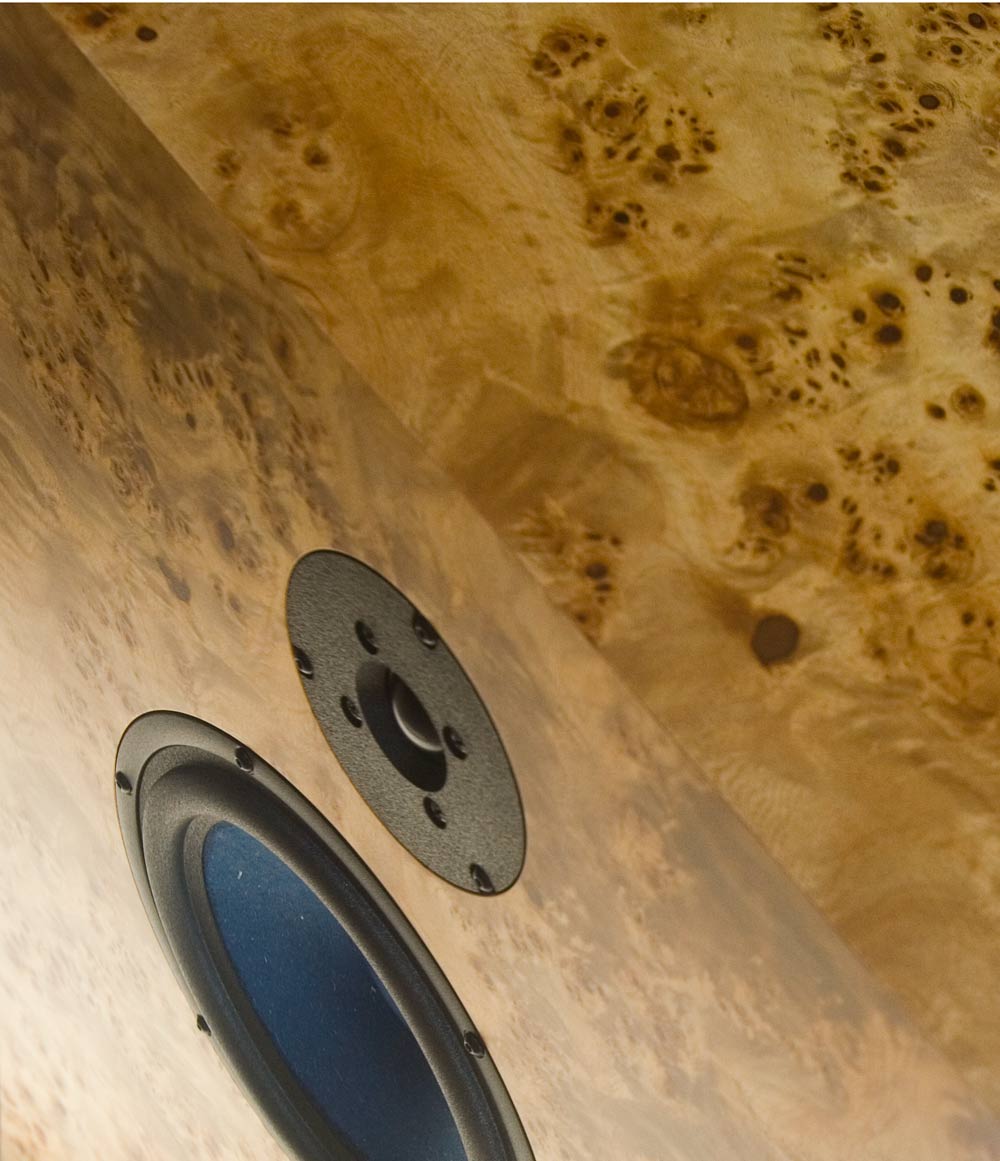
Featured photo above is the Audio Note AN/E Spe HE speaker in the beautiful Poplar Burl veneer (standard matte finish, no extra charge)


IMG_0787-2-audio-note-cdt-five-transport

Audio Note CDT-Five transport

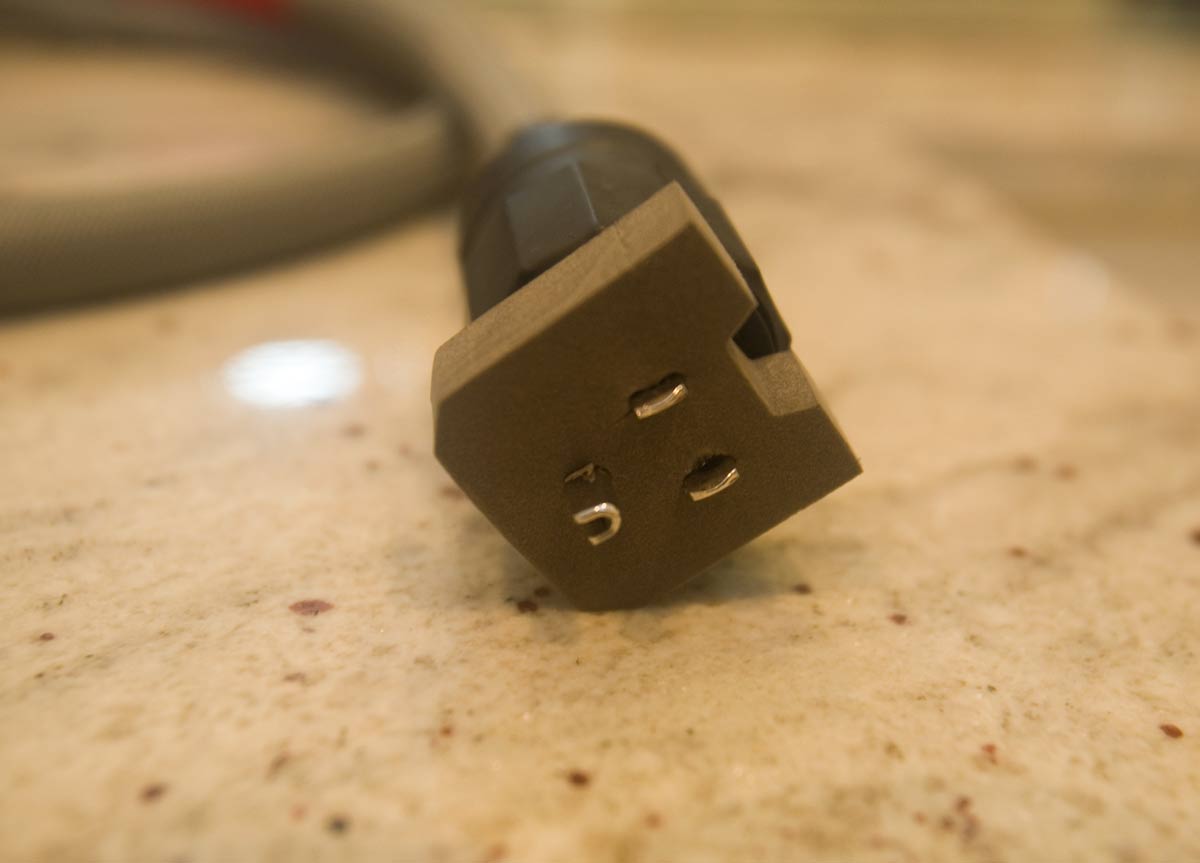
IMG_0783-nvs-sound-silver-inspire-power-cable

NVS Sound Silver Inspire power cord

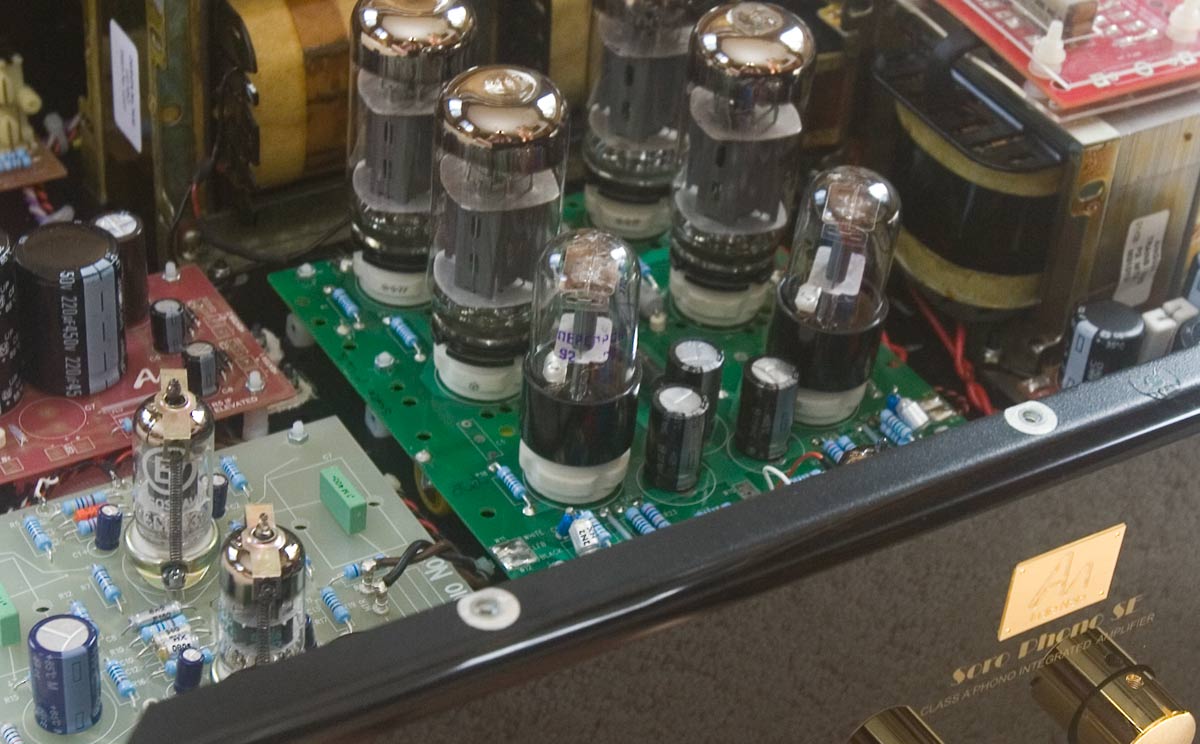
IMG_0598-audio-note-soro-phono-se-integrated-amp

Audio Note Soro Phono SE


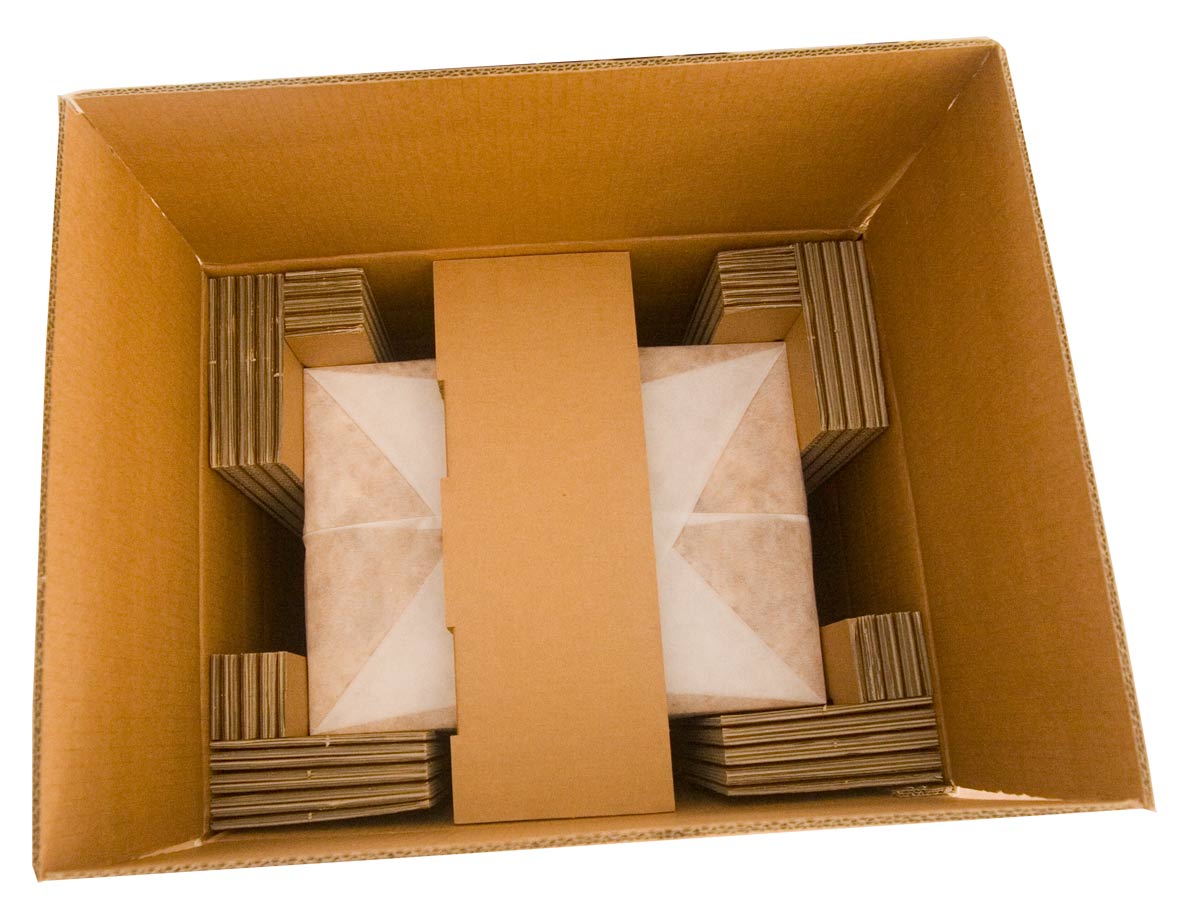
IMG_0609-audio-note-ane-spe-he-speaker-packing

Audio Note AN/E Spe HE speaker in the box

IMG_0767-emmlabs-mtrx-logo

EMM Labs MTRX amplifier: top

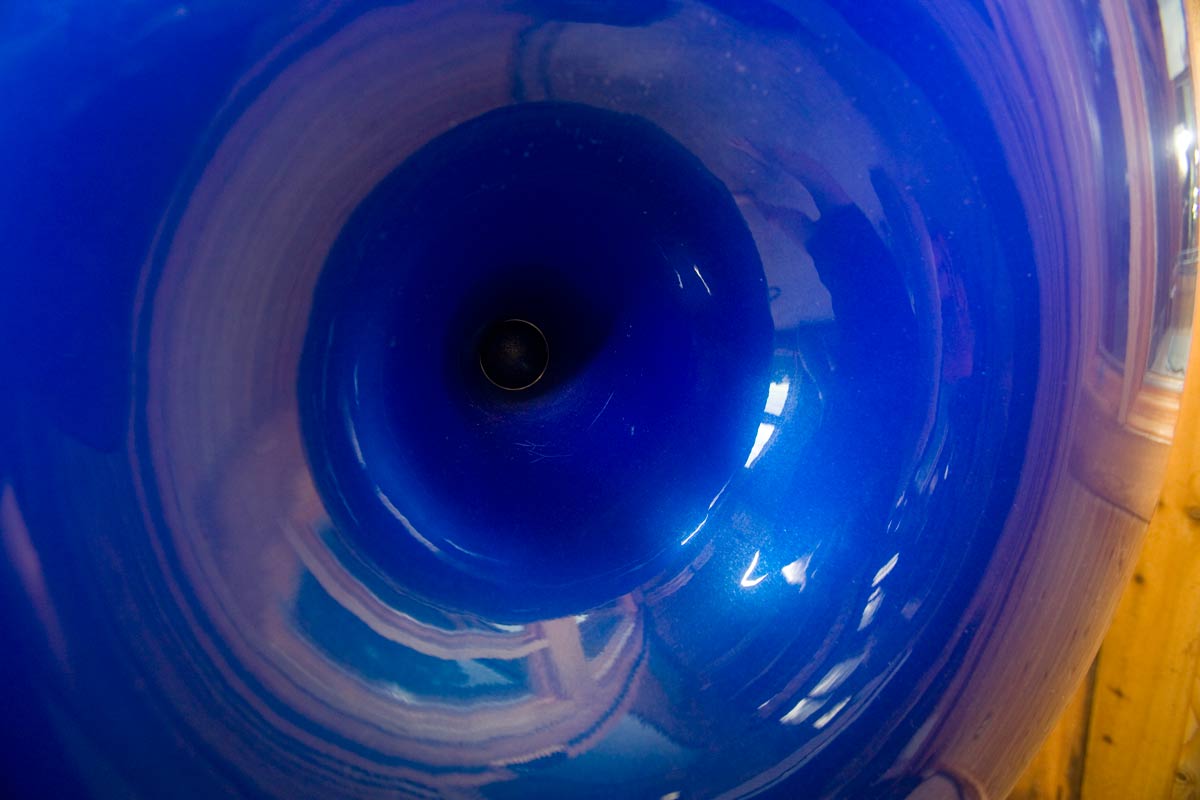
IMG_0773-acapella-blue-horn-speaker

Acapella Audio Arts ‘Atlas’ loudspeaker’s midrange horn in Blue

Happy holidays everybody! If you are in Vegas for CES, please stop by and visit (30-225 in the Venetian Tower)

– Mike + Neli

Use the ears, Luke: hearing aids for music

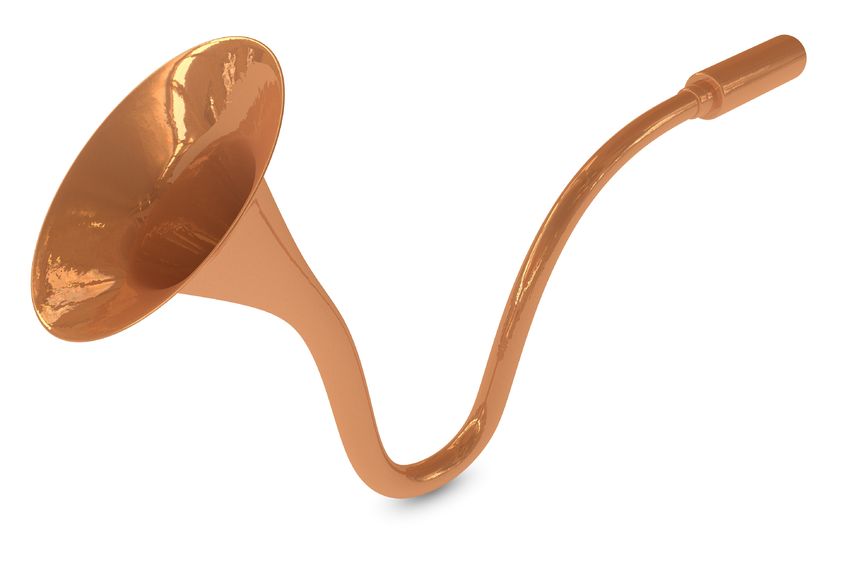
One of our customers recently got hearing aids (smaller than the oldschool one pictured above :-)). He’s using them while listening, with positive results, and wrote about his experience:

MY ADVENTURES OBTAINING HEARING AIDS FOR MUSIC

My hearing loss started in 1967 while going through US Army Basic Training. The Army did not believe it was necessary to use hearing protection while firing a M14 rifle hundreds of times. I noticed some high end hearing loss at that time but not enough to consider hearing aids. I mostly noticed it when trying to carry on a conversation in a loud environment.
Fast forward to 3-4 years ago and I started noticing I was having a harder time hearing and understanding conversation. I tried getting hearing aids from the VA, but that was a total waste of time. While I was waiting for the VA to act, I started doing research on hearing aids and music. I was able to find a number of older articles mostly referring to a “K amp” hearing aid (most of the articles were by a doctor of audiology out of Canada – Dr. Marshall Chasin). However, I could not find the K amp being produced any longer (this was about 2 years ago) (more about the K amp below in NON-AUDIOLOGIST HEARING DEVICES).

I read a lot online about the advantages of digital hearing aids for speech but the negative effects for music. A short summary of the issue is that music is heard over a broader range than speech and the Analog to Digital processor (A/D) in the hearing aid had an upper limit lower than needed for most music. A proposed solution was called ‘raise the bridge”, the idea to raise the lower end starting point which results in the top end also being raised, to a point that is not detrimental for music appreciation. There is more on this in the article linked below.
Fast forward again to about 6-8 months ago when I received the VA rejection of my claim, I decided to proceed with purchasing hearing aids and 2 interesting things occurred about that time.

1. I read an article from the same Dr. Marshall Chasin comparing 2 similar digital hearing aids from the same manufacturer, Widex;. One with and the other without the raise the bridge technology. He had conducted a test with musicians with hearing aids trying out the 2 types. The raise the bridge version was a clear winner for music. Here is the link to the study.
http://www.hearingreview.com/2014/01/a-hearing-aid-solution-for-music/

2. On the internet, I found articles talking about a change in Federal Government policy that would now allow companies to sell “hearing devices” directly to consumers. I found two companies advertising K amp hearing devices for music, see below.
Though much less expensive that the hearing aids from an audiologist, I did not go with the hearing devices as I also wanted the benefits for speech recognition to be gained by a programmable digital hearing aid. I decided on the Widex Dream, the winner of the test from #1 above. It also has separate programs one of which is a music program that turns off the filters that are used in the speech program.

NON AUDIOLOGIST HEARING DEVICES – these devices are not programmable but are designed for use with the most common hearing loss, high frequency loss.
The first I found was the BEAN. It is made by Etymotic which is the company that invented the K amp. The Bean is an ITE (in the ear) design and I believe can only be purchased online from Etymotic.
The second device is the Simplicity Hi Fidelity 270 made by General Hearing, which had made a hearing aid using the K amp many years ago. I believe there are other similar models from General Hearing. The Simplicity can be purchased online and at Walmart / Sam’s Club (Sam’s Club was quite a bit less expensive). This is an OTE design (open ear mini-BTE [behind the ear]). The OTE may be easier to use for the occasional user and has an easy to reach volume control on each device. (My WIDEX is on OTE and I found the OTE style very easy to use right from the start.)

By the way, I have found the Widex Dream with the music program to offer an improvement in the listening experience. I am now hearing a much wider sound stage than before having hearing aids.

I hope this helps clear up some of the confusion about hearing aids and music.

Over the years, I’ve had private conversations with many people about hearing loss, and its impact on music appreciation and critical listening, so I thought this would be a useful post. Our customer has offered to answer questions here. I’m really happy that he’s had such a positive experience. Soundstage and the ability to hear into the recording space is dependent on many soft sounds and room cues. These conversations have also taught me that our brains learn to hear better with practice, even with measurable hearing loss including significant asymmetry between the hearing ability of our two ears.

CES 2015 – Equipment Racks Galore

CES 2015 – Equipment Racks Galore from Harmonic Resolution Systems (HRS) this year, as always.

At least SOMEBODY is getting a workout with all those 40 to 60 lb Isolation Bases!

We are also bringing an HRS equipment rack to Vegas:

ACAPELLA  AUDIO  ARTS and  AUDIO FEDERATION Venetian Tower ROOM 30-225
HRS SXR 1921-3V with M3X isolation bases. (At least we think it will be the 3-shelf rack, if we get the Audio Note DAC5 Special here in time. Otherwise it will be the two-shelf rack)


HRS Static Display and Meeting Room – Venetian Tower  29-203
HRS RXR-1921-3V in Natural Maple Finish with Silver R-Shelves and new R3X isolation base. Also Feature will be discussion on expansion of SXR Frame Size Options

AYRE ACOUSTICS, INC Venetian Tower ROOM 34-310
HRS RXR-1921-3V in black with black R-Shelve and R Series isolation bases.

MUSICAL SURROUNDINGS Venetian Tower ROOM 29-333 & 29-335
Multiple HRS SXR 1921 3V & 4Vs  in Black with M3X isolation bases

VANDERSTEEN / AUDIO RESEARCH – Venetian Tower ROOM 29-201
HRS MXR IN MAHOGANY FINISH WITH M3X ISOLATION BASES

CONSTELLATION AUDIO – Venetian Tower ROOM 34-210
HRS SXR 1921 3V in black with S1 and M3X isolation bases

BOULDER AMPLIFIERS – Venetian Tower ROOM 34-307
HRS SXR 1921 3V in black with M3X isolation bases

BEL CANTO DESIGN – Venetian Tower ROOM 29-236
HRS SXR 1921 3V in Silver with Silver S1 isolation bases.

AUDIOQUEST – Venetian Tower ROOM 30-105
HRS RXR-1921-3T3 in Natural Maple Finish with Black R-Shelves and S1 Isolation bases

VTL – Venetian Tower ROOM 30-102
HRS SXR 1921 4V with M3X Isolation Bases, SXR Signature 1921 4V with M3X Isolation Bases


Mirage Hotel Active Rooms


dCS North America – Room TBD
SXR Signature 4V in Black with M3X isolation bases

Nagra – Room TBD
SXR 1719 4V in black with S1 and M3X isolation bases


CES 2015 – Million Dollar System

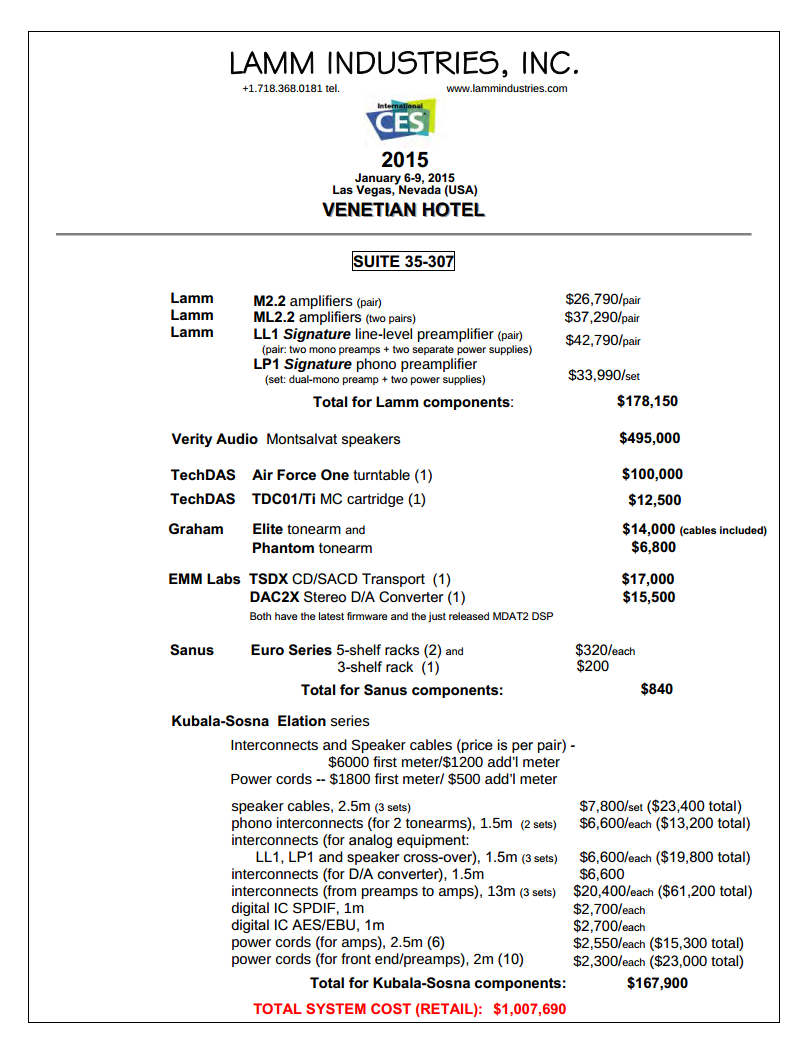
CES 2015 – Million Dollar System this year from Lamm Industries.

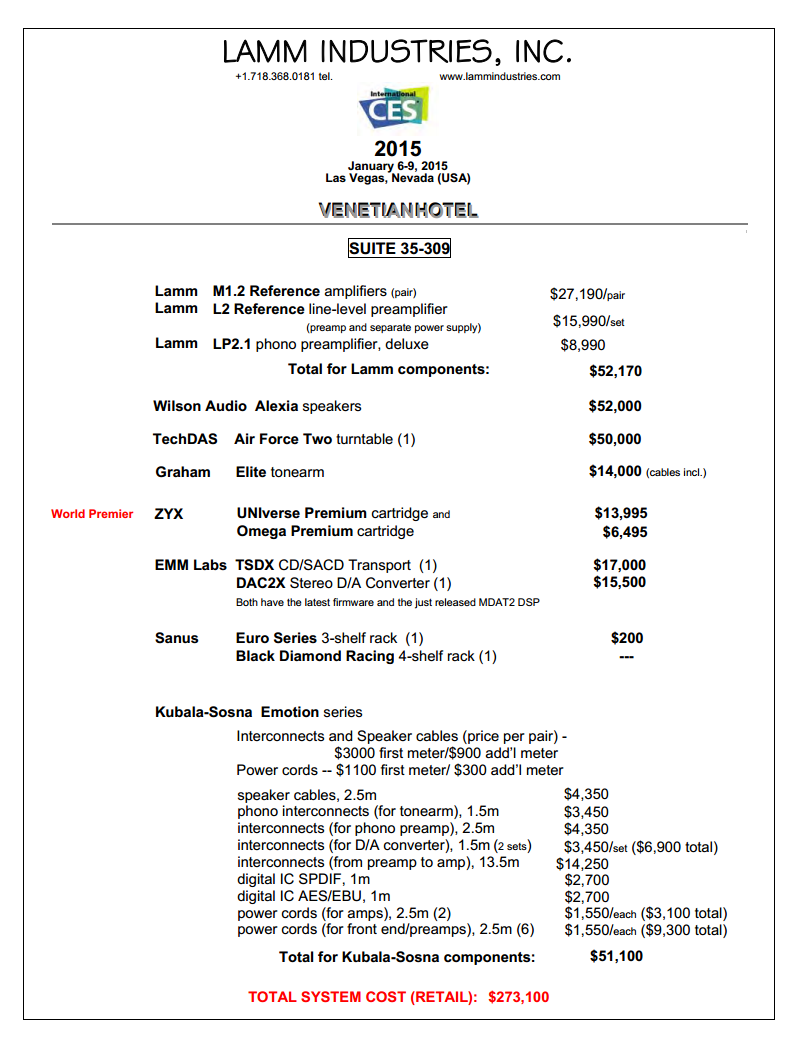
Lamm again has two rooms this year, one with  a more modest system and… a room with one not so modest.

Lamm adds EMM Labs as a room partner this year, who will supply the digital source components [TSDX transport and DAC2X DAC ].

Other participants are the Air Force One and Two turntables from  TechDAS and Kubala-Sosna cables.

What brings the main system up to $1M this year are the new statement Verity Audio Montsalvat speakers listed at $495K.

The smaller system features the $52K Wilson Alexia speakers.

ces 2015 lamm industries


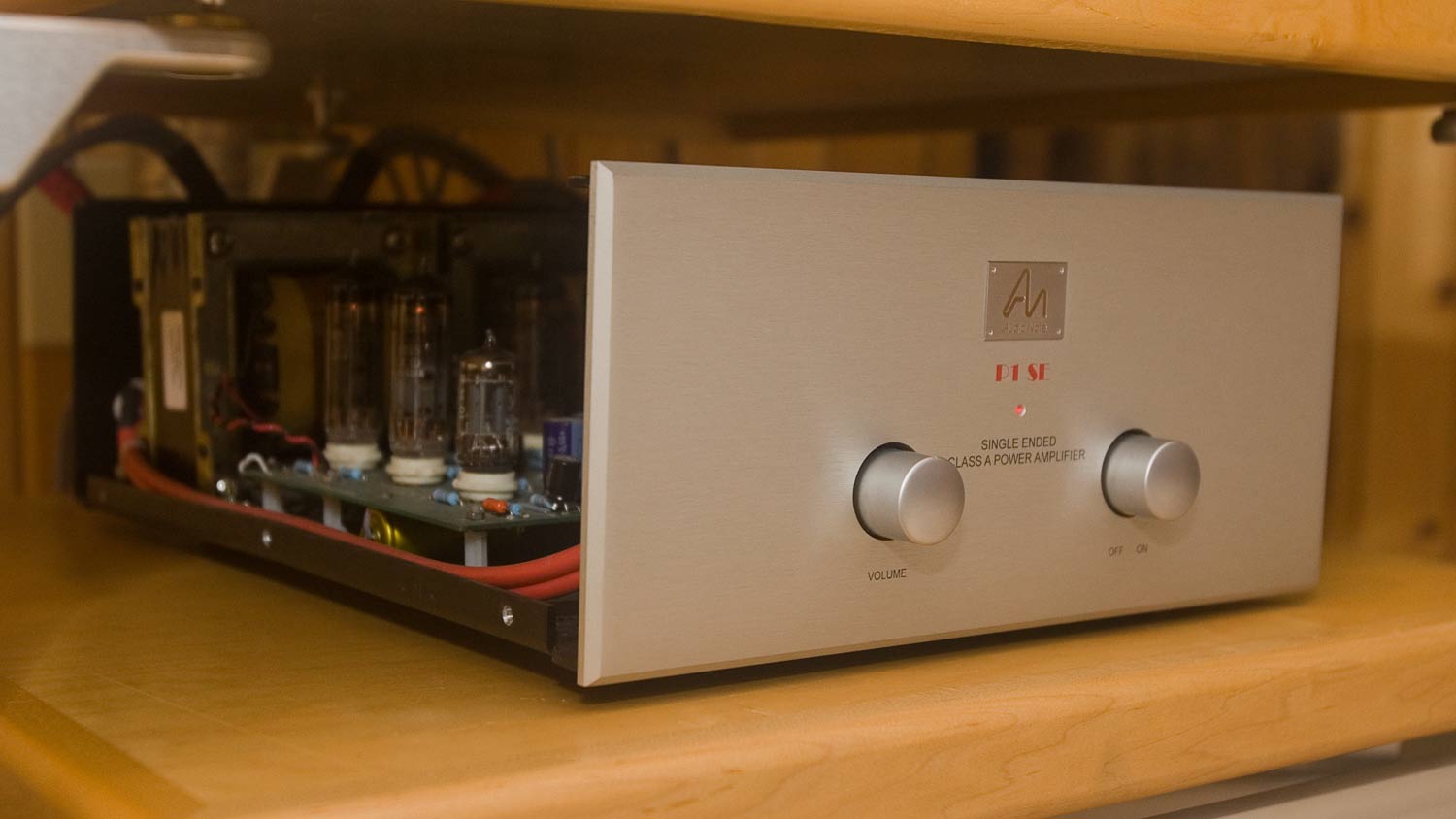
Audio Note P1 SE Amplifier

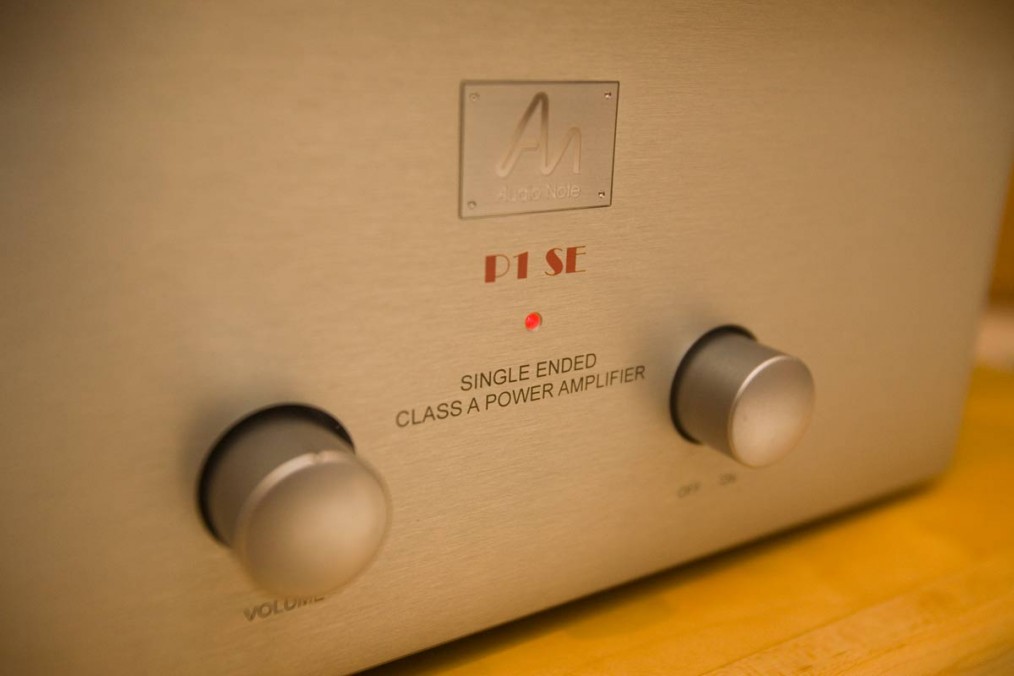
The Audio Note P1 SE Amplifier has taken the place of the Audio Note Soro integrated amplifier in our 100% Audio Note system.

Very different sound.

Where the Soro uses the 6L6 (guitar amplifier) output tube, the P1  uses the EL84 tube, like the Oto integrated.

Where the Soro is very dynamic the P1 SE  is very dense and rich.

I think.

Everything we are talking about here is between $2K and $7K.

Audio Note P1 SE amplifier

Now I wonder how Neli hooked it up, and whether the Audio Note M2 preamplifier is run into the P1 SE, or if  we are just using the nice volume control this amp has for those who want to forgo a pre.

This is the problem with these audiophile wives, they are always messing with the systems and not telling me what they did 😉

Anyway, we are letting this new configuration settle in and then we will be ready to enjoin the Oto versus Soro wars 🙂

NVS Sound vs. NVS Sound: Power Cable shootout

We held an NVS Sound Power Cable shootout here between 3 NVS Sound power cords recently.

It is so much fun to hear the differences as we moved up and around the product line. We threw in a couple of other brands of power cords as well, just for fun  😉
IMG_0639-audio-note-an-spe-he-speakers

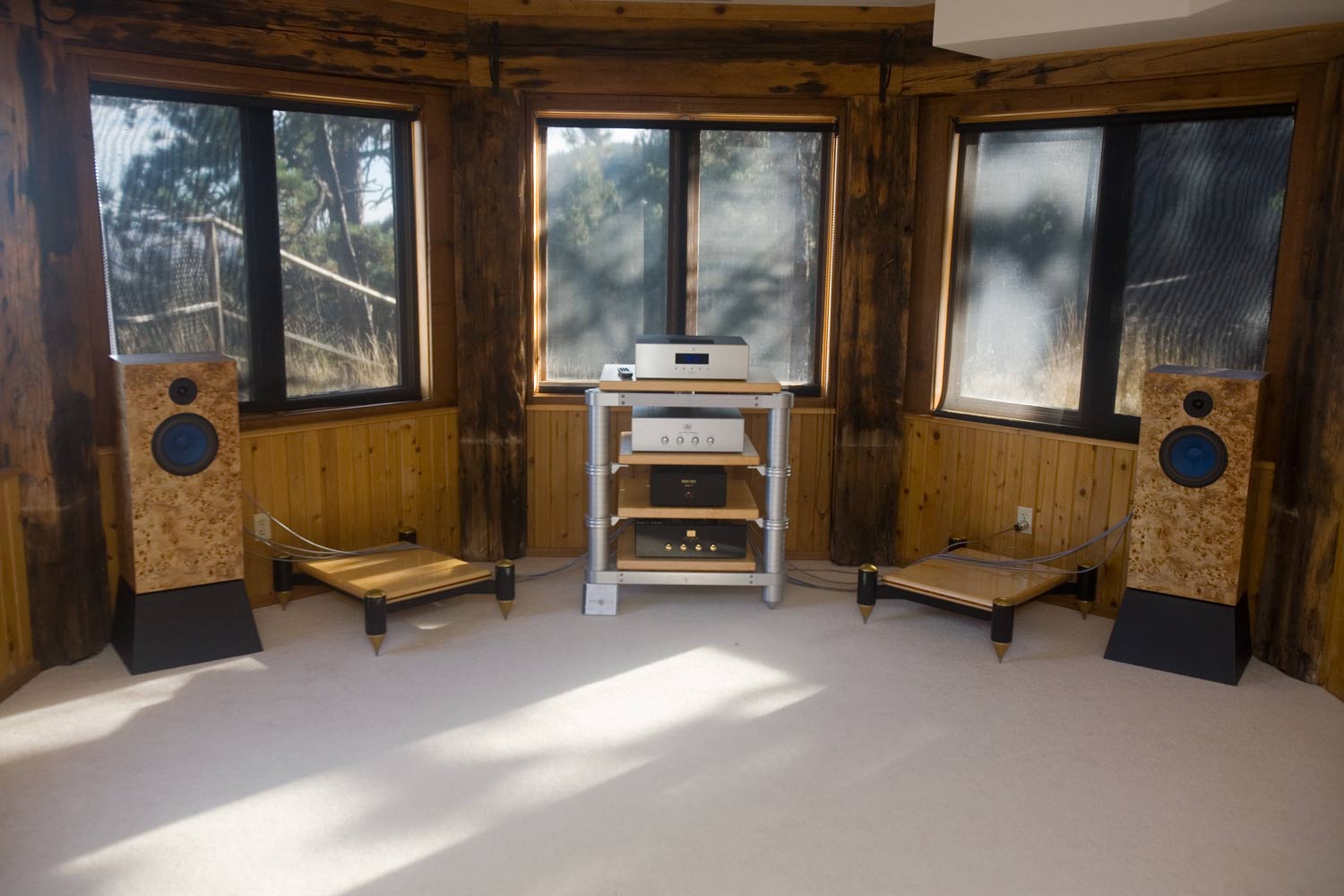
The system we ran the shootout on was an 100% Audio Note system: Soro Phono integrated amplifier [we love the Soro!], AN/E Spe HE speakers, a  combination of AN Lexus and LX speaker cables, and CDT-5 transport and an old DAC 4. We put the power cords, one by one, on the Soro integrated.

We started with an Audio Note power cord terminated with plugs that are perhaps not the best fit for this power cord. What it did well was that it held together during crescendos [the Crescendo problem]. One of the things it did not do as well at was a little bunching of the soundstage into left, right and center clumps [the LRC problem].

The Crescendo Problem

Something we are going to come back to over and over again here is a problem during playback when the music gets loud for a moment [in the old days of recording onto cassette tape, this is when the needle would swing into the red for  a fraction of a second]. This system is not naturally a hard-sounding or bright-sounding system. But it will be true to both the music being played on it and the upstream components, including cables and power cords.

During crescendos, a music system can become very unpleasant to listen to, and cause our ears to ‘shut down’ to block out the unpleasantness.  Even nice audiophile music has crescendos; like when a female vocalist belts out a note, for example. The sound can become hard [there is insufficient resolution for the ear to distinguish individual parts of the notes – so it sounds as one big ‘hammer’ of a sound], or the sound can fall apart all together and become harsh and bright [the amp, in this case, is starved for power].

The LRC Problem

Many of us are familiar with the music sounding like it is coming directly from the speakers. That the speakers, instead of ‘disappearing’, are in fact, on some notes more than others, quite visible to the ears. This is usually a problem with the speaker setup [assuming you have decent speakers to start with well-integrated drivers] – they are too far apart or have a wide baffle and are pointing directly at the ears.

But this can also happen if the high frequencies, which help our ears place the location of things, are being muffled, blurred or distorted. This problem can be caused by any component and any cable, not just by sub-optimal speaker placement.

Acrolink Power Cord [No photos]

The first power cables we tried were Acrolink power cords which retail for around $500.

These had decent resolution in the highs, the notes were solid. It was also a little compressed sounding, but in that ‘notes more solid’ kind of way which was not unpleasant. There was emotion evident in the music, but also  a tiny bit of sibalence. Nice image solidity, but less midrange resolution. There were some Crescendo problems, but less of a LRC problem.
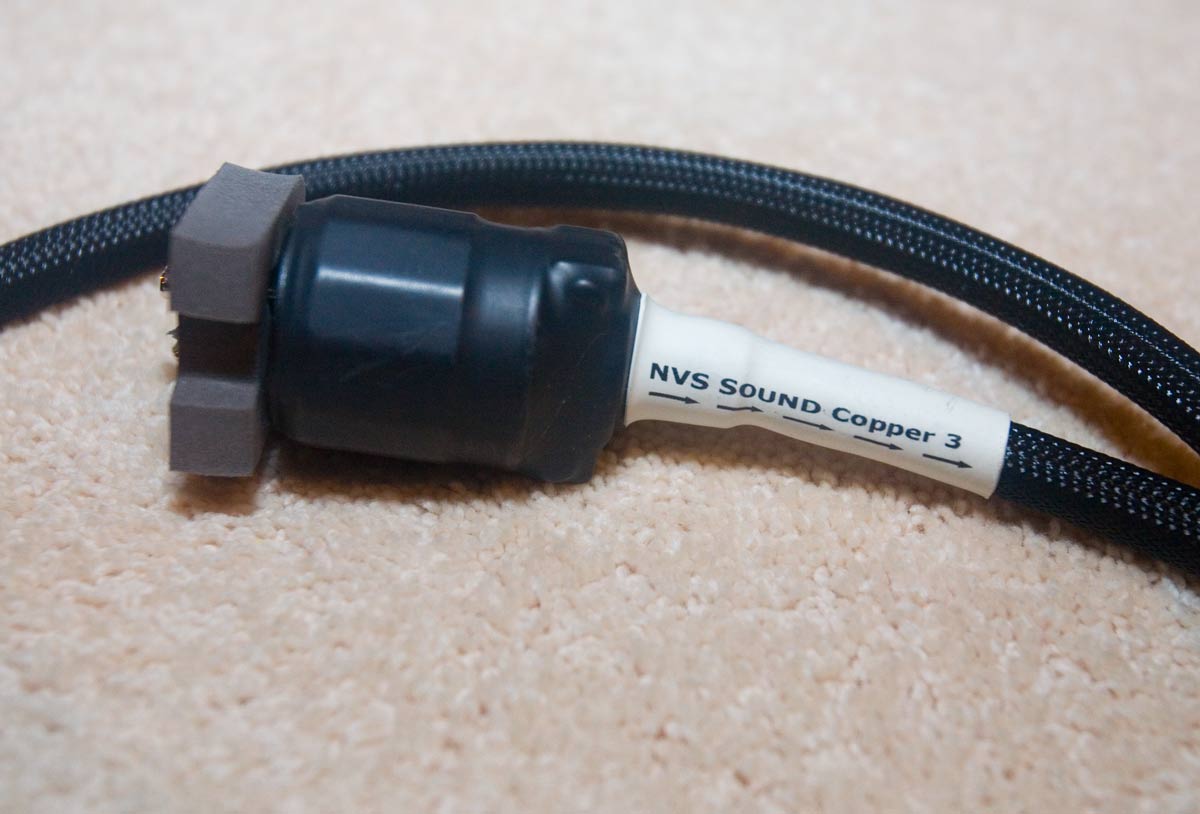
IMG_0745-nvs-sound-copper-3-power-cable

NVS Sound: Copper 3 Power Cord

These are about $1065 for a 4 foot length.

More resolution, more SUSPENSE [I *love* sound that includes suspense – where you find your self waiting in anticipation for each note as you know it must arrive any nanosecond now…!]. More open and relaxed sounding. A definitely quieter background.  Much better at  handling the Crescendo problem than the Acrolinks. NO LRC problem, whatsoever.

PRaT [rhythm] shows up – and separation much better but not perfect. We now have real, true-to-life imaging; things are placed on the soundstage as they would be in real  life.
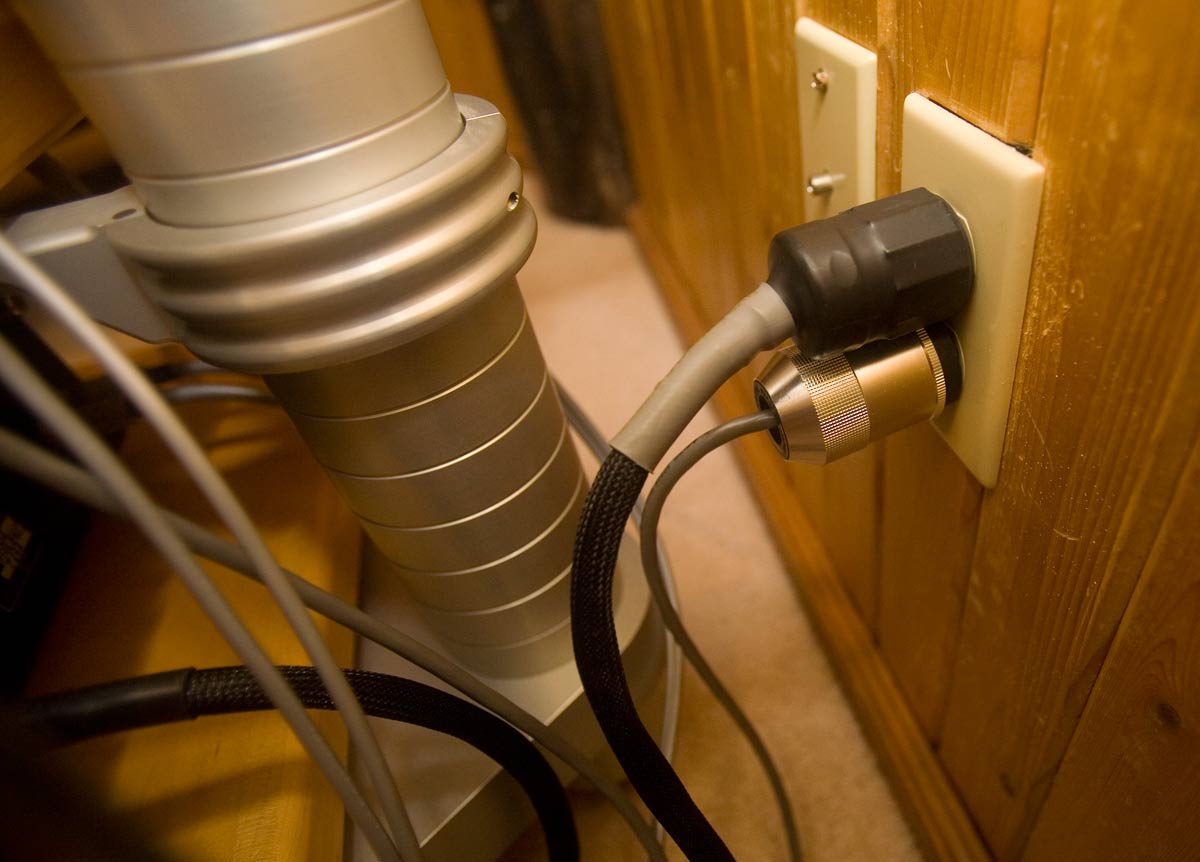
IMG_0752-nvs-sound-copper-1-power-cord

NVS  Sound: Copper 1 Power Cord

These are about $2145 for a 4 foot length

There is  a LOT more ambient information – a lot more was going on in the music than we had heard before, there were a lot more subtleties. More resolution – specially notable in voices, showing a LOT more emotion. More sense of rhythm, more separation. Really sucks me in to the music. NO LRC and NO Crescendo problems.

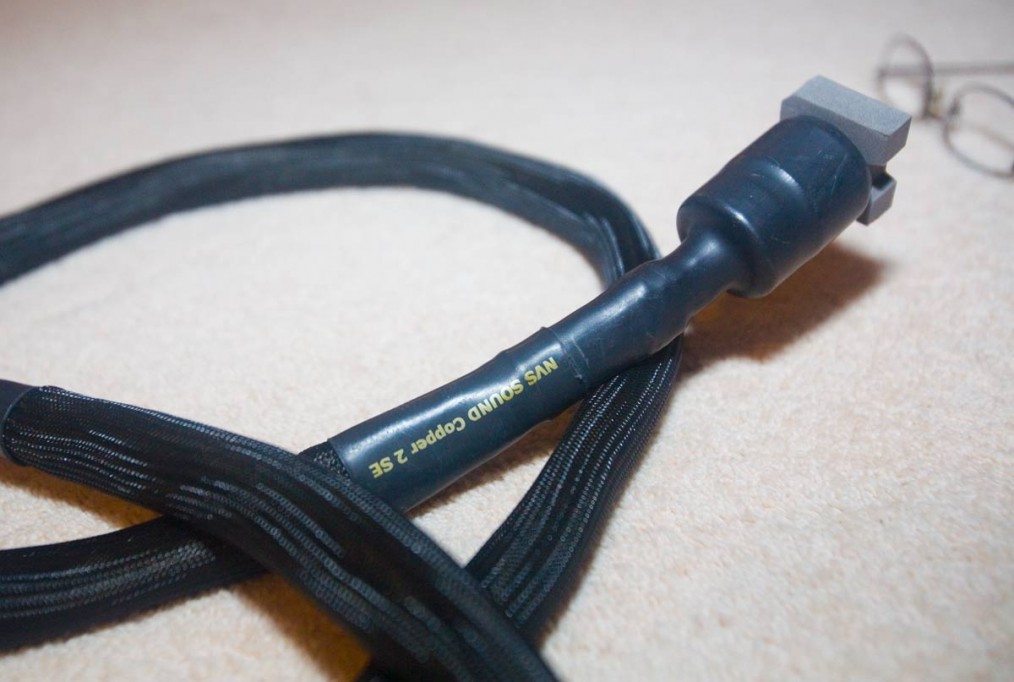
NVS Sound: Copper  2 SE Power Cord [Discontinued] [Featured photo]

There were about $1905 for a 4 foot length

This was an interesting cable and we went back and forth to the Copper 1 a few times.

Compared to the Copper 1, the sound here was warmer, more compressed  | more solid |  more dense sounding. Less resolution and maybe a little more LRC problems.

So why was it interesting? Because the sound was ‘simpler’, more focus on the melody, a little ‘happier’ sounding. More focus on the integration of the sound into a whole [that ‘more compressed, more dense’ sound often has this not unpleasant effect]. There wasn’t as much separation as the Copper 1  and not as much emotion was coming through in the voices.
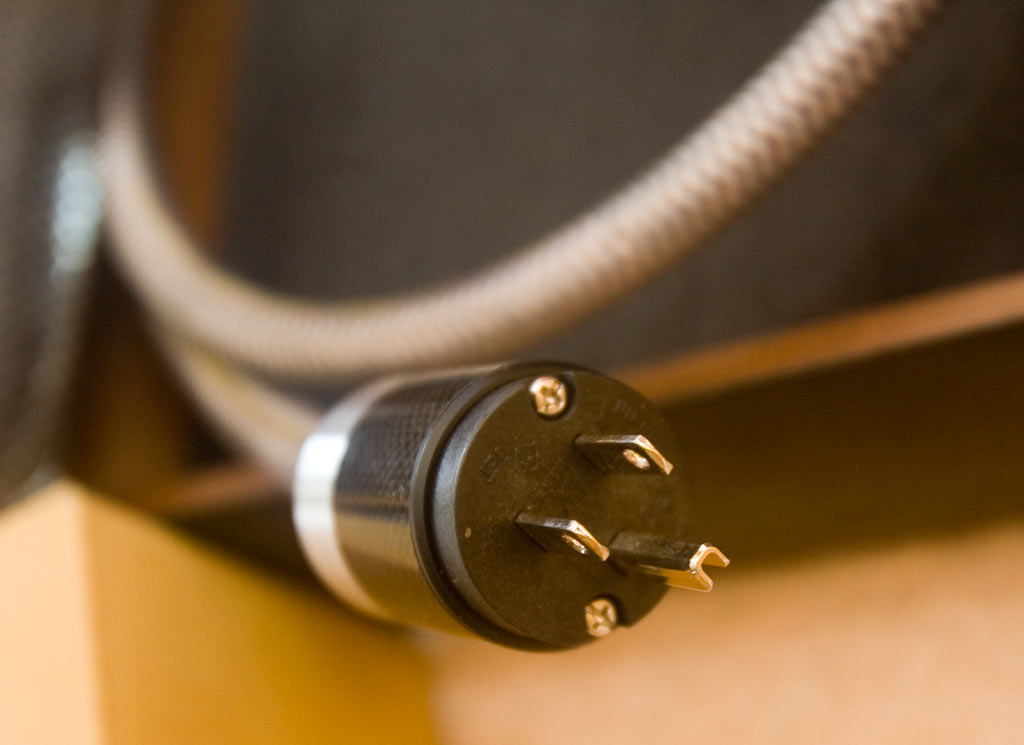
IMG_8530-acrolink-7N-PC7100-power-cable-closeup

Acrolink Mexcel 7N-PC7100 Power Cord [older version]

This was about $2700 for a 5 foot length

[This was hard to evaluate  in some ways because we are SO familiar with its sound. But we went back and forth with the Copper 1 a few times, and I think we got a handle on exactly how they differed].

More emphasis on certain frequencies of the bass, louder voices. It was like the melody was turned up at the expense of the more subtle sounds in the music. Less resolution in the voices, less image solidity, less separation, less linear across the frequency spectrum.

Going back to the Copper 1, the sound was happier, more open, had more resolution – like the sun had come out and bathed the music in sunlight.

These Acrolink PC have been our ‘go to’ cables for several classes of components. They have been sold now, but they have been reliable performers for many years. They are, after many shootouts over the years where we compared them against many contenders, a little midrangey, and little less open -sounding compared to the Elrod PC or Nordost Odin – and this profile is sometimes exactly what is called for in many situations. At heart, they are  a  ‘fast-sounding’ cable with high resolution, especially in the midrange.

From this perspective the NVS Sound Copper 1 power cables are  very high-resolution power cords, and very linear – their response and resolution is very even from bass to treble. They are as open-sounding as  the classically open-sounding power cables, but also able to communicate the subtitles of the music – the emotion and delicate background sounds.

Happy-Sounding Cables

Certain cables have what we call here a ‘happy’, upbeat sound. Some have a tired sound. Some have a ‘cold’ sound. I think this has to do in this case, with NVS Sound cables, not so much with warmness  [unlike some other cables], but with the ability to communicate the beginning of notes in a way that  captures the swell of the note  envelope in such a way that the brain can determine not just the emotion of the music, but the mood of the musician who is making it. Experientially, it just comes much closer to capturing the mood of the musician, or, rather, the mood the musician wants to convey, than other cables.

We like  this.  We like it a lot.

Can’t wait until we can do a shootout of NVS  Sound’s top-of-the-line Silver 1, 2, and Inspire power cords. 🙂 For now, the Copper 1 is still in the system, on the Audio Note P1 SE amplifier

New servers for the blog (and website)

Just a quick note for now to say that we moved from MediaTemple to Linode.

We apologize for all the 503 ‘overloaded server’ messages that you probably encountered the last 7 weeks or so. We were getting the same errors and let me tell you it was a real pain.

[Full story later, but short and sweet: MediaTemple Premium WordPress hosting sucks :-)]

Any problems now are my responsibility. Please let me know if there are ever any problems. Once we get things ironed out, we should be up for years [like Ultimist], not minutes.  But also let us know, for example, if the site is slow, especially if you are located in Asia [we’ve run tests, and the site should be faster in the U.S. and about the same in Europe, but YMMV, and we want to  know  about it.]

Thanks, everybody, for putting up with us 🙂

Soul-caressing Sound

This is the third post of the series, the other two being: Ear-caressing Sound and Body-caressing Sound.

I think soul-caressing sound is more often experienced, and by more people, than the other two.

It is similar, however, in that we can experience it over and over again, but without realizing that we are experiencing it. We just think ‘Wow, that is really inspiring, or engaging’, or  all of a sudden our eyes are tearing up, or we become energized, after listening to a particular  movement or melody – but then proceed to ignore it.

But if we stop and realize what is happening to us, we can, I feel, more fully experience what is happening.  We can open up to the experience, making sure we don’t fight it, but rather embrace it. This puts is in a little better position of controlling what is happening, which does have its ego-ist issues, but in aggregate allows us to experience soul-caressing more often, and to avoid much of the ‘down’, the ‘crashing’ , when the experience [musical passage] is over.

51OTjJNo5EL

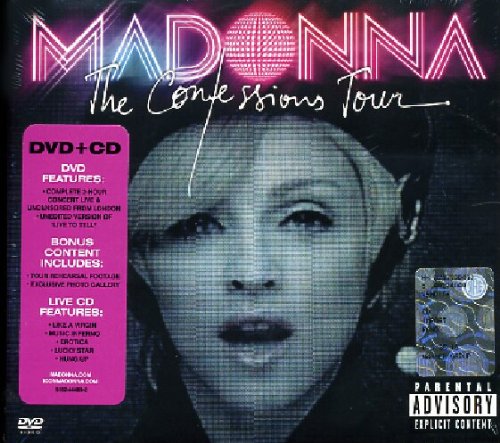
We were listening to Madonna: Live (the Confessions Tour) a few days ago, and I kept getting all these emotions filling me, unwittingly, tossing me from poignant, to upbeat, to energized… I imagine this was in large part influenced by her very upbeat tone of voice as she sang and talked / rapped to 10s of thousands of fans who are in love with her.  [The professionalism of these shows by several of the top women vocalists is staggering. Not like the old days where a bunch of drunk  and high musicians go out in front of all these people and kind of ‘wing it’. Not that there isn’t  a place for spontaneity, and I personally prefer it, but still have to admire the show that some of these more ‘modern’ musicians put on].

But I didn’t WANT to experience these emotions. I had work to do and things to plan, and to think about  –  not the least of which was trying to understand  just how good the sound was that  we were listening to. Some of the time I was even in another room, just overhearing the music from afar –  and still, in the end, I just had to realize ‘soul-caressing’ was going on; something was happening to me and I just needed to try and enjoy it [and to try and not let Neli  see me tear  up  –  she always thinks it is so ‘cute’ and ‘endearing’. Argh. I am a guy. We are only supposed to be cute and endearing when we want to be ;-)] .

Unlike drug-like sound in general, which is kind of a catch-all for all sorts of [fun] effects that music can generate in our minds, soul-caressing is just the part of drug-like  sound that reaches out and grabs our soul,  it affects ‘us’, that entity we call ‘me, myself’, our ego, directly. It is not always pleasant, or welcome, but if we acknowledge it  we can better accept it –  and maybe make time and place to enjoy it.

Otherwise a little-bit lower fidelity might be called for – and we can understand why some people just do not want truly high-fidelity, rich, engaging music in their lives. It can be intense.