Pursuing the Ultimate Music Experiences

Audio Federation High-Fidelity Audio Blog

Digital Cable Shootout

A digital cable shootout without any digital cables… but we won’t let THAT stop us…

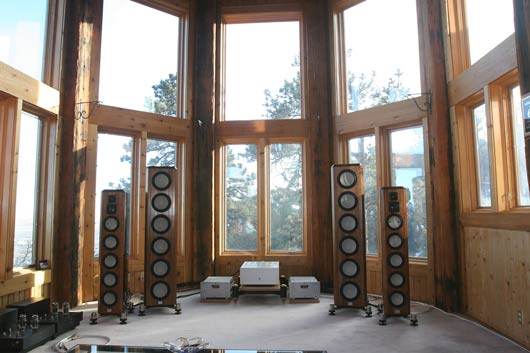
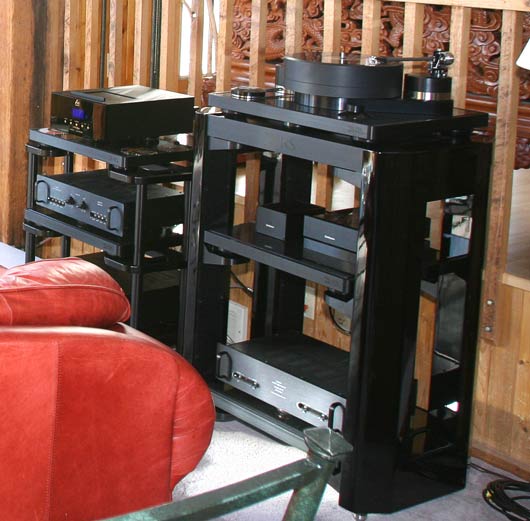
The room showing the listening couch (I sat in the sweet spot behind the couch on a chair that puts my ears on a good level].
Neli, Kevin (thanks! Kevin) and I shot out 7 (SEVEN!) cables last night in a marathon listening session.

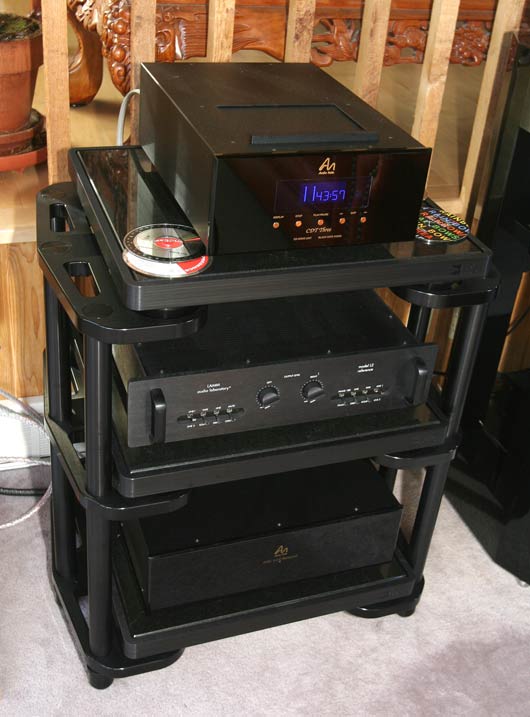
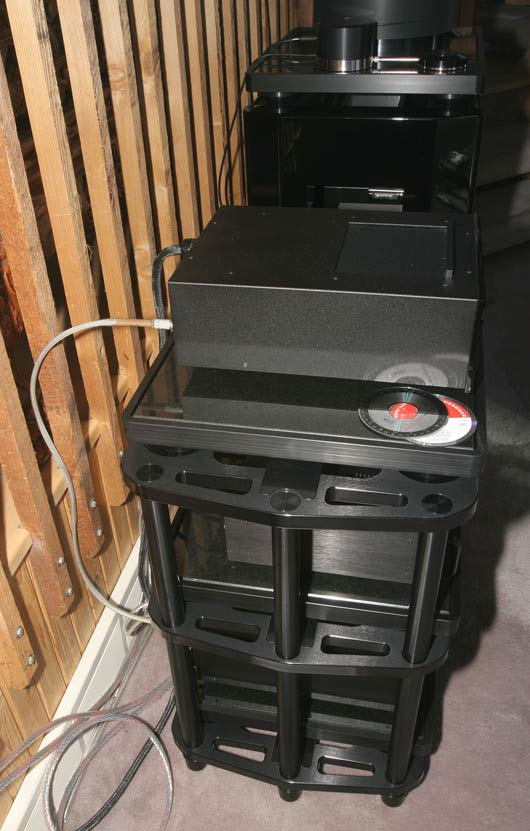
The cables were each substituted, some of them twice, between the Audio Note CDT Three transport and DAC 4.1x Balanced. The signal then ran through a Valhalla interconnect into a Lamm L2 Reference line stage. From there through 10 meters of Valhalla to the Marten Coltrane Supreme loudspeaker’s crossover box. Then through Nordost ODIN into the Lamm ML2.1 amps. Finally, that nice old signal completed its mission through Jorma Design PRIME speaker cables.
We played, over and over again till we was about to die, three cuts: Mark Knophler’s Sailing to Philadelphia track #2, Rachmaninoff track #6, and Radiohead Amnesiac track #2. Neli and I know these cuts REAL well, and Kevin knew one of them [and now all of them :-)] really well, so these particular cuts helped us focus more on learning about how the songs sounded versus on learning the songs themselves. We played CD 1, then 2, 3, 2, 1, 2, 3, 2, 1 in this pattern so that we would here some of the tracks back to back on different cables.
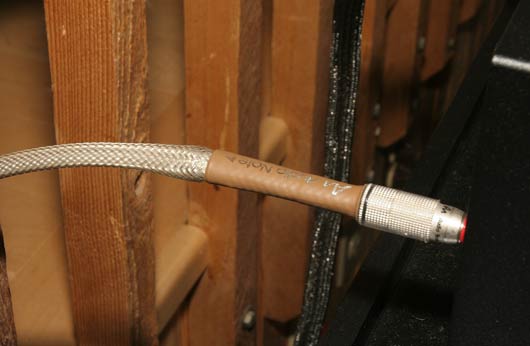

The PALLAS is still on the system this morning.

Neli did all the cable swapping, about 10 swaps in all. It took about 6+ hours. They went and got Vietnamese take out at about 2/3 of the way through. Yes, there WERE complaints about chewing sounds getting in the way of the listening. For my part, I just could not IMAGINE what Neli was chewing that would make such a noise. But, to rapidly continue on…. 😉

The cables finished the shootout in this order. Note the 3-way tie *(which we can help break for you based on your individual preferences, perhaps) and how the SOOTTO seemed to do better as a low-signal turntable cable compared to this one (that may be because this system, the Coltrane Supremes specifically, really likes to show off top-to-bottom detail and clarity – the SOOTTO being more about solidity and dynamics and color. As mentioned below, after some thought, it is perhaps the Kharmas love of dynamics that boosted the SOOTTO into a tie for first in that system]:

[[[Nordost Odin, Jorma Design PRIME, Audio Note PALLAS]]], Audio Note SOOTTO, Nordost Valhalla, Stealth INDRA, Audio Note SOGON.

Hopefully I will add some photos here… but… oh, I am!
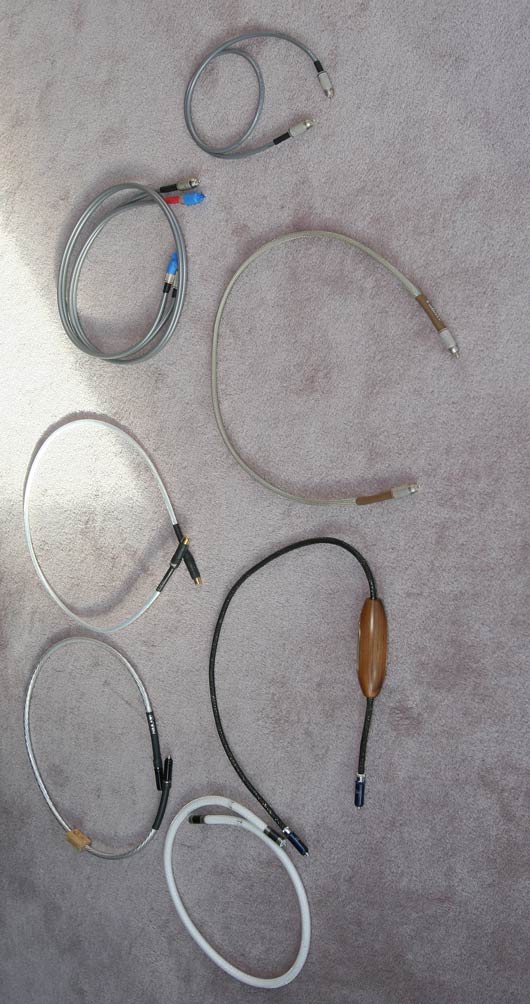
*** Nordost ODIN. ***
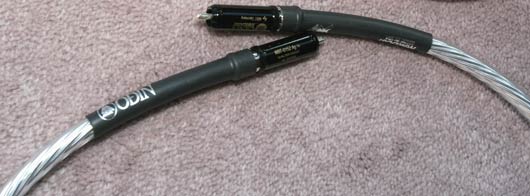
Both the Odin and the PALLAS were doing things that we all found a little hard to get our ears around. I think that is both because they are relatively new here and that they are both breaking new ground in terms of what they can do.

The Odin was the clearly the overall audiophile performance winner. Front to back depth and separation was so good it took some time to get used to. The clarity was other worldly. The even-handedness up and down the frequency spectrum. The precise imaging. Precise harmonics. This is the only ‘competent’ interconnect, just like the Coltrane Supremes are the only competent loudspeaker – they just do the things they should be doing – nothing less, nothing more.

So why the 3-way tie then?

Was it just because we were tired of getting dry-mouth, forgetting to close them during all the ooohs and ahhhhs as we listened to the ODIN?

Yes.

But it was also because we really liked the intense color and apparent humanity of the human voice when using the PRIME (Kevin called it ‘Vivid’), and the ‘rightness’ and cohesiveness of the PALLAS.

We are very familiar with the PRIME, and the sound was therefore more accessible to all of us – it sounded like our system was sounding REALLY EXCELLENT with these cables. With the PALLAS it was like being there (especially the Rachmaninoff) and communicated much more of what I thought the musicians were trying to communicate – their interplay, the threads of melody, the stage – much more like REALLY being there than I have ever heard.

The Odin was more like… WTF! So THIS is what this recording sounds like. Seems like we need to reposition the speakers because we are getting some soundstage fuzziness… there… and THERE! [True.We do. The bass towers between the main towers is just not working out so well where we have them. We either need to to move the bass towers back or to the outside of the main towers].

We would be happy with any three of these cables. They all sounded excellent. The 10th time we played each song was as entrancing as the first – even though my brain was melting and it was hard to analyze what I was hearing at the very end anynore [but the last few songs were just a confirmation pass – yes we DID hear what we heard during the first pass, and yes, it is still quite nice thank you].

The Odin would, however, push us to optimize the rest of the system a little sooner – it being such a good window on what is actually on the source media. Just like the Supremes have forced us to continually improve our system. These definitely are pushing the audiophile envelope – raising the bar of what CAN be done with a high-end audio system.

*** The Jorma Design PRIME ***
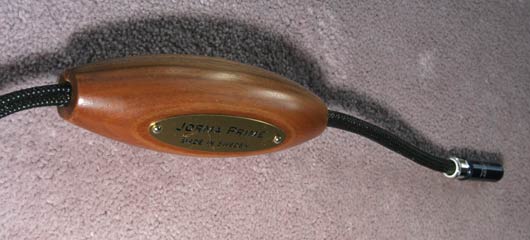
Neli says there is chocolate on the Prime, and then she looks at ME(!) Now I ask the world, who is the chocolate addict in our house? No it is not me 🙂 [But I guess I do eat protein bars that have a chocolate coating… Oh no! Banished to the audiophile penalty box!]

This will be the hardest to write, I think, because we are SO familiar with the sound – I will have a tendency to skip over some of its attributes. On the other hand, Kevin was there, and he brought up things about this sound that was a reminder to me… Oh yeah, they DO do that don’t they.

That said, each time these cables were put on was a joy. We have NOT grown tired of what they do. In fact, it was still a WOW experience.

First off, the voices. The voices on Radiohead, for example – but the Knopler too, were clearly better than the voices with any other cable. The HUMANITY of the voice stood out. This sounds like a real person! Somehow the balance of the frequencies and resolution just works. The throat and chest and gutturalness was just perfect.

There was also a lot of color to the harmonics. Not overly much – in fact just the amount that I want to hear. For example: A lot of notes in music are just plain ‘fun notes’. If you had a button and it made this sound when you pushed it – you’d be sitting there all day pushing it over and over and over because it sounded so cool. Knopler ‘s guitar, a lot of the sounds [but not all :-)] on Radiohead, some of the violins on Rachmaninoff. Just like a kid we would be. Pushing that button over and over. But a lot of our systems leave out the ‘fun stuff’ in notes. This cable emphasizes the fun stuff.

This cable also had excellent separation, side-to-side and front-to-back. details were sufficiently plentiful that it kept us engaged as we continued to find new ones – new depth and characteristics of the performance – after the 10th [1000th] time we heard the track, etc. etc. [See, I TOLD you this is hard to write down everything we know].

Not as delicate sounding, not as much finesse, as the other two top contenders [something we thought we’d never hear ourselves say about the PRIME, which has details out the wazoo compared to most anything else on this planet here].

This was the most exuberant cable of the top three. Happy Happy. Enchanting. The PALLAS was joyous and romantic. The Odin was kind of like all emotions mixed together , being VERY emotional and engaging – but nothing stood out.

This cable is probably best, out of the ones we tested here – for people who love those audiophile-like performance characteristics, who want their system to sound really, really good – but don’t want to, or aren’t ready to, push the envelope and re-evaluate what they know about system setup and configuration and just what can… be… done… with the ODIN. [The ODIN *WILL* show you what your system sounds like – not in a harsh way, unless you have a bright system and are upgrading from something like CARDAS – but in a Oh! That is the contribution of my amp! Oh! That is my CD player. Hmmm… needs some vibration control to tighten THAT up a little bit. OK let’s do that. Oooooooooh. That sounds awesome. OK, sounds like the speakers need to be moved a wee bit to starboard… Yeah. Like that. OMG!].

*** Audio Note U.K. PALLAS ***

Confusing this one is, Luke.

In some ways that I did not understand, this one had a sound-stage stability and a lack of compression and a separation that equaled or bettered the Odin – but with an entirely different kind of presentation.

Lots of delicacy, so detail and micro-dynamics were there almost as extreme as with the Odin.

The solidity though was not as impressive as with the other two top contenders. This was definitely more of a light weight, in comparison, kind of presentation.

What I kept coming back to was the ‘Rightness’ about this sound. The soundstage was laid out in a realistic manner – but it was hard to care much. Each violin could be picked out [this was really quite fun], more or less right… THERE IT IS! But it was just like at a concert, where you can point at the musicians, but not know if they are wearing underwear or not. Or maybe this is another result of our non-optimal positioning of the speakers and we will hear more, like with the Odin, when we adjust this some.

Funny, the first few seconds of all these 3 cables was like an AAAAAAhhhhhhhh experience. “How pleasant it is to hear this sound after all the others. THIS is my favorite”.

Though this cable rivals or betters the other two cables in audiophile attribute checklisting, it seems to be more a music lover’s cable. It doesn’t ASTOUND one as much as the others.

The ODIN is for being Astounded and for helping make our system sound its very best – leaving others in the audiophile history bin. Do you want to build your system into a state-of-the-art WTF [e.g. a non-denominational OMG] system?

The PRIME is a plug-and-play conversion kit to make your system into a freaking-awesome-sounding system. Do you just want to make your system sound excellent?

The PALLAS is for listening to music on a system that matches or betters all others in audiophiledom, but doesn’t flaunt it. Do you just want to listen to and grok The Music?

*** Audio Note U.K. SOOTTO ***
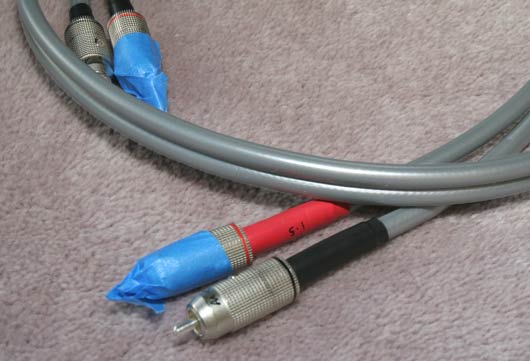
Like with our previous shootout, this is a super-charged version of the SOGON. If you like SOGON, you HAVE to hear this.

After the second pass through the other cables, it was evident that this had greater macro-dynamics and more solidity of any of the other cables, which is saying something. Knoffler’s guitar sounded EXACTLY the way one would want it to sound. Made me want to put on Pink Floyd which is chock full of soulful and very colorful guitar. So, yes, this is also a very colorful / harmonically available cable. Not as much color as perhaps the PRIME, but the PRIME is almost psychedelic.

But the solidity, it is like the amp is taking more control of the speakers – each note is forcefully placed into the air. The musicians sound like they are in perfect control of their instruments.

And the interplay between musicians was also communicated better with these cables – which Kevin also independently mentioned – so the both of us noticed, on the Rachmoninoff, the back an forth and interplay between the musicians… something I was hard pressed to identify later on the other cables.

Why didn’t it score higher? There was some air missing, perhaps? Some slight lack of detail in the upper mids? A little bit of rounding? Last night we were just in the mood for something a little more copasetic with the Supremes – which really, really like Resolution. Downstairs on the Kharma Mini Exquisites a few weeks ago, in the other shootout, it was a slightly different story – the Kharmas really being partial to anything which makes them more dynamic.

*** Nordost Valhalla ***
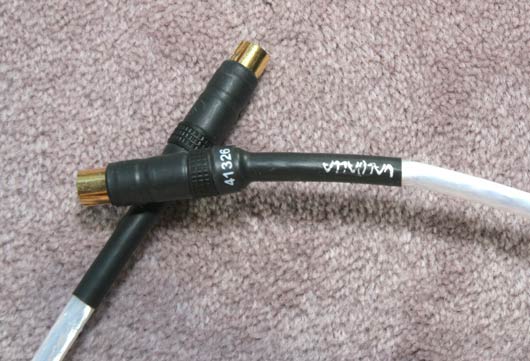
The old champion. How technology has advanced. Still hanging in there though. A little rough sounding compared to the others, good midi-dynamics though. Separation is good in a macro sense, but details are smushed together compared to the others.

*** Stealth INDRA ***
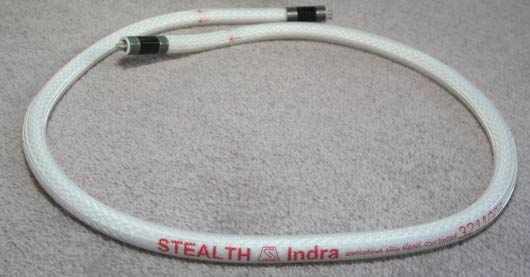
A delicate sounding cable. Very pretty midi-dynamics, but not much macro dynamics. A little more congested than the others.

*** Audio Note U.K. SOGON 50 ***

A little more laid back than the others. If we hadn’t heard the others…. But not as exciting as the others on our system.

*** More Others ***

From previous shootouts, we know we like the Nordost Valhalla interconnect better than the Valhalla digital cable. We like the Valhalla digital very slightly better than the Jorma Design digital.

Getting the picture?

Digital cables are not performing as well as their siblings who are just ordinary interconnects.


I took 6 pages of large scribbley notes – most of which I still have to add to this post. So, stay tuned….!

————————————————–
Notes:

ODIN: A larger impact than expected perhaps 75% of the performance boost of putting it in as a regular interconnect? ENGAGING. Emotion. Pacing.

PALLAS: Not as forward. Great integration, image stability, presence, sound-staging. Less aggressive. Emphatic (Kevin). Balls [Neli]. Great sound-stage fill-in. Softer and more delicacy. Romance. Not quite as good PRaT. A little congested in the mids. Better sense of the music. “Rightness”.

SOOTTO: Not as clear. Very pleasant. More like a classic recording sound. Clearer view into interplay between instruments (Kevin aslso). Not as transparent. More solid. Awesome control over the speaker. Guitar is S-O-L-I-D. Not as engaging. Some of the instruments in the background are more forward (Kevin also).

PRIME: Solidty of voice! Not as delicate as Pallas or Odin. Separation alsmost as good as Pallas and Odin. Happy Happy. Almost as forward as Odin. Good PRaT, tonal color. Happy. Great transparency.

INDRA: Congestion on complex passages. Less midi-dynamics. More focused on speakers. In the delicate-sounding cable category. Constipated. [these do a lot better on stronger signal areas of the signal chain like between pre and amp]. Some emotion. A nice audiophile sound – but not great resolution [compared to the other uber resolution cables here!].

VALHALLA: Rougher than Indra, but more emotion, suspense. Less resolution. More separation, more midi-dynamics. Louder. Less finesse. Made Indra sound too polite. Less transparent. More compressive on macro dynamics. Focused on speakers and center stage. [This is the cable we usually use in this position – as it WAS better than all the other cables we had tried before – not wanting to know, perhaps, what these more expensive cables could do in this little corner of the system – until now of course].

ROUND TWO ——–

ODIN: Amazing separation and CLEAN. The incredible depth of the soundstage, more than we are used to, throwing off perception transparency a little? [I know, almost a complete sentence in my notes!]. Harder to integrate into a whole. A RELIEF [like Valhalla used to be for us – no B.S.]. Pretty, uncompressed. Not at all focused on speaker. Good PRaT.

PRIME: Singer more human. Better presence. Less separation. This amount of congestion / compression / constipation is comforting because we are so used to it? More like a stereo system [than real]? Very enchanting.

PALLAS: Beyond separation – more like spreaderation – an evenness to the spread of soundstaging, of the management of the distance between notes. Uncompressed. Rightness. Less digital. PRaT. Happy. Natural. Wide natural soundstage. Lighter weight on the guitar than the other two.
How to Make a Successful Show System

Looking at the the rooms that sounded good at this years 2008 CES show, one might wonder, if one has the time to wonder about things, if there are any commonalities between the rooms that sounded musical [by which we mean a system that is engaging and has an audiophile performance commensurate with the price].

But, looking at the rooms…

We CAN say that a lot of old wives tales [just who WERE those old wives, anyway?] and rules of thumb are not really rules that people should be paying a whole lot of attention to.

For example:

* Always use small speakers in a small room, and big speakers in a big room.

But the huge Evolution Acoustics speakers sounded just fine thank you in a tiny room, and the Classic Audio Productions horn speakers sounded darn good in the Atma-sphere room, and similarly the Hansens [though this year they did bring a somewhat smaller speaker]. Now, mind you, they didn’t try and turn the systems all The WAy UP – not while I was there – and I am sure they could overload the room just fine. But that capability can also be a real plus when you think about certain genres of music that can use a little volume. On the other hand, the Cessaro speakers in the Zanden room did feel a little too large – that the room was impacting too much on the music.

It seems much more true that small speakers in a large room do not fill the room satisfactorily – though the little Magicos can do well [you just need to drive the poop out of them] and many small speakers in the best of show rooms filled their side of the room quite nicely indeed.

OK, what other rules can we throw away 🙂

* It costs a lot of money to make a great sounding system

This one is easy. It takes a lot of money to make a great PERFORMING system, one that is at the leading edge of humanity’s ability to reproduce music, one that has all of the audiophile attributes associated with the ‘high-end’. But if someone just wants to enjoy listening to music on a system that sounds good – that is not embarrassingly offensive – that was not built by people just trying to put out product without any thought to the performance that CAN be achieved at their asking price – then this is possible at all price points.

————————————-

And then there are rules that do seem to always apply [it is so like life to have some rules that work and some that are more flaky].

* Its hard to make a system sound good when the source equipment is severely compromised with respect to the rest of the equipment.

Many rooms had problems associated with source equipment that was almost an insult to the listeners – almost a ‘no one cares about how it is going to sound’ attitude. They used everything from DVD players to CD carousel players to iPods to laptops with cheap soundcards. EEEEwwwwww!!! They sounded… how shall we put it…. severely compromised.

This rule really is: Source components won’t Make a system, but they Can break it.

* Things like cables, equipment racks, power cords, etc. rarely make or break a system.

These are really ways to refine a system and get the most out of it as one can. But at a show – this level of attention to detail is appreciated, but systems can sound good at shows with cables and racks that we would not be caught dead using here.

* It is the amp / speaker combo that determines in large part what the system will sound like. This is what Makes a system.

If this ain’t right – well, might as well go home. Luckily a lot of combinations do work.

Sure would be nice though for some exhibitors to realize that their combo does Not work and try something different one of these years.

—————————–

Shows are one great laboratory where one has a lot of experiments running at once – about 233+ of them.

OK, I’ll add to this list if we come up with some more lessons learned. A lot of the lessons have to do with training the ear – learning how things sound… low efficiency speakers, different kinds of solid-state amps, different kinds of speaker cabinets, different kinds of cables and… on and on.

The thing, for me, at this years show was being able to tell if the exhibitors paid attention to the details of system configuration. No, I probably couldn’t do this blind, but with the help of looking at a system, I think I can now hear how there are fewer problems in some systems, that they played with things enough, optimized things to a point where a lot of the things wrong with other people’s systems – things that one just accepts at a show like room problems, vibration-induced congestion, etc. were reduced quite a bit if the exhibitors spent some time on system setup.

Again, this didn’t Make or Break the system, perhaps, not going to turn a sleeper system into a Standout, but it did make the systems more enjoyable – and more likely to get on the Best of Show list when perhaps otherwise they would otherwise just be mediocre and kind of annoying.

One reason why music amazes me

I have to get this down before I forget. We had a visitor who was talking about how he liked ‘artificially’ generated music, as opposed to those from ordinary acoustical instruments – largely because, if I got it right, it is just not possible to make these sounds in the ordinary, traditional world.

And that made me think of why I liked electronic music. And in some sense it is for the same reason – the artist can do so many many things that are just outrageously creative – 3D rolling, spinning shapes that burst from nowhere and wrap around the listener then dissipate slowly into the air, for example.

And that is true. But then I thought the core of why I like electronic music, and acoustical music, is the way and the mystery of how a musician can use this ‘THING’ and make people feel things.

How and why can a violin sound so very poignant. In some sense it invokes a baby’s cry – but is that all there is to it?

Why does rock-and-roll induce adrenaline and testosterone production?

How about something as simple as drums? Mimicking the heart beat? Is that all there is to it?

And then there is the human voice. Singers. Love. Angst. Anger [rap is great at that. Don’t even have to listen to the words to know that Someone is Pissed Off].

Do all musical instruments mimic the human voice, and the rhythm the human heart beat?

I have been amazed my whole life at the variations of meanings different accents and tonal colorations in spoken language. For a VERY crude example: How are you? HOW are you? How are YOU? etc.

Frank Herbert must have thought about this when he came up with the Bene Gesserit in his book ‘Dune’. One can watch politicians and newscasters and try and figure out what they REALLY think. One listens to Frank Sinatra and can tell when he REALLY means what he is singing [his early years], and when he is really BORED.

It is these cues that we learned somehow, sometime in our lives and that we want our stereo systems to reproduce. This is the underlying message, the underlying truths that we are used to hearing.

We may not pay attention to this other ‘language’ all the time – and some musicians, let’s face it, just do not have the talent to add this subliminal subtext to their music.

But it seems it does not take maturity to produce this, nor always a great system to hear it. And often groups will have a general subtext in all their songs.

The Beatles, for example, have that youthful exuberance, that tongue in cheek, the world is a giant playground attitude that comes through in almost all their songs – no matter what words they are singing. Radiohead has this ability, but they are unfocused and tease us and play with us. Rap music just focus on anger and frustration. Classical music has lots of subtext – but it is ethereal and sophisticated.

Just playing around now [and your guess is as good, or better, than mine]: Led Zeppelin – exultation. Pink Floyd: early days – LSD [exploring strange new worlds, seek out new life and civilizations…OK, Pink Floyd is not sending their subtext to me very clearly – but I consider this to be some of the best live music ever – so I am too close to it to see clearly?], DSOTM and after – humans living with the purity of the machine. Neil Young: Sweet Angst. Grateful Dead: We are all human.

OK, well that was fun.

The point is that we seem to be programmed to recognize sound, sound that is not composed of words, as another carrier of information. And that these subtle and not so subtle sounds may have many, many layers of meaning that we do not consciously understand, nor recognize in our day to day lives, but exist nonetheless. And to truly understand what music is communicating – we need to hear it all, all the layers, from our high-end audio systems.

Welcome to our new readers …

… from: China, Hungary, Malaysia, Slovenia, Serbia and Montenegro, Belgium, Singapore [Hi guys!], and….. Croatia [Hi hrky! We should get to that shootout this weekend].

And of course the U.S. of A. and Canada [Hi Canada!]. Where would we be without them? Living somewhere else, I guess.

We know some of you better than others, whether because we see you at shows or you or your friends have the same equipment as we do, or just… because. You know, we audiophile nuts got to stick together in this big fishbowl we call the world [badly paraphrasing Roy Buchanan’s The Messiah Will Come Again – he can do the best ‘crying’ guitar ever].

But we appreciate ALL of you stopping by our little [or not so little] website and if you have any ideas about what shootouts we should do next, or subjects we should explore, just drop us a line, send an email, or post a comment here in the blog [no registration required. You just have to indicate that you are a human and not a spam robot].

Anyway, once again. Welcome!

Shootout: Audio Note Interconnects: Sogon versus SOOTTO versis PALLAS

A shootout! A shootout!

OK, in this corner weighing in at, well, it is the heaviest cable, is the new top-of-the-line SOOTTO [SO Over The TOp].

In this other corner is the new 50 strand version of the legendary SOGON.

And in this other corner [a lot of corners, yes] is the new limited-quantity low-capacitance minimally shielded PALLAS.


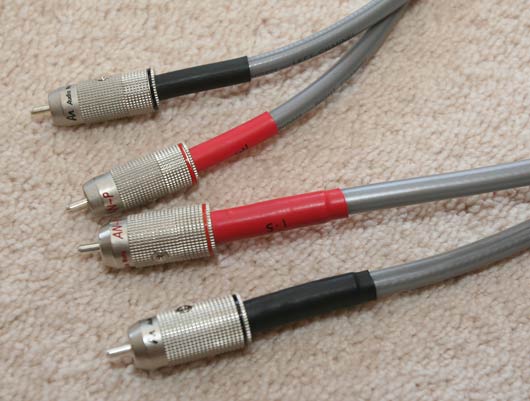
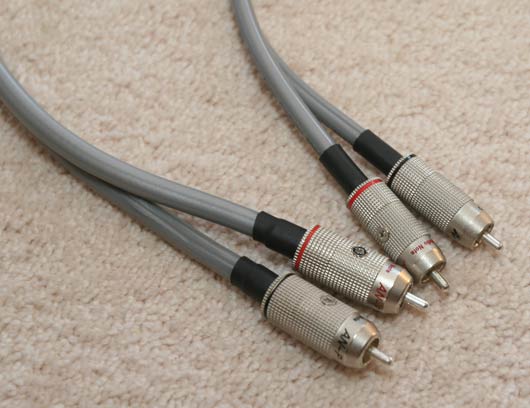
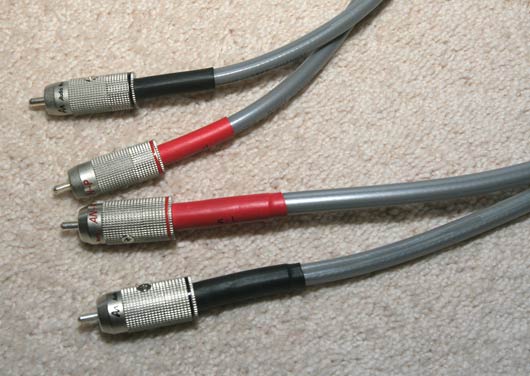
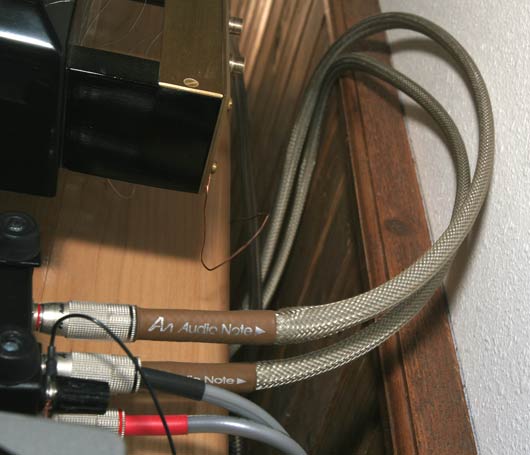
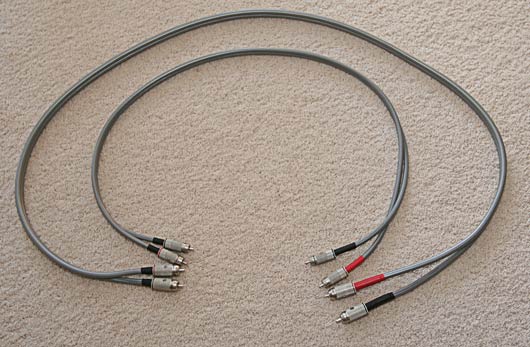
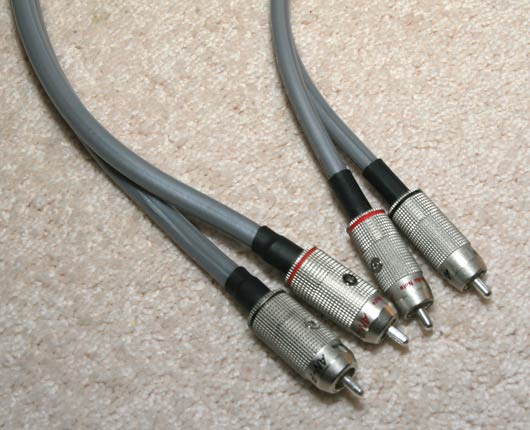
A photo of a 1.5m SOOTTO and 1m SOGON cable. The PALLAS is still on the system (see below).


The SOOTTO is about 50% larger in thickness than this new SOGON50 which appears to be slightly larger than the old SOGON cable.


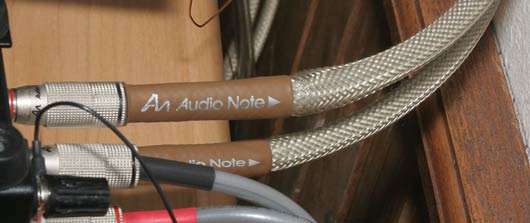
The PALLAS low capacitance cable on the back of the TT3 Reference turntable. The current configuration is not shielded.

We tested the cables going from the step-up transformer to the Lamm LP2 phono stage and ultimately to the Kharma Mini Exquisites. So this was a test of the low-signal handling capability of the cables on a system that does not have a lot of capacity for detailed bass below 30 Hz or so [but has one of the highest capabilities of midrange resolution of any speaker on the planet].

We think of the AN SOGON cable as analogous to the Nordost Valhalla [which is familiar to many people] – and in general applications, one can be swapped for the other in a reasonably well-designed system with the overall performance remaining about the same.

What this means in practice, is that the upper mids and low treble are more or less the same – and this is the area of most information.

Where they vary, and become useful in customizing a particular system, is that the SOGON has more color in the mid and lower mids, and the Valhalla has more detail in the lows and some of the highs. At least, to a first approximation, this is how we use them.

The second order approximation [i.e. finer differences] come into play when looking at separation and transparency [Valhalla] and continuousness, soundstage consistency, midi-dynamics [SOGON].

The SOOTTO is like a nuclear-powered SOGON.

The [having a hard time thinking about how to describe this very basic attribute], the *power* of the notes are clearly unmatched by any cable we have heard here before. Kind of like a Mohammad Ali punch when he is just playing around – it doesn’t hurt you, but the fists are humongous and you can feel the strength in each note.

Similarly the naturalness of the color of the notes and the smoothness of the transition of the notes one into the other [so that riffs inside melodies were easier to follow] is also exceptional and unmatched [though the Jorma PRIME has a more *vivid* color spectrum].

It was agreed that this was definitely a WOW! and WHOA!!! kind of experience. Reminds me of those Strongman competitions. Other enhancements were the tactility of the notes [not so much the presence, nor solidity, though these were excellent, and related, to tactility but the feeling that one could go up and hug the notes, as opposed to the people or instruments making the notes].

We liked it and it was kind of hard to think about going back to SOGON after doing the shootout [funny, but before a shootout, swapping things here-there-and-everywhere, the differences aren’t so present in one’s mind, but after a shootout where you sit and explicitly listen for differences – you are screwed].

Finally the PALLAS.

First, let’s deal with the unshieldedness. In the position that you see it in in the photo, there is some hum. Not much, and only barely audible from the sweet spot. Compared to the oh so wonderful WBT RCA connectors, which generate hum in that position at about 60-70dB, and make the cables that use them worth less than lamp cord, the hum from the PALLAS is nothing.

The PALLAS is designed by AN for low signal strength connections, and we have not tried it anywhere else.

OK. It is hard to compare the PALLAS to anything we have here. Because of this it will require more listening. But…

It has separation as good or better than the Valhalla – but not as clear sounding – but more clear than the SOOTTO. It sounded more musical than anything we heard in this test. Great transparency, but not like that of, say, the ODIN – things are not outlined with that kind of preciseness – it is more like the center of things is more solid than the edges, but that the roll off of the solidity was exactly what one [me anyway] would expect when one thinks about analog [as opposed to digital].

So, for me, I liked the PALLAS the best and SOOTTO second best in this test. I would hate to live without either – they are so different and I love being able to switch back and forth sometimes. Over time this may change – maybe after we get over the WHOA! experience with the SOOTTO we will come to prefer it. But in general I like the slightly more clean sound of the PALLAS which still retains the harmonics and dynamics of its brethren, if not the impact and POWER.

Again, a reminder, this shootout was for small signal connections. These results are for interconnects between turntable to phono stage, and probably the same results would be achieved between a transport to DAC. Some cables do better than others at this: Stealth INDRA for example does not work nearly as well as Valhalla [and for some reason we have never tried the Jorma Design PRIME. Well, maybe Neli has…]. In fact, we liked and use the plain old Valhalla RCA interconnects almost exclusively in this low-signal capacity. The Odin is better than the Valhalla in low signal connections – and the resultant purity of the overall sound is what dreams are made of – but Odin kicks Valhalla butt all the way to the Moon in high-strength connections, and since our supply of Odin is, so far, uh, limited, you would see Valhalla serving in this capacity here most of the time.

But now we have a few more cables that have proven themselves to be better at the low-signal thang in at least one situation. So next time we move things around, we’ll have More Work to do figuring our which cable sounds best. Oh boy.

I mean, Oh BOY!!! [actually, I do enjoy these shootouts very much, though the turning on and off of equipment over and over is kind of stressful – on the equipment specifically, and making sure we don’t hook up something backwards, or the in to the out, takes some amount of, uh, hmmmmm…. paying attention to the physical world when I just want to focus on the sonic world].

Well, there you have it. There needs to be another shootout, specifically for normal connections, and hopefully in that shootout we will revisit this shootout with any updates, if necessary.

What we're playing with this week

We’ve been spending most of our time downstairs.


We set up the Audio Note TT3 Reference turntable next to the Walker Proscenium Gold Signature turntable.


It has been back-and-forth, Walker –> TT3 –> Walker –> TT3 ….. both through the Lamm LP2 phono stage into the Ongaku integrated amp and the Kharma Mini Exquisite loudspeakers.


How do they compare, you may ask? In raw terms, the Walker is an audiophile’s dream come true and the TT3 is a music lover’s dream come true. Since we are music loving audiophiles, we can’t really talk about one being the ‘winner’. The TT3 is more dynamic, more lively, more engaging… more youthful. The Walker has a lower noise floor, is more accurate top-to-bottom, a more mature sound.

In fact, the idea would be for us to make them sound a lot more alike [which we have to some extent already] – to get a more musical cartridge for the Walker [we are using the Blue Magic Diamond – not so bad obviously, but there are better, unfortunately more expensive ones out there that are generally considered better]. And conversely, to dress up the TT3 with a rack with more vibration control, to correspond to the Walker’s air suspensions [even though the RixRax with HRS platforms comes close, HRS’s MXR rack still laughs at this setup].


Upstairs we still have the EDGE amps on the Coltrane Supreme loudspeakers, with the Lamm ML2.1 amps waiting for us to get our act together and replace the EDGE.


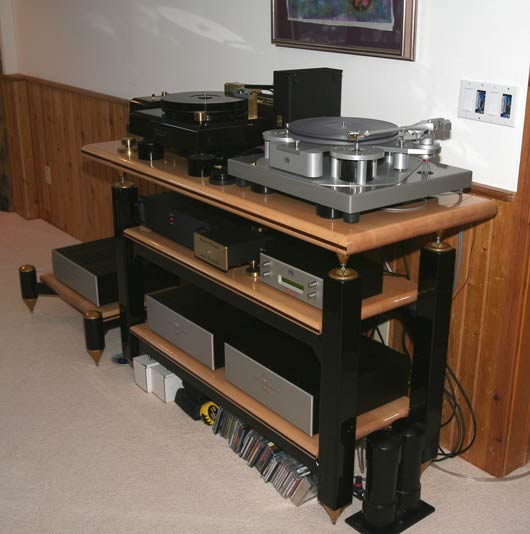
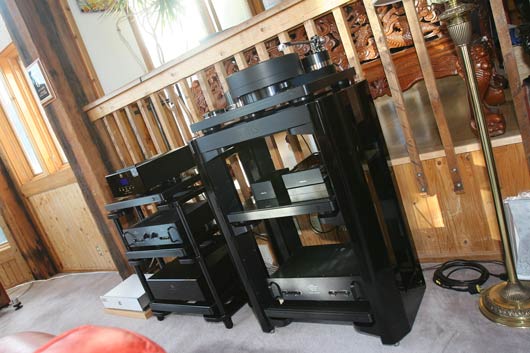
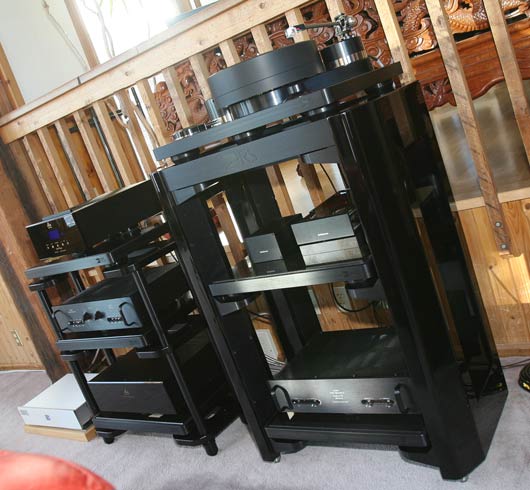
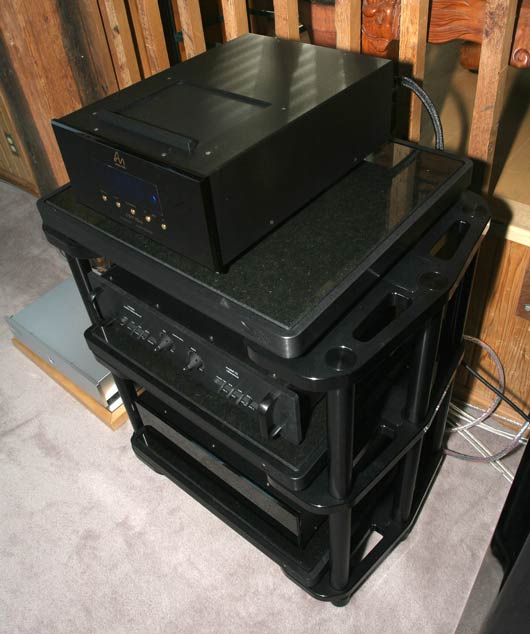
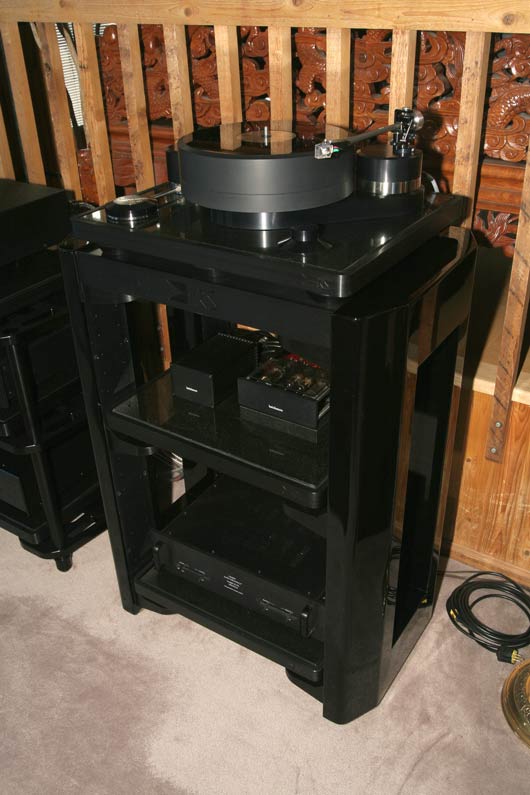
We have our new HRS SXR 3-shelf rack next to our HRS MXR 4-shelf rack.


Look at all that black!


Neli cleaned everything up, but this is two days later and already some Rocky Mountain dust has found its home on our stuff again.


We’ve appropriated some platforms / shelves for our playtime downstairs.


The Brinkmann Balance turntable.

Right now, we only have one phono stage, which the TT3 and Walker share. Even after our Audio Note M9 Phono arrives, we will only have two phono stages. But we have THREE turntables [well, four, but the little TT2 uses the little Audio Note Oto integrated’s phono stage].

We also do not have rack space for digital on the RixRax equipment rack in listening room 2.

What this means is that our Walker is up for sale on Audiogon [Neli is still glaring at me, because this was really my decision]. If anyone is interested…. be sure to think it over… it is not like they appear on Audiogon everyday [in fact, almost never. And for a good reason].

Next : Audio Note SOGON interconnect versus Audio Note SOOTTO interconnect versus Audio Note PALLAS interconnect. And a CES 2008 retrospective.

Can Hi-Fi Go Big Time?

Mike Fremer and J.A. seem to be of the opinion that the Mass Media is to blame for the small size of the audiophile marketplace – as they editorialize in Stereophile.

regmac over at the Asylum described problems with this perspetive [look, I post a link to the show report there then I kind of check to see if there are any questions, and so I am over there. So I peek around to see what is happening. Seems that people are a little nicer to me and nastier to each other over there].

Messrs. Atkinson and Fremer are mad as hell and they aren’t going to take it anymore!

I agree with most of the thrust of this post – essentially that the Mass Media is the mass media. They conspire to help their owner corporations make more money in every way this side of blatant murder – and they just don’t seem to be focusing much on keeping high-end audio out of the hands of wealthy adults.

So, lets look at this a minute.

We want more people in high-end audio? It is called marketing. It is a known science.

Dealer organizations, Manufacturer organizations, and dealers and manufacturers themselves can put ads in U.S. Today, the Wall Street Journal, NYT, Inquirer, Car and Driver, Robb Report, … whatever.

Depending on the quality of marketing, and the investment, … and considering that we are starting out with essentially zero percent of the population, we could double, triple, … even grow the market by 10 times without relying on GREAT marketing [great marketing is Apple’s marketing of the iPod and iPhone].

The problem is, how many manufacturers could handle this? Some are at capacity now. Some can grow by 2X .. maybe. The ones not shipping anything can fill in the gaps, but then we have all these new people in the hobby getting second rate gear.

And what about customer service, repairs, and reliability?

So, the growth would have to be slow if it is not to collapse and make a bigger mess of things than they are now.

If we accept that dealer’s graphical restrictions makes it counter-productive for them to run ads, and that dealer and manufacturer organizations are hard to start, hard to keep from going corrupt, and hard to raise funds within a hobby that is shrinking,… then we are left with the fact that it is the manufacturers (M) that need to advertise. OK, like Honda or, say, Bose.

In order for the M. to justify this, they need to have a good dealer network, spare capacity to deliver product, a product that does not change versions every Tuesday, a product that is reliable, and enough profits to be able to afford to advertise.

I think that the number of M’s that satisfy all these requirements must be close to zero – which is why we don’t see these ads. [except for the every Tuesday part, Esoteric might be close].

CES 2008: Ear to the Grindstone

One of the questions we get asked a lot by people is “Did we hear anything great” that they should know about… that might affect their purchase plans over the next few system upgrades.

Thinking back to other shows, we, like most audiophiles we talk to, only find a couple or three things we think change the high-end landscape at each show.

On the plus side we have

Amps:


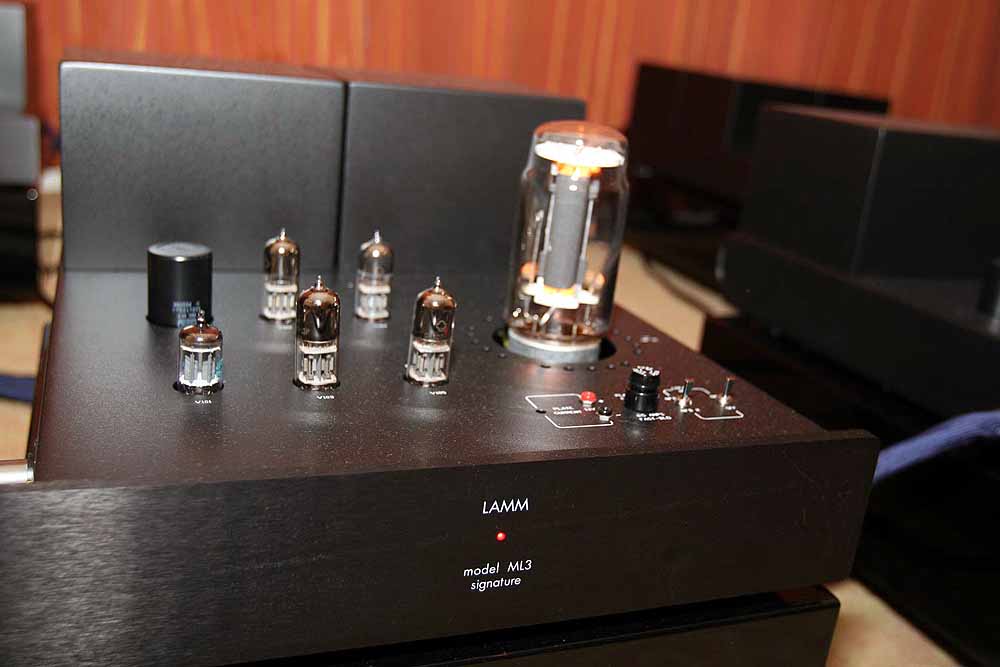
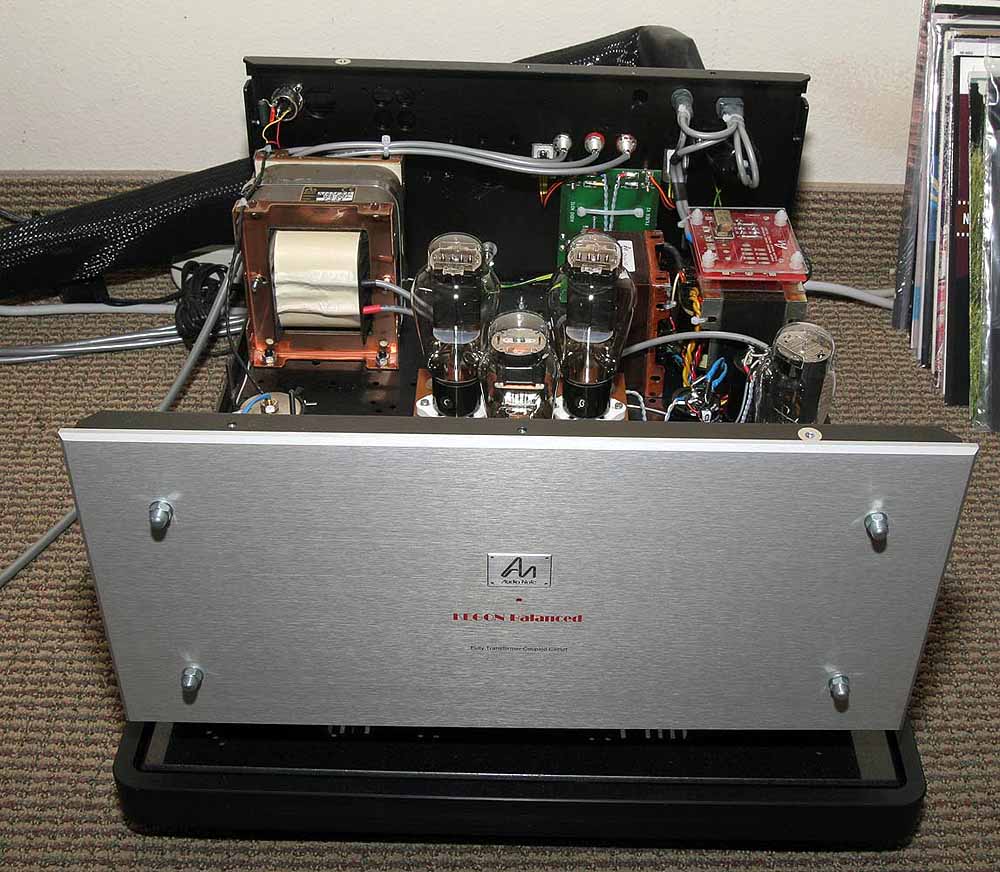
the $139K Lamm ML3 and the $85K Audio Note U.K. Kegon Balanced. There are now two more ultra-fidelity amps added to what is still only a handful of ultra-fidelity tube amps.

Since these two brands, which we happily carry and use on a day to day basis in multiple systems [:-)], already had most if not all of the amps in this category to start with [Kondo is great, but their purpose is very different, and somewhat inaccessible to the American taste] – they have just solidified their reputation even more.

And, with the proliferation of so many newcomers, with amps from $30K to the sky, having brands with a reputation for building world-renowned amps for more than a few months should appeal the the buyer who wants to get their monies worth.

What does this mean for people with, uh, restraint? While the Kegon Balanced is like a 300B Gaku-On [the Gaku-On uses 211 tubes], Audio Note does use lots of the same technology in their new P4 Balanced [which is MUCH less expensive – the exact price of which is waiting on us to finish staring in horror at the British pound / U.S. dollar charts].

It is very unlikely that Lamm will come out with a ML2Prime or something between the ML2.1 and ML3 [unless everybody clamors for it – and even then, likely not] but the ML3 does increase the worthiness and renown of the brand [not that they needed it – so this is not major].

Speakers

Let’s just go through them quickly and see which ones merit further discussion vis-a-vis people changing their buying decisions [as opposed to being pleasantly surprised that their previous choice is now sounding better than ever]. The $45K or so Audio Note AN/E SEC Signature now with high-efficiency hemp driver and high-resolution AlNiCo tweeter, The $16?K Classic Audio Reproductions with Field Coil midrange, … well, then we have the usual suspects: Hansen, EPOS, Audio Machina, Sunny Cable.

But new this year we have the Cessaro in the Zanden room [first time at a U.S. show], and new Kharma, Marten, Acoustic Zen speakers [are they trying to drive us nuts?]

For Kharma the new 3.2.2 [introduced at RMAF] and the new Galileo Exquisite [maybe I now will learn how to spell Galileo] make those who had the decision to make between going with the smaller 3.2 and the larger Midi Exquisite much more difficult – which these two speakers filling in that gap. For prospective Marten purchases – the new Form series competes with their Miles III [choose Form’s if you prefer lively and forgiving over accuracy and transparency, is the way I look at it]. And Acoustic Zen, with their new six foot tall statement speakers [I think these are still in prototype – but they sound ready to me and they are full range and somewhat forgiving].


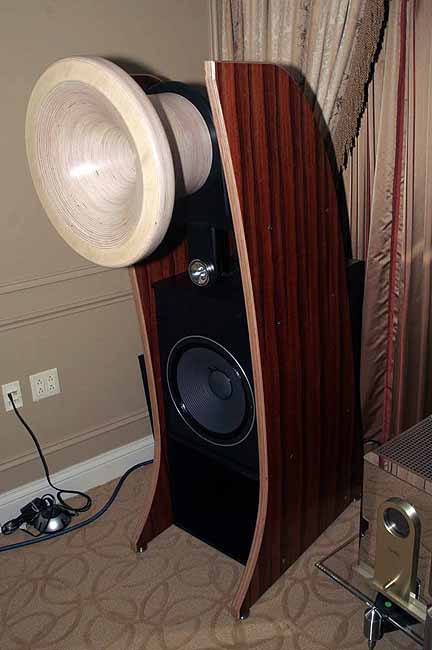
The Cessaro – it is so much easier to talk about things we don’t sell, mostly because I want to be completely accurate about the pluses and minuses about the things we DO sell, and the things we don’t… well, I can just give kind of a general recommendation – that it ‘looks good’ at first blush [or second or whatever]. So, uh, yeah, the Cessaro horn speakers sounded good within the constraints of a room that had giant speakers and no room treatment. The highs were pure, the midrange was decent and the bass was attached and not under- or overwhelming – very much that ‘big horn sound’ done correctly, to my way of thinking, so that it sounds like the music other speakers make, just bigger and more relaxed and more dynamic. To be explicit: these sounded a lot like Acapella speakers – the sound quality [and appearance :-)] of this particular pair roughly falling between their Campanile and Triolon models. I say roughly because I only heard a few songs here – it was just a first blush.

Cables?

We are still staggering under the blow that the Nordost ODIN has delivered to our expectations of what cables can do. Specifically the interconnects. They rock.

Turntables?

Well, besides the Audio Note TT3 Reference [which we will post LOTS about over time here], the other tables I did not hear – and many I did not see. The big Transroter – seen and not heard. The, geez I do not know their names off the top of my head – the table in the Sanders room and the one on the 7th floor of the Venetian with a granite platter – I did not even see, much less hear [so the names won’t do me any good anyway].

On the minus side, we have


1. the commoditization of what was the hallowed [by some, admit it] Continuum turntable. Being heard, as it was, in so many systems, and many that were not WOW systems, the hype bubble surrounding the Continuum has leaked a little of that hot air.

2. the proliferation of new expensive amps and speakers from companies, new and old, that have never built one of these things before – and whose core competency, whether it be cables or whatever, is being neglected with respect to advances that one might imagine [or not] they could be making instead.

What does this mean? More choices and more confusion for the consumer. The beginning of the end of a number of companies [well, it does portend big problems in other industries, anyway, usually to do with money squandered and focused competition grabbing market share].

3. The [growing?] disrespect some exhibitors have for the sound. Maybe it is just more obvious now. But with iPods and sound cards and laptops and cobbled together media servers going into so-so DACs – many exhibitors just did not care if the megabuck things they were supposedly trying to get dealers to sell sounded good or not.

4. In a similar vein – the media server craze. The number of media servers in the prototype stage at CES was amazing.

In the early days of the PC, say 83 to 95, it was obvious that the PC would kill workstations. So some people used the PC [DOS and Windows] to do their work for all those years, even though it was inferior [and still is to some degree]. People may not remember, but there was a Win286, Win386, Windows 3.0, 3.1 and finally 95 that almost really worked for the first time. I know because I was one of those people and I own all of these.

Again, we have high-end audio companies spending their research dollar on this stuff – instead of better sound – when at the end of the day, Amazon, for example, can just keep your music server on the net for you, never any risk of hard disk failure, available at your friends house, in your car, on your cell phone, wherever – and you just have to click on ‘buy’ to have any track or CD added to your server instantly. All these hardwired incompatible GUIs, having to manage a physical CD or inferior MP3, worrying about format changes as they improve download speeds and the MP3 format… it will all be done for us. But hey, maybe one of these companies will beat Amazon and Microsoft and Apple – I certainly would be over-joyed to see it. But…

Hope all this was more or less in English – cause I need to boogie. I’ll re-read it later. Or get Neli to do it 🙂

[Oh, but I should add photos too…]

CES 2008: The Vibes

As you may have noticed…. Visually, the Venetian is very different than the St. Tropez and Alexis Park.

The rooms at the Venetian, especially some of those up on 35, are exquisite. Well appointed, well decorated, clean – suitable for entertaining just about anybody you can imagine: rich folk, Hollywood actors and actresses, sports stars, even the handful of politicians you think you might be able to stand a few minutes alone with. Not quite what you think of when you think of your average audiophile.

The rooms at the Alexis Park, and more so the St. Tropez, are old, dilapidated, scungy, skanky, horribly decorated with stiff soiled curtains that conflict garishly with the patched, blackened carpet, and kind of smelly to boot – suitable for entertaining, well, nobody. Not quite what you think of when you think of your average audiophile either.

The equipment in the photos at the Venetian are gorgeous, more so that THE Show. At T.H.E. Show did my best to crop out the icky curtains and stains in the carpet, whereas at the Venetian I felt free to include some of the yellows and reds of the backgrounds, and the golds of the lamps, it added color and context for the equipment.

I do not believe that the equipment is all that much lovelier at the Venetian than at the St. Tropez and Alexis Park.

At the Venetian, the exhibitors setup their equipment in this luxurious environment. They look around at the fine furniture and the view and the elegance – and they dust off their equipment a little bit, make sure it is all aligned in an attractive manner. Maybe ask someone for an extra rack or go get some plants to spruce it up a little.

At the T.H.E. Show, people kind of shove some of the mismatched furniture down to one side of the room and plop some equipment on it, or on the floor. Wires go everywhere. Components are kind of dusty and fingerprinted from the last 3 shows, but, heck, they are still cleaner than the room.

So I think this helps explain the difference in the attractiveness of the components in the photos.

But given all this, I think it is universally acknowledged that it was more fun to attend T.H.E. Show than the Venetian. It was more of a personal experience. More of an audiophile experience.

Why?

Is it because:

A. the business business business attitude of the rest of CES [some of which is right downstairs]?

B. the Venetian has a casino downstairs? [I personally think not. The casino is like a whole other world, man. More Ferengi than Humon]

C. the traffic was lower at the T.H.E. Show? So people got individual attention and the exhibitors didn’t get overwhelmed and treat people like moving bowling pins [but still sufficient that it kept most exhibitors busy all day]?

D. the quality of the traffic, that only true believers made the effort to make it to THE Show?

E. the beauty [and perhaps the sterility] of the Venetian distracted people from the equipment? [I think not, THE Show could use a little of that sterility, let me tell you. And if the grunge did not detract from the enjoyment, why would cleanliness detract?].

F. None of the above

G. All of the above

H. I have no idea.

I. I hate tests… Cut it out!

At this point, we are returning to the Alexis Park. It worked well for us. We talk about getting one big room instead of two small ones, different rooms, blah blah blah. Point is, we’ll be back. At least for next year, anyway. The Alexis Park is in somewhat better shape than the St. Tropez, and, at the end of the day, it is all about connecting with other people.

And maybe I should … borrow … a couple or three of furnishings from the Venetian and use it, going room to room, to throw behind each system at THE Show as it is photographed.

Oh, and carry a duster with me. We use the ones they sell for automotive use. Picks up the dust instead of pushing it down the ventilation holes of the equipment.

And, uh, then make sure we use it in our rooms each morning… 🙂

CES 2008 High-end Audio Show Report with 2800 Photos

Is now, more or less, complete.

Less because we want to add an index to the report(s) …someday.

More because that day is not today, and it is not tomorrow.

So, then this is it, in two resolutions: Medium, suitable for lower resolution monitors and most laptops; and High, what the report was designed for .

2800 photos, of 180 rooms at the Venetian and 52 rooms at T.H.E. Show.

CES 2008 High-end Audio Show Report

We’ll be posting more about what was heard at the show on the Blog here, specifically the rooms in the Most Loved list.