Pursuing the Ultimate Music Experiences

Audio Federation High-Fidelity Audio Blog

3700 attendees, 470 exhibitors, 150+ rooms

3700 attendees, 470 exhibitors, 150+ rooms… wonder how many see the high-end audio part of CES? My guess is that it would be about the same number of attendees per room… but CES has over 200 rooms.

Sometimes I hate show reports. Usually about now in fact. I am about 60% done and get so tired of Photoshop and, boy, do I take too many photos or what.

Hope people are liking the background story on the rooms at RMAF on Spintricity. Still working on trying to make it interesting to all you experts as well as to the newbie who is kind of trying to scope out what is what in this kind of complex hobby we have here.

Most improved sound at RMAF 2009

There have been a few rooms that I have heard in the past that… were in previous years far from the mainstream preferences in terms of their sound… but this year sounded quite musical.

These were the Rethm, the Daedalus and the Affirm Audio (previously Maxxhorn) rooms.

For me, the sharp rolloff and lack of harmonics typical of the Rethm speakers were just not going to be enjoyable by most people after lengthy listening. But this year, and perhaps it was because of the use of the AMR digital being a very laid back type of digital playback component, it had enough harmonics and roundedness to the notes that, in addition to the Rethm’s natural midi-dynamics strengths, made it quite a nice sounding system.

In past years, I would go into the Daedalus room and the system would be blasting and the room would be empty and the eXemplar CD player would be playing and it would sound bright and uneven and disconnected…

This year, not sure what they did, but the sound was much more melodic and mainstream. Still big sounding, still capable of rocking out, but there was flow and top-to-bottom coherency and even-handedness. This was a system where, if someone told me they fell in love with it, I could with a clear conscious tell them to go buy it, knowing that they were not going to be doing their spouses and housemates in, ear first.

Last year, I thought one of the Feastrex driver speakers sounded quite good, and the other 2 did not. That these other two had the same problems that the Rethm speaker typically has, described above. One of these, the Affirm Audio (previously Maxxhorn) speakers, however this year sounded much more tuneful and melodic. Again, like the other 2 rooms above, I feel that if a system puts out a more mainstream sound, but keeps its inherent strengths [in this case, single driver coherency] then it is a win-win for everybody.

——

Although there are those who will put up with the deficiencies of a non-mainstream sound, like sliced-off notes and harmonic deserts [:-)], in order to have access to the strengths they perceive of a sound [perhaps midi-dynamics and single-driver coherency, or perhaps a big big big sound], I think even they [these crazy people obsessed with a specific aspect of sound above all others :-)] would be happier if the system sounded more like real music [or, if ‘real’ is too strong a word, then ‘more enjoyable and accessible’].

And I can’t help but think that their friends and family would agree with me.

Warning: Reading Show Reports May Be Hazardous to Your (Hi-Fi System's) Health

As I casually read what various reviewers wrote about the sound they heard at the show a few things become obvious. This is not about the sound in our rooms, about which I have read one positive and one not so positive (about the small room – but I did not hear the system after a major cable change was made – so do not know if the reporter was right or not)

1. A lot of reviewers just can’t hear. They string together a lot of good sounding ‘audiophile words’ and hope in this way to gain some advertising. This would be shocking if it wasn’t so sad.

2. Some just mention the positive things about the sound, never the negative [same ole same ole – but only a few people/mags are this honest anymore].

3. Some lie, sometimes describing sound more or less accurately, and sometimes just negative and/or positive things in order to achieve some political or economic goal they must have in mind.

As for comments on forums, take a room at random and make it the Best of Show. As far as I can see it is completely random – aka noise. Aka no information provided.

There is not any room so horrible sounding that someone, somewhere won’t post that it is the best of show.

I used to think this was akin to ‘there is no man so ugly that some woman somewhere won’t think he is handsome’.

But this has more to do with the beholder being really confused, than it does with seeing the inner beauty of someone/something. And it has to do with people being manipulated into thinking something different happened [good or bad sound] from what REALLY happened.

Of course, this cacophony of misinformation, lies, political maneuvering, sloth, etc. just mirrors that of the current state of affairs everywhere circa 2009. The difference lately has been that so called ‘trusted sources’ do not have loyalty to the traditional reporter’s ‘creed’ to tell the truth.

That, while representing yourself as being ‘independent’, but instead telling a self-serving point of view that makes you money is AOK.

The 1984 part of this is that people have been programmed to accept this as being acceptable behavior for a ‘news organization’.

The upshot of all this incompetence and deception is that it is really hard to get any real information about the sound at a show, or, to expand our focus, any component. Even if you listen to it, if the person setting it up did not have the correct associated components, you still didn’t hear it [most systems seem to be either the random Audiogon click to buy approach or some dealer putting components together because it is good ‘politics’]. It is hard to get an idea of how something really sounds [think how poorly Wilson has been represented all these years – how many people hate their speakers. This is why].

Because of all this, Spintricity is just presenting things like specs, people, how-tos and why-tos, and ads. Because of the rampant unethical behavior of the press, we can’t even think about doing reviews ourselves, of equipment or rooms at shows, without tarnishing our magazine with the stink of the current zines. [Even though we are darned good at it with having probably the most significant and wide-ranging experience with uber high-end audio of any reviewers/reporters/audiohpiles. And our personal preferences are also 1) known to us [so we can at least try to listen around them] and 2) fairly mainstream]

RMAF Whirlwind Tour Report

We will take as a starting point Jonathan Valin’s $20K+ Speaker Show Report:

Show Report

First, to get it out of the way, what he said about our big room seems to be relatively accurate and even quite favorable and can only figure the surprise at the ‘sweet and smooth’ness was because 1. he has never gone into the small Audio Note room and 2. maybe he has previously heard the speakers when they were playing heavy metal at 110dB (which they can do without distortion or sweating).

OK. Now that the detailed analysis of the sound is over here in the blog – we are going to be even freer about what we can talk about.

Primrose Suite: This is a local dealer’s room [Audio Limits] with the YG Acoustics. I think what JV heard, and what I heard, but what others I trust did not hear, was the sound of this little memory card stuck into a cute little digital playback device. We have photos but – geez – they won’t be up for a few weeks at this rate – so I don;t know what it was exactly. The Weiss front end is certainly decent and from what I have been able to ascertain it sounds better than cheap digital [I am being ironic]. This is one of the rooms that prompted my previous post about how the adoption of the iPod and other digital playback before it is ready may well kill what is left of high-end audio.

One thing I can say is that I prefer the FM Acoustic amps solution over the Soulution amps solution on the YG Acoustics speakers at this point. And that is because, sad to say, the rooms I have heard the Soulution amp in sound bad and the ones I have heard the FM Acoustics amp in sound good sometimes. People are showing so much disrespect to the quality of their gear when they pair them in inappropriate combinations. Those poor Mixibitors are getting old and tired of all this sh*t 🙂

First, the other YG Acoustics room [GTT Audio, with the Soulution amps] has a severe bass hump – it had it with the Kharmas and it ain’t gone nowhere in the intervening year[s]. Second, the CD player in this room was damaged during shipping, so a digital recording/playback device was used instead. Ignoring the bass hump: the sound was… it did not have much harmonic color or micro-dynamics or PRaT or even the linearity that YG is known for. Maybe JV can hear around the problems [since he has a Soulution amp under review for the last year or so] but the sound did have these problems and as much as I am familiar with the YG Acoustics speakers this system did them an injustice. Just Say No to Cheap Digital Sources [although in this case Bill Parish, the exhibitor, had little choice].

I did not hear the Acapella room, nor the TiDal room – so we will skip these.

The Analysis room… has a definite ‘planer speaker sound’ to me.

Classic Audio Reproductions Project room on the 1st floor [Atma-Sphere amps]. It does sound better each time I listen and they are very close to a mainstream sound [with the resolution etc. that we are used to] but with decent dynamics and scale [which only speakers like this can do easily]. But I did not listen intently.

The GamuT room was playing very loud in a very, very large room. Assuming a person wants to do this, with speakers like this of only modest size, then this system did very well at it. I, personally, thought this is no way to evaluate a system for a modestly sized room playing a modest volumes – so about the over all quality of the system I cannot say all that much.

In the Kimber room [funny how JV does not attribute the rooms to their owners] I did not get to hear the JBL speakers [one of my biggest regrets this show]. I heard the Sony speakers [not available in the U.S], and there was a lot of hash and piercingness in the upper mids, lack of decay, lack of harmonic structure etc.

I believe the Dynaudio Consequence Ultimate Edition was in the Wadia room. I agree it was something interesting. Did not think the amps were from Levinson – but maybe it is Mark and not Madrigal who is building them. I described this as best as I could a few posts back.

I also thought the On A Higher Note room [Vivid speakers] sounded better than at CES. I attributed it to the hearing of a turntable [the new Brinkmann Bardo] on the system instead of a CD player [forget which player]. I disagree that all of the ‘bad stuff’ was gone – it just wasn’t in-your-face anymore [i.e. what was still there was just more well hidden – and if that is what you wish your cables to do, then… :-)].

Agree about everything with respect to the Hansens on the Accuphase electronics [as mentioned in a previous post].

The big Focals? I listened for a second and could only see one reason why people would buy a system like this: for the Impressive macro dynamics. I wished I could have heard it more last year with the big ClearAudio turntable.

The Legacy speaker-fronted system did not sound like music to me – too much like a stereo system.

The Electrocompaniet room was interesting. Like the Wadia room, it required more time than I had at the time to figure out its most obvious strengths and weaknesses.

I thought the Nola Baby Grand Reference room was not interesting. I did not hear the reel-to-reel I do not think [the photos will tell the story] – but this was muffled and off-axis behavior was not so good [there was not room for a lot of people, and many were standing and I could not get a center spot to listen to [nor take photos from] but usually of axis behavior is decent when on-axis behavior is decent [but not always].

I heard the Wilson Sasha speaker on ARC electronics… and that is what it sounded like. My current opinion is that Wilson is a formula 1 racing car and people should respect it and treat it as such [NAIM on the Wilson was much more interesting].

The Carnegie Acoustics room had a reasonable sound. Did not hear the bite JV referred to while I was there – but agree that it was OK but not a standout.

The Vandersteen Model 7 room – well, I know the speaker well enough now to isolate its sound from the rest of the system. Yep, still seems to be a worthy speaker. Otherwise it sounded better at CES, even though at CES it was on Aesthetix gear that was somewhat cool sounding. Here there was a lack of linearity that was disturbing [in everything from harmonics to dynamic response]. Not sure what these speakers really need to show them off [but I can guess] and would love to hear them PUSHED to their limits to see what they can really do.

[Notice a theme here with respect to the lack of respect some people show for what their gear can do and what it needs to show itself off to best effect? The WinAnalog room was probably the showpiece for this kind of mismatch. Yes, they [rumor has it] built the little speakers but to put these little speakers on their new megabuck amps – what does this say about their confidence in their amps?

As Neli says, “so much opportunity for great sound… WASTED.” Or how about this: “A great component is a terrible thing to waste”.

Yes, we understand that dealers/salespeople like to pair popular brands with popular brands – easier to make bundled sales etc. – but if it doesn’t sound great then they are just killing the industry for all of us, including themselves]

In the Haniwa room I did not hear anything special. Is it just me? I expected to hear something like the Intuitive Designs, or – I forget: that monitor with the weird-ass stand we gave a best-of-show to a few years ago, etc. Something that has a very good dynamic response. I just heard a normal everyday speaker driven by less-than-average electronics.

The Merlin room has been sounding these last few shows – well as JV said ‘rich, warm, and sweet’ – but with Joule Electra and Audio Aero and Cardas, almost everything would sound ‘rich, warm, and sweet’. If Merlin sticks with this sound – and with everyone else using iPods and Media Servers, etc. they will end up as best of show any day now 🙂

German Physiks and Vitus? You know, it just sounds like …? OK. I try to hear the amps [receive many questions about these amps :-)] and I do not hear them. This can be a good thing or a bad thing [about the amps and/or system]

Avalon Indras? I believe he is referring to the Blu-Note room. Why oh why do people pair these with VTL? But anyway, this room – even so, I thought – sounded decent compared to the competition at the show.

Skipping the the Lotus Group ‘Granda’ speakers. With 10 minutes left to the show and Steve reminding me we had several rooms left to do, I did not get to hear these speakers except from very, very nearfield – where they did not have space to gel. Not hearing these and not hearing the JBLs are my main regrets this show.

I also liked the Odyssey Audio room – as usual, for their well-balanced approach to music reproduction: separation, harmonics, dynamics: everything is there to an appropriate degree for the $8K or so price of a system. This is a high-end system on a low-fi budget.

The RAAL speaker system also sounded interesting for $4K or so [the soda cans and coffee can speaker on a flexible lamp stand]. Probably a little expensive for what you get – but you can’t beat it for innovation and space saving and attention getting. Maybe the interior decorator in your life might like it too.

I didn’t listen closely to so many rooms: often because it gets to be depressing. But I should have tried in the Galibier room [blame it on Danny Kaey. No wait: Wes Bender. No wait… :-)], Joe Cohen’s room [Lotus Group], and, well, this was more a ‘things sound good but not great’ show [if I can ignore our room. We have come to realize that we are among a very few who even TRY to have rooms that advance the state-of-the-art. CES has much more an atmosphere where this is attempted more frequently than ‘never’. OK, yes, Ray Kimber also tries to do this most years – though from a ‘this will be so cool if we can get this to work’ as opposed to the Best Sound Ever approach].

The WinAudio amps are pretty, very expensive [what DO companies that put out excellent products for decades think about companies that come out day 1 with $120K amps?] and did not sound horrible. The speakers really veiled any attempts at really hearing what they sound like. But many show goers did not care [Steve :-)] and the focus of many audiophiles seems to have shifted some towards build-quality and appearance and away from performance. Is this due to the Great Recession? Is it due to the pretty steady decline in intelligence we’ve seen since the Millennium? Is it because no one has any money anyway, so their LIKES and WANTS do not have to be practical. Ah… I think that is it :-).

Finally figured out that Robert Lee really knows how to setup a room at one of these shows. Their [with Triode Corporation] room sounded quite good. This had a rounder, more harmonically rich, less resolution and a less linear presentation than the Kubala-Sosna room [described below].

The Grant Fidelity room sounded musical.

The Kubala-Sosna, EAR, Marten rooms was [and Joe will kill me for saying this] actually pretty good – probably the best I have heard the EAR sound, and had lots of resolution, dynamics, harmonics [though not QUITE as colorful as what I personally prefer] and presented these a linear fashion across much of the frequency spectrum – exactly what one looks for in a system that is to afford long term listening pleasure in my estimation.

OK. IF we were going to do a best of show [hey, at least I went to ALL of the rooms], and with me ignoring the few rooms [mentioned above] that might REALLY had best of show [including our own], then, in no particular order:

Best of Show RMAF 2009

Kubala-Sosna, EAR, Marten
Odyssey Audio
Acoustic Zen, Triode Corp.
RAAL [Bryston et. al.]

iPods at Hi-Fi Shows

Each year I get a talkin’ to by *somebody* about my show reports and this year it was Channel Islands Audio (CIAudio) in the Von Schweikert room.

It started off by them accusing me of trashing their room sound. I tried to think of whether I had ever said ANYTHING about CIAudio in any show report. I am sure the confusion showed on my face [Neli says I look especially stupid when I am confused :-)].

So then the clarification arrived [to save me from looking stupid… or as stupid anyway] which was that I said their system couldn’t be taken seriously because it was driven by an iPod.

And then more clarification about how I only like tubed gear and Analog sources.

Well, that last is not exactly true, but I can understand how one might arrive at that conclusion.

And the statement about the iPod sounds exactly like something I would say.

At the time I said I was sorry, but we really had to decide how much ‘fidelity’ we were going to sacrifice in order to attract the iPod generation [the idea being, that if we sacrifice too much to get them, we will have won the battle and lost the war].

With some prompting, another person in the room indicated that they thought that the iPod with the Wadia dock sounded better sometimes than the Oracle CD player. We shall skip the discussion about whether the Oracle CD player is a good benchmark of high-fidelity or not and discuss something I think is a more general problem.

1. Almost every electronics manufacturer at the show has some kind of support for the iPod.
2. The iPod does not sound great when playing in a hi-fi system [hopefully we can agree on this]
3. The iPod generation is completely, absolutely, without a doubt absent from hi-fi shows, and we don’t hear much about them shopping up a storm at any high-end dealerships either

Now I am going to state some assumptions, otherwise this post will be as long as your typical online equipment review:

1. To attract a listener to the audiophile way of life they have to hear a system that sounds good.
2. Support for the iPod is a pre-requisite for the iPod generation who we want to transition to something better [there are technological methodologies that would help to transition them in other ways – like to a music server, with potentially much higher fidelity, but let’s continue…]
3. Making the iPod sound good in a good sounding system would be a home-run in this game of ‘save our industry from a lingering death’.

Just doing step 2 leads to failure to attract the iPod generation, and loses us some of the current generation of audiophiles as well, and this is where we are right now.

My proof comes with the experience I had in several rooms at the show, where, when I was in the room they played an iPod (or digital source) which was extremely bright and, in fact horrible in many ways – whereas other people whose ears I trust and who know my criteria – they heard a real source component and the sound was reportedly good to excellent.

This is plain stupid. In fact it is idiotic.

We would do better to attract the iPod generation by people bringing decent system source components and not looking strange, or even hostile, at young people when they want to play young music [you know, like the music WE LIKED when we were young? Duh].

Neli’s idea is that there could be an iPod docking station and lazy exhibitors are NOT to use it because they are too lazy to bring a real source component and CDs [or a turntable and box of LPs… unlike us lazy bones this year].Instead they should offer to plugin other people’s iPods and play THEIR music.

But this only works if it sounds better than them just sticking a couple of ear plugs in their ears. And if the exhibitor’s system is playing an iPod – and it sounds like poop – and the exhibitor happily grins and says “ain’t that great?” … what does that say about our entire hobby to a newbie. It says all we have in high-end audio is poopy sound and that they should spend their money on a bigger flat-screen instead.

So, now I not only reiterate that a iPod-fronted system can’t be taken seriously as hi-fi – but that, at shows, they are a threat to the hobby. And that includes laptops and music servers – which, with iPods, significantly increases the number of rooms that have megabuck equipment in them that sound horrible most of the time because they try to be ‘cool’ playing these sources that they cannot [yet!] make sound good.

So, let’s make this stuff [yes, it is COOL. No doubt about it. In fact we are eager to jump in with both feat.] sound good BEFORE we subject all these listeners to it, OK? Otherwise we have a repeat of the CD introduction – and we know what THAT did to our wonderful hobby.

Remember, CD Players were just as COOL, back in the day.

And they darn near killed high-end home audio.

Playing with some toys left over from the show…

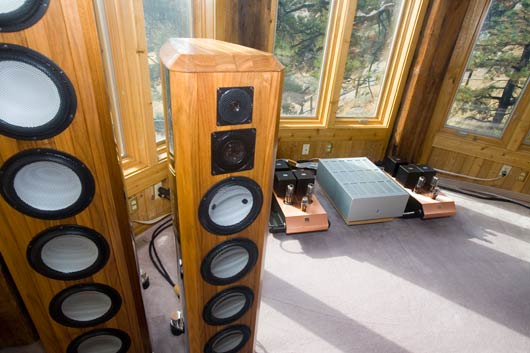
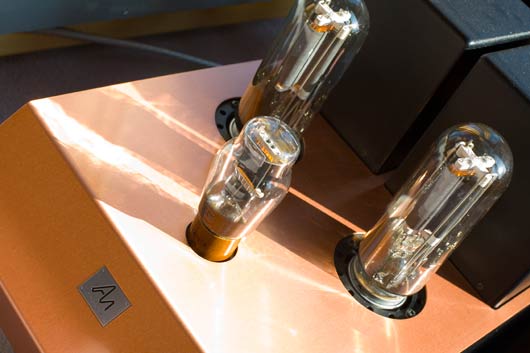
We put the Audio Note Gaku-On amps on the Marten Coltrane Supremes. And we had a few extra Nordost ODIN cables we put on the amps [I did not trust myself to put them on the pre-amp at the same time]. With the Emm Labs XDS1 CD/SACD player there was an amazing amount of separation – both dynamically and spatially. We then hooked up the S9 step-up transformer to the Brinkmann Balance turntable with an old Lyra Titan cartridge.

It has made me re-evaluate the assumption that real dynamics could only be [best be] gotten from a horn speaker.

Almost all of our equipment lately has gone to improving dynamics – and at the Same Time increasing the delivery of uber resolution and clarity to the Supremes – which can handle everything we throw at it [try to name one other speaker that can do that. It sucks but that is where our industry is at: it costs $300K just to be able to forget about the speaker being the primary limitation of your system. …though we would like to try the Marten Momentos… and they are only $150K :-)].

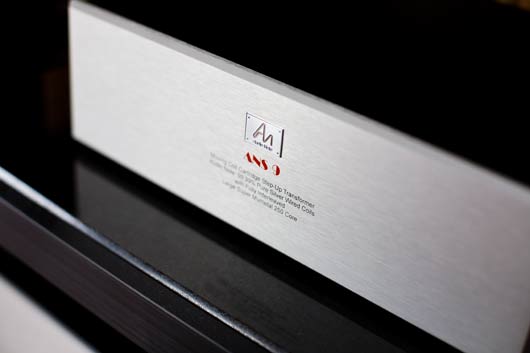
And, personally, I think the improvement of the S9 step-up over the S4 that we have been using is head-spinningly silly amazing. We will be doing some tests shortly to verify this – for other reasons too annoying to disturb our fine readers about.


The Marten Coltrane Supremes in the foreground, the Gaku-Ons in the background.


Audio Note U.K. Gaku-On


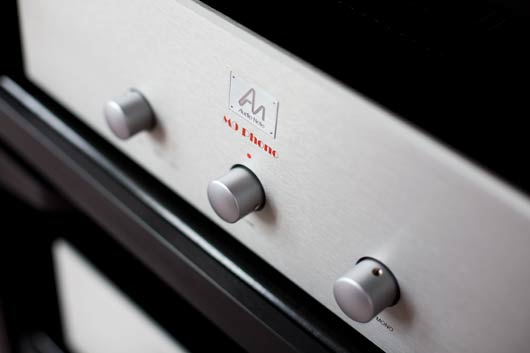
Audio Note U.K. M9 Phono – a preamplifier with a built-in phono stage.


Audio Note U.K. S9 step-up transformer

More RMAF…

Random thoughts here… but silly to wait 2 weeks until report is done.

I thought the Accuphase amps on the Hansen speakers worked pretty well. As you all may know, Accuphase has a particular flavor of sweet and laid back kind of sound. This sound is up there with the CAT 150 watt tube amp sound on the Hansens. The CAT is another laid back, albeit very neutral amp sound.

The other amps we have heard on the Hansens: Boulder and BAT [solid-state if I remember correctly] just sounded etchy and like someone was poking me with a knitting needle: some notes would rise too rapidly, and be jagged at the tops, and other notes just about disappeared.

Yes, I am sure we would all like to hear the Hansens with other amps someday and 1) see if they were able to drive them and 2) if the sound was kick butt or not. The mixibitors would rush around at midnight and try the: big Audio Note like the Gaku-On and big Joule Electra which would both be very interesting. The MBL and even the FM Acoustics would be interesting.

Our Show Report(s)

The Show Report is splitting into 2 reports. The main RMAF 2009 Show report is on Spintricity. We will not talk about sound there for the reasons stated there.

Our readers here we expect are more interested in the hardcore technical description of the sound – and we will post that here in this blog.

For example the Wadia room system. To force listeners to listen off-axis the Dynaudio apparently put the speaker’s tweeter close to the floor. Since I took photos crouching in the front of the system, and then sat front row almost center [it had an interesting sound that peeked my curiosity] it worked for me. In a in-home situation, most people who listen from a sweet spot will have the tweeters in their sight which is all that is required for this design to work. In the few minutes I had I was not able to figure out what it was about this system that I thought might be worth investigating further. It was certainly a soft, and digititus-free sound [which does not mean it was analog-sounding]. Maybe they just removed all the frequencies above 3000Hz – but I did not think so at the time. It seemed to have good separation, and controlled midi-dynamics – typically uncharacteristic of solid-state sound. Guess I should wait until I get to the photos again and then we can talk more about this room.

We will also talk about our room, of course. It was quite an experience!