
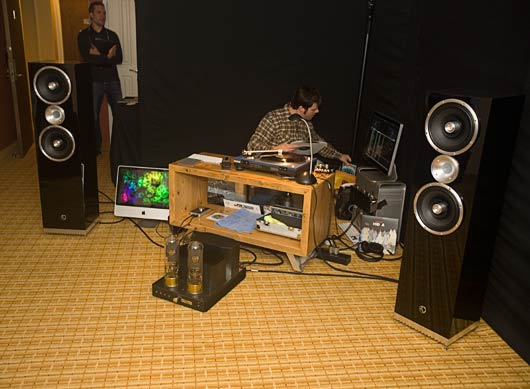
The Zu Audio room had an innovative setup, kind of a club-like DJ effect. I think Steve Rochlin looks cool, but these guys ARE cool [at least from the point of view of this geeky audiophile :-)]
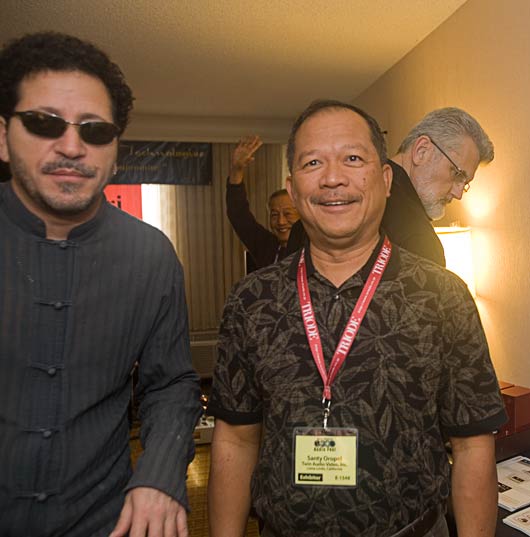
Walking in to the Acoustic Zen / Tri room, we see our good friend Santy (Tri) [who is looking at me, not the camera – I shot this photo gunfighter style from waist high], Steven Rochlin (Enjoy the Music) looking very, very cool, and the wonderful and wizard-like Robert Lee (Acoustic Zen) waving to us from the rear.
ONEDOF makes a turntable, which debuted last RMAF and is produced here in Denver. It lists for $150,000.
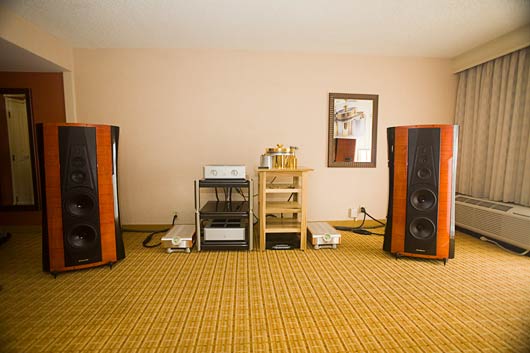
I listened intently to this system to try and hear what the turntable was doing – what it sounded like. Considering that, for example, how hard it is to tell the difference between a 6C33C-based Lamm ML2.1 amp and a 211-based Audio Note Ongaku integrated on the Sonus Faber Stradivarius speakers [our customer could hear no difference and Neli had to struggle to hear a difference] I think these wonderful sounding speakers are not the most revealing speakers in the world. The other components were perhaps not the most revealing either and, cutting to the quick, I could not hear the particular sonic characteristics of this, what could be really great, turntable.
That said, I took a lot of photos while I was there 🙂
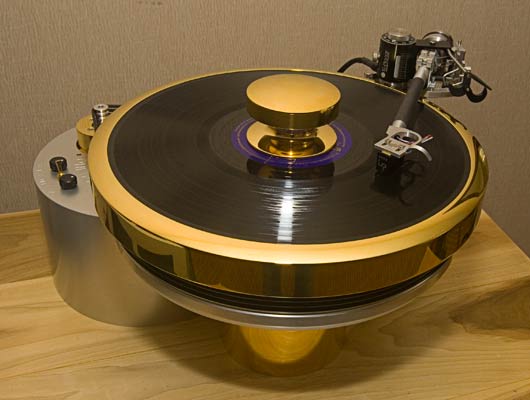
That gold metal is…uh… real gold.
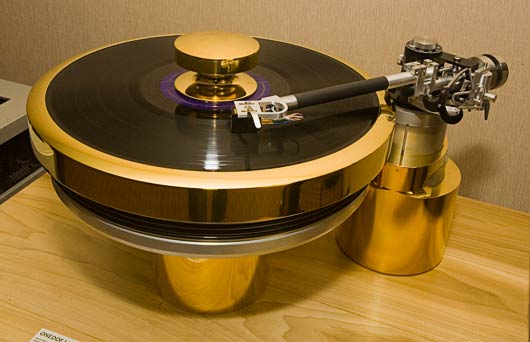

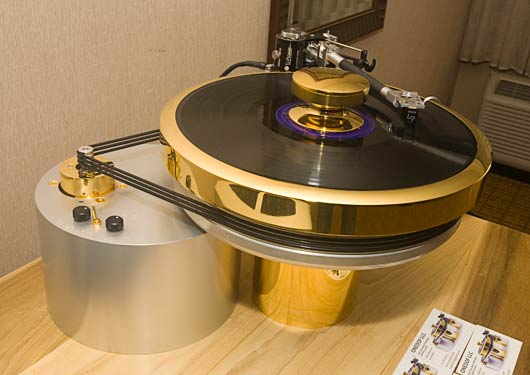
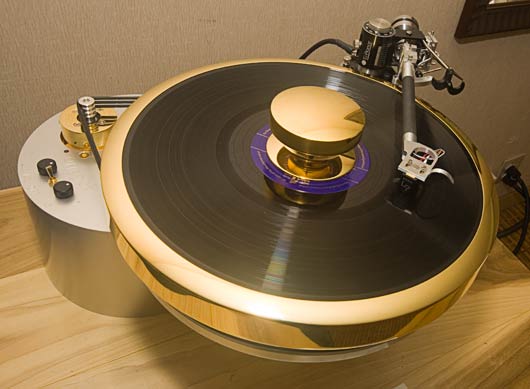
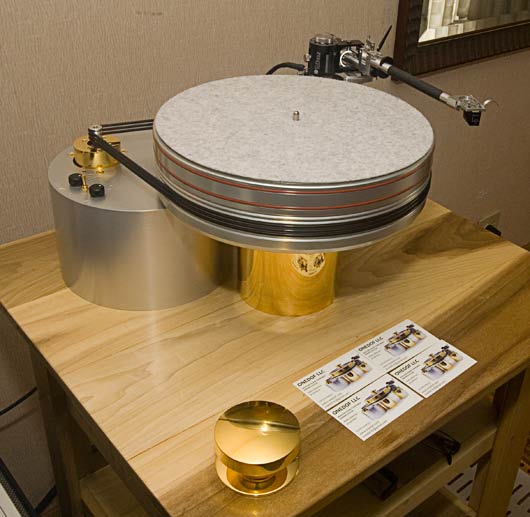
The record is held down by a clamp and a very substantial ring.
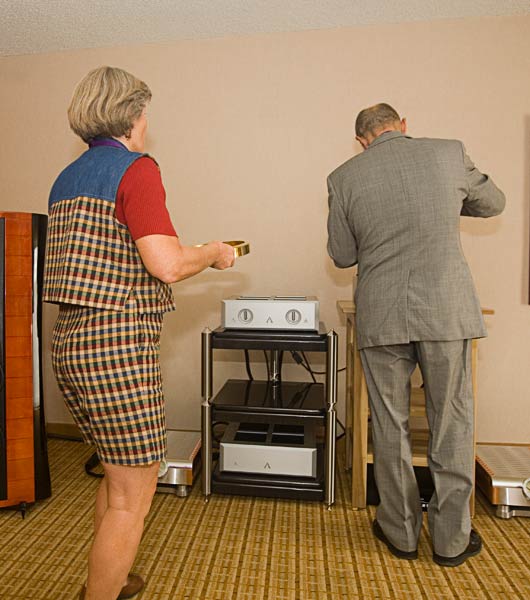
The ring picked up some fingerprints, so they wiped them off – but fingerprints are kind of just going to be on a turntable ring while you are actually using the table [between playing session one could presumably polish it so that it looks perfect when not in use].
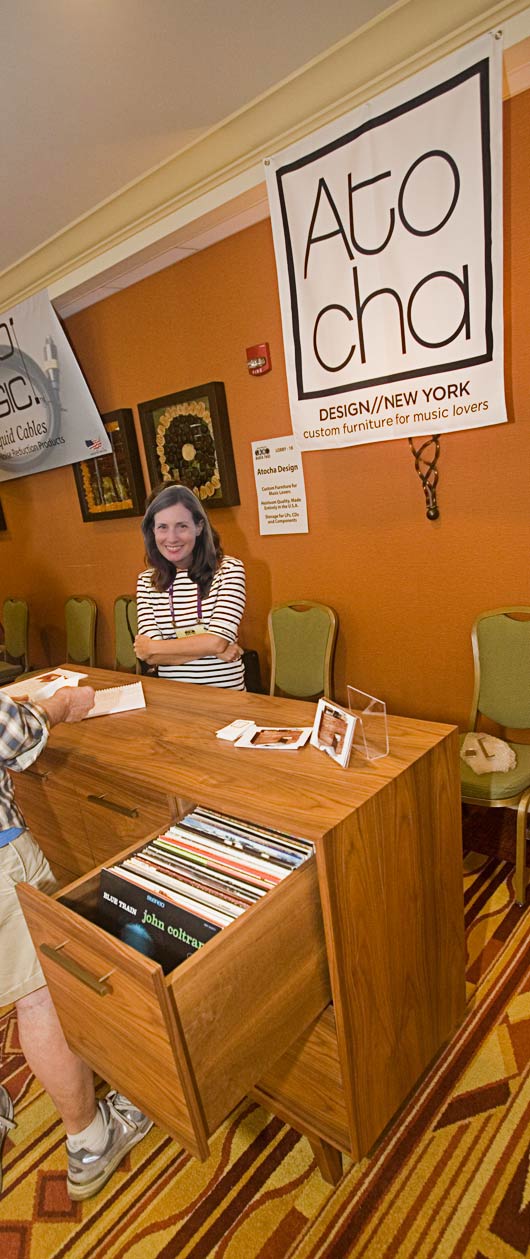
A nice approach to LP storage. At least one of our little group of site-seers wanted this BAD.
I think the woman behind the counter is ready for the show to be over [which it was 2 or 3 hours later].
This photo actually features a less tired Jenn (Atocha) [Hi Jenn!]. We do try to post reasonable facsimiles of people in these photos :-).
Unfortunately, our room never did get to where we wanted it this year. It wasn’t because a piece or two of equipment was brand new or anything, it was because we just didn’t get it setup optimally in the 4-days we were adjusting and adjusting and adjusting it.
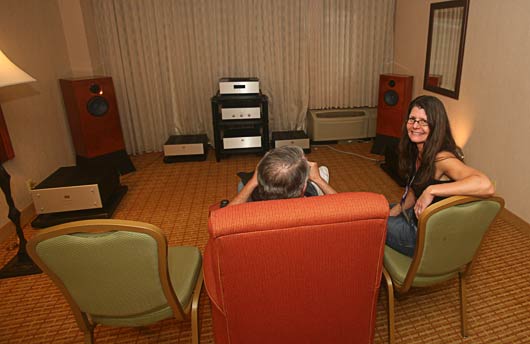
Neli early afternoon Sunday, the last day of the show
AN/E SEC Signature speakers
Kegon Balanced monoblock amps
M9 Phono preamplifier
Fifth Element DAC and Fifth Force power supply
CDT-5 transport
SOTTO and PALLAS cabling
Sogon power cords
When we picked the room, we were fully intending on showing a system like last year: The new Marten Coltrane 2 speakers, The Audio Note Ongaku integrated amp, Nordost ODIN cables, and the Emm Labs XDS1 CD/SACD player.
But we had shown Marten 5 of the last 6 shows, Nordost 6 of the last 6, and Emm Labs also 5 of the last 6, I believe. Over the course of the year, we decided to show the Audio Note speakers instead (last time we showed them it was in our large suite that we used to have at these shows). Which soon became a 100% AN system. And, somehow, we [or at least I] thought that the room we had picked had real corners, so that the speakers would really work the way it is supposed to. Corners do not matter for the Marten speaker but they really do for the Audio Note [much more later]. I know we did discuss which rooms had corners and which had air conditioners and conduits in the corners – and for some reason I thought only rooms that faced the atrium had air conditioners and well, wishful thinking I guess.
Oh well.
Oh, and before I forget – the small rooms in the tower are better than the small rooms on floors 4 and 5. They appear to have more solid walls, to be slightly larger, and the carpet is thicker, the hallways wider and the carpet thicker out there as well. In other words, they are more isolated from external noises – aka other exhibit rooms – than the rooms on floors 4 and 5. So maybe next year, if we show again at RMAF, we will get a tower room.
Anyway the next 4 days became an object lesson about how small movements of a speaker affect the sound of AN speakers [usually we move the speakers AND adjust the cabling and power cords to get the sound to where we want, but we wanted to keep this a 100% Audio Note system. We all setup little goals in life and this was ours last week].
We set the speakers equidistant from the sweet spot and at 45 degree angles to the corners – such as they were – a foot or so behind the speakers – to optimize bass response and listened. It was a little hard and bright on some passages so we toed them in a few times ending at about a 1/2 inch more toed in and we got highres, emotional, tuneful music. The reason for the large toe-in is that Audio Note speakers are designed to sit right smack tight in the corners, horn-loading the corner and using the corner itself as part of the speaker to increase bass response and room engagement [and other frequencies as well, like a megaphone or cupping your hands in front of your mouth like a little horn to increase the SPL of your voice].
This was pretty much the setup the first day.
Problem was that, although there was lots of bass during passages that had bass, the overall presentation was somewhat lean. The midrange was not getting that ‘full’ sound that comes with having bass even when bass notes are not being played. We were just too far from the corners.
So that night [or the morning the next day – hard to remember, except that we did it when no people were there to see us huffing and puffing with these little speakers :-)], we tried moving one speaker, the left side, which was about an inch or two from the sidewall, to sit directly against the wall – to get a fuller sound.
Hmmm…. now the left side was noticeably louder than the right – not just in the bass, but just about all frequencies were louder. The corner it was sitting in was a less deformed corner than the right side’s corner.
So we decide to bring them forward some to get them away from the corners so that the left side would see a corner more like the right side, so both sides would have somewhat similar freq responses to each other. And somewhere in here Neli mentions that Peter Qvortrup, of Audio Note, had suggested we move the speakers forward some. You know, sometimes spouses are the slightest bit annoying. So we go back and forth about how much to move them forward, and Neli decides from one boldish yellowish strip to the next, or about 4 inches [everything on these carpets is easy aligned by watching where the stripes are. VERY convenient]. Me, I do not care how much forward we move them, I think we just need to move them and see if it gets better or worse and in what manner it does this.
After the move it sounds like the SPL have actually increased [even though it is further from the corner], and the speakers are back to performing their usual disappearing act.
But we still weren’t getting as much of that ‘full sound’ as we were hoping for.
Now for a slight digression.
Something has to go between the speakers and the speaker stand. We often use HRS Nimbus Couplers, flexible custom polymer ‘cookies’ that are made to channel vibrations between 2 solid objects. This allows us to 1) easily adjust the orientation of the speaker [a towel between speaker and stand works wonders here too] and 2) optimize the amount of observed resolution at the listening positions. Both Audio Note and HRS do not really recommend this [AN thinks it is detrimental and HRS thinks it is unpredictable – depending on the speaker design characteristics]. But hey, at least some of us Americans are still bad at following rules and like to think for ourselves, experimenting with all sorts of stuff [and not just the economy :-)] to see just what happens.
So, kind of in that spirit, and because we were kind of desperate, we decided to try following the recommended procedure in this case and use Blu Tak [kind of like blue Silly Putty, or clay] between the speaker and speaker stand.
Definitely different.
Essentially more dynamic, more immediacy and more PRaT. More exciting.
There was also, as expected, less resolution [Peter Qvortrup thinks there is just less energy in that region of the frequency band, that the frequency response is now more flat, more linear, more accurate.] Maybe PQ is right, but we like our resolution, helps prevent a hardness in the sound – especially during notes like an opera singer belting out a high note, or a guitar player smacking a high note – very high resolution helps break up those notes from being a solid hammer on the ear drum to become multiple shades of harmonics that the ear can process comfortably, in fact even pleasurably 🙂
OK. So we put HRS Nimbus under the preamp and DAC power supplies [we did not have enough on the first day to do this] and we adjust the speakers toe in again and again – trying to get the resolution as high as possible. We KNOW it is there right? We know it is getting to the speakers and we know the speakers can reproduce it. We are still orienting the speakers around the 45 degree angle, pointing somewhat directly away from the corners of the room, such as they are. We are only partially successful at this but overall the sound is better after these changes and we leave it in this configuration on Saturday and most of Sunday.
Well, Sunday was slow. Sunday mornings are always slow. And it doesn’t get that much better later, peaking around noon or 1 pm (the show closes at 4pm). Not so much because of people going to church but because of Football [esp. if the Broncos are playing] . At least, that’s what I think, living here outside Denver for several decades now.
So, eventually, we get bored.
Earlier Sunday morning Neli and Peter were having coffee and I was watching them drink it [I’m not a coffee drinker, though I love the aroma] and we were all talking and he sketched out a diagram showing how orienting the speakers differently can take advantage of the 1st reflections off of the side walls to augment the perceived SPL of the midrange frequencies. [we have not seen this in the manual or on the websites, and will write this up in a different post so it is more easily Googleable]. The basic idea is that if the sound from the 1st points of reflection arrive no later than 2.7ms (or 3.2ms – not sure here) then the ear will not be able to detect a difference between the two. In this way the speaker will appear to be more powerful than it really is.
Cool huh?
So I manhandle the speakers on the Blu Tak, without moving the speaker stands, so that they no longer cross in front of the sweet spot and in fact look like more normal positions. The 4 corners of the speakers are kind of hanging off the stands and I am not sure all the blutak is in place – but we only have an hour or two left to the show and visitors come in and leave quickly, not really listening, as they approach warp speed trying to see everything they did not get to in the previous 2.5 days.
I hadn’t talked to Neli about this first, and was hunkered down for the possible sh*t storm for seriously mucking with things in the middle of a show day – but she was apparently preoccupied with those business-like tasks that make it so we can eat next week – because I am still alive to tell the tale and able to write this report … 🙂
After this adjustment of the speaker orientation, the midrange frequencies were indeed boosted some, the SPLs increased yet again, and we did get an increase in resolution. The sweet spot no longer worked, however, being now either too close to the front of the room or something because the speakers no longer disappeared from that position. ‘Course the speakers were not exactly symmetrical 🙂 and, whatever, the show was over and we were tired and it was time to go home.
——————–
Every room is different, but I personally like to have a number of arrows in my quiver that have some kind of predictable behavior, so that if we run in a problem, say X, we know that we can try A, B and C to try to ameliorate the problem.
Not only that but I like to understand in what circumstances the darn arrows work, and do not work, to the point of being able to describe them to other people [do you know how RARE this is? to actually understand something well enough to describe it? Schools these days just teach people by rote, to follow little rules blindly]. And, finally, to document them, so that other people can use them too. Can’t but imagine this would be useful to other people besides us.
To that end we will try and setup a Toolbox category here on the blog, or on the website, where we document how to go from sound point A to sound point B [there will no doubt be many ways, some expensive, some free (yes, you might want to try the free ones first)] and not just with respect to Audio Note and Audio Note speakers, but cabling and vibration control and all the rest.
The Highwater Sound room had a few interesting things. The Cessaro speakers, for one.
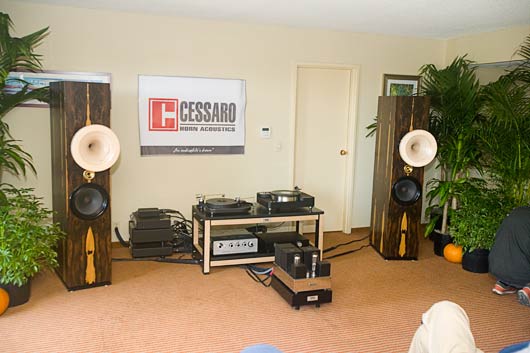
Unfortunately, I think the speakers may have been too close to the front wall, creating a bass overhang, detracting from, and sounding distinctly distinct from, the immediacy of the horn midrange. We have heard these before and at that time bass integration was not an issue.
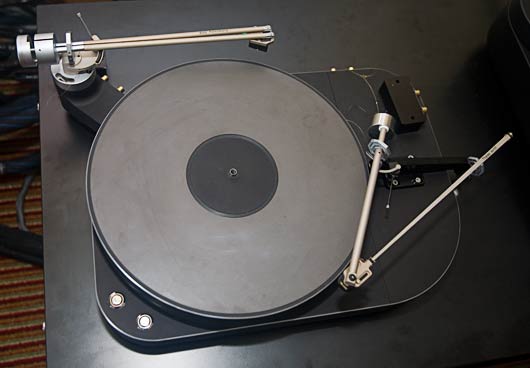
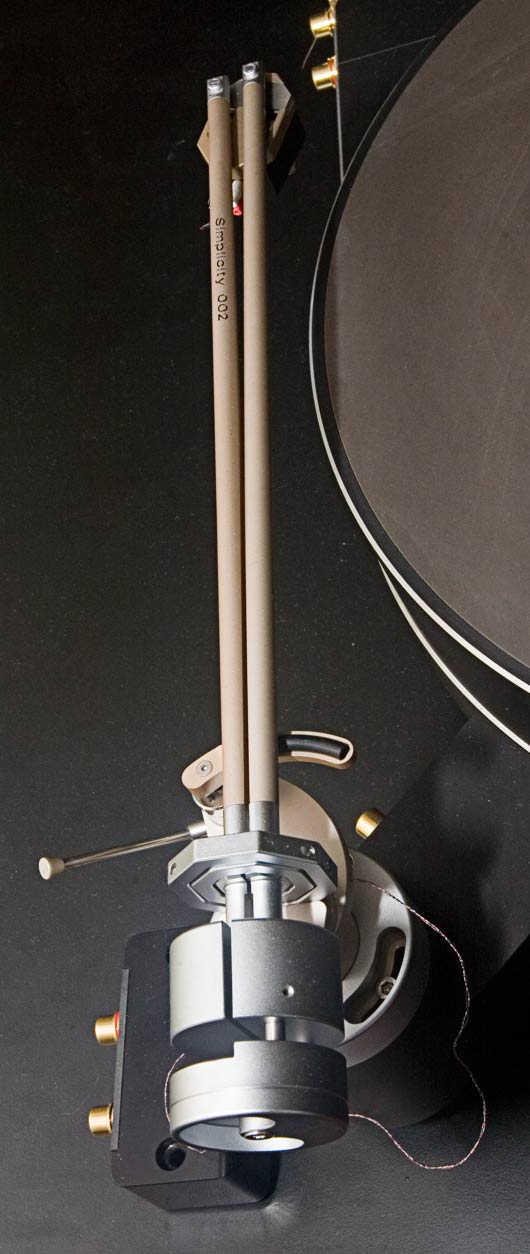
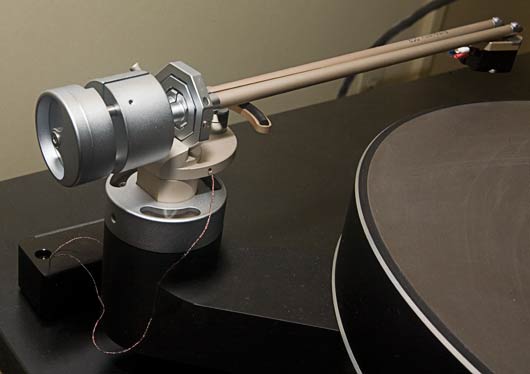
They also featured a couple of different Thales (pronounced ‘Tallas’) tonearms that are so innovative – the convenience of a pivoting tonearm with the hopefully more accurate and more better sounding linear tracking cartridge (i.e. the cartridge is aligned with the grooves, similar to the lathe that made the grooves in the first place).
The first tonearm, below, the Simplicity, is quite new. The second, more expensive one below that, debuted a few years ago [it looks like it is now much more robust in its current configuration]. Both are on a Thales turntable.
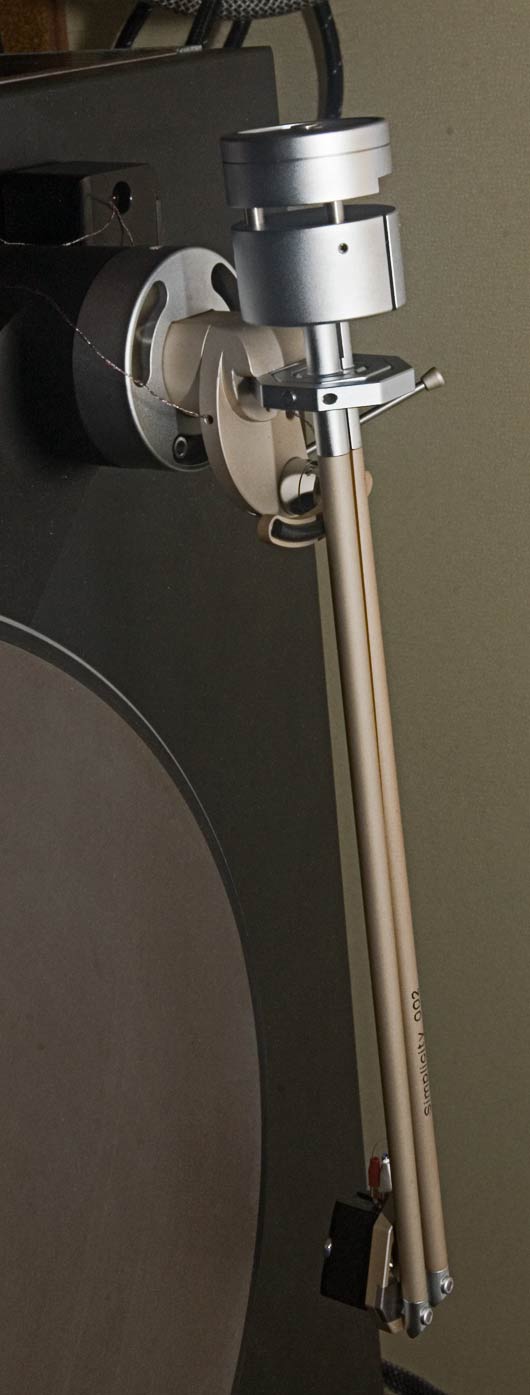
How this actually works … ?

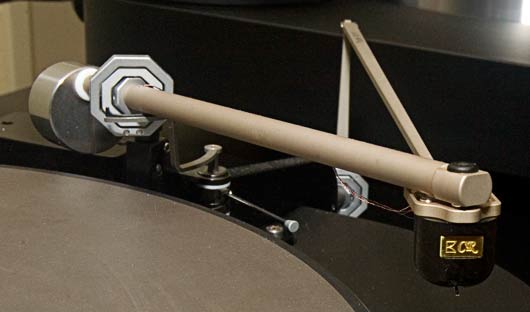
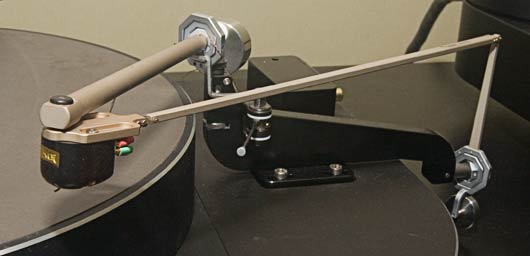
After spending this show across the hall from the D’Agostino room (Krell++ on Wilson) and listening to a steady thumb Thump THUMP for a few days, I think we’ve come up with another way to organize show rooms:
They should put all the rooms that will play opera near each other (all one or two of us). And all those that will play techno (again all one or two rooms). All those that will play Diana Krall and Patricia Barber together (a lot of these). And a few rooms will be in the classical section.
And a few rare rooms in the ‘we will play anything’ category.
And so on…
And, finally to put all the ‘thumpers’ together. 😉
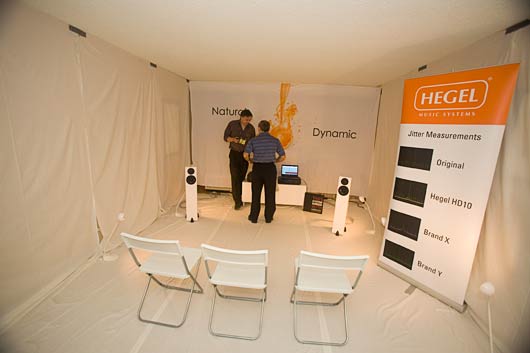
The White Room (Hegel)
White and more white, even on the floor.
Kind of a sensory deprivation room – it affected me in several ways:
1. Forced me to focus more on the sound, as my eyeballs had much less to do than normal.
2. Disoriented me, in that there was much less information telling my woefully tired brain which way was up (i.e. horizon information) – so I was a little more wobbly on my feet and had to think more about which way was straight down (paying more attention to gravity)
It was just really weird, man 🙂 We’ve all probably been in near pitch black rooms and listened to music. Or just closed our eyes. This was like that but with the eyes wide open.
This made me think of how I would rank all the things I could be looking at while I listen to music [which would actually add to – not distract from – the enjoyment of the music]
My Favorite Front Wall Views
1. The Ocean with various islands in the distance [i.e. Hawaii at about a 100+ foot elevation]
2. Waves breaking over rocks/onto a beach
3. Our current trees and cityscape view
4. Nature
5. 100% whiteness
Yeah, so I liked this room’s setting a lot.
When we think of where to move, I fantasize about the places that combine the 1st three views into one 😉
What I think I prefer least is (just my opinion):
* A painting (I just get tired of string at the same thing all the time. I have thought and thought about this as I have gone to art galleries for decades. Side walls of the room is fine)
* LPs (I love looking at LPs – but I like them on the sides of the room, looking directly at them reminds me of other music I could be listening to instead)
* A stupid tiny little window (sorry, but I have lived in too many basements with too many stupid tiny dirty spidery windows)
* Rock posters (makes the most sense, perhaps, but the reading part of the brain would read them over and over…)
What I do not know if I would really like or not:
* A giant aquarium (in college I used to stare into an aquarium and play LPs – or rather visa-versa :-))
* A giant fire (in a fire place, silly :-))
* Various seamless natural wood or polished stone walls (don’t know if my pattern-finding part of the brain would not be able to stop finding patterns in the wood/stone, detracting from finding patterns in the music)
——-
Oh, and the sound in this room was typical Hegel: more tuneful than average, and with average amounts of dynamics and resolution and continuousness etc, for their price range.
There is no spoon… I mean… Best of Show.
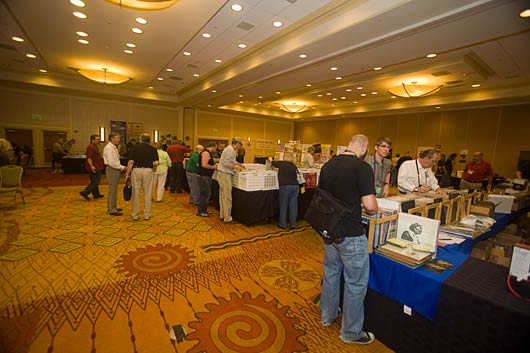
The Best of Show, if there were to be a best of show this year, was the music vendor room. That carnal lust for more music – that almost irresistible gravitational field sucking me in, making me start leafing through albums was only resisted by walking very quickly past the booths without looking close enough to see the objects of my desire . It was the room where, if we had any room here at all for more LPs, I would have done some real serious damage to the wallet.
Otherwise, there wasn’t really anything I thought really kicked butt, although there were several interesting things that I think made the show very worthwhile for me, anyway, and maybe some of you will think they are pretty cool too. I’ll talk about them in the next few posts.
Traffic/attendance was – experientially – about 10-20% down from last year [although having the new d’Agostino (Krell-founder) amp playing subwoofer rich music extremely loud with the door open a lot probably scared away a lot of people. Sometimes you get good neighbors at these shows – and sometimes not.
Exhibitors seemed more stressed out, attendees seemed more relaxed this show compared with last year.
A LOT of systems were downsized this year – Magico, Evolution Acoustics, Audio Limits, IsoMike, etc. and put even more distance between the state-of-the-art and the average system at this show [not being known for debuting state-of-the-art systems in the first place].
What really set this show apart from the previous years, I think, was that a lot of CES-only diehards finally broke down and attended / exhibited at this show this year [you all know who you are :-)].
Well, that’s ’bout it. Not much to say this year. [yes, we are DEFINITELY looking to spend our efforts on other, up-and-coming shows (Dagogo, Newport, Toronto) next year. ]
On to the more interesting rooms…
It is nice to sleep in one’s bed every night but the commuting to the show from home everyday means we spend 6 hours driving [an hour there, and hour back, times 3 days] while other people sleep, or play music, or talk about music or gear. Not sure we made the best decision here.
Anyway, it was fun and lots more tomorrow. 🙂
