Pursuing the Ultimate Music Experiences

Audio Federation High-Fidelity Audio Blog

Rigged. Corrupt. A Joke. Olympic Ice Skating: Sochi 2014

For many this is now obvious after the women’s single ice skating competition.

After seeing the rigged doubles ice dancing competition a few days ago, and the “very, very, VERY generous” scoring of the single’s short program yesterday – today’s competition was unwatchable. I mean, it is just so embarrassing – I personally could not stand to win something like a gold medal this way.

After seeing how the judges scored the Canadians Kaitlyn Weaver and Andrew Poje doing their long program two days ago – it became obvious the technique the judges were using to pump up who they had agreed would win. Essentially: take every opportunity to deduct points from the scores of the potential serious competitors and be very, very generous when scoring the person that is ‘going to win’.

[ I think the results for the couples ice dancing should have been more like:

1. Kaitlyn Weaver and Andrew Poje (Canadian)
2. Ekaterina Bobrova and Dmitri Soloview (Russian)
3 (or 4) Meryl Davis, Charlie White (USA)

and for the women singles ice skating:

1. Yuna Kim (Korea)
2. Carolina Kostner (Italy)
3. ?
]

There does seem to be some hullabaloo now about the rigging of the singles competition [the Toronto Star says it was a collusion between the US and Russian judges, helping give each ‘firsts’ for gold medals in these respective competitions]. The singles competition was broadcast during prime time tonight, so everybody got to see how rigged it was. Big mistake, guys.

But the doubles ice dancing was just as bad – it was just that the top two couples where not shown during prime time (they were shown in the afternoon on a NBC subsidiary channel) – so not as many people caught on to the corruption. [Sneaky huh? :-)]

How does this relate to high-end audio? [there are no competitions this important, no where near this important, in high-end audio. So any collusion to pump up a brand or product is kind of swamped by the competition doing the same thing for another brand or product].

It relates in this way….

One of the ways I used to verify to myself that the couples I thought were best really were best [besides just rewinding TiVo :-)] was to watch the skaters in slow-mo [as NBC showed us after each couple skated] and to look at still photographs. The couples I thought were best looked like they were performing magic, even when frozen in a photo – the winners like they were working out in our gym [lots of grimaces, shaking muscles, visible preparation and deep breaths before they made a large movements, etc. ]

I would include photos but I fear the Olympic Committee and NBC would send a nuke out our direction if we did.

Is there a way for us to evaluate the sound of a hifi in this way? You know, in addition to listening?

1. J.A. obviously thinks his technical measurement graphs do this – and they do to some extent, the precise degree however being up for debate.

2. One can get some mileage with the ‘listening from the hall or another room’ approach, which can show up timbre and even dynamic problems.

3. A 5 seconds or longer clip of a passage of a song might be interesting, like a photo, and reveal enough about the sound of a system. I.E. if this clip includes a vocal [naturalness, timbre, emotion], a dynamic percussive impulse [macro-dynamics, decay], violins or something requiring resolution to render correctly [resolution, duh], and lots of stuff going on in the background [separation, ability to handle complexity] – then 5 seconds should be all that it takes.

4. Spectral graph? I know people are using these to find 16x44kHz mascarading as 24x92kHz. Can they tell us anything else?

Anyway, it is up to us, the crowd, to police the powers that be to keep things on the up and up. Or at least scream when we see it is not.

Price Performance in High-end Audio (and elsewhere)


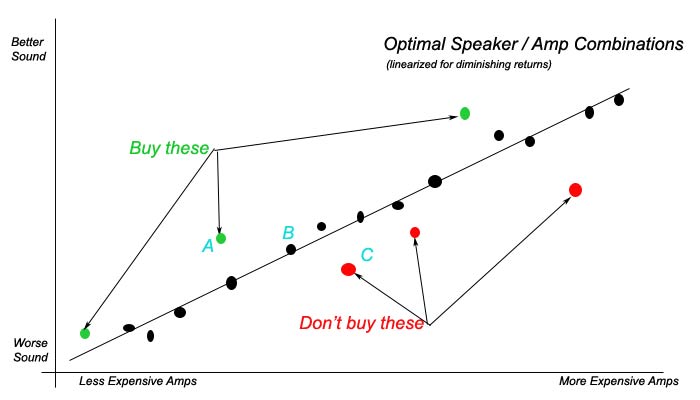
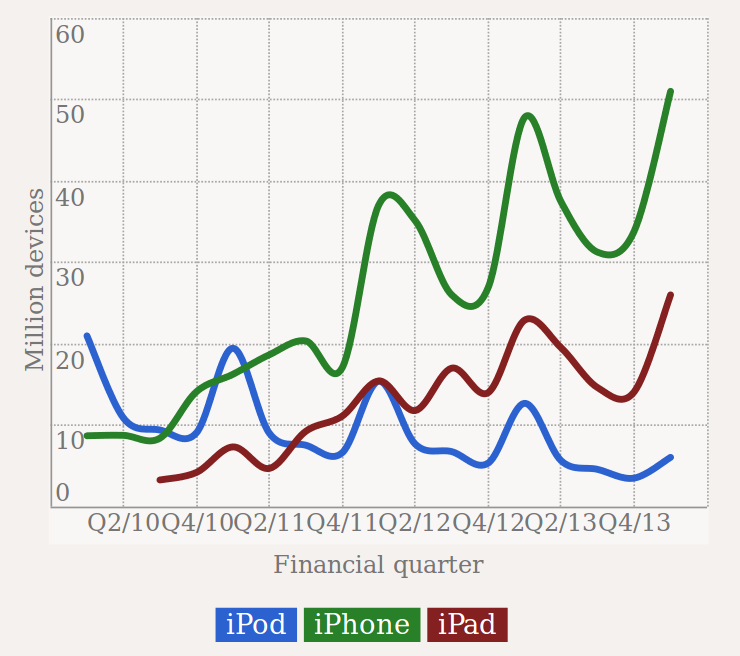
What this graph shows, is that, for a given speaker, different amps provide various degrees of sound quality.

The more expensive the amp, the better the sound quality… on average… and that adjusting for diminishing returns (paying twice as much does not usually result in twice the sound quality), most amps perform more or less where they should based on their price [i.e. their performance point lies on the ‘line’ which represents average performance for a given cost.].

But, as you can see, some amps under-perform at the price point [for this one hypothetical speaker] and others over-perform. Assuming you are not loony tunes – you will probably want to spend your hard-earned dolluhs on one of the over-performing amps. Or at least on one of the average performing amps.

Note that what we are showing here is a graph that says performance is directly related to sound quality. For many people, there are other things that they consider when buying an amp. Things such as appearance, provenance, brand, resale value, marketing slogans, discounts, technology, social network buzz, maintenance requirements, and other such things unrelated to sound quality.

Another thing which attracts peoples attention away from the basic truth of graphs like this, which is applicable in many other domains besides high-end audio, is the relationship between amps A, B, and C. This rare but real anomaly [and originator of so many conspiracy theories and misinterpretations about the way capitalism works], is where A is less expensive than B, and B less expensive than C, yet A outperforms them both. In this contrived example, the manufacturer of A has made a mistake [possibly on purpose if they are altruistic] and under-priced their amp and manufacturer of C has over-priced it [definitely on purpose]. The manufacturer of B has priced their amp just right.

Many people who cycle through amp after amp after amp, all they are looking for is an over-performing amp in the ‘A’ position, or maybe even in the ‘B’ position if ‘C’ is very popular. It makes them feel so good to have an over-preforming amp [or other over-performing component] that they spend [lose] $10’s of thousands in buying and selling amps just to find this particular one. Of course, in a perfect world, dealers and the press should be pointing out these over-performers so they would not have to waste all this money and time [and Mike Fremer does do this in turntable land] but it is almost unheard of them to do so – perhaps because they do not hear a lot of the candidates in a particular market segment to get a feel for where that average price-performance line is, or, unfortunately, because they cannot understand and categorize what they are hearing in a quantitative way.

The concept of this graph was brought up in the comments a little while ago, and we may continue to explore this graph, as we did in those comments, to nail down other component to component relationships that are kind of murky.

The Good, the Bad, the Ugly… which wins in high-end audio?

Meet the Good. Good sound with or without excellent marketing and dealer penetration.

Meet the Bad. Bad sounding. Typically has excellent marketing and dealer penetration [otherwise very few are sold – those being sold usually based on some amount of trust and personal connection the manufacturer is able to generate].

Meet the Ugly. Typically mediocre sounding. Sales are often based on any uniqueness of their technology and the desire of some people to stand out from the crowd.

Previous posts here have argued that audiophiles, unlike the general public, do not have good sound at the top of their list of requirements. That they do not ACTIVELY pursue good sound.

This post will continue that argument by suggesting, however, that audiophiles are passively interested in good sound. That good sound wins out in the end.

I would guestimate that about 80% of the gear in a typical street-corner dealership is Bad. [I wonder if this is just me being cynical or whether there is a general consensus that this percentage is just about right. Maybe I am optimistic here?].

But most of this Bad used to be competitive in its heyday and was actually Good. That the Bad is using the money and dealer network and goodwill it made from being Good and is just slaking off and becoming insipid and decadent and draining off the lifeforce of the hobby.

Then there is the gear that was Born Bad. No heyday. They just pushed themselves into the marketplace and dealer networks through force of will and lots of dollahs [a LOT more than a fistfull… ;-)]. Some of these that are Born Bad go on to evolve and improve and become at least much more sort of mediocre if not good [and successful. I am thinking of several of these. I think checking out an older Stereophile and its ads will feature many of these brands].

If the hypothesis is true, that audiophiles DO care about sound, only passively, then we should see the Bad die out, but verrrrry slowly [they would die out overnight if audiophiles were ACTIVELY pursuing Good sound, and immediately rejecting Bad sounding gear].

And this does seem to fit the facts. Look at how many major brands, that were perhaps quite a ways past their heyday and became, you know, Bad, have gone bankrupt and/or been bought out by Hedge Funds / Investment Groups.

We should see these brands get a little bump in life, perhaps becoming Born Again Bad, but if they are to survive they need to evolve and improve. Otherwise they will continue to decline, being passively rejected by audiophiles into obscurity [though there will always be some audiophiles who ONLY buy based on brand name and discounts. so it is only when these audiophiles die – not far off BTW – that some of these brands living off their heyday many decades ago will finally perish as well].

That is all well and, perhaps, a great theory about what is happening but why doesn’t Good just push Bad the heck out of the dealerships? You know, faster than geologic time?

Don’t know. Some product categories are just filled up by these brands that had their heyday come and go not leaving any floor space for the Good. Some, like Peachtree [which I consider to be pretty good], create a new product category and make their way into the dealerships that way. Others get their way onto the Stereophile Class A buying guide list and then elbow their way into a few dealerships.

There are so many Good out there that are Bad at business that dealerships are wise to stay away – these Good that are unethical kind of give a bad name to the other Good out there – scaring dealerships away from being bold and bringing lots of Good gear into their stores.

In the end, Good sound by brands with a decent to good sense of business [and hopefully ethics to go along with it] will rise to the top – it will just be so slow and only of benefit for the few of us who will still be alive [no, I am not depressed. No, we don’t really give a hoot that the Denver Broncos lost the Superbowl in such a pitiful and painful display. Just thinking we ain’t none of us getting any younger… that’s all…. 🙂 but thanks for all your condolences, anyway ;-/]

Lamm LP2.1 versus LP1 Signature phono preamplifiers – the mini shootout

predicatably
At CES 2014 in the larger Lamm Industries room, Vladimir switched between their new LP2.1 phono preamplifier and their also relatively new LP1 Signature preamplifier. The system was the Lamm ML3 amplifiers on the Verity Lohengrin speakers.


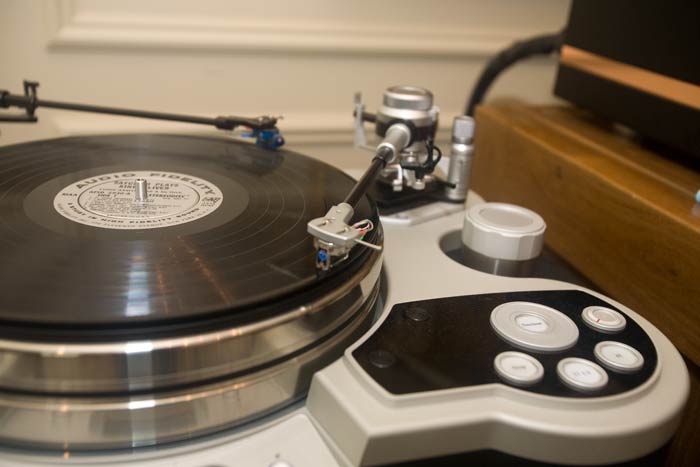
The source was the TechDAS turntable.


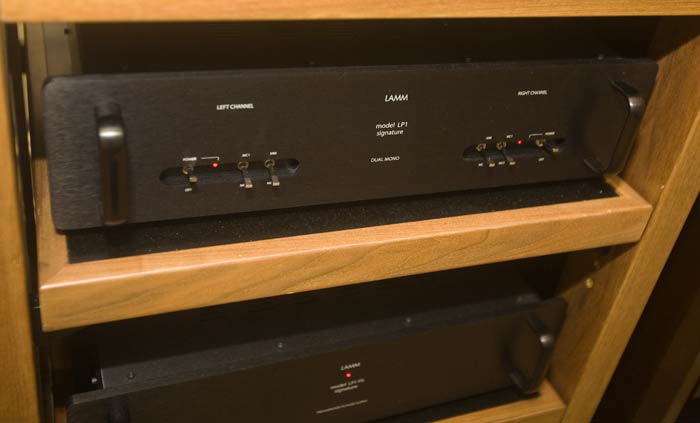
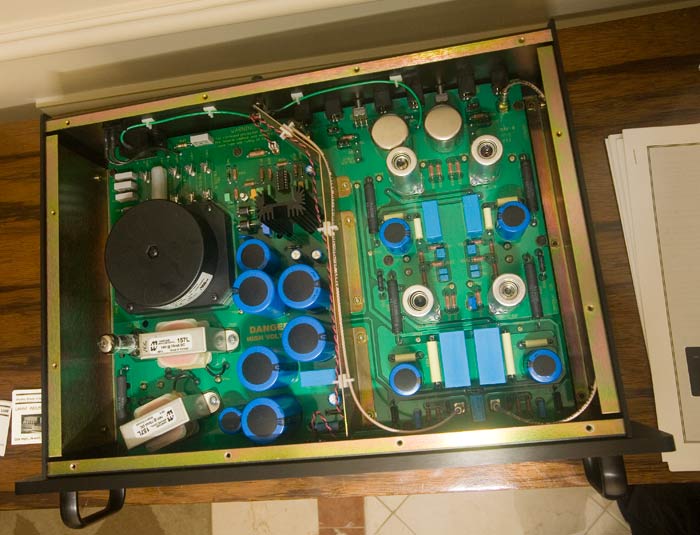
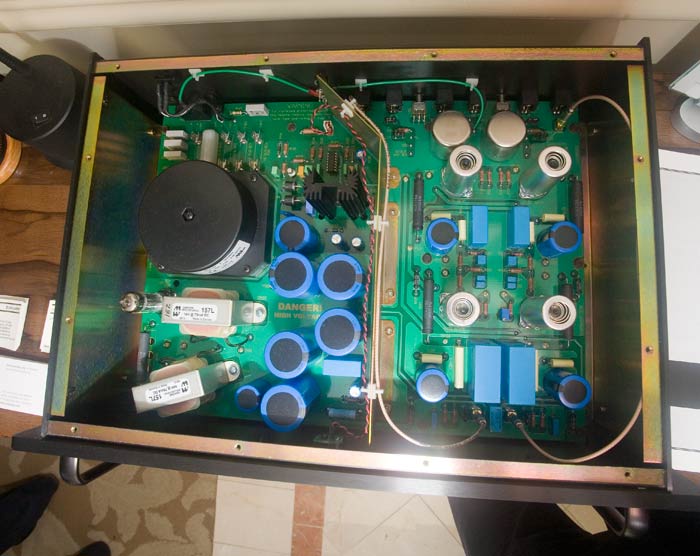
This is the main chassis of three [the other two being power supplies] of the Lamm LP1 Signature phono preamplifier


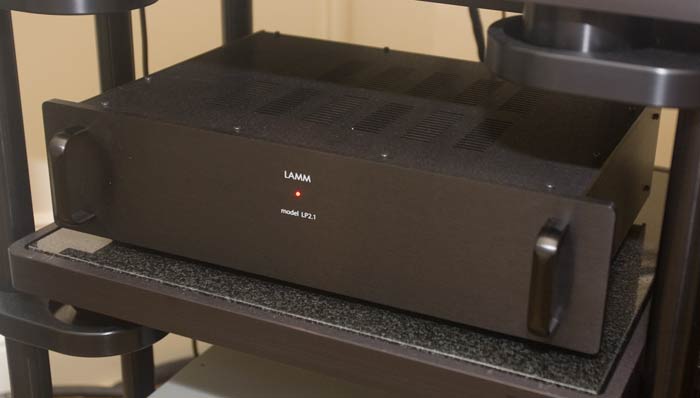
This is the new one box Lamm LP2.1 phono preamplifier

This is the transcript of what I write earlier in the CES 2013 show report:

“Vladimir Lamm swapped back and forth between the LP2.1 phono stage (which debuted this show. photos on the inside of the chassis are posted below and will also be posted on Ultimist) and the more expensive LP1 Signature phono stage, several times by using the two tonearms on the TechDAS at the same time [say what? this was fun]. With two very slightly different cartridges it was a little bit of a Fuji apples to Braeburn apples comparison, but the short and quick is that if you didn’t hear them back to back (the more expensive LP1 being smoother, less grainy, and just more of that good old analog wonderfulness) you would think you were already listening to the LP1 when it was in fact the less expensive LP2.1 all along (the original LP2 has been a giant killer among phono stages here at the Fed, at least until you get up into the $20-$30K range of the competition)”

As I have continued to reflect on what we heard, the LP2.1 still seems like an amazing value, albeit the LP1 Signature an obvious choice if you have the money to spend.

As most of the multifarious competition continues to charge more and more outrageous prices for mediocre performance, new high value phono preamplifiers take their place. And all the while, the predictably high value Lamm LP2, now LP2.1, from a well-known, well-reviewed brand, just keeps on providing excellent music for your audiophile dollar, with the LP1 Signature continuing this tradition up into the stratosphere of phono preamplifier performance space.

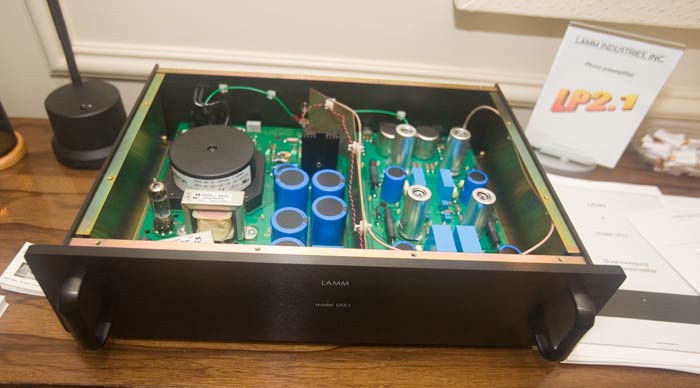
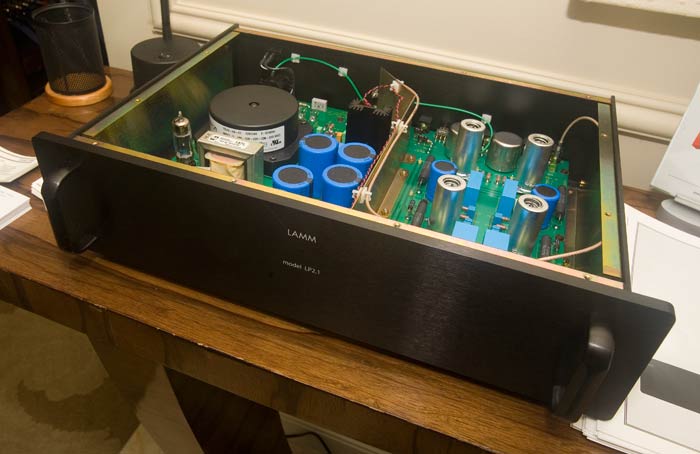
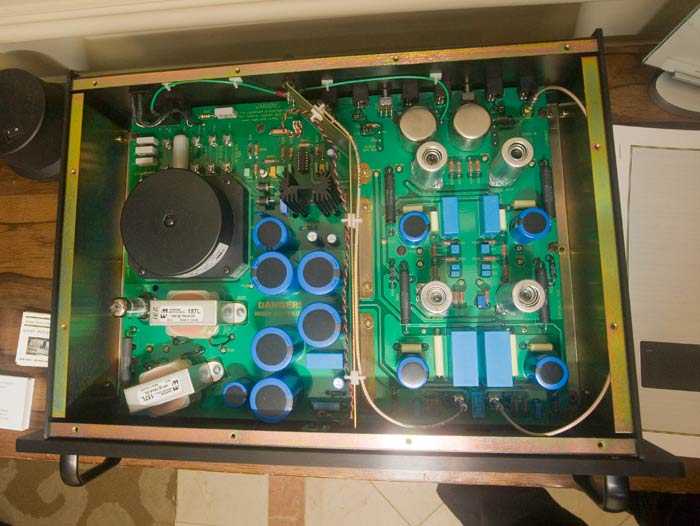
Below are some photos of the static display of the open chassis LP2.1. As usual, I couldn’t decide which was best, so I included several.

Optimal Speaker / Amp Combinations in History

[I’ve been thinking about a series of posts about how few audiophiles actually care about good sound.

It is certainly an ephemeral concept – and it is certainly hard to use written or spoken language to talk about in any kind of precise manner. So it is not too much of a surprise to find most of what passes for discussion, albeit coached in audiophile-ese, is not about the sound.

And it is not a surprise, that given the dearth and inability to talk about good sound – that the gear and systems people buy have little relation to what they would be buying if it was generally known what good sound actually was and how a person could go about getting it.

Finally, I think this is a real problem for the industry if it ever wants to make inroads to selling to the General Public. Unless the GP can be convinced that geeking out buying extremely expensive gear just because it is oh my gee whiz cool, or incessant arguing about nothings on forums which takes the place of pride and passion in our little hobby, is worth the price of admission i.e. dedicating a few years of all your spare time learning ill-defined audiophile-ese – then our little slice of heaven is just going to get smaller and smaller.

This is if you agree that M. and J. Q. Public generally just want good sound in their living room – and why wouldn’t they? – without a lot of fuss and bother.]

By some strange, wonderful and curious happenstance certain speakers work much better with certain amps than with other amps. This fact is largely, almost entirely, ignored by pundit and audiophile alike.

People pretty much pick amps for their speakers and speakers for their amps at, what is for all intents and purposes, random. They certainly do not pick them, these marriages of amp and speaker, these trysts, based on the quality of the resulting sound.

[Some manufacturers, to get around people putting random amplifiers on their speakers, often to horrific effect, offer their own line of amplifiers. Makes it easier for everyone. Although these are rarely optimal with respect to the actual sound quality they can set the bar tolerably high.]

This is not like human marriages where the couple has a chance to actually fall in love later in their marriage. This marriage of amp and speaker, if they do not love each other at first listen, they ain’t ever going to get the deed done. It is unchanging and final: it is like playing Russian Roulette with $10K bills and the gun is pointed at your ears.

In this game, people typically pick a cool lookin’ or hot or well-reviewed speaker and pair it with a cool lookin’ or hot or well-reviewed amp. Has to sound good, too, right?

Anyway it certainly is fun to experiment. Krell on Quad anyone?

It is awesomely fun, especially if you have a lot of time and money [and who doesn’t? ;-}]. But don’t kid yourself that it is about the sound.

Who cares if it is not about the sound? About how good it sounds? Does it really matter? Not everybody has to be a purist, right?

I think not many audiophiles really, truly care at all… but that the General Public does! The one thing high-end audio is supposed to do, Sound Good, is what the General Public may, if they so dare, poke around our neighborhood looking for.

But instead it is like going to an auto dealership and all you can find is people putting old Chevy engines in Toyota Camrys and talking about how cool it all is.

Yep.

Cool. Fun. But not about the sound [ala Performance].

OK. Best speaker amp combos in History [these are somewhat limited by what we are familiar with here at the Fed as well as what exhibitors like to bring to shows. We used to tour dealerships to hear different systems, but most of the systems kind of sucked a bit and misrepresented what we now know was possible with the gear].

Shows and exhibitor’s tendency to just pair this thing with that – much more random even than audiophiles, allows one to hear a lot of strange and not so strange combinations of gear.

* Kharma speakers on Tenor amps [yes, Tenor amps had a tendency to blow up their tubes and take a speaker driver with them. But otherwise the combo was… awesome]

* Wilson speakers on Lamm amps [no, we do not include the other ‘marketing-driven’ marriages that Wilson has set up on this list].

* Magico speakers on Luxman amps [has real potential. Need to hear this again in a different system to confirm. But exhibitors are too clueless about magical pairings like this that we are unlikely to hear it again].

* SoundLab speakers on Wavac amps [Need to hear this again in a different system and/or room to confirm. No, this does not mean that SoundLab speakers will sound amazing with any random tube amp you care to put on them. They might – but you can’t tell until it is heard a few times and in the context of other similar systems].

And in the Wayback Machine….

* Acapella Violon speakers on discontinued Edge amps [with discontinued Jorma Design No. 1 cables. Hey, this worked. As much as I try and pull apart the sound it is still really good in so many aspects.]

* Crosby modified Quad 63’s driven by Richard Lee’s modified Spectral DMC10/ mono DMA50’s ( that is the original marginally stable DMA50 not the later more stable version).

* Jadis JA30 driving the smaller Magnepans

* Levinson HQD driven by ML2

Others? I know I am missing some. Feel free to post your comments about others – but please don’t just post some system you liked when you haven’t heard a bunch of other systems that are quite similar to your choice but which sound very inferior to your choice. When you hear a system with the same speaker and cables but lots of different amps – and that one amp stood out head and shoulders above the others? That system just kicked rear end up and down the frequency spectrum? Then you got something special!

The kinds of marriages we are listing here have gone up against many, many other combinations of similar gear and are far and away the best sounding combination.

It is the fact that everybody is not, each and every one of them, just using these known combinations of gear that really excel in the sounding good department that raised the WTF flag for me and inspired this post.

Where we pore over JV's CES 2014 show report

Its about time for our traditional microscopic sifting through the CES 2014 show report from JV. It is over at TAS:
JV’s $20K speakers on up.

Or is it.

This year JV says he is doing something different. He only reviewed a handful of rooms, what he feels were the best, and it is really unclear whether this is all there is of his show report or what.

After reading the report in depth I now think ‘this is it’ and that JV did not have a lot of time at the show, nor time to spend on the report.

Still, I find we are in broad agreement about many of the details of the sound in most of the rooms, but sometimes not so much about what the details signify in the bigger picture. For example, we both feel that the Magico S1 and S3 systems are sounding more musical than systems with most previous Magico speakers. But he sees this as a conscious move by Magico to make more forgiving speakers in order to reach a wider market, and I see it as [and sincerely hope that it is] just an improvement in efficiency of the speakers that allows for more musical amplifiers to be used with them.

Given the set of rooms that JV actually heard [with the proviso that we did not hear the big Focal speaker room], I think we would agree with his rankings except to put the Cessaro Chopin speaker room ahead of the MBL room.

We posted a four part CES 2014 show report with many rooms JV did not cover.

Focal Grande Utopia EM speakers on VAC electronics

We did not see nor hear this room. Must have made a mistake traversing the rooms – a lot of the signs look exactly the same… ? Kind of miffed about it. Let’s just move on…
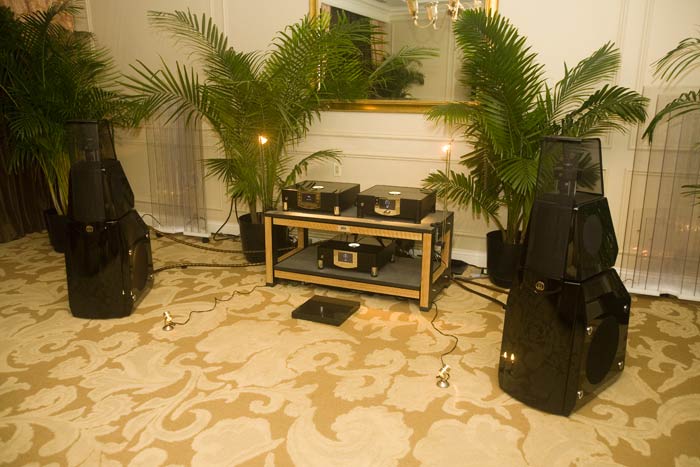

MBL 111F speakers on their new midline Nobel Line electronics

JV thought this was the 3rd best of the show. It was OK, but compared to their top of the line gear they usually show with, I thought it was missing a little of that sparkle [air], some of the harmonic color [typically quite good for solid-state], and the micro-dynamics. The liveness was not quite there. Still good – still MBL – but a more reasonable sound at a more reasonable price.
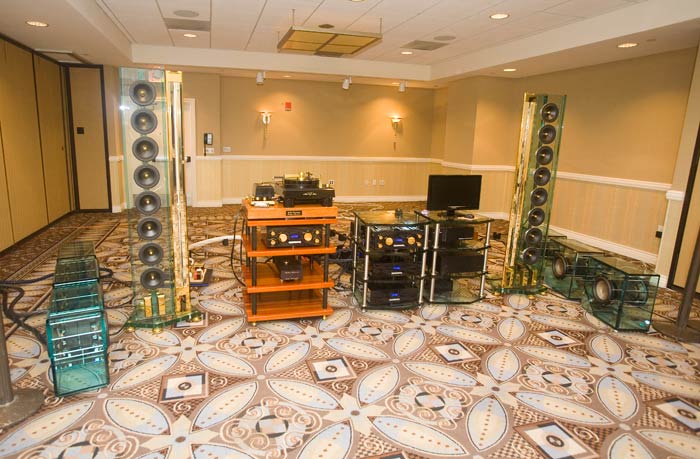

Perfect8 Technologies’ $375k The Force speakers on VAC electronics and Walker turntable

JV thought this was one of the two best systems and goes into some detail about the sound. Note that his choice of the top two systems both had VAC electronics. I also have noticed that the price of VAC has gone up a bit since the last time we looked at their gear. It is no longer ‘reasonably priced’ [sorry if I misled people saying it was].

JV starts with saying that [paraphrasing] “….the Perfect8 speakers [and sometimes the Scaena speakers], are the only two speakers to ‘disappear’ – the Perfect8 also reliably disappearing in the bass….”

[Excuse me while I have a little bit of a WTF moment here…]

[OK. Thanks for your patience]

The speakers did disappear pretty nicely, we do agree on that.

JV again: “Even the great Focals, and they were great, sounded more like “box speakers” than this astounding ribbon/cone system”.

Well, considering that these Perfect8 speakers are not box speakers, it will of course be true that all box speakers will sound more like box speakers than they do [unfortunately, big speakers like the Focal, Wilson, Rockport, etc. who lay on the cabinet thickness in the attempt to make them ‘more better’ fail especially badly at not sounding like box speakers. Kharma and Von Schweikert do better. Open baffle hybrids like the Nola also do well. And, of course, the speakers using aluminum and carbon fiber do particularly well at not sounding like box speakers – even though they all, you know, actually ARE box speakers.

He just goes on to say that he really enjoyed the sound without any further detailed analysis. Our opinion is detailed in Part I of our show report already posted. The short and sweet, is that the overall sound was just a little too wishy washy in the mids and discontinuous in the soundstage and other tiny little things that would just niggle us to death.
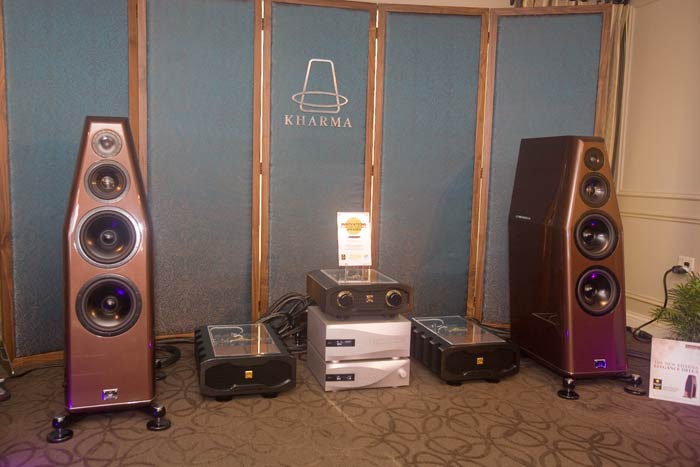

Kharma Elegance dB11-s speakers on Kharma electronics

JV … “so-called Elegance Line”. Made me laugh. I so relate to the waste of valuable brain cells required to keep up with all the manufacturer product category names and their incessant changes.

JV: Historically, Kharma speakers… ” leaned toward the analytical side. Super-detailed, super-fast, to some listeners they seemed to gain their phenomenal speed and resolution at the price of naturally rich timbre (particularly in the bass and the all-important power range). In this regard, they were reminiscent of certain early Magico loudspeakers (or, more properly, vice versa).”

Analytical? Yeah kind of [also read this as ‘transparent to upstream gear’]. So that is why we all put tube gear on them [he mentioned the need for rich timbre?]. Typically Lamm and Tenor. Match made in heaven and some of the great amp / speaker pairings in history. Seriously, do you want your ‘musicality’ to be built into the speaker, and you are kind of ‘stuck’ with that sound for as long as you have that speaker? or do you want your speaker to be transparent to upstream gear so that you can have a variety of sounds for your system, depending on upstream gear? Just askin’.

Newish Kharma speakers are designed for solid-state gear [specifically theirs, naturally] . One of the most musical solid-state driven amp / speaker pairings you can buy.

Like early Magico??? Sorry, JV, I just can’t quite get there…. this is so bizarre and we’ll have think about what exactly he means by this.

JV: “particularly in the bass and power range…” Wish we knew what the ‘power range’ was. The frequencies with ‘punch’? The ‘punchables?’

OK, we agree with much of what he said here about the sound…. though I am personally at a loss as to what exactly to attribute the change to.

JV: “…has gained much, much richer tone color (particularly in the bass and power range) at no apparent cost in resolution of transient speed.”

This room has certainly gained all this with respect to last year’s system at THE Show. Looks to be about the same upstream gear [Sorry. Just in one of those slacker moods].

JV: “(without much of the bite in the treble that I still hear, depending on source, from all beryllium tweeters)”

🙂 You go, JV. Big dark secret… *exposed*. So many people love these tweeters with some kind of misplaced obnoxious emotional fury. They are just tweeters with problems like most other tweeters, you guys. More than their share, I think, sometimes.
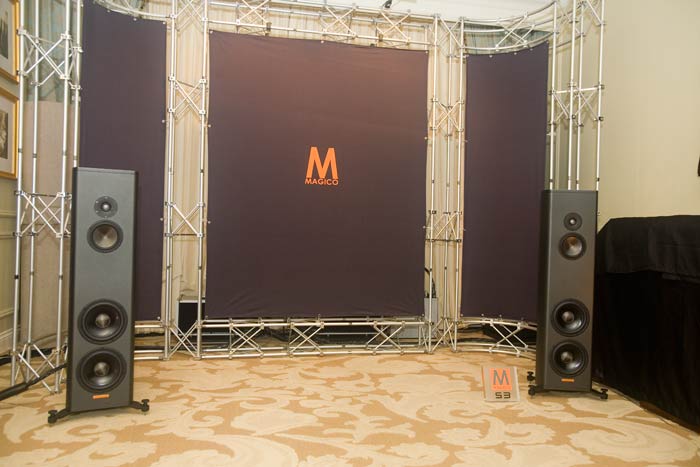

Magico S3 speakers on Vitus electronics

JV: “Its new speakers, the Q7 in particular, have a warmer overall balance, bespeaking richer, denser, more natural color in the power range (which is, IMO, one of the chief keys to a loudspeaker’s appeal)”

This is not my sense of what is going on at all. They are first and foremost much easier to drive than the previous Magico speakers for the most part. Reportedly, the Lamm ML3 at 32 Thor-blessed watts drive these speakers. If we [and we did] call those previous speakers soulless, it was not because the lacked ‘natural color’ or were ‘lean’. It was because a) they were so hard to drive that the notes were flattened out [anti-bloom] with attenuated attack and decays that made it artificial and boring sounding and b) the hugemongous amps required to drive the speakers were by their nature cold and – well, they had issues.

So, making the speakers more efficient would, by itself, result in the same differences JV attributes to a conscious decision on the part of Magico to make their speakers ‘more appealing’. I hope they did not make the speakers, essentially ‘sweeter’, because, well, we like speakers that are transparent to upstream components, not ones that walk all over the signal with their own sound.

JV: “the S3 actually took this kinder, gentler Magico balance a step further, without losing much of Magico’s trademark low-level resolution or transient speed. ”

I’d like to hear the S3 on a different system before I can really place these sonically in the Magico speaker family – but I think that JV is right that Magico took a step further, but that it was too big of a ‘step further’. Missing too much of the eager midi-dynamics and inner-detail that the S1 would have had in the same room, that was my impression of the sound in this room.

JV: “Soulution’s new $65k 711 stereo amp and $55k 725 preamp made my ears water and my hands shake with lust”

Hmmmmmmmmmm…..

Soulution’s signature sound has not changed re: these new components, at least from what I heard.

JV goes on to talk a tiny bit about several rooms.
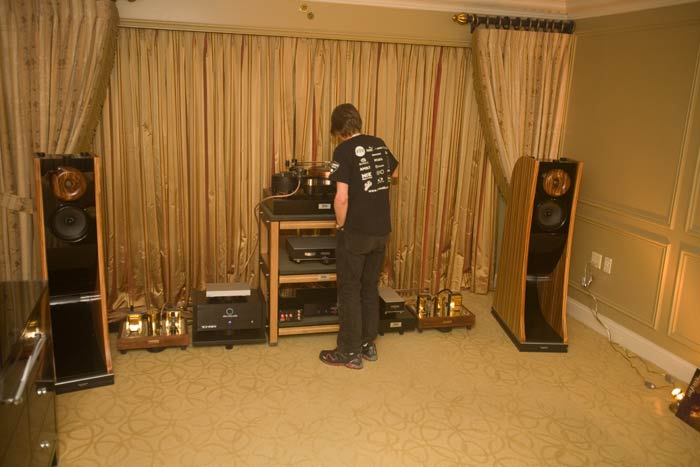

$40k Cessaro Chopin two-way front-loaded horn loudspeakers on Electra-Fidelity A3-500 300B amplifiers

JV: “were as void of horn colorations and as “of a piece” as any horn speaker I’ve heard”

If this is all he gets out of listening to horn speakers, trying to hear horniness and integration issues, then he is missing out on a f-load of what goes into making a good sounding music reproduction. Much better dynamic envelopes of the notes and a natural excitingness that other designs can usually only look at in envy. Hello?

We liked this sound quite a bit as seen in our show report a few posts back. If you want to talk about integration issues [i.e. “of a piece”], then lets talk about JV’s choices for 1st and 2nd best of show this year. No? We could go on but I think you see how JV’s pre-conceptions about horn speakers kind of prevents him from writing as adroitly about them as he does about other kinds of speakers.
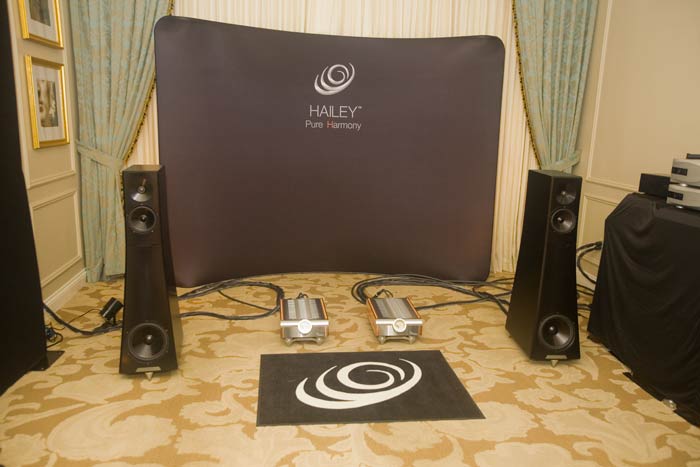

YG Acoustics’ superb new $45k Hailey speakers

JV: ” a little compression on hard transients at very loud levels aside, were in the running for Best of Show”.

I heard lots of compression on everything. Something was wrong here, and looking forward to hearing these at the next shows.
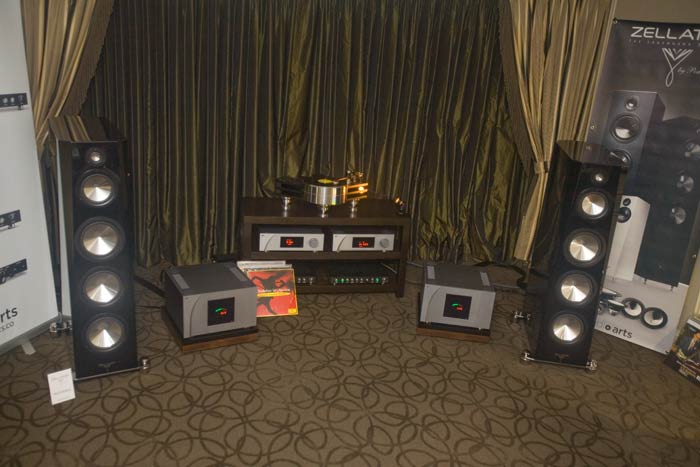

$100k Zellaton References speakers

[I had no idea they were this much. I had assumed… something much less].

JV: ” …despite a little lightness in the bottom octaves, managed to dig out more detail …”

I just thought they were more musical and transparent than expected, but had been evaluating them with respect to an expected price of around $20K. Oops.

Did you notice that JV did not say anything about the two SoundLab rooms, the two Lamm rooms, the Acapella room, nor the Marten room? Did he, uh, just figure that Mike & Neli were going to cover those rooms [even though we have not been dealers for SoundLab for years and have been quiescent about Acapella ]?

Highly conspiracy-thinking-ish there Mike…. [… or… is… it? :-)]

Anybody else still getting sticker shock at each and every one of these shows? Holy Great Recession Batman. There’s some weird jujus going on in dealership land, too, and can’t help but think what the high-end audio industry does best is embarrass itself with respect to the general public.

OK. Well… on to the next show. Which is, like, tomorrow right? 😉

CES 2014: SoundLab and WAVAC

There have been some interesting comments, by Myles Astor for one, on this system. I want to respond.

Some background.

We were SoundLab dealers for 6 or 7 years before we amicably went our own ways about 5 years ago. We have no relationship to WAVAC; not having a lot of success when we auditioned them and hear them at shows. We have no intention to start relationships anew as we are too freaking busy to tie our shoes it seems these days.

We are all about the sound. As we become more and more familiar with this industry [12 years now as dealer, importer, publisher, etailer, and curmudgeon (me!)], we have come to realize that we are in the minority. Most opinions you will hear are not based on sound but rather based on brand strength, advertising expenditures, appearance, technology, history, friendships, business relationships, storyline and/or the social aspects of the hobby. Not saying this is terrible but it does make for a wide range of opinions and performance characteristics out there.

We do not like a lot of the sound at shows. But when we do we feel it is important to speak up. Among all the loser sounds someone did a good job. Truly amazing [he says sardonically]. They should be roundly and publicly applauded in our opinion.

Our perspective on SoundLab is from the point of view of an ex-dealer who at one time wanted to sell a boatload of them to people because they really are an excellent sounding single driver speaker for seriously not a lot of money in today’s marketplace.

Typically people try to put inferior sounding [even if perhaps well-designed] solid-state amps on these speakers. These kinds of amps fail even more miserably at reproducing music on SoundLab speakers than they do on box speakers because the SoundLabs, and electrostatics in general, are so revealing. The SoundLabs are very revealing of just the types of flaws that that typically abound in these kinds of amps: overly aggressive note attacks [or artificially rolled-off attacks] and overly quick decays, leaving little time for the notes themselves. Combined with these kind of amps characteristic leanness, this makes the presentation harmonically barren and a difficult listening experience for the unconverted.

We tried many, many amps, from about $5K to $140K, on these speakers. If we were to pick a winner based on these experiments that is currently available and reasonably priced we would pick the Sanders amp. No relationship to this guy either except that he lives [last we heard] somewhere up in the woods about 50 or 60 miles south of us.

The MSB amps, seemingly one of the better solid-state amps out there, which were on the SoundLabs upstairs on floor 4 is a good example. All the details were there. And maybe the imaging and soundstage depth was excellent. I don’t know because it did not sound like music. There wasn’t the rushing swell of the notes and hypnotic decay that we get from real music. There wasn’t the harmonic content that real music has. Because of the way the notes are deformed by the amps, there is not that continuousness, no natural flow of one note to another, that like you would hear when you hit two notes on a musical instrument one after the other. It fundamentally just isn’t as engaging as a music reproduction should be, and sounds more like a very high end tinny-sounding radio.

Fine I guess if you are going to put them in a mancave and treat them as some sort of laboratory experiment [what can I say, electrostatic and panel speakers are cool. Single drivers are cool. Box-coloration-free sound is cool].

Getting tubes to work well on the SoundLabs has been the holy grail – its is all about getting these awesome speakers to sound more like real music [we first heard and picked up the SoundLab line at the Tuscany at THE Show 2002, when they were on those inexpensive powerhouse of a tube amp – called…. anybody? We forget the name of these. The brand folded soon thereafter. Ah. I remember. Wolcott I think they were called]. But most tube amps hated being put on these speakers. It.. was.. often… very… scary.

This has been the state [albeit slightly exaggerated] of the SoundLab speaker universe.

But the factory has been slowly but steadily improving the efficiency and design of the speakers, from even before we went our separate ways, and now we have the Majestic 945PX [or 845PX, but looks like the 9’s to us].

Before we talk about potential problems lets talk about what was right about the sound of the WAVAC-powered SoundLab system at THE Show 2014.

We were thre about 5 hours before closing. In this particular room I only heard the digital. I was walking around half the time and in the sweet spot several rows back the other half. Neli [I think she heard the analog], and sat out of the sweet spot [yes, yes, I usually am smart enough to sit off center as well, but I just wanted to luxuriate and get the full impact of the SoundLabs finally sounding wonderful].

* First, there were harmonics. Not overly done but enough so the brain did not have to spend a lot of cycles adding in harmonics that it knew were AWOL in the sound of your typical SoundLab speaker on solid-state amp sound. This meant the brain could relax a little bit and listen and enjoy the music more. It was rich, colorful and nuanced. The best we have heard from a WAVAC amp BTW.

* Second, there was excellent control of the notes. This meant that a) the attack and decay were much more lifelike, more round and finessed, like real notes, than what we had heard previously on the SoundLabs [and, better, in fact than the vast majority of the rooms at the show]. It also meant that the notes had more authority; they were more solid and substantial.

* Third, there was excellent separation. Separate notes stayed separate [as much as can be expected given the sources. We heard relatively complex music, but not, unfortunately, full on orchestral music].

These 3 characteristics by themselves put this room in the top sounding rooms at the show. These characteristics, combined with a reasonable frequency spread and reasonably linear response to frequency and dynamics, is what turns sound into music. Quite rare for systems to be this good [whether at shows, in dealerships or in people’s homes].

OK. So I posted that I liked this room on WhatsBestForum [I know, silly me]. Myles Astor responded with a embarrassingly negative [hey, been there done that] expansion of his negative comments that he posted in his show report on Positive Feedback:

“Did nothing for me. If your head wasn’t clamped in a vise, the imaging sucked and the instruments were stuck to the panels. Not to mention there was zero, read nada depth. SS was two dimensional. Also what happened to the upper octaves?”

Even if the things he implied by these general accusations were true, it would STILL be in the top sounds at the show [though I somehow missed the big Focal room and the Estelon room was locked the few times I went by there – doh! thank goodness it is anatomically difficult to kick oneself – both rooms which were in his top 3 rooms].

Let’s look at these one by one:

1. Head-in-a-vise. These are curved panels, not flat, so there is not inherent head-in-a-vise issues like the flat panel speakers out there [considering most people listen to their systems alone and in the sweet spot, this is usually not a problem. I listen with my wife … sometimes 🙂 …. so head-in-a-vise does not work for us].

I am not sure how wide the sweet spot was. I would guess about 6 feet side in a large room like this. Just guessing. These speakers have 30 degrees of curvature. If you want a wider sweet spot you can order your speakers with 45 degrees of curvature.

When I was walking around I certainly did not hear any instruments being stuck to the speakers or LRC [left, right, center] effects. This does have a tendency to annoy me as well, so, yeah, don’t want this kind of behavior.

2. Soundstage depth. Have to admit we are not soundstage depth junkies, although a lot of our friends are 🙂 As long as we can get a realistic soundstage with room for musicians and instruments to be more or less correctly sized [smaller speakers obviously have problems, as do close-miced instruments and voices] we are good. Yes, of course, we want deeper soundstages for orchestras and music like Radiohead [which plays with the depth of notes all of the time to wonderful and fun effect].

3. Upper octaves missing. I think MylesBAstor is pointing out that the part of the Soundlab panel that generates high frequencies is above ear level. These were taller SoundLabs [7 feet?]. We get a lot of our directional cues from these frequencies, and this is probably the root cause of at least some, if not most, of the issues Myles had in points #1 and #2.

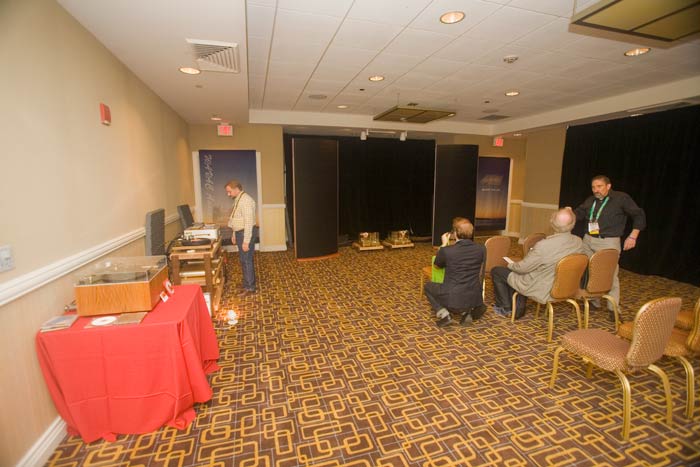
In my photos of the SoundLab speaker base, the lows are at +0, mids at +0 and Brilliance at Max. This is good. But this is a huge room [see added photo]. In-room response will be much flatter in a smaller room with more reinforcement of the highs [and lows] depending on the liveness of your room. What we did here at the store a lot, because some of our rooms are also relatively big [but not this big!] is tilt the speaker, which normally tilts up a little, so that it tilts down a little, pointing the entire speaker to the level of the listener’s ears.

That said we did not have any problems with the directional cues or ‘higher octaves’ in this room. Probably because this is a ‘show’.

Excepting , you know, the ENIGMAcoustics super tweeter rooms, most rooms at the show weren’t showing off a heckuva lot of air.

So many rooms add damping and power conditioning to purposely roll off the treble as much as possible at shows. It is so easy for things to sound bright and harsh and for listeners. Listeners have a heightened sensititivity to those frequencies because they are tired, because they are listening so intently, and probably for lots of other reasons.

——————————————————————————-

Anyway, great sounding room. And this is why we thought it was in the top 2 or 3 rooms this year. Raises the bar for both SoundLab and WAVAC at future shows [just sayin’… :-)]. One of our original goals [which have evolved since then] for our dealership was to present the best of the 3 major speaker technologies for our visitor’s listening pleasure: cone drivers in boxes, panels (typically electrostatic), and horns. With this system the panel has caught up to the other two technologies. May the competition continue.

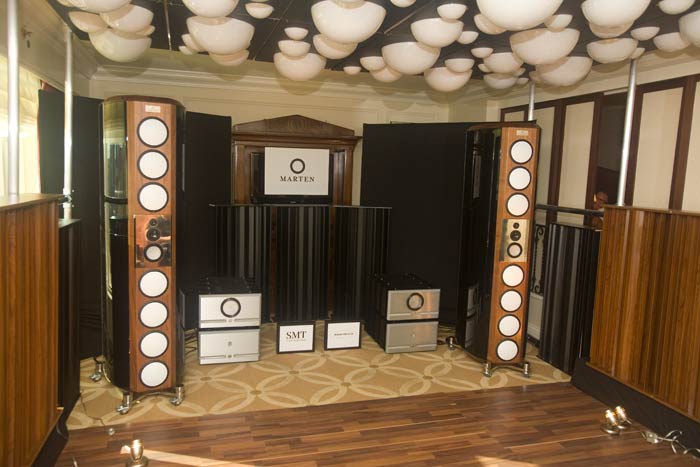
CES 2014: Marten Coltrane Supreme II – Most Interestings of Show (part five)


Marten Coltrane Supreme II speakers on Pass Labs amps and MSB digital

Yeah. Spacey room treatments.

These speakers, and the pen-ultimate Momentos, reflect a new direction for Marten. The original Coltrane Supreme speakers, and their Coltrane speakers as well [we think both the original and V2], were, as I have often described, a tabula-rasa. A blank canvas. They played whatever signal you sent them. Which was cool, because we could put umpteen billion dollar expensive extremely high-quality gear on them and actually get to hear the gear. Other speakers have their own sound, to some smaller or larger degree, and you didn’t really get to hear the gear. Not fully.

Let’s take a step back. Hearing your gear, when it is a extremely well made relatively low-power 211-tube based amp, or GM70, or 300B, or what have you, is an experience akin to the most ecstatic moments we can experience in this life. All those subtle layers and layers of inner dynamics and harmonic transitions and all riding on top of a musical carrier signal that just steals your sorry ass away from this troubled world and into something a whole lot better.

The speakers had their own unique performance characteristics, like all gear, but really very, very little sound of their own.

OK. Hearing your awesome gear. Got it?

Now what happens when someone puts a not so wonderfully awesome amp / front-end on these same speakers? Well you hear that too. And who gets the blame for the resulting not-so-pleasant sound? Is it the inferior gear? Nooooo. It is the speakers.

Look at the reviews of these speakers. Same thing. They hear their [sorry, but…] woefully sucky gear on the speakers and then report on what they hear.

Are they idiots? Maybe, but it is not like anyone but us has been writing about this [and who pays attention to little ole us? Sure, we actually do have 10s of thousands of readers – but in the end it is just the ravings of a couple of nutty audiophiles against the realities of an anti-audiophile world]. We ourselves kind of stumbled upon this by accident, years ago. We just kept putting better and better stuff on the speakers and we kept hearing deeper and deeper into the sound [No, sorry, this is rarely if ever the case. Most speakers provide diminishing returns as you put better and better gear on them. See the room review below of the Lamm ML3 on the Verity Lohengrin speakers as just one example].

Now the factory just wants to sell speakers. They do not care about Mike and Neli [and a few of you out there] and whether we are experiencing musical ecstasy or not. In fact, I am willing to bet you that none of them, except perhaps [maybe] the designer [who is one of the best speaker designers in the world, but…], even know what these original speakers do. All these people trying to sell these speakers, they put mid-fi junk on them and think they are hearing what they do. Nope. They are just hearing their mid-fi POS junk.

So what does the factory do? They make the speakers more forgiving so that people putting inferior grade gear on them do not go home unhappy. A side effect of this is that the speakers are harder to drive. Remember all those cool, ultra-high-quality single-ended tube amps that you could use with the original Supremes, with the powered bass? No longer gonna happen.

So the sound in this room at CES 2014 was hard sounding and smeared, with not enough resolution, in the upper midrange [etc. let’s call it screechy] and fundamentally unenjoyable. As one might expect. But the point here, which is hopefully more clear after all the above background information, is that it wasn’t as screechy and unenjoyable as it should have been.

You could still hear the quality of the speakers through all that mismanagement of the musical signal. But this is like a 600 watt amp we got here. These puppies require Power [minimum 50 watts. The previous version had an active (2000 watt powered) bass and was easy to drive].

For many, perhaps most, of you this will be a welcome change. It will be easier to get a listenable sound, yet completely accurate with extreme high-resolution, with these speakers using your average everyday gear out there.

But what if you, like us, are going for the ultimate sound experiences? The reason we like to use smaller tube amps is because so many of the larger amps, both tube and solid-state, have had so many music-obliterating mind-numbing headache-inducing issues [i.e. they suck] that it has been easiest to ‘just say no’.

Now, we might able to say ‘yes’. After listening and listening and from all we have heard the 1500 watt EmmLabs MTRX amp is significantly different from (read: better than) their high-powered brethren. In fact they are starting to change the whole way we look at power-hungry speakers [and they are quite a bit less expensive than the Gaku-on and slightly less than the ML3. Less expensive is good, yes it is]. People going for the gold can now just put the MTRX on the speakers and drive the poop out of them. With these speakers this would be a truly powerful, accurate, no-nonsense-allowed musical reproduction. The sound’ll no doubt be excellent [not screechy nor unlistenable at all :-)]. But otherworldly? Maybe…. [hope so!].

Because of this change of focus, the Martens are now part of a different market segment. The Supreme I was part of a rarefied and august group of easy to drive ultra-high-end speakers, some a little too forgiving, perhaps, but with not that much sound of their own: the Acapellas, the big Wilsons, perhaps the Magico Q7, and perhaps a few others [there are conflicting reports].

The Coltrane Supreme II (and Momentos but not the Coltrane II), on the other hand, are up against many more, a few dozen or so, other statement speakers that are also somewhat forgiving, a little less [some might say ruthlessly, some might say perfectly] revealing, and a little hard to drive, each with their OWN sound [read coloration] that each person must decide is a ‘good’ sound or a ‘not so good’ sound: The Kharmas, Magicos (except perhaps the Q7), YG Acoustics, Perfect8, Avalon, Focal, Genesis, Tidal, … And many others.

What the Supreme II has going for it is higher resolution [that diamond midrange thing along with all those Accuton drivers] that is more musically true, more linear and accurate than the competition [Leif does innovative things with crossovers that keeps things sounding like music and not some mad scientist’s concoction, while still keeping true to the input signal], This all contributes to the enjoyment of the music, as opposed to just artificially calling attention to itself [look at me! look at me! i.e. it goes way beyond the basic Impressiveness which is all that the vast majority of statement speakers have to offer. Impressiveness, you know, is really cool – who doesn’t love that big, BIG sound! – but sometimes a person wants more than that].

[neli: We do hope to hear the Coltrane Supreme II with different gear, gear that is more to our taste [and more suitable for $500K speakers IMHO (mike)], in early summer [if our customer, Encinitas Jim is up for it]. At that point, the speakers also should be more fully broken in, and hence we should be better able to assess their performance compared to the original Supremes, and also to their current competition.]

So, yeah, enough about the sound. The Supreme II is 2 boxes versus the Supreme I’s 5 boxes [although we never had a problem positioning the 4 towers, perhaps others did]. The look is also quite different: there are no grills over the drivers on the front of the Supreme II. The new Accuton cell technology drivers look cool [what can I say? They do]. They are also fatter, kind of like the Coltrane II in that way….

Can’t wait to hear them again…. 🙂

CES 2014: Most Interestings of Show (part four)

[Similar to the RMAF 2013 show report – we will put the politically correct version for all ages and levels of audiophile, along with well over 1000 photos, over on Ultimist – and we will put the more opinionated report here on the blog, which we will call ‘Most Interesting of Show’, for people who are focused on Pursuing the Ultimate Music Experiences.]

There were actually quite a few rooms this year that we thought were interesting. Interesting sometimes due to an intriguing pairing of different brands of gear together and sometimes due to interesting sonics, and there were also a couple of exceptional sounding systems as well.

In no particular order:


Kharma Elegance DB11S speakers on Kharma electronics and cables, dCS digital

I wasn’t happy with Kharma’s room last year at THE Show. It was cold and analytical. Not Kharma-ish at all.

This year’s room at the Venetian was way different. That old Kharma excitingness was back.

I have spent a lot of time trying to quantify and qualify this sound and what makes it different. It is definitively more exciting than most other speaker sounds [I used to compare it to how one feels about one’s girl (boy) friend versus how one feels about one’s wife (husband) – and I know none of us have girl (boy) friends, of course, but I think we can imagine just what that would be like just fine ;-)].

Is the midrange and upper bass slightly more dynamic than the rest of the frequency band? Are the mids more harmonically rich? I don’t know, but I do like it; although to hear it best I kind of have to sort of turn my mind’s ear and point it toward the 6th dimension [I don’t know how else to describe this].

Anyway, a bold sound, a little too much for the room but it worked much of the time. Very dynamic and powerful, especially in the upper to mid bass. Very harmonically rich and engaging. Uneven and not very linear top to bottom, however, and a little wild. But it was fun and exciting, so I liked it, especially in the context of the show where a lot of systems sounds are, whether good or bad, just plain boring.


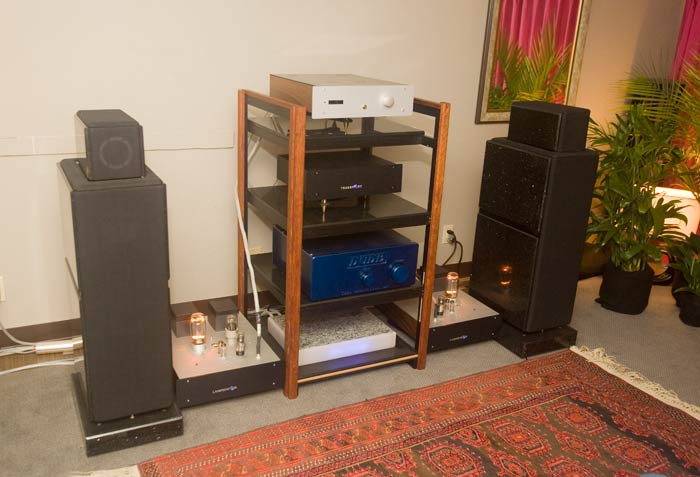
Theorem Imaging Science speakers on Lampizator electronics

These guys are so infuriating. We only got a very little time to listen to these before they drug us over to the next room to see their smaller system that was not playing any music. Argh.

I think this system is interesting because it did sound pretty darn good. Maybe they do wonders with cross-overs but I suspect it is the fact that the cabinets are made from granite and are so inert and stable that there is not much box coloration at all. And this is seemingly very, very important if you want to elevate your playback into state-of-the-art territory. All of the energy for each note goes into the note and not into warming up and vibrating some large chunk of wood or fiberboard or composite material. Lots of good separation and dynamics. Speakers that start with an aluminum, granite or perhaps carbon fiber cabinet enclosure have a real advantage over those that do not.

The harmonics also seemed quite rich [but not too rich] and musical as provided by the Polish Lampizator company.


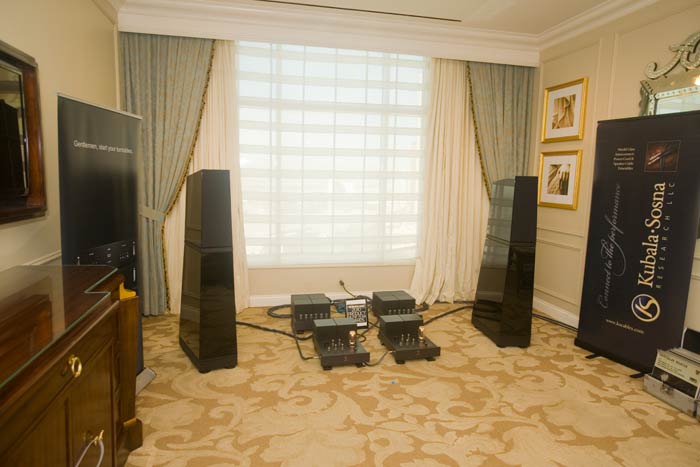
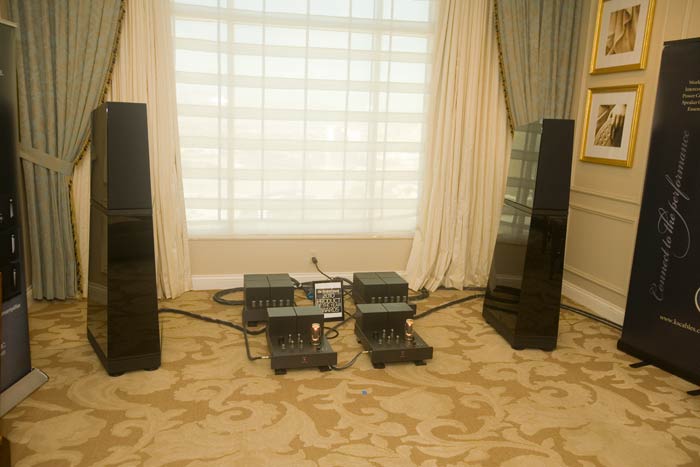
Lamm ML3 amps, LL1 linestage, LP2.1 phono, LP1 phono on Verity Lohengrin II speakers with Kubala-Sosna cables and HRS (under the TechDAS turntable) and Kanso rackage

We have a friend customer who has the ML3 amps on these the latest Verity Lohengrin II speakers [with Jorma cables instead of Kubala-Sosna and Audio Aero La Source front end, all on RixRax equipment racks with Harmonic Resolution Systems M3x isolation bases under everything]. His goal was [more or less] a sound that was always musical and never aggressive, otherwise with as high a resolution and as much accuracy as possible. That system succeeded wonderfully for him. He could spend 2 or 3 times as much and get something better [IMHO] but, heck, this is pretty gawd darn expensive already.

As I sat in this room and heard how much of the wonderfulness of the ML3 amps was not getting through to my ears, I still thought our friend bought the right thing… for him. But for me? I want to hear that amp. I know it to have wonderfully detailed and subtle harmonic and dynamic transitions that add so much [for me] to the music. And more.

But the speakers, and to some degree the cables, and perhaps even the unfamiliar Kanso equipment rack, were softening up the sound enough that I did not feel as engaged here as I did in previous years, or even as much as I did in the Lamm M1.2 amp on the Wilson Alexia speakers room next door.

[Vladimir Lamm swapped back and forth between the LP2.1 phono stage (which debuted this show. yes we have photos on the inside of the chassis to be posted on Ultimist) and the more expensive LP1 Signature phono stage, several times by using the two tonearms on the TechDAS at the same time [say what? this was fun]. With two very slightly different cartridges it was a little bit of a Fuji apples to Braeburn apples comparison, but the short and quick is that if you didn’t hear them back to back (the more expensive LP1 being smoother, less grainy, and just more of that good old analog wonderfulness) you would think you were already listening to the LP1 when it was in fact the less expensive LP2.1 all along (the original LP2 has been a giant killer among phono stages here at the Fed, at least until you get up into the $20-$30K range of the competition).]


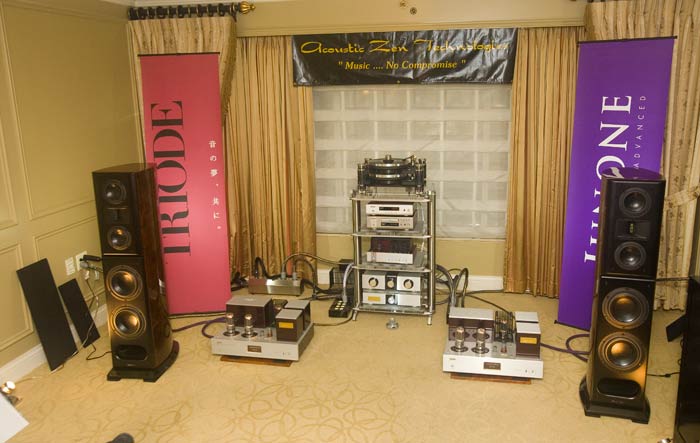
Acoustic Zen Crescendo Mk. II Speakers on Triode Corp electronics

It is funny [or not] when I read the better show reports and how they report on these rooms setup by Acoustic Zen and Triode Corp at all these shows. They point out something like that they heard a slight issue with the sound of a part of one of the tracks they played here. Ah, then this, they imply, can’t be best of show then.

What this really says to the perceptive reader who reads a lot of these things and thinks to themselves a little bit is that, hey, these rooms are such reliable performers, and it is so boring to keep awarding them the accolades they deserve, that they will dig deep down and find something [anything!] wrong so they do not have to put them somewhere on the BOS list yet again. The Lamm rooms experience this same thing.

Show reporters get so bored with seeing the same things each show [most of the gear, the setups, the people… it is all 98% the same from show to show] that they need to mix it up once in awhile and pick someone else as BOS, someone else to talk and rave about. And heaven forbid that they bore the readers [equals less traffic equals less ad revenue] by talking about the same old boring rooms that sound good, that perform well, each show after show after show.

And the speakers are only $18K? And the electronics are actually fairly reasonably priced?? BO-ring. Can’t get any more boring than this. Show reports got to be exciting wiiiild stuff, man…

They played music here. It sounded like music. It did nothing egregiously wrong and got a lot just right. It was immensely enjoyable. Like freaking always.

Well, I guess [and after all I am kind of a show reporter too…] I am also a wee tiny bit bored :-).

Yah, you know, each show it is the same… I can’t ever afford to spend a lot of time here [and this is what sucks about being a show reporter who actually goes to all the rooms (otherwise you have prejudged the show before you even arrive! Having decided what is best by the choice of what rooms you omit even visiting)]. You know I have to go and check out all those other rooms…

*sigh*