RMAF: Venture / FM Acoustics (Audio Limits)

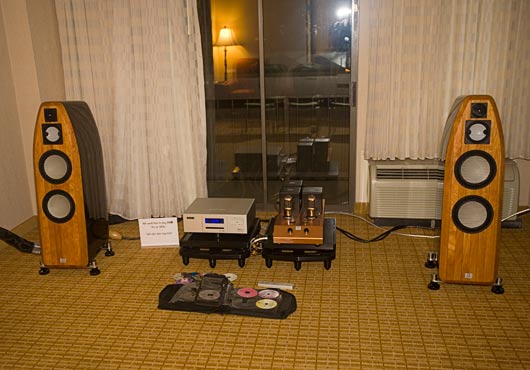
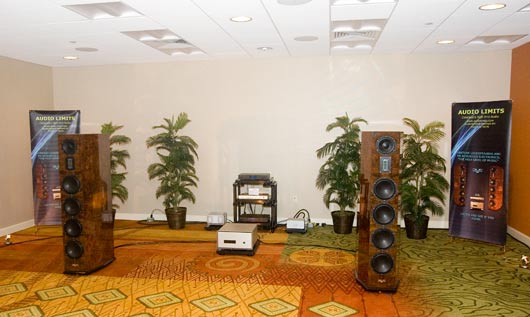
Venture speakers

This is the best sound Audio Limits has had for a few years, since their show system with the Acapella Campaniles speakers (also on FM Acoustics, I believe). However, this is not like that system in several key ways.

The Venture speakers are laid back and ultimately very polite [and very attractive] speakers. They are also reasonably hard to drive. The vast majority of the systems we have heard them in the speakers have sounded very under-powered [which we can live with if there are other, redeeming aspects to the sound. But in these cases there weren’t].

These are the largest Venture speakers we have heard (Venture Reference III) and in this system the FM Acoustics woke them up. The sound was big, macro-dynamic, well-separated, accessible, and under no strain at very loud volumes in a very, very large room.

However, the sound was also lacking micro-dynamics to some extent, lacking air to some extent, and sounded a little dense and slightly compressed. These sonic characteristics are predictable given the family sound of this line of speakers.

What is neat about this system, and why I thought it was interesting, is that it is on the border between a Boy Toy system, a Practical system and a Drug-like system. Most Boy Toy systems are aggressively unlistenable [my spell checker suggests ‘untenable’. That is a good description too :-}]. This system is listenable.

Does this system have a Drug-like sound? Can this system be pushed further into the Drug-like sound category? Hard to tell. Right now it is a little laid back and missing a lot of color. Not sure what cables were in here but everything else in this small system is in the A+ to B+ kind of quality [HRS, Weiss, Sound Applications, ISOTEK].

Right now, I would say this system, at its best, might be akin to a 12oz bottle of Guinness Stout. With a lot of work [mostly trying to preserve micro-dynamics at each step in the signal chain] one should be able to get it to a glass or two of heavy red wine [some large amount of hand waving here – this is the first time I thought these speakers were at all interesting and we know very little about their behavior in this kind of system. For example, what they sound like at a much lower volume on beefy amps like this].

For those interested in more powerful drug-like sounds [like me!], I wonder if speakers that are on the hard to drive side of the ballpark, and almost as a side-effect micro-dynamic limited, will be able to satisfy our hunger.

Walker / Technical Brain, (small) TAD room

This is the 2nd Walker room that I visited. The first, with the larger TAD speakers, had too much uncontrolled bass and was not interesting.

This room here, however, WAS interesting. [and not just because this was where Lloyd Walker was hanging out :-)]
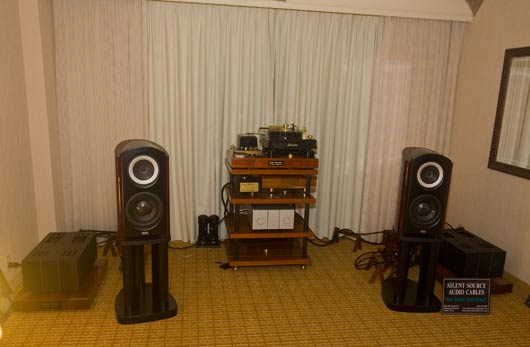
Walker at RMAF

The smaller TAD speaker’s sound was filling the room quite well without overloading it. Lloyd was playing an LP with the famous track from the Burmester CD about the diamond mine trains in Africa. OK. We’ve all heard this track like a million times, right? The singer’s voice is a combination of showman, stylized story telling and real [spooky] anguish sometimes slips through.

Well, not with this system. There was hardly any micro-dynamics or inner-detail – hardly any note attack and decay at all. There was NO emotion to the voice. You could understand the words, but not much was accessible beyond that.

This is much more interesting to me because we are very familiar with most of the components of this system.

The Walker turntable is one of the, if not THE [which I can argue I think convincingly], highest resolution turntables in the world. No problem with micro-dynamics here.

The AirTight PC-1 Supreme cartridge, Neli tells me, is highly regarded and retails at the $9,000 range.

The Silent Source cables we used to carry here, and we are somewhat familiar with them. In addition, recently [well, this year some time] we did a shootout here with their speaker cables. They are not bad at all [they seem to like to be warmed up a little, more than most cables, so if you do a shootout, play some music through them before the shooting begins], and in the same stadium as, say, the Nordost Valhalla. Perfectly capable of decent micro-dynamics.

But there was like NONE in this system.

[I am ignoring the rack and amp stand.. even the most terrible micro-dynamic-absorbing but quite popular racks and amps stands could not do THIS much damage to the micro-dynamics… and they would do it in an uneven fashion across the freq spectrum, causing tonal anomalies but leaving micro-dynamics alone at various frequencies for us to hear, for the most part]

So we are down to the Technical Brain TBC Zero Pre-Amplifier and a Technical Brain amp… and the TAD speakers. One of these two brands is INcapable of rendering micro-dynamics, and I would say, incapable of rendering any fine detail at all.

Which one is it?

Don’t know for sure, but let’s look at both for a second. We heard Technical Brain electronics at CES in the big Magico room. This is inconclusive because that system had a lot of problems – and close listening [beyond gross evaluations] did not seem to be of interest given the limited time available at these shows.

We’ve heard TAD speakers at these shows many, many times. But I’ve just realized in the last few days that I’ve never heard them on anything but muscle amps – designed to produce loud impressive noises. Never with an amp designed to reproduce music in its entirety [see list below for possible candidates if we must stick with solid-state i.e. because the speakers need a lot of power].

My guess is that it would be hard for a speaker to be designed to have no micro-dynamic capability, esp. speakers that are so lovingly designed [I do not hold for that “TAD is just a Pioneer” talk, anymore than I do for Lexus being just a fancy Toyota or Esoteric being a fancy Teac.].

On the other hand, it is in fact quite common for amps to only be capable of the brute force, “let’s go for the note magnitude and none of its structure” approach.

So we are going to put Technical Brain amps [and Levinson by special request :-)] into our list, last found in the thread at:

https://audiofederation.com/blog/archives/656

// MICRO DYNAMICS < - less .... more ->
VTL – Soulution – Technical Brain – McIntosh – BAT – Levinson – CAT – ARC – Pass – Boulder – Krell – FM Acoustics – Spectral – Halcro – MBL – Ayre – Sanders – Goldmund – Edge – Vitus

Again, this is somewhat inexact; we are stereotyping an entire brand, which means it is more or less true but that there are probably exceptions – and you could probably swap any 2 or 3 adjacent slots in the list with each other and still be more or less on the money.

Let’s talk about what Micro-dynamics is so that everybody knows what we are talking about. Micro-dynamics is related to inner detail which is related to fine detail. It is how we can listen to a voice and hear what kind of feelings they are trying to communicate…. peevishness, loss but hope for the future, love with hope for passion someday… simple and complex emotions like these are communicated through very subtle voice [and instrument cues by the best musicians] – and are an integral part of real music.

It would be my guess that most people who buy high-end stereo systems want this – and I know for sure that very few get it. The muscle systems they are sold instead are great for keeping the more sensitive spouse out of the listening room, and great for showing off to people who do not have to buy or listen to the system day in and day out.

Here are some graphs I drew in photoshop. They look like poop but they, hopefully, help illustrate what we are talking about


The original note in all its glory [OK. I know. But use your imagination :-)]
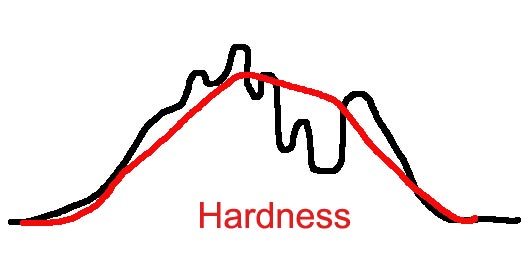

Hardness: a loud note that does not have enough micro-dynamics to relieve the impact of pressure on the ear drum. [I think what we call shrill, Jim, is hardness at high frequencies]. Note that to avoid shrillness, most amps without micro-dynamics are rolled off severely in the higher frequencies.
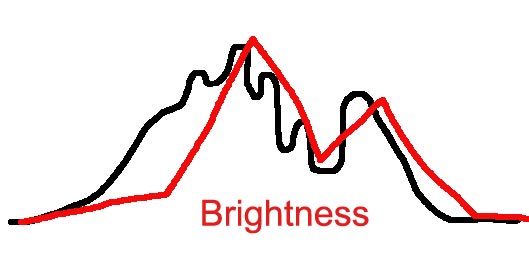

Brightness: too sharp of note transitions, especially in the upper frequencies.
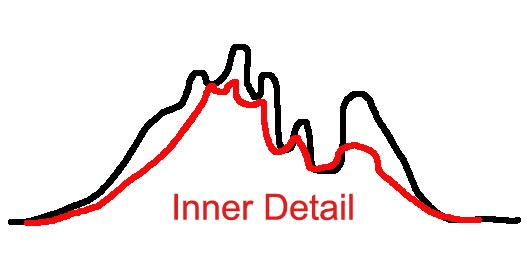

Inner Detail: We will define this as micro-dynamics that has too little magnitude [i.e. just a hint of micro-dynamics] [agree? disagree?]
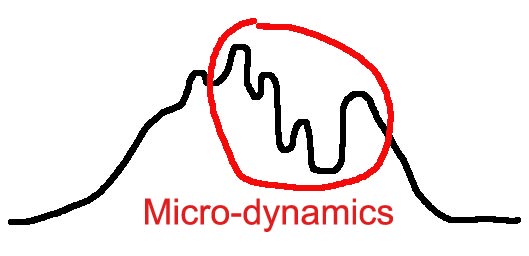

Micro-dynamics: The actual way notes appear in the wild, with lots of bumps [abrupt changes in magnitude – and other things like freq and related freq (harmonics) all with lots of bumps]
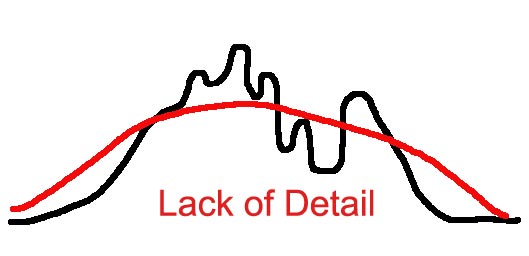

Lack of detail: note transitions too rolled off, soft, rounded,…
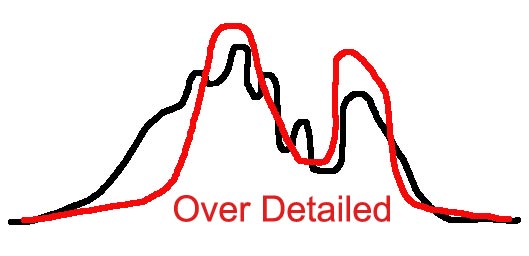

Too much detail: note transitions too abrupt [but not sharp], note envelopes rise and decay too quickly.

As these charts indicate [well, they TRY to indicate] micro-dynamics is really all about accuracy.

The fact that the industry describes ‘accuracy’ as having the measured magnitude [the top point? or weighted average most likely] of a reproduced note being within a few dB of the original note – is a wildly gross simplification that causes no end of grief to people who want their reproduced music to sound like music, and not simple sin waves [which have no bumps, hence no need to think about micro-dynamics]

Concluding… this system is a Muscle output section on a wonderfully high-resolution, perhaps Magical, front end. Lowest common denominator rules in system design, and the overall result is a Muscle system.

Audio Federation Rm 557 pt. 2

Marten, Audio Note, Emm Labs at RMAF

Marten Coltrane speakers, Audio Note Ongaku integrated amp, EMM Labs XDS1 CD  / SACD player, Jorma Prime speaker cables [and sometimes integrconnect) and Nordost Odin interconnect and power cords, Elrod power cord, HRS amp stands.

SOUND

The sound was very high resolution, very clean, very harmonically rich and very pure.

OK.

Done with the ‘very’ies. But keep them in mind because they do describe and define the core of this system’s sound.

The sound was filling the room and we had good room pressurization going on. The bass was present and fairly well-dampened and we did not have significant problems with room nodes. The sound was quite musical, if not quite riveting [by Wednesday it would have been riveting :-)]. Frequency response and dynamics were even-handed top to bottom [a little less authority on the bottom, this is a relatively small speaker], a natural amount of micro-dynamics, a natural amount of separation [notes perfectly separated but still part of the whole]….

This system handled complex music just about as well as it handled simple notes – there was no sense of added confusion as the music transitioned from simple harmonies into complex harmonies [complex passages in better recordings do resolve better, however].

Similarly, the high resolution and harmonic detail – and our willingness to play opera attacted a number of people with their opera CDs. The voices, instead of sounding shrill as they often do when there is not enough resolution or harmonic color – were wonderfully involving and hypnotizing.

I talked about playing rock and roll in the last post, and I could now talk about how each component [and we always include cables and cords in these discussion as if they were components] handles its responsibilties in the musical chain – but because each component did its job so very well, I think it might be hard for everybody to believe that each component is really as important as every other component. So we will move on to the next post [Uh, I am writing this section last, sorry] where it will become obvious what happens when a piece or two does NOT do its job.

ISSUES

I promised to talk about the 3 1/2 days of breakin of the Marten ‘Coltrane’ speakers.

The LACK of being broken in had several clearly audible signatures:

1. Brightness and sibilance in the treble (the occurrence of this was reduced to about half, say, by the 3rd day)

2. A stiff, unrelaxed sound, all-too-quick decays, ‘cold’ kind of sound (this was much improved by the 3rd day – but this is an asymptotic kind of break in, taking months to get to 95% and always getting better and better the more it is played)

3. A rare ‘tizz’ in the low treble that sounds like a metal bee got caught in the speaker (this was gone by the 3rd day. Whew!)

4. Exaggerated percussive transients that makes things like symbols and drum whacks etc. more prominent than normal (here this is caused by #2, above [which happens for all speakers] but #4 is somewhat more prominent on ceramic driver speakers. Again, the longer the speaker is played, the more natural this becomes) [this aberration is very prominent on several horn speakers (not Acapella BTW) and never seems to go away (or maybe, of the dozens of different versions of these speakers – I have never heard a broken-in pair)]

What did we do? What we did (besides fret and worry) was to

1) play an ocean waves disc at night, and the louder we played it at night the more it seemed to have improved by morning.

2) play Whos Next quite loud. Later Aerosmith Toys in the Attic. These [I think both were the SACDS versions] have lots of detail – revelatory for me, like the 1st time hearing the SACD version of the Moody Blues albums. Lots of energy in the treble – helped the speakers get to the next plateau

3) Tried to keep the volume down to a reasonable level. This was almost impossible [we tried to do the Lamm room thing, keeping things mellow, but I guess our hearts just weren’t in it]. We invite everybody to play their own CDs, and most want to hear them at a specific volume: loud. We rarely went past 4 [which was quite loud], out of 10, on the Ongaku – this system CAN go LOUD.

Mike Latvis did convince innocent ole me 🙂 to turn the volume up to 5.5 on Bela Fleck (track 4 on the CD) and the bass on that track was pretty darn impressive [not sure how else to describe it] at that volume. Let’s just say that the Ongaku drove those [89dB] speakers to very high SPL, controlling each note perfectly from birth to death, without straining.

4) We pointed the speakers down at the seated listeners. It was determined early on that this helped reduce the negative effects of un-broken in tweeters. Usually this hardly matters and we point the speakers midway between a standing person’s ears and a seated person’s ears [more or less]

5) Worry and fret.

——————————————

Like I said in the previous post, we were happy with the result. However, this happiness is somewhat the result of coming to a realization about how stupid and foolish we were to expect miracles from a more-or-less brand new speaker – and being relieved that we were able to navigate the treacherous waters of un-broken-in-hood lane and come out the other side alive.

SETUP:

After much advice and after many different positions we finally placed the speakers about 2.5 feet from the front walls and facing almost perfectly straight ahead.

The 2.5 feet was Neli’s idea. I thought that they should go closer to the front wall, Martens like that, but the draperies were absorbing way too much energy and generating a dull confused presentation. We pulled them out another 1/2 inch on Saturday morning – the breaking in was loosening up the speakers and causing it to interact negatively again with the drapes [maybe. But it did sound better after that 1/2 inch move].

The straight ahead idea was mine, sort of. Somebody pointed out that the soundstage was still kind of narrow, and I remembered how we used to set these speakers up straight ahead sometimes. The final test was to sit in the chairs left and right of center, in the front row, which were almost directly in front of one of the speakers, and see if there was a soundstage – see if whether the speaker right in front of us would disappear or not. It did.

We put the paper posters on both sides of the room at the 1st reflection point (for most seats) and that added about 5% more clarity to the separation etc.

The 13x19feet room is much easier to setup than the big 19×30? [I think the audiofest website is wrong] rooms. Optimally I would like a 16 x 25 room, I think, for shows. Easy to setup and fill with music but with a lot of seating.