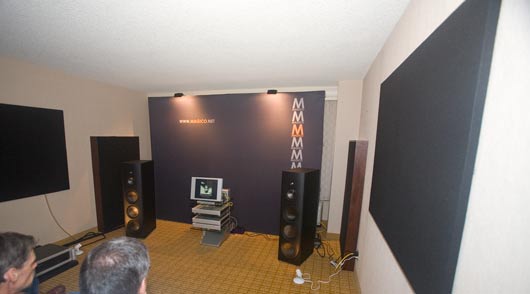
Audio Federation Rm 557

This year we were in a smaller room than the previous 6 years – having unexpectedly lost our large 9030 room.

We will NOT get this room next year and we do NOT recommend room 557 to anybody else. The soda machine and ice machine outside in the hall generated a 60dB noise floor in our room with the door closed at their quietest and 65 to 70dB at their noisiest. Considering that one of the special things about the system we had setup is its incredibly low noise floor and ability to generate very, very subtle details [as most listeners can still attest] this sucked.

We would like to thank Kevin for helping staff and tear down the room [thanks Kevin!] and Mike Latvis [of HRS] who I hear also staffed the room for a bit [:-)]. Steve, who often helps staff our room, instead helped setup and tear down HRS racks in several rooms this year. Also thanks go to the PTE (PRECISION TRANSDUCER ENGINEERING) guys for helping us get the speakers to the show and up to our room (and back again. Thanks guys!).

We always pay for the entire room for our mixed system room – owing no allegiance to any manufacturer so that we can freely design whatever system we want to take to the show. This year was somewhat unique in that we asked many of our [very charitable] manufacturers for the loan of equipment for the show in order to build this particular system – which we had prototyped a year or so ago but no longer had all the components to build.

Our many and grateful thanks go to Peter Qvortrup (Audio Note), Dan Meinwald (Marten), Shahin and the entire Mietner clan (Emm Labs), Mike Latvis (HRS), and Michael and the entire Nordost clan.

People we sorely missed: LCBIII [GWS!], M Mallory, R Halterman, P Strain, Danny K., Jody, J. Hilton, J. Miller, and J. Rebman. PQ, Vince, Vladimir and Elina – you guys are soooo lame for never making it to this show [;-) yeah, yeah, you all have your very good reasons. Still lame :-)].
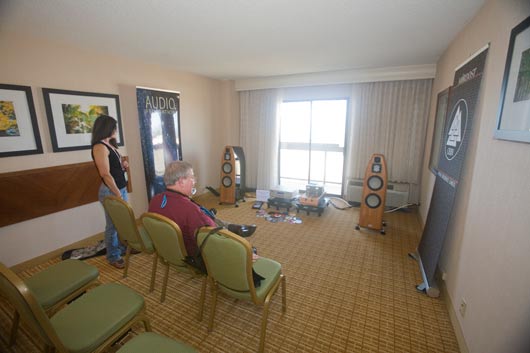

Neli and Fred Crowder on one of the several quiet moments on Sunday

OK.

This system is designed to be a medium-scale EXTREMELY high resolution, EXTREMELY accurate, yet EXTREMELY musical system. Starting at the source:

* The Emm Labs XDS1 player playback is at a very, very low noise floor and high resolution but, uniquely for having such a high resolution, does not sound artificially ‘detailed’ but like how music is supposed to sound

* The 2 Nordost Odin power cords delivered instantaneous power in response to a components needs that is experientally quite important for components in order to retrieve subtle details that were, amazingly, on our source material all along. Similarly with the Odin interconnect – it delivers more of the signal from source to destination than anything else we have heard.

* The famous Audio Note Ongaku integrated… is at heart a very clean and honest amplifier that knows just how to woo speakers into doing what they are supposed to be doing [bested in this aspect only by the AN Kegon Balanced and Gaku Ons. Seriously, 99% of your amps out there are real wimps and let the lazy ass speaker do whatever it wants most of the time during each note attack and decay] .

* The Marten Coltrane speakers are one of the most honest and even handling and revealing speakers in the world – and at only a 104lbs and bottom ported, are one of the most room friendly speakers.

* The components were sitting on HRS M3x platforms and amp stands, which prevents vibrations from stealing our hard-earned resolution from us – everything from subtle details to slam.

* Finally, Jorma Design ‘Prime’, very high resolution, harmonically transparent speaker cables finishes our equipment list.

As with most of our systems at these shows, each component is either best in class, or best in all the world in the pursuit of reproducing Music.

[I can hear [not really, my ears aren’t THAT good :-)] a couple of you saying to yourself “Oh, there he goes again – talking about how great their system was. Guess he has to do that for the business”. For one, I always talk about the pluses and MINUSES of the sound in our room. Second, people that actually heard the sound in our rooms can read what I say, and they can use this to calibrate what they heard against the way I describe things and extrapolate that to the other rooms I describe. Third, just look at the caliber of ALL the components in our room and compare it to any other room. Fourth, its not like we designed or built this stuff – we only lug it in and set it up – we are just giving credit where credit is due.

We put these supremely excellent components in a system of other components of similar excellent quality – allowing them to actually be heard and not shadowed by inferior components [cables too, of course]. Why this is, by and large, so very, very uncommon is a complete mystery to us. The room we setup SHOULD be the best of show with respect to the type of system we are going for – it would only be news if it was not.

This is the system that *I* want for my office. And I’ve wanted it for over a year now – and that is a long time for someone like me who has access to a lot of toys here. Not so overpowering that I get blasted out the windows [or somebody calls the police 🙂 But seriously, I do not want to just make a lot of loud noises, i.e.a Muscle system, certainly not in my office – nor do a want a Technical Marvel system – my job makes high end marvels look extremely quaint. I want a Practical system, a small Audio Note system would be great, or This One], but with the ability to plumb the deepest depths of musical angst and heights of musical joy, a vehicle which can take me away and provide me with a very, very rich universe to explore of musical atoms and melodious molecules and entire worlds of harmony and galaxies of compositions. Then, to bring me back refreshed so I can get back to work and stop telling the computer (Windows, Comcast, etc,) it is a POS (and worse! ;-)) quite so often.]

As we whined about so much on Thursday and Friday (the 1st day) the Coltrane speakers had only been used once, 10 months ago at CES, driven by the flagship, yet still quite laid back, Cary amps. And even though the Marten factory uses special hardware to break-in their speakers – the speakers were for the most part very stiff after sitting in crates for all that time and for all intents and purposes were still unbroken in.

So this system did not *quite* live up to our expectations [we prototyped this system about a year or so ago, so we had a good idea what to expect +/- 10% say] but by Sunday, it was 80% there [i.e. perhaps 80% of the people who heard it could probably understand what we were trying to do]. On Friday it may have been, justifiably, only about 20-30%, using the same metric.

Overall, we were very happy – for most of this year we were so upset about losing our big room, 9030, that we were not going to show at all. But we pulled this together at the last minute, and we got to hear one of our very favorite systems for a few days and we got to see a lot of our friends.

It was a blast.

Part 2 forthcoming…
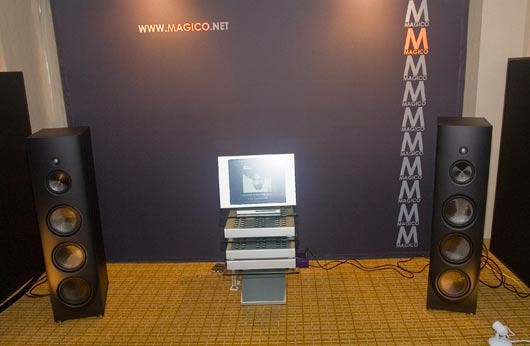
Magico / Spectral and Just what is this soullessness stuff anyway?

[See the Magico / Spectral room review in the last post]

What does it mean when a system is said to be soulless?

We will try here to describe ‘soul’ in some way better than the ‘know it when you hear it’ kind of way.

Can we design a system so that it will likely have soul? Or do we have to rely on that ‘miracle occurs’ luck that plays so large a part in high end audio these days?

The pat answer has been that tubes have soul and transistors do not. The technical specification junkies say, in a somewhat derogatory manner, it is the 2nd-order harmonic distortion of tubes that people call ‘soul’.

Certainly dropping a tube pre or amp into a system can often add soul – and a very few components like the Joule Electra amps and Audio Aero CD players *always* add a World of soul to any system [just hooked up the Audio Aero LaSource directly to the Edge Reference solid-state amps. Very soulful and very different than the Audio Note, or even Lamm, approach to tube-powered sound]

Some small part of soulful music may indeed have something to do with 2nd-order harmonics – but I believe that there are many technical aspects of tube sound that are more Real than what solid-state can typically reproduce. It is these technical feats that should give the solid-state folks some hope that someday that can match, and even surpass, what can be done with tube-based architectures.

What do we mean when we say a system has ‘soul’?

Essentially [love that word ;-0] it means that the emotional aspect of the music is readily accessible by the listener. In practice this usually means the emotional state that the musician is trying to convey through the music .. love, angst, suspense, release, anger, passion, etc. – often combinations of these and many emotions may be found throughout more complex [emotionally] pieces of music. When you realize that the number of possible emotions is a very large [uncountable finite if we are going to be picky] number – and that we have the capacity to vicariously experience and enjoy these emotions [even the bad ones. Horror movies anyone?] you can begin to understand why people LOVE to listen to music [and read and watch movies].

Soulless music reproduction systems, like that in the Magico / Spectral room at RMAF 2010, however, have little or no emotionally accessible component.

What technical aspects of musical reproduction are required to convey emotion?

After thinking about this for a long time – it appears that much of the emotional content [as opposed to the aesthetic content, an area where tubes also best solid-state] is found in the attack and decay of each note.

Suspense, for example, is the slight delay of the note relative to the beat of the music [which solid-state can do fine] combined with the swelling of the note in a somewhat more rapid manner so that the note at maximum SPL itself appears exactly on the beat.

It is [for sake of argument] the emotional importance assigned to the note attack / decay by the listener – the parts of the note that solid-state gets completely wrong [very slight exaggeration :-)] -that tubes [can] do well, that makes tubes able to convey emotional content so much more competently than solid-state.

In Conclusion

So, yeah, seems like systems have to rely on tubes have no soul.. But there is no immediately obvious reason why SS cannot someday surpass tubes. It is quite a challenge – but maybe, if these SS guys can get it into their heads that music has soul [emotion] and audio reproduction equipment should be able convey this to the listener [and that harmonic distortion is almost completely meaningless in the context of music (as opposed to ‘sound’)] then maybe they will get to fracking work and make SS amplification a Real contender in this hobby.

RMAF: Magico / Spectral

It took me awhile to figure out what to think about the sound of this system. I kept thinking that there was something hauntingly familiar about the sound.

It was very even top to bottom, even the dynamics were even-handed top to bottom. There was a lot of detail [midi-detail and macro-detail, micro-details were not glaringly absent, but they were weaker than what I would call natural]. Tone was good solid-state-ish tone. Harmonic resolution was typical for solid-state [aka not all that good, but it *is* solid-state]. There was good image stability and good separation – although something was happening during complex passages that seemed unnatural – like one channel was happening ‘before’ the other channel or something – that prevented that lovely effect of allowing one to hear every instrument as a separate entity when everyone is playing at once.

So. One interpretation of all of this is…

That this is a realization of the way I thought [and many still think] a stereo system should sound when I was a young geek. I was way into math and physics and the engineering sciences. I would have wanted a system that had as source material something as close to the master tapes as possible and recorded it in as high a resolution as was possible. Then I would have used a dedicated computer music server to deliver it to a solid state amp of low distortion, probably after passing it through a room correction device. Finally this system would have speakers that measured very, very well.

This is what I saw in this room.

Well, now I am an old geek.

This is not a derogatory perspective. And this system is not like TaCT which MANIPULATES the signal in the pursuit of some goal mathematically arrived at. The system in the Magico room tries to PRESERVE the signal by methods mathematically arrived at.

There are many reasons people buy audio equipment. If we break those reasons down into general categories we have the:

BOY’S TOYS: big and small noise makers. There are a fracking [the Battlestar Galactica Finale sucked so very, very much – but I like using their colorful words] lot of these at the show. [YG Acoustics/Soulution, Wilson/ARC, Focal/whatever, TAD/whatever, etc.]

COOL GADGETS: technology at its newest buzzword- and acronym-generating mind-expandingly best

PRACTICAL APPLIANCES: Systems that let one play music at home and be able to enjoy it to some extent

DRUGS: Systems that try to reproduce music in ways that ‘feed your head’ [yes, drugs may be too flippant a word, and we’ve used both MAGICAL and SPIRITUAL to describe this in the past. But I am trying to add a little humor and also to reach people who might think the previous words too ‘newage-y’ or just plain opaque]

Many systems mix and match various quantities of these 4 audiophile food groups.

I think the Magico system in the room at RMAF did the COOL GADGETS thing and that no one else is really doing it front-to-back like this. Many rooms do something like this – notably the Kimber room uses similar high-quality source material, but everyone mucks it up somewhere in the chain.

See, this system SOUNDED like a Cool Gadget system, and that makes it a grown-up BOY’S TOY. I think that if a system like this was marketed this way – that it might be quite successful with real people [you know who I mean. Those non-audiophiles that seem to appear out of the woodwork at grocery stores and can be seen walking down the street during the daylight hours].

That said, this system would be an example of what is commonly called a ‘soulless’ system. This was the primary comment people had about this room.

The Magico room system degrades into an impressive BOY’S TOY [mostly because COOL GADGET systems do not primarily connect one with the music so much as connecting one with the awesome world of technology].

I am personally interested in systems as DRUGS. I want to get high on my music. I want to experience new and intensely aesthetic perspectives on life and living. I want my system to be so good that I have no choice but to be forcibly projected into another dimension better than this one [:-) seriously, it is instead a more accurate and timeless view of the true reality of this dimension – that is too often obscured by the ever present noise of people yelling at us wanting to convince us of something. I SAID ‘seriously’… :-)]. I am too busy [to have the time to listen for hours before I get a buzz] and too worried about the world going to hell [the music has to be very powerful in order to work at all] and too cynical [the musical goodness has to be so good and so subtle and encompassing that it can sneak up on the nasty ole suspicious ‘nothing can brighten my day’ me]. And at the low end, I want my systems to smoothly degrade into being PRACTICAL [i.e. built on a PRACTICAL foundation] .

There is a point here I want to make. It is cool wanting and buying a COOL GADGET system. No question about it. Maybe someone just wants to have fun, or expands their minds in the old fashioned way 🙂 or whatever.

I just think it is important for people to recognize that systems have different purposes – and that lumping them all together is very misleading and confusing. That the more we identify and categorize [yes, I know that categorization leads to closed-mindedness – but, seriously, things are just too chaotic] the better it will be for people who want to enter this hobby. You know, just like cars are divided into ‘sports cars’ and ‘luxury cars’ and ‘SUV’s?.