
Pursuing the ultimate sound for a single song…

… or band… or genre.

Or, for many people, a set of test tracks that they use over and over.

Whenever I get to catch the Grateful Dead Hour on the car radio, I think we should just make sure our system does great Grateful Dead. There are 1000s of live shows and a steadily growing catalog of official releases, so quite a body of work. The Dead, 24x7x365.25.

Neli actually did this in an earlier life and on a budget. Klipsh speakers and Adcom electronics. You can imagine how it does kind of approach concert like dynamics and volume. And when you are young [excepting this latest generation], the idea of playing a stereo at below concert-level volumes just seems… well, wrong.

I’ve often thought that our previous system, especially with the EMMLabs digital front end, was optimized for Dark Side of the Moon. It just presented that song in such a magical manner that worked on so many different levels: intellectual, emotional, hormonal, and practical audiophile levels. Yummy.

And many audiophiles try and optimize for Classical Music.

Before the Acapella Atlas speakers got here I was fixated on making Imagine Dragon’s Radioactive song sound as good as I could get it: My Imagine Dragons ‘Radioactive’ playlist.

I know this is wrong, intellectually, from a system designer / optimizer’s perspective. But there is still this really strong emotional need to make the system sound really good for My Music.

Which, you know, changes. But that is all to the good.

What this is not is having to ‘change what you like’ because nothing else sounds good on your system. So many audiophiles just play 4 piece jazz, or 3-piece Jazz plus female vocal. They act like this is their favorite music. Great music, sure. Enjoy it myself.

But seriously? I am sure there are closet Death Metal enthusiasts, for example, who are audiophiles, but they have been told to not optimize for Their Music so they go along with the small jazz program.

So, as we optimize the Atlas speakers, we try to just make them sound their best, of course.

But darned if I don’t stick in my favorite music a lot to see how IT sounds. 🙂
Rigged. Corrupt. A Joke. Olympic Ice Skating: Sochi 2014

For many this is now obvious after the women’s single ice skating competition.

After seeing the rigged doubles ice dancing competition a few days ago, and the “very, very, VERY generous” scoring of the single’s short program yesterday – today’s competition was unwatchable. I mean, it is just so embarrassing – I personally could not stand to win something like a gold medal this way.

After seeing how the judges scored the Canadians Kaitlyn Weaver and Andrew Poje doing their long program two days ago – it became obvious the technique the judges were using to pump up who they had agreed would win. Essentially: take every opportunity to deduct points from the scores of the potential serious competitors and be very, very generous when scoring the person that is ‘going to win’.

[ I think the results for the couples ice dancing should have been more like:

1. Kaitlyn Weaver and Andrew Poje (Canadian)
2. Ekaterina Bobrova and Dmitri Soloview (Russian)
3 (or 4) Meryl Davis, Charlie White (USA)

and for the women singles ice skating:

1. Yuna Kim (Korea)
2. Carolina Kostner (Italy)
3. ?
]

There does seem to be some hullabaloo now about the rigging of the singles competition [the Toronto Star says it was a collusion between the US and Russian judges, helping give each ‘firsts’ for gold medals in these respective competitions]. The singles competition was broadcast during prime time tonight, so everybody got to see how rigged it was. Big mistake, guys.

But the doubles ice dancing was just as bad – it was just that the top two couples where not shown during prime time (they were shown in the afternoon on a NBC subsidiary channel) – so not as many people caught on to the corruption. [Sneaky huh? :-)]

How does this relate to high-end audio? [there are no competitions this important, no where near this important, in high-end audio. So any collusion to pump up a brand or product is kind of swamped by the competition doing the same thing for another brand or product].

It relates in this way….

One of the ways I used to verify to myself that the couples I thought were best really were best [besides just rewinding TiVo :-)] was to watch the skaters in slow-mo [as NBC showed us after each couple skated] and to look at still photographs. The couples I thought were best looked like they were performing magic, even when frozen in a photo – the winners like they were working out in our gym [lots of grimaces, shaking muscles, visible preparation and deep breaths before they made a large movements, etc. ]

I would include photos but I fear the Olympic Committee and NBC would send a nuke out our direction if we did.

Is there a way for us to evaluate the sound of a hifi in this way? You know, in addition to listening?

1. J.A. obviously thinks his technical measurement graphs do this – and they do to some extent, the precise degree however being up for debate.

2. One can get some mileage with the ‘listening from the hall or another room’ approach, which can show up timbre and even dynamic problems.

3. A 5 seconds or longer clip of a passage of a song might be interesting, like a photo, and reveal enough about the sound of a system. I.E. if this clip includes a vocal [naturalness, timbre, emotion], a dynamic percussive impulse [macro-dynamics, decay], violins or something requiring resolution to render correctly [resolution, duh], and lots of stuff going on in the background [separation, ability to handle complexity] – then 5 seconds should be all that it takes.

4. Spectral graph? I know people are using these to find 16x44kHz mascarading as 24x92kHz. Can they tell us anything else?

Anyway, it is up to us, the crowd, to police the powers that be to keep things on the up and up. Or at least scream when we see it is not.

Price Performance in High-end Audio (and elsewhere)


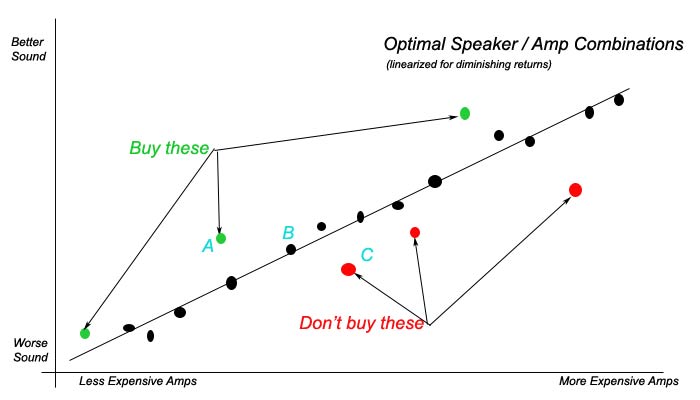
What this graph shows, is that, for a given speaker, different amps provide various degrees of sound quality.

The more expensive the amp, the better the sound quality… on average… and that adjusting for diminishing returns (paying twice as much does not usually result in twice the sound quality), most amps perform more or less where they should based on their price [i.e. their performance point lies on the ‘line’ which represents average performance for a given cost.].

But, as you can see, some amps under-perform at the price point [for this one hypothetical speaker] and others over-perform. Assuming you are not loony tunes – you will probably want to spend your hard-earned dolluhs on one of the over-performing amps. Or at least on one of the average performing amps.

Note that what we are showing here is a graph that says performance is directly related to sound quality. For many people, there are other things that they consider when buying an amp. Things such as appearance, provenance, brand, resale value, marketing slogans, discounts, technology, social network buzz, maintenance requirements, and other such things unrelated to sound quality.

Another thing which attracts peoples attention away from the basic truth of graphs like this, which is applicable in many other domains besides high-end audio, is the relationship between amps A, B, and C. This rare but real anomaly [and originator of so many conspiracy theories and misinterpretations about the way capitalism works], is where A is less expensive than B, and B less expensive than C, yet A outperforms them both. In this contrived example, the manufacturer of A has made a mistake [possibly on purpose if they are altruistic] and under-priced their amp and manufacturer of C has over-priced it [definitely on purpose]. The manufacturer of B has priced their amp just right.

Many people who cycle through amp after amp after amp, all they are looking for is an over-performing amp in the ‘A’ position, or maybe even in the ‘B’ position if ‘C’ is very popular. It makes them feel so good to have an over-preforming amp [or other over-performing component] that they spend [lose] $10’s of thousands in buying and selling amps just to find this particular one. Of course, in a perfect world, dealers and the press should be pointing out these over-performers so they would not have to waste all this money and time [and Mike Fremer does do this in turntable land] but it is almost unheard of them to do so – perhaps because they do not hear a lot of the candidates in a particular market segment to get a feel for where that average price-performance line is, or, unfortunately, because they cannot understand and categorize what they are hearing in a quantitative way.

The concept of this graph was brought up in the comments a little while ago, and we may continue to explore this graph, as we did in those comments, to nail down other component to component relationships that are kind of murky.