The Cogent True-to-life Horn Speakers at CES 2006

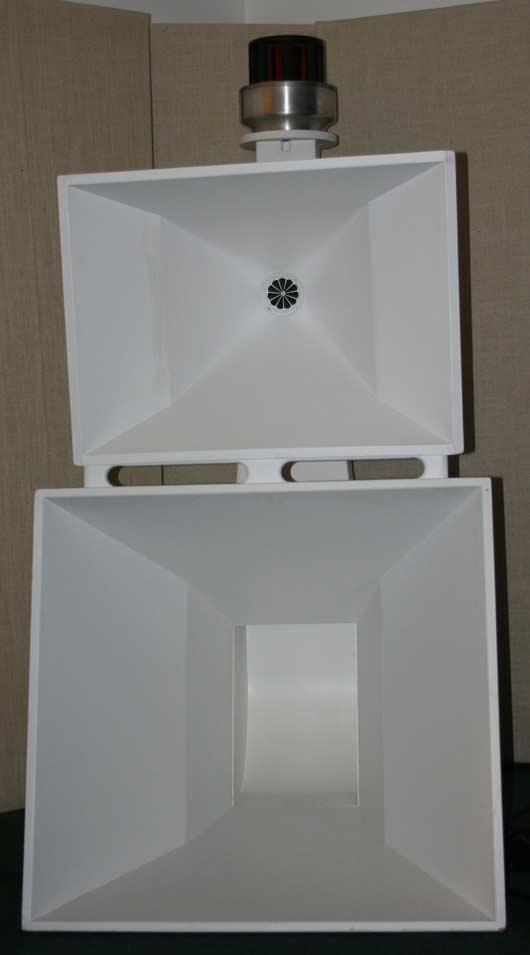
Two large white squaring horns, one on top of each other, for each speaker

Still thinking about these speakers and what their impact is going to be, both on me personally, and on our industry and audiophiles in general.

Although the speakers had numerous problems (speakers did not dissapear in any way, horn resonances and reflections along with buzzing and dullness in the subwoofer and no real highs to speak of) they did some things so very, very well that it makes me wonder…

These speakers were one of the very few (two?) horn speakers that do not have offensive, to me, horn colorations. They reproduced transients in their target frequency range effortlessly. These kind of REALISTIC (not overly exaggerated, not compressed and muffled) transient details we have heard only with the best speakers: Marten Design Coltranes, Kharma Midi Grandes (with the Tenors), and the Acapellas can do this – usually requiring very careful amplifier pairing and it comes off not quite as effortlessly – often with more of a ‘the speaker is gripped really hard by the amp’ sound. The SPACE aorund the microdynamics was awesome. The timbre was very, very rich. The sound was very big and open (somewhat an artifact of the nearfield listening position).
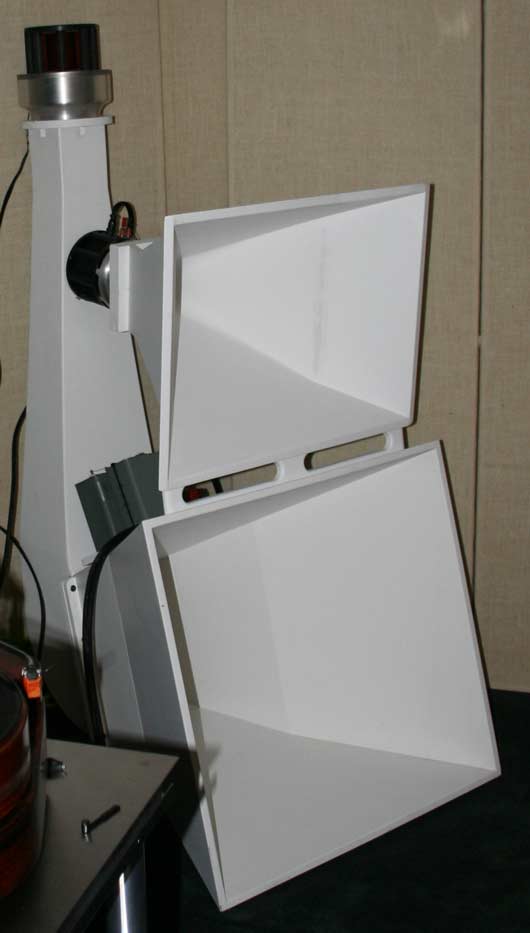
Two large white squaring horns, one on top of each other, for each speaker
So, did you notice that I am describing sounds and not music? Nothing about whether a piano sounds like a piano, whether sounds were properly positioned and imaged in a realistic soundstage (it was not too bad, as Radiohead Amnesiac played back well and that first track stresses this exact thing, amoung others….:-)), whether the dynamics was balanced between the quiet sections and the loud, etc. etc. etc. Whether these are done well, poorly, or excellently, I cannot answer given the extreme nearfield listening position and because I was, addmittedly, hypnotized by other aspects of the sound at the time of listening.

A Mythical Commercial-Quality Speaker Built Using Cogent Hardware and Designs
Two large white squaring horns, one on top of each other, for each speaker
Will audiophiles like and buy such speakers? Their ease of drivability with even modest sized amps and their kick-ass dynamics seems to be a win win situation. The problems as I see it are the lows, the highs, and the appearance.

The lows at CES were produced by a very large folded horn subwoofer. This configuration will just not be acceptable to most people. So integration with a common standalone subwoofer would be required. It would also be great if the Cogent speaker went down to 30 Hz. so that the speaker could stand-on-its-own without requiring a subwoofer but this may be impossible while still keeping the rest of the frequencies pristine.

The highs were absent; as I understand it everything above 10K Hz was left to the listener’s imagination. One of the numerous super tweeters, for example the Corona plasma tweeeter, could, however, be paired with the Cogent horns to provide the necessary high frequencies.

The appearance, which is already quite good and certainly better than all of the GOTO and ALE horns I could find on the net, is still not as livingroom friendly as most people would probably prefer. But a little work on the paint job, using a composite material instead of wood for the construction, a nice veneer, and perhaps adding a little curvature to both strengthen the horn to minimize resonances and to minimize those reflections of sounds off of the room back to the horn and then back to the listener’s ears.

So here we then have a speaker that uses 3 different technologies, each the best at reproducing music in its frequency range. Integrating these different technologies into a seemless whole will take work and genius. Sound familiar?

These will also be expensive. Figure a minimum of $50K for the horns (it costs $32K for the drivers alone), $5K for the subwoofer, and $5K for a super-tweeter. $60K is expensive – and a speaker this expensive will probably require a dealer network, so add some on top of the $60K for that.

So, the answer to my question – will this be really popular with audiophiles, is I do not know (I know, all this and I cop out at the end. The real answer is yes, for some audiophiles, yes. But Wilson Audio does not need to get too worried yet). There are a lot of weird speakers out there in the $60K to $100K range – with a lot less potential than this one.

Further reading on the Cogent horn speakers at CES:
Audio Asylum

A funny thing happened on planet Abraxas

The first track on Santana’s Abraxus, “Singing Winds, Crying Beasts”, is one of our test tracks.

This track has revealed some supposedly top-flight systems to be incapable of managing the etheral ‘sound angels’ flying in and out and around the soundstage.

Abraxas cover photo

While listening to the Marten Design Coltrane Supremes I was struck with the a very interesting, some might say bizarre, 3D impression of some of the notes in this song. Now, this happens to me a lot when I am falling asleep, Jazz and Classical music seems to not be ‘heard’ anymore but instead transformed into moving, interlocking 3D soundscapes that I fly around in.

Hey, those white coated fellas can just stay where they are, thank you anyway.

But in the Marten Design room at CES, I was awake! I mean it WAS the last day of the show and all, but seriously….

Triolons
O.K. First I will describe what I usually see when I hear the sounds, in this case, the tiny bells that kind of fade in and out at various places in the soundstage during this song, while listening to the Acapella Audio Arts Triolon Excalibur speakers.

What I see is this:

It is right after a fresh snow, and it is very cold so the snow is not sticking to itself or anything else, it is very fluffy but not so fluffy that it does not have a good ratio of water to size. The sun has come out and is shining on a large number of very tall pine trees. A gentle breeze comes up and sends a number of snow flakes dancing, as they are wont to do, in all directions: up down swirling bouncing gliding…As some of the 100s of flakes hit the rays of the sun that are penetrating through the bows of the trees, the flakes ‘light up’, temporarily, in a prismatic flash of dozens of pure colors alternating with pure white snowflakeshine, before they are again returned to invisiblity as they reenter the shadows to be replaced by a 100 others. These flakes are small, about 1/2 inch or smaller.

These sparkling, flashing swirling colors popping in and out of existance is what I ‘see’ when hearing these bells. This more or less seems like a normal kind of thing to ‘see’, to me, and corresponds pretty well to the ‘type’ of the sound. To me.

Supremes
But. The Coltrane Supremes….

What I ‘saw’ was weird, man.

What I saw were these aluminum things shaped like Cheeto corn chips, in kind of an unpolished silver metal color varying between 1/2 and about 2 inches long and about, I guess, 1/8 inch thick. They kind of faded into existance, moved a little bit closer then a little bit away from me, rotating a perhaps up to 45% during this time period, before they faded out again. There was a gentle diffuse white light playing on these ‘bell chips’.

I cannot let myself beleive that the resolution was so good in that room that I was ‘seeing’ the sides of the bells as the overall sound outlined their shapes as it bounced off them and into the microphone. I mean, SACD has a lot of detail, but this is crazy.

Anyway, I wonder if other people sometimes see music as ‘things’.

And I also wonder if sometimes they also experience visual musical shapes that sometimes come unbidden and are shockingly different from what they normally ‘see’. While they are awake.

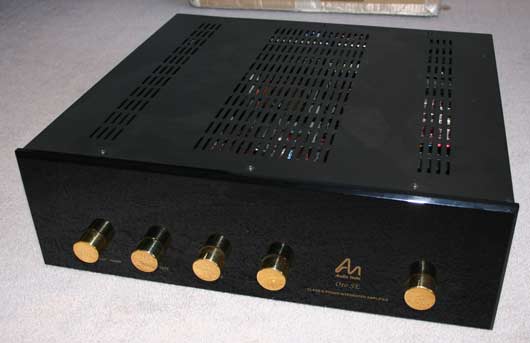
The Audio Note U.K. OTO Integrated Amplifier

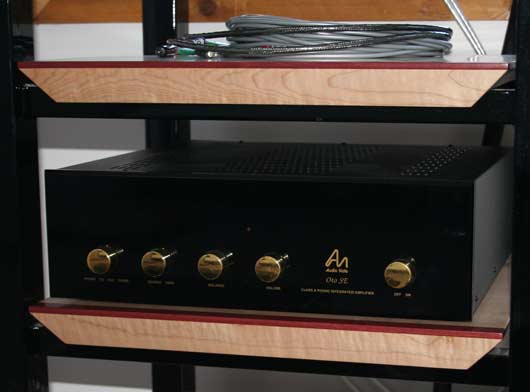
We had the Audio Note OTO SE here for a few days before it went out on audition. The OTO is a 10 watt Class A single-ended EL84-based integrated amplifier. The one we had here had a phono stage and retails for $3100.00.

So, we thought, what the hey and put it on one of our hardest to drive speakers (second only to the big Sound Lab U1 electrostatic speakers), the Acapella Violon High Sub.


Here it is on the Rix Rax driven by the Audio Aero Capitole MK II (it is not actually hooked up in this picture as we had a Violin audition and needed to show just what it was capable of and used the $20K Lamm ML1.1 mono-block amps for this purpose).


A close up of the OTO on the equipment rack.


The front of the OTO. You can kind of see the inside of the OTO here. There is a lot of stuff in this chasis, this thing is heavy! 30 lbs if it is an ounce – but that is just a guess since I had to carry it down the 45 steps.


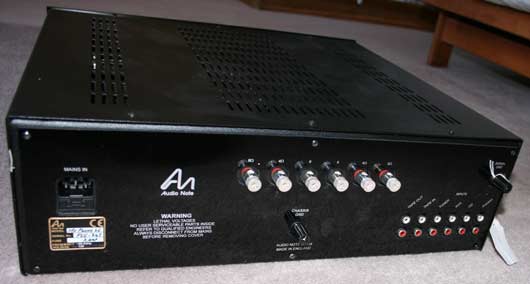
The Rear of the OTO


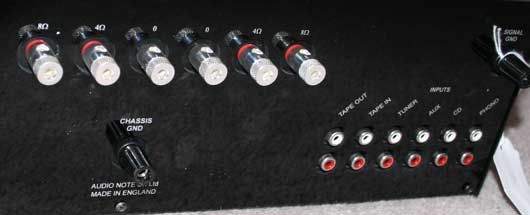
A close-up of the rear of the OTO.


A close-up of the controls of the OTO.

The OTO actually sounded pretty darn good on the Violons. We heard the OTO, driven at that time by the Audio Note U.K. CD2.1x CD player (discontinued. Only $1000 but was about $1750 new, also out on audition, so no pics, sorry), right after CES and at low volumes (it IS only 10 watts) that system was better than most, well 99.9%, of all systems we heard at CES.

Yeah, this at $52K (not including rack) , is an expensive system including $48K speakers and the rest on the OTO, CD2.1x and Audio Note cables … oops and add a couple of $K for Shunyata power cords – but is was just so pleasant and musical after the sonic hysterics of CES.

The little CD player had less bass than the Audio Aero, which kind of worked well on the Violon High Sub (with built-in isobaric subwoofer) in that small room.

There were a few tonality problems, and it ran out of steam when we got it to around 90dB or so. But if *I* had only $53K or so, and a small room, and I knew I would be able to upgrade the upstream components later and get a larger room… This somewhat lobsided system would be near the top of my list.

Maybe we should do a piece on lobsided systems – usually I think the key to the best sound is Balance Balance Balance (you Brinkmann Balance turntable fans can stop smirking now :-)).

But it seems there are always special cases.