Hyper Fidelity

Joe Roberts commented, back a few posts, that “…there is more detail coming out of many speakers than was in the original musical performance…” and that “balance is the key”.

This is a commonly expressed sentiment – and this post is not directed at Joe [ 🙂 ], but to all of us who enjoy music reproduction and wonder about why we enjoy the things we do, and don’t the things we don’t.

I think [I hope] we can all agree that balance is the key.

But is there indeed more detail?

Hopefully we can also agree that there is not MORE detail [the software and computing power to do this is not something your typical high-end audio manufacturer is capable of] but that the detail has added emphasis.

I would suggest we try and break the question up into several easy questions:

a) Do some systems make detail easier to hear than others. Yes.

b) Do some systems make detail HARDER to hear than the original musical performance (OMP). Yes. In fact most.

c) Can some systems make detail too easy to hear (over emphasizing detail). Yes [even if they have LESS detail than the OMP].

So these easy questions aside, we are left with the crux of the issue:

1. Can a well-balanced system emphasize detail and still be well-balanced?

2. If so, is this such a bad thing?

I want to suggest that these two questions are related and that for a set of listeners whose membership includes people besides myself – I hope! – a well-balanced system can emphasize [but not OVER emphasize] detail and be a good thing.

As an example I want to use the single pluck of a guitar string of an acoustic guitar. The amount of information, detail, is enormous as the other strings vibrate in harmony and dis-harmonies and their sound echos and reverberates in and out of the guitar body cavity, the vibration of the string against the frets [if struck hard enough], the change in harmonics during the long long decay. The strings, the GUITAR! actually throbs as it resonates [you can feel it through your body if you are holding the guitar].

So now, what if we have a system that is quiet enough, and sensitive enough to not only pick up this guitar throbbing but makes it easy for us to hear. But is it TOO easy? Or should we have to strain to hear what is there?

If you go to Guitar Center and go into their humidity-controlled room and play with the acoustic guitars there, especially old used ones – just walk up to each one and pluck a string with your finger, then listen, then go to the next, pluck it, …

There is an amazing amount of difference and some [my favorites :-)] will resonate, throb, much, much more than others. I LOVE this.

Now say you have a friend drive you to guitar center, because you have been imbibing your favorite mood-alerting substance. Now, NOW your brain will resonate along with the guitar, the walls will throb along with the guitar like the walls at the end of The Matrix, the decay will last weeks and weeks [YMMV :-)].

This is because, if you imbibe the right stuff, :-), you will find yourself much more focused on the particular sounds, so focused it kind of hurts. The fact that your license expired 2 months ago and you are still driving around anyway? Not something no way no how as important as the the observation that the harmonics of each guitar seems to complement the patina of their wood. The sound has not changed at all – just your quality of focus.

It has been my experience that at most live events it is extremely difficult to focus on the sound and it is much easier to focus on various aspects of the sound in private at one’s leisure.

So 1) if you can Itzhak Perlman in your living room, playing and stopping, rewinding himself, playing some more, adjusting volume to your liking, etc. then there would be a lot more subjective detail than what one hears when sitting in the middle a live performance with several hundred other soft protoplasmic blobs wrapped in soft cloth distracting us with their unfamiliarity.

And 2) if you were able to focus much more intently – or cheat [e.g. wine lending much more harmonics] – there would be a lot more subjective detail than what one hears in a more casually focused, mindset.

So A) in some sense Druglike sound – for those of us not imbibing – requires the sound to emphasize reproduction of those things that are special, that are there somewhere in the OMP, that trigger interesting mental states of mind…

And B) I forgot what B was supposed to be 🙂

The main complaint about hyper fidelity, like all complaints about sound reproduction, is that it can sound unnatural. That it detracts from the Believability Factor. But I think what is ‘natural’ depends on one’s state of mind and one’s expectations [is the guitar an ancient Gibson or a new Stella?].

In a large sense, for me, a hyper fidelity system allows one to focus on ANY part of the music, stone cold sober having driven home after a hard day’s work in 2 hours of stinky traffic, and see it in as much awesome vivid wonderful living detail, as one would be able to do after imbibing a liberal amount of one’s favorite substance while on vacation for a month in Hawaii [or as one would hear it if Miles Davis was your closest friend, cracking jokes about your appearance, playing at his best while you put your feet up on your fave couch in your holey underwear].

One can compare this to photography – where a great professional photo of, say, Einstein [usually] brings out so much more – so much more depth and character and … detail… than an amateur photo taken with a Brownie camera. Same reality, just different technique and hardware. There is a zone where, with just the perfect amount of lighting and shade, it is still ‘real’ and yet communicates so much more than even a typical face-to-face with the Professor in real life [well, assuming he was still alive, of course].

We usually use the term ‘Enjoyable’ for sound that is by definition not hyper fidelity, and is not designed to trigger adrenaline rushes (Boy Toy) nor altered states of mind (Druglike). Just something to listen to music on and enjoy for what it is.

A lot more to say about this… but later….
Building systems around a component that is so very precious but not to one's taste

Noticed a lack of response to our lists of Bests and Most Respected…

Is it because:

1. Everyone is overwhelmed with 100 pages of 10 referenda per page voting materials?

2. Everyone agrees 100% with the lists of Best and Most Respected we have proposed?

3. Everyone does not know why the heck we are even talking about this?

To try and clear up those who classify themselves firmly with #3 above…

We have talked over and over about how different people are seeking different kinds of sound: Druglike [me :-)], Boy Toy [boom and sizzle], Gee whiz [cool tech, often related to Boy Toy], Enjoyable, etc.

We all have components sometimes that we love so much we expect to be buried with them… but as often as not, these components do not actually match our sonic preferences. Strange… but oh so true.

—–

OK. Now let’s pick on everyone’s favorite [at least it was 6 months ago] speaker d’jour, the Magico Q5.

What if…

This prototypical Gee Whiz speaker was paired with front-end equipment and made to sound… sweet (say)? Or Enjoyable? Or Druglike?

In my experience and to a large degree, this is indeed possible.

What if when an audiophile went into a dealership, and was looking for the Q5, they were presented with several systems with this speaker: with one sounding Enjoyable, one Druglike, one Boy Toy-like?

Then they could hear what the speaker sounds like in systems 1) designed to show off various strengths of the speaker and 2) with a sound that appeals directly to their particular preferences [assuming their preferences lie pretty squarely in the Enjoyable, Druglike, or Boy Toy-like sound categories].

——

OK. Back to the lists of Best and Most Respected.

The idea here is that when people come in looking for a product, say ‘X’, to be able to be able to show them, not a system thrown together to kind of sound ‘OK’ [usually a boom and sizzle Boy Toy] that happens to have ‘X’ as a component, but to show off ‘X’ in its best light, in fact in several different ‘best lights’.

This is opposite to the unethical well-worn cross-sell strategy where you show off ‘X’ in its WORST light in order to sell them ‘Y’ instead.

This is also different from the optimal strategy of trying to illuminate the audiophile about what components out there match their sonic preferences. Teaching is thankless job #1 in all the universe.

Here, we go ahead and sell them ‘X’ [or encourage them to keep ‘X’], which they actually seem to want [people often being reviewer- and forum-driven in their decision making process and get pretty damn convinced], and at the same time show them how to get the most out of it in a way that suits their individual taste.

For a more concrete example, say an audiophile is like me, they want a druglike sound, but they also want the Magico Q5, being impressed, like me, with the build-quality and design approach. Instead of just sending them home with the Q5, having them be unhappy because their current system does not generate a druglike sound using the Q5, and all that wonderful information on the web is geared toward, guess what?, making Boy Toy sounds with the Q5 – we show them an actual druglike system with the Q5 – they go home happy knowing they can have the Q5 *AND* the sound they actually like.

Are all speakers [or amps, or…] created equally able to be Boy Toyish, or Druglike, or Sweet? Not exactly, but perhaps more so than is commonly portrayed.

Can all be made to be druglike, or Enjoyable, or Boy Toys? If you spend enough money I am certain the answer is yes. [Otherwise, it takes a lot of work and experimentation, which might cost the same in the end]

——-

OK, back to the lists.

The idea is that, for cost no object systems, a person can actually purchase a component somewhat unsuited to their actual tastes [because they just freaking want to – i.e. they are a common, garden-variety human being], and still achieve a system sound that they really like [if they tailor the rest of the system, accordingly].

The lists, then, are the superset of all components that people either 1) want, or 2) need in order to get the sound they desire from the components they want.

—–
Hope this helps explain what the Best/Most Respected lists are about anyway…

This chain of logic is actually just common sense, if somewhat audacious and kind of upside down to the way people usually think about all this … 🙂

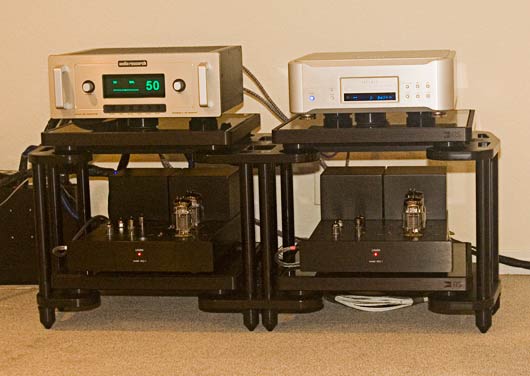
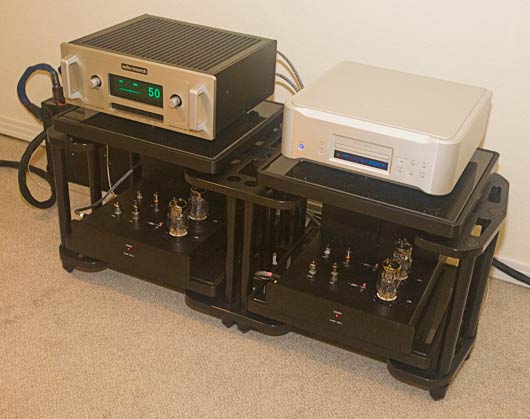
Lamm ML2 amps on bottom shelf of HRS SXR equipment rack

In order to form a more compact system one can do several things, many of which, however, lead to a compromised system sound.

Compact systems are still desirable for a number of reasons: ease of use [being able to walk right up to the source components], aesthetics [components strewn about can result in a geeky aura around your system ;-)], and they just help make more room for other things in the sometimes all-too-crowded listening room.


Lamm amps on a SXR rack

Here is something that improves the sound AND reduces the footprint of the system components: Putting ones amps on the equipment rack itself.

Here is an example where we put Lamm ML2.1 amps on the bottom shelf of a Harmonic Resolution Systems SXR rack. The bottom shelf is 12 inches tall [it was originally 10 inches, but we ordered replacement 12″ posts and swapped them out in about 1/2 hour(?) – photos forthcoming]


Lamm ML2.1 amplifiers on a SXR rack

The reason this kicks ass is that the HRS amps stands [which have no peers performance-wise based on our experience with the top contenders to-date and work as normal amp stands that sit out in the middle of the floor], are the EXACT same components as used for the bottom shelf of the SXR.

So essentially we are morphing, Transformers-style, an equipment rack into a combination first-class amp stand and equipment rack.

And, because the amps are somewhat better protected by the rack, and more out of the way of the speaker sound waves, this is probably an even better place for them than the traditional amp stand location [a less sturdy rack, however, might itself pick up vibrations from the sound, and then transfer these negative vibrations to the amp through the rack, something a stand-alone amp stand would not do].

And it looks cool too.

And it takes up a lot less space 🙂