
CES 2012: TigApp's Audio Audit

[Another news flash from the CES 2012 news deluge. I’m not an Apple guy anymore – but perhaps one of you might find this, currently free, app of use. It seems to me that if your only source in your system is an iThing, then this app would be invaluable. Also, if the iThing’s microphone is any good, then having a frequency analyzer with you at all times would be a heck of a lot of fun – especially at shows. English does not appear to be their native language, and I am somewhat confused by what their target use cases[s] are beyond possibly these two].
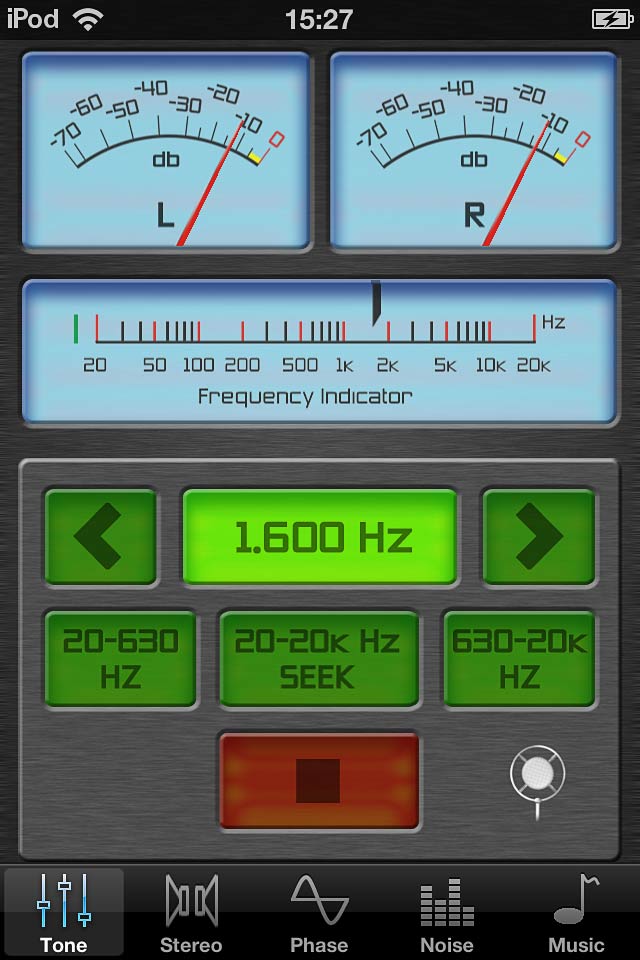
“TigApp is a young and dynamic company which develops applications for the iPhone, iPad and iPod.

This application is focused on testing different audio systems for home and professional use.

The application serves as a reference generator of sounds or records for the purpose of setting up, testing and burn-in speakers, headphones and Audio components.

This application comes to the AppStore December 23, 2011 and will be free for a limited time.”

From the TigApp website:

Frequency generator

generates sinusoidal frequency or swap sinusoidal signal for testing

Noise generator

generates white, pink, brown, human and silence noise

white noise – noise containing all frequencies in the range defined by the same volume
pink noise – containing all the audio frequencies with a defined volume falls off at 3dB per octave
brown noise – containing all the audio frequencies with a defined volume falls off at 6dB per octave
human noise – containing all the audio frequency range with a defined volume adjusted according to physiological properties of the human ear
silence noise – white noise with reduced volume
Adjusting of the stereo base

when right speaker is on the right side and left speaker is on the left side – it’s OK

Indication of inverted phase

control of the inverted phase (swap of the plus and minus cable on one speaker)

Records for testing

music with the full spectrum frequency range for testing

Microphone

for ambient testing

Detail information

“Analogue” indicators:

Peak indicator – red color (-75dB – 0dB)
RMS indicator – black color (-75dB – 0dB)
Peak and RMS indicators for the left and the right channel

Frequency generator

Sinusoidal signal of frequency (1/3 octave scale, Peak -12dB, RMS -15dB):
20Hz, 25 Hz, 31Hz, 40Hz, 50Hz, 63Hz, 80Hz, 100Hz, 125Hz, 160Hz, 200Hz, 250Hz, 315Hz, 400Hz, 500Hz, 630Hz, 800Hz, 1000Hz, 1250Hz, 1600Hz, 2000Hz, 2500Hz, 3150Hz, 4000Hz, 5000Hz, 6300Hz, 8000Hz, 10000Hz, 12500Hz, 16000Hz, 20000Hz

Swap sinusoidal signal: 20Hz – 20000Hz (logarithmic course, Peak -12dB, RMS -15dB)
Swap sinusoidal signal: 20Hz – 630 Hz (logarithmic course, Peak -12dB, RMS -15dB)
Swap sinusoidal signal: 630Hz – 20000Hz (logarithmic course, Peak -12dB, RMS -15dB)

Noise generator

White Noise: Peak -10dB, RMS -15dB, frequency range 20Hz – 20000Hz)
Pink Noise: Peak -2dB, RMS -15dB, frequency range 20Hz – 20000Hz)
Brown Noise: Peak -2dB, RMS -15dB, frequency range 20Hz – 20000Hz)
Human Noise: Peak -2dB, RMS -15dB, frequency range 20Hz – 20000Hz)
Silence Noise: Peak -55dB, RMS -96dB, frequency range 20Hz – 20000Hz)

Adjustment stereo base

Bass Drums L: left side (Peak -2dB, RMS -15dB)
Bass Drums R: right side (Peak -2dB, RMS -15dB)
Bass Drums L-R-L: transition from left to right side and back (duration 30s, Peak -2dB, RMS -19dB)
Treble Drums L: left side (Peak -1dB, RMS -16dB)
Treble Drums R: right side (Peak -1dB, RMS -16dB)
Treble Drums L-R-L: transition from left to right side and back (duration 30s, Peak -1dB, RMS -21dB)

Indication of inverted phase

Guitar-normal: phase in order (Peak -0.3dB, RMS -14dB)
Guitar-Invert: right channel inverted (Peak -0.3dB, RMS -14dB)
Cool-normal: phase in order(Peak -0.3dB, RMS -13dB)
Cool-invert: pitch channel inverted (Peak -0.3dB, RMS -13dB)

Test records

Classic: duration 30s, Peak -0.3dB, RMS -15dB
Cool: duration 36s, Peak -0.3dB, RMS -13dB
Guitar: duration 36s, Peak -0.3dB, RMS -14dB
Jazz: duration 36s, Peak -0.3dB, RMS -15dB
News: duration 38s, Peak -0.3dB, RMS -15dB
Road: duration 50s, Peak -0.3dB, RMS -16dB
Microphone

Precise graphics indicators for the both channels (from -22dB to 0dB, step by 1dB)

CES 2012: AfterShokz ear phones that do not go into the ear

[Getting a TON of news from CES this year. Very rarely is something somewhat relevant. Here is one of the ‘somewhat cool but still not exactly relevant’s]

AfterShokz is a brand new company on a mission to change the way the world listens to music on the go — with ear-free headphones that transport sound through your cheekbones. They’ve used patent pending bone conduction technology (initially developed for military special ops) to create the ultimate sports, mobile and gaming headphones. Benefits for users range from basic comfort, to long-term eardrum health, to increased safety during activity. This technologically-advanced product line will be available to the masses at everyday price points in time for CES — innovation yet to be matched. The flagship product (Sport) is currently one of the most popular semifinalists in the Last Gadget Standing competition: http://bit.ly/tLkmxA. “

The Right Song at the Right Time II

We will now look at The Right Song and how it is able to affect us so deeply from a more abstract viewpoint.

We talked some time ago about how the patterns of notes in music [especially classical] mimics the patterns in reality and how listening to music can somewhat subliminally show us patterns that are occurring in our life – some of which we may not be all that aware of – helping us experience life more deeply and sometimes even helping us solve problems by revealing patterns that make the subtle relationships between the things we are dealing with more clear.

Patterns [I think of them as weighted undirected graphs mapped into a 2D projection, because I am more comfortable with 2D than 3D. YMMV.], in this context can mean professional relationships between you and your co-workers, between the various priorities in your life, between your kids multitudinous kinds of ‘success’ in life and their overall well-being, … it can be just about anything. Perhaps you might think of these patterns as fractals [fractals have been matched to many patterns that organic life presents to us].

Back to The Right Song, and cutting to the chase, one can think of the patterns in the Right Song matching some kind of matching need for this pattern in the mind so that when the two come together, it is quite pleasurable. I think of this as two, very complex puzzle pieces, one being the Song and one being your current state of mind, and they fit together more or less perfectly. Or I think of it as two molecules, thinking back to high school chemistry, with one missing a few electrons [the brain] and one with a few extra electrons [the Song] and they come together to form a 3rd molecule [a happy brain].

In these two senses, the Right Song ‘completes me’ [back to Jerry Maguire again? And, no, I haven’t watched that movie for a year so this is NOT a Jerry Maguire inspired post. Or at least I do not THINK it is. Better go listen to some classical music… :-)].

One reason hifi works so well in making us feel good is that many more complex patterns are made audible in a given piece of music compared to what lofi reveals. With more patterns there is many more opportunities for the music to ‘fit’ the ‘holes’ the brain is producing.

We now another perspective on Druglike music:

Some high quality audio is just able to stimulate the brain in some areas and relax it enough in others enough that we experience wonderfully expansive states of mind.

The perfect song is a piece of music we are receptive to Right Now. It will have The Most Impact on us at this time.

But we also carry around with us medium term and long term patterns of receptivity [the sizes and shapes of the puzzle pieces of our mind], making us especially susceptible to enjoying certain songs and certain types of music.

So we can stimulate our minds to special states with high-quality hifi music, or we stimulate our minds with the Right Songs. Or we can do both – and at the same time.

Open questions are

A) how to determine what your Right Song is at this moment. More generally, is there a way to determine what your Right Music is at any given moment?

B) Is there a way to put yourself into a receptive state for a particular song or music? [e.g. you are going to a Stones concert. Or a rendition of Nelson’s Mass. Or you just got a new Bjorn CD]

One potential solution to A) is, maybe, to rapidly play small snippets of songs [say 2 sec each?] and have the listener stop and listen to a song when they Think it is The One, or use some kind of biofeedback so that our brains automatically pick The Song. Software that supported this feature would have as a side-effect a new kind of ‘sampling music’ where people would listen to only parts of [potentially] dozens of songs each minute they are listening. Obviously some kind of streaming or disk-based audio system would be required as the back end.