
The New Audiogon

According to the vocal hordes on the Asylum and AudioCircle … nobody likes the New Audiogon [right now it is down, although you still can get to the forums if you are sneaky].

Having been on the receiving end of the ire of the same vocal hordes [e.g. w/r to Spintricity Magazine] seeing this happen to Audiogon is really fascinating. And we have also seen this backlash happen to Digg and Facebook, but not Twitter [which is bizarre because the Twitter UI changes by-and-large are non-intuitive, even after repeated use… much more like Facebook now, in fact]

It is fascinating because I think it allows us to rule out the validity of this or that particular feature and instead focus on the social dynamics of the situation.

Fact #1. Only techies like websites to change in any way

Many people claim to be techies, because they own a business that has a website, or they played with HTML some [and many have gotten paid for it!] , but really are not, are confused by web technology, and hate these kinds of changes. [This behavior really confused me for a long time]

Twitter is largely techies, so they got away with it. Digg, a counter example with supposedly a large techie population, has lots of people who, seriously, just like to be nasty and whine a lot.

Most of the home audio sites are horribly designed and implemented, but audiophiles love them because they are now used to them.

Rule #1. If you make a change to a site popular with non-techies, make it look exactly other sites they are comfortable with.

Stereophile changed its site to look just like an ordinary blog. This was largely accepted by audiophiles because they are now used to blogs. [I personally think it was nuts, they gave up their claim to fame – that of being a successful print magazine – to compete at the same level as 1M other blogs. Best thing they can do now is try to implement meta features like Engadget has done – but this will take time and be expensive].

When we recently changed Audio Federation, we copied a couple of other well-known luxury brochure sites as well as several very popular luxury shopping sites.

Audiogon is, unfortunately, making their site look like eBay – which is a quite unloved, albeit successful, site

Rule #2. Try to make a big change by making lots of itty bitty changes over time.

This is often extremely hard to do [i.e. very expensive], from a programming point of view.

Assuming Audiogon’s troubles go on for awhile, and even if they do not, I wonder if there is an opportunity here for a competitor to step in and break the Audiogon monopoly?

Opinions?
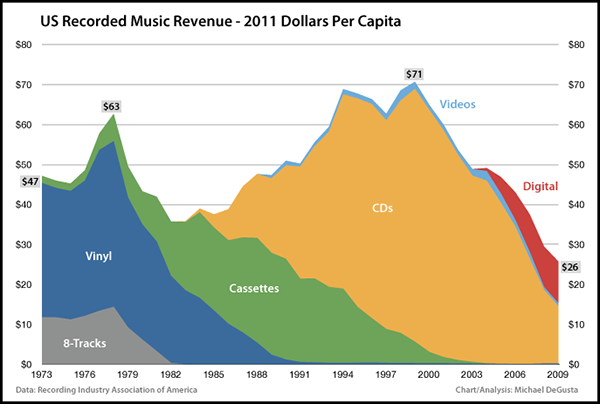
Death of the Music Publishing Industry

[I found this on a blog that looks at a lot of business charts…, The Understatement]

The music industry is down 64% from its peak.

The music industry is actually down 45% from where it was in 1973.

The CD peak was only 13% better than the vinyl peak.

10 years ago the average American spent almost 3 times as much on recorded music products as they do today.

26 years ago they spent almost twice as much as they do today.

Kind of a ‘This Was Your Life’ chart, isn’t it? Memories…

Whoa. 10 years ago CD sales jumped off a cliff [just about the time Neli and I turned our hobbyist tendencies into business. Doh!].

Not sure why the recording industry is so dependent on ALBUM sales. Why not singles too? [see original website to see what I am talking about, if you care]

Apparently the iPod killed the CD. Presumably the smartphone will kill the iPod.

Not sure how the ultra high-end is affected, but mid-fi better support the smartphone as a source, or else.

The current trends.

[Personally I think online subscriptions will win the day, albeit apparently the current trend is flat. I think the flat trend is a damping factor provided by the iPod generation who has not yet switched to listening to music on their smart phones].

How does it make you feel?

Reading an old post from 2006:

Where No Low Powered Amps Have Gone Before

Although being a little old-love-letter-embarrassed about some of my ecstatically enthusiastic exclamations… there was this:

But this is not about how the speaker or system sounds.

It is not.

This is about how the sounds affects the listener.

In the end why should I care about the sound, beyond a certain minimum standard, any more than I care about the minute construction details of the chair I sit in, or the the type of weaving and glue the carpet underneath my feat uses? What we CARE about REALLY is how comfortable the chair is; about how pleasant the carpet is to look at and feel underneath our feet.

What if all reviews and all show reports paid attention to nothing except how the sounds …made …them …feel.

I bet the Stereophile list of Class A components would look a lot different than they do now.

Ah, the old days of Stereophile recommended lists and innocent youth:-) [They are so far down into mid-fi these days that they just are not relevant from our perspective].

So, having this discussion, this argument, with both Peter Qvortrup, and on this blog with Joe Roberts, about their perspective that the ultimate is the ‘absolute sound’ and how anything else is, essentially, worthless candy that is just a passing fashion….

I see their points, and do not necessarily disagree with them if one is trying to make a LOGICAL choice about what their system should sound like… but I keep coming back to the above sentiment. I may not care, and my feet and toes do not care, if the carpet under my feet is a Persian carpet from one of the oldest families and a very valuable antique. Authenticity is not always the highest priority. Sometimes it is softness, and attractiveness, and smell and cost and numerous other things that are independent from authenticity.

Sure, if authenticity has all the features you are looking for, and you can afford it, then you are in the best of all worlds, and you just have to do some investigation and find the most authentic instance of whatever it is you are interested in, whether it be Persian carpets, Winterthur Queen Anne chairs, or home audio reproduction.

But if you are looking for that gestalt, that symbiosis with the Now, that unnameable something, then perhaps some more introspection is required and deeper evaluation of just what it is that our particular souls are looking for.

Which is, of course, the problem with using ‘how do you feel?’ methodology – it relies on us being introspective, and being introspective is difficult. It also relies on us being extremely honest with ourselves- and that is nearly impossible for any of us. It is easier to rely on one’s ‘betters’ to tell us what to buy and what to think. And then move on.

Facts… unfiltered and unprejudiced facts… are great and I am not suggesting anarchy [ala TAS].

But if you can understand ‘how you feel’ about something with minimum contamination from all the hordes telling you what you feel, then I believe THIS is the way to determine the true worth of something that is much art as science.

[This is a fun movie clip, but in truth, I find the newer Star Treks juvenile, shallow and self-indulgent, including much of what is at the end of this clip (after Spock’s mother appears). But I LOVE the original series, written by the who’s who of sci fi authors and inspiring several generations at NASA et. al. … and little ole me. ]

How.. do… we… feel?

Not an easy question. In fact quite difficult, for all of us.

Funny, I like PQ’s Audio Note gear precisely BECAUSE of the ways they can make me feel. 🙂 [to wit, it makes me feel good or ecstatic, and does not make me feel bored or irritated]. That some of this gear is as close to authentic we can get with current technology, approaching the ‘absolute sound’, well… that’s just great too. 🙂