Imaging, Soundstaging, Reality and Enjoyment

[Neli thinks I write too many pieces on the industry, so here is one on sound]

I was surfing and ran across an article on imaging and soundstaging at Romy’s site

Now, Romy is too opaque for me in that thread, but I am pretty sure I disagree with what he is saying 🙂

Lot’s of people are confused about soundstaging – and it is indeed popular to tarnish it as being faux and imaging as being required to be in some nebulous constraints of size and specificity.

Let’s define these two, shall we? At least for the duration of this post, and I hope these are more or less in line with what you think of them as. So we will define:

—————————

Soundstaging: as the location on a virtual 3D stage of where a sound is coming from, usually on the side of the room where the speakers are

Imaging: as the spacial and textural definition of the musician and or sound – their outlines, their weight, etc.

—————————

So imaging has to do with perceived image specificity and soundstaging as its location in 3D space.

I think I will ignore imaging in this post and talk about the much maligned soundstage.

I, personally, love the soundstage. Even though it is probably 5th or 6th on my list – it is still very important to me.

The only thing I can think of why people disparage soundstaging so much is, as pointed out on Romy’s thread, is that it is popular to do so [though not for monetary gain, as implied there, and which requires a very cynical view of the industry to imagine – though, yes, there are many unscrupulous types in retail out there, I just don’t think they are this smart :-)].

It obviously occurs in acoustic reality. But what really interests me [and I think upsets the detractors] is the liberties that sound engineers take with the positions of sounds in the 3D space.

On a good system [the precise quality and make up of which we can debate and agonize over some other time] you can hear the sound engineer move things around, fade them in and out, and change them in other ways that have nothing to do with unamplified/unprocessed sound.

I think of sound engineers as the ‘forgotten musician’. They add all this stuff to the music – and yet they do not get the big bucks. Nobody knows their name. And many people – audiophiles anyway – think the music would be better off without them.

I don’t think so.

Obviously I am talking about bands like Radiohead and Pink Floyd, and not Led Zeppelin or classical music. But if you listen to your casual pop rock country and crossover songs – in the background, there is a lot of stuff going on that is very entertaining. To me anyway.

And that is why I like soundstaging. I enjoy all the background stuff and the way it appears and disappears and moves around [in, out, left, right, up, down] and [rarely] changes phase and pitch and texture.

On a car radio, or iPhone, all this stuff is merged into The Song. But on a quality high-end audio system – this stuff expands into a wondrous playful menage of delightful sounds, which just feeds back into greatly enhancing the overall song.

For me.

And hopefully for you too. The more things one enjoys in this life, the less room there is for things we do not enjoy. 🙂


Think you are getting a discount? Think again… that's what its worth

The only reason discounts work is because every buyer thinks they are ‘special’…

1) “Everyone else pays full price but *I* get it at 50% off. This salesperson must really love me, they just let me keep my extra $10K in cold cash that I can now spend on my spouse.”

or

2) “Boy oh boy, I found a great deal! 65% off – I bet nobody else gets this great a deal. The salesperson said they were able to do this because I was the 1st caller that minute.”

Problem is, we are programmed to respect MSRP as being equal to the value of something,. But it is not. What it sells for is ‘the value’.

But the perception of MSRP may be changing.

When shopping for video cards on newegg.com, who looks at MSRP, it is the street price we care about.

When shopping for CDs, the MSRP is what $15, $17? [this was written a year or two ago and not posted. I think $18.99 is now the standard price]. Kind of hard to tell. But we know they go on sale at random (it seems to me) for $11. And they are free if you can find and download them or copy them from a friend.
[Not sure why I originally put this in here. This is the opposite of a discount economy and is pure price gouging. It might have worked a decade or two ago – but we now all KNOW how much it costs to make a CD. In some ways it is this kind of over-charging that may have triggered the discount economy.]

This is worse now during this ‘Downturn’ or ‘Great Recession’. It is worse because both consumers, sales people and manufacturers think they now have carte blanc to play games with reality. “Everybody expects to get big discounts these days”.

It ain’t a discount if that is what they are selling it to you for – that is what it is worth.

See also:


Cheap: The High Cost of Discount Culture

and more factoids:

“Manufactured goods have been getting cheaper, both in absolute terms and relative to services. Since the Consumer Prices Index was first launched in 1996, the prices of “goods” have fallen an average 2%; while the prices of services have risen 35%. The most talked about example has been in textiles: since 1996, the average price of clothes has fallen 36%. But it is not just clothes that have been falling in price: new cars are 1.5% cheaper than they were in 1996; household appliances are 24% cheaper; toys are 30% cheaper, and of course, in the audio-visual category, you’ll find things are on average now 56% cheaper than they were nine years ago”

And this is BEFORE the 50% off discount…. 😉

Where most people shop for pedestrian and cheap [what others might (do) call America’s love affair with the shoddy], others shop for uncommon value. I personally do not see how the ‘discount economy’ has caused the current economic clime, but I do, personally, find it boring and tiresome and not at all where the ‘cool’ stuff is happening.

Smoke from the L.A. fires

Can hardly see the city today, or even more than a few 100 yards, because of all the smoke.

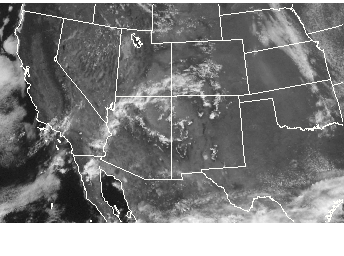
You can see from the satellite map how the smoke from the fires is blowing here [Boulder, Colorado] from California

It seemed like such a long distance. But it apparently is not. You can even smell the smoke. We are located at the right tip of the smoke stream.