
Wilson Alexandria XLF speakers

We got a chance to hear the Wilson Alexandria XLF speakers last week.
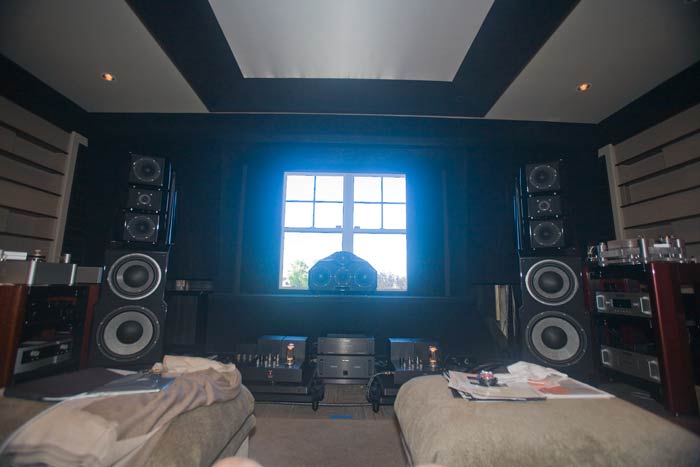

We listened to them in a nearfield position, I would say about 7 feet from the plane of the loudspeakers.

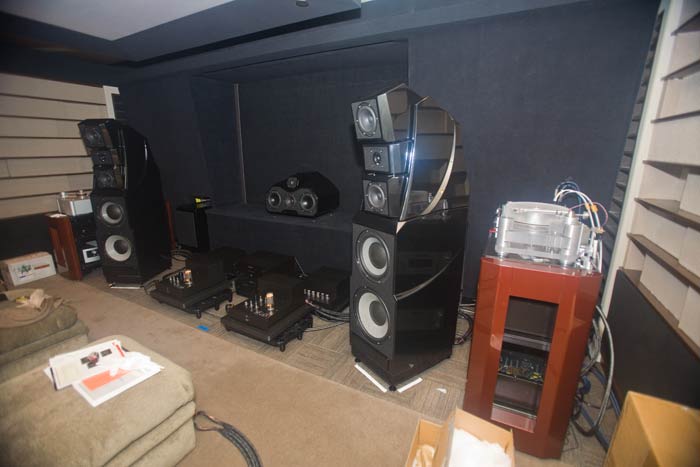
We heard them with Audio Research 750ish [:-)] amps, Lamm ML3 amps, Audio Research Reference Anniversary preamp, Lamm L2 preamp, Tara Labs The Zero Gold interconnects and speaker cables, Nordost Odin interconnects and speaker cables. Tara Labs Cobalt power cords and Nordost Odin power cords.
Source was a Basis Inspiration with their Vector arm and a Lyra Atlas. Phonostage from Ypsilon, with external stepup transformer. Everything was on HRS M3X platforms and MXR equipment rack.
Because we never heard the system in an entirely familiar configuration [there were always Tara Labs interconnects in the signal] and because we listened in quite a nearfield position to such large speakers, we cannot do an exact comparison with the previous model: the Alexandra X2 [2nd update] speakers.

But we can say a little something…
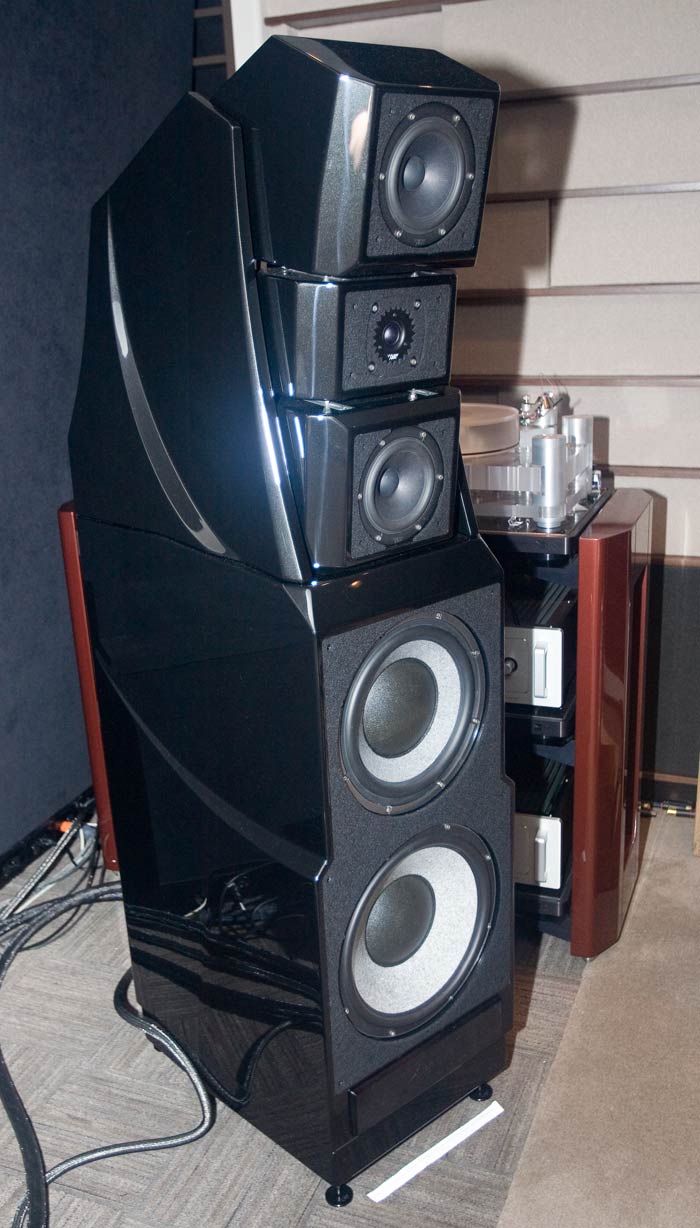

First, listening nearfield to such imposing speakers went quite well. The only issue, for me, was that the highs were always coming from the top of the soundstage and the lows from the bottom. Sitting farther away would help merge the two frequency extremes.

Second, the speakers do sound more integrated and the cabinet also more rigid – the only overt cabinet issue to my ears was that the bass frequencies tended to be drawn to the speakers [mostly noticeable only when sitting quite a bit off center from the sweet spot]. [the previous model had a preponderance of softness extending down from the midrange which sounded like the cabinet was robbing the sound of a lot of its energy – typical of speakers not perfectly rigid. For example compare the sound of aluminum speakers to ordinary speakers – with everything else being equal the aluminum speakers will have more energy and the midbass frequencies will be less likely to seemingly originate from the cabinet ]

The speakers do respond well to changes in upstream components which means one really can tailor the sound to one’s sonic preferences to a large degree.

It was a real kick listening to these this way – with the drivers exposed and staring us down it was like listening to really, really large monitors – or like a wall of speakers at a concert.

The Lamm ML3 amps are able to drive these speakers to louder-than-you-want-to-listen-to volumes without any apparent strain to any of our ears [and we were listening closely for any sign of weakness or hesitancy. This would be a fun test late at night :-)].

The speakers were back ported in this room and, although that is a little strange for such a small room with the speakers along the long wall, the speakers did not sound at all to us like they needed to be setup any differently [most listening rooms we see often need the speakers to be re-positioned to sound their best.]

Listening to the Alexandria XLF nearfield like this was a blast, but after listening to our system here (Lamm ML2.1 amps on Marten Coltrane Supreme speakers) in a similar nearfield position, and recalling other Wilson Alexandria systems, the Wilsons do sound their best in a larger room (if possible!).

I would say the XLF is an evolutionary upgrade, as opposed to revolutionary – but at this level, every last little improvement to the sound will be appreciated by avid listeners – so if you are a Wilson owner with the rest of your system such a configuration that you are [at least for the moment :-)] happy with it , you should by all means go for the XLF.

Perspectives on positive equipment reviews

There is some heated debate among book reviewers / book critics about whether there are way too many positive reviews in comparison with critical reviews. Sound familiar?

Here is a summary of some of the points of view of various people:

book reviews debate

I found most of it to be quite relevant and an interesting perspective on equipment reviews, except that high-end audio reviewers, and high-end audio magazines, have MUCH more financial incentive to publish positive reviews than do book critics [even though our reviewers do not get quoted in the New York Times… ever :-)].

It may just go to show that to a large extent the culture of a niche – whether books or high-end audio or movies or computers or whatever – dictates the percentage of positive reviews versus negative reviews. That even if we, in high-end audio, held reviewers and magazines to a higher standard, so that they had absolutely no financial incentive to publish a positive review – we would still most likely end up with near the same percentage [what is it? 95%+?] of positive reviews.

Analytical listening and short-term memory

Some background:

I have spent much of my life working by myself on technical projects. Over time more and more thoughts were in the form of pictures rather than words.

Now, after all this time, I have a have a rather harder time understanding what people are saying as they are talking. Instead, I ‘replay’ what they said, what was recorded in my short term memory, going over and over it and analyzing it [hopefully quickly! :-)] several times before I am sure what they meant, as well as getting some kind of handle on the subtle subtexts of what they said.

I presume most of us do this to some degree.

Listening closely to music:

A similar thing happens when I am listening to music – consuming both the music in real-time as well as going over it several times in short term memory.

Yes, one can miss a small snippet of music while one is doing this. But this repetitive analysis can result in moving some of what one has heard to long term memory, which can be useful if one is seriously evaluating equipment or systems and one wants to compare them later ‘offline’ as it were.

Methods:

This list is by no means exhaustive, but is instead an attempt to try and start talking about how people can analyze sound quality using their short-term memory.

1. comparative analysis. Comparing the sound: harmonics, dynamics, resolution etc. to what we have heard before – both with similar music and the exact same music

2. emotional analysis. Determining how we feel when we hear the music and, in fact, individual passages and notes in the music. Does it make us feel happy, sad, angry, involved…?

3. rightness analysis. Does it sound right? or does it sound wrong? Some of this can be as easy as determining whether guitars sound like guitars, for example. Some is more subtle, for example is one being fooled into think there is actually a real person standing there in the room playing this instrument. Finally, there is this sense of just plain ‘rightness’; something CD players did not have for a decade or two – something that is still somewhat elusive even today, but only noticeable when you actually something that is significantly more ‘right sounding than what we are used to’. [and by this we DO NOT mean accuracy or ‘realness’ – this is more about how the human mind hears things and is more related to ‘believably’].

4. separation analysis. During complex passages, did every instrument stay in place and sound like it would all by itself? Or did it blend in a mushy wall-of-sound? This is easiest if one just plays the complex passage over and over again – indeed – but a lot CAN be done by analyzing one’s short term memory recollection of the passage.

5, 6, 7… ?

Although short-term memory vanishes after about 90 seconds, at least mine does – getting more and more severe as I age – the immediate term memory of just a second or two, used for analyzing the sound of music, seems to still be working OK. Here’s hoping it continues to do so! 🙂