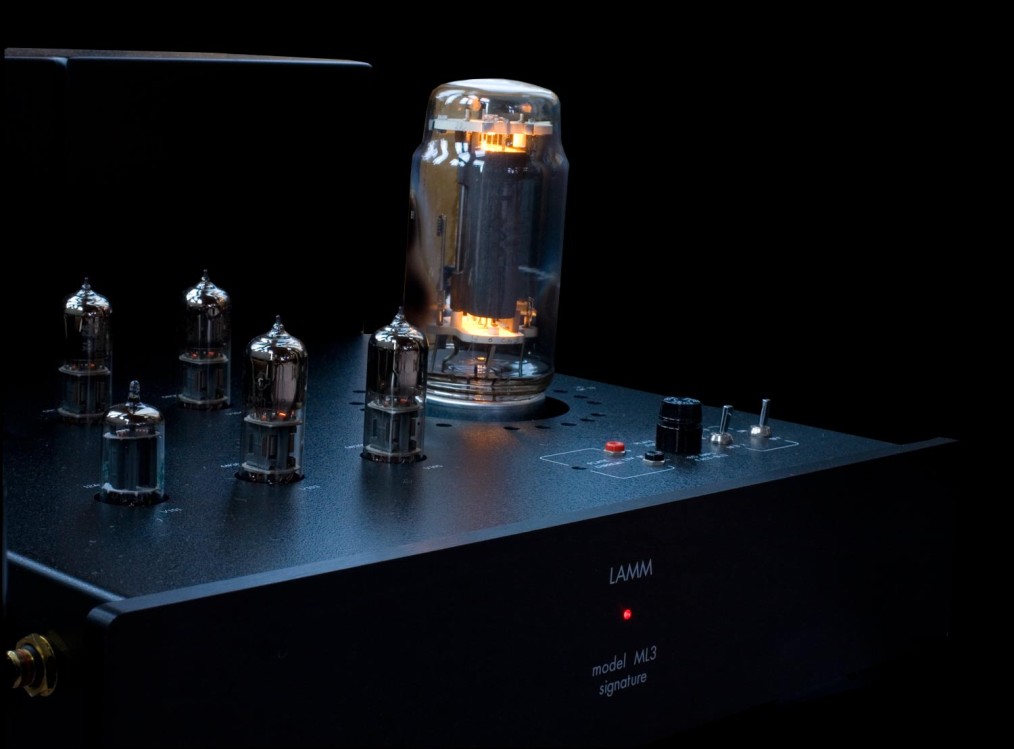
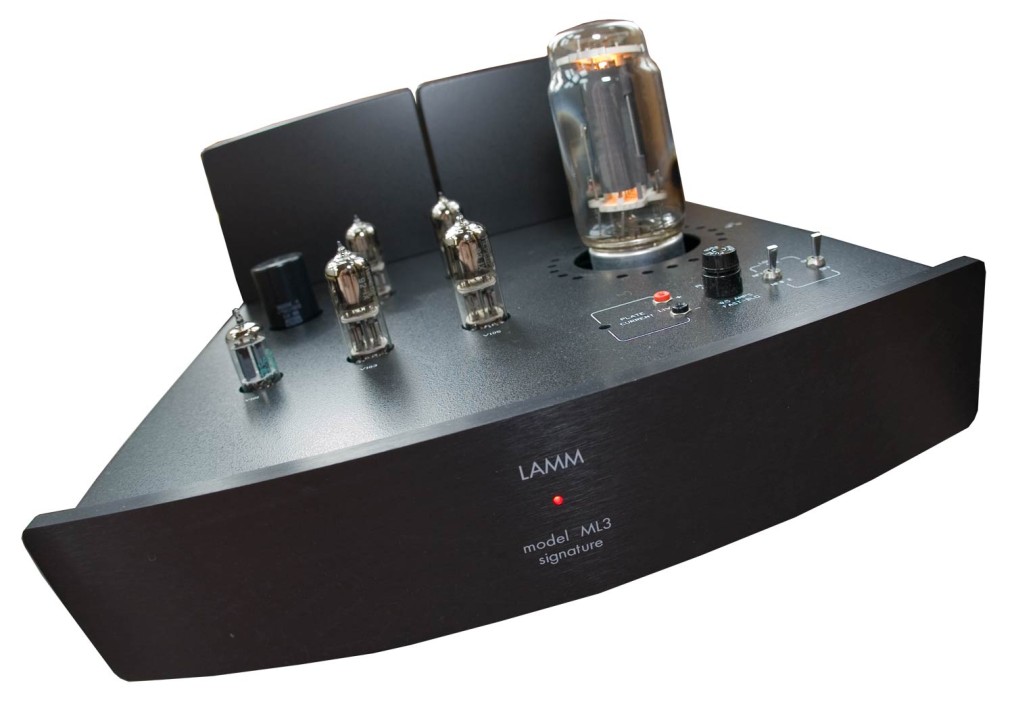
Part 2: Lamm ML3 amplifiers – Review of the Stereophile Review

[continued…]

5. Only big [solid-state] amps need apply

Next he mentions that the ML3s …

“must be paired with a sensitive speaker with a relatively benign impedance curve”.

This statement is so laden with solid-state amp falsisms that it is really misleading and even insulting. First, ALL amps, solid-state and both large and small tube amps, sound better paired with ‘sensitive speaker[s] with a relatively benign impedance curve[s]’. Second, speakers that are harder to drive ALWAYS [in my experience] have problems with the amp not being able to drive them well. Even hugemongous amps will have problems with these kinds of speakers. Yes, smaller amps have MORE problems, everything else being equal. But everything else is not equal; smaller amps almost always have a better sounding midrange. I.E., depending on your preferences, you might prefer a little less electronic drum-like slam and a little more Stradivarius-violin-like charm and use a smaller amp instead of a larger amp.

So perhaps one might say: “when choosing speaker / amp pairings one should chose a more efficient speaker in direct proportion to your desire for electronic-bass-like slamm and overall SPL, realizing that the specifics for any given speaker’s impedance curve, and the way each amplifier design seems to interact with these curves differently, makes it hard to predict, just from the efficiency of the speaker alone, just how any specific model of speaker / amp combo will perform.”

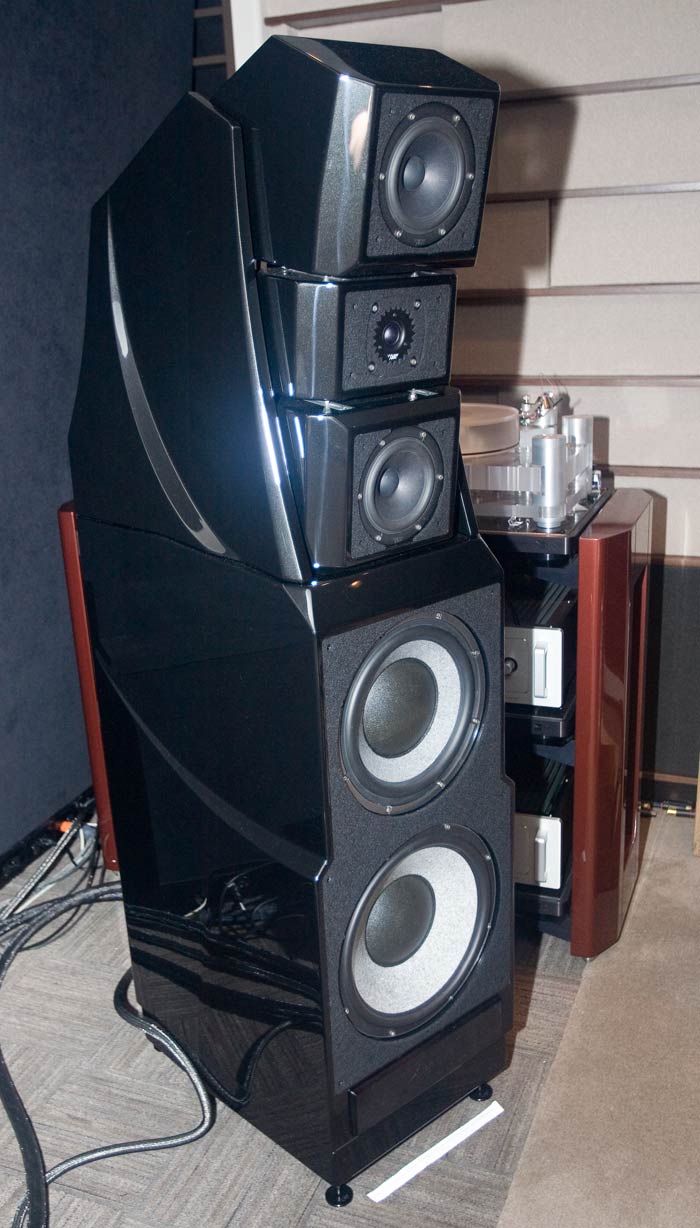
Mr. Fremer says he heard “two ML3s driving Wilson… MAXX 3 speakers in a large hotel room at …CES”.

Actually, there were two Lamm ML2.2 amps driving the Verity Lohengrin speakers in a small room at CES [we have a guy who really enjoys these speakers with one pair of the ML3 amps] and next door to this room at CES there was just *ONE* pair of ML3 amps driving the MAXX 3 speakers.

Mr. Fremer says he found the sound “anemic and lacked dynamic drive and slam” and … “though tonally it was mesmerizingly lush and smooth”.

My impressions were different.

First, Vladimir and Elina Lamm go for the ‘musical oasis’ sound at shows as opposed to the in-your-face let’s impress the silly boys who like to get pummeled by their music sound [ 🙂 I exaggerate a little bit… but, since I AM a boy, and sometimes as silly as the next guy, check out our write-up of the Luxman amps on the Magico Q5 a few CES’s ago – lots of wild dynamic drive and slam for us boys; and which did not seem to do anything particularly horribly (if you can ignore the near absence of micro-dynamics and texture) which, unfortunately, is rather extremely rare with these boy toy type systems. This sound, which neither component seems to be able to achieve by itself, is one which other boy toy systems should be very envious of].

Second, the cabling and equipment rack that were used in the Lamm ML3 / MAXX 3 system are ones that will typically reduce dynamics [often desirable in certain systems and arguably very useful at shows where the average showgoer’s ears are so bloodied that an little extra smoothness is like a ice cold beer on Vulcan].

Third, it is a BIG room.

Fourth, lush? LUSH? OMG. This was not lush. Calling it ‘lush’ sounds like just another solid-state fanboy trying to make a strength out of the weakness that plagues solid-state amps: i.e. that they are dry and scratchy in comparison to the harmonics of real music.

Realize that music is ALL about harmonics [voice, strings, woodwinds, keyboards] and that real instruments are so full of harmonics that they make, in comparison, the typical stereo system sound like sandpaper on a chalkboard…. Dynamics are fun, required for percussive sounds, and help us determine where the notes harmonics start. But that is all they are.

I am somewhat fond of this particular system because I spent a lot of time in this room. We had the Marten Coltrane Supreme speakers up for sale. We weren’t about to buy another pair of these $350K speakers or anything near its price. Certainly not until we finally sell our home here in the foothills above Boulder Colorado [hint, hint]. So listening… listening… All the while thinking about what system we would be able to live with. About what the criteria was [to enjoy many kinds of music, to have no bad behavior that distracted from the music experience, etc.]. Neli disagrees with me [she much prefers the Alexandrias – as do I, but I think they are just an improvement on the MAXX 3 ‘in kind’ (in the same vein)].

So, anyway, I tried hard to poke holes in the quality of this sound in this room, and in my opinion it was decently balanced. I felt that the distance between the sound in that room and the one I wanted in our room was one that I could achieve by using the standard tricks of the trade [and bringing the speakers closer together for more solidity] and careful [but not THAT careful, for goodness sake, people] component / cable choices.

OK… back to the review of the review.
5. Summing up #1

We talked above about measurements and who cares if solid-state amps measure better given the fact that what we are all measuring here has only theoretical connection to what we are hearing [and how we are processing what we hearing]. In fact the evidence from the last 50 years of transistor-based gear and digital playback is that there is often an inverse relationship between how well something measures and the quality of the perceived sound. So measurements are fun for us geeks, but it is like measuring the quality of the suspension on a car – it is so much easier to just drive the darn thing.

Given a relaxed view of Mr. Fremer’s definition for some of our woefully under-defined audiophile terms I can agree with most of the benefits of solid-state described in the following paragraphs except ‘superior bass… control’. I do not think solid-state amps control the bass at all well. They throw watts at the lower frequencies, they ‘punch the speaker drivers’, but this is not control. There is a tremendous amount of information in the bass that solid-state amps walk all over that many good tube amps do not. In fact, solid-state amps try to ‘power through’ most dynamics and in so doing over-power [get it? 🙂 I know. Stupid pun.] the other information present at those time-slots – and this occurs at ALL frequencies.

The paragraph on problems with tube amps is more or less true for less expensive tube amps [say, less than $5K… there are a lot of these tube amps out there] except for the following extreme generalization: “are generally overripe, richer than life…”. I wish. Most are dull sounding, only slightly better than solid-state amps [mostly because they will NOT bite your ear off, will not give you frequent headaches, and not make people think you (and all audiophiles) are an idiot for spending money on something so aggressively unpleasant. On the other hand, the Ford F150 pickup is the best selling car, so I don’t know, maybe people like living on the edge]. Joule amps are a popular notable exception and richer than life [which is kind of fun, IMHO].

But, guys and gals, real life music is rich. The richness found in harmonics is ignored by so many audiophiles because for the most part we have no choice if we are going to be audiophiles. Our systems are so under-performing in the harmonics department and when you finally realize how bad it is, it is extremely sad and disturbing. You finally realize that dynamics are FUN [and exciting] but harmonics is the MUSIC [yes, I am yelling]. The more accurately we can reproduce harmonics, the more depth and color and resolution and inner-dynamics to the harmonics [yes, harmonics have dynamics] the more we will connect with the music, feel it in our souls, and just spontaneously start emoting over the beauty of life [ok, yes, life, the universe and everything. Can’t forget to stick Douglas Adams’s tongue into the mix when we start getting too serious :-)].

I remember one time in Santa Fe we were on a balcony looking over the city, in an art gallery or something, and then this trumpet player seemingly comes out of nowhere and starts playing jazz about 10 feet from us. The color and harmonics were a-mazing. If you were fortunate enough to have grown up in a school with a band, or music class, remember what the trumpet sounded like there? Or the clarinet? Or flute? I think people get so used to the coldness of solid-state sound reproduction, that even when they hear live music, they are are continually interpreting it through the lens of their comfort zones: perfect-sound-forever and tubes are old-fashioned [it is *safe* to think these things – safe to say these things in public and on forums. That measurements measure how things sound, as opposed to the fact that they are REALLY just measuring some relatively random minuscule slices of something. That we are choosing what to measure, and what measurements to use as the basis for what is good and bad, based on the sole fact that they were easily measurable back-in-the-day.]

Solid-state amps ARE good in some circumstances

Solid-state is good if you do not want to muck with the thing for 5 to 15 years and do not want to have to replace tubes every several or so years [this is me. I’d MUCH prefer solid-state if it didn’t sound so poorly. I do not think tubes are cool (well… a little but) and I think they are a pain to track down and replace. But they sound SO MUCH better! neli likes the whole tube scene much more than I do.] If you have young kids or dogs [cats seem not to get into as much trouble] and you can’t elevate the amps to your top shelf out of reach. If you do not like staring at the light tubes make. If you want something that does not give off much heat (ignoring class A solid-state). If you do not want your neighbors to wonder what the heck is THAT thing with the light bulbs sticking out of it? And they are good if you just want to play with with the darn things for no discernible reason – who cares why.

But to imply that solid-state is inherently BETTER, for reproducing MUSIC? It just ain’t so. In fact they are worse [but getting better]. This whole argument is an analog [sic] to the LP versus CD arguments. Surprised Mr. Fremer is on the wrong side of this one.

Mr. Fremer then goes on to describe the characteristics of the sound of the ML3 based on his mental reference of what ‘real music’ sounds like. Its all really positive, especially coming from a solid-state guy.

6. Uh oh! Associated equipment makes a difference

The review then talks about choosing the right cable and how all cables seemed to reveal the cables weakness, but

“choose the right cable, and it was smooth sailing from top to bottom”.

We’ve heard one of the cables listed in Mr. Fremer’s associated equipment, the Tara Labs Omega Gold ( Zero Gold ), in this exact same system [ML3 on Alexandria XLF] and they are really decent (albeit expensive $22K/speaker $18K/interconnect) cables – a little less dynamic and transparent than Nordost Odin, but a little more compressively solid. For Mr. Fremer’s apparent sonic tastes, I think either cable would be about as good as the other in this system. As far as the other associated equipment goes… the dCS is the best of his digital sources [which is what he uses later in the review]; the analog looks like it would be actually fun to hear [as expected at Mr. Fremer’s digs], hopefully the power conditioners were not in the system [or just on the turntable power-supply], and hopefully, HOPEFULLY the amps were on the SXR amp stands, sitting on their HRS Nimbus spacers/couplers.

You do not need to use top-notch associated equipment with these top-notch amps, but if one is going to criticize, it behooves one to at least use associated equipment that is not going to cause one frustration [i.e. when you drop a new extremely high-quality component into your system – you have to assume, initially, that the component is the perfect component. That all the problems you hear are endemic to other parts of the system, and the previous component being used was compensating for these problems – perhaps exaggerated in some way, perhaps covering up something else, problems that were always there, but were obscured by, or over-powered by, the old component. This is true whenever a new component or cable is dropped into a system. The balancing act of the system is thrown out-of-kilter]. Through complex triangulation, one can explore and determine the weaknesses of a system, and what component’s weakness is balanced by what other component’s strength [or weakness, like when, for example, a bright-sounding amp is balanced by dull-sounding cables].

Can’t tell you how many times we dropped a wonderful component into a system just to have a problem of the system revealed and to have the owner of the system blame the problem on the wonderful component. You hint and nudge the owner into realizing what is happening, all the time wanting to shout: Your precious XYZ component over there is really a POS [in this context]! They no doubt will fall out of love with the XYZ POS soon enough, but it is unfortunately us who are the first to deliver the bad news to the poor guy/gal.

Anyway, it would be interesting to know what cables in his collection he thought was (were) the ‘right’ cable(s). [Oh, Neli points out that Mr. Fremer mentions the Wireworld Platinum Eclipse 7 later on in the review.]

[to be continued…]
Part 3: Lamm ML3 amplifiers – Review of the Stereophile Review

[continued…]

8. The bass thing again

Then he says “…the solid-state’s fast, lean low-end attack, which is needed for the correct reproduction of amplified bass”.

Says who? God? [this first 2/3 of the review is really more a canon on how solid-state design must always be triumphant, a very public affirmation of Mr. Fremer’s [and seemingly J.A.’s] faith in solid-state sound forever, more a religious treatise than a review – people’s ears and musical health be damned]. I wonder if the fact that amplified bass guitars often use tube-based guitar amps bothers Mr. Fremer late at night or weakens his belief system the least little bit. Do you ever get the sense we are reading something out of Stereo Review from the mid 70s?

Again we are back to the bass. The ‘fast lean attack’. Which is all that most solid-state amps really can do, right? They attack the notes. Throw watts at this frequency and throw watts at that. The subtle variations in those attacks, at each harmonic? Oh, well, at least they attacked the note really well. The very best solid-state amps are very fast and very high-resolution, so they can kind of work by using a whole bunch of little attacks for each the note [with problems similar to that found with digital audio in that there seems to be a fundamental impedance mismatch with the analog harmonics being produced].

Ironically, the recent trend for solid-state amps seems to be that they should be smoother and notes should be more round sounding, [like their idea of tube amp sound, I guess], but they so far have been sacrificing resolution and harmonics in the process – resulting in a clumsy, low-resolution, and often atonal sound [piling on the irony: they sound a lot like old, old, legacy (think 60s and 70s) tube amp designs].

I, personally want the entire note myself; like an Oreo cookie, I want the cookie part [top and bottom, attack and decay] AND its wonderful chewy, creamy, tasty center. And I want to be able to savor the taste every single delicious crumb and sugar molecule [this is why I like being an audiophile better than eating, a couple of chews and the Oreo is GONE already].

In this system the Alexandria XLF’s absorb energy in the bass region more than other very large expensive speakers we have played with [but they are better than the X2]. It ain’t much, but enough to sort of dull the low frequencies a little. This is only a problem if this is what the listener is primarily interested in hearing [aka obsessed with]. To compensate for this weakness in the speakers [or any other component] one should use dynamics preserving vibration control [as opposed to vibration dampening tweaks that smooth out the system sound] like HRS under everything in the system [Mr. Fremer is using some HRS, not sure where it is in the system, nor if he has ever used their Nimbus, which have a giant effect on when one is pushing a system to its limits] and cables and power cords that preserve as much of the dynamics as possible.

Look, this is an expensive system. One usually has to spend a little more time and money to optimize around the specific characteristics of the system in order to tailor it to one’s own personal preferences. This is something system OWNERS almost always do and system REVIEWERS almost never do. The vast majority of reviews toss a superior or break-through component or speaker or cable into their system and then pretend to evaluate it, using associated equipment in the system left over from previous and up-coming reviews – NO MATTER HOW INAPPROPRIATE THE GEAR IS in a system with such a superior component. This review is way, WAY better than most in this regard.

Mr. Fremer seems to be all about the [percussive-like] attack, and the overall dynamic extremes, liking things on the lean side in terms of harmonics and decay. This is doable, as described above [although I cannot currently think of a way to artificially dampen the decay more than is natural without harming other parts of the sound]. And then, after this is optimized, and over time, a person gets to enjoy things in the music that they had not immediately focused on. They get to enjoy all the tons and tons of intra- and inter-note dynamic shades that is not in-your-face but is actually in-the-music [it looks like Mr. Fremer is calling this ‘texture’ in this review. A good name for it].

The preternatural focus on, what seems to me to be the first 1/10 second of a note versus, say, the first 1/3 of a second is to my way of thinking very limited. Slam your fingers down on a piano keyboard. The first 1/10 of a second is more or less fairly well reproduced on most systems with speakers of decent efficiency and reasonable to average amplification/cabling/source. As a wild-eyed guess I’d say they were within 5-10% of real. The next part of the note though, where it reaches its maximum volume, very few systems get within, [what do you say, JL?] maybe 50%? And this is one of the areas where tubes kick solid-state amps butt, getting much closer to the truth when we actually use the ears to listen [as opposed to circa 1960-2013 measurements. There are models we can come up with to explain this, but that is something for late at night BSing. Stay tuned :-)].

9. Nicey Nice

The next paragraph has a nice compliment about the “naturalness of its [the amps] portrayal of instrumental attacks put it as close to … as I’ve heard from any amplifier” as well as pointing out again the “rich harmonic palette expected from tubes”.

10. BO-ring

He goes on the usual boring-ass reviewer-ish ‘first I listened to this and then I listened to that’ boring-ass part of the review that seems to be a boring-ass requirement for reviews these days. YMMV.

11. Finally to the actual review

Agree that the Wilson Alexandria XLF speakers baffle-free presentation is quite good and up there with the best of the baffled competition [Marten, Kharma, Magico, etc.] but still not in the same class as, of course, horns.

Agree that the amps are SUPERNATURALLY quiet.

Look, the amps are not about the immediate attack of a note. Not about the ‘rich harmonics’. They are about the BALANCE. They do everything really really well. That’s it. You do not have to sacrifice Sue [harmonic truth] to save Charlie [soundstaging]. Or whatever other trade-off one is usually forced to make.

Solid-state amps do the square-wave like notes thing better. The big Audio Note are richer harmonically [more colorful] and more midi- and macro-dynamic. The big VTL have more weight and slam. But this is the first amp that kind of just does what an amp is supposed to do. This amp does have the highest resolution [and texture] of any amp we have heard – but one can convince oneself that this is again, part of being well-balanced – of being the closest thing to straight-wire with gain.

11. Comparison to a similarly-priced solid-state amp

The next part of the review involves the JA-recorded music of a concert in a church; a concert that Mr. Fremer also attended.

He then goes on to describe the sound as played through the dCS digital stack. The weaknesses in the sound as described is as expected, given the current state of digital recording and playback [hey, but it *is* getting better].

He then goes on to describe the same music through the darTZeel NHB-458 amps. He describes the pluses and minuses of the sound on the darTZeel versus the ML3 in what seems to me to be the old secular insightful Mike Fremer manner. I want to highlight one part of this comparison though, because it comes into play again in his conclusions [we’re almost there! :-)].

This is that “… the double bass was more like I heard live, with greater control and authority, a tighter physical presence, and better delineation of the instrument for the reverberant space”.

First, notice again how Mr. Fremer focuses on the strength and magnitude of the dynamics when talking about ‘how things sound live’. There are other things to music than dynamics [although, let’s admit, Impressive(tm) dynamics from a double-bass is awesomely cool and one of the first things we learn to enjoy when we have speakers with bass].

Second, when you take a track like this, something that has a good bass track, around at shows [when they used to let you play you own music tracks at shows – now it is mostly laptop junk], you get to hear the bass sound strong and POWERful on one system and weak and washed out on another and tuneful and dry and everything in-between.

So… what does the recording REALLY sound like? One wonders.

Many times stronger more powerful dynamics just means that the available power available to an amp is going to support the loudest notes, short-changing the ambient quieter notes. Many cables do this. Most conditioners do this. But, you know, its funny but a lot of people LIKE this effect; it can be really enjoyable. I enjoy it. Sometimes. I would hate to be saddled with it all the time though. I like it maybe, oh, 1 or 2% of the time or so. Good reason to go to shows is to hear this effect :-).

But back to this review [I keep getting side-tracked! Argh.]

[to be continued…]

Part 4: Lamm ML3 amplifiers – Review of the Stereophile Review

[continued…]

12. (or 11b.) Mr. Fremer didn’t try hard enough to personalize the system to his particular tastes

Supposing you are like Mr. Fremer and are in the situation where you think there should be / want there to be a stronger more physical presence to your double bass notes on this track. Sounds reasonable. Well, you say to yourself [because you spend a lot of time alone in your listening room, saying things to yourself is now second nature], ‘it behooves me to try and optimize the system so that it will do this bass thing. The system should do what I want, darn it [and hopefully I won’t muck up something else in the process!]’. Because you got all this obviously nice gear, you must have some amount of money lying around [not that you are likely to ever, EVER admit it to anyone else, especially your dealer and significant others ;-)] and so, you say, lets try a few different powercords on the amps. Lets make sure each component in the chain is optimized – both vis-a-vis powercords and vibration control [tube amps are much more susceptible to attenuation of the bass response, and dynamics in general, due to deleterious vibrations than most solid-state gear because tubes themselves are so susceptible. And something about the Lamm chassis also make Lamm amps more susceptible than most tube amps we have played with as well. Just think of it as having to buy special tires for your new Porsche, except these ‘tires’ won’t wear out every 6 months].

13. The other expensive tube amp that Stereophile has reviewed… in 2004. The WAVAC.

So, anyway, Mr. Fremer says some nice things then … oh wait, he first talks about the $350K WAVAC SH-833. 2004 was a long time ago. I do not understand the phrase ‘pants-down performance!’ in this context. But moving on… Relying on the 5W [supposed power required by the Alexandria speakers] obtained from an analog meter on any amp is fraught with peril, but the ML3 does drive the XLFs quite, quite loud in our experience as well – so we reached the same conclusions here. They lost me at ‘excessive warmth from the WAVACs’… but hey, it was 2004, we are all a lot smarter now. [We find the WAVACs to be a little on the cool side of neutral but with the warmth ultimately being quite susceptible to upstream electronics – so their level of warmth is kind of however warm you want them to be].

Then, skipping the part where Mr. Fremer attempts to remember the linearity of the WAVACs, 10 years ago, on no doubt inferior speakers [hey, not criticizing, we all have to do the miracle memory thing from time to time (its not like we can go back in time or… record what the system sounded like so we can replay it for future years and generations… or can we?)], he says:

14. Summing up. The Nice stuff.

“…though not as linear or well-controlled as the darTZeels, but it was close enough to call it a trade-off…”

And this is my point. Even in the mist of a riot of solid-state zealotry [yes, zealotry. To put this kind of over-the-top pro-solid-state ideology in physical print like this means there are some powerful anti-tube feelings here] there is sentiment that these amps perform as good as solid-state amps in this area where typically solid-state amps perform best – i.e. just amplifying input in a predictable, linear manner. I think then that at some level Mr. Fremer agrees that these amps are indeed this new kind of amp that does just what amps are supposed to do, no more, no less. And tube amps got here first [ha ha! 🙂 We’ll address the other issues Mr. Fremer has been harping on: leading edge dynamics and overall dynamic solidity, which we talked about above – later in our conclusions below].

So Mr. Fremer then concludes, after the traditional nicey nicey words [are you like me and always skip to the last paragraph? Thank goodness for the ‘summing up with caveats’ review tradition we have in this industry – otherwise we would all have to read the entire text of these review thingies], he says:

“… gulf between solid-state and tube amplification remains…” This is his religious fervor talking again. The gulf that is important in this context is the gulf between amps and musical truth. Not between various failed attempts and other failed attempts. The majority of this review has Mr. Fremer stomping his feet ‘Noooooo! solid-state still rules!’, and so seriously, one has to think that he was somehow threatened by the ML3’s shrinking of this gulf to this extent.

15. Summing up. The solid-state hard-line theology. And the point.

Then “if you want weight and articulation on bottom, especially if you listen to a lot of electronic and/or amplified music, you’ll probably…[want] solid-state”.

What a weird thing to say.

First, I am the only one I know in the audiophile community who listens to a lot of electronic music [about 1/3 of my several 1000 CDs. Neli doesn’t like it (nor hate it) so we do not listen to it as much as other music]. In some sense Radiohead and Sigur Ros are mostly electronic music with voices. And we listen to a ton of this kind of stuff.

There are a lot of parts to electronic music that an audiophile can be attracted to:

A lot of it consists of multi-layered soundscapes. The layers are composed of sounds and arranged in complex and/or entertaining ways for your listening pleasure. The layers are organized by frequency, location, magnitude, by everything you can think of. The ML3, in my fervent opinion, is truly the best amp for this kind of music.

Then there is techno [and its hundreds of offshoots]. A lot of rapid bass beats with guitar-like keyboardish sounds sprinkled in. Seriously, one needs a speaker with a basshorn or a cheap club-like speaker like the Genelecs or something. Everything else is too slow: certainly the XLFs, and even the Coltrane Supreme speakers, which has the best, most articulate bass of any cabinet speaker [obvious to people without an agenda], but still doesn’t have that club-like techno heart-thumping chest-punishing beat [at least not at the volume we are willing to play them at!].

By amplified music… does that mean Rock and Roll? I guess it means everything except classical and acoustical new age and world music. Most of our collection is rock. Most of what we have played on the ML3 is rock. It feels a little sacrilegious: Vladimir and Elina Lamm listen to something like 99% classical and 1% jazz. But rock sounds way better on these amps than expected. I am always surprised. Maybe my expectations are low. One expects amps like the big VTL or hugemongous Boulder amps would be required to wail away on the speakers [ROXannne….], that this kind of machismo amp is required to kick their [the speakers] butts into high gear. But nope, the ML3 rocks out with the best of them [Noooo… not Twilight Zone theme time… Perhaps the beginning to the 2001 theme…?].

And as far as “articulation on the bottom” goes… Besides the leading edge of the loudest notes that occur during a musical passage in the lower regions, solid-state does a particular BAD job at bass articulation. Seriously, look beyond the edge, Luke…

14. Well then…

So, what Mr. Fremer is really saying, as he has said throughout the review, and omitting the anti-tube bias, is that the ML3s did everything better [or as good as] than any other amp except for the sharp leading edge on some notes, primarily the bass notes, nor did it have the same solidity and weight in the bass, that he prefers when his system plays back amplified music.

And what I am saying is that, omitting the anti-anti-tube bias, is that the process for optimizing the sound of a tube amp is different than that for a solid-state amp, and that with a few adjustments and tweaks here and there, mostly to do with protecting the tubes from harmful vibrations, the ML3 can get as close or closer to ‘real sounding’, in those specific areas that Mr. Fremer is concerned with, as any current solid-state amp on these speakers. Using a Lamm preamp instead of the darTZeel preamp will almost certainly increase the solidity and palpability of the midrange and lower registers, and most of all the dynamic response [especially when using the Lamm LL1 Signature which is the matching preamp for the ML3 (and about 1/3 the price of the darTZeel preamp)].

Mikey was so close!

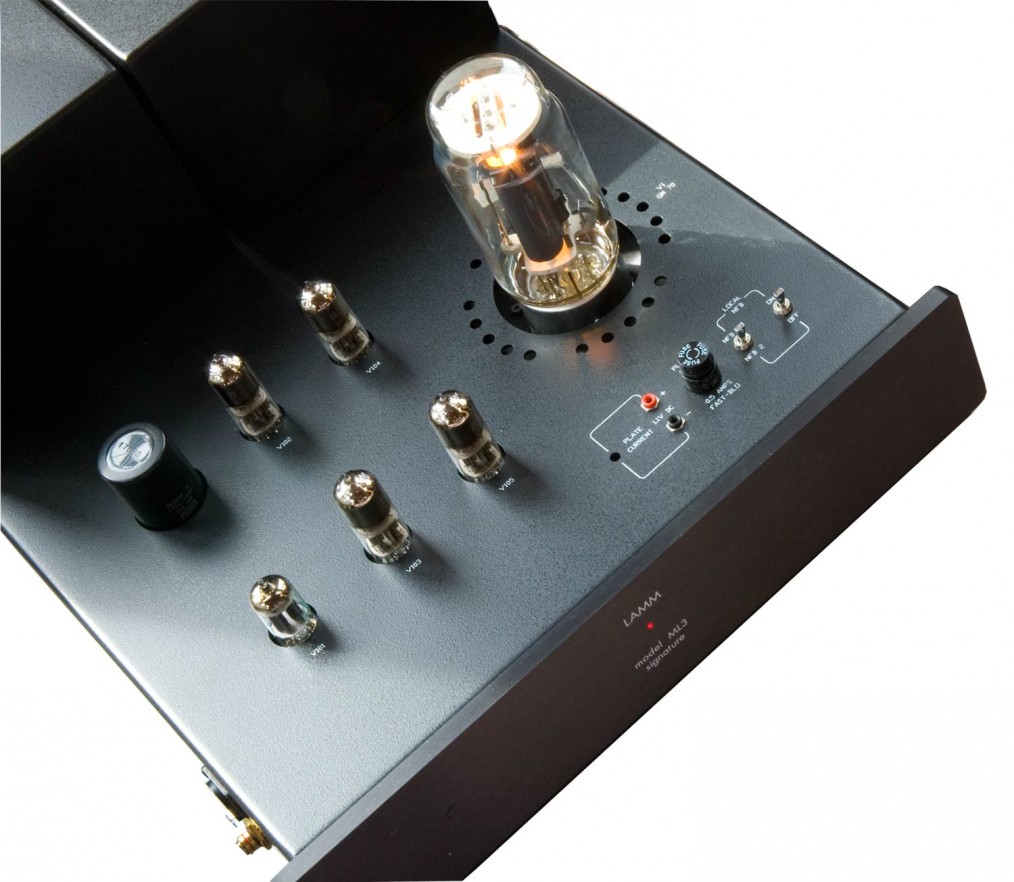
The Lamm ML3 Signature amplifiers are a breakthrough product breaking significant new ground for linearity and balance [even-handedness across the frequency, harmonic, time and dynamic spectrums] and textural resolution [the entire Oreo cookie] against a background of extreme quietness. This is the audiophile’s ultimate amplifier to geek out with, it is probably the closest we need to get to straight-wire-with-gain, and it is extremely Enjoyable to listen to.

In this new Golden Age there have been and will be other break-throughs. It is important to differentiate good products from break-through products so reviewers just don’t start labeling everything everywhere as ‘break-through’ products. This we will do in an upcoming post, and we will compare break-through amps, cables, etc. which help the listener hear ever deeper into the depth of musical compositions.

Welcome to the new [golden] age everybody.

15. P.S.

Mr. Fremer talked a bit about how the listener is actually connecting to the Music [yay!]. But the impression I was left with was that there was always this lurking fear in the background that ‘Oh my, I am enjoying this passage too much… therefore the sound must not be real or accurate anymore [Awooga… Awooga… its a Tone Control. Its a TONE CONTROLLLL!]’.

In a large sense the measurements-first, ‘the reproduction must be as accurate as possible’ approach, preferring to err always on the side of sterility, is really kind of navel watching at its finest. Comparing this to painted portraiture, a portrait capturing some of the inner life and strength of, say, George Washington, is preferable to a photograph taken by an old smartphone, which, although potentially more accurate, and you can see that it is The Man with the long curly white hair – it does little to reveal much about their personality and character, which, after all, is why we care to even bother looking at [listening to!] them at all. We really want, most of us, to connect to them as people/music.

I am not talking Picasso or Gauguin-like interpretive art here … even though I do think impressionistic systems have their place, and in some ways may be preferable, when one starts wanting to explore some of the deeper, spectacular meta-verses of the Human-Music interface [although, seriously, the uber high resolution texture of the music heard through the ML3 opens up a LOT of doors / stargates. At least it did for me.]

16. P.P.S.

Yep, it is too darn expensive. All the break-through products I know of are [unless one includes the old EMM Labs CDSA]. Until the middle-class stops shrinking and ‘discretionary middle-class income’ ceases being an oxymoron, we are probably stuck with these high prices for awhile [and while we are all waiting manufacturers will hopefully build a few more of these kick-ass take-no-prisoners betchya-never-woulda-thunk-it toys to bring us all closer to the Music].

We still would like to have this Wilson Alexandria XLF / Lamm ML3 Signature system here sometime, as our primary system. Last I heard this is the system that Wilson himself listens to. The older Alexandria X2 might do as well – the used ones have been going for an amazingly reasonable price. But getting 700 lbs up our 45 steps here…? Been there, done that, REALLY don’t want to do it again. When all is said and done we still need to sell this house and move somewhere a little bit more crazy-audiophile friendly.