CES 2014: Marten Coltrane Supreme II – Most Interestings of Show (part five)


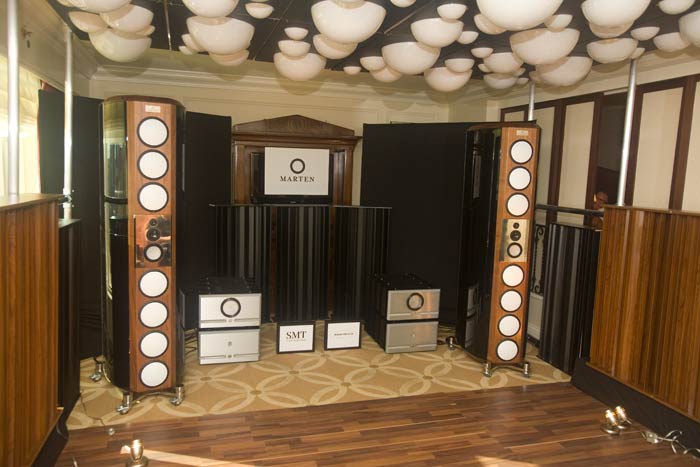
Marten Coltrane Supreme II speakers on Pass Labs amps and MSB digital

Yeah. Spacey room treatments.

These speakers, and the pen-ultimate Momentos, reflect a new direction for Marten. The original Coltrane Supreme speakers, and their Coltrane speakers as well [we think both the original and V2], were, as I have often described, a tabula-rasa. A blank canvas. They played whatever signal you sent them. Which was cool, because we could put umpteen billion dollar expensive extremely high-quality gear on them and actually get to hear the gear. Other speakers have their own sound, to some smaller or larger degree, and you didn’t really get to hear the gear. Not fully.

Let’s take a step back. Hearing your gear, when it is a extremely well made relatively low-power 211-tube based amp, or GM70, or 300B, or what have you, is an experience akin to the most ecstatic moments we can experience in this life. All those subtle layers and layers of inner dynamics and harmonic transitions and all riding on top of a musical carrier signal that just steals your sorry ass away from this troubled world and into something a whole lot better.

The speakers had their own unique performance characteristics, like all gear, but really very, very little sound of their own.

OK. Hearing your awesome gear. Got it?

Now what happens when someone puts a not so wonderfully awesome amp / front-end on these same speakers? Well you hear that too. And who gets the blame for the resulting not-so-pleasant sound? Is it the inferior gear? Nooooo. It is the speakers.

Look at the reviews of these speakers. Same thing. They hear their [sorry, but…] woefully sucky gear on the speakers and then report on what they hear.

Are they idiots? Maybe, but it is not like anyone but us has been writing about this [and who pays attention to little ole us? Sure, we actually do have 10s of thousands of readers – but in the end it is just the ravings of a couple of nutty audiophiles against the realities of an anti-audiophile world]. We ourselves kind of stumbled upon this by accident, years ago. We just kept putting better and better stuff on the speakers and we kept hearing deeper and deeper into the sound [No, sorry, this is rarely if ever the case. Most speakers provide diminishing returns as you put better and better gear on them. See the room review below of the Lamm ML3 on the Verity Lohengrin speakers as just one example].

Now the factory just wants to sell speakers. They do not care about Mike and Neli [and a few of you out there] and whether we are experiencing musical ecstasy or not. In fact, I am willing to bet you that none of them, except perhaps [maybe] the designer [who is one of the best speaker designers in the world, but…], even know what these original speakers do. All these people trying to sell these speakers, they put mid-fi junk on them and think they are hearing what they do. Nope. They are just hearing their mid-fi POS junk.

So what does the factory do? They make the speakers more forgiving so that people putting inferior grade gear on them do not go home unhappy. A side effect of this is that the speakers are harder to drive. Remember all those cool, ultra-high-quality single-ended tube amps that you could use with the original Supremes, with the powered bass? No longer gonna happen.

So the sound in this room at CES 2014 was hard sounding and smeared, with not enough resolution, in the upper midrange [etc. let’s call it screechy] and fundamentally unenjoyable. As one might expect. But the point here, which is hopefully more clear after all the above background information, is that it wasn’t as screechy and unenjoyable as it should have been.

You could still hear the quality of the speakers through all that mismanagement of the musical signal. But this is like a 600 watt amp we got here. These puppies require Power [minimum 50 watts. The previous version had an active (2000 watt powered) bass and was easy to drive].

For many, perhaps most, of you this will be a welcome change. It will be easier to get a listenable sound, yet completely accurate with extreme high-resolution, with these speakers using your average everyday gear out there.

But what if you, like us, are going for the ultimate sound experiences? The reason we like to use smaller tube amps is because so many of the larger amps, both tube and solid-state, have had so many music-obliterating mind-numbing headache-inducing issues [i.e. they suck] that it has been easiest to ‘just say no’.

Now, we might able to say ‘yes’. After listening and listening and from all we have heard the 1500 watt EmmLabs MTRX amp is significantly different from (read: better than) their high-powered brethren. In fact they are starting to change the whole way we look at power-hungry speakers [and they are quite a bit less expensive than the Gaku-on and slightly less than the ML3. Less expensive is good, yes it is]. People going for the gold can now just put the MTRX on the speakers and drive the poop out of them. With these speakers this would be a truly powerful, accurate, no-nonsense-allowed musical reproduction. The sound’ll no doubt be excellent [not screechy nor unlistenable at all :-)]. But otherworldly? Maybe…. [hope so!].

Because of this change of focus, the Martens are now part of a different market segment. The Supreme I was part of a rarefied and august group of easy to drive ultra-high-end speakers, some a little too forgiving, perhaps, but with not that much sound of their own: the Acapellas, the big Wilsons, perhaps the Magico Q7, and perhaps a few others [there are conflicting reports].

The Coltrane Supreme II (and Momentos but not the Coltrane II), on the other hand, are up against many more, a few dozen or so, other statement speakers that are also somewhat forgiving, a little less [some might say ruthlessly, some might say perfectly] revealing, and a little hard to drive, each with their OWN sound [read coloration] that each person must decide is a ‘good’ sound or a ‘not so good’ sound: The Kharmas, Magicos (except perhaps the Q7), YG Acoustics, Perfect8, Avalon, Focal, Genesis, Tidal, … And many others.

What the Supreme II has going for it is higher resolution [that diamond midrange thing along with all those Accuton drivers] that is more musically true, more linear and accurate than the competition [Leif does innovative things with crossovers that keeps things sounding like music and not some mad scientist’s concoction, while still keeping true to the input signal], This all contributes to the enjoyment of the music, as opposed to just artificially calling attention to itself [look at me! look at me! i.e. it goes way beyond the basic Impressiveness which is all that the vast majority of statement speakers have to offer. Impressiveness, you know, is really cool – who doesn’t love that big, BIG sound! – but sometimes a person wants more than that].

[neli: We do hope to hear the Coltrane Supreme II with different gear, gear that is more to our taste [and more suitable for $500K speakers IMHO (mike)], in early summer [if our customer, Encinitas Jim is up for it]. At that point, the speakers also should be more fully broken in, and hence we should be better able to assess their performance compared to the original Supremes, and also to their current competition.]

So, yeah, enough about the sound. The Supreme II is 2 boxes versus the Supreme I’s 5 boxes [although we never had a problem positioning the 4 towers, perhaps others did]. The look is also quite different: there are no grills over the drivers on the front of the Supreme II. The new Accuton cell technology drivers look cool [what can I say? They do]. They are also fatter, kind of like the Coltrane II in that way….

Can’t wait to hear them again…. ๐Ÿ™‚

CES 2014: Most Interestings of Show (part four)

[Similar to the RMAF 2013 show report – we will put the politically correct version for all ages and levels of audiophile, along with well over 1000 photos, over on Ultimist – and we will put the more opinionated report here on the blog, which we will call ‘Most Interesting of Show’, for people who are focused on Pursuing the Ultimate Music Experiences.]

There were actually quite a few rooms this year that we thought were interesting. Interesting sometimes due to an intriguing pairing of different brands of gear together and sometimes due to interesting sonics, and there were also a couple of exceptional sounding systems as well.

In no particular order:


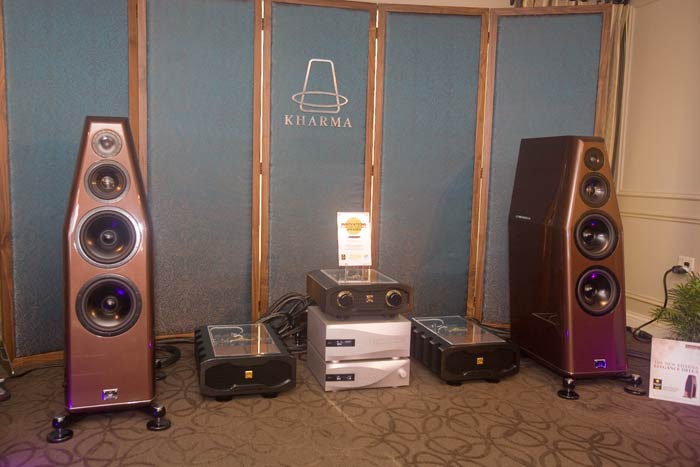
Kharma Elegance DB11S speakers on Kharma electronics and cables, dCS digital

I wasn’t happy with Kharma’s room last year at THE Show. It was cold and analytical. Not Kharma-ish at all.

This year’s room at the Venetian was way different. That old Kharma excitingness was back.

I have spent a lot of time trying to quantify and qualify this sound and what makes it different. It is definitively more exciting than most other speaker sounds [I used to compare it to how one feels about one’s girl (boy) friend versus how one feels about one’s wife (husband) – and I know none of us have girl (boy) friends, of course, but I think we can imagine just what that would be like just fine ;-)].

Is the midrange and upper bass slightly more dynamic than the rest of the frequency band? Are the mids more harmonically rich? I don’t know, but I do like it; although to hear it best I kind of have to sort of turn my mind’s ear and point it toward the 6th dimension [I don’t know how else to describe this].

Anyway, a bold sound, a little too much for the room but it worked much of the time. Very dynamic and powerful, especially in the upper to mid bass. Very harmonically rich and engaging. Uneven and not very linear top to bottom, however, and a little wild. But it was fun and exciting, so I liked it, especially in the context of the show where a lot of systems sounds are, whether good or bad, just plain boring.


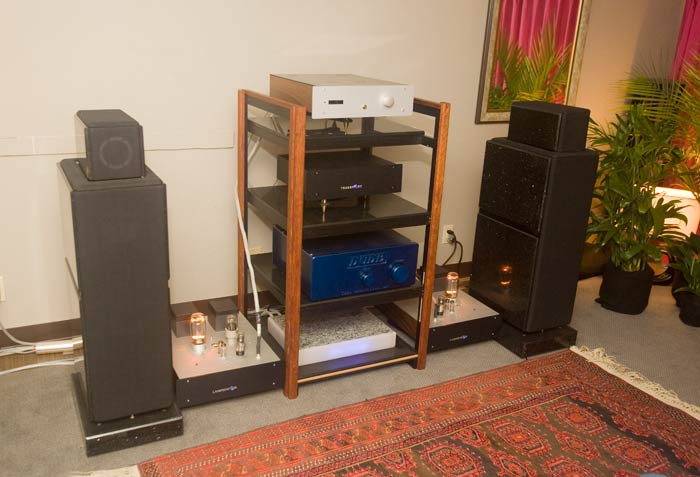
Theorem Imaging Science speakers on Lampizator electronics

These guys are so infuriating. We only got a very little time to listen to these before they drug us over to the next room to see their smaller system that was not playing any music. Argh.

I think this system is interesting because it did sound pretty darn good. Maybe they do wonders with cross-overs but I suspect it is the fact that the cabinets are made from granite and are so inert and stable that there is not much box coloration at all. And this is seemingly very, very important if you want to elevate your playback into state-of-the-art territory. All of the energy for each note goes into the note and not into warming up and vibrating some large chunk of wood or fiberboard or composite material. Lots of good separation and dynamics. Speakers that start with an aluminum, granite or perhaps carbon fiber cabinet enclosure have a real advantage over those that do not.

The harmonics also seemed quite rich [but not too rich] and musical as provided by the Polish Lampizator company.


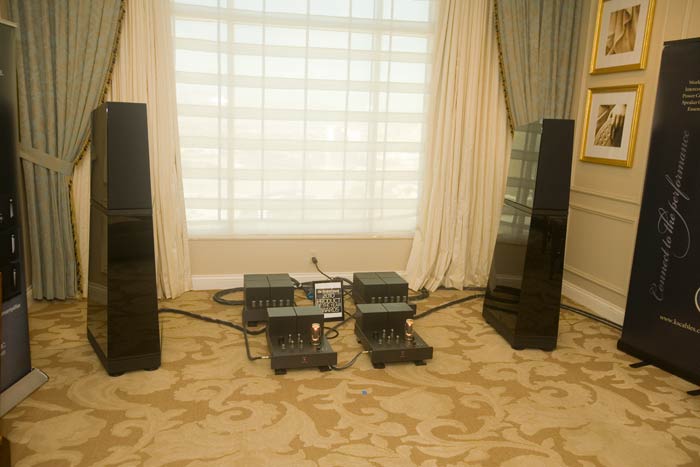
Lamm ML3 amps, LL1 linestage, LP2.1 phono, LP1 phono on Verity Lohengrin II speakers with Kubala-Sosna cables and HRS (under the TechDAS turntable) and Kanso rackage

We have a friend customer who has the ML3 amps on these the latest Verity Lohengrin II speakers [with Jorma cables instead of Kubala-Sosna and Audio Aero La Source front end, all on RixRax equipment racks with Harmonic Resolution Systems M3x isolation bases under everything]. His goal was [more or less] a sound that was always musical and never aggressive, otherwise with as high a resolution and as much accuracy as possible. That system succeeded wonderfully for him. He could spend 2 or 3 times as much and get something better [IMHO] but, heck, this is pretty gawd darn expensive already.

As I sat in this room and heard how much of the wonderfulness of the ML3 amps was not getting through to my ears, I still thought our friend bought the right thing… for him. But for me? I want to hear that amp. I know it to have wonderfully detailed and subtle harmonic and dynamic transitions that add so much [for me] to the music. And more.

But the speakers, and to some degree the cables, and perhaps even the unfamiliar Kanso equipment rack, were softening up the sound enough that I did not feel as engaged here as I did in previous years, or even as much as I did in the Lamm M1.2 amp on the Wilson Alexia speakers room next door.

[Vladimir Lamm swapped back and forth between the LP2.1 phono stage (which debuted this show. yes we have photos on the inside of the chassis to be posted on Ultimist) and the more expensive LP1 Signature phono stage, several times by using the two tonearms on the TechDAS at the same time [say what? this was fun]. With two very slightly different cartridges it was a little bit of a Fuji apples to Braeburn apples comparison, but the short and quick is that if you didn’t hear them back to back (the more expensive LP1 being smoother, less grainy, and just more of that good old analog wonderfulness) you would think you were already listening to the LP1 when it was in fact the less expensive LP2.1 all along (the original LP2 has been a giant killer among phono stages here at the Fed, at least until you get up into the $20-$30K range of the competition).]


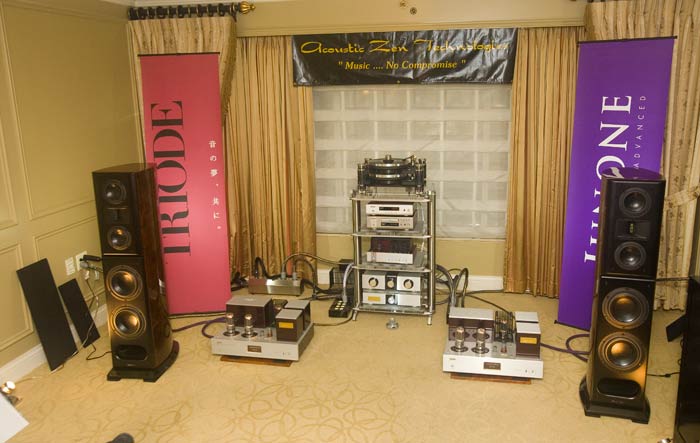
Acoustic Zen Crescendo Mk. II Speakers on Triode Corp electronics

It is funny [or not] when I read the better show reports and how they report on these rooms setup by Acoustic Zen and Triode Corp at all these shows. They point out something like that they heard a slight issue with the sound of a part of one of the tracks they played here. Ah, then this, they imply, can’t be best of show then.

What this really says to the perceptive reader who reads a lot of these things and thinks to themselves a little bit is that, hey, these rooms are such reliable performers, and it is so boring to keep awarding them the accolades they deserve, that they will dig deep down and find something [anything!] wrong so they do not have to put them somewhere on the BOS list yet again. The Lamm rooms experience this same thing.

Show reporters get so bored with seeing the same things each show [most of the gear, the setups, the people… it is all 98% the same from show to show] that they need to mix it up once in awhile and pick someone else as BOS, someone else to talk and rave about. And heaven forbid that they bore the readers [equals less traffic equals less ad revenue] by talking about the same old boring rooms that sound good, that perform well, each show after show after show.

And the speakers are only $18K? And the electronics are actually fairly reasonably priced?? BO-ring. Can’t get any more boring than this. Show reports got to be exciting wiiiild stuff, man…

They played music here. It sounded like music. It did nothing egregiously wrong and got a lot just right. It was immensely enjoyable. Like freaking always.

Well, I guess [and after all I am kind of a show reporter too…] I am also a wee tiny bit bored :-).

Yah, you know, each show it is the same… I can’t ever afford to spend a lot of time here [and this is what sucks about being a show reporter who actually goes to all the rooms (otherwise you have prejudged the show before you even arrive! Having decided what is best by the choice of what rooms you omit even visiting)]. You know I have to go and check out all those other rooms…

*sigh*

CES 2014: Most Interestings of Show (part three)

[Similar to the RMAF 2013 show report – we will put the politically correct version for all ages and levels of audiophile, along with well over 1000 photos, over on Ultimist – and we will put the more opinionated report here on the blog, which we will call ‘Most Interesting of Show’, for people who are focused on Pursuing the Ultimate Music Experiences.]

Again, in no particular order… [if I forget to mention a brand of cable or rack, and you think it needs to be mentioned, please let us know, either here or in a personal email. Oh yeah, and anything else I got wrong? Let me know about that too ๐Ÿ˜‰ (Neli does try to correct my bad grammar, but sometimes she has a hard time keeping up with my fingers when they are on their wild grammar-killing sprees)].


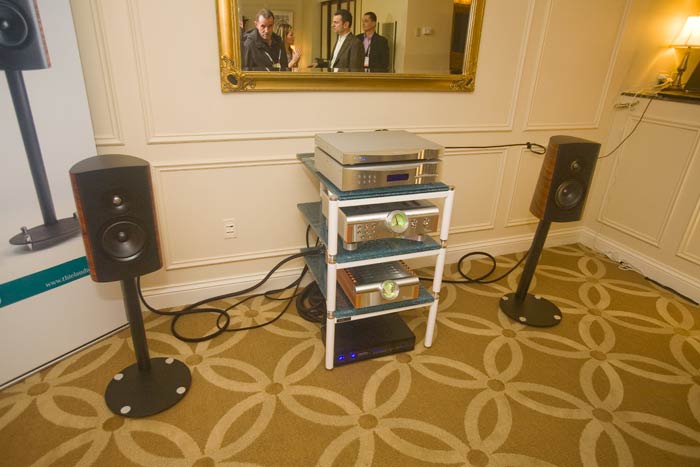
Thiel TM3 speakers on D’Agostino electronics and dCS digital
This system was interesting to me because it had the best sound of any Thiel speaker system I have heard lo these many years. It was musical, approachable, decent harmonics, not grainy or shouty, and even engaging to a certain degree.

I didn’t play our own music here, so their ultimate capabilities are unknown to me, but if I was a Thiel dealer, I would be looking into these speakers (and the new modern-looking Thiel TT3) and picking up D’Agostino gear to play on them very, very seriously [OK, yes, D’Agostino is a wee bit expensive for these speakers, but they really seemed to like each other].


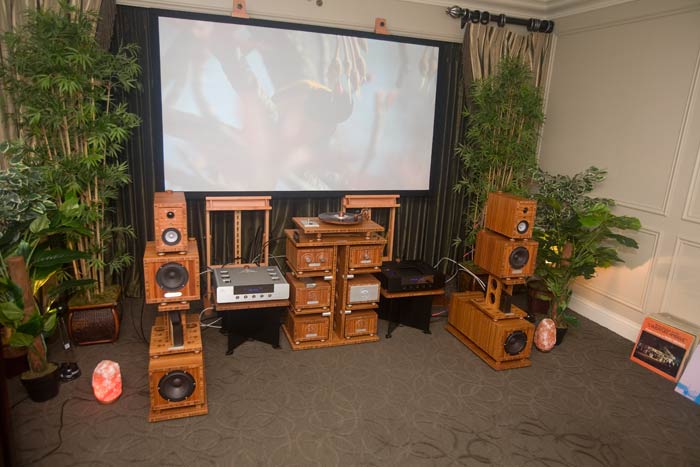
Tri-Art Audio
This somewhat startling-looking system sounded pretty darn good. I heard very little boxiness or speaker coloration, so there was good separation, which I am quite partial to. From separation we usually get good imaging and soundstaging, linear-ish dynamics and response. So the performance of this system was up there with the second or third tier of rooms at this show. Not a lot of bass here, but at a show that is often for the best.

I really just thought this was interesting because, well, if you are someone who really likes the use of natural-looking high-end audio cabinetry, your choices in brands of gear are severely limited. And here we have someone who used just that approach and it worked! It is something well-worth listening to.


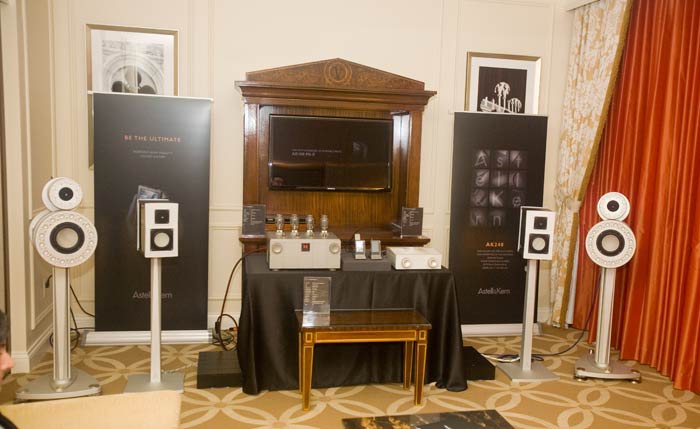
Astell and Kern

Astell and Kern is a Korean company that makes, as I understand it, a handheld device with a DAC and discrete component output stage that orchestrates digital playback. In this room they were showing a system with prototypes of their forthcoming speakers, tube amplifier (a solid-state amplifier will also be available), and preamp [and maybe cables too, I forget].

Although they did not play this loud enough for me to get a sense of the overall quality [no, I am too damn overly polite and did not ask them to turn it up. I’ll try to do better in the future], these speakers are by the same designer who built the Metal Design Systems [I think it was called] speakers that showed here several years ago and with which I was extremely impressed [probably still have their brochure here somewhere. I know I saw it here a year ago but sometimes I do have to throw things out when the file cabinet will no longer accept new brochures ๐Ÿ˜‰ I can’t be the only one who collects these things].

So, the fact that they are (1) using this speaker designer who can build speakers with excellent [excellent!] separation and transparency [both attributes a reflection of accuracy for those who shy away from audiophile terminology], and also that they are (2) willing to go the extra mile and build a tube amp for those of us who think tube amps are usually better sounding than solid-state for listening to music, and (3) they are heavily into the modern streaming-music revolution, so they will be offering us the conveniences of same – well, this is a company to watch, IMHO.


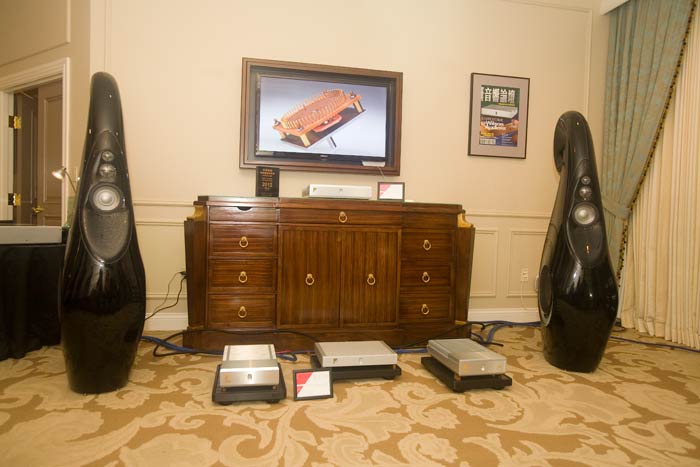
Ayre Acoustics electronics on Vivid Giya G1 speakers. HRS amp stands. Cardas cables.
Vivid, a home audio speaker company that deserves a lot more accolades than it gets. Ayre, an home audio electronics company that… also deserves a lot more accolades than it gets.

This system was approachable, enjoyable, somewhat sophisticated, although a little laid back. Essentially, I could actually spend time listening to this over the course of many, many hours and you wouldn’t have to hold a gun to my head. Quietly in the top 10 rooms.

Other the years, Ayre is slowly edging out all other solid-state amplifiers in the reasonably priced [or, at least, not outrageously priced] category to my way of thinking. Just enough accuracy, resolution, dynamics, harmonics to keep it all sounding like music.


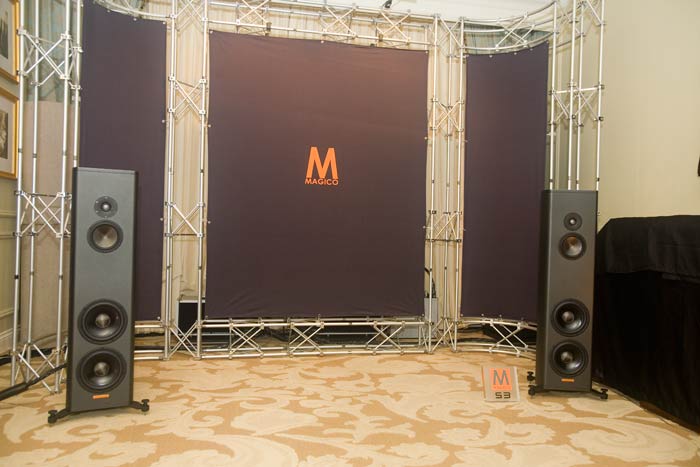
Magico S3 speakers on Vitus electronics

It seems these are new speakers from Magico [who seems to pop them out like … well, like popcorn. Not sure how they do it but I kind of wish they’d stop it. Keeping up with all these puppies is tiring me out], and one can hope that they took the lessons learned from the successful nd smaller S1 speaker [hope they are successful; a very nice speaker at a very nice price] and made these using the same design parameters with just a bit more bass.

Did they succeed?

Hard to tell. Hard to tell.

I like that they put these on some well-known electronics. Unfortunately the sound was not very exciting, not quite as tight as what would show these off to be the true bigger brother to the S1 – but this is also often a signature trait of the electronics being used. So… hard to tell. Hard to tell.


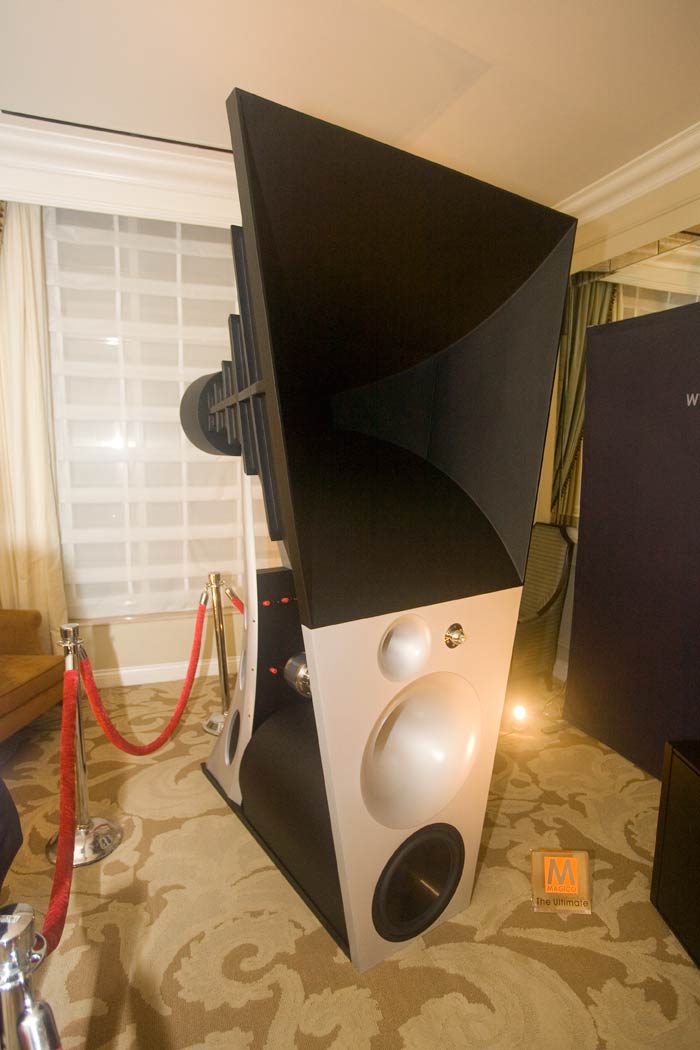
Magico ‘the ultimate’ speakers on static display

I am sure there will be plenty of reports that regurgitate the specifications of these $600K speakers. So I will just post a few observations.

What I wonder is, when run in 5-way mode, or even 3-way mode, where does one put all those amps? Especially if you use higher quality monoblocks. Can you imagine 10 amps on their 10 amp stands, each with their own power cord and interconnect and speaker cables? I only ask this with a slightest bit of tongue in cheek ๐Ÿ™‚

The speakers are solid aluminum [which we were not supposed to touch and I, at least, did not get to touch them. Alon would kill me (again ๐Ÿ™‚ )]. But it *looks* like some kind of composite material; the corners are mitered so well, and the paint job so thick and warm-looking, that it is hard to believe it is made of metal. The fit-and-finish here is amazing.

We have a few dozen photos of this speaker which we will be posting on Ultimist.