
Power Conditioners

This has been the subject of a few emails lately. Some of you may have noticed the Belkin surge protector in some of our pictures (what we call the Office Depot Special ๐Ÿ™‚ ).

Here is an example of an email that we received from a nice gentleman,

“I perused with interest your Audiophile’s Guide to the Galaxy. In your Power Conditioners, Isolators and Regenerators section, I noticed your following claim:

Typically power conditioners increase dynamics and lower background noise at the expense of microdynamics, emotion and that toe-tapping pacing, rhythm and timing.

I mean this very respectfully, but as an experienced audio / video technician and avid audio enthusiast, I can’t think of any reason why a power conditioner should have any negative effect on microdynamics, emotion, or pace, rhythm and timing. Perhaps you will be good enough to share with me what experience or impart on me that knowledge which has led you to this conclusion.

I enjoyed your web site and will certainly recommend it to others I know.”

First, we thank you sir for your kind words and question.

There are two answers to his main question.

The first is my preferred answer, which is:

* We have tried a number of power conditioners and by far the common result is that we, and many other people, consistantly hear these negative effects.

So, this is that good ole scientific method of performing repeatable experiments and observing the results, The important thing here is that the observation, the ‘measuring’, is done with the ears and not mechanical or electrical instruments.

If someone has the time and genius to create a phsycial model of why power conditioners do this, build the instruments to verify their model, perform the experiements and determine that yes, their model matches the evidence of what we *hear*, then that would be great.

It is this return to first principles, to common sense, that many people [for example those that will not hear differences in cables] we see post on the net fail to recognize in their pursuit of science as religion [you won’t find a more scientifically geeky couple than Neli and I – but true science knows that it does not know, it only hypothesizes testable, verifyiable and often quite useful models of how many things work – but models often need revising if the experimental data requires it, and there are not detailed models for EVERYthing out there yet – like cables and powercords and power conditioners… ๐Ÿ™‚ ], that somehow science, circa 2006, now knows ALL the answers, and if science can’t explain it, then it don’t happen.

So, in actuality, no one knows exactly WHY most power conditoners have this effect.

Eventually someone will figure it out.

But it might not be very satisfying.

For example, the sun warms our skin when we are outside. Why? Because (and I am paraphrasing, and probably not absolutely correct, but follow my point, if you will) the photons from the sun hit our skin, increasing the kinetic energy of the molecules floating around in the epidermous layer by converting the electromagnetic energy of the photon into mechanical energy of the molecule, which our nevrve endings interpret as ‘warmth’.

I beleive that is the model that best describes what happens in today’s scientific gargon, but there are both a lot of holes in the explanation [how is the energy actually transfered from that massless photon when it hits that wonking large molecule? All we can say now, is, that it does. The apples falls when we drop it because of gravity. Gravity is created by the Earth’s mass deforming 4D (or 11 or whatever) space. Why does mass deform space? It just does. ]

.. and it is not as satifying as one might want it to be, as say ‘the sun is sharing its life force with us’, and the real explanation is not often very useful in dealing with the situation: warm sunrays, gravity and power conditioner effect are really dealt with better in the common sense mode: wear sunscreen, don’t jump off tall buildings and don’t use power conditioner indiscriminately.

But, with all that out of the way, and with the reader now knowing full well that I am Making This Model Up – just like everybody else who is not performing real experiments [that can be verified, othrewise we will have them proving gravity does not exist, the sun is not warm, and power conditioners all work wonders].

And it is:

That power needs to be supplied to components as instantaneously as possible, and capacitors, usually found in Power Conditioners, even after being charged up for a few days, absorb charges while simultaneously being unable to release a charge fast enough, and in correct proportion to the request to compete with a straight wire, and also cannot be large enough to release a charge that is FREQUENTLY needed by larger components like amps. Same with coupled transformers.

When the component asks for more current, there is some delay and, primarily, dampening of the magnitude of response in electron flow coming from the wall. The PCs seem more inept at handling small ‘spikes’ in the request stream that major spikes, so that often MACRO dynamics does not suffer as much, or may even be increased.

Hmmmm…. wonder if that was clear. It also helps explain (in my head if nowhere else ๐Ÿ™‚ ) why powercords work – they hold a resevoir of electrons ready to supply the component’s needs instantly.

Oh, and just to finish up, most Power Conditioners, being unable to respond instantaneously to demands for current, these small spikes, in order to render the more subtle details in music is what puts those more subtle details, microdynamics, emotion, at PRaT at risk.

Hope this helpssssss………

[The Shunyata Hydra, that we use here when we they are not out on audition – contrary to Robert Harley remark in this month’s TAS, is not a power conditioner – it is a power distributor. There is nothing in the path of the current getting from the wall to the component. BTW, also contrary to his assertion, the Pyython -sorry wordpress dies on the correct spelling – is not 98% of the Anaconda. No one, not us, nor anyone else would pay twice as much for a 2% improvement. We’re nuts but not NUTS]
Buying amps based on Most Watts Per Dollar

I peaked at some of the other forums today…

I know, I know, I should know better.

Somebody pokes their head up to ask people to recommend tube amplifiers… I just imagine this person, afterwards, head fogging up, eyes going in circles…

I always wonder, should I post something? Like…

Buying an amp like this is like buying wine by what is the cheapest with the highest alcohol content.

OK, admit it, most of us HAVE bought wine this way (Mad Dog 2020 anyone?) , but we were young and stupid, or rather, young and desperate ๐Ÿ™‚

But this is no way to buy an amp.

This approach gets people to the ASL Hurricane at $5K for 200 watts. It diesn’t help that HP says wacko things like “once in a decade an amplifier comes around that redefines state-of-the-art – this is such an amp”. He just forgot to mention ‘in the $5K price category’. Kind of missleading otherwise… Perhaps not a bad amp for $5K.

——

Then there is the ‘get the wine with the most alcohol, no matter the price’ folks.

OK, this what we looked for after we got our first job, … we wanted that EXPENSIVE rot-gut, right? Hmmmmm… hope I am not the only one who went through all these fazes of alcohol abuse …. And I can’t remember if Everclear goes into this category or the one previous…

This gets us the massive VTL, ARC, and BAT amps.

——

Next, a significant other may have stepped into the picture. Now we wanted something that was impressive, it no longer was REQUIRED to have the kick of a mule, and it needed a nice label and some nice flavor.

We may have tried orange schnaps, for example. ๐Ÿ™‚ Quickly to be replaced by Amaretto and Kahluha.Or great Port.

This might correspond to say, Cary, Joule Electra or Jadis amps.

Our significant others have to like THIS, right?

And they do, for the most part.

But it may grow old, after awhile, like eating ice cream for supper every night. [Of course, some of us LIKE eating ice cream every night… or pie ๐Ÿ™‚ ]

——

Next, we start looking at the GOOD stuff. Stuff that has enough character, but not too much character, to both entertain and astonish, but with subtlety, and in measured doses, containing enough mystery to not bore us right away yet enough truth to norish us.

The stuff that is considered good now, and will be considered good in 10 years, and, hopefully, in 50 years.

I wonder how many used-to-be audiophiles no longer count themselves among us, OD’ing on the bad stuff before they can find the good stuff?

I hope at least some of them get to the pie.

Updated Our On-site Equipment List found in the Tour

Still need to update the Tour photos…

But it was time to update the Equipment List.

Much of the text that we had there (and some of it still is there) was written in the first year of our store, some 4 years ago.

I had included stuff like This Magazines Award and That Magazines Award.

I thought I was sceptical at that time of the Reviewer community… hah! Now it is all but ludicrous.

I can just see the budding reviewer as a child on career day…

Politician? Reviewer? Politician? Reviewer?

Hey, at least it keeps them away from the nukes.

We try hard to ignore that part of the industry… really we do.

The equipment page was fun to redo – we have some cool stuff here – and some cool pics:

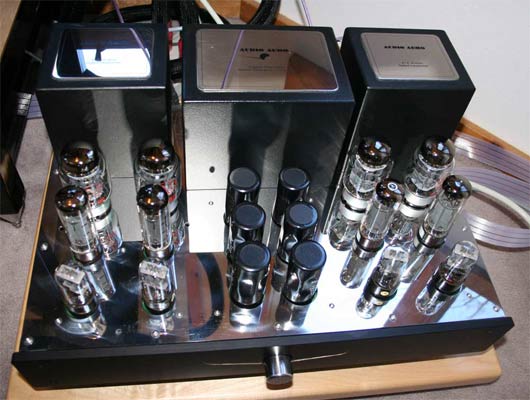
Audio Aero Capitole amplifier
Audio Aero Capitole amplifier. The colors! More larger pics

The text describng our equipment here has a ways to go – to sort of migrate from the advertising copy approach which we kind of cut and pasted from various manufacturer’s copy to the “What Neli and Mike Think” approach.

For example:


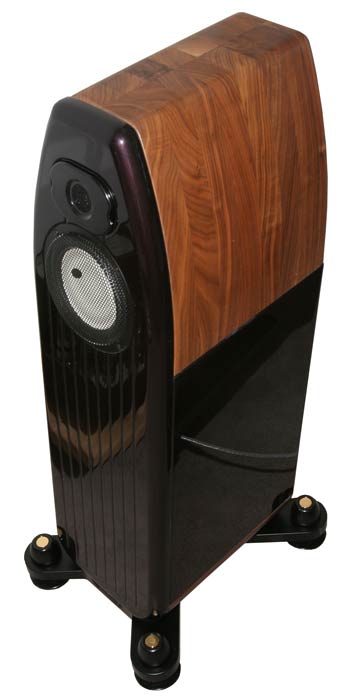
Our Kharma Mini Exquisite loudspeaker. More larger pics.

What we say now is:

“The best 2-way speaker technically and perhaps the most magical 2-way as well.

Ours here, pictured at left, are in aubergine – which is kind of like an eggplant purple. Subtly hallucinogenic – just like the way they sound.

That 1.0 inch diamond tweeter provides an amazing amount of resolution, seemingly much more than the 3/4 inch, and it just seems to be able to project the music from the speaker into the listener’s head.”

This is all to say that the speaker functions excellently in a technical sense from the perspective of a listener compared to all other 2-way loudspeakers (for the sake of argument please ignore the ‘stone knives and bearskins’ that J.A. et. al. use to measure sound quality).

It also is trying to say that there is something going on that is hard to describe, but revelatory and pleasurable – that the mind, while focused on and enjoying the very high resolution of the one inch diamond tweeter, is penetrated on other levels which at this time there are no words for.

So we call it magic. Or hallucinogenic. Or “don’t know what it is but I like it”.

It would be easy to kind of cop out and borrow lots of terminology from some religion or another, or Terrence McKenna, or New Age Hermetics, or…. .or Cheech and Chong.

But, although once in awhile borrowing phases from Star Trek TOS (which is simultaneously both tongue in cheek and strangely technically relevent), we try to avoid letting the ‘magic’ of muscial experience be drowned by the hyperbole, nomenclature, stifling hierarchical bureaucracy or consensual irrelevancies of these other pursuits.

We have our own hyperbole and consensual irrelevancies, thank you.

Oops, got side-tracked.

So, trying to explain each component we have here in a few words to someone checking out the list to see if we have something worthwhile listening to… What to say. What to say.

If they are just looking around at various dealers to hear what has received rave reviews – well, that is not going to narrow the list at all. Everything sounds great, haven’t you heard?

So, hopefully just putting down what we think is going on, in halting English, putting it out there – exposing our stumbling around in the dark, for everyone to see, as we try to figure out just WHAT this speaker, and a few other components here and there, do that is so darn AMAZING – that this will tempt people into comimg here to hear and experience the whatever-the-heck-it-is for themselves.

[Oh, and now I see in the TAS we just got that Wayne Garcia just raved the Mini Exquisites. Don’t know whether to giggle or scream. So I guess I’ll just go to bed. G’night everybody.]

[P.S. Hope everyone had a peaceful night. The problem with a rave reviews from most reviewers is that it puts a potentially really great speaker or component on the same level as all the mediocre speakers and components that the reviewer also gave rave reviews to.

Yes, many dealers just point to the recommended lists in Stereophile and TAS and grunt a little – and so random raves do spread the sales around to a wide variety of products – but it does a disservice to the consumer interested in the sound of their equipment. Why must this industry treat audiophiles like ‘marks’ at a carnival – like they were just wallets and purses with credit cards for arms, industry sanctioned ‘recommeded lists’ for eyes, and without any ears? We can do better.]