Are CDs over-priced compared to DVDs?

We’ve been having this … discussion [funny how more and more discussions include phrases like ‘nuts’ (this is a family blog), ‘I married you why?’, and ‘OK, ask people on the Blog what THEY think’] about whether CDS *SHOULD* be priced at the same price as DVDs, [and with pre-viewed DVDs being so plentiful, more like two to four times the price I pay].

*I* say [and I write the blog so I get the first word in :-)] that DVDs are twice as long, have extras, and have video as well as sound. This should make DVDs four times MORE expensive than CDS, and that it is only our beloved recording industry whose monopoly has driven the price of CDs up to ridiculous levels.

*They* say [and Neli is among these sorely misguided people, poor girl] that we listen to CDs over and over again, whereas we only watch movies once or twice. So CDs are worth more because they provide more entertainment in the end. [funny, using this metric, ‘Kind of Blue’ and ‘Star Wars’ should go for $Millions. They are WORTH millions, but that value is spread out amongst the millions of copies people ‘own’ of them].

Anyway, on this blog I may lose this argument 🙂 But I think in the marketplace, people feel that $19 for a new CD is too much and are voting with their wallets by Not Buying Them. Almost all of us now have bought and made a data CD for ten cents – the rip-off factor is kind of in-our-face.

That said, I heard clips from the newest Steven Stills CD yesterday with cuts from the original CSN tapes. I think I will get ripped off at least one more time 🙂
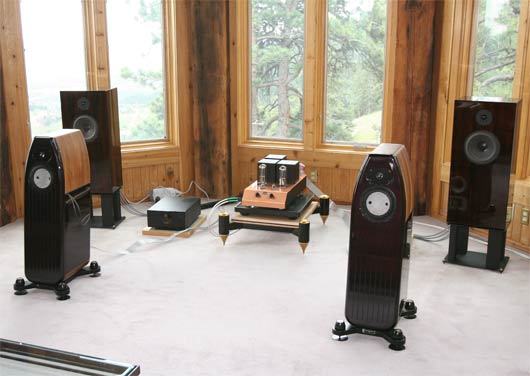
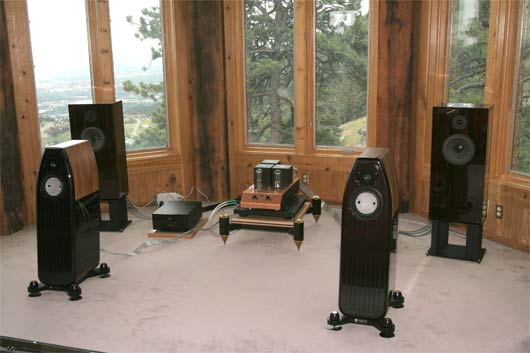
Audio Note Ongaku amp on Kharma Mini Exquisite speakers

Well, well, well… it is working a heckuva lot better than anticipated.

Actually, it sounds really excellent.

We are really performing two tests here:

Can the little Kharma fill our large room with sound? Yes.

Can the Ongaku integrated drive the Mini Exquisites. Yes, for the most part.

The highs and mids are extremely lovely. We have not heard the Kharmas sound like this before. The 6C33C tubes on the Lamm ML1 and ML2 amps, and even the 300B on the audio Note Kegons, just do not have the amazingly seductive quality of the 211 tube on the Ongaku. Combined with the Kharma’s natural seductive qualities, along with its very, very high resolution in these frequencies – it is just a joy to listen to.

As for the bass – the bass is present – and satisfactory. Enough to not take away from the rest of the frequencies. But seriously, bass is not why a person has these littler Kharmas nor a tube amp. So I would give it a ‘B’ for bass. An A+ for the rest.

Finally – there is some slight congestion during very loud, complex passages… this started to diminish over time, so perhaps the amps were still warming up from when we turned them off to hook them up. We’ll hear how far things have improved in a few days….

The upstream components… mostly using the Emmlabs CDSD/ DCC2 combo, with the Audio Aero Capitole stepping in for comparison purposes.

Soundstaging – An American vice or the face of truth?

We talk to a number of people from outside the U.S. – a significant percentage of our readers are from overseas and Canada – and we often hear something like:

“Oh, only you Americans care about soundstaging.”

Soundstaging – for the purpose of this post – is depth and breadth of imaging – being able to hear WHERE the instruments are. Soundstaging is the opposite of a ‘wall of sound’ – where the sound seems to come to the listener in one big mish mash from the general direction of the plane of the speakers.

OK, it does take a larger-sized room to be able to pull the speakers out from the wall in order to hear any kind of soundstagjing. And many people in Europe do not have large-sized rooms. But we hear the same thing from Australia – which has side-open spaces like we do and presumably large-sized listening rooms.

Funny, Americans are supposed to be unsophisticated – not caring about subtle details that contribute to enjoyment of the finer things in life. Well, at least in this case – I think they are wrong.

Why? Because soundstaging occurs in real life – and one of the things our systems should do is try to mimic real life.

Certainly acoustical instruments soundstage. Otherwise we would be a dead species – hearing the lion’s roar, or baby’s cry, not knowing where it came from.

In many amplified venues, the counter-argument goes, people do not hear a soundstage. I think this is because the amplification is cheap and not setup correctly, sound coming from speakers mounted on the ceiling, in the walls, … coming from amps shared by multiple instruments… etc.

So, not much else to say – it is obviously NOT a vice, and is instead an attribute of the Real Thing. Hopefully our audiophiles overseas will catch up to us 🙂 Funny though, speakers manufactured overseas soundstage just fine thank you, being a result of matching pairs of speakers (frequency response, etc) and a decently detailed treble. So we just got to get them to pull the speakers out from the wall and get with the program…. 🙂

One thing I know, once you get used to soundstaging, it is hard to live without. It is addictive.

Whoo hoo, we’re one of the blogs feeding speshy.com!