
Our Listening Rooms Today

[… previously on Audio Federation…]

[… as we return to our story…]

🙂
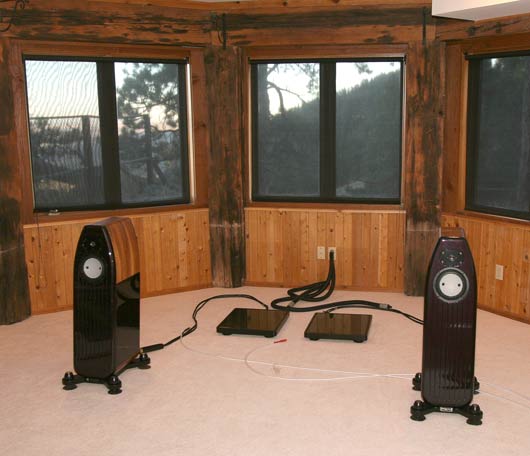

The Kharma Mini Exquisite speakers [the Lamm ML2.1 amps are out on audition]. At reasonable volumes, this combo is SO seductive.

Sometime we should all have a sit down and talk about what is a reasonable volume. This is probably the area of most divergence among audiophiles, by which I mean some people like it always around 80 – 85 dB and some like it always around 110 dB, and lots like it in between these SPLs. This is a WIDE range, and a system optimized for one level may not necessarily do so great at the other extreme.
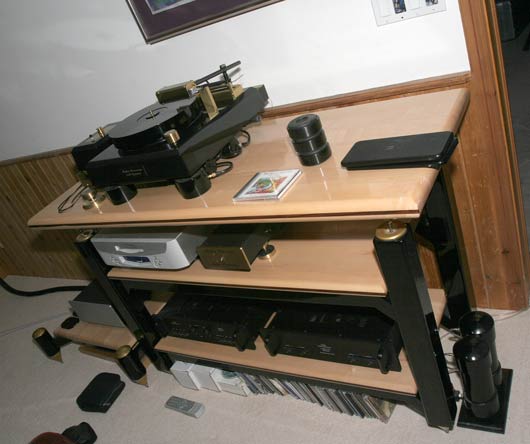

The equipment driving the Lamm ML2.1s [The Walker has been moved so that work can be done on the light switches that melted during the lightning strike]
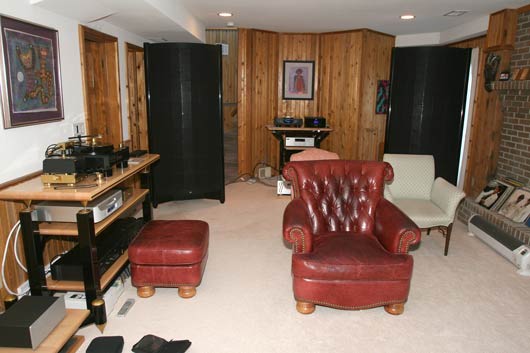

The room from the Kharma’s eye view. Those are the soundlabs in the back there and the red leather command chair in the front.


The equipment driving the Ultimate Soundlabs. Neli set up three digital on this systems: Audio Note, Emm Labs, and Audio Aero for people who want to do a digital player taste test. It is somewhat compromised, everything running through the Audio Aero Capitole CD Player’s built-in preamp, but it does help people understand the CHARACTER of the different player’s sounds.


And the main system upstairs. Still not positioned 100%, as Neli annoyingly reminds me. We just need to play a few dozen records and start the speaker positioning rumba: play, listen, move, listen, move, play something else, repeat.

The 3rd listening room is still a mess: Adagios, our RMAF Audio Note system and rack, trade-in Nolas, DeHavilans, cables galore,…. it is a very expensive Mess.

A Two-Tier Marketplace

OK, here is an idea that some smart guy presented to us during the show.

The high-end audio marketplace is splintering into two main product delivery categories.

In the bottom tier, the product (brand) is sold on the internet or through second tier dealers at a discount. Service and support is minimal, and there is lots of used cheap product on the net at an even steeper discount.

In the upper tier, the product (brand) is sold through first tier dealers at little or no discount. Service and support is extremely high, and there is rarely used product on the net and when there is, is at high enough of a percentage of the new price that it tempts people to pay extra to buy new to get the service and support.

Of course, we see this happening all over the place.

A corollary to all this is that brands rarely straddle the two tiers and dealers who carry brands from both tiers will be forced to choose between carrying either exclusively top or exclusively bottom tier products.

It is unclear where music direct and acoustic sounds fits into all this. They offer high price and minimal service. A profitable business model if it is sustainable.

Orthogonal to this is brands moving rapidly through new versions as the manufacturer struggles to stay alive by encouraging people to ‘upgrade’.

One can certainly point to a number of brands that do this all the time, and bottom tier brands with so much product available on the net at such large discounts, what else can they do. [ignoring digital, where the optimal cycle is like two weeks these days of rapid innovation].

Transitioning from the bottom tier to the upper tier takes several years, several years of little or no sales as the supply of cheap product drys up and people stop expecting to being able to buy it at steep discounts.

Anyway, if it isn’t obvious, we are very much a top tier dealer. It will be interesting to see how this all plays out.

The State of the High-End Audio Business

We heard, and are hearing, a lot about how bad the high-end market is these days.

Audio Federation is growing faster than Google, so we are thankfully we are only seeing this second hand. (A big thank you to all you out there, customers, manufactures and people keeping the flame alive)

But we hear concerns about Krell’s health, the deal for Harmon being terminated because there “were material changes that had hurt the company’s business”.

Many, many dealerships are hurting, or just closing their doors altogether.

And there are the explanations: age demographics this, home theater that.

And then there are all the new products hurried to market as people continue to add to the glut of non-selling product out there.

Sounds pretty bad, huh?

Well, I’m here to remind people about cycles. Stock market cycles, real estate cycles, fad cycles, etc. and that stupid and vacuously untrue cliche: it is always darkest before the dawn [seems like it is darkest at midnight, several hours before dawn, but let’s not digress just yet].

Let’s take something most of us are not heavily invested in, like office space. Most cities go through cycles, at at one point they will overbuild office space until there is so much they can’t give it away.

Smart people then go in and buy office buildings at that time. When it looks like the most stupid thing to do ever because there will never be a need for this much office space, ever.

Ever in the foreseeable (aka IMMEDIATE) future.

OK, that is the crux of my argument that It Will Get Better.

But not before it gets worse.

Based on this model, one might expect it to be ‘popular’ knowledge that this industry is not a place to make money and the new products rushed to market are mostly focused to the home theater installer market [designer in-wall speakers, expensive cable tuned specifically for home theater, luxury-class amps designed to be installed in the walls, etc]. We are of course seeing some of that now, for example this post – and almost every speaker and electronics manufacturer, some very recently, offering in-wall and multi-channel versions of their product line.

If our fellow audiophiles in Europe and the Far East weren’t keeping most of these companies going, we’d have seen a mass extinction already.

Now the fun part (for me)

How will the industry come back? Why?

My wild-eyed guess is that the iPod / computer / DVD generation will eventually want good sound.

So in this scenario, the system of the Mary and Joe of the future will be computer (media server) based with a docking station so people can upload and download music into a portable device, and it will be integrated with their video device.

But, a word of caution.

There also exists the ‘buggy whip’ scenario. In this scenario, new homes come with built in systems, with in-wall speakers which are ‘good enough’ for 90% of the population, just like cars come with stereos that are good enough for most people. And when the 10% people upgrade, they just replace these system with other better built-in systems. People will upgrade their home electronics systems like they do their dishwashing machines and cooktops.

Of course, at the bottom of every cycle, in every industry, there is always a ‘buggy whip’ scenario… So who can tell.