We keep moving things around but…

… here is how they look, well, how they looked a couplea days ago, anyway.
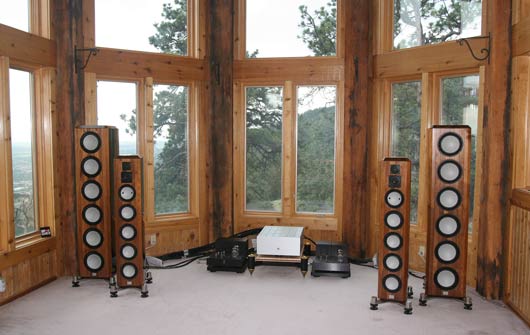

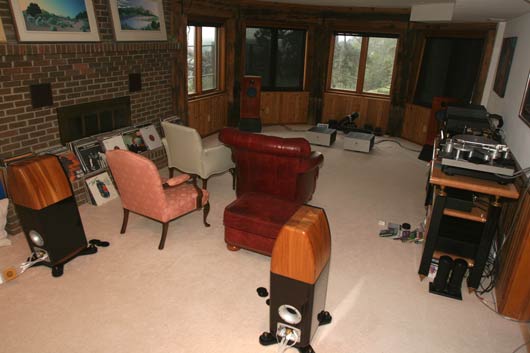
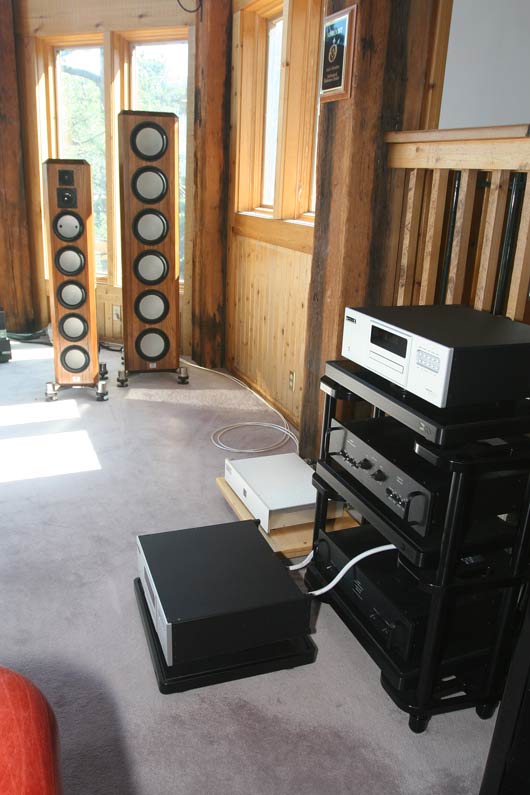
The Lamm ML2.1 are still driving the Marten Coltrane Supremes loudspeakers. That is Nordost ODIN interconnect connecting the amps to the Marten crossover box. We have the Jorma Design PRIME speaker cables on the main towers, and a bi-wire [i.e. double run] of Jorma Design No. 1 speaker cables on the bass towers. The bi-wire run sounds much beefier than the single wire run on the bass towers.
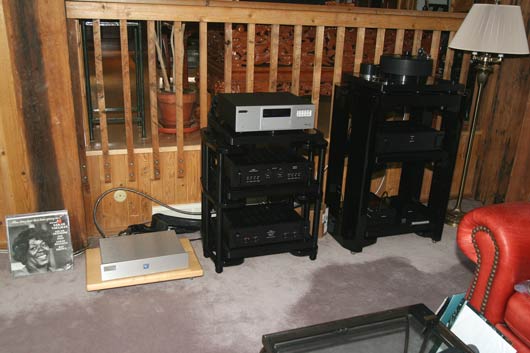

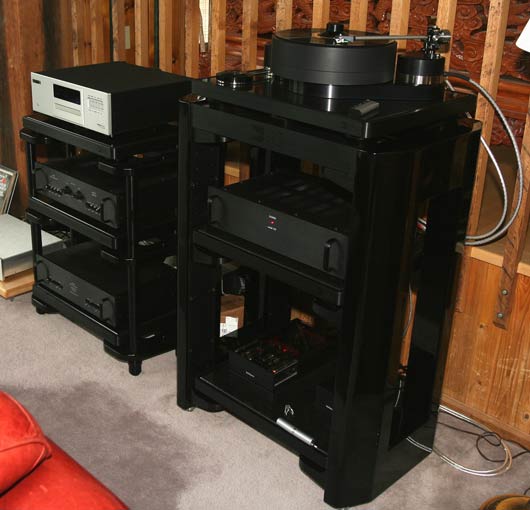
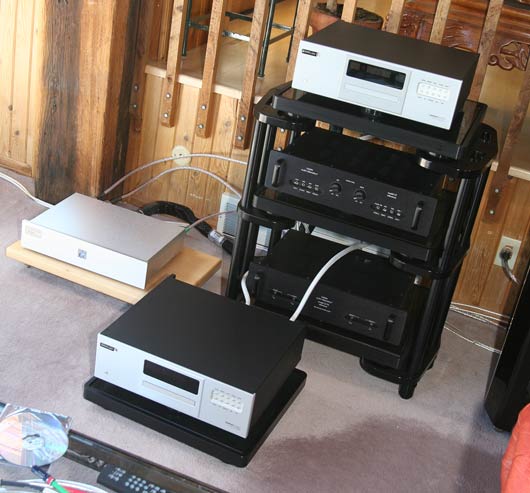
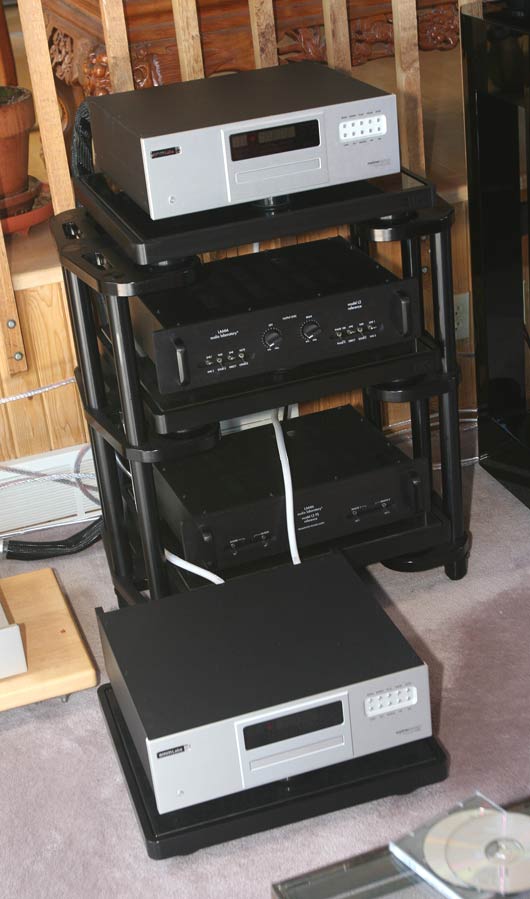
The rack : HRS MXR on the right and SXR on the left. Lots of good good black things here. The Nordost THOR power distributor being the silver outlier [oh, and the Meitner CDSA. That’s what I get for not looking at the photo while I type] ๐Ÿ™


We put the Nordost ODIN on the back of the Brinkmann Balance turntable, connecting it to the Lamm LP2 Deluxe phono stage. In a quick test of the Audio Note PALLAS cables in place of the ODIN – the musicality was very ‘right’ and the soundstaging was more evenly laid out, I thought, but the uber-resolution and detail [I have a hard time writing about details without clarification after that last post :-)] and uber separation of the ODIN was really awesome. Neil Young sounded edgy AND emotional AND listenable – and if you are a Neil fan [we we are] you know this is the promised land.

That said, at 1/4 the price, the PALLAS is a contender with the big boys hangin’ out in the $10K+ category and these need to be heard if your cables play in these leagues. Good deals in this business don’t stay around for long….
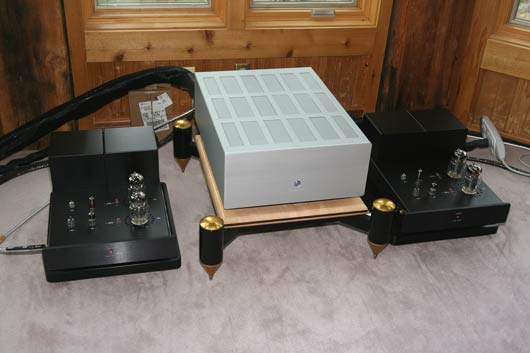
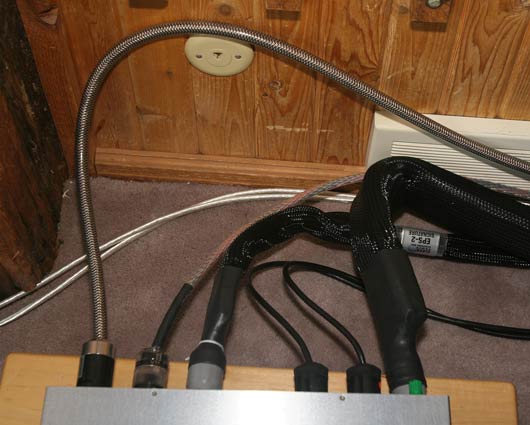
After some optimization, we ended up with a real potpourri of power cords. We got the big ELROD supplying power to the THOR. This really opened up the soundstage and at the same time made the sound more forward [in a good way] and immediate.

Then we have the old Acrolink 7..N.. something [how are we supposed to remember all of these numbers? Kind of like the Acura cars these days. Anybody remember the Legend? That was a name I could remember] running into the Lamm L2 Reference line stage power supply. This added a level of refinement that was juuuuust right.

Let’s see, we have the Valhalla power cord on the Lamm LP2 phono stage and the smaller ELROD on the Emmlabs CDSA. I forget how we got to these and what they contributed. Something good no doubt ๐Ÿ™‚


Downstairs we have the Kharma Mini Exquisite speakers on the Edge, driven by the Audio Aero Prestige CD/SACD player using Nordost ODIN speaker cables and the Audio Note system at the other end of the room [that was yesterday. Today we moved the Kharma back to the other side of the room for an audition because we are still playing too much with the AN speaker placement in this here non-symmetric octagonal room. Actually we are still struggling with the Kharmas placement too ๐Ÿ™‚ We have just been struggling longer with the Kharmas and are more confident that we are much nearer perfection].
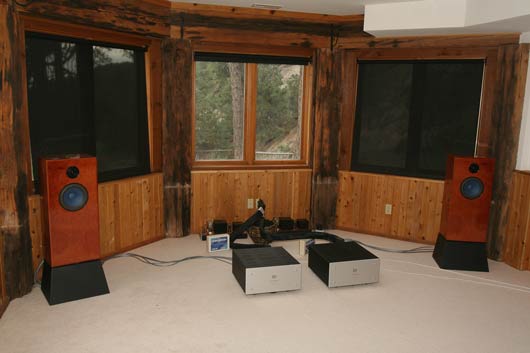

These are our Audio Note SEC Signature speakers on the Audio Note Kegon Balanced amps and Sogon speaker cable.
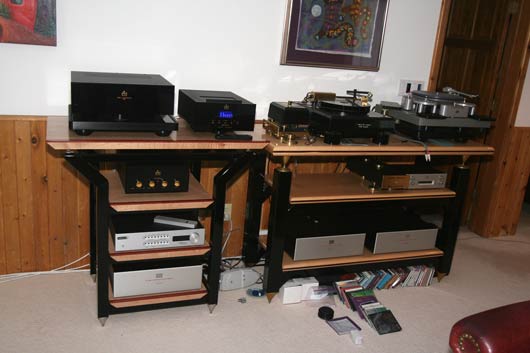

We still have our little AN M1 Phono preamp in the loop – so sounds are a little muted, and we can’t use balanced cables to the Kegons… but it sounds pretty good and in some ways nothing here sounds better. But… lots of work to do on this system p the upstairs system has been scarfing up all the good power cords and cables and vibration control too, the stingy thing :-)].
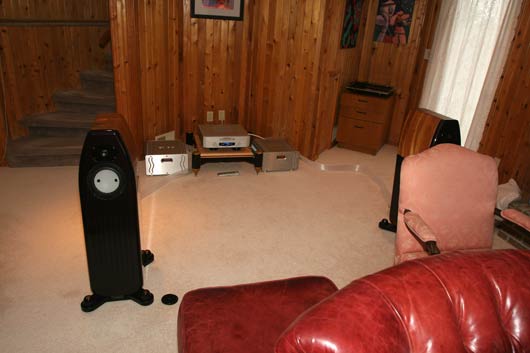

Always one system looks like we are snubbing it… but, hey, we got to face one way or the other – so we will always be treating one of the systems with No Respect… I think all of our systems have a Rodney Dangerfield attitude sometimes….
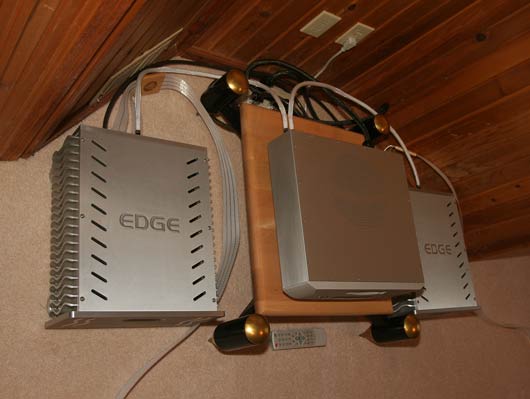

Closeup of the Edge / Audio Areo.
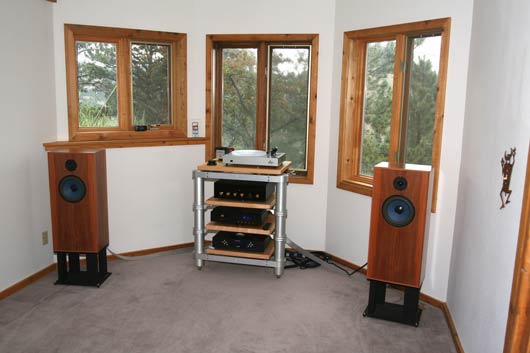

Finally the smaller system. The system that it is just fun to sit and listen to. We slipped in some SOGON interconnects (about $3K on a system that is about a $15K system) and it sure makes it easy to just hang out and chat. Sometimes we forget that we can chat in the other rooms too ๐Ÿ™‚

Details, Details

For the longest time I would get so confused when I read someone posting that, say, the sound of Boulder solid-state amps had more detail than Edge solid-state amps, which I totally disagreed with [this was back when I believed everybody who posted about how something sounded had actually heard the darn thing. How innocent we all were about the side-effects of anonymity on the web in those good-old days].

I finally figured out that they were talking about the the ‘leading edge’ of the notes, combined with, in this case, less continuousness which made the notes ‘stand out’.

If we think about the sound as composed of many notes, and each of those notes having texture [dynamics of things happening inside the note] and harmonics, we can compare sounds to, say, sand on a beach.

You got your fine sand, you got your larger grains, which when large enough are ‘pebbles’. You got [depending on the beach] larger pebbles that eventually get so be as to be rocks [boulders, boulders would be like the cannon shots in the William Tell Overture]. Each one of these grains is a different shape, with bumps and different colors all over them.

OK.

The Edge amps have lots of finely grained sand detail [which we now call finesse – to get around the problem that people do not agree on just what detail *is*.] and the Boulder has pebbly detail.

The music has some of both [usually], large and small, and we can think of the sand->pebbles->rocks being dynamics and the color of their facets being harmonics/tone.

Solid-state equipment tends to reduce the beach to black and white and tube amps turn up the color saturation a bit. Solid-state equipment also shines a light on the beach like high-noon in death valley [the edges of the pebbles appear sharp, the find sand disappears into the background of white glare], tube equipment like, like, … ambient sunshine on a beach right after a rain just when rainbows are starting to come out [makes you think I like tubes better than solid-state, huh :-)].

[So far, we have only modeled sound and its harmonics and dynamics by comparing it to the visual appearance of a beach. We can also think about the experience of *listening* to sound with that of walking on the beach… some people want a nice soft sandy walk, some want a rougher, firmer walk. Some don’t care and are only getting exercise or going for a swim.]

We can think of playing music, then, as taking a yardstick and scraping it across the sand, larger pebbles being more dynamic than smaller, the colors of the pebbles representing different tones.

So, using these models…. we can [try to!] define:

Dynamic Resolution: Numbers of different sizes of sand that a system is capable of rendering – higher resolution systems are able to make a particulate of sand sound different than a slightly larger one, which would sound the same on a lower-resolution system. Note that this is often a function of the size of the grain: i.e. two boulders, one inch different in size may sound the same, but two pebbles, one inch different in size would sound different. The best systems are linear… if the pebbles, boulders are more than, say, 1% different in size, we can hear them.

Fractal Dynamic Resolution: The smallest size of a facets on a reference sized particulate of sand that a system is capable of rendering. We want linearity similar to that described above. This indicates the dynamic resolving capability of the system while it is already reproducing another dynamic. Very few systems can do this at all.

Harmonic Resolution and Fractal Harmonic Resolution: Similar to the above, but for tone [frequencies] instead of dynamics. The Lamm ML3 has really good Fractal Harmonic Resolution – it can render not only the colors of fine sand, but of their facets as well.

Dynamic Detail [ability to change direction]: the cleanliness of the beach [i.e. how much mud :-)]. Is that yardstick we are using make some good THWACK sounds as we hit things, or does it kind of slide up and over them. Again we want this to be linear – to behave the same for larger rocks and tiny particles of sand. Otherwise certain dynamics [horns anybody?] and frequencies [tipped up midrange anybody?] are over / under-emphasized. [We, Neli esp. usually calls this ‘light on its feet’. Most people referring to detail are talking about only the leading edge this very small set of dynamic changes somewhere between micro-dynamics and macro-dynamics – i..e kind of small sized next to slightly but noticeably larger pebbles. Not sand, and not rocks].

Dynamic Control [accuracy]: the ability to accurately trace the edges of the sand/pebble/boulder [what we usually call the note envelope]. That yardstick traces the pebbles up and over, without going too high, without pushing the pebble down into the sound … AND without jumping down too quick and missing tracing all the detail on the other side.

Fractal Detail and Fractal Control. Same as the above two, but for facets. The Audio Note Kegon Balanced amps are great at Fractal Dynamic Control.

Harmonic Detail and Harmonic Control: and Harmonic Fractal Detail and Harmonic Fractal Control: same as above, but for tone [frequencies].

See, we all knew that the reproduction of music was a beach.. ๐Ÿ™‚

Meitner versus Meitner – The CDSA SE 'metal tray' upgrade

Well, we finally got around to doing the shootout between the CDSA with the old plastic tray and the latest with the metal tray.

Both players were on HRS nimbus couplers which coupled the players to the HRS M3 Isolation Bases they were sitting on [so we did not use either of their feet, neither the old nor the new].

Both were connected to the Lamm L2 Reference linestage on its L1, L2 symmetrical inputs [its direct input by passes a few things and sounds a little better] using Stealth INDRA cables.

Both players were broken in – though the older one has been played a lot more. Both cables were also well broken in… Both players were powered by ELROD EPS-2 Signature power cords.

We used Radiohead Amnesiac, Rachmaninoff, and Dire Straits – of which we had two copies each – to switch back and forth between players.

The short and sweet – the older player seemed to be a bit louder, a bit more dynamic, the sounds were more clustered together and was slightly ‘edgier’ than the newer player.

The newer player was more transparent, more naturally spread out in the soundstage, and a little less dynamic [but it may need a little more breaking in? The player has been off a lot during the last month with all the thunderstorms we have been having – us being a little lightning-shy after being hit last year.]

The weird thing is that the Meitner CDSA was at the top of the list of un-edgy, un-digital, un-harsh sounding solid-state players. But the newer CDSA clearly beats it. This greater listenabilty was the largest difference between these two – and made us not want to listen to the older player knowing what we now know.

That is the problem with these shootouts. A person LEARNS things – and can’t go back to the sweet naivete of ‘about the same’ and ‘good enough’.