Sorting large amps based on their micro-dynamic capability

In the comments section of one of the previous threads we came up with the following list:

Micro Dynamics low to high:

Soulution – BAT – CAT – ARC – VTL – Pass – Krell – Boulder – Vitus – Spectral – Halcro – MBL – Goldmund – Ayre – Edge (early NL series)

The most recent question was where to put the McIntosh amps on the list:

Soulution – BAT – McIntosh – CAT – ARC – VTL – Pass – Krell – Boulder – Vitus – Spectral – Halcro – MBL – Goldmund – Ayre – Edge (early NL series)

A case can be made for swapping these amps around a bit, based on the particular model (for example, the more expensive Edge amps are more expensive than any Ayre amps and also have much better micro-dynamics than any Ayre amps), and the particular speaker being driven. I also swapped Krell and Boulder – I think that better represents the intention of the brand, and maybe reality too.

Amps also seem have better micro-dynamics as you listen to their more expensive offerings (which would imply that all brands may value this aspect of music, just some value it more than others – for some it is a high-priority, and others not so much)

But it serves to give one a sense of the overall ‘company’ sound profile.

That being able to reproduce the subtle delicacies of music, the ability to tell a real guitar from a guitar synthesizer, for example, is not a priority with many amp builders. Especially big amp builders.

Big amp builders often focus only on macro-dynamics, and some on midi-dynamics. Also, as you understand, there is a continuum between micro- and midi- dynamics, as notes can exist ANYWHERE between quite delicate or as part of the melody foreground.

MIDI-Dynamics, least to most (just making a stab at it, this list will probably change as more thought is given)

VTL – BAT – CAT – ARC – McIntosh -Vitus – Edge – Pass – Ayre – MBL – Spectral – Halcro -Krell – Soulution – Boulder

MACRO-Dynamics, least to most (just making a stab at it, this list will probably change as more thought is given)

Spectral – Vitus – Edge – Ayre – Pass – CAT – Halcro – MBL – McIntosh – Krell – Soulution – ARC – Boulder – BAT – VTL

… and then we can talk about DETAILED macro-dynamics, which acknowledges the fact that micro- and midi-dynamics occur at the beginning and end of most macro-dynamic events.

And then a couple of lists to do with harmonic color (McIntosh, ARC, MBL…) and harmonic purity (more or less reverse the macro-dynamics list…!?).

We’ll leave that for the comments or another post…
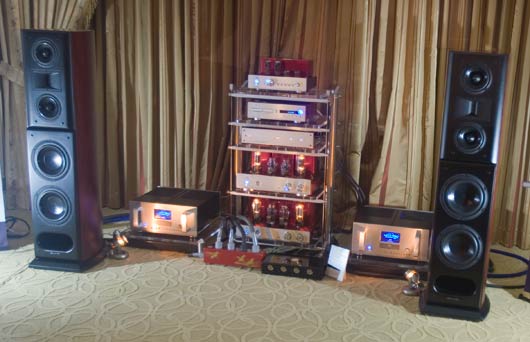
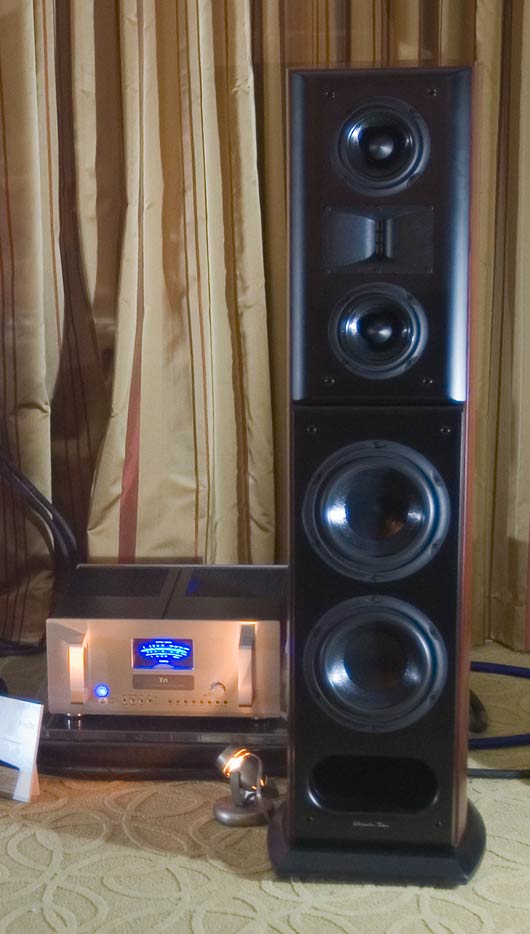
Acoustic Zen Crescendo and Tri at CES 2010

Wherein we go into more detail about the sound at this year’s CES.

First, Robert Lee of Acoustic Zen knows how to set up a room at a show. He knows what kind of sound he is after, and if the amp he was supplied is not doing what he wants, he will put it on static display and use something else that gets the job done.

What this means is that 1) you can go to their room at a show and be pretty certain it is not going to suck. In fact, it will likely be quite good sounding [we’ll go into what good sounding means in this context below], and 2) that the amps he is using are amps YOU can use with these Acoustic Zen speakers and be pretty sure that it is going to also sound good.

Yes, this is indeed extremely rare. By far most rooms (99% or so), even ones we give best of shows to, either A) sound good because they got lucky and the unfamiliar amp from a manufacturer who was the first to agree to share costs of the room JUST HAPPENED to sound good with the speaker manufacturer who was the first to agree to pay some of the room costs or B), the quality of one of the components, or the speakers, is so good that even with mismatched components the room still sounds pretty good.

Acoustic Zen has paired with Red Dragon, Edge, Response Audio and Tri.

Essentially, the Crescendo speakers are full-range Adagio speakers, which were already pretty full-range but were not enough for people with larger rooms or who listen to a lot of classical music and want the lower octaves to sound realistic. The Crescendo has a greater ease of presentation and a bigger, fuller sound.

Which I think is the point of these speakers.

First, most speakers in this price range suck. They are a joke. Few attempt to do full range and those that do usually suck more.

Let’s talk about the ones that do not suck for a minute.

We have the Marten Miles III and Kharma 3.1C. More detail, more transparency, more audiophile, but no where near the authority or frequency range.

The Soundlab A1 has the frequency range, but not the authority unless you really out a mofo amp on it, but if you want a electrostatic then you are probably not reading this post anyway.

You got the Wilson Sophia [not the range or sense of ease], Avalon… not sure which one [not the authority or range], Audio Note [if you have corners available. If you do then this might be a possibility, with careful attention to setup]. Let’s see… what else?

Most people who come here to demo these speakers, to tell you the truth, have just come from auditioning the B&W, Definition, and JM Lab/Focal. They have just been fed tipped up midrange hell and musical slurry. They are rarely audiophiles and we have so little time to demonstrate to them that they are on the road to ‘audio hell’ [when they see $350K speakers, they think we have already arrived at audio nutsville :-)]. The Acoustic Zen are audiophile-grade speakers, whereas the others are not [sorry]. Which takes us to the next section.

These speakers have what I think of as 2 distinct sounds – depending on the amp driving them. With a Red Dragon amp, or little Kharma amp, these are very dynamic, fairly quick sounding speakers. With Edge amps and tube amps, these are more…tube-like, a little more harmonic and continuous. With BAT amps you can achieve the middle ground – more or less.

We’ve found people greatly prefer either one or the other with these speakers [whereas we do not. We like both flavors of sound].

I think these speakers are for music lovers, not quite so much into the sophisticated sound gymnastics as some audiophiles are [guilty as charged, love those crazy subtle details and intricacies!] , and want a audiophile-grade full-range speaker for an audiophile-grade 2-way speaker price.

Yes, we are back from CES 2010

… as you probably know if you visited Spintricity.

We also had a few hours downtime over there – hopefully THAT won’t happen again.

It also looks like we will create a second issue for the rest of the CES Show Reports. With the amount of traffic we are getting – 400 page issues get to be a little large for us to edit and for people to visit simultaneously.

Still waiting for our shipment from Las Vegas to arrive – after which we can spend several hours schlepping it up from Denver and up into the house – and then back to fully operational here again. Whoo Hoo!