Mental and Physical Predispositions to Experiencing Druglike Sound

1) We all know that one’s emotional state can affect how one feels about the sound of their system. This state can increase or decrease the likelihood of having a druglike sound experience.

2) We also know, or have read about, how alcohol and various drugs can affect how one feels about the sound of their system and can similarly increase or decrease the likelihood of having a druglike sound experience.

3) There are other things, both internal and external, that can also affect (increase) the probability of a druglike experience.

Artificially inducing strong emotions (1), like anger [got fired, for example] or exuberance [got hired], just to have a druglike sound experience seems a little on the ‘needs therapy’ side of the fence. (2) can be hard on the body and or brain cells. (3) however, if we can enumerate several relatively sane and healthy techniques, would seem to be the approach of choice.

Things that [may] affect the probability of a druglike experience:

A) Mood lighting. Bright light seems to be of no help at all, but dim light, the glow of vacuum tubes, city lights or Christmas tree lights all seem to increase the chance of a druglike sound experience

B) Comfortable seating, in my experience, does NOT affect the probability of a Druggish experience

C) Going from a good to a great quality sound / recording does increase the probability of this experience. Perhaps one can artificially arrange to closely listen to, first, a medium quality recording then a high quality one, esp. of the same music, JUST to create one of these experiences?

D) Casual chitchat during the music almost always reduces the probability to zero.

E) Being tired, but not so relaxed that you are falling asleep, in my experience, increases the probability.

F) Good company, whether friends or strangers, increases the probability. Hostile people, or just people in a bad mood, people reduces the probability to near zero.

Other things to think about: aroma, clothing, ambient temperature, time of day. Others?
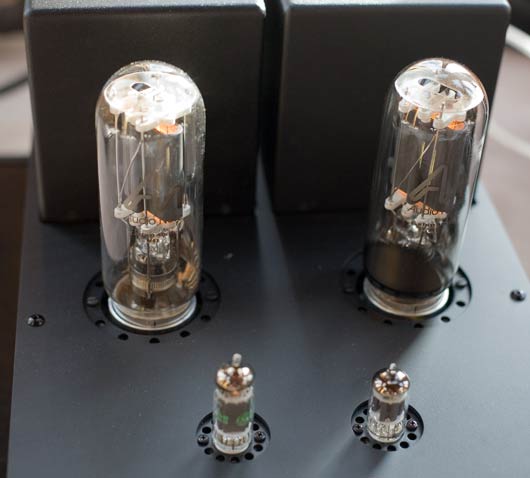
Audio Note Jinro 211-based tube integrated amplifier

I’ve wanted to put the Jinro through its paces for a loooong time, ever since the Jinro integrated amplifier came to this country at last year’s CES, where I was impressed with its sound and its low cost. Like the bigger Ongaku, combining a very high quality stereo amplifier with a very high quality preamp in one chassis saves on power cords, interconnects, and amps stands/rack space. This allows one to achieve price-performance ratios unheard of in here in our Extreme High-end part of the audiophile hobby. Essentially, it allows you to get close to the Extreme high end at ‘slumming it’ prices.


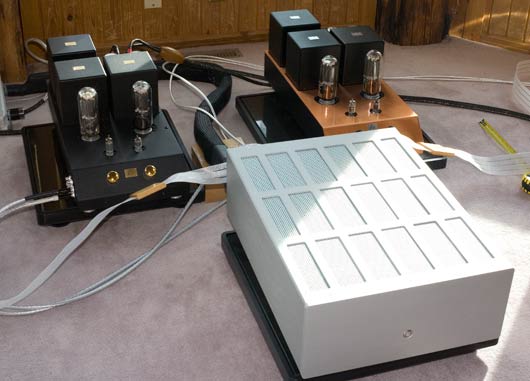
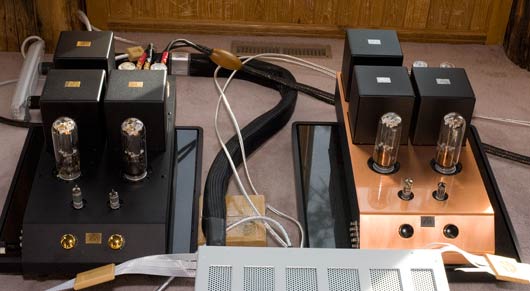
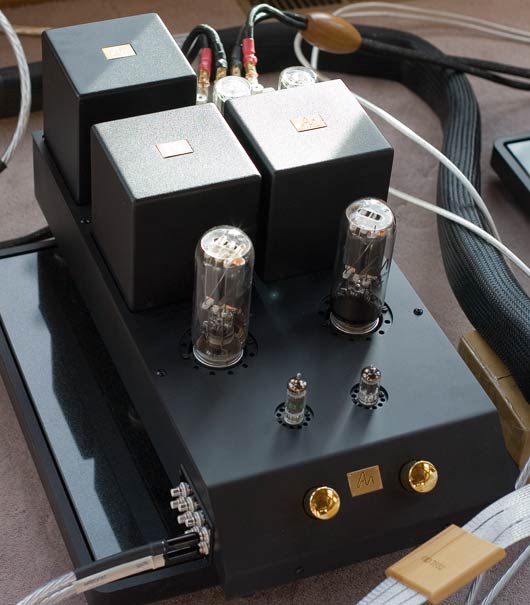
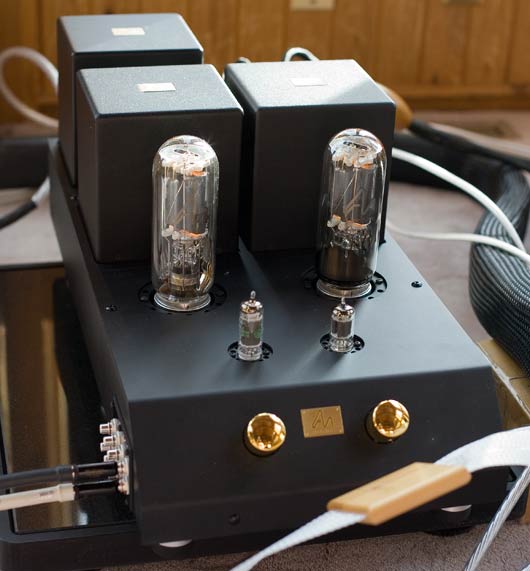
We performed a shootout between the $20K Audio Note U.K. Jinro, in black, and the $95K Audio Note U.K. Ongaku, in copper. As you can see, they are very similar externally, and are using the same brand of 211 tubes. Internally the Jinro is wired with copper and uses copper-wound transformers as opposed all silver inside the Ongaku. They both weigh about 60 pounds or so and put out about 25 watts. Kevin O., Neli and I were in attendance.

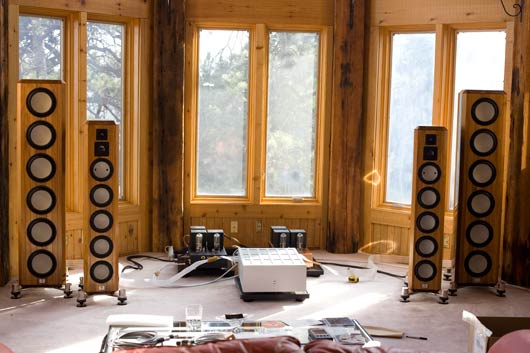
The system was the Marten Coltrane Supreme speakers, Emm Labs digital, Nordost Odin interconnects and power cords, Jorma Design Prime speaker cable and HRS platforms. We will also do another, similar shootout on the All Audio Note system downstairs with Steve G., Neli and I doing the finger pointing at that time.


We played the Jinro first using our 3 test cuts: Gloria Esteban, Elton John and a short but complex Mozart piece.

It was great: good details, lots of good separation, dynamic, good color. The Elton was not quite as magical as we remembered it, but maybe we had exaggerated the magicality in our minds over the last few weeks. Certainly did not hear anything that didn’t sound great.


We then played the 3 cuts on the Ongaku. Kevin kept bringing up Mike Tyson, so I will put it like he did: It was like me, Mike Davis, and Mike Tyson going into the boxing ring. It wouldn’t take anybody very long to figure out who was the winner [me being the first, in that scenario :-)].

The Ongaku has a LOT more stuff happening between the notes, which allowed it to have a lot more resolution and the harmonics to be much more vivid. We went through the motions and played all 3 cuts – the Elton piece was as amazing and drug-like as we had remembered it being [more so in fact – hearing a song be ‘great’, and then soon after be ‘OMFG great’ has its own special kind of drug-like effect. More later on this].

As a shootout this was somewhat worthless – but we did learn a few valuable things nonetheless.


The $20K Jinro did a great job on this 1/2 million dollar system. Without hearing the Ongaku, many people would never know what they would be missing and would be very happy campers.


Is the Jinro as magical and drug-like as the Ongaku? No. But that is not saying much, as only very, very few other amps are.

But the system around a Jinro can be designed so that the Jinro doesn’t have to do ALL the heavy lifting [our test system is pure straight-line high resolution components and cables counting on the Ongaku do all the drug-like magic]. For such a Jinro-centric drug-like system, the Jinro will be able to supply very high-quality dynamics, separation, phenomenal note control, and harmonic purity…. and quite a lot of resolution (esp. compared to most amps).


Our next step here will be to put the Jinro on a system with a Audio Note digital front end, on Audio Note speakers, and see – I mean hear – how it compares once again to the Ongaku [we really do like the Jinro, a lot(!), even though we are putting it up against impossible odds against the Ongaku in these shootouts]. This shootout will then tell us how they compare on a very musical front end.

After that we will proceed to try and build, hopefully several, reasonably-priced drug-like Jinro-centric systems from the components we have lying around here.

Harmonic Color, Harmonic Purity, Harmonic Vividness and Visual Color

I guess we should try and define some of these terms and then [I should] try even harder to stick to using them correctly.

*Harmonic Purity is analogous, in my mind to a tuning fork. A ‘ringing’ purity with all subharmonics intact and appropriately long decays. The opposite to harmonic purity is ‘blanched’ [i.e. washed out. Anyone else use a different term?]

*Color is how much subharmonics are present at all frequencies and SPLs and dynamics, especially in the smaller, more subtle notes. The opposite to having lots of color is Leanness.

*Harmonic Vividness is the cross product (multiplication) of Harmonic Purity and Color – when they are both present the music harmonics are very brightly colored – very real [or better than real since many live performances have lots of soft people around you absorbing various harmonics]. Harmonic Vividness is the real goal here with respect to harmonics.

*Harmonic Resolution is how many different harmonic tones are audible within a single major note. The lack of harmonic resolution [no term for this yet] is for example a middle ‘C’ note where all you can hear is the one frequency, growing loud then soft. With lots of harmonic resolution that same note has audible delineatable harmonics in the related octaves, as well as some harmonics at freq a little above and below [if this is a real world instrument] and all of which decay at different rates – and sometimes reinforcing and/or diminishing each other- lending a fullness and richness and character to the note.

From a recent deranged comment (of mine :-)):

“McIntosh can be said to have color, but it is low on harmonic purity and ‘vividness’. I do not see this as a particularity good thing. There is this Visual Color I see when I hear equipment. Valhalla is bluish silver. Jorma Prime is orangish brown [more like a burnished orange, actually]. McIntosh… is uneven, kind of like a faded-in-some-areas worn plaid pastel shirt. The Ongaku is…”

[as I continue to think about the mental colors I associate with things that I like the sound of…]

… like sunlight on a bar of gold [a lot of bright colors on a background that is slightly gold]. The AN DAC 5 Signature was as close to a pure rainbow (or prism, think Dark Side of the Moon album cover) as I have heard.

Sometimes colors are hard to pin down (for me, anyway). The Nordost Odin power cord is white. The Odin interconnect is slightly grayer than the Odin PC. The AN PALLAS is a smallish rainbow [actually, 100s of smallish prisms. and the Lamm ML3 is millions of smallish prisms]. The Lamm ML2.1 is purplish grayish white.

I do not see a mental color when I think of speakers, or rather I see the actual color of the speaker itself in my mind, which is *so* boring 🙂

Anyone else have colors they associate with equipment?