The link:
JV’s CES 2011 Show Report page 3
* Trenner & Friedl
I did not get to this room. Reportedly the room sounded closed in at low volume and distortion free at very high volume, which is what I remember also from previous years with these speakers.
* D’Agostino (Krell founder) electronics / Wilson Sasha
Hmmmm… Well, this sound was what I would call overly smooth with good tone. i.e. It was lacking in midi-dynamics and micro-dynamics. Seems like this would not be JV’s cup of tea, and for me, I think in the attempt to learn from Krell’s mistakes and to differentiate themselves from the Krell sound they have gone too far. Great looks though.
* Vitus/ Wilson Sasha
A friend really liked this sound and I was supposed to get back there – but did not [for some reason I missed hearing this room on my first pass]. Sounds like JV heard some weird room anomalies since Vitus, in general, is not far from perfectly neutral in the large scheme of things.
* TAD Reference Ones
For some reason I only paid attention to the room with the new TAD electronics. JV says “sound was a little dark (what else is new?) but very detailed and beautiful.” I do not understand the ‘what else is new?’… often rooms with TAD speakers sound aggressive and almost always Boy Toyish. But I have to agree with his assessment of this room. The sound had lots of micro-dynamics etc., but perhaps the decays were cut a little short, and there was an overall feeling of reticence and lack of ease – not in a big way, but enough to take some of the natural excitement out of the music.
* Silbatone [not Silvertone]
These large speakers were designed for a larger room [:-)] but I did listen to them carefully for a period of time. JV doesn’t really say much [though, if the bass wasn’t limited then we’d all be dead, or deaf anyway :-)]. This was a very balanced sound, not the last word in resolution or micro-dynamics [or deep bass as JV points out], or air or anything, but there was also nothing really wrong with the sound either. In a very large room I could see these speakers as sounding convincingly real. I read elsewhere [probably Stereophile] that the amps are quite expensive ($140K) as are the tubes ($5K)
* Venture / Lamm
??? I do not remember this room.
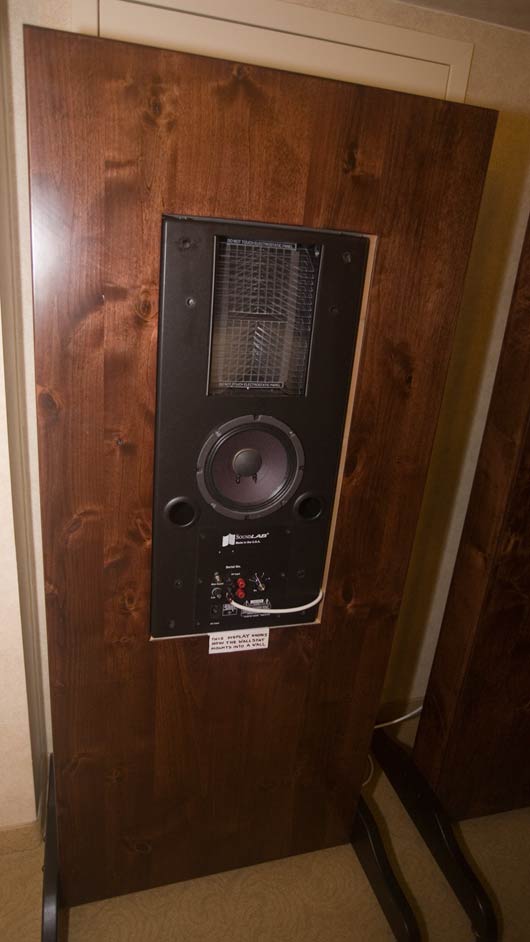
As far as side-firing woofers go… I guess we have paid more attention to this type of speaker over the years because they usually perform quite badly [even though the speaker profile is narrower, which should be a good thing]. Besides the fact that the woofer is firing at either your electronics or the side wall, it is very difficult to get the bass to be coherent [all of one piece] with the rest of the frequencies… at least to our ears across many, many brands of speakers who use this approach. But our ears are always open…
* Synergistic Research / YG Acoustics / Technical Brain
JV: “sound was little dark and the bass a little heavy”. I agree except that the sound was a lot dark and the notes were smeared etc. etc. No comment on JV’s comments about the house sound of the brands here except to say that I disagree vociferously.
* Hansen speakers / Tenor electronics
JV mentions the word ‘gemütlich’ several times which I had to look up: “Warm and congenial; pleasant or friendly”. Hmmmm…. First, I would call this sound “a little bigger than life, a little slow, a little … how do I put this… the harmonics were a little less pure than they might be… which one might call dark, but we have reserved that word here for – more or less – rounded off midi-dynamics.
Second, calling the Hansens warm sounding…? I am trying to think of what JV is referring to exactly, if I agree, and if all of you also would use the term ‘warm’ for the house sound of these speakers. I think JV is referring to a lack of midi-dynamics ‘punch’ [fast attack and decay]. To me, ‘warm’ means forgiving, and with a inherent sound that is pleasant across all kinds of pleasant and unpleasant music. I’ve heard these speakers with a lot of different electronics; they can be punchy [when loud anyway], they can sound horribly closed in, they can sound cold and harsh. I guess the sound consistent across all this is that they perhaps blunt the leading edge of notes a little, they have strong bass, and they have a large sound. These are relatively hard to drive [but much easier than the Magico or YG Acoustics, for example] and so have some of the same problems associated with other hard to drive speakers.
Third, Tenors warm sounding…? They are slightly more round and harmonically rich than neutral, so technically yes. But they do seem to walk the fine line fairly well close to neutral [you see, the problem is that the typical amps people are using with these Boy Toy systems, the ones that are supposedly perfectly neutral – are harmonically threadbare and – these days – overly round yet bright at the same time]. I personally welcome the Tenor hybrids to this party, though Lamm hybrids, and other hybrids, are just as welcome in my book.
Otherwise, I agree with JV’s overall description of the sound here, although I do not attribute any of it to a “prominence of the bass”.
* Estelon XA / Tenor (et. al.)
More or less agree [except about the CJ, which to my ear are colored, smeared, and whiteish sounding]. The speakers were interesting and do a good job of minimizing speaker enclosure coloration, although I found the midrange to be a little weak and, since this is where most of the music is, this may be a fatal flaw.
* Peak Consult
I did not think this room was interesting… i.e. there were enough problems that I did not think, in the time allotted during a show, that I would be able to learn anything useful here. Given the number of things JV starts enumerating in his report about this room, I think he must agree.
* Avantgarde’s Duo Omega
JV: “very coherent but a bit thin in the bass” … say what? I would say the bass was quite disconnected from the rest of the music [I had hoped that this problem had been addressed. I would so LOVE to love these speakers]. The bass was very present and punchy – although no doubt uneven across the lower octaves. The first problems being so egregious I did not bother to listen further. I just want to grab the manufacturers and force them to make the speaker assembly 5 to 10 times more rigid and to add supporting struts to the horn or something to make these speakers kick butt.
…skipping several low-end rooms…
* Siena speakers
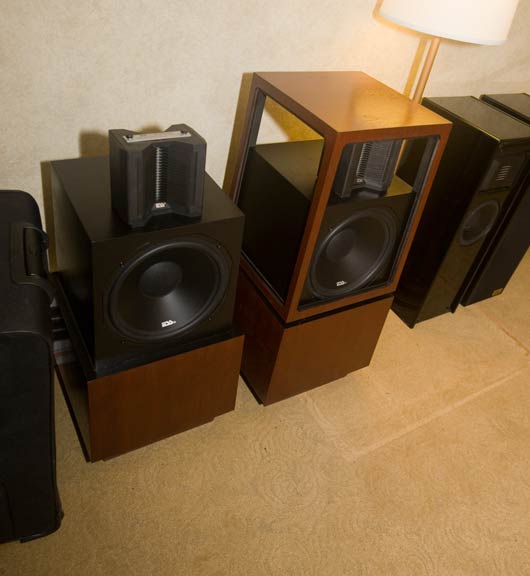
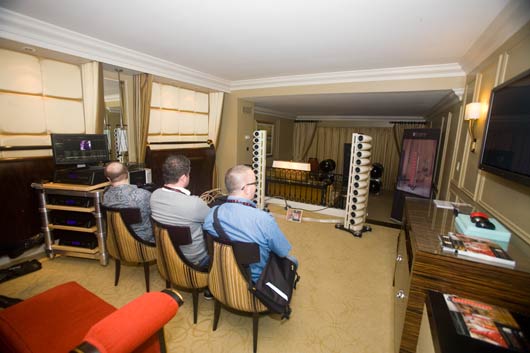
JV was obviously captivated by these speakers. I’ll try and insert a photo here so you can see what is going on. First, I cannot comment much on these speakers because every time I went by this room they were playing a drum solo. You know, I like rap and opera and country and jazz and techno but I do not like to waste any microsecond of my life listening to tracks of drum solos. It also makes me suspicious when a superbly dynamic speaker system plays drum solos… what are they trying to hide? Heck, in this room Diana Krall would strangely actually be an appropriate and illuminating piece of music to play.
My concern here, for you readers out there, is that the room setup was not horribly home-friendly [the subwoofers are way in the back of the room], and that these speakers typically have a very small sweet spot. Oh yeah, and perhaps an inability to render the subtle details associated with real music and voice [a curse of the original Pipedreams]. Even the drum solo did not sound so good out from in between the speakers – I thought it [the drum solos] sounded better in previous years…. [I say this somewhat tongue in cheek]
* Marten Coltrane II
I have discussed these speakers in detail a few posts ago, and more or less agree with JV except to say that I have less to say about “slightest hint of ceramic whiteness or enclosure grain” than he did because, for me, the room and/or associated equipment got in the way of hearing things at this minute a level.
It is funny [OK, somewhat annoying too :-)] how JV picks on ceramic drivers [and horns], and how some people pick on domed tweeters, inverted tweeters, diamond tweeters, metallic drivers, etc. i.e. some people pick some technology used by a component and use it to explain/predict a sound of a component in a system. Not that ceramic driver speakers don’t often have a touch of whiteness and box speakers a touch of enclosure effects [I do think that Marten deals with the issues associated with ceramic driver speakers better than anyone else to date to the point that they are a non-issue (and Kharma speakers are usually a hybrid of different types of drivers, some of which are ceramic, and who now makes their own custom ‘black’ ceramic drivers), and also that ceramic drivers do several important things better than other drivers: like fast midi- and micro-dynamics and rendering the delicacy of real music].
* Magico Q5 / Soulution
Somehow I missed this room?
To be continued…