
Magazine Reading with Jaded Eyes

Leafed through the HiFi+ at Barnes & Noble last night. I thought later about how my trade magazine reading has reached a different stage… yet again.

Many years ago… many, many years ago… I read them to find out what things sounded like. You know, how the last paragraph or two has all the meat and I would just read that, and then maybe scan the rest of the article if I was bored. I only read the equipment reviews – the music reviews never made sense to me (how are they supposed to know what kind of music I like?) although some background on the artists can be interesting – at least in pre-Google, pre-Wikipedia days.

Then I would just read the reviews of the ultra high-end equipment.

Then I would just read the reviews of the ultra high-end. written by the reviewers who frequently reviewed [aka knew something, anything about] the high-end.

Then I would read these particular reviews of the ultra high-end to see how much they agreed with what I had heard

Then I would read these particular reviews of the ultra high-end to see if and how subtly they pointed out the flaws in the piece of equipment

Then I would read these particular reviews of the ultra high-end to see if they had any clue about what was the important things that the piece of equipment did right and the important things that it did wrong.

Then I pretty much stopped reading reviews

Now, when I see a review, I think “cool, somebody is getting some positive press”. I mean, you know it is going to be positive, right? No reason to read the review. When I saw that the Edge G6 amp got reviewed in HiFi+, I thought “Good for Steven and the Edge factory, they got some positive press”. When I see the new Evolution Acoustics monitor speakers highlighted on the first page of the HiFi+ CES Show Report, I think “Good for Jonathan Tinn”. No reason to read the actual comments or reviews – they really do not matter. It is not like they are going to try and accurately place the sound of the piece under review in the context of its peers, the available associated amp [if speaker] and speaker [if amp] and with respect to the other components in its product line.

I am not sure what the next step is in my consumption of trade magazines.

But it probably ain’t gonna be pretty 🙂
Listening to Mixes and Masters

Todd, a friend of ours is producing an album and he brought up several versions of each of the songs on the album to hear what they sounded like in high fidelity.

We played them mostly upstairs on the Emm Labs XDS1 CD player [the Audio Note CDT Five and Fifth Element digital are currently being enjoyed in the Bay Area for a week or two], the Audio Note M9 preamp, the Audio Note Ongaku integrated amp and finally into the Marten Coltrane Supreme speakers.

The way I understand it, 16 tracks went into the mix, where their equalization and relative volume etc were played with and condensed into 2-channels and saved onto a 1/2 inch tape and at the same time onto a ‘mix CD’. The mastering engineer then mastered the 1/2 inch tape in several different ways, each time, apparently, in response to feedback from the musicians and our friend the producer. This particular producer, Todd, goes to great lengths to try and use the right technologies to try and preserve the original performance, live in this case, and not rely ONLY on tape and tubes and not ONLY on DSP software and hard disks.

So, today, what we heard was, song by song, the original Mix version of the song and two to three masterings of the song.

The Mix version was always cleaner with better separation and containing more delicate nuances – revealing more inherent emotion and musician technique than the masterings of the song did.

The masters… the mastering process is more brute force than the mixing process; there being only 2-channels instead of 16 – equalization and compression affects more than just one instrument, for example. So some mastered songs were digital sounding [too much treble?], hard sounding or dull sounding [too much compression? top rolled off too much] but some masters really were better.

Sometimes the bass would be diminished somewhat, bringing the vocals and harmony forward making it more accessible to the listener. Some masterings seemed to increase the air a bit, capturing the emotion and suspense at the very end of various phrases song by the vocalist [cool that this is how many people put emotion into their voice, at the very end of words and sentences]. Some mastered songs seemed to have much more PRaT than their pure Mix versions [which I suspect was do to slight compression of the frequencies of the main melody line – but I liked it!]

So what I learned here was that slightly different masterings have a big affect and can take what I would consider a good song and make it very engaging and involving or make it boring and brash. Just shows how much trust we put into not only the musicians, not just the studio and mastering technologies, but in the mixer, the masterer, and the producer of these albums – that they will deliver to us audiophiles something decent that we can now try and reproduce to the best of our abilities.

I also learned that, personally, although I prefer the clean Mix version [it is much more real], it took less time, and was easier, to ‘get into’ and enjoy some of the mastered versions. The music was first rate, IMHO, and I would call it a blend of bluegrass and… honky-tonk? folk?

Anyway, this was a great way to spend an afternoon.

Three pairs of Lamm ML2.1 SET Monoblock amps for sale

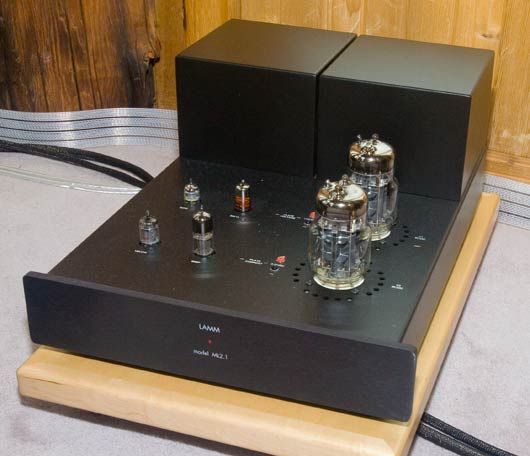
We have three pairs of these legendary amps for sale at used prices. This is kind of a preview notice before we put them up on the general classifieds sites and announce their availability to the general public.

You all know what kind of rave reviews these 18 watt amps have received in the ‘press’ and we have driven the $350,000 Coltrane Supreme speakers with them many, many MANY times with great satisfaction. Articulate, clear and natural sounding, great separation, good tone – an AMAZING bargain at their $29,990 full retail value compared to the 99% of the competition [which might be saying more about the outrageousness of the competition pricing strategies than the price of these amps, but…] and at their ‘used price’ a freaking otherworldly-ish good deal…


Lamm ML2.1 amplifier


Lamm ML2.1 amplifier

One pair is a trade-in by a fella who upgraded to the $139,290 Lamm ML3 amplifiers.

One pair is a trade-in by a fella who upgraded to the $105,000 Audio Note Ongaku integrated amplifier.

One pair is our dealer demo pair we have had on the floor for several years. Not sure if we are going to upgrade to the new, somewhat more expensive Lamm ML2.2 or the ML3 [would prefer the ML3, but we are kind of strange that way :-)].

Send us an email or call Neli if you are interested!