Audio Note CDT-5 transport and Fifth Element DAC observations

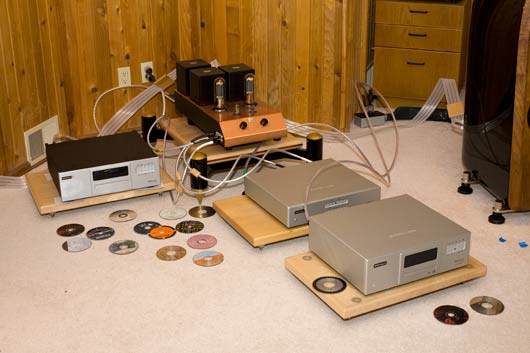
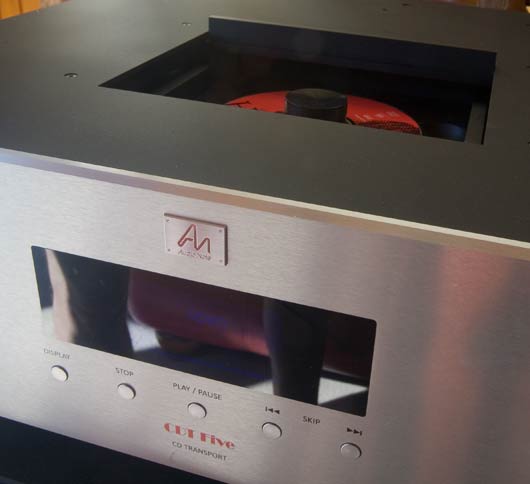
This $185K (2011 pricing), 3-box (CDT-Five Transport, Fifth Element DAC and its Fifth Force power supply) digital front end is somewhat difficult to describe and put into context except to say that it is so clearly better in so many. many ways than what has been previously available – it is hard to imagine even those audiophiles with preferences out there on the very fringe not easily, EASILY preferring this player over other players and most turntables.
But, OK. Some details…

It is expensive. OK. Got that out of the way. ๐Ÿ™‚

It is also unquestionably significantly better than other playback, and by so a large a margin, that it is easy for one to fall into this “Why would I ever want to play anything else?” attitude and just stop thinking about what it is doing. You stop thinking in terms of “Oh, I wish we had an LP version of this CD” and start focusing on the music [and finding out where it has hidden itself in your collection if your collection is as unorganized as ours is :-)]

This playback is better in all the areas, if we are going to slice and dice it, that audiophiles might feel are important: if you are a detail head, this playback has so much more resolution that it restores your faith in science [more on this later]. If you are a harmonics-head, … oh boy. If you are a sound-stage head, or imaging-head, or dynamics head [later, later]… everybody who focuses on their must-have attributes – they will be ecstatic because they are all there to the max, glorious in all their splendiferousness.

[later] This may be hard to explain to people who are not familiar with what LPs do so well compared to CDs… but let’s try. CDs are supposed to have a larger dynamic range than LPs, but this seemed true only when one compared the softest possible note that these media can manage with their loudest possible note. But with ordinary notes, CDs have always sounded compressed. Dull. Not as lively as an LP. I have always thought ‘more dynamic range’ was essentially marketing BS. But… with the CDT-5/Fifth Element, the difference in dynamics between CD and good LP playback is so small, I do not know now which has more dynamics [it is close enough, I am not sure I care all that much to see which ‘wins by a nose’ here].
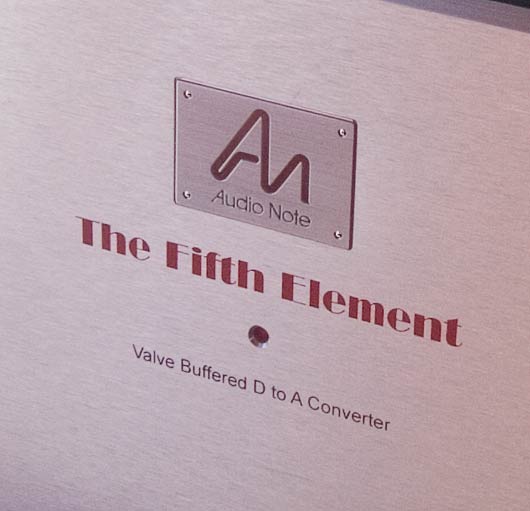

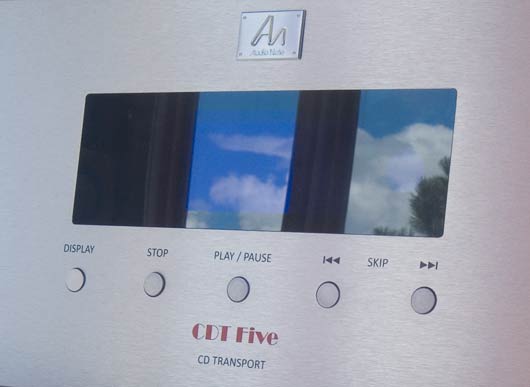
(the Fifth Element DAC. The metal appears slightly red because the nearby sunlight is reflecting off our bright red leather couch)

Let’s compare this stack to the Emm Labs XDS1. No we are not eating our young here, we love love love the XDS1, but I think it might help to compare the Audio Note to this very different sounding player that we have so much respect for here at Audio Federation. Although the XDS1 is only $25K (i.e. one EIGHTH the price) it is significantly better than all other solid-state players no matter their price and no matter your sonic preferences [Of course, the same can be said for their little $11,500 CDSA player as well, but let’s not go there…].

It might be instructive to revisit the ways in which the XDS1 excels as a CD/SACD player. First, it has an amazing ability to render the various threads in a musical score without jumbling them all up – not just great separation of notes, but of separation of sequences of notes, various harmonics and of the instruments themselves.

Second it has an extremely black black background. When a note decays you can hear it… hear it… still hearing it… until it ends or the recording engineer turns the volume down to zero. This also allow us to hear very very fine subtle notes and note characteristics. This might be considered another side to ‘high resolution’ – allowing us to actually hear the resolution that is there as opposed to artificially shining a light on the note attacks in various regions of the midrange as is so common amongst the competition.

Finally [skipping to the end here…] the XDS1 just sounds less digital and more like music. I always find this amazing, when comparing this player in shootouts. The other players do not ‘sound digital’ until one hears the XDS1… and then it is “OMG, how did I not hear this problem before?”

OK.

Back to Audio Note’s Fifth Element DAC and CDT-5 Transport.

This is a tube-based solution and therefore you might think it has its natural advantages and disadvantages.

BZZZZZZZZZZzzzzzzzzzt! Wrong.

Well. You are right but…

…just not as right as you think you are ๐Ÿ˜‰

The Audio Note digital source really excels in the areas where solid-state usually reigns supreme [love that word], it has higher resolution, better separation and Alllllmost as black a background in our shootouts [and, uh, maybe even a blacker background than the XDS1 – note-to-self we really have to move around some power cords to make this a little more fair].

In other areas it has [very very close!] the midi-dynamics of a good LP playback, it has a tonal truth that I have not heard ANYWHERE else [enough to make you cry when you realize just how poor our usual playback harmonics have been in this regard for the last 100 years]…. You can just add lots of etc.s here – but these are just some of the characteristics, the punching-me-in-the-face differences, of this digital solution compared with all others.

So…

It is 8 times as expensive as the XDS1… and 99% of all other players [many of which really, really suck – why do people buy this stuff? ]…

Is it 8 times as good?

It is this question, me trying to figure out what “8 times as good” means, that has taken me all these many weeks to understand [I could have written the above review in the first 10 minutes or so of hearing the Fifth Element/CDT-5].

One could approach this in this manner: The Fifth Element/CDT-5 is to the XDS1 as the XDS1 is to the…. well, I am not all that familiar with $3125 CD players. One could look at a used Audio Aero Capitole [$4K? a steal] or used Emm Labs CDSA [$5500K how do other solid-state CD player manufacturers stay in business…] or …

So, yeah. 8 times better.

One could also approach this as in “Where is the best place for me to spend $200K in my system?”

๐Ÿ™‚

Well, it depends on your system and budget… and really, if you play CDs and want your CDs to sound their best and you just want to KNOW they sound their best and you don’t want to waste your life not listening to the best [which pretty much DOES describe myself, when I have the funds… (oh, and Neli? *sheesh*, she is more gung ho than me half the time)]
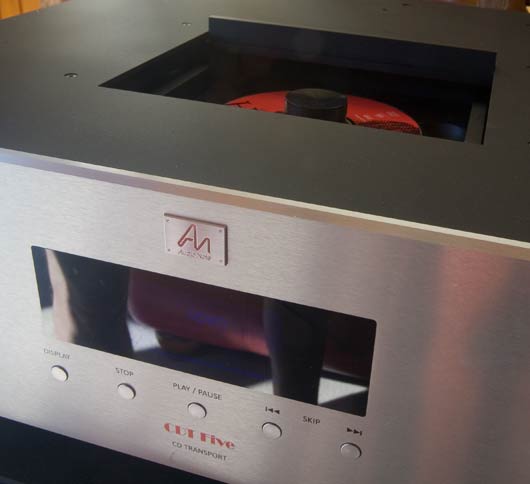

(the CD is IsoMike’s release of the Fry Street Quartet playing Haydn)

For the first time since Audio Federation started I started bringing out old OLD CDs. Old Cocteau Twins. Old Patrick O’Hearn, Old Pink Floyd live concert bootlegs [you never seen 3 people more hypnotized by the music – ever have a hard time blinking? – as we listened to an old version of Echos. Magic? Drug-like? How about Warp Drive-like]. Old Jefferson Airplane…

Let’s use Surrealistic Pillow as an example. A gold CD from 1985 or so. Sounds horrible. Seriously, seriously mucked up, man. Especially the complicated electric guitar sections – bright, confused, over-saturated, noisy, you name it. On the CDT-5/Fifth Element you could hear exactly how bad it is – but it wasn’t painful and there wasn’t any problem with listening to the whole CD. This digital playback is really good at stitching together the stuff it finds on CDs and making notes and stringing them together into music. This makes it sound nothing like a ‘digital sound’ with good CDs and makes bad CDs also not sound like digital, but instead like just good, but very badly recorded, music.

Typically, bad CDs are very painful to listen to because their badness, often very aggressive digital-sounding notes, is too hard for most players to handle – and those that can handle it, it is because they just dull and smooth the notes down to round blobs… which of course they also do to all kinds of music played, good or bad. But the CDT-5/Fifth Element does not sacrifice resolution or detail – instead one might say it is the over abundance of resolution, and perhaps especially harmonic resolution, that allows us to have our cake and eat it too i..e very well recorded music has all the detail you will ever be able to hear and bad music is actually listenable and to some extent enjoyable [limited in this case by our knowledge that we should be able to find a better recording of this if we could just get our lazy butts off of the couch :-)]

OK. Kind of a longish review. I won’t bore people with the “equipment has to go back, hate to see it leave, wish we could afford it” end-of-review cliche.

Instead, I will mention a way we use to make us psychologically come to terms with this eventually having to go back to the continent [it is AN’s show digital]. We could just not play music for a couple of weeks – and let the memory dim. We could throw a tantrum and stomp our feet [Oh, I so much want to do THIS!]. We could close Audio Federation, sell a lot of demo stuff off the floor, and just order them up.

But, another perspective is… we now know what the best digital is. No question. And there is nobody else really trying to make the best digital [though they are good at making the most EXPENSIVE this or that out there, and, with the press, the most hyped]. So we put it on The List, we look at the budget, and when we can afford it we will get it back. The hardest part – the analysis and getting to the actual buying decision, is done. And meanwhile we can enjoy other digital, hearing some issues they may have but that is OK. The CDT-5 transport, Fifth Element DAC and Fifth Force power supply are on our (capital ‘L’) List, don’t you know?…

i.e. …They’ll Be Back.

[thanks Jim, I think I stole this perspective from you(?)]
Emm Labs CDSA + Nordost ODIN versus Emm Labs TSD1 and DAC2

The question: Does an ODIN power cord on the back of a CDSA make it the equal of Emm Lab’s new ‘black badge’ TSD1 transport and DAC2 pair?

[Thanks Steve G. for the idea for this shootout.]

Starting off with a question like that makes me think of Carrie in ‘Sex and the City’ writing her column [just got done watching the movie. Liked it but it should have been called Spoiled Women and Wimpy Men in the City. Am I right or am I right? :-)].

The question is especially relevant because the price of an ODIN + CDSA combo is about equal to the price of the TSD1/DAC2.

We decided to do a slightly different shootout, perhaps unfortunately, that compares the CDSA + ODIN against the TSD1/DAC2 using fairly decent power cords [Valhalla and ELROD]. At the time this seemed to make more sense – most people would put a decent PC on the ‘Black Badge’ pair [the ‘Silver Badge’ pair being the CDSD/DCC2]. And the Kimber PC that comes with the Emm Labs gear had not been broken in at all – otherwise we should have used that power cord.

Anyway, we learned a lot from the shootout – or at least confirmed what out other – very lengthy shootouts [appearing soon in the Magazine] told us about the two players.

For this shootout, we were able to just switch back and forth between the two players. They were both run into the Audio Note Ongaku integrated using Nordost ODIN interconnects. The Ongaku was connected to the Marten ‘Coltrane’ loudspeakers using ODIN speaker cable. Every thing was sitting on Acoustic Dream’s amp stands.

Since we were eagerly anticipating the luxury of being able to switch back and forth between the two players in real time [usually we have to do a lot of disconnecting and connecting between listening to one component and other – trying to do it as fast as possible to keep as much aural information in short term memory as possible], we needed to find discs that we had two of. We did and they were: red book Radiohead’s Amnesiac, SACD Santanna’s Abraxus, and SACD Janis’ Rachmaninoff.

Radiohead:

The CDSA sounded a little ‘dirtier’, with a little more ‘spit’. Perhaps a little more romantic – but we later decided that the reduced separation here was more familiar, more comfortable, and more accessible. We talked about this before – how as a system gets better and we leave the old familiar problems behind – we miss them. Many people think those problems are part and parcel of the way music is supposed to sound and they [and their poor roommates] get stuck in a sonic rut, a backwater, a musical ‘hell on earth’ [but I probably exaggerate a little].

The Pair had way more separation, a much deeper [spooky] blacker background, and better purity. By purity here I mean that the notes were not more harmonically pure – they are about the same on both players – but that the black background and separation allowed notes to be heard, that they were allowed to live out there lives the way they were meant to, that – well that is what I am calling purity until I can think of a better name [I would say ‘clean’ but that is taken by people describing the lack of note attack aggressiveness. Maybe ‘spotlessness’?? Integrity??].

Anyway, I hope people can begin to see that these 3 things: separation, an incredibly black background, and purity/cleanliness/spotlessness/integrity are all related and are a major factor in the difference between the two players on this particular system. [Previously, the Pair also seemed more linear, more well-balanced, than the CDSA but the ODIN PC helped out a lot on this. It also increased resolution, separation and the ‘romantic/engaging’ aspect of the CDSA as well].

Neli: CDSA fuzzier, not quite as crystalline.

Abraxus:

The Pair: The ability for greater separation between the notes helps out a lot here. The first track is actually quite complicated – and the pair was able to separate out separate strains of the music much better than the CDSA. [there was a feeling of… wow, I didn’t even know that those were separate instruments before…]

The CDSA: Again, somewhat more accessible, but in comparison with the Pair, it sounded like things were mixed up, much more the familiar amorphous mass of cool sounds we usually hear when we listen to Abraxus.

Rachmaninoff:

The Pair: the spatial connectedness is better. The rhythm is much more life like.

The CDSA: A little harsher.

PRaT and Presence/Solidity were ….different between the two.

—————-

OK. It is time fasten seatbelts and leave the standard digital player shootout and discuss just what I think this Pair does to the digital playback universe.

First, I think that finally, digital, THIS digital pair, is now perhaps the equal of analog playback. Before you all click the back button on your browser, let me say what I mean by that.

First, it is OK, for me, that digital be *different* than analog. Why make it sound like analog, we already got analog and it does quite fine, thank you.

Second, what are the ways that analog is better than digital? Separation, midi-dynamics, and sense of rhythm [not PRaT]. It also has a harmonic distortion that many of us enjoy.

OK, in what ways does the TSD1/DAC2 pair excel? Separation. Black background [revealing the midi-dynamics in a way much like analog]. And a sense of rhythm that is not like PRaT.

So, let us talk about PRaT – which in general we can describe as a strong emphasis on the main beat of the song – resulting in an urge to perhaps do some toe-tapping. The idea here is that perhaps it is the lack of separation, causing things to collapse, both spatially and timewise, so that too many things happen at once, and too many things in one amorphous image, causing:

1. an abnormal emphasis on the main beat, and deemphasizing the natural delays between the actual notes and the interplay amongst musicians as they play off one another and which, in reality, are not exactly 100% on the beat each and every beat.

2. an abnormal collapse of the spacial image, in the soundstage, into a solid mass, that makes it seem like there is a solidity and presence there that doesn’t really exist. That in reality there is actually a guitar body, and a guitar neck, and a voice,and the voice reflecting from the microphone…. which makes ‘presence’ and ‘solidity’ more real, and more 3D. And less of a ‘lump’.

So rhythm should be what it should be: and notes should happen on the beat when they were recorded that way, and a little before or after if they were recorded that way. When the notes are smeared the least little bit – it is perhaps made up for in the mind of the listener by assigning them to the nearest ‘beat’. But when they are clearly off of the beat, they are interpreted as the natural interplay between musicians, the natural human failing of not being perfectly on time [and this is a good thing – it is how things sound like, live].

So what the pair did, on this system [and make no mistake, this is a *system*. We’ve done so many, many shootouts here lately, everything contributes: the speakers, the ODIN – the decay of the notes are unbelievably beautiful, on both players – and the Ongaku is not chopped meat either :-)], was to allow us to experience, to enjoy, the music in more ways than we have before using digital playback.

A lot of people [who have lived with audio for awhile and graduated from the impressive], say they want a richer warmer sound. That they want more PRaT. That their system is not involving enough and that adding warmth and toe-tapping PRaT is the way to fix that.

Well, that would certainly help. For awhile.

But what people really want, deep down, beyond this or that tweak or enhancement – if I can be so bold as to say it in print – is to have a convenient playback that evokes the real – that allows them to hear the wonderful interplay amongst the singers and musicians, to hear the beautiful tones and decay and care that went into every single darn note in every single darn piece of music in their music library.

Neli thinks the TSD1/DAC2 Pair is evolutionary. I think it is revolutionary. But maybe she is right. The way way black background [not like stupid power conditioners that strip away detail at the same time], and the ability to keep the different notes from collapsing into each other – is probably just evolutionary.

But there is a tipping point to things. And I think this is one of those ‘tipping point things’. [Boy, and I thought this was going to be a short post].

In this idea, suggesting that the Pair is like analog – different but equal – is the idea that it must be the depth and variety of the ways we can enjoy the two mediums that we need to compare and contrast. It is my sense that the Pair adds more ways to enjoy music – that some of these ways are similar to analog – and unlike the digital of the past – as described above, but that they get there a different way [lower noise floor versus greater dynamic response to notes at ordinary loudnesses, etc.].

More later on all that…


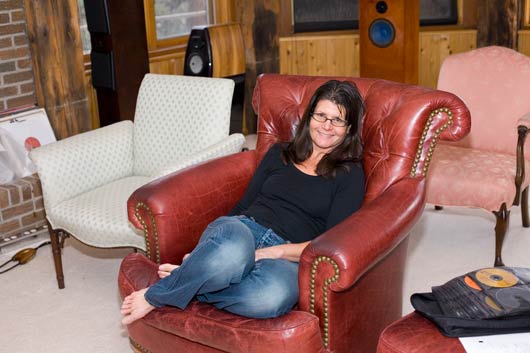
Neli with the Audio Note, Kharma and Acoustic Zen speakers in background, and Jorma Design PRIME interconnects on floor at left.

So, ๐Ÿ™‚ we went upstairs and played the same Rachmaninoff music, but on LP on the Brinkmann turntable, Audio Note M9 Phono preamplifier, Kegon Balanced amps and Coltrane Supremes. With the low-gain Lyra cartridge and a problem with noise on the line getting into the sound – it wasn’t an optimal setup by any means.

OK, OK…. But when the massed strings played over on the left, on both systems I enjoyed them, and in similar ways. I could pick out this or that guy a little louder than the others or a little too long with the note… [in some ways, it is the ability to hear the mistakes in the music that make it seem much more real :-)]. I got the same feeling of ‘wow’ that the music was trying to invoke in the audience.

I got the same feeling at being present at a concert – the conscious and subconscious cues each medium was giving me that this was REAL were different but equal.

More about THAT later too. This is all just supposition – that the TSD1/DAC2 pair can offer as convincing an experience as analog – it seems like this is something that will come to pass someday – and it seems like that is today, to me, now – but it will take a long time to verify.

Personally, we do not differentiate here between SACD and red book CDs on the Emm Labs gear. The differences between them has more to do with the recording and mastering than the medium. But lately, and maybe it is just me being lazy [and heaven knows I would love to be less of a perfectionist, it would certainly reduce our high-end audio expenses – Oh, wait, Neli would have to get lazy too] – I did not feel I had to care if we were playing CDs on the TSD1/DAC2 pair and LPs at RMAF, and that has been true here as well. Sure they are different. But all the dimensions in which I enjoy LPs I now can enjoy CDs. This was not the case with previous digital gear.

————–

So, do we still like the CDSA? ๐Ÿ™‚ We had to send our TSD1/DAC2 pair back – it was just loaned to us for the RMAF show – we had previous commitments and were not able to buy this demo pair :-(. Big unhappy frown for Neli. Big unhappy frown for me, too, but I am an optimist – or maybe just a masochist ๐Ÿ™‚ – we’ll have our own soon. And then we can think about what it will sound like putting a pair of ODIN powercords on the TSD1/DAC2 instead of the CDSA….

YES we still like the CDSA – it does almost everything as well as the Pair, and we still have the ‘silver badge’ Pair, too. But………………….. stay tuned ๐Ÿ™‚