'Reviews'

Digital Cable Shootout

Monday, February 18th, 2008 by Mike

A digital cable shootout without any digital cables… but we won’t let THAT stop us…


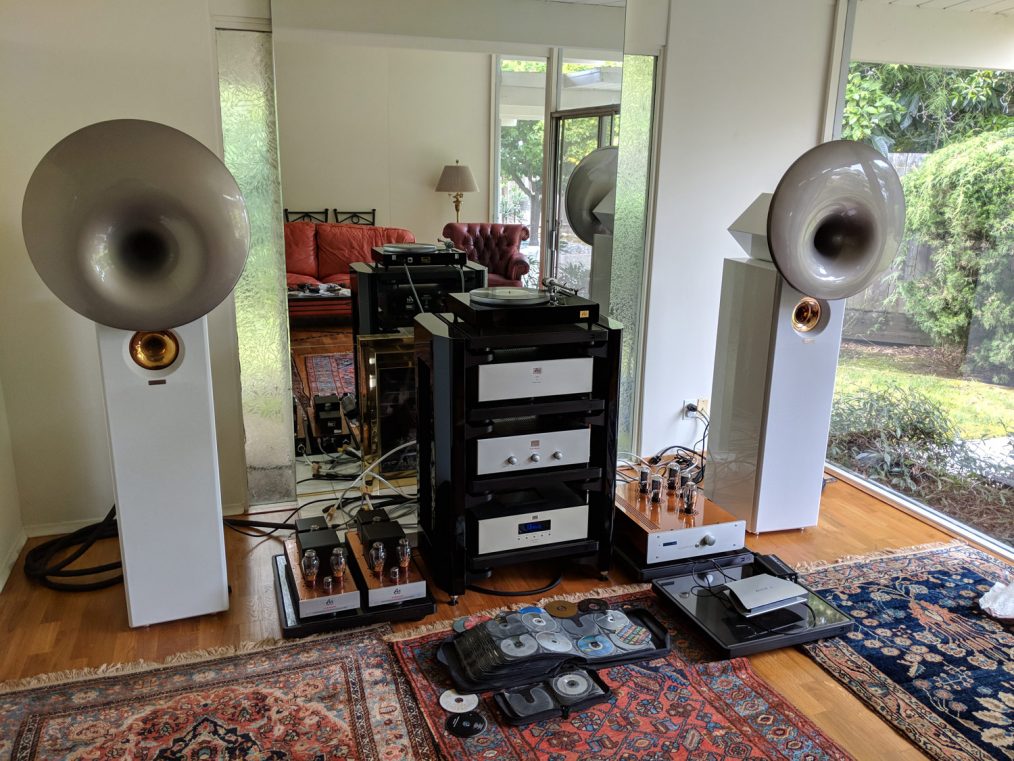
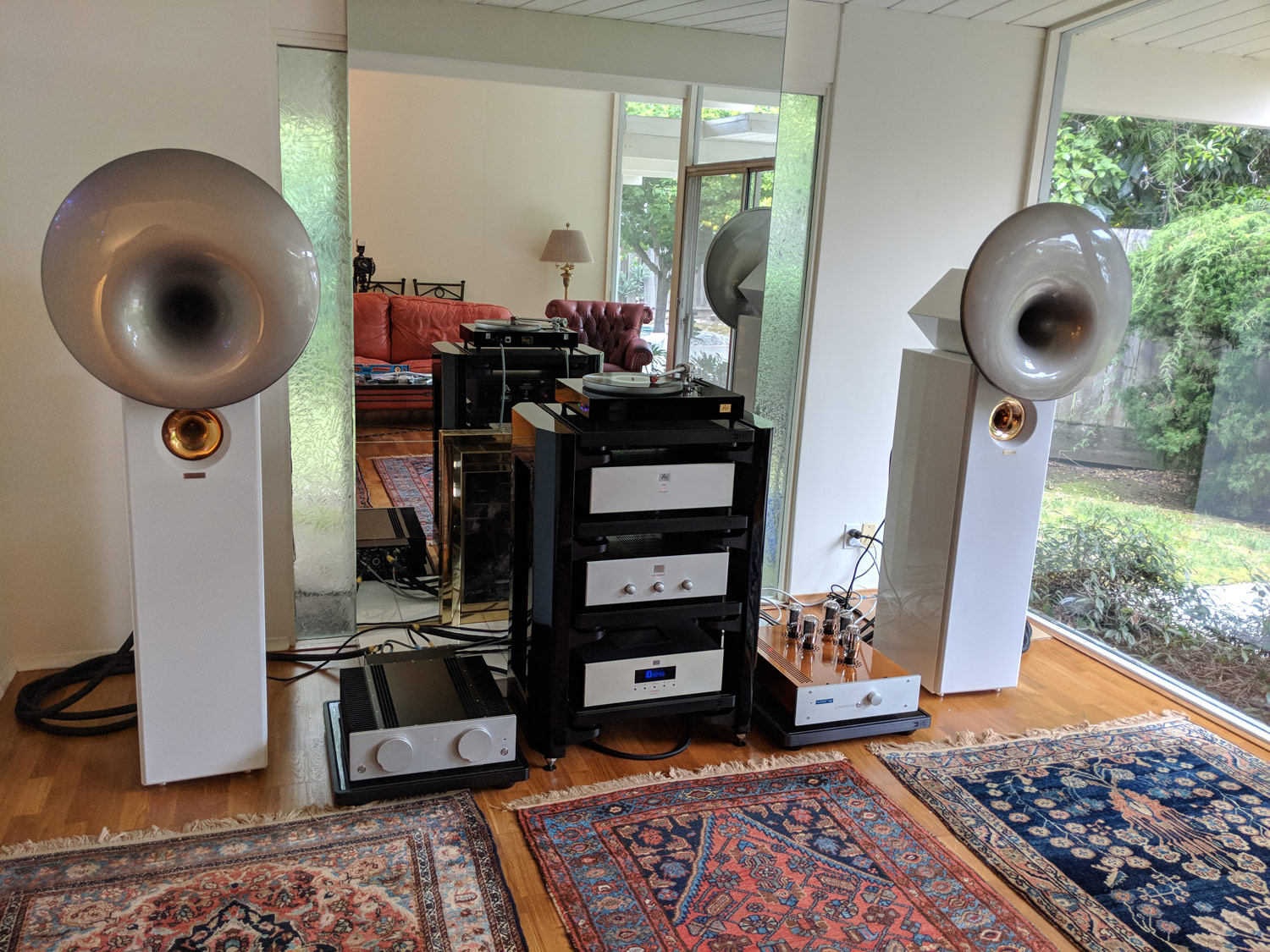
The room showing the listening couch (I sat in the sweet spot behind the couch on a chair that puts my ears on a good level].

Neli, Kevin (thanks! Kevin) and I shot out 7 (SEVEN!) cables last night in a marathon listening session.

The cables were each substituted, some of them twice, between the Audio Note CDT Three transport and DAC 4.1x Balanced. The signal then ran through a Valhalla interconnect into a Lamm L2 Reference line stage. From there through 10 meters of Valhalla to the Marten Coltrane Supreme loudspeaker’s crossover box. Then through Nordost ODIN into the Lamm ML2.1 amps. Finally, that nice old signal completed its mission through Jorma Design PRIME speaker cables.

We played, over and over again till we was about to die, three cuts: Mark Knophler’s Sailing to Philadelphia track #2, Rachmaninoff track #6, and Radiohead Amnesiac track #2. Neli and I know these cuts REAL well, and Kevin knew one of them [and now all of them :-) ] really well, so these particular cuts helped us focus more on learning about how the songs sounded versus on learning the songs themselves. We played CD 1, then 2, 3, 2, 1, 2, 3, 2, 1 in this pattern so that we would here some of the tracks back to back on different cables.


The PALLAS is still on the system this morning.

Neli did all the cable swapping, about 10 swaps in all. It took about 6+ hours. They went and got Vietnamese take out at about 2/3 of the way through. Yes, there WERE complaints about chewing sounds getting in the way of the listening. For my part, I just could not IMAGINE what Neli was chewing that would make such a noise. But, to rapidly continue on…. ;-)

The cables finished the shootout in this order. Note the 3-way tie *(which we can help break for you based on your individual preferences, perhaps) and how the SOOTTO seemed to do better as a low-signal turntable cable compared to this one (that may be because this system, the Coltrane Supremes specifically, really likes to show off top-to-bottom detail and clarity - the SOOTTO being more about solidity and dynamics and color. As mentioned below, after some thought, it is perhaps the Kharmas love of dynamics that boosted the SOOTTO into a tie for first in that system]:

[[[Nordost Odin, Jorma Design PRIME, Audio Note PALLAS]]], Audio Note SOOTTO, Nordost Valhalla, Stealth INDRA, Audio Note SOGON.

Hopefully I will add some photos here… but… oh, I am!

*** Nordost ODIN. ***

Both the Odin and the PALLAS were doing things that we all found a little hard to get our ears around. I think that is both because they are relatively new here and that they are both breaking new ground in terms of what they can do.

The Odin was the clearly the overall audiophile performance winner. Front to back depth and separation was so good it took some time to get used to. The clarity was other worldly. The even-handedness up and down the frequency spectrum. The precise imaging. Precise harmonics. This is the only ‘competent’ interconnect, just like the Coltrane Supremes are the only competent loudspeaker - they just do the things they should be doing - nothing less, nothing more.

So why the 3-way tie then?

Was it just because we were tired of getting dry-mouth, forgetting to close them during all the ooohs and ahhhhs as we listened to the ODIN?

Yes.

But it was also because we really liked the intense color and apparent humanity of the human voice when using the PRIME (Kevin called it ‘Vivid’), and the ‘rightness’ and cohesiveness of the PALLAS.

We are very familiar with the PRIME, and the sound was therefore more accessible to all of us - it sounded like our system was sounding REALLY EXCELLENT with these cables. With the PALLAS it was like being there (especially the Rachmaninoff) and communicated much more of what I thought the musicians were trying to communicate - their interplay, the threads of melody, the stage - much more like REALLY being there than I have ever heard.

The Odin was more like… WTF! So THIS is what this recording sounds like. Seems like we need to reposition the speakers because we are getting some soundstage fuzziness… there… and THERE! [True.We do. The bass towers between the main towers is just not working out so well where we have them. We either need to to move the bass towers back or to the outside of the main towers].

We would be happy with any three of these cables. They all sounded excellent. The 10th time we played each song was as entrancing as the first - even though my brain was melting and it was hard to analyze what I was hearing at the very end anynore [but the last few songs were just a confirmation pass - yes we DID hear what we heard during the first pass, and yes, it is still quite nice thank you].

The Odin would, however, push us to optimize the rest of the system a little sooner - it being such a good window on what is actually on the source media. Just like the Supremes have forced us to continually improve our system. These definitely are pushing the audiophile envelope - raising the bar of what CAN be done with a high-end audio system.

*** The Jorma Design PRIME ***

Neli says there is chocolate on the Prime, and then she looks at ME(!) Now I ask the world, who is the chocolate addict in our house? No it is not me :-) [But I guess I do eat protein bars that have a chocolate coating… Oh no! Banished to the audiophile penalty box!]

This will be the hardest to write, I think, because we are SO familiar with the sound - I will have a tendency to skip over some of its attributes. On the other hand, Kevin was there, and he brought up things about this sound that was a reminder to me… Oh yeah, they DO do that don’t they.

That said, each time these cables were put on was a joy. We have NOT grown tired of what they do. In fact, it was still a WOW experience.

First off, the voices. The voices on Radiohead, for example - but the Knopler too, were clearly better than the voices with any other cable. The HUMANITY of the voice stood out. This sounds like a real person! Somehow the balance of the frequencies and resolution just works. The throat and chest and gutturalness was just perfect.

There was also a lot of color to the harmonics. Not overly much - in fact just the amount that I want to hear. For example: A lot of notes in music are just plain ‘fun notes’. If you had a button and it made this sound when you pushed it - you’d be sitting there all day pushing it over and over and over because it sounded so cool. Knopler ’s guitar, a lot of the sounds [but not all :-) ] on Radiohead, some of the violins on Rachmaninoff. Just like a kid we would be. Pushing that button over and over. But a lot of our systems leave out the ‘fun stuff’ in notes. This cable emphasizes the fun stuff.

This cable also had excellent separation, side-to-side and front-to-back. details were sufficiently plentiful that it kept us engaged as we continued to find new ones - new depth and characteristics of the performance - after the 10th [1000th] time we heard the track, etc. etc. [See, I TOLD you this is hard to write down everything we know].

Not as delicate sounding, not as much finesse, as the other two top contenders [something we thought we’d never hear ourselves say about the PRIME, which has details out the wazoo compared to most anything else on this planet here].

This was the most exuberant cable of the top three. Happy Happy. Enchanting. The PALLAS was joyous and romantic. The Odin was kind of like all emotions mixed together , being VERY emotional and engaging - but nothing stood out.

This cable is probably best, out of the ones we tested here - for people who love those audiophile-like performance characteristics, who want their system to sound really, really good - but don’t want to, or aren’t ready to, push the envelope and re-evaluate what they know about system setup and configuration and just what can… be… done… with the ODIN. [The ODIN *WILL* show you what your system sounds like - not in a harsh way, unless you have a bright system and are upgrading from something like CARDAS - but in a Oh! That is the contribution of my amp! Oh! That is my CD player. Hmmm… needs some vibration control to tighten THAT up a little bit. OK let’s do that. Oooooooooh. That sounds awesome. OK, sounds like the speakers need to be moved a wee bit to starboard… Yeah. Like that. OMG!].

*** Audio Note U.K. PALLAS ***

Confusing this one is, Luke.

In some ways that I did not understand, this one had a sound-stage stability and a lack of compression and a separation that equaled or bettered the Odin - but with an entirely different kind of presentation.

Lots of delicacy, so detail and micro-dynamics were there almost as extreme as with the Odin.

The solidity though was not as impressive as with the other two top contenders. This was definitely more of a light weight, in comparison, kind of presentation.

What I kept coming back to was the ‘Rightness’ about this sound. The soundstage was laid out in a realistic manner - but it was hard to care much. Each violin could be picked out [this was really quite fun], more or less right… THERE IT IS! But it was just like at a concert, where you can point at the musicians, but not know if they are wearing underwear or not. Or maybe this is another result of our non-optimal positioning of the speakers and we will hear more, like with the Odin, when we adjust this some.

Funny, the first few seconds of all these 3 cables was like an AAAAAAhhhhhhhh experience. “How pleasant it is to hear this sound after all the others. THIS is my favorite”.

Though this cable rivals or betters the other two cables in audiophile attribute checklisting, it seems to be more a music lover’s cable. It doesn’t ASTOUND one as much as the others.

The ODIN is for being Astounded and for helping make our system sound its very best - leaving others in the audiophile history bin. Do you want to build your system into a state-of-the-art WTF [e.g. a non-denominational OMG] system?

The PRIME is a plug-and-play conversion kit to make your system into a freaking-awesome-sounding system. Do you just want to make your system sound excellent?

The PALLAS is for listening to music on a system that matches or betters all others in audiophiledom, but doesn’t flaunt it. Do you just want to listen to and grok The Music?

*** Audio Note U.K. SOOTTO ***

Like with our previous shootout, this is a super-charged version of the SOGON. If you like SOGON, you HAVE to hear this.

After the second pass through the other cables, it was evident that this had greater macro-dynamics and more solidity of any of the other cables, which is saying something. Knoffler’s guitar sounded EXACTLY the way one would want it to sound. Made me want to put on Pink Floyd which is chock full of soulful and very colorful guitar. So, yes, this is also a very colorful / harmonically available cable. Not as much color as perhaps the PRIME, but the PRIME is almost psychedelic.

But the solidity, it is like the amp is taking more control of the speakers - each note is forcefully placed into the air. The musicians sound like they are in perfect control of their instruments.

And the interplay between musicians was also communicated better with these cables - which Kevin also independently mentioned - so the both of us noticed, on the Rachmoninoff, the back an forth and interplay between the musicians… something I was hard pressed to identify later on the other cables.

Why didn’t it score higher? There was some air missing, perhaps? Some slight lack of detail in the upper mids? A little bit of rounding? Last night we were just in the mood for something a little more copasetic with the Supremes - which really, really like Resolution. Downstairs on the Kharma Mini Exquisites a few weeks ago, in the other shootout, it was a slightly different story - the Kharmas really being partial to anything which makes them more dynamic.

*** Nordost Valhalla ***

The old champion. How technology has advanced. Still hanging in there though. A little rough sounding compared to the others, good midi-dynamics though. Separation is good in a macro sense, but details are smushed together compared to the others.

*** Stealth INDRA ***

A delicate sounding cable. Very pretty midi-dynamics, but not much macro dynamics. A little more congested than the others.

*** Audio Note U.K. SOGON 50 ***

A little more laid back than the others. If we hadn’t heard the others…. But not as exciting as the others on our system.

*** More Others ***

From previous shootouts, we know we like the Nordost Valhalla interconnect better than the Valhalla digital cable. We like the Valhalla digital very slightly better than the Jorma Design digital.

Getting the picture?

Digital cables are not performing as well as their siblings who are just ordinary interconnects.


I took 6 pages of large scribbley notes - most of which I still have to add to this post. So, stay tuned….!

————————————————–
Notes:

ODIN: A larger impact than expected perhaps 75% of the performance boost of putting it in as a regular interconnect? ENGAGING. Emotion. Pacing.

PALLAS: Not as forward. Great integration, image stability, presence, sound-staging. Less aggressive. Emphatic (Kevin). Balls [Neli]. Great sound-stage fill-in. Softer and more delicacy. Romance. Not quite as good PRaT. A little congested in the mids. Better sense of the music. “Rightness”.

SOOTTO: Not as clear. Very pleasant. More like a classic recording sound. Clearer view into interplay between instruments (Kevin aslso). Not as transparent. More solid. Awesome control over the speaker. Guitar is S-O-L-I-D. Not as engaging. Some of the instruments in the background are more forward (Kevin also).

PRIME: Solidty of voice! Not as delicate as Pallas or Odin. Separation alsmost as good as Pallas and Odin. Happy Happy. Almost as forward as Odin. Good PRaT, tonal color. Happy. Great transparency.

INDRA: Congestion on complex passages. Less midi-dynamics. More focused on speakers. In the delicate-sounding cable category. Constipated. [these do a lot better on stronger signal areas of the signal chain like between pre and amp]. Some emotion. A nice audiophile sound - but not great resolution [compared to the other uber resolution cables here!].

VALHALLA: Rougher than Indra, but more emotion, suspense. Less resolution. More separation, more midi-dynamics. Louder. Less finesse. Made Indra sound too polite. Less transparent. More compressive on macro dynamics. Focused on speakers and center stage. [This is the cable we usually use in this position - as it WAS better than all the other cables we had tried before - not wanting to know, perhaps, what these more expensive cables could do in this little corner of the system - until now of course].

ROUND TWO ——–

ODIN: Amazing separation and CLEAN. The incredible depth of the soundstage, more than we are used to, throwing off perception transparency a little? [I know, almost a complete sentence in my notes!]. Harder to integrate into a whole. A RELIEF [like Valhalla used to be for us - no B.S.]. Pretty, uncompressed. Not at all focused on speaker. Good PRaT.

PRIME: Singer more human. Better presence. Less separation. This amount of congestion / compression / constipation is comforting because we are so used to it? More like a stereo system [than real]? Very enchanting.

PALLAS: Beyond separation - more like spreaderation - an evenness to the spread of soundstaging, of the management of the distance between notes. Uncompressed. Rightness. Less digital. PRaT. Happy. Natural. Wide natural soundstage. Lighter weight on the guitar than the other two.

Shootout: Audio Note Interconnects: Sogon versus SOOTTO versis PALLAS

Tuesday, February 5th, 2008 by Mike

A shootout! A shootout!

OK, in this corner weighing in at, well, it is the heaviest cable, is the new top-of-the-line SOOTTO [SO Over The TOp].

In this other corner is the new 50 strand version of the legendary SOGON.

And in this other corner [a lot of corners, yes] is the new limited-quantity low-capacitance minimally shielded PALLAS.


A photo of a 1.5m SOOTTO and 1m SOGON cable. The PALLAS is still on the system (see below).


The SOOTTO is about 50% larger in thickness than this new SOGON50 which appears to be slightly larger than the old SOGON cable.


The PALLAS low capacitance cable on the back of the TT3 Reference turntable. The current configuration is not shielded.

We tested the cables going from the step-up transformer to the Lamm LP2 phono stage and ultimately to the Kharma Mini Exquisites. So this was a test of the low-signal handling capability of the cables on a system that does not have a lot of capacity for detailed bass below 30 Hz or so [but has one of the highest capabilities of midrange resolution of any speaker on the planet].

We think of the AN SOGON cable as analogous to the Nordost Valhalla [which is familiar to many people] - and in general applications, one can be swapped for the other in a reasonably well-designed system with the overall performance remaining about the same.

What this means in practice, is that the upper mids and low treble are more or less the same - and this is the area of most information.

Where they vary, and become useful in customizing a particular system, is that the SOGON has more color in the mid and lower mids, and the Valhalla has more detail in the lows and some of the highs. At least, to a first approximation, this is how we use them.

The second order approximation [i.e. finer differences] come into play when looking at separation and transparency [Valhalla] and continuousness, soundstage consistency, midi-dynamics [SOGON].

The SOOTTO is like a nuclear-powered SOGON.

The [having a hard time thinking about how to describe this very basic attribute], the *power* of the notes are clearly unmatched by any cable we have heard here before. Kind of like a Mohammad Ali punch when he is just playing around - it doesn’t hurt you, but the fists are humongous and you can feel the strength in each note.

Similarly the naturalness of the color of the notes and the smoothness of the transition of the notes one into the other [so that riffs inside melodies were easier to follow] is also exceptional and unmatched [though the Jorma PRIME has a more *vivid* color spectrum].

It was agreed that this was definitely a WOW! and WHOA!!! kind of experience. Reminds me of those Strongman competitions. Other enhancements were the tactility of the notes [not so much the presence, nor solidity, though these were excellent, and related, to tactility but the feeling that one could go up and hug the notes, as opposed to the people or instruments making the notes].

We liked it and it was kind of hard to think about going back to SOGON after doing the shootout [funny, but before a shootout, swapping things here-there-and-everywhere, the differences aren’t so present in one’s mind, but after a shootout where you sit and explicitly listen for differences - you are screwed].

Finally the PALLAS.

First, let’s deal with the unshieldedness. In the position that you see it in in the photo, there is some hum. Not much, and only barely audible from the sweet spot. Compared to the oh so wonderful WBT RCA connectors, which generate hum in that position at about 60-70dB, and make the cables that use them worth less than lamp cord, the hum from the PALLAS is nothing.

The PALLAS is designed by AN for low signal strength connections, and we have not tried it anywhere else.

OK. It is hard to compare the PALLAS to anything we have here. Because of this it will require more listening. But…

It has separation as good or better than the Valhalla - but not as clear sounding - but more clear than the SOOTTO. It sounded more musical than anything we heard in this test. Great transparency, but not like that of, say, the ODIN - things are not outlined with that kind of preciseness - it is more like the center of things is more solid than the edges, but that the roll off of the solidity was exactly what one [me anyway] would expect when one thinks about analog [as opposed to digital].

So, for me, I liked the PALLAS the best and SOOTTO second best in this test. I would hate to live without either - they are so different and I love being able to switch back and forth sometimes. Over time this may change - maybe after we get over the WHOA! experience with the SOOTTO we will come to prefer it. But in general I like the slightly more clean sound of the PALLAS which still retains the harmonics and dynamics of its brethren, if not the impact and POWER.

Again, a reminder, this shootout was for small signal connections. These results are for interconnects between turntable to phono stage, and probably the same results would be achieved between a transport to DAC. Some cables do better than others at this: Stealth INDRA for example does not work nearly as well as Valhalla [and for some reason we have never tried the Jorma Design PRIME. Well, maybe Neli has…]. In fact, we liked and use the plain old Valhalla RCA interconnects almost exclusively in this low-signal capacity. The Odin is better than the Valhalla in low signal connections - and the resultant purity of the overall sound is what dreams are made of - but Odin kicks Valhalla butt all the way to the Moon in high-strength connections, and since our supply of Odin is, so far, uh, limited, you would see Valhalla serving in this capacity here most of the time.

But now we have a few more cables that have proven themselves to be better at the low-signal thang in at least one situation. So next time we move things around, we’ll have More Work to do figuring our which cable sounds best. Oh boy.

I mean, Oh BOY!!! [actually, I do enjoy these shootouts very much, though the turning on and off of equipment over and over is kind of stressful - on the equipment specifically, and making sure we don’t hook up something backwards, or the in to the out, takes some amount of, uh, hmmmmm…. paying attention to the physical world when I just want to focus on the sonic world].

Well, there you have it. There needs to be another shootout, specifically for normal connections, and hopefully in that shootout we will revisit this shootout with any updates, if necessary.

Amplifier Shootout - Audio Note vrs. Lamm vrs. Audio Aero vrs. Audio Note

Friday, February 9th, 2007 by Mike

We held a shootout here a few days ago - $85K Audio Note Ongaku versus $22K Lamm ML1.1 versus $10K Audio Aero Capitole versus $9K Audio Note Conquest Silver. Prices rounded, so don’t quote me to Neli :-) .

The Audio Aero Prestige as serving as CD / SACD player, and sometimes as linestage as well. The Audio Note AN/E Signature loudspekaers were serving as… speakers.

So, with the disparity in pricing - it wasn’t really a shootout. More an investigation into different sounds - how the different amps sounded, given that they are indeed so very different from each other.


We finished up with the Audio Note Conquest Silver 300B amps.

We will try to describe the *differences* between the sounds, as opposed to the sounds themselves.

Going from the Audio Note U.K. Ongaku to the Lamm ML1.1.


The Ongaku and ML1.1 amps resting behind the couch after their workout during the shootout.

The sound was not as big with the Lamm, somewhat more compressed - but perhaps more even-handed because the somewhat rolled-off deep bass [which lends the deep bass a compression-like signature], because of where the speakers were located [in front of the horns, which are out of here as soon as the snow melts. If it melts.].

The Lamm sound was more laid back, the soundstage receeding somewhat, which allows one to better appreciate the music in measured doses when desired, as opposed to being transfixed unable to move for whole CDs at a time [from this description I hope people see that we like both types of soundstaging - really depends on our mood at the time].

The Lamm harmonic color was a little grayer, and the dynamics, as mentioned above, a little less exuberant. This goes in keeping with our general interpretation of the Lamm sound as being stately and sophisticated, natural and self-consistant.

This is not to say that the Ongaku is an exuberant amp either - it is actually quite balanced, unexpectedly so from my point of view, with just a little flavor from the use of the 211 tube. We still have a lot to learn about Audio Note, but it is my current impression that as you move up in the Audio Note line, things become less colored and more accurate and therefore much more revealing of the color and subtleties of the music itself, quite unlike anything else out there. This seems different to me from the brands that, as you go up their line, you get more and more improved versions of their ‘house sound’. ‘Course, you can always tube roll the amp and get just about any sound you want - but I think the point has been made.

Going from the Lamm ML1.1 to the Audio Aero Captitole amp

The Capitole was sweet in comparison with the ML1.1. More euphonic, rounder, less resolution and transparency. For some reason, about half of the people we talk to these days are conscously steering away from high-resolution sound - so this amp, with ‘just enough’ resolution, should really be on everyone’s short list. No one really knows about it, but, especially teemed with the Capitole or Prestige CD player, you can get a really wonderful, Enjoyable and slightly Sweet, sound.

Going from the Audio Aero Capitole amp to the Audio Note Conquest Silver amps


The Audio Note Conquest Silver amps in play. The Audio Aero Capitole amp behind, resting.

Easiest to compare these to the Ongaku.

Less density. By which we mean less resolution, less micro-dynamics, less macro-dynamics, less color. Just less going on. But at the same time, note by note, it was the same: the notes were where they were supposed to be, the rose and fell like they are supposed to, they were just a little thinner sounding. OK, a lot thinner sounding.

Thinner sounding isn’t exactly ‘bad’, though, There is a lightness to the music, very similar to the experience of the $11K Kharma 3.1c versus the $45K Kharma Mini Exquisite, which I think is largely a psychological, not electro-mechanical, experience that is quite pleasant and refreshing. That sometimes a ‘lighter fare’ is as enjoyable, to a listener, as the full-featured experience.

Kind of like comparing the Simpsons [the old shows which had content] with a James Bond movie. One can enjoy both. But one generally prefers, and will actually pay more money for, the Bond movie.

Well, depends on the particular Bond movie :-)

Audiophile 101 - Reviewers

Sunday, February 4th, 2007 by Mike

Reviews of audio equipment are compromised because reviewers are compromised. They cannot be trusted.

Both print and online magazines are compromised because one never knows if they are writing positive reviews in response to advertising dollars, or trying to solicit new sources of advertising dollars. One thing is proven, that bad reviews chase away advertising dollars.

Online magazines are compromised further by the fact that reviews are ‘linked to’ by the manufacturers of the equipment that was positively reviewed, increasing the magazines popularity with search engines, which attracts more traffic, which allows them to raise their advertising rates.

Reviewers also are compromised by:

1) Having to conform to the stated policies of the magazine they work for

2) If they do not write positive reviews, manufacturers will not want to lend them equipment for the next review

Dealers who write reviews are also comprimised because no one ever knows if they are saying something in order to try generate more sales.

Individuals, which includes reviews at the above mentioned magazines and dealers, are firther compromised because:

1) One doesn’t know if they are an idiot or not

2) One doesn’t know if they are a shill or not [for those that don’t know, and apparaently some do not, a shill is someone who pretends to be an individual but really works for a dealer or manufacturer]

3) One doesn’t know if they are just conforming to the natural human tendancy to praise the equipment they currently own [and disparage that which they no longer own].

4) One doesn’t know if they are just trying to praise, or disparage, a piece equipment because they like, or do not like, its particular manufacturer.

————–

The point is that all reviewers, and therefore all reviews, are compromised.

They can’t be trusted!

Or can they?

What we can trust is that some reviewers care about their reputation. How they see others see them, and want others to see them.

What we have is:

** REPUTATION-BASED TRUTH **

Both institutions (like magazines and dealers) and individuals (reviewers at those magazines) have reputations - good or bad, or just plain weird.

The argument here is that you CAN TRUST People, and Organizations to more or less behave and write reviews in accordance with their view of their reputation, based on how important that rep is to their personal views of themselves, to their personal self-worth.

——

Take, for another example, TV news reporters.

Edward R. Murrow - apparently [sorry, before my time] had a reputation based on his dedication to telling the Truth.

Some popular networks, and their reporters, have a reputation based on the consistant ridiculing of other’s political ideologies. They can be ‘trusted’ to report in a way that always conforms to this reputation they and their organzation have.

Some reporters whole reputation is built around their ability to get the next scoop, the next Big Story, not having anything to do with the truth, necessarily.

——

So, back to audio,

We have some magazines whose reputation is built on all the published reviews being positive (Positive Feedback [see this recent castigation of non-positive reviews], Inner Ear)

We have some whose reputation is closer to that of Murrow, but which is distorted by what they judge to be ‘truth, but in a responsible manner’ (Stereophile, 6moons). [Here we start entering the domain of serious reporting ethics, the necessity of having to report news without ever having ALL the facts - something too serious for this post, or this website].

[The Absolute Sound and HiFi+ seem to have a mix, there being so obvious, to me, reputation associated with the magazines as a whole, except that of this plurality of reviewers with different types of reputations].

Then you got the ‘Malcontents’, as Inner Ear called them this month [are we malcontents? I hope so :-) ]. These peoples reputation vary, sometimes being just ways to publically express their need for anger management, or remedial logic 101, classes. Our rep, as I see it, is that we try to shed light on the very high end in a ruthlessly honest, but inclusive, manner - in a way that seeks ways to explain the what, how and why that the high-end is not just some morass of similar sounding components all rated ‘A+’.

You also got your netizens, who consistantly praise their own equipment as being the very, very best the world has ever seen, and disparage everyone else’s as either ‘been there done that’, or ‘being privy to a special network of only the best audiophiles [i.e. not you! :-) ], I have heard that your gear sucks in comparision to my gear’. Their reputation, as they see it themselves, is built upon some variation of everyone thinking that they have the best equipment in the world.

—–

The point is, they are all behaving in accordance to what they want their reputation to be.

Some people care about their own reputation. Some not so much. The ones that care the most seem to be the more consistant reviewers: Mike Fremer, J.A., Srajan for examples.

But it is not a given that their reviews are ‘better’, or worse, than that of other reviewers. It is just that some reviews can be trsuted to be written to be within the context of the individual reviewer’s, and their organization’s, reputation.

—–

The final point, finally, is that everything DOES sound good and everything DOES sound bad.

Everything sounds good to reviewers who are not all that critical of each single aspect of the sound something produces, whose rep is based on welcoming nearly all components into the wonderful world of high-end audio.

Everything sounds bad to reviewers whose rep is based on being very critical of the sound a component produces, always comparing it to what it ‘could be’, if someone had just put a little more effort into its design and manufacturing.

Interconnect Shootout: Nordost Valhalla Neutrix vrs. Valhalla WBT vrs. Audio Note Sogon vrs. Acrolink 7N-DA6100

Sunday, December 31st, 2006 by Mike

The setup
The test consists of swapping out various interconnects between the outboard crossover of the Marten Coltrane Supreme loudspeakers and the Audio Kegon amps that handle the frequencies above 100Hz. Picutred you can see the gray Audio Note Sogon interconnect in place.

The Acrolinks
The Acrolinks.

The Acrolink interconnect up close
The Acrolink interconnect up close. These connectors are massive, and I believe this the only connector they come with. Very substantial and secure fitting things they are.

The Valhallas
These are the two Nordost Valhalla interconnects side by side.

Part of this test was for us to see… hear… the difference between these two connectors. Was it all just hype?

The Valhallas

The Valhallas with the new WBT connectors
We are not so sure about these connectors. They seem to pick up ground loops like nobody’s business. It is possible, and quite frequently the case, that:

* they are on too tight or too loose, in which case they either appear to be broken (aka no sound comes out) or

* they generate a large ground hum because they are not grounded at all (the area of contact on the target connecting post is dirty? or perhaps they are just too loose), or

* they pick up a small ground loop hum because they are only partially grounded (perhaps the connector is so thin that it needs its own shileding….?)

The WBTs up close
The WBTs up close

The Valhallas with the old Neutrix connectors
We love these old connectors. You put them on, they stay on. They feel secure. They don’t wear out after many, many uses.

The Audio Note Sogon interconnect

The Audio Note Sogon interconnect

The Shootout.

From one extreme to the other:

*** The Acrolink 7N-DA6100 - $4995 ***

Very clean. the cleanist sounding of this bunch (but not as clean as the Jorma Design Prime, at $2K more!). Very detailed and lovely air. Midrange is clean with perhaps a little too quick on the top of the note attack and on the decay. Bass is good.

*** The Nordost Valhalla with the WBT connectors - $4000 ***

Rounder than the Acrolink, more body. Also more veiled than the acrolink. Smoother because of it but there was also a whisp of a feeling of the music struggling to get out.

*** TheNordost Valhalla with the old Neutrix ***

The midrange frequencies are more laid back, a little more veiled. A little less midi- and micro dynamics in the midrange as well, compared with the WBT solution.

How subtle is the difference? In my mind I keep thinking 10% - whatever that means. I think it means that if the WBT was 100% better than it would be twice as good. In the midrange. In terms of these attributes.

In this test we did not get the dreaded ground loop hum with the WBT and we did prefer the WBT solution. The slight increase in resolution and slightly more presense in the midrange - was nice, and appreciated

*** The Audio Note Sogon - $2725 ***

The midrange was quite similar to the Vahalla in terms of detail and resolution, but with more color and subtle harmonic content. The bass was a little muddier than the other cables but a little more natural. The highs not as prestine as the Acrolink, and similar to the Valhalla in quantity but a little more natural in quality - i.e. not so much going for the ability to spotlight each detail in the treble, which I know many people like (including us, sometimes :-) ), but instead makes the details more integrated into the overall sound stream.

For this system, in its current state of break in (its making good progeess, finally) with the all Audio Note front end, we left the Sogon in place. It made the system much more musical to listen to, at least at this time.

There is a 5 meter Valhalla interconnect (Neutrix) between the linestage and the amps.

Swapping this out for, say, Sogon, or Acrolink even, would *probably* make the sounds of the various setups with these various cables more reflective of the underlying strengths and weakness of these cables.

[Is this always true? That a system cabled throughout with just one kind of cable will always highlight both the strengths and weaknesses of that cable? I know many manufacturers and dealers say you MUST use just their cable for your whole system to get best results. And I can agree with this if their cable is way better than what is currently in the system.

But what about using various cables as ’spice’? I know that the word ‘tone control’ is a pejorative thse days, but until we get the perfect wire, all cables, including the lauded Belkin power cords, will be tone controls, like it or not. And so, taking this reality into account, I propose we must carefully, and consciously, spice our system with various cables lest we get something that tastes salty, …or like poop ;-) ]

More on Number 4 Setup of the Powercord Shootout

Wednesday, December 6th, 2006 by Mike

We listened to this setup more this morning.

Even awake, which I was this morning, it was a very interesting sound with the Satori on the EmmLabs digital front end and the Elrod on the Edge amps.

The soundstage was quite different from the one we are used to, not at all like the suspension-of-disbelief transparency that makes one be able to squint one’s eyes and see the orchestra laid out in all its glory.

The instruments were indeed where they were supposed to be, but … it was like the information about how things were laid out In Relation To Each Other on The SoundStage was instead replaced with something else…

Now, this is going to sound weird… :-)

But it was like it was replaced with information on how things were Related to Each Other in Purpose, or perhaps, to be a little more easy to understand as a strawman concept, Related to Each Other in Time instead of Space.

Listening to Radiohead, it was like each group of distinct notes, I do not know what they call them.. a riff perhaps, or a sub-melody, had its own life. But it was also related to the other riffs, connected by the key they are playing in, by the scale and rhythm they are all part of. And also by this point - counterpoint kind of plat that composers seem to use a lot, scripting riffs both in opposition and support of other riffs.

So, ANYway….

This system caused me, anyway, to be almost forced to be absorbed by these different aspects of the music as opposed to how I normally listen to music, which is to ’see’ the musicians playing and hearing the music as it passes by, the words, the basic linear progression of the composition.

This is different from the ‘life’ or ‘psychadelic’ nature of the music which the Pranawire Satori added to the mix. And to think it was just adding them to the CDSD and DCC2 that made this change.

I told Neli at the time that it was like a geometric relationship now between the notes and ‘riffs’, but I do not want it to be confused with the traditional distance relationships that the images of the different notes have in a soundstage.

This is more like make visible the multi-dimensional relationships between notes, composed of tone, duration, texture, similarity of note envelope, etc. etc. and, yes, purpose - WHY those notes were composed to be there - as opposed to just where in the soundstage the musicians (or their notes, which may be located elsewhere do to those Wily Soundboarders) are located.

So two questions remain:

How do we get both the Real and this Uber Real in the same system?

and

How does a powercord, so far up in the chain, make such a difference?

Later, we put back the Shunyata powercords, one an old Python, on the Emm Labs, and the transparency and soundstaging was back to ‘Normal’.

Don’t know whether to be happy or sad.

So I’ll just be confused, instead.

And, yes, this was somewhat like our A funny thing happened on Planet Abraxus experience with the Coltrane Supremes at CES 2006.

But where that was a very ’solid’ extra-dimensional relationship visualization experience, this was a more spiritual,…no, strike that, a more perceptive, deeper yet more ethereal experience…

We need to try the Satori, the Jorma Design ‘Prime’ and the Coltrane Supremes all together sometime…. Then maybe we can get Real, Perceptive and Solid Visuals all at the same time.

Can we handle it? [My daughter is a psych major - will she get her PHD in time? :-) ]

Shootout at the PowerCord Corral - Shunyata, Pranawire, Elrod

Tuesday, December 5th, 2006 by Mike

By the wagons we got the Shunyata Anaconda Helix Alpha.

By the well we got the Elrod Signature 3.

and By the barn we got the Pranawire Satori.

OK. Ready. Set. Play!

Showroom 3
The system we compared them on was the following: Kharma Mini Exquisite loudspeakers, Edge Signature One amps, Lamm L2 linestage, and EmmLabs DCC2 SE / CDSD SE CD / SACD front end. INDRA interconnect between the DCC2 and the L2, Valhalla between the L2 and amps, and Jorma No. 1 between the amps and speakers.

We tried out all 3 power cables on the Edge Signature One amps.
Showroom 3

1.

First up were the Shunyata Anaconda Helix Alpha (who win the award for the longest name). Usually we like the Shunyata Anaconda Helix Vx cords better than the Alpha cords on the Edge, and now was probably no exception, but the Vx cords were on the Audio Note M10 linestage power supplies on a different system… so…

We played the first track on Radiohead Amnesiac. My thought when it was all over was that nothing was going to beat this - the resolution and imaging and ‘techno feel’ was first rate. And I was right, as far as it went, that nothing did beat them in these categories - there are other categories however… always more categories…

The Power Cord Fiesta
Photo taken after the shootout. Here we see the power cables with the red label (Shunyata Anaconda Helix Alpha), the green label (Shunyata Pyython [sic, WordPress has a bug that does not allow this to be spelled correctly, since this is also the name of a computer language it is confusing the poor thing…] going to the Soundlab speakers - not in the shootout), gray label (Shunyata Anaconda Alpha that were powering the Emmlabs), the silver-braid shielded power cords are the Pranawire Satori, and the big (but not as big as their brothers!) Elrod Signature 3 power cords. Oh, and the cords that look like red and blue stripes is the Valhalla going to the Lamm L2 linestage.

We also played Mark Knopfler’s Sailing to Philidelphia - first two tracks. [Pick this up if you like Mark Knopfler and high-quality music and sound - we’ve had many people who wrote the name of this CD down after hearing it here].

On the first track, Mark plays several licks that are up front and can be biting unless there is a lot of support from the system in terms of not just resolution, but harmonic integrity - the notes have to swell just right or they rise too fast and sound ‘bright’. It is in this respect that we prefer the Shunyata Vx cords on these amps - they handle the notes in a more relaxed, organic manner that seems to fit most of the music better.

2.

Next volley was heard from the Pranawire Satori. Pranawire has a trademark sound that is, what we call ‘psychedelic’ [or acid-like …including flash-backs] (and the Jorma Design Prime cable has some of this too, but in a different context, as do the Kharma loudspeakers). This sound is very very engaging - somewhat like 2A3 tubes in a good amplifier in that it is very subtle yet readily recognizable. Which is to say it does NOT distort the sound in order to entertain the listener in some kind of gross way by catering to the common human weakenesses for syrupy or euphonic sound.

The Power Cord Fiesta

It is a sound that is hard to describe - it is like adding ‘life’ to the music, or ‘color’ where there was none before but we were colorblind and did not know it. Anyway, with the power cords on the amps we heard this ‘effect’, which we have heard in their top-of-the-line cosmos speaker cable, but not so much in their cosmos interconnect. YMMV.

As for the sound, per se, solidity in the soundstage was better than the Shunyata for various instruments, accompanied by a reduction in resolution and - if I remember correctly (Neli is at the gym) a reduction in mircodynamics and air but an increase in the ability to swell dynamics from one state to another.

The Power Cord Fiesta

In many ways this was similar to going from solid-state to tubes - it is a tradeoff and depending on you and your system, you may or may not like it. I liked it, and certainly from the point of view of being a system builder: now I could add this ’sound’ without having to deal with the somewhat large Cosmos speaker cable - which had some other side-effects - or having to swap out amps of source components or anything. I.E. swapping powercords for for the listener [who might be us!] who wants something a little more engaging (albeit a little less real) at the moment is now as easy as switching a power cord or two.

Radiohead’s voice and Khopfler’s guitar were all wonderously colorful and alive - there was however some reticience in the transition from one note to the next which we interpreted as probably resulting from these powercords being not quite burned in yet. [If you have been following the Blog lately, you might understand how we are growing impatient waiting for things to finish breaking in around here… ;-) ]

The Power Cord Fiesta

3.

The Elrod mosey’s in with the shotgun.

The Power Cord Fiesta

The sound of these was surprising to me … more detail (though not quite as much as the Shunyata Alpha) and much more separation - the soundstage really cleared up. The solidity was about the same as the Pranawire (the Anaconda Alpha had better pinpoint imaging than either - but it was not as 3D or ’solid’). The Shunyata Anaconda Helix Vx has been our reference on these amps - and will continue to be so as it has performed well in 100s of system configurations we have set up - but the Elrod Signature 3, which we are learning more and more about, did much of what *we* like in a system, which is walk that fine, fine edge between real and musical. It entertained our minds, fooled our minds, and warmed our hearts (though that last not quite as aggressively as the Satori :-) )

4.

As a final test, we replaced both the powercords that were powering the Emmlabs transport and DAC with the Satori, they were what I think are from the photos Anaconda Vx (not the new Helix) . Could we hear the Pranawire effect even with the cords on a low current device like the digital front end?

The asnswer was yes, but it was only about between 15 and 25% of the effect it had when on the amps, in my estimation. It also clouded up the soundstage some,,, I think. It was weird. Maybe I was too tired at this point. Instruments and voices just sort of appeared in the soundstage, solid, but then faded from view somehow. It someway this was much more REAL than anything I have heard before in terms of what happens when a musician plays something then stops for a few moments. Or it was totally wacky and unnatural as the msucians did not seem to be in the same universe - much less in the same studio - but who knows, maybe they weren’t.

Anyway, more experiemtation is needed with mix and matching of these cords together in various systems.

Finale.

Acrolink burning in
Acrolink burning in on the Winter burn-in device

Acrolink burning in

So. We didn’t get to hear from the Shunyata Anaconda Helix Vx, nor from the Valhalla (which is on the Lamm L2 in this shootout - but we do not usually put it on the Edge, but in a shootout, ANYthing can happen :-) ), nor the Acrolink 7N power cords (which in some ways are the ultimate powercord, having both most intensly detailed resolution we have heard in a PC along with an even handed approach to harmonic body).

Blow-by-Blow: The Latest Marathon Audition

Tuesday, November 28th, 2006 by Mike

Thought this might be interesting …

As we mentioned previously, we setup a number of systems for the guy who is purchasing our Triolon speakers. This audition occured over a three day period.

The different sounds of the different setups are somewhat illustrative of our approach here to High-End Audio System Optmization [sorry, it looks so much more highfalutin when it is capitalized :-) ]. We started with a very good system, and slowly optimized it until it was, well, see below.

The first day I think we just played system 1 (below) and our Soundlab system, our Marten Coltrane system and our Marten Coltrane Supreme system. He had already heard Kharma speakers many times at shows, and our Audio Note system at this recent RMAF show.

He was very impressed by all the systems even though he had some (valid) concerns about the Soundlab system which was having some imaging problems on this new side of the room that we have recently put it on (we had the Adagios over there until a day earlier). Its always something that goes wrong… the walls went wrong in this case… Luckily everything else went very well.

System 1 [sorry, somehow we only got photos of about half the system setups]:

We started with the Audio Aero Prestige CD / SACD player with internal linestage running direct (no preamp) into the well-warmed up $140K Edge Electronics NL Reference ‘pyramid’ 800 watt solid-state amplifiers.We were using Nordost Valhalla interconnect and Valhalla speaker cable, Shunyata Anaconda power cords of all 4 kinds, with the Prestige sitting on a Fondato Silenzio platform and the amps sitting on Rix Rax ‘Outpost’ amp stands.

The Audio Aero adds a touch of warmth and drama and character to the tube-like big open sound of the Reference amps. The sound was big, juicy, with a very wide and very deep soundstage. All notes and dynamic swings were generated effortlessly. The downsides, if you can call it that, were that the imaging was fairly indistinct, the dynamics somewhat soft, from micro to mini to macro, and the overall resolution was good, but not great. This was as if the sound was painted with a big, gloriously colorful and fairly wet paint brush.

System 2:

A ‘minor’ change, we put the Prestige on the HRS M3 Isolation Base and Nimbuses. This is a reference system for us here on these speakers. The dynamics snapped into place and the imaging firmed up compared to the previous system setup. This system strikes a nice balance between naturalness and resolution, between a gargantuan soundstage and pin-point imaging. It is this balance that kind of keeps a listener off balance, never really believing that the system is going to continue to manage to paint such large pictures with such finness.

System 3:

System 3

Next the Edge NL Reference amps were replaced with Lamm ML1.1 90 watt push-pull amps sitting on HRS Isolation Bases with Nimbuses. We probably should have moved the big Ref amps out of the way, but they are a heavy 220 lbs, and we didn’t want to (aka plain forgot) move them then - and then later they were trapped as more and more equipment was brought up from downstairs. BTW, we do all the heavy lifting ourselves, even though every single one of our very courteous guests always offer to help - we are the hosts, they are the guests. And anyway, we need the workout… because guess who gets to carry all this stuff back downstairs? :-)

We do not run the Audio Aero directly into the Lamm very often - thinking it might be too ‘tubey’ of a sound. But it was not all that tubey at all. There was good resolution, still a nice large soundstage, good depth. It was, however, the slightest bit soft on the top and bottom. In many ways, it was very much like the Edge NL Reference amps, the Lamm ML1.1 being most like the ‘Refs of any of the demo amps here - and probably of most amps out there as well. A very good balance of resolution and naturalness and dynamics.

System 4:

As planned, we swapped in Emm Labs SE CDSD / DCC2 transport and DAC pair for the Audio Aero Prestige. The Emm labs (Meitner) was run direct into the amps using its internal linestage. Now this system is starting to do things that are hard to explain. The solid-state digital source is a natural balance to the push-pull tube amps - and it works. All the truth, the unexpurgated yet unenhanced details and resolution are provided to the Lamm ML1.1, and it is up to the amp to decide what to do with it. We trust this amp to do the right thing with that information stream - and our trust is rewarded. Now we have big, open, with enough resolution to tighten up the imaging and define the toplogoies of the soundstage, added micro-dynamics that communicates more of the subtle characteristics of the music.

System 5:

System 5

As we were talking about the sound of the Edge Electronics Signature One 400 watt monoblocks compared to the big ‘pyramids’, we just said, hey, you can hear for yourself. So the Edge amps were swapped in for the Lamm ML1.1. The amps were cold so we played a CD or two in the background as we waited the hour or so for these amps to get to 95% or so of their optimal sound [actually, a number of components were added to the system cold - and this got to be a pattern: Isert component into system. Listen casually. Wait. Listen carefully. Rinse and Repeat.]. Now, this is not a system that we play too often - the Edge Signature One amps are a very smooth and detailed sound - very much like the Meitner / Emmlabs CD / SACD player we had in the system. So the balance was likely to be, and was, a little on the very detailed but somewhat uninvolving side. The soundstage was smaller, the images more pinpoint but not as 3D-like, much more resolution and micro-dynamics, but less midi- and macro-dynamics.

At this point the Favorite was the Audio Aero Prestige CD / SACD player with internal linestasge running direct to the Edge NL Reference amps. Second was the Meitner CD / SACD transport / DAC pair running direct to the Lamm ML1.1 amps.

System 6:

System 6

Now we start bringing in the big boys, so to speak. We keep a straight face as we hook up the Lamm ML2.1 18 watt SET amps in place of the Edge Signature Ones. ‘They have to warm up’ we say (they were warm but cooled off during the Edge Sig One stopover). Hee hee hee. Bamm, the sound-stage width and depth expands to equal, if not better, that with the Edge NL Reference. Solidity, presense, dexterity, integrity, naturalness, purity - the midi-dynamics in the midrange are memorable. Note envelopes are as smooth and hypnotizingly fluid as ocean waves, as Pulitzer-prize winning as the notes coming from the Meitner.

We let this system stay up for awhile - wanting to establish this system as a milestone as we traverse further into the audition. It was now the favorite at this point. There is always this certainty that our visitors have that we do this to, I mean ‘with’ :-) , that, after this kind of Rush caused by hearing what was previously thought impossible, there is this deep subconscious questioning about why would anyone want anything better than this? Nothing can be significantly better than this, can it?

[Oops, somewhere in here we replaced the Valhalla interconnect that was running between the Meitner and the amps with Jorma Design ‘Prime’. This added another quantum step up in sound-stage definition and harmonic purity and resolution].

System 7:

The (very warm) 20 watt Audio Note Kegon SET amps are rushed upstairs to replace the Lamm ML2.1. This system, with the Meitner running direct to the Kegons, with INDRA interconnects instead of the Jorma Prime, was our primary reference system with these speakers. It is hard to describe all the things it does well, because we are SO familiar with it and we have described it so many times in the past. But, one of the most obvious differences now was the bass. It was VERY natural yet Impressive yet well-defined. These amps grip the speaker with an iron (make that Silver) fist at all frequencies, but it is most noticable in the bass, where other amps have the most difficulty.

This system was starting to pick up some ground loop hum, and so we replaced the Jorma ‘Prime’ with INDRA interconnect, correctly predicting that the WBT connectors on the Prime were picking up some nasties. The INDRA reduces the resolution and clarity and imaging somewhat, but has a purity that, in my opinion, works very well with the extreme purity of the sound of the Meitner.

At this point, there is an understanding now why we rave about these amps all the time. But, to get this sound, let us not forget the other players: the Meitner, the HRS bases, the Shunyata power cords, the INDRA and Jorma Design Prime and the Valhalla speaker cable.

But we rush to set up the next systems. Time is running out, it is the last day, and we want to spend the most amount of time with the system we think is the Most Optimized of them all…and we have a few more iterations to go…

System 8:

We add the Audio Note M10 linestage which replaces the internal linestage of the Emm Labs DAC. NOW we really have controlled bass. Never heard these speakers do this before. But before we enjoy it we have to deal with our ground loop hum, which is back again.

Do to the occasional (we hope) people who are very confused about electrical things yet get hired to do electrical inspections here in Wonderful Boulder County - the grounding of our dedicated lines are messed up. Yes, we can fix them sometime (it won’t be easy) but until then… Until then, Mike and Neli get to have a nice family discussion about cheatering (that would be me) and why not to cheat (that would be Neli) in front of our guest, and after messing some with groundwire we finally cheated and lifted the ground on the entire system.

We’ve said it before, the M10 is like having another Kegon, or maybe more like a Kegon with 40 watts instead of 20, or perahps like ‘no need to Bi-amp it, M10 it’. Everything is much more controlled, accurate, dynamic, well-formed, solid….

System 9:

Oh, wait, now we want to add back in the Jorma Design ‘Prime’ interconnect [I swear, I started getting blisters on the tip of my Switch-turning-off-and-on finger :-) ]. It goes in and replaces the Valhalla. How can the Valhalla be called muddy? It can’t. But it was, in comparision!

Bamm, off everything goes again and another Prime goes in to replace the INDRA. Another increase in resolution and harmonic integrity - but not as much, leading us to put another checkmark in the box supporting the proposition that it is the first Prime that makes the most difference.

System 10:

System 10

Bamm, Neli tells me that they all want to replace the Valhalla speaker cable now with Jorma Prime and Jorma No. 1 speaker cable (this is a tri-wired system and we only have one bi-wire Jorma Prime at this time). OK. Fine. But it is getting dark quick, so flashlight in hand, Neli and I change the speaker cables to Jorma. Not quite fast enough, we have to move a lamp over to shed some light to tell which are the red and which are the black connectors… important things like that.

Before we headed out to load up on Indian food, to let the system warm up and settle in some, it was apparent (to me, anyway, but I think I was much more interested than they were in hearing this particular change, as I have been thinking a lot about the difference in the impact on a system’s sound of the Prime interconnect versus the speaker cable) - that the sound-stage and imaging RELAXED. It felt like there was an easier and much smoother transition as the musicans, or their sound-engineers, moved things around on the stage. That, before, the soundstage was blotchy, that images jerked from place to place and clung to certain spots. Now, the soundstage was no longer constipated.Now it flowed…

This increased sense of continuity was also somewhat apparent in the dynamics as well: whereas before it seemed like there were maybe, say, 100 different ways a note could go from soft to loud (and back again) now there were 1000.

There were other improvements as well - the resultant being that the system felt whole now, having everything be wired with 100% Jorma Prime (except for the Jorma No. 1 speaker cable on the bass towers) seemed to allow the Prime’s capabilities to shine through, all the way from source to speaker.

After Indian buffet dinner (the food was kind of bland,.. how can they make bland Indian food??? How embarrasing, since we picked the place. Seems like Mike and Neli need to catch up on where the good Indian food restaurants are again.. and add a few pounds in the process I bet :-) ) we played a few songs from each of about a dozen CDs. Played it fairly loud, since it was our last night (volume set at ‘7′ for those who grok Audio Note volume controls, driving a high-gain amp on 97dB speakers :-) ). It was kick ass.

Classical music was so much more realistically laid out, both dynamics and imaging - such separation and definition, not quite at Real, of course, but there was a lot of stuff now that we didn’t know that we were missing before this [we never had the Jorma Prime combined with the M10 here before].

Played some of Lady in Satin as well, the 3D nature of her voice and the way she moved - it was much more like being in a cabaret than sitting in a livingroom.

And…

We heard this same system for a few more days after our guest left and then performed the swapping out of the front end for the Audio Note digital to see what THAT would do [see previous post].

No, we did NOT try adding analog to system 10 - creating system 11. Have to save something for next time, right? :-)

By then the M10 will be broken in (it is only 5 weeks old at this point).

And it will be the Marten Design Coltrane Supreme loudspeakers that we will use to navigate even further out into the Audiophile Gulf Stream, ….

Junior Mixibitor fun with Audio Note Kageki

Sunday, October 22nd, 2006 by Mike

[After this was written, I learned that the 4 ohm taps on the Kageki are located where the 8 ohm taps are on the Kegons. So, stupid story short, the description below is of the Kageki on the 4 ohm outputs. That therefore most likely means that the enhanced bass and decresed resolution had more to do with the using the 4 ohm instead of the 8 ohm outputs than it had to do with the difference between amps - BUT that the difference in emotion and dynamic swell will likely only be MORE different than reported here]

Been a very busy show for us. I am trying to get at least a photo or two of each room - and we are about 90% there. But even with help from our friends, the high amount of interest has kept me in our exhibit room quite a bit.

We did get to play junior Mixibitors this evening. We swapped out Audio Note Kegon amplifiers for the Audio Note Kageki amps next door for a long listen.

The Kageki amps in our RMAF show system
The old high-gain Kageki amps in our RMAF show system

The Kageki are 2A3 tube-based and about 7 to 8 watts in comparision to the 300B tube-based Kegons at 22 watts or so.

The Kageki have slightly richer harmonics and a slight ’tilt’ to the tonal signature in comparison to the more neutral Kegons.

The dynamic ’swelling’ on the Kageki was more pronouced. The bass was also gripped slightly tighter in the mid-bass, but was not as controlling nor beefy in the lower bass.

Listening to the 2A3 Kageki was a somewhat more emotional experience, with perhaps a slight reduction in resolution as well. I also wonder if the separation on the Kageki was slightly better as well - but this may be because the bass on the active (self powered) Marten Coltrane Supreme loudspeakers was reduced a bit in comparision with the Kegons because we did not have time to dial it in - and the bass in this room is a little problematic, often negatively affecting the overhang and imaging and separation.

The Kageki amps in our RMAF show system

All in all the two amps were quite comparable in my opinion - but definitely different flavors…. So of course we want both! But.. not going to happen any time soon, unfortunately. Reason must prevail… right?

Last I looked the Kegons are at about $50K and the Kageki at $40K.

Anyway, those darn Mixibitors did not get to have ALL the fun this show…. :-)

Audio Note U.K. M10 3-box Preamplifier

Wednesday, October 11th, 2006 by Mike

The Coltrane system in listening room #2 with the M10
The Marten Design ‘Coltrane’ loudspeakers, Audio Note Kegon amplifiers, Audio Note M10 preamplifier, Emm Labs CDSD Signature transport and DCC2 Signature DAC, Brinkmann’s Balance turntable, Lamm’s LP2 phono preamplifier.

A closer view of the components on the floor

It kind of spreads out acorss the floor, doesn’t it? Cable length issues dictate that the Meitner CDSD Transport be out front with the Kegons. Then we have the two ‘Galahad’ power supplies in the row behind them. All are on HRS ‘M3′ Isolation Bases. Shunyata power cords and Valhalla cables adorn the floor space between the monoliths.

A closer view of the equipment rack

Another closer view of the equipment rack

We do now seem to have a equal numbered set of both silver faced and black faced equipment. What to do… what to do.

How does it sound? Even though cold? Even with the M10 not broken in?

We haven’t heard the Kegons on this system in a long time, the Meitner for an even longer time. But given what we know about the Kegons and Meitner together - and these speakers - and we know a bit….

This is a big step towards the sound we have been always looking for.. engaing, magical, sophisticaed, natural, dynamic, exciting,,,.

The guitar on Radiohead Amneeeeesiac now sounds like my guitar upstairs. Never noticed that it didn’t sound quite exactly right, tonally, until now.

The soundstage is much more dynamic - like the recording engineer intended it to be - things not only more solid, but moving much more fluidly around while maintaining their solidity, keeping the part of one’s brain, that ancient part that keeps an ‘eye’ on things in one’s immediate neighborhood, which was suspicious before about those solid-sounding singers and instruments that were seemingly invisible, at even fuller attention. [uh, sorry about all the commas in that sentence…kind of a parsing nightmare… but onward…]

And we have two more big steps to go until we get to our RMAF Show system:

1. Putting the Jorma Prime cables on the system…

2. Replacing the Coltranes with the Coltrane Supremes.

Holy ‘How am I supposed to get any work done NOW?’ Batman!