'Marten Design'

Marten ‘Momento’ speakers

Sunday, August 29th, 2010 by Mike

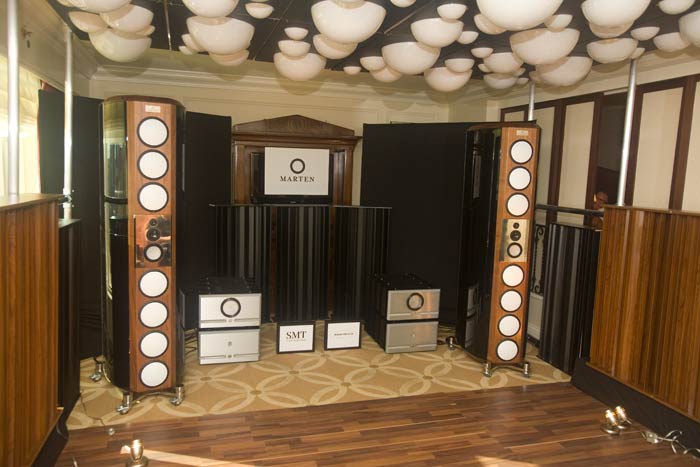
Mike Valentine has written up the Marten Momento speakers [their second largest, penultimate speakers] . The Momento speaker article has several photos and his listening impressions (fortuitously for most of us here, it has been translated into English :-) ):

Mike Valentine: Marten Momento Speakers

[Thanks Mike!]

Marten Coltrane Supremes part II

Thursday, October 22nd, 2009 by Mike

After the last post, it has come to our attention that some people still do not know what the $295K Coltrane Supreme speakers are.

Nor what we mean by competent, nor by capable.

First, we do not use the word ‘best’, because by ‘best’ most people mean that the speakers work and that someone - with likely limited experience in the high-end, corruptible ethics, or whose vocabulary is limited to about 10 words - somewhere, likes the speakers sound better than the sound of other things they have heard and so they grunt out ‘best’ or ‘blows me away’.

By COMPETENT we mean they do the thing speakers are supposed to do… i.e. convert the electronic signal they are given into sound in a way that is actually faithful to the signal they are given.

No, most speakers DO NOT do this. They try to make impressive sound in response to a signal, whether that signal is impressive or not. They try to be enjoyable, or engaging, or coherent, or dynamic - both to 1) compensate for the anticipated problems the manufacturers anticipate their speakers will have to deal with vis-a-vis upstream components, and 2) to cater to the natural desires of humans to enjoy / brag about / talk about overly emphasized aspects of music (and of life in general) [i.e. people do not mind, for awhile, something that is too sweet, too dynamic, to detailed, too big breasted… but it will get old and it is almost certainly fake].

An example of competency? Well two actually.

First, the 2.5 inch diamond midrange handles all frequencies between 1200 and 8000 Hz. So in a large sense, the Supremes are able to achieve the coherence, imaging and soundstage of a single-driver speaker, using the best [conventional] driver known to man or woman.

Second, the active bass is powered by a [included] 2000 watt / channel solid-state amp. Compared to other speakers with powered subwoofers [big Von Schweikerts, YG Acoustics, etc], and closest competition price-wise [Focal Grande Utopia FE, Acapella, Kharma Grand Exquisites] the two dedicated towers of 6 10inch high-resolution ceramic woofers, with phase and volume control to adjust to the room] has the ability to render DETAILED bass. Yes, it can sound impressive when your teenage son’s friends come over - but, and this is what is amazing, it can also sound real. Like real instruments. Or rather, it just reproduces the electronic signal it is given by the upstream components. It will sound natural on jazz, and tight and electronic on Techno and ethereal on classical movements recorded in large halls.

Yes, some people want that BOOM boom big boom box sound with marginal detail or structure for the bass frequencies on every track of every kind of music. And the speakers above try to do the best they know how within the limitations imposed by the speaker’s design [and certainly, people put the most gawdawful amps on them that exacerbates this, esp. at shows]. But for people who want a little more, who have the wherewithal and desire, you can choose to have a competent speaker that allows the music to sound like music, even below 100Hz.

By CAPABLE we mean that the sound coming out the speaker is not only influenced by upstream components [most are, though some, still sold as high-end audio speakers, are not] but the sound is almost completely determined by the upstream components. Capable is really 1) having no [little] sound of its own and 2) having no [minimal] limitations on what kind of signal it can reproduce.

An example of capable is the ability to render decay properly [as determined by the input signal]. With the latest Emm Labs players (XDS1, TSD1/DAC2) and Nordost ODIN cable (and top flight components) the background is so black, and there is so much control over the signal, that the decays in each note are almost orgasmic. If you have ever strummed a REALLY good acoustic guitar, or hit a key on a really good piano, you know about decay. These are the kinds of instruments musicians are using, why aren’t you hearing it on your system? It is one of the most delicate aspects of a note, and one most audiophiles have had to ignore. For many years we blamed the source media, but we were wrong.

The point is that most speakers are incapable of rendering this kind of decay [which, by the way, the $60K Coltranes can also do].

Maybe this, and the 100s of things we do not have time to talk about, like inner harmonic detail and color, evenness of treatment of all kinds of dynamics from 20Hz up, etc. that we have heard with everything from the Lamm ML3 and Audio Note On-Gaku and Kegon Balanced, to Edge NL Reference amps] is not important to you, personally. Maybe you like to put ketchup on everything you eat. Me, I like to taste the actual food [music]… but then again Neli puts hotsauce on everything that is green.

—————-

Sure, we all enjoy speakers that are cheaper or have lots of flaws here and there - often because of a few individual strengths which we treasure. Most of us even enjoy our measly car stereos to some extent. That is not the point. The point is if you want the ability to stop worrying about how your speakers are Mucking up the sound of all this great gear you have, and want to worry instead about how there are people in this world that have way way more LPs than you do, then these speakers can do that for you.

Marten Coltrane Supremes

Tuesday, October 20th, 2009 by Mike

Well, its like this.

Marten has just come out with their new Momento speakers. We want to try them here. We want to try them here for a, shall we say, extended period of time.

We *could* put them downstairs I guess, in front of the stairwell.

But…

What we really want to do is put them upstairs. But the Coltrane Supremes are there, right?

So what we want to do… is to sell the Supremes to a [soon to be deliriously happy] audiophile and put the Momentos up in the main room.

We think we can get Momentos here by Christmas - so we are motivated to do this quickly.

So all you who have been poking around looking at these, which are the - and I can still say it because it is unfortunately still true: the only competent speaker (and the most capable) made today - this is your chance.

If you look at linearity of response (across frequency, micro-, midi- and macro-dynamics, harmonic, and SPL ranges), drivaeability, ease of in-room placement and adjustment - everything. Nothing even comes close.


The Marten Coltrane Supremes

And, for you fans, we WILL be getting a new pair of Supremes again. Access to unlimited, audiophile-quality bass is addictive [a key point, most other big speaker bass is not audiophile quality, its just loud]. And the 2.5 inch diamond midrange… well… hmmmm… this seemed like a good and logical idea for the store when we talked about it a few weeks ago…. and we really *are* a store, we can’t just keep these here forever… can we?

Well, Neli is going smack me upside the head [several times no doubt] but I think we do need to play with the Momentos some here and learn exactly what they can do. We are Audio Federation. We are the experts. This is what we do, right? Right??

So our precious Supremes are now available at a reasonable price [well, not completely reasonable. But more reasonable]. For those of you who desire the best, the best just might finally be within your reach.

6 Moons shares English translation of visit to Marten Design Showroom

Thursday, July 2nd, 2009 by Mike

Includes some background on Marten and on the new Momentos.

Marten loudspeaker showroom tour

Marten’s new Momento loudspeaker

Saturday, June 20th, 2009 by Mike

The latest penultimate speaker from Marten. We don’t know too much about it yet - but we do know is that it sits between the Coltrane and the Coltrane Supreme speakers in their product line and that it is the same size as the bass tower speakers of the Supremes.

momento speaker

momento speaker

A larger picture of this brochure is in the latest issue of spintricity.

New Coltrane Soprano and Jorma Design Origo

Wednesday, January 7th, 2009 by Mike

A few preview shots on Neli’s camera.


Coltrane Soprano. $45,000.00.


Jorma Design Origo [Jorma Design Prime without the bybees]

Emm Labs CDSA + Nordost ODIN versus Emm Labs TSD1 and DAC2

Saturday, November 15th, 2008 by Mike

The question: Does an ODIN power cord on the back of a CDSA make it the equal of Emm Lab’s new ‘black badge’ TSD1 transport and DAC2 pair?

[Thanks Steve G. for the idea for this shootout.]

Starting off with a question like that makes me think of Carrie in ‘Sex and the City’ writing her column [just got done watching the movie. Liked it but it should have been called Spoiled Women and Wimpy Men in the City. Am I right or am I right? :-) ].

The question is especially relevant because the price of an ODIN + CDSA combo is about equal to the price of the TSD1/DAC2.

We decided to do a slightly different shootout, perhaps unfortunately, that compares the CDSA + ODIN against the TSD1/DAC2 using fairly decent power cords [Valhalla and ELROD]. At the time this seemed to make more sense - most people would put a decent PC on the ‘Black Badge’ pair [the ‘Silver Badge’ pair being the CDSD/DCC2]. And the Kimber PC that comes with the Emm Labs gear had not been broken in at all - otherwise we should have used that power cord.

Anyway, we learned a lot from the shootout - or at least confirmed what out other - very lengthy shootouts [appearing soon in the Magazine] told us about the two players.

For this shootout, we were able to just switch back and forth between the two players. They were both run into the Audio Note Ongaku integrated using Nordost ODIN interconnects. The Ongaku was connected to the Marten ‘Coltrane’ loudspeakers using ODIN speaker cable. Every thing was sitting on Acoustic Dream’s amp stands.

Since we were eagerly anticipating the luxury of being able to switch back and forth between the two players in real time [usually we have to do a lot of disconnecting and connecting between listening to one component and other - trying to do it as fast as possible to keep as much aural information in short term memory as possible], we needed to find discs that we had two of. We did and they were: red book Radiohead’s Amnesiac, SACD Santanna’s Abraxus, and SACD Janis’ Rachmaninoff.

Radiohead:

The CDSA sounded a little ‘dirtier’, with a little more ’spit’. Perhaps a little more romantic - but we later decided that the reduced separation here was more familiar, more comfortable, and more accessible. We talked about this before - how as a system gets better and we leave the old familiar problems behind - we miss them. Many people think those problems are part and parcel of the way music is supposed to sound and they [and their poor roommates] get stuck in a sonic rut, a backwater, a musical ‘hell on earth’ [but I probably exaggerate a little].

The Pair had way more separation, a much deeper [spooky] blacker background, and better purity. By purity here I mean that the notes were not more harmonically pure - they are about the same on both players - but that the black background and separation allowed notes to be heard, that they were allowed to live out there lives the way they were meant to, that - well that is what I am calling purity until I can think of a better name [I would say ‘clean’ but that is taken by people describing the lack of note attack aggressiveness. Maybe ’spotlessness’?? Integrity??].

Anyway, I hope people can begin to see that these 3 things: separation, an incredibly black background, and purity/cleanliness/spotlessness/integrity are all related and are a major factor in the difference between the two players on this particular system. [Previously, the Pair also seemed more linear, more well-balanced, than the CDSA but the ODIN PC helped out a lot on this. It also increased resolution, separation and the ‘romantic/engaging’ aspect of the CDSA as well].

Neli: CDSA fuzzier, not quite as crystalline.

Abraxus:

The Pair: The ability for greater separation between the notes helps out a lot here. The first track is actually quite complicated - and the pair was able to separate out separate strains of the music much better than the CDSA. [there was a feeling of… wow, I didn’t even know that those were separate instruments before…]

The CDSA: Again, somewhat more accessible, but in comparison with the Pair, it sounded like things were mixed up, much more the familiar amorphous mass of cool sounds we usually hear when we listen to Abraxus.

Rachmaninoff:

The Pair: the spatial connectedness is better. The rhythm is much more life like.

The CDSA: A little harsher.

PRaT and Presence/Solidity were ….different between the two.

—————-

OK. It is time fasten seatbelts and leave the standard digital player shootout and discuss just what I think this Pair does to the digital playback universe.

First, I think that finally, digital, THIS digital pair, is now perhaps the equal of analog playback. Before you all click the back button on your browser, let me say what I mean by that.

First, it is OK, for me, that digital be *different* than analog. Why make it sound like analog, we already got analog and it does quite fine, thank you.

Second, what are the ways that analog is better than digital? Separation, midi-dynamics, and sense of rhythm [not PRaT]. It also has a harmonic distortion that many of us enjoy.

OK, in what ways does the TSD1/DAC2 pair excel? Separation. Black background [revealing the midi-dynamics in a way much like analog]. And a sense of rhythm that is not like PRaT.

So, let us talk about PRaT - which in general we can describe as a strong emphasis on the main beat of the song - resulting in an urge to perhaps do some toe-tapping. The idea here is that perhaps it is the lack of separation, causing things to collapse, both spatially and timewise, so that too many things happen at once, and too many things in one amorphous image, causing:

1. an abnormal emphasis on the main beat, and deemphasizing the natural delays between the actual notes and the interplay amongst musicians as they play off one another and which, in reality, are not exactly 100% on the beat each and every beat.

2. an abnormal collapse of the spacial image, in the soundstage, into a solid mass, that makes it seem like there is a solidity and presence there that doesn’t really exist. That in reality there is actually a guitar body, and a guitar neck, and a voice,and the voice reflecting from the microphone…. which makes ‘presence’ and ’solidity’ more real, and more 3D. And less of a ‘lump’.

So rhythm should be what it should be: and notes should happen on the beat when they were recorded that way, and a little before or after if they were recorded that way. When the notes are smeared the least little bit - it is perhaps made up for in the mind of the listener by assigning them to the nearest ‘beat’. But when they are clearly off of the beat, they are interpreted as the natural interplay between musicians, the natural human failing of not being perfectly on time [and this is a good thing - it is how things sound like, live].

So what the pair did, on this system [and make no mistake, this is a *system*. We’ve done so many, many shootouts here lately, everything contributes: the speakers, the ODIN - the decay of the notes are unbelievably beautiful, on both players - and the Ongaku is not chopped meat either :-) ], was to allow us to experience, to enjoy, the music in more ways than we have before using digital playback.

A lot of people [who have lived with audio for awhile and graduated from the impressive], say they want a richer warmer sound. That they want more PRaT. That their system is not involving enough and that adding warmth and toe-tapping PRaT is the way to fix that.

Well, that would certainly help. For awhile.

But what people really want, deep down, beyond this or that tweak or enhancement - if I can be so bold as to say it in print - is to have a convenient playback that evokes the real - that allows them to hear the wonderful interplay amongst the singers and musicians, to hear the beautiful tones and decay and care that went into every single darn note in every single darn piece of music in their music library.

Neli thinks the TSD1/DAC2 Pair is evolutionary. I think it is revolutionary. But maybe she is right. The way way black background [not like stupid power conditioners that strip away detail at the same time], and the ability to keep the different notes from collapsing into each other - is probably just evolutionary.

But there is a tipping point to things. And I think this is one of those ‘tipping point things’. [Boy, and I thought this was going to be a short post].

In this idea, suggesting that the Pair is like analog - different but equal - is the idea that it must be the depth and variety of the ways we can enjoy the two mediums that we need to compare and contrast. It is my sense that the Pair adds more ways to enjoy music - that some of these ways are similar to analog - and unlike the digital of the past - as described above, but that they get there a different way [lower noise floor versus greater dynamic response to notes at ordinary loudnesses, etc.].

More later on all that…


Neli with the Audio Note, Kharma and Acoustic Zen speakers in background, and Jorma Design PRIME interconnects on floor at left.

So, :-) we went upstairs and played the same Rachmaninoff music, but on LP on the Brinkmann turntable, Audio Note M9 Phono preamplifier, Kegon Balanced amps and Coltrane Supremes. With the low-gain Lyra cartridge and a problem with noise on the line getting into the sound - it wasn’t an optimal setup by any means.

OK, OK…. But when the massed strings played over on the left, on both systems I enjoyed them, and in similar ways. I could pick out this or that guy a little louder than the others or a little too long with the note… [in some ways, it is the ability to hear the mistakes in the music that make it seem much more real :-) ]. I got the same feeling of ‘wow’ that the music was trying to invoke in the audience.

I got the same feeling at being present at a concert - the conscious and subconscious cues each medium was giving me that this was REAL were different but equal.

More about THAT later too. This is all just supposition - that the TSD1/DAC2 pair can offer as convincing an experience as analog - it seems like this is something that will come to pass someday - and it seems like that is today, to me, now - but it will take a long time to verify.

Personally, we do not differentiate here between SACD and red book CDs on the Emm Labs gear. The differences between them has more to do with the recording and mastering than the medium. But lately, and maybe it is just me being lazy [and heaven knows I would love to be less of a perfectionist, it would certainly reduce our high-end audio expenses - Oh, wait, Neli would have to get lazy too] - I did not feel I had to care if we were playing CDs on the TSD1/DAC2 pair and LPs at RMAF, and that has been true here as well. Sure they are different. But all the dimensions in which I enjoy LPs I now can enjoy CDs. This was not the case with previous digital gear.

————–

So, do we still like the CDSA? :-) We had to send our TSD1/DAC2 pair back - it was just loaned to us for the RMAF show - we had previous commitments and were not able to buy this demo pair :-( . Big unhappy frown for Neli. Big unhappy frown for me, too, but I am an optimist - or maybe just a masochist :-) - we’ll have our own soon. And then we can think about what it will sound like putting a pair of ODIN powercords on the TSD1/DAC2 instead of the CDSA….

YES we still like the CDSA - it does almost everything as well as the Pair, and we still have the ’silver badge’ Pair, too. But………………….. stay tuned :-)

Shootouts and more shootouts

Tuesday, November 4th, 2008 by Mike

We’ve had a lot of shootouts lately. Many power cord shootouts. And we’ve started several EMM Labs shootouts.

More later, but here are the upshots:

*** ODIN power cord. Simply put we have a new favorite cable.

*** ODIN power cord versus ODIN interconnect - which is the biggest bang for the buck as your first cable? The short and sweet: In this case, on this system of EMM Labs CDSA, Audio Note Ongaku and Marten Coltranes] it was [kind of] the PC that was the biggest bang - but there is an explanation why the $11K PC beat the $16K IC.

First, the SOUND was better with the IC. But the MUSIC was better with the PC and we didn’t care that the sound wasn’t as good. The explanation? My hypothesis is that the Ongaku, the amp we put the PC on, is the great contributor to the musicality of the system and costs about 8X times what the CDSA player costs. So adding the ODIN PC to it just made that more musical. The ODIN IC, as expected, let way more sound from the CDSA get to the integrated amp - and the sound had more body, more information, etc. But, again, we didn’t care. On a different system, with perhaps a less dominating amp, the IC will likely dominate the PC even more and we would elect a different winner.

*** EMM Labs CDSA versus CDSD/DCC2 versus TSD1/DAC2 [versus red badge CDSD/DCC2]. In progress [but in this system, with the ODIN and the TDS1/DAC2, we heard revolutionary amounts of separation. Each instrument was clearly defined and you could easily follow just one instrument’s sound and its decay. Just like in reality. No, really. We have NEVER heard anything quite like it. It is addicting. This whole system has become addicting. It is so pleasing to the mind [so deep, so many complex musical passages revealed], and so pleasing to the heart [so pure and the decays last exactly as long as they are supposed to and the harmonics are so lovely]. Rarely has anything excelled at both - especially on such a small scale.].

Quick Tour II

Tuesday, September 23rd, 2008 by Mike

Ooops - Tour three got posted before two.

Well, not much is happening on this floor. Two nice systems. The EDGE is still on the AN speakers - where we are performing some macro-dynamic shock treatments and seriously braking them in, using solid-state so we do not have to waste any tube life on the somewhat contrived process.


Some shots of the Audio Note and Walker turntables. No phono-preamplifier down here yet - so these sit here, appreciated only for their good looks.


The Marten Coltrane loudspeakers [on consignment] on the Lamm ML2.1 and Audio Aero Prestige

First glimce of new Marten penultimate loudspeakers

Tuesday, September 23rd, 2008 by Mike


Photos of the late prototype of the speaker that goes between the Coltrane and Coltrane Supreme on the Swedish Euphonia Forum

[Thanks Alex!]