'CES 2006'

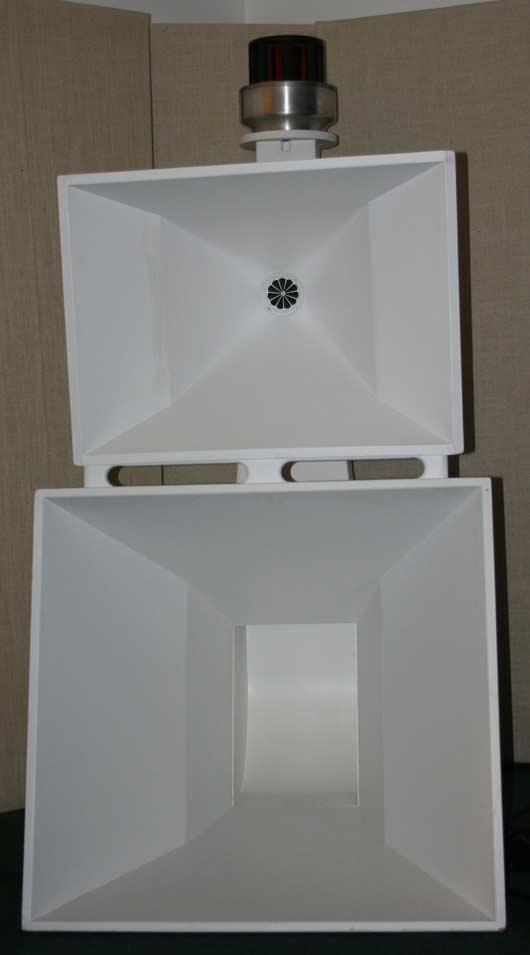
The Cogent True-to-life Horn Speakers at CES 2006

Friday, January 27th, 2006 by Mike

Two large white squaring horns, one on top of each other, for each speaker

Still thinking about these speakers and what their impact is going to be, both on me personally, and on our industry and audiophiles in general.

Although the speakers had numerous problems (speakers did not dissapear in any way, horn resonances and reflections along with buzzing and dullness in the subwoofer and no real highs to speak of) they did some things so very, very well that it makes me wonder…

These speakers were one of the very few (two?) horn speakers that do not have offensive, to me, horn colorations. They reproduced transients in their target frequency range effortlessly. These kind of REALISTIC (not overly exaggerated, not compressed and muffled) transient details we have heard only with the best speakers: Marten Design Coltranes, Kharma Midi Grandes (with the Tenors), and the Acapellas can do this - usually requiring very careful amplifier pairing and it comes off not quite as effortlessly - often with more of a ‘the speaker is gripped really hard by the amp’ sound. The SPACE aorund the microdynamics was awesome. The timbre was very, very rich. The sound was very big and open (somewhat an artifact of the nearfield listening position).
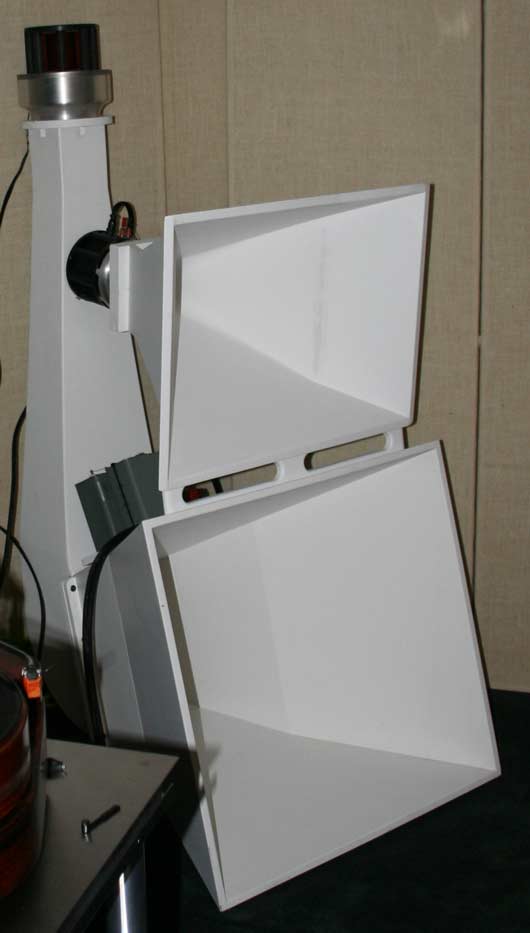
Two large white squaring horns, one on top of each other, for each speaker
So, did you notice that I am describing sounds and not music? Nothing about whether a piano sounds like a piano, whether sounds were properly positioned and imaged in a realistic soundstage (it was not too bad, as Radiohead Amnesiac played back well and that first track stresses this exact thing, amoung others….:-)), whether the dynamics was balanced between the quiet sections and the loud, etc. etc. etc. Whether these are done well, poorly, or excellently, I cannot answer given the extreme nearfield listening position and because I was, addmittedly, hypnotized by other aspects of the sound at the time of listening.

A Mythical Commercial-Quality Speaker Built Using Cogent Hardware and Designs
Two large white squaring horns, one on top of each other, for each speaker
Will audiophiles like and buy such speakers? Their ease of drivability with even modest sized amps and their kick-ass dynamics seems to be a win win situation. The problems as I see it are the lows, the highs, and the appearance.

The lows at CES were produced by a very large folded horn subwoofer. This configuration will just not be acceptable to most people. So integration with a common standalone subwoofer would be required. It would also be great if the Cogent speaker went down to 30 Hz. so that the speaker could stand-on-its-own without requiring a subwoofer but this may be impossible while still keeping the rest of the frequencies pristine.

The highs were absent; as I understand it everything above 10K Hz was left to the listener’s imagination. One of the numerous super tweeters, for example the Corona plasma tweeeter, could, however, be paired with the Cogent horns to provide the necessary high frequencies.

The appearance, which is already quite good and certainly better than all of the GOTO and ALE horns I could find on the net, is still not as livingroom friendly as most people would probably prefer. But a little work on the paint job, using a composite material instead of wood for the construction, a nice veneer, and perhaps adding a little curvature to both strengthen the horn to minimize resonances and to minimize those reflections of sounds off of the room back to the horn and then back to the listener’s ears.

So here we then have a speaker that uses 3 different technologies, each the best at reproducing music in its frequency range. Integrating these different technologies into a seemless whole will take work and genius. Sound familiar?

These will also be expensive. Figure a minimum of $50K for the horns (it costs $32K for the drivers alone), $5K for the subwoofer, and $5K for a super-tweeter. $60K is expensive - and a speaker this expensive will probably require a dealer network, so add some on top of the $60K for that.

So, the answer to my question - will this be really popular with audiophiles, is I do not know (I know, all this and I cop out at the end. The real answer is yes, for some audiophiles, yes. But Wilson Audio does not need to get too worried yet). There are a lot of weird speakers out there in the $60K to $100K range - with a lot less potential than this one.

Further reading on the Cogent horn speakers at CES:
Audio Asylum

A funny thing happened on planet Abraxas

Monday, January 23rd, 2006 by Mike

The first track on Santana’s Abraxus, “Singing Winds, Crying Beasts”, is one of our test tracks.

This track has revealed some supposedly top-flight systems to be incapable of managing the etheral ’sound angels’ flying in and out and around the soundstage.

Abraxas cover photo

While listening to the Marten Design Coltrane Supremes I was struck with the a very interesting, some might say bizarre, 3D impression of some of the notes in this song. Now, this happens to me a lot when I am falling asleep, Jazz and Classical music seems to not be ‘heard’ anymore but instead transformed into moving, interlocking 3D soundscapes that I fly around in.

Hey, those white coated fellas can just stay where they are, thank you anyway.

But in the Marten Design room at CES, I was awake! I mean it WAS the last day of the show and all, but seriously….

Triolons
O.K. First I will describe what I usually see when I hear the sounds, in this case, the tiny bells that kind of fade in and out at various places in the soundstage during this song, while listening to the Acapella Audio Arts Triolon Excalibur speakers.

What I see is this:

It is right after a fresh snow, and it is very cold so the snow is not sticking to itself or anything else, it is very fluffy but not so fluffy that it does not have a good ratio of water to size. The sun has come out and is shining on a large number of very tall pine trees. A gentle breeze comes up and sends a number of snow flakes dancing, as they are wont to do, in all directions: up down swirling bouncing gliding…As some of the 100s of flakes hit the rays of the sun that are penetrating through the bows of the trees, the flakes ‘light up’, temporarily, in a prismatic flash of dozens of pure colors alternating with pure white snowflakeshine, before they are again returned to invisiblity as they reenter the shadows to be replaced by a 100 others. These flakes are small, about 1/2 inch or smaller.

These sparkling, flashing swirling colors popping in and out of existance is what I ’see’ when hearing these bells. This more or less seems like a normal kind of thing to ’see’, to me, and corresponds pretty well to the ‘type’ of the sound. To me.

Supremes
But. The Coltrane Supremes….

What I ’saw’ was weird, man.

What I saw were these aluminum things shaped like Cheeto corn chips, in kind of an unpolished silver metal color varying between 1/2 and about 2 inches long and about, I guess, 1/8 inch thick. They kind of faded into existance, moved a little bit closer then a little bit away from me, rotating a perhaps up to 45% during this time period, before they faded out again. There was a gentle diffuse white light playing on these ‘bell chips’.

I cannot let myself beleive that the resolution was so good in that room that I was ’seeing’ the sides of the bells as the overall sound outlined their shapes as it bounced off them and into the microphone. I mean, SACD has a lot of detail, but this is crazy.

Anyway, I wonder if other people sometimes see music as ‘things’.

And I also wonder if sometimes they also experience visual musical shapes that sometimes come unbidden and are shockingly different from what they normally ’see’. While they are awake.

THE STEREOTIMES CES 2006 SHOW REPORT

Thursday, January 19th, 2006 by Mike

I didn’t know they were doing a show report, so I just recently added a link to theirs along with everybody else’s on our show report’s main page.

I particularly like Frank Alles’s report. There is no link to it, because they use frames, but if you click on ‘Show Reports’ at the top of the Stereotimes site and then scroll down using the scroll bar way at the right side of your browser, then you should see a link to it. The pages load slowly so you have to be patient.

He says something about the sound of each room, and you can read between the lines in true carefully-parse-what-the-reviewer-said-to-get-the-secret-message-of-what-they-are-really-saying fashion to determine more or less what really went on. And he lists a number of favorites and runners up, …

all of which Did Actually Sound Better Than the Majority of the Other Rooms!

Well, this guy is in big trouble now, and will probably be run out of Reviewer Town for not throwing in the minimum allowable FUD factor (Fear, Uncertainty, and Doubt) that is required in each days allotment of information disseminated to the Audiophile Community in microscopic packages like some Information Age version of the legendary Chinese water torture.

I’ve never heard of this guy - which don’t mean squat but let’s pretend I do infact remember a name for longer than the refresh rate on my LCD monitor here - and maybe that is the secret. If nobody knows you, you are perceived to have no power to persuade or inform the masses - so you can say more or less describe what you actually heard (Well, he does say it in a nicer way than I do - but here in geek land, clarity of expression is valued more than in Politics and Show Reviewing).

Or maybe it is the age that is important - there are a number of younger reviewer types over at Positive Feedback - they do not appear to have soldout, or perhaps worse, to have so much at stake that they no longer hear what they listen to.

Whatever it is, there comes a time when their days as a hard-hitting reporter are over. Now the days of wine and the never-ending-auditions have arrived. All they need is the page in the thesaurus for the word ‘best’ and thick-skinned ears and they are ready for stardom. Woo hoo!

If by some chance of fate this happens to us please let us know. If there is ever a consensus (and we will be checking where the emails come from so if they all come from the folks at Stereophile it just won’t carry as much weight, sorry) that we have finally soldout to become just another cheerleader - we will shut down Hifi’ing show reports and the Blog - and contemplate the misery of our fate.

The CES Mixibitors STRIKE AGAIN

Wednesday, January 18th, 2006 by Mike

We have received a lot of email lately because of our show report, and one of the more interesting had details concerning a group called The Mixibitors.

Apparently, every year at CES, about 30 people quietly got together in the middle of the Alexis Park courtyard, late, late Saturday night.

Their plan: to hear the unhearable. Too many rooms were unsatisfactorily setup. Too many had fustratingly problematic components paired with the barely legal primo stuff. There were just too many ‘What If’ system setups that were just a few heaves and a helluvalotof ho’s away from realization, perhaps never to exist before or after this special night.

They had carefully crafted, over the previous days and evenings of the show, designs for the systems that would be carefully pieced together, existing only for a few hours, for the pleasure of a very few… for the pleasure of The Mixibitors.

Only they would experience the glory of hearing some of the most awesome and outrageous hifi systems perhaps only glimpsed before during the most hardcore audiophile’s fanatic wetdreams.

Not that the plan hadn’t had it detractors and major revisions.

The email went on to describe some details about the discussions concerning the Kondo room. The Kondo room had been particularly difficult to plan. Everyone agreed they wanted to put different speakers on the Kondo Gakuon system - but which ones? There were the ‘use small speakers and keep it in the same room contingent’.

Everyone agreed that the ‘keep it in the same room’ approach did have some appeal - especially as some of the senior members (and some are apparently very old, but just cannot bear to quit) had starting growing tired of lugging 100s of lbs of equipment across show hotels over the years, and, even more so, because they also remembered that they all had to lug all this stuff back and set it up again before the show started stirring again in the morning.

The choices were of course limited to what was on hand at both T.H.E. Show and CES - but this was not too limiting as there were a number of excellent candidates and the weather was great this year. The small speaker candidates were Audio Note U.K. speakers, the Acapella Filedio II, the Oskar Heil Kithara. The large speaker candidates were the Wilson MAXX II, the Acapella Violon, and the Cogent horns.

The optimal configuration of this and other rooms were debated long and hard. Secret hand signals had been developed over the previous years so that votes could be curried and polled inconspicously during the days as they all appeared to be just like all the other wacky audiophiles wandering in and out of rooms listening for the holy grail.

Only they knew that the Holy Grail was not here, yet was here.

Here is the list of some of the rooms they setup that night (the actual plan goes into much more detail including cables, power cords, electronically calculated speaker system positions, potential tube replacements, etc):

* All Kondo Audio Note system components, on a HRS rack and platforms purloined from the Audio Aero room, driving Coltrane Supreme speakers all installed in the very large room at the St. Tropez where the VR-7 speakers had been setup. The Continuum turntable with the Boulder phonostage from the Alexis Park were used for analog.

* The Audio Note U.K. Gakuon system, except the turntable which was replaced with the Continuum, also on HRS rack and platforms, moved to the very large Thiel room and drivng the big Cogent True-to-life horns.

* The Kharma Mini Exquisites, moved next door to the larger Kharma room, driven by the ML2.1 amps from the Lamm room and the Meitner from the VR-9 room as digital source and pre, all equipment on HRS racks and platforms

* It was decided that the big Joule Electra OTL amps from the Joule room would be put on the Wilson MAXX 2s, largely as an experiment. But the Mixibitors Charter allows this so it was agreed. They needed a larger room and decided on the large Genesis room (which wasn’t very far away). The digital front end and preamp was the Meitner.

I asked, but No, they emphatically DO NOT have any pictures.

What did these rooms sound like? I wish I knew! They did say that many Mixibitors learn to wear diapers during this evening.

The KHARMA Mini EXQUISITES: THE EXTENDED SHOW REVIEW

Tuesday, January 17th, 2006 by Mike

This CES 2006 room review was added after the report had been published and so is available here as well.

The Kharma mini-Exquisites - like the Kharma 3.2 but with a diamond tweeter and made to look a lot like its bigger brother, the midi-Exquisites. Driven by the small Kharma amps and MBL electronics with Kubala-Sosna cables.

The Kharma room
The Kharma Mini Exquisite room at CES 2006

Very engaging, very musical in that classic, ‘what we want music to sound like this’ fashion. Not so much a ‘you are there’ presentation like the Marten Coltrane Supremes - more like a ‘you are alive and feel good about it’ kind of thing. I really loved the sound in this room - for a small scale system it really does ‘it’ for me.

We described the sound of the Midi Exquisites driven by Lamm amplification at the Home Entertainment New York show in May, HE2005, as being almost drug-like, like a magnetic force it tried to suck you into the music, and, if you let it do this, if you gave in to it, there was a rush of feeling and emotion that swept one away, flying with the music.

The ASR amps on the Midi Exquisites, at this show, did not have the same effect, on me anyway, for whatever reason, but the Mini Exquisites…now they had an interesting effect, though somewhat different, from my perspective. Instead of having to consciously ‘let it’ do its magic, the magic just ‘was’. And whereas the ‘magic’ was thick and dense, like a hot summer night with the Midi Exquisites / Lamm system, the Mini Exquisites were light and airy, like a sunny Spring day.

The Mini’s magic was less intense, but more accessible. Perhaps this was in some part attributable to the better support the Mini had for an audiophile-quality presentation compared to the Midi system - I was able to relax more because the Mini presentation was more balanced and more realistic - albeit at a smaller scale.

Lots of detail, stable imaging, good separation, a rather narrow soundstage which we blamed on the room, good dynamics, and bass was scaled nicely to the room. Based on our two, admittedly short auditions, we think these are a slam-dunk, you are going to be so happy, upgrade for people who have the similarly sized Kharma 3.2’s and have had the money for the bigger Kharmas, but not the room.

In fact, I have a sneaky suspicion that the little 2-way 3.2s may have been the best speaker, for my tastes, of any in the amazing Kharma lineup of much more expensive speakers - and that now I have found a new ‘best’ speaker, the Mini, also a 2-way, with more of the Kharma magic and more of the audiophile attributes that make the music both more realistic and enjoyable.

The associated equipment is interesting: warm, smooth, and somewhat detailed MBL into a small (sized anyway) detailed solid state amp. The system was quite detailed sounding and engaging. It would be interesting to put these speakers on something more conventional, like Lamm amps and Meitner digital. THEN, with this cross-section of equipment, we could perhaps pinpoint the location in paradise these speakers come from - or whether, after all, they are from planet earth like most other speakers.

Oops, being a little overly effusive, I am. Time to turn Effusive menu option to OFF.

Only problem is the price: $45K. At this price it is going up against the similarly-priced Wilson Maxx II, Acapella Violon, Marten Coltrane, Avalon Eidolon, and Audio Note speakers.

Let’s discuss the competition some.

The Kharma room
The Mini Exquisites are for small to medium sized spaces for people who want engaging and startlingly emotional and detailed renditions at the expense of having less detail in the low bass.

The Lamm room
The Wilson Maxx 2 is for larger spaces, and for people who want an impressive sound: large scale soundstages, midrange and bass details, and dynamics at the expense of an almost complete lack of emotional capability and some unruly behaviors like drivability and an overly enthusiastic treble / upper midrange.

The Acapella room
The Acapella* Violon is also for larger spaces and for people who like a very natural musical realism and large engrossing soundstages at the expense of some bottom end slam.


The Marten Design* Coltrane speakers are for people who like a very accurate and realistic presentation, at the expense of not having a big and open type of sound.

The Argento room
The Avalon Eidolon Diamond is also for bigger spaces and people who like emotional yet dynamic presentations at the expensive of deep bass control and drivability

The Audio Note U.K. room
The Audio Note* U.K. AN-E SEC Signature is for smaller spaces, like the Mini, and for people who want very dynamic and exciting and harmonically rich and detailed presentations, supplied by the necessary Audio Note electronics upstream, at the expense of looking at a box.

Looking at this run down - it seems that there is indeed a place for a $45K 2-way speaker, as much as this price for a relatively small speaker may make us uncomfortable. And that place is for people with relatively small rooms who still want one of the best, no compromise, musical experiences that money can buy.

The only alternative, from the perspective of this quick survey, is the Audio Note speaker, (though the Coltrane speakers are known to work very well providing a full-range experience in as small a room as 12.5 x 16 feet) and it is also an expensive 2-way speaker - albeit one that can be driven by that amazingly pure first watt of a small SET amplifier - and it does not quite have the visual presence and beauty of the Mini, but then few speakers do.

The COLTRANE SUPREMES : THE EXTENDED SHOW REVIEW

Monday, January 16th, 2006 by Mike

This CES 2006 room review was added after the report had been published and so is available here as well.

We spent the end of the show listening to the Marten Design* Coltrane Supreme speakers, with Bladelius electronics, Jorma Design* cables and the Power Wing power conditioner.

This system re-created the recording venue nearly as well as the Acapella Triolons here at the Audio Federation, on a smaller scale but with more resolution. Nothing else comes close in our experience to this kind of feat. Everything else creates this simulacrum, this hoax, which requires you to forcibly suspend belief to imagine that there are real ‘musicians’ out there.

On the Triolons, you don’t have to do this nearly as much, and this leaves our poor overtaxed brains much more free to ponder the quality of the musicianship, the score, the soundboard engineering, the art, the spirit, the love, the meaning of it all. To see much, much deeper into music’s other dimensions than just the physical dimension of vibrating compression waves moving through air.

This difference has had a unexpectedly intense emotional impact on our perspective of what music is, and on our lives as a whole. Seriously, this just isn’t a fucking stereo anymore.

The Coltrane Supremes gave us a taste of this. We would love to have them here and put our favorite electronics on them - and see just how far we could push them. To see just how far they could take us.

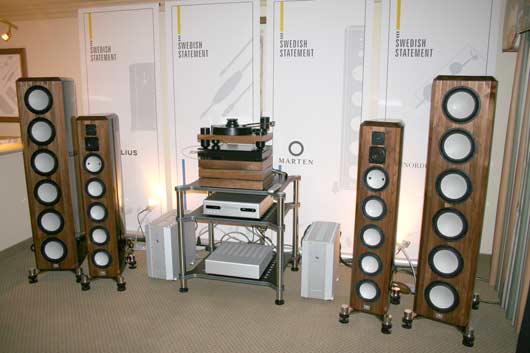
Picture from the show
One channel of the 2-channel system at the show

The Swedish Statement room presented a sonic experience that was incredibly true, but not in that in-your-face style that so many large, high-end speakers do these days. It make take a few minutes for a listener to relax and realize that the music here is not a parody: it is not pumping the bass dynamics in your face to impress, not spotlighting midrange detail to distract from a uneven frequency response (these speakers are +/- 1.5 dB up and down the scale). All aspects of the performance, EVERYTHING is absolutely top-notch in quality, and EVERYTHING is treated fairly, nothing has more tone, more jump factor, more warmth, more presence, sharper images, more stability in the soundstage, than anything else.

To be clear: very, very few speakers in the world are able to do this. I would say that just about none of them even try. They try to make something that sounds pretty damn good, pat themselves on the back, and go home.

So here you have a sonic presentation that sounds and quiets and quickens and slows just like it is supposed to, just like what our brains have been wired to expect and treat as real for millions of years. What does this do for the listening experience? It allows us to relax many of our layers of defenses and buffers and filters and shields we have built up around our listening processes to both protect us (from physical damage, from harmful and socially unacceptable psychological reactions, from headaches, from who knows what else) and to interpret for us what we are hearing.

When was the last time you heard a piano and had to think ‘that is a piano’. I challenge the listener to hear a piano on a stereo without thinking ‘that is a piano’ AFTER considerable, (and lengthy, taking perhaps up to 1/2 second, causing much of the music to be lost while we are trying to determine ‘just what the hell was that note, anyway?’) mental calculations and interpretations.

These mental gymnastics often consist of a little voice in our head that narrates a process that goes something like “that was a single note, so it has to be a guitar, piano, harp, or some kind of electronic effect”. Then we rule out things: “I didn’t hear a pluck (assuming the system is capable of rendering such a thing, stick in probability factor here that there was, in fact, a pluck), so it is not a guitar or harp. It wasn’t an open ended kind of decay, so it might be an electronic keyboard, but was there an associated sound of the echoes in the piano body? Hmmmmm… that was awhile ago now, lets see if I can pull it from the very short term aural memory…” Oops, song is over already.

The solution for most people to this dilemma, of not being able to tell what they are listening to in real-time, is to not even care. They enjoy the tune and the bombast, and do not care that they do not, and cannot, hear or understand what the musicians are actually doing. There is absolutely nothing wrong with this. You can still groove to the tune, tap to the beat, and get a smile on.

Ginevra de' Benci  - National Gallery of Art, Washington, DC

But if you, personally, think there is a difference between a snapshot of a woman’s face and a painting by Leonardo da Vinci (if you have ever seen a Leonardo painting in person, you know exactly what I mean),

if you personally want to experience the art and the majesty, the talent and the skill and the message and the emotion and the awesome delicacies and complexities of the human condition as communicated by the musicians to listeners just like you throughout the ages, then perhaps a system like this is for you.

UPDATED THE FOLLOWING SECTIONS OF THE REPORT

Saturday, January 14th, 2006 by Mike

The MBL section was unclear and could be misinterpreted [at least, it was by Neli, but she is my wife, it is her job to missinterpret everything her husband says. But upon re-reading the section when awake, I decided, of my own free will, to improve it a minor amount :-]

The section realy addresses the ideas I have been thinking about how to get others involved in this hobby - and I have a tendency to use shorthand ‘key phrases’ which I know what I mean by but nobody else will, so…. I think it is better and clearer now. I hope.

Neli added significant content to the Cogent True-to-life horn, the Alexis Park ‘Continuum room’, the Acapella Violon room and the Globe Audio Marketing (Audio Aero) room and a number of other sections I can’t keep track of it all anymore: In a few days when google goes through the report search for “Neli says:”.

CES 2006 SHOW REPORT IS FINALLY….

Friday, January 13th, 2006 by Mike

… more or less done. Spelling and factual corrections will be added over time - but the jist is now there….

CES 2006 Show Report

This year we have up approximately 1000 detailed pictures - with the commentary about each room that stood out in some way right there with the picture. Finally, we have our usual ‘Best of Show’ lists in the ‘Official Report’.

Enjoy!
Mike & Neli

CES SHOW REPORT - ALL PICTURES PROCESSED AND UPLOADED TO WEBSITE

Thursday, January 12th, 2006 by Mike

THE CES 2006 SHOW REPORT

This year we tried to get to as many rooms as possible and are putting up as many of those pictures we took as were in focus and interesting.

Each picture has to cropped, resized and, often, tweaked (the Canon Rebel XL has real problemd with dark rooms and resolving shades of gray) in Photoshop.

One thing I came away with is just how much stuff is out there and how much effort everyone puts into their room - almost everyone brings a LOT of stuff to the show.

Next is to try and annotate each photo with technical details and any listening impressions we may have had.

In general our show reports tend to be more ‘experience-oriented’ (i.e. ‘what were these people thinking?’ or ‘the soundstaging is positioned in an arch above the speakers’) rather than ‘brochure-oriented’ (i.e. ‘the price per watt exceeds the national average of MOSFET-based amplifeirs by 100,000,000.6%…’). It was my fustration with the ‘brochureware’ that was passing for show reports in Stereophile that led me to start writing these show reports in the first place.

And, yeah, I am still sick as a dog (do dogs really get so sick?) and kind of ‘out of it’ - so here is the deal:

If you disagree with what I write, then I was mad with fever when I wrote it and didn’t know what I was saying. If, however, you do agree with what I have written, then I was recovering nicely and in complete control of my mental facilities - inasmuch as one is ever in control of such a thing.

STILL AT CES AT THE ALEXIS PARK

Monday, January 9th, 2006 by Mike

Where is everybody? We’re here, where’s everybody else?

Due to a misunderstanding, we thought that T.H.E. Show was its usual 5 days, and that it would end on Monday, not Sunday at 6 (which was more like 4:00 as everybody was packing up early).

Oops.

Ever year we usually stay at the MGM Grand and walk to the Alexis Park and back once or twice a day… it is about a 25 minute walk each way and is only a pain if we (me) forget to bring a coat, because the show ends each day after dark, at 6:00 pm, and it cools down fast here in the desert. Then it turns into a 20 minute walk.

But after 2 days at the MGM Grand, in a tiny little room costing an embarrasingly large amount of money each day - Neli managed to find a couple of vacant rooms at the Alexis and we did the move on Saturday morning.

Anyway, so here we are, staying unwittingly a extra day for no good reason. Outside there is the ringing of pipes all day long as they tear down the tents that covered all the walkways - just in case it rains or snows or, who knows, it might get a blazingly hot 100 degrees here at CES one of these years.

And now I caught a cold (I am so happy it decded to pay me a visit AFTER CES). So I stay here in the room, coughing and wheezing - apparently working on the show report (I mean, seriously, what else is there to do when laid up with a nasty cold in a hotel room?) on this laptop (that is 10 times slower than my PC with its 4 GB of memory, Raptor disk, Radeon X1800XT 512MB video card…. argh)….and Neli goes shopping (she says she is trying not to get the same bug that has me by the throat…).

Day 4 is about done, and I am starting on Day 1. Kind of backwards, but Day 4 was fresh in my mind - and, well, we were the ones that thought the show was 5 days instead of 4 - so you just have to expect that mixups like doing Day 4 before Day 1 is to be expected here at the Belfry.

This year we tried something a little different - trying to see every single room. Didn’t make it - still missed Ray of Sound, Cabasse, and one of te Magico rooms - and who knows how many others. But we did see a LOT more than we usually do. Wow. There is a lot of interesting technologies and people at this show. Hopefully we can convey some of the color and bewildering numbers of really pretty darn good equipment that was being shown at CES ths year.