'Reviews'

An (Almost Pure) Audio Note System

Wednesday, October 11th, 2006 by Mike

Listening room #3
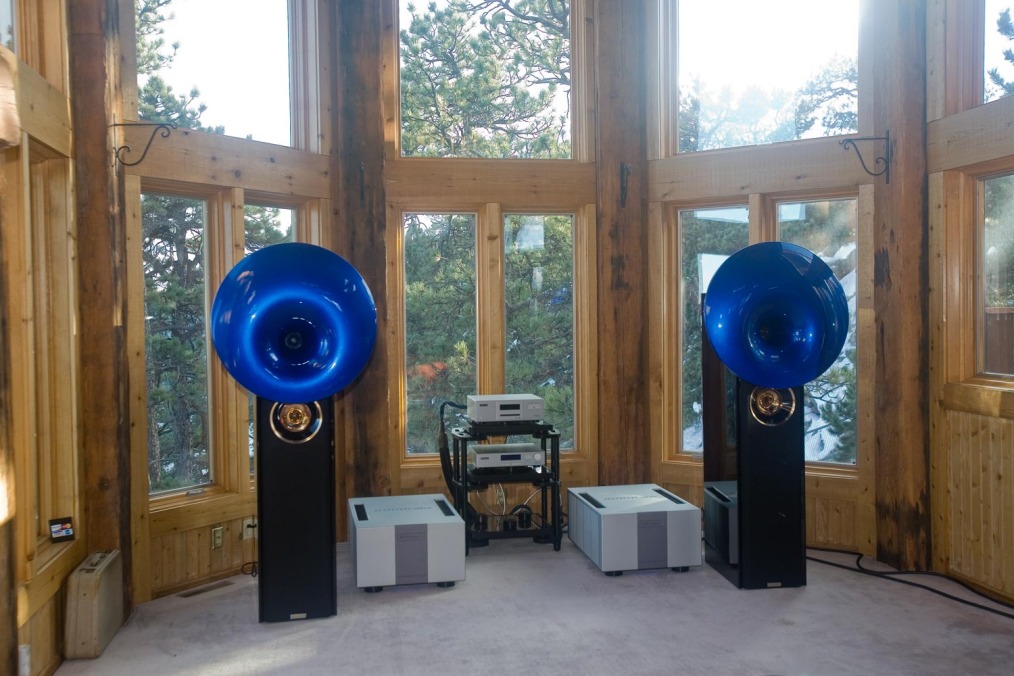
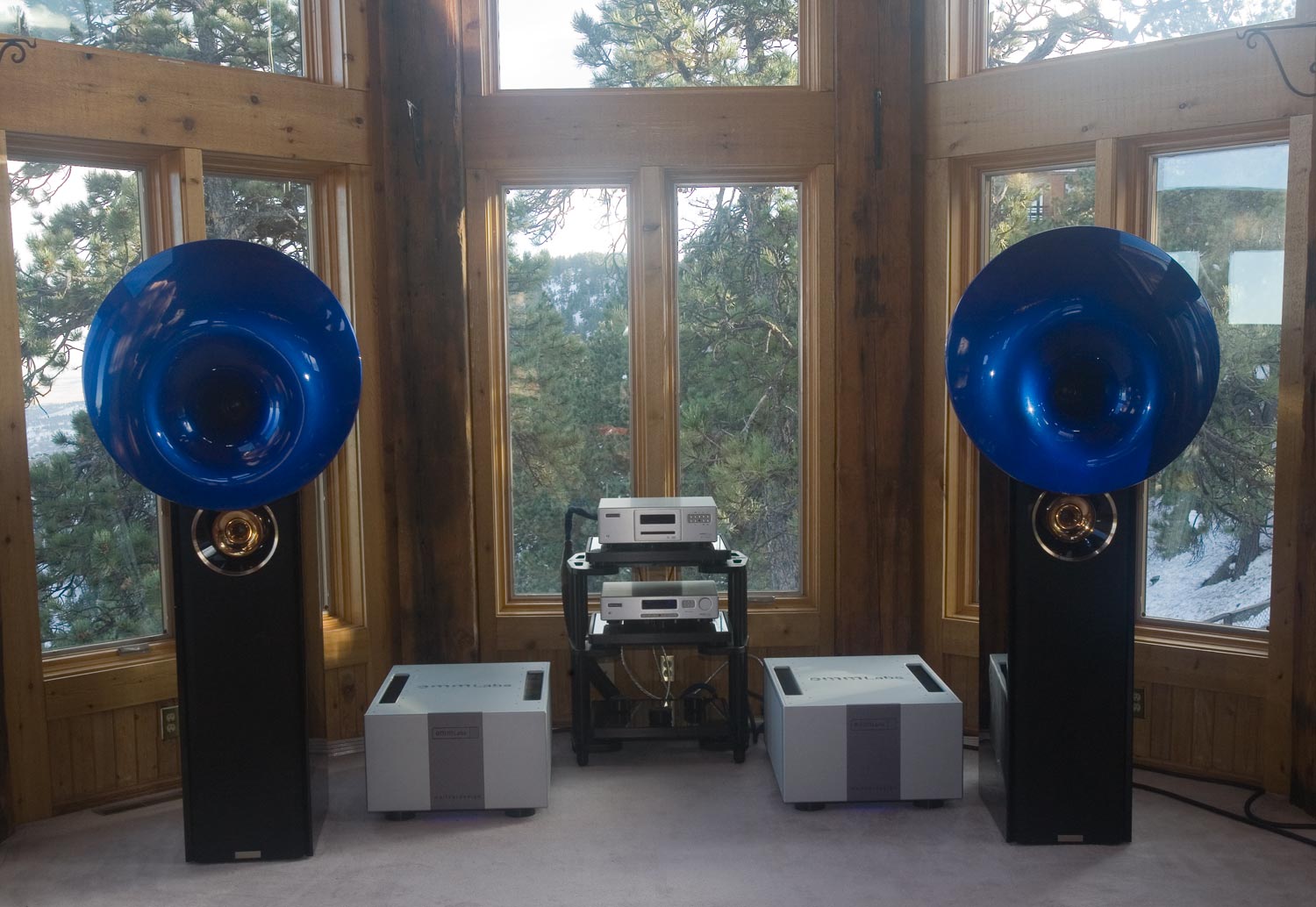
Listening room #3 with Audio Note AN/E SEC Silver Signature loudspeakers, Audio Note high-gain Kegon SET amplifiers, Audio Note M8 preamplifier, Audio Note 4.1x Balanced DAC, Audio Note CDT-Three transport, all on a Acoustic Dreams equipment rack.

First we put in the M8 preamplifier into the system with the Lamm ML1.1 amplifiers. But something was wrong, the timbre was messed up to these ears (Neli didn’t hear anything wrong). Well, I’ve never heard Lamm sound off key, so it was kind of a mystery… until we put the Audio Note Kegon amplifiers into the system in place of the Lamm.

Ahhhhhhh……..

For some reason the M8 and ML1.1 just did not work well together. But with the Kegons….

The one thing that Audio Note does better than anyone else seems to be the reproduction of Music - with a capital ‘M’. There is just something ‘right’ about the sound that is quite unique. More on this when we talk about the M10 preamplifier that arrived today - but I think it has to do with some very subtle cues from the music that other equipment seem to obscure a little - cues like very fine gradiations of harmonics,

Listening room #3

This system, sorry or glad to say, not sure which - sounded WAY better than the Audio Note systems we have heard at shows - both Kondo and U.K. I guess we are just addicted to what vibration control and fat power cords will do for a system - which both of those camps eschew (though Kondo did use some kind of platforms at CES 2006 - they also used a loudspeaker that just…did … not… work).

Our Kegons are the high-gain Kegons. Our Kegons can drive a rock. The newer low-gain Kegons however have more finesse and micro-dynamics, especially on efficient speakers like the Audio Note speakers.

This system actually had too much bass - to keep these amps on here any longer we would have to move the speakers out from the wall, or reposition them in some fashion.

We also used Nordost cables in this system which caused our system to sound leaner in comparison to one cabled with the Audio Note cables, whcih are very rich, and emotional sounding cables.

So, we didn’t get to a 100% pure Audio Note system. But we got a glimpse of what it would be like. We got a glimpse of our future.

Listening room #3
Listening room #3 - The listening couch.

Audio Note AN/E SEC Silver Signature Loudspeakers

Thursday, September 28th, 2006 by Mike

Audio Note Loudspeaker in system in Listening Room 3
Audio Note AN/E SEC Silver Signature Loudspeaker with external crossovers in Listening Room 3 with Lamm ML1.1 amplifiers, Andio Note CDT-3 (CDT-Three) transport and DAC 4.1x Balanced.

Nope, no preamplifier in this system at the moment. Long story… but the Lamm L2 preamplifier, that was here, is now on the Kharma Mini Exquisites in the another room (thanks Joe!), and the Audio Note M8 will be here instead any minute….riiiight Neli?

Audio Note Loudspeaker
Audio Note AN/E SEC Silver Signature Loudspeaker closeup view

It is hard to describe this speaker. We have had a number of amplifiers and source components driving it - so we are starting to get a sense of it….

It is not like the other speakers here - it does not have a laundry list of things it does ‘best’ - want the ultimate in resolution? Look to Marten Design and Kharma. Want a super flat feequency response? Look to Marten Design. Want beguiling transparency? Look to the Triolons. Want seemlessness between drivers. Well the single driver SoundLabs can’t be beat.

Even with respect to musicality - the Kharmas will have to take that gold medal…

But what these are is the most Enjoyable speaker we have ever heard.

What does that mean?

It means that the system anchored with these speakers is the one where we have to kind of urge people to get up off the couch and go hear the next system not because it is ohmygod astonishing - but because it connects us to us. This is the reason we got into this hobby in the first place. Something inside us just likes to listen to music.

This system is the one where it is just so easy to listen to music for hours and hours.

The other systems are considered ‘better’ by most audiophile-approved and -endorsed measuring sticks - but they are all also challenging in some way. Overwhelming perhaps. Or startlingly detailed. Or something that draws ones attention, one’s intellectual attention, to aspects of the music that have nothing to do with music.

Audio Note Loudspeaker and external crossover
Audio Note AN/E Loudspeaker and external crossover

Do you remember when, perhaps in your teen years (for those of you not in your teen years now) when you did not examine the music - you listened to it?

Well, even after all these long cynical years as a picky audiophile - you can listen and enjoy music that way again. Not that these speakers are cheaper than most other speakers, coming in at $40K.

But they are an end-of-the-search kind of speaker. The ‘you are done exploring what is possible in music reproduction, now is the time to start listening to music’ kind of end of the road, the ‘let’s get on with our life’ kind of beginning of the rest of your life. Or maybe it is just time to ‘get a life’?

Nahhhhhhh… hey these are just speakers - it will take more than that to get most of us ‘a life’…. :-)

Audio Note Loudspeaker
Rear of speaker, with integral Audio Note Sogon speaker cable… yummmmmy.

Audio Note Loudspeaker
The speakers are very reflective, here you can see our light-switch cover, an artistic and autotomically correct dancing man, reflected in the speaker. Oops, well, I guess this isn’t a family blog anymore… [Hey! You can stop peering so closely now…I have more things to say below :-) ]

Audio Note Loudspeaker
Audio Note SEC external crossover - Front view

What this says, for those who can’t read the picture, is:

“AN-E Special Edition Cobalt
Hand Calibrated Copper Foil Capacitor Crossover
Solid Silver Inductors
SilverWired Voice Coils
ALNiCo Woofer Magnet
SOGON Speaker Cable”

Audio Note Loudspeaker
Audio Note SEC external crossover - Top view

Audio Note Loudspeaker
Audio Note SEC external crossover - Rear view

Audio Note Loudspeaker
Final view of the AN/E speaker…

These are what I call my desert island speakers (actually, include the rest of the audio note electronics with it too, please). (oh, and an HRS MXR rack. This is a very nice 5-star desert island :-) ).
[OK you spellers out there, I originally spelled this ‘dessert’ island - but now that I changed it, I am not so sure that dessert island isn’t a better description after all….Nahhhhh. Desserts are usually sweet but of little redeaming value otherwise. The point really is that this speaker, these systems are what one ends up at after one is done fracking around with all these fun audio toys and just wants to listen to music]

And on this desert island, I would hope that it would have normal walls - as our current listening rooms do not have any corners, nor do any of the rooms in this house (except the closets) [which is a good thing… and a bad thing…. The Audio Note loudspeakers like corners to be nearby].

And we haven’t even been able to take the full measure of these speakers yet! [See next post].

But if you are finally through with exploring the strange new worlds of the audio reproduction universe (encountering strange new systems - most likely configured in a unique way, in a unique room - boldy going where no one has gone before… only to find “its dead Jim”), then you REALLY should check this stuff out.

The Cogent True-to-life Loudspeaker

Thursday, June 29th, 2006 by Mike

While at Stereophile’s Home Entertainment Show 2006 in Los Angeles we visited the home of one of the principals of Cogent True-to-Life. Cogent is working on modernizing the field-coil compression driver that was used in loudspeakers ‘back in the day’.

To hear what these drivers sound like they put them in custom loudspeakers such as the white horn loudspeakers we heard at CES 2006 and earlier this month during our visit.

Close up of Cogent True-to-Life high-frequency horn

We very much liked what we heard both at CES and during our recent audition - though we feel that both systems were comprimised and wonder what these modest horns with their state of the art drivers would sound like hooked up to comensurable equipment.

Perhaps the Mixibitors will come to the rescue…

But until then here are some pictures and some listening impressions:

The Audio Federation Cogent True-to-Life Horn Loudspeaker Report

Enjoy!

Audio Note, Lamm, Audio Aero

Wednesday, June 28th, 2006 by Mike

Audio Note AN-E/SEC Silver Signature loudspeakers, Lamm ML1.,1 amplifier, Audio Aero Prestige CD / SACD player in listening room #3
[Audio Note AN-E/SEC Silver Signature loudspeakers, Lamm ML1.,1 amplifier, Audio Aero Prestige CD / SACD player in listening room #3]

What a nice system. Works great in this room - deeply enjoyable, great PRaT, emotion, realistic and well-articulated voices…. we like it!

And everyone else so far likes it too :-)

Audio Note AN-E/SEC Silver Signature loudspeakers, Lamm ML1.,1 amplifier, Audio Aero Prestige CD / SACD player in listening room #3

OK, we have an audition this evening - now! - so we’ll have to post more on this later….

Audio Note M10 preamplifier

Saturday, June 24th, 2006 by Mike

We put the Audio Note M10 preamplifier on the main system upstairs today. Things were kind of in a mess after a recent audition, anyway… :-) so we took it as an impetus to see what a Meitner front end driving the Audio Note M10 preamplifier itself driving an Audio Note Kegon amplifier would sound like.

Main system with Acapella Triolon Excalibur, Meitner, Audio Note M10 and Kegons on HRS and Acoustic Dreams platforms
[By the way, that white stuff outside, that is a couple of inches of hail. Yes, it is indeed June 24th.]

I mean, instead of using the Meitner DCC2 DAC built-in preamplifier, which can only but be about $5K of the cost of the DAC, we put a $50K preamplifier in the system with its brother $50K amplifier.

How do you think it is going to sound?

Neli is planning on writing a nasty letter to Peter Q. of Audio Note for letting us ever audition the M10. :-)

Main system with Acapella Triolon Excalibur, Meitner, Audio Note M10 and Kegons on HRS and Acoustic Dreams platforms

We did most of our listening after the unit being on for only 5 minutes, It has now been 3 hours or so.

There are some audiophile-approved attributes that got a big jump up in quality: harmonics, bass, room pressurization, continuousness, imaging, solidity….

But, people, this is not about me devolving, dehumanizing, detaching the sound into its constituent parts.

OK, Janis’s Rachmaninov on SACD is playing - and I am trying to write this during the breaks between pieces because it is too hard to concentrate when the music is playing down the hall outside my office in the livingroom.

For many people, of a certain age and certain life experiences, music and the pursuit of the reproduction thereof, is an attempt to not only experience the music of our youth, but to recapture the feelings and sense of wonder and appreciation of the beauty that life offers us - but which the years and a well-nourished cynicism distances us from; slowly, inexorably, until life sometimes seems like a cold, boring, cruel joke.

But for a few minutes, or hours if the system is very, very good, and most of the time if the system is this good, our defenses are ripped away and we are filled with the child’s sense of the wonder-of-it-all.

Main system with Meitner, Audio Note M10 and Kegons on HRS and Acoustic Dreams platforms
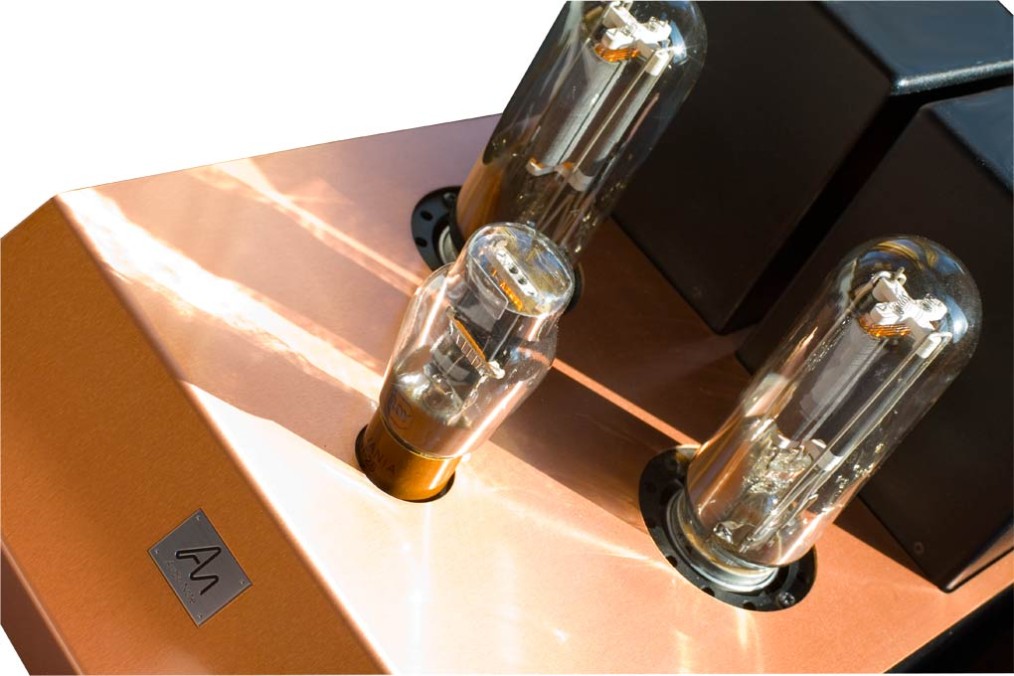
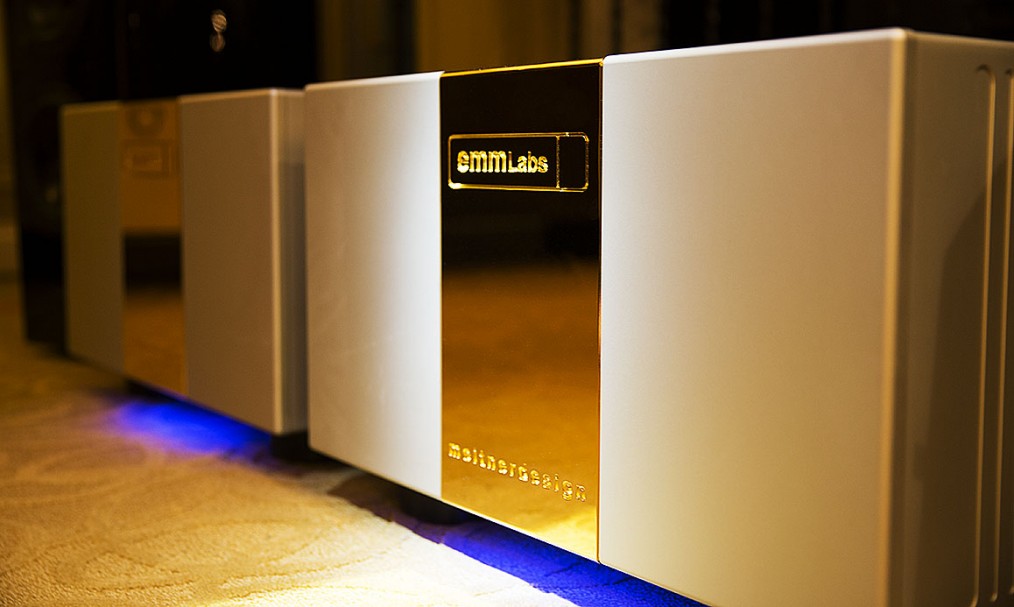
[Here we see the Emm Labs DCC2 DAC, the silver-ish box, which is receiving a signal through 10 meter long optical cables from the transport located on the other side of the room. This is connected, by the Valhalla interconnects that are looping through the sky like the St. Louis Arch, to the M10 preamplifier in the center front. The M10 preamplifier is powered by the two, large, black, about 50lb each power supply boxes called Galahads located in the rear. Finally, the M10 preamp is connected, through INDRA interconnects, to the two Kegon 300B single-ended triode amplifiers (whose tubes are plainly visible).]

What we want our systems to do, what this system does for the both of us:

To communicate with our hearts and minds so well, so powerfully, that we are defenseless against it.

Neli says: “Yeah, Neli hates almost all preamplifiers … finally found another one she likes, 3 big boxes, 2 of ‘em heavy boxes, $50K. Verrrry nice linestage. Ack!!!”

Emm Labs Signature editions - interim update

Sunday, May 28th, 2006 by Mike

It wil be two weeks this coming Monday since we started breaking in the Meitner pair - about 300 hours.

We figure about one month, or 600 hours, is about the minimum breakin period for these puppies.

After the first week, with all of the improvements over the previous, non-signature editions, the sound was still somewhat lean.

Now, at about two weeks, the sound is already at, oh, at about 90-95% of the full weight of our previous pair. One can still tell they are not completely broken in during really quick percussion transients in the upper midrange which still sound a little brittle.

Our impresions of the overall improvements of the CDSD Signature and DCC2 Signature editions are the same as that after the first few days:

An evolutionary improvement on just about all fronts with no negative side-effects (thank goodness, as sometimes ‘improvements’ are often a very mixed blesing - think ‘Adobe Photoshop’ - but not in this case) with primarily a darker background feeding more detail, especially in the bass, better midi- and micro-dymamics, and in general more clarity feeding the awesome ’signature’ transparency which is the real revolutionary impact of Meitner ’s consumer-targetted digital equipment, from our point of view.

We are playing CDs on the Emm Labs pair 24 hours a day, 7 days a week.

At night, and when we have guests auditioning other equipment, we ‘play waves’:

Echoes of Nature: Ocean Waves
This CD is mostly ‘white noise’, with some amount of bass when the waves crash on the beach and some diminutive bird calls in the background. Very easy on the ears and one can listen to it as background ‘music’ over and over and over and….

… without going… batty.

Unfortunately, our 3-week update on the breaking-in process will be a little late… because we plan on attending the Stereophile HE 2006 show!

System #3: Marten Coltrane, Lamm ML2.1, Jorma Prime, HRS MXR

Saturday, May 27th, 2006 by Mike

The System: Marten Coltrane speakers, Lamm ML2.1 amplifiers, Jorma Prime speaker cable, HRS MXR equipment rack. Also Lamm L2 preamplifier, Audio Note CDT-Two and DAC 4.1x Balanced. Nordost and Shunyata cabling.

We mentioned how amazing this was sounding in our review of the Jorma ‘Prime’ interconnects.

What does does amazing mean?

Here is what amazing means:

The Coltrane speakers are so freakin revealing… The Jorma Prime cables are slightly more forward than their No. 1 and even the Valhalla, and this new effect was already taking hold. Now, with HRS’s MXR rack [we set it up yesterday, much more on this later :-) ] in place of the Acoustic Dreams, the system sound is even more ‘present’.

We kind of take it for a given that the Coltrane speakers are a little laid back - given the highest quality, completely neutral components up front. But maybe not…

Witb these two new, admittedly over the top, additions to the system… the sound is much more of a engulfing, in the room type of experience.

Our good Canadian friend, Dave H., [you there Dave? Missed you in Monteal] used to talk about how he wanted the sound to come to him, to not have to focus on listening to what was being played, to have the sound ‘take control’ [my words] as it were.

The system was already subtley sinister in the way it would sneak up on a person and make one stop mid sentence, whether one wanted to or not, as the music Took Control.

But now, …

It is hard to move, much more hard to get up.

It is like ‘if I miss this next note, my life will have been worthless and empty’… ‘I must hear this next note!’

I think this house is going to be much more quiet now… because if we start playing any music, we aren’t going to get ANYTHING done.

[Though I am much more disclipined than Neli, and this system is on the same floor as her office. She, she is doomed. So if you can’t get her on the tele as easily as you could before today, you’ll know exactly why!]

And the new Audio Note CDT-Three transport just arrived. We are doomed! :-) :-) :-)

Jorma Design ‘Prime’ interconnects

Saturday, May 27th, 2006 by Mike

The shootout:

In one corner, weighing in at a slim $4K: the Nordost Valhalla interconnect

In another: the Stealth INDRA interconnect, at a nice $5700.

And the challenger: the Jorma Design Prime interconnect at a healthy $7K

First, the Valhalla.

The Valhalla is an amazingly competent interconnect. The sound is presented in a straight-forward, honest manner. Nothing artifical, no additives, musical without being overbearing.

Then, the Stealth INDRA.

The purity. The transparency. It was like this interconnect was made for the Emm Labs digital front end. Better separation, better soundstage depth, more harmonic color, more life than the Valhalla. Yummy.

Finally, the contender, the Jorma Prime.

Oh.

“Not bad. I think I actually like the Jorma better on this track than the INDRA!”

Track after track. It was the same observations over and over.

And when we switched back to the INDRA for a bit, it became very easy to understand much of the quality of the differences:

As the INDRA is to the Valhalla, so the Prime is to the INDRA.

More harmonic color. Not just that but more shades of harmonic color. Much more resolution, more bass, better separation, deeper soundstage. And some things I noticed right away, before the cables were even broken in: better integration of the music presentation into a single whole and just amazingly wonderful articulation of voices.

The human voice is so rich and full of subtle meanings - a richnes which requires the system to reproduce the most minute variations in harmonics, inter-vowel and consonant emphasis, and precise breath variations - all necessary to form and communicate the exact emotion of the singer.

It all becomes so… much… more… intimate. Like the singer is sharing something so very, very personal - do they really want us to know this about them? We have never even met!

To somewhat exaggerate:

If the Valhalla is a Black & White movie, and the INDRA is a color movie, on standard TVs, then the Prime is a technicolor HD movie on a giant HD TV.

We are really picky around here: many very expensive amplifiers, CD players, speakers… and cables, are nice in some way but have deleterious side-effects that detract from overall listening experience. Here, we strive to make every piece carry its own weight - to be as clean and perfect and wonderful as is technologically possible today.

The cables we like best are those without bloat, without artificial flavors, without preferences for this frequency (typically the bass) or that (typically the midrange), very capable of carrying the signal in its entirety from the sources to the speakers preserving those subtle, but so very critical Fundumental Music Elements like micro-dynamics, inner detail, presense, true-warmth - able to communicate the VAST amounts of information of a complex musical passage, crunched down into a split-second, without becoming sonic mud.

Well, now you have a better idea of what we mean when we say we like these Jorma Prime cables - both the speaker and the interconnect.

Personally, I am somewhat shocked. Really didn’t really epxect to like them so much, to be able to find some fault….

At the price, only incrementally more than some of the excellent competition, the interconnects ARE a real bargain.

The speaker cables are also really, really wonderful. The Coltane / Lamm ML2.1 system is just a-m-a-z-i-n-g right now. But even us here at Audio Federation experience price shock every so often. To deal with this personal, psychological block, I have convinced myself that the interconnects, at one third the cost, give the system some of the same wonderfull improvements as the speaker cables. And they do.

But I’d hate to hear what both of these cables in the same system would sound like.

No, really.

Wait. Not hate. Make that fear.

I keep telling Neli not to try it.

And if she tries it, I do not want to hear it. Or about it.

Why?

Count it up: we have 4(!) systems here.

Fair warning. Once you hear these, you will be spending lots and lots of time figuring out how to get them, and keep them, in your system. I know we are, ….dammit. :-)

Jorma Design ‘Prime’ Interconnects… the Prologue

Thursday, May 25th, 2006 by Mike

Finally performed the definitive shootout between the interconnects last night:

Nordost Valhalla vrs. Stealth INDRA vrs. Jorma Prime.

When we first got the Prime they were not broken in - a somewhat foward and compressed midrange, and in general the sound came through with a weird, non-flat frequency response. After waiting 3 or 4 days for them to relax, and only hearing minor improvements (exactly as if they were still breaking in), they got put on the Nordost Vidar cable burner for a week or so.

Then we had a marital dispute about the direction the cables were supposed to be used in: should the Bybee purifier go towards the receiving end or the source end? Mike, the Magnificent, (me! insert chest thumping here) thought that they should go towards the receiving end because that is how the Bybees in the speaker cables are oriented. Neli, the wife of Mike the magnificent, remembered Jorma telling her that they went the other way - and somehow during the tests of directionality somebody (not Mike the Magnificent) confused what was towards the receivnig end and what was away from it … well, let’s just say that this week it isn’t I who is the butt of all the jokes around here… :-)

‘Course, this post won’t earn me any points….

Well, it is only fair. last week it was me providing the humor… but I insist it could happen to anybody. You be the judge. The marriage you save could be mine….

In the Audio Aero Capitole player, I looked inside, saw there wasn’t a CD, and put on Ashkenazy’s Rachmanonov.

I pressed play, but different music started playing. Really different.

What did I do to fix this?

I looked inside and saw, yes, the Rachmananov CD was plainly visible. Check.

Then, well…

I pressed STOP, then pressed PLAY again, of course.

This should fix it right?

I mean, when your CD player starts playing something entirely different from what you put in it, this works for you, right?

OK, this was happening during an audition for a nice couple from Rhode Island. So there was an attentive audience for this show I was putting on…

Finally, the Neli of the house came over and took off the Rachmananov CD ….

… and then took off the completely black (exactly the same black as the inside of the top loading Capitole drawer by the way) De Mat that was…. on top of the CD that was underneath the Rachmanonov CD…!

Ha, ha. Very funny.

No I wasn’t trying to play two CDs at once. Yes, I do look inside the player before I just stick a CD in it. No, I wasn’t trying to invent another tweek by stacking CDs in order to improve the sound. No, it wasn’t even a demonstration to show that the player would still play with two CDs and a DE Mat inside of it.

*sigh*

[The De MAT is a black rubbery thing that covers the top of a CD in top loaders to improve the performance of the laser - and thereby the sound - and it works]

Oh, anyway, now everybody has forgotten all about my little ‘incident’ - well, they had until they read this post, anyway.

**************

Back to the Jorma Design Prime interconnect.

It turns out that Mike and Jorma were right and Neli was wrong.

Hee hee hee :-) ))))))

Next - what we heard at the shootout.

As a teaser, let’s just say that $7K for a one meter interconnect is looking like a helluva bargain.

I kid you not. The incremental cost for these cables above the other two brings a tremendous improvement in the listening experience.

Next - the details.

First Blush: Emm Labs CDSD And DC2 Signature Editions

Sunday, May 14th, 2006 by Mike

We moved the new Emm Labs transport and DAC upstairs where the old pair sat for just about a year and a half. [They had just spent its first week on the system with the Kharma Mini Exquisite speakers - which are nearly, but not quite, broken in].

I let it settle in some and then played some test CDs.

Swtiching back and forth between the multichannel and 2-channel version of Dark Side of the Moon, it was so obvious that the 2-channel version sounded quite a bit less strident in the midrange, more relaxed, uncompressed, unconfused during complex passages… i.e. it is starting to break in!

In comparison so our previous Emm Labs pair, this pair already had more resolution and a lower noise floor. The combination of these two is serving to increase the transparency even beyond the state-of-the-art industry-leading transparency we had experienced with the older version.

It has been a week since we have been playing it - but it is just starting to relax, which was another major, for me, feature of the Meitner pair: Startling transparency in this casual not-even-trying manner (which derives from, I think, the resolution, especially in the midrange, coming fron naturally formed details, as opposed to the popular lotsa details where notes rise and fall faster than is real).

The trademark purity of tone was immediately apparent from the get-go, after 10 seconds of playing time.

This transparency and purity… it is something no other digital we have heard is able to challenge. Yes, the others may have more detail, or slam, or a rounder sound more able to mate with unforgivning electronics located somewhere else in the system. But if you want a ’straight wire with gain’ kind of sound… this is it.

But… you… have… to… let… it… break… in.

24 x 7 by, say, 6 weeks or more…

OK?

And break in each path through the player that you are going to use: redbook, SACD, preamp analog output, and analog input if necessary… I am not sure the unit gain output needs breaking in too if you are going to use that. But it can’t hurt…

OK.