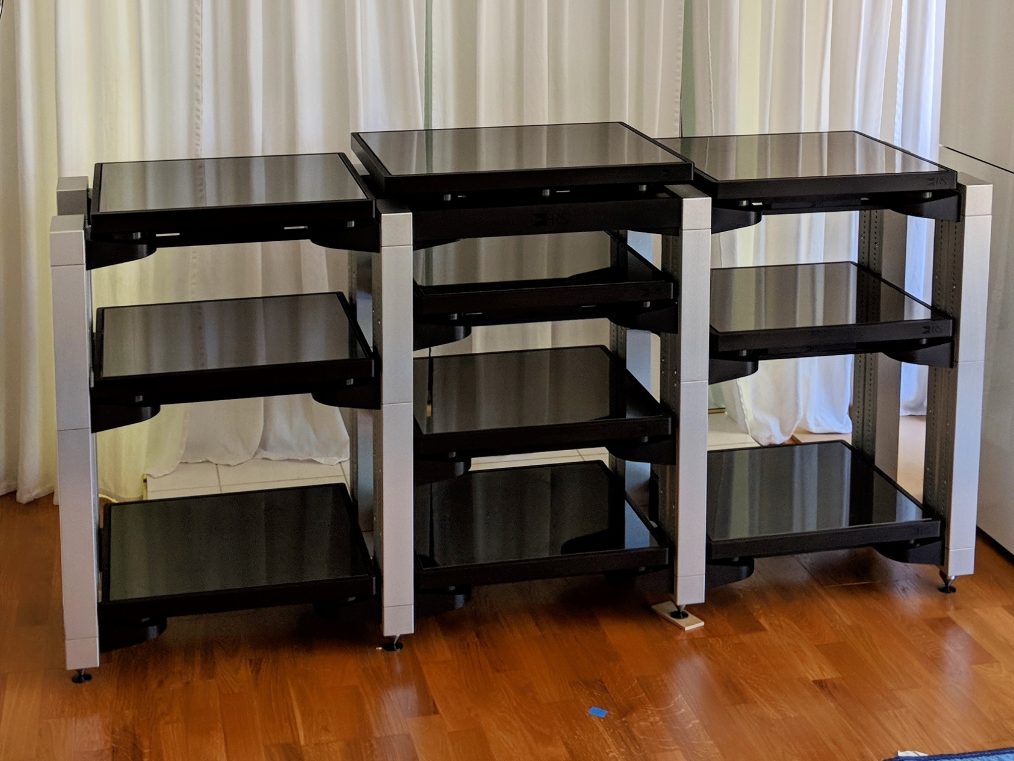
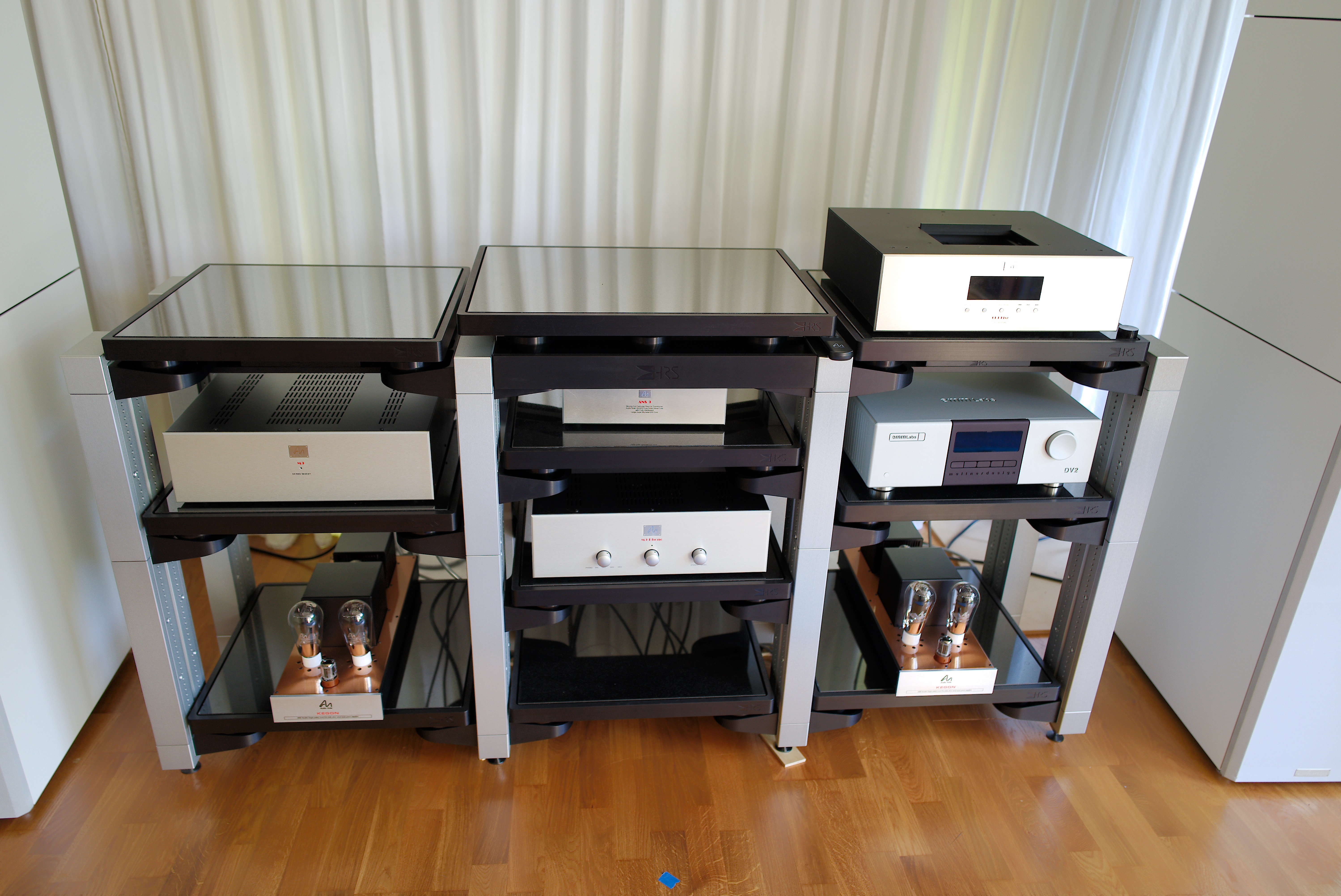
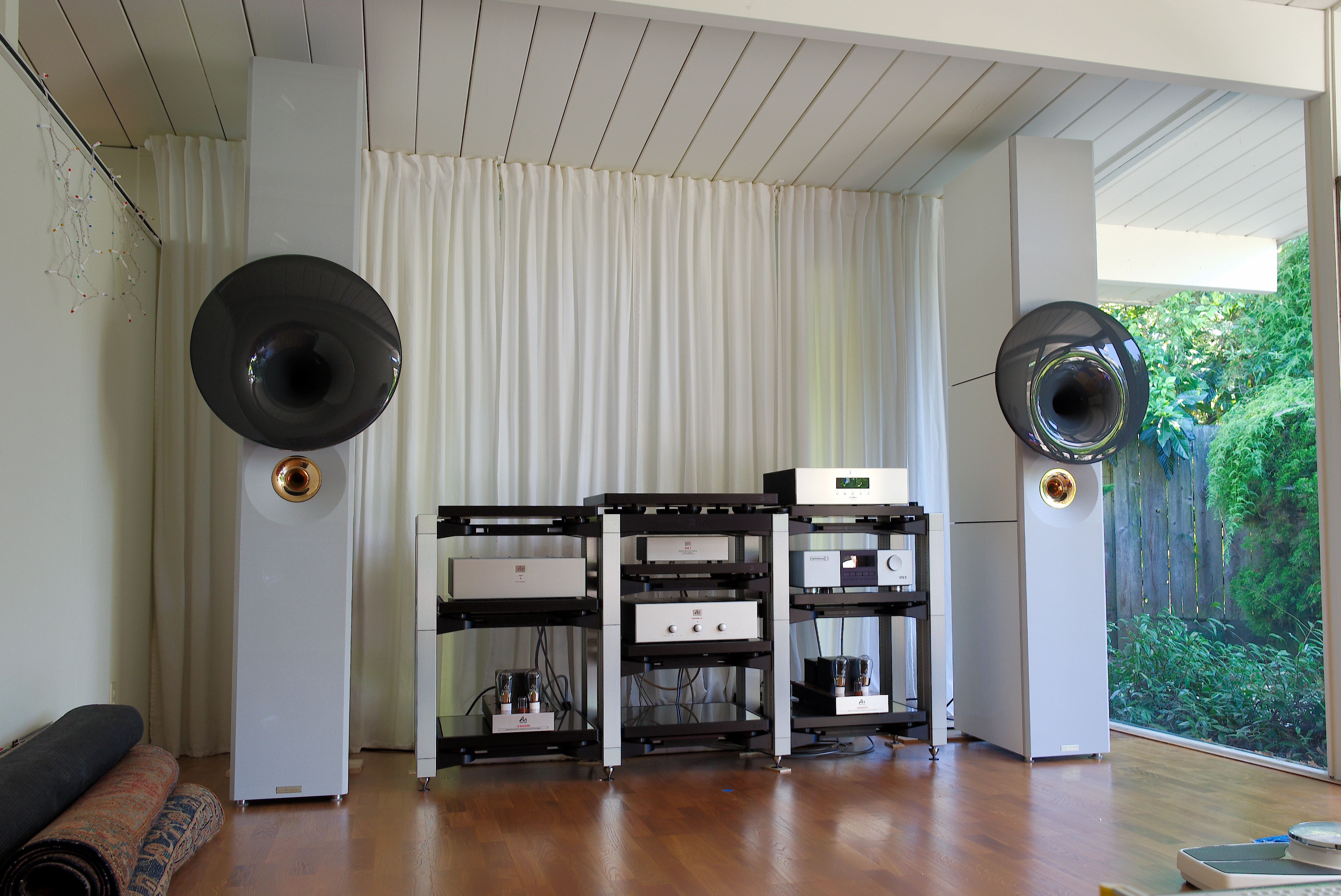
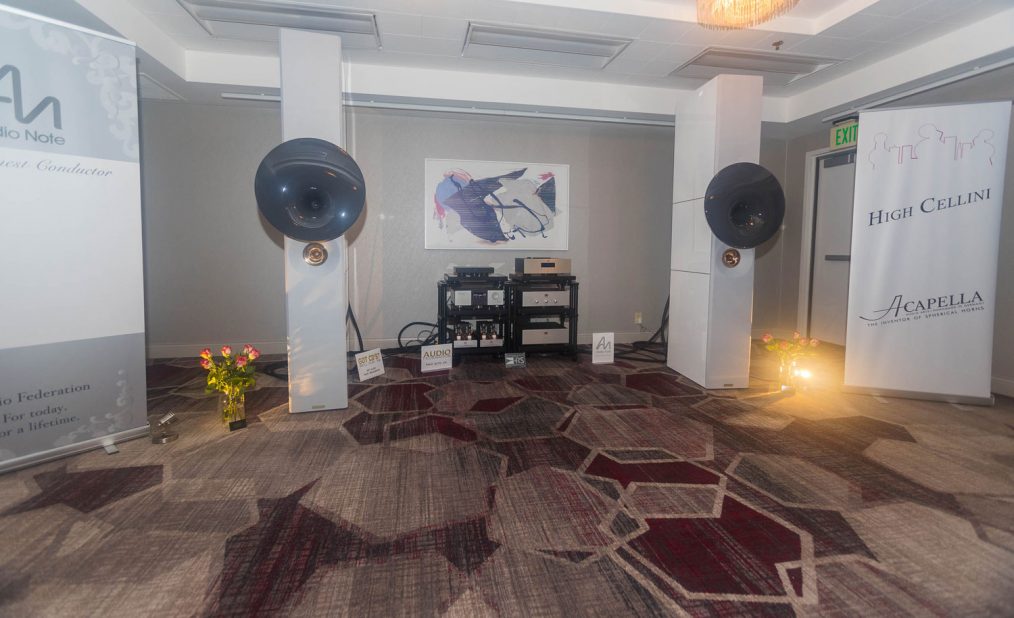
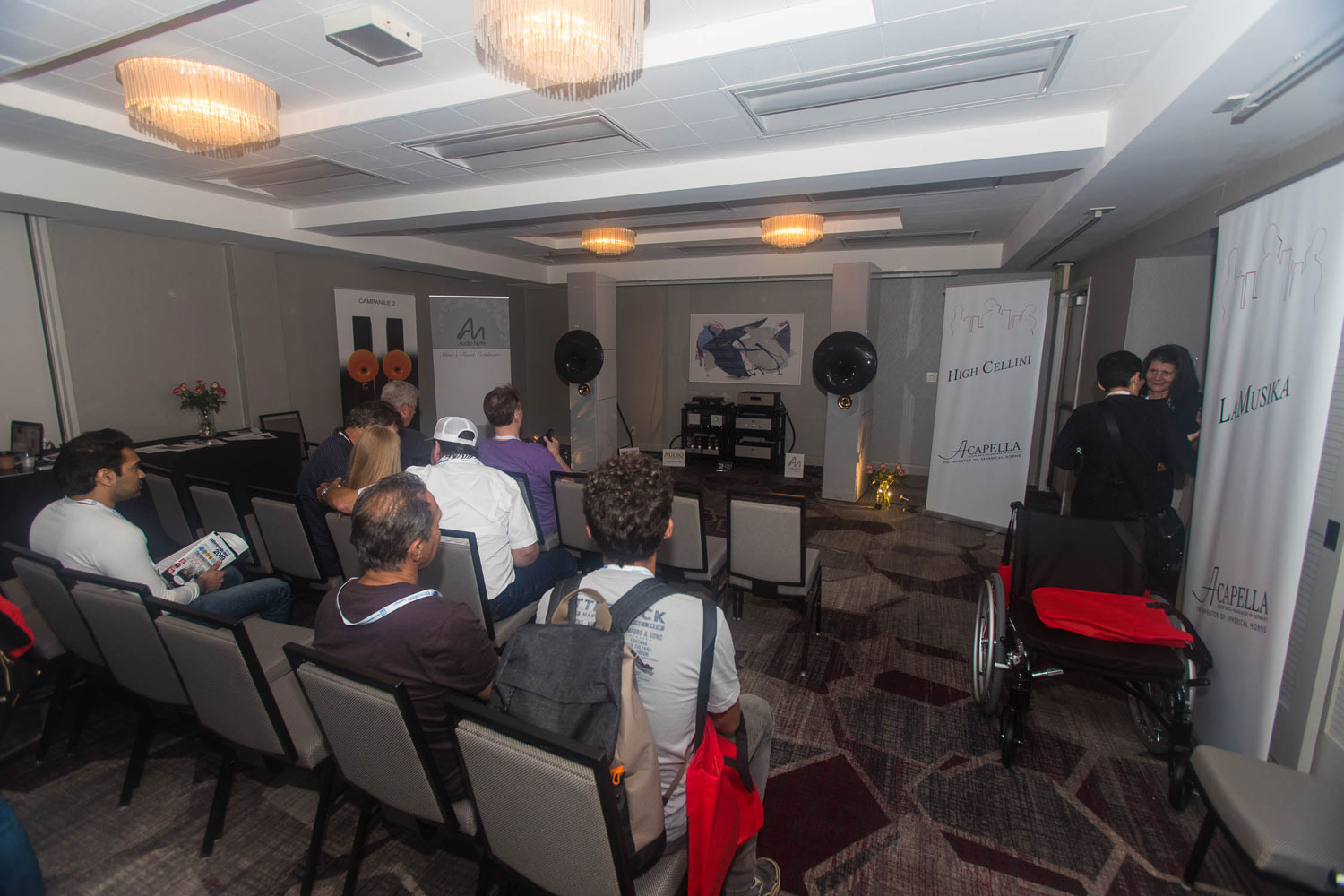
Finally managed away some of the clutter here and got the main system photographable.
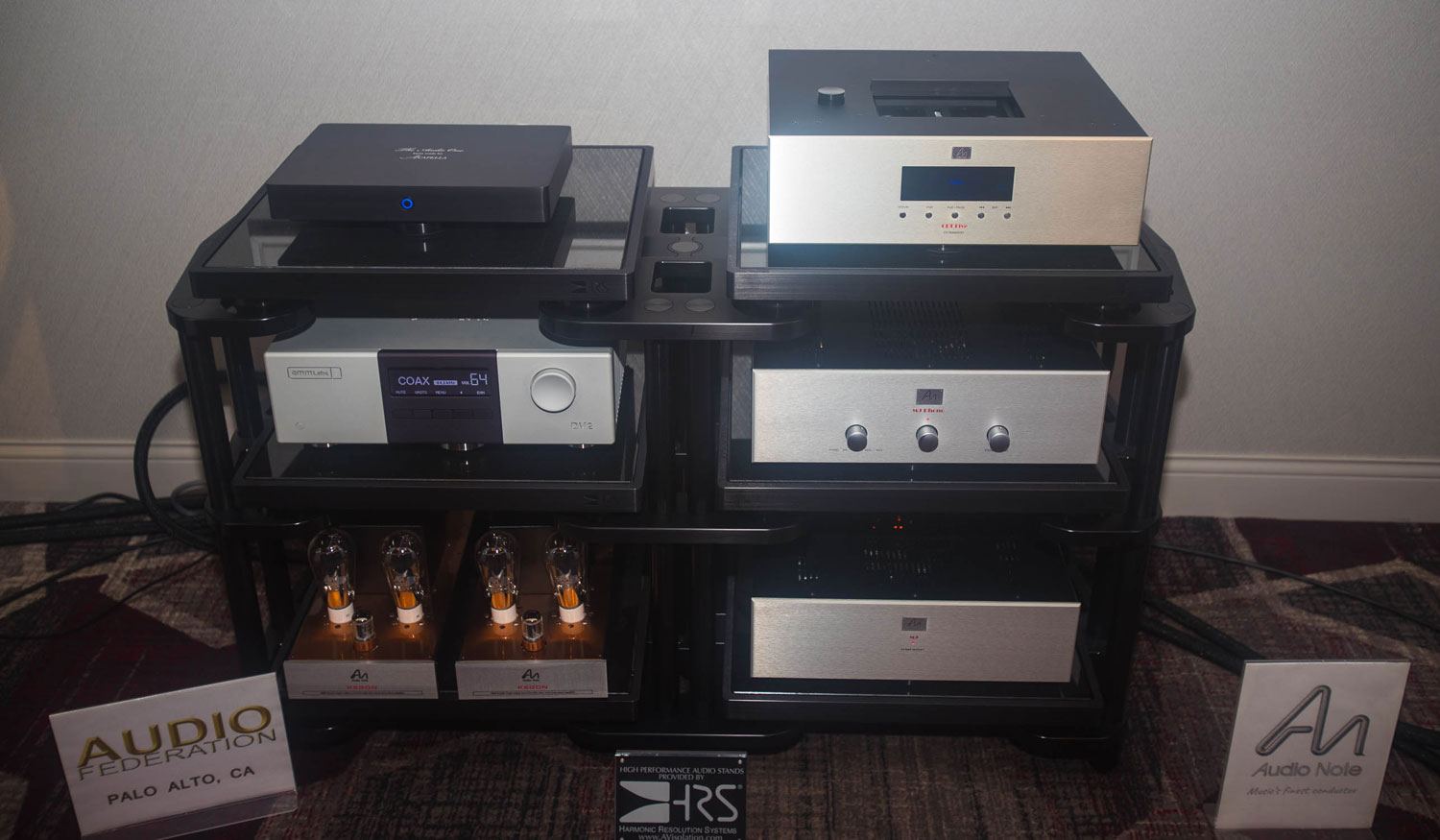
I am finding the empty VXR rack in this unusual silver post, black shelf configuration strikingly elegant. [It isn’t so bad with gear on the shelves, either! :-)]
Sharp eyes will notice that we have shims under some of the feet and bigger shims underneath each speaker… the house here is SINKING into the San Francisco bay [about two inches so far, with 13 feet more to go].
We’ll have a number of videos about uncrating and setting up the HRS VXR shortly on our YouTube channel.
Oakland. End of July. Hot. Air-conditioned Hotel. Music.
In general, all the rooms sounded pretty good. You know, comparing to the last couple of decades.
However, there is a stark difference between the systems that sounded good and the systems that sounded like music that sounded good – but many people seem to not differentiate between the two. And at this show it was easy to detect the difference – in the frequency range, say, 1000 Hz to 3000 Hz, did the notes sound round and full like real notes, or brittle and artificial?
Anyway, makes a big difference to me in that I may be entertained for a few minutes by just about anything, but for long term listening I really don’t want another irritating thing in my life. I want my stereo to contribute positive vibes [yeah, man], to soothe the savage beast abused by a world run amok. Yep, that is what I am looking for in a nutshell. The rest is just details -how to get there. Important, FUN details, but need to keep an eye on the ball here.
Continuing on…
I heard, and believe, that there were only 3 CD players and 3 turntables at this show. Nobody wanting to read memory sticks anymore either. Out of 20 rooms or so. Interesting trends.
As for the show being smaller this year… yes, but the people were there and rooms were crowded almost the entire 3 days. I can’t think of a room that didn’t have its fans. So a very positive show.
I recorded rooms in 24×96 audio and added it as a soundtrack to the video of each room. Also did a quick, 50 minute two-part tour of the show which is pretty entertaining [well, I think it is, anyway :-)].
Sorry about the Audio Note U.K. room in Part II – they played Animals “House of the Rising Sun” which YouTube blocked worldwide – so I had YouTube remove the sound during that portion of the video. Sounded GREAT, though, with the new Meishu Tonemeister and the speakers a tiny bit further from the corners.
Voxative
One of the rooms that sounded like music was the Voxative room – two little single driver monitors and a box [with amp, pre, DAC, and streamer]. That was it. For about $8K or $9K. If we omit the rooms that I have a natural affinity for (and whose sound still kicked butt): Audio Federation, True Sound (Audio Note) and Old Forge Studio (Acapella dealer), the Voxative room was my favorite room at this show.
My impression of these speakers and the associated electronics is that there are a high-performance, audiophile-grade, clean sounding, efficient, fairly linear – not polite but not aggressive either. The highs were reasonably well done and had at least some body and roundness to them – unlike many other rooms at this show.
I liked this system more than the big Voxative system in Munich. It is now on my list of favorite little systems / speakers: Audio Note “J” and “K”, PranaFidelity “Fifty90”, Acoustic Zen “Adagio”, old QUADs, little Magnepans…
Old Forge Studio
This was the first time I have heard the Sound | Kaos speakers. They are another of those modern marvels – those “how do they get so much sound out of such a little box?” speakers.
The sound here was approachable, full, musical, amazingly complete top to bottom. Of the three reasonably-priced [IMO good sounding] small systems – this was the most laid back. The True Sound / Audio Note U.K. room in the middle somewhere, and the Voxative more upfront and lively. Not to say that this was “laid back” nor that the Voxative was “aggressive” in a general sense. Far from it. But first order approximation of the differences between the three?… yeah, this is how I would characterize them.
True Sound | Audio Note U.K.
I thought the sound here was really excellent this year. There was the addition of the new TT3 turntable and Meishu “Tonemesiter” integrated, along with pulling the speakers out [I know!] 6 to 8 inches from the corners. The bass was still present, and there was a delicacy and adroitness to the sound that was fun to follow with the mind as well as enraging, as AN always is, the heart.
Speaking of Audio Note, Peter Qvortrup, CEO, Founder and Visionary of Audio Note was also at the show and was primary pundit, along with Constantine Soo and RGA, on a panel discussing anything and everything.
Due to several rather strange yet ultimately should-have-known predictable scheduling issues, we showed with the Acapella “Campanile 2” speakers from last year driven, however, this time driven by 18 watt SET 300B Audio Note Kegon amplifiers [instead of the mega-watt Acapella La Musika amplifiers]. On the other hand, we used the EMM Labs DV2 DAC with volume control [put to good use by Hermann Winters from the back of the room] instead of the Audio Note Fifth Element / Fifth Force DAC. Even though the La Musika is a hybrid amplifier, one could still think of this as last year’s system, but moving the solidstate part of the system from amplification to DAC duties.
It worked. We love our Kegons! And the EMM Labs digital performed admirably [esp. considering it was 5 days new].
Margules and Lyn Stanley
Margules’ rooms sound pretty good at these shows. I do think they play too much “audiophile music” and they think we play too little [we are next door to each other at this show :-P].
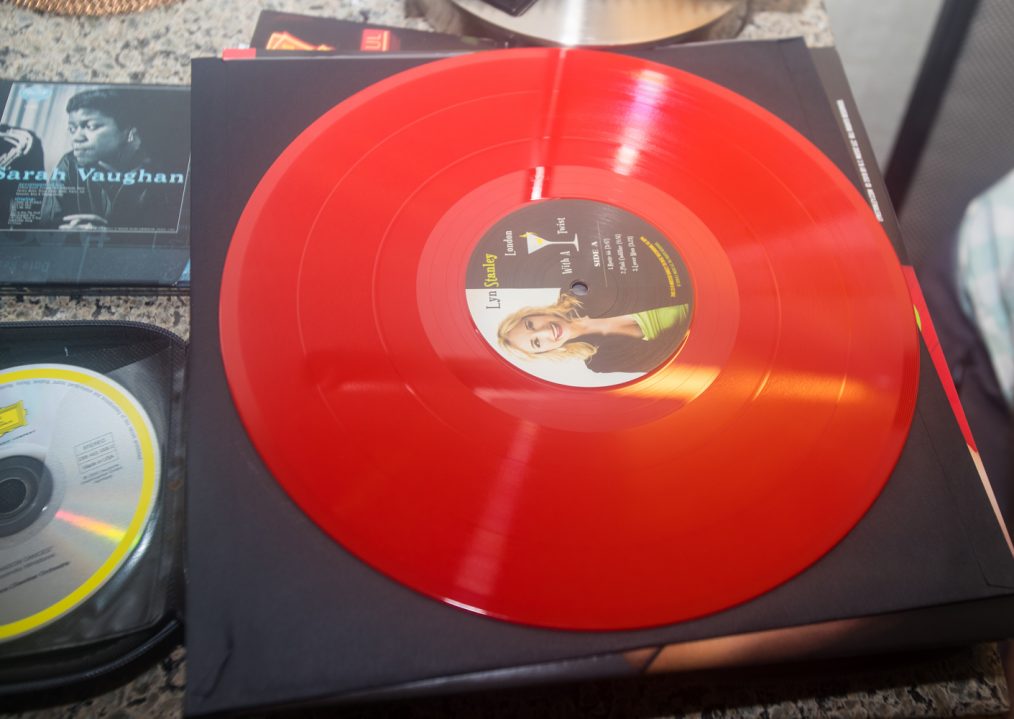
Is it just me or does her SACD really sound better than the $100+ LP in this video clip? [it seems louder so a little hard to tell, but even so…]
There was much talk at the show about the relative quality of Lyn Stanley as a singer – but heard she sold something like 1000 LPs at Munich this year. This was the first time I had heard her CD. I am not much a fan of close-mic’d female vocals music [except Pop Pop by Rickie Lee Jones :-)] but this seemed kind of average to me for that genre [which means I expect we’ll hear it a lot more at shows in the future].
The rest of the rooms were interesting, and as I said they had their fans. Perhaps there will be a part II of this report where we will talk about them…
Let’s see… what will we bring to this show next year….!!!
Next up: Capital Audio Fest (and maybe RMAF, but this would be as happy attendees only).
We went. We exhibited. We photographed and videod.
Never saw so many people amazed and confused by an 18 watt amplifier driving these speakers to more than fill up the room with gorgeous music – more as in Neli and Hermann and RGA like it loud enough to chase me out….. again [I went up to Nick and Lee’s for some sane volume listening 🙂 Luckily, Peter Qvortrup wasn’t in control of their volume, yet, otherwise I’d have to hightail it somewhere else yet again 🙂 [though he plays fun music…. not to say RGA doesn’t … 😉 … but seriously, I am so bored right now with the music Neli and Hermann (and I) play at shows … we HAVE to do something]] .
Showed the Acapella Campanile 2 again this year, but driven by Audio Note Kegon 300B amplifiers, and we used the EMM Labs DV2 DAC with volume control for D to A duties this year.
And… now we have a boatload of gear here that we need to assemble back into some kind of semblance of what passes for normality.