'Emm Labs'

EMM Labs CDSA still breaking in…

Tuesday, March 13th, 2007 by Mike

Still breaking in. Wordpress lost my first post on this. So let’s try again, although somewhat worse for wear … :-)

We have a somewhat interesting setup here - but right out of the box, the CDSA sounded pretty good, albeit in a constipated and compressed sort of way.

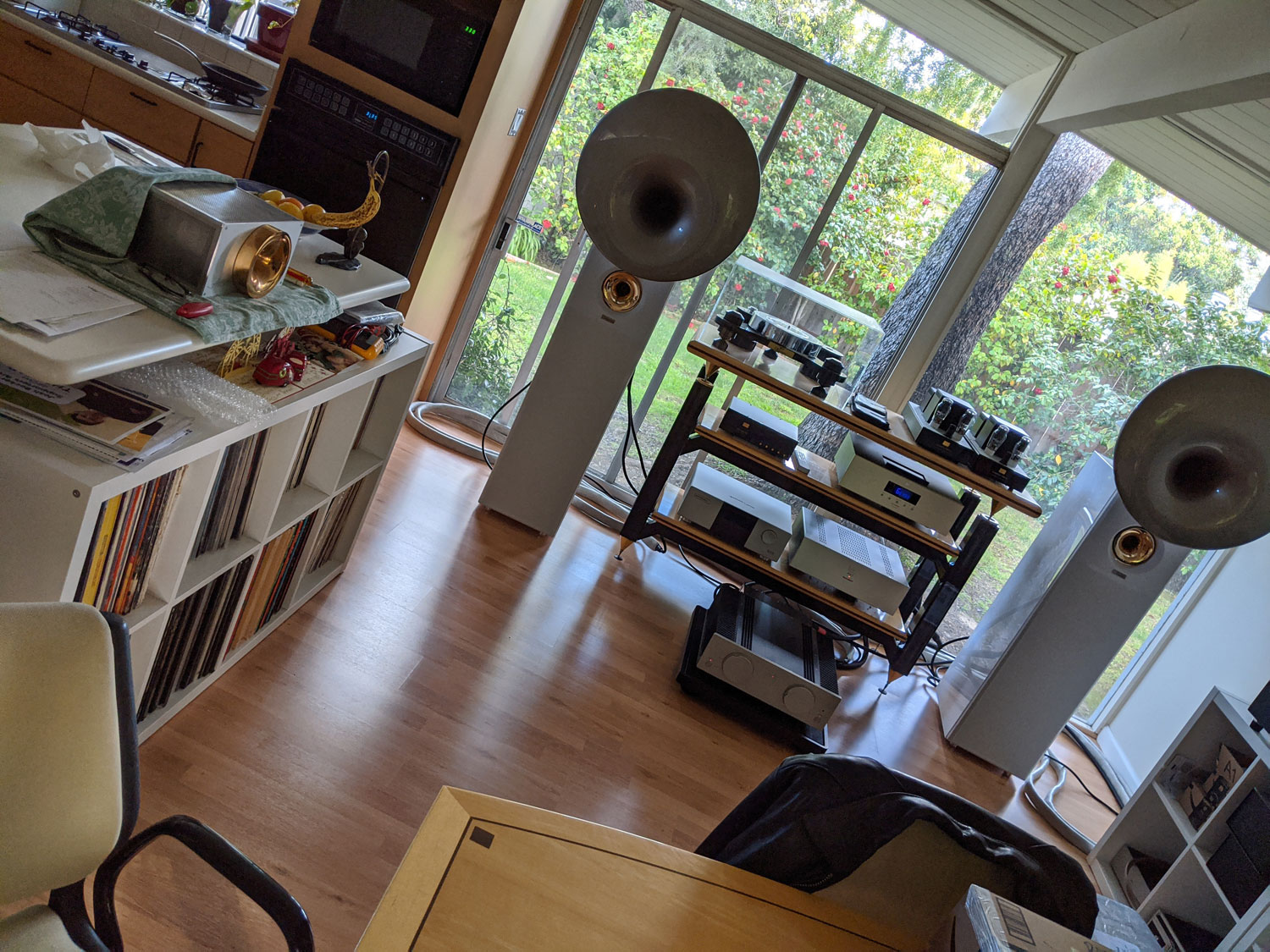
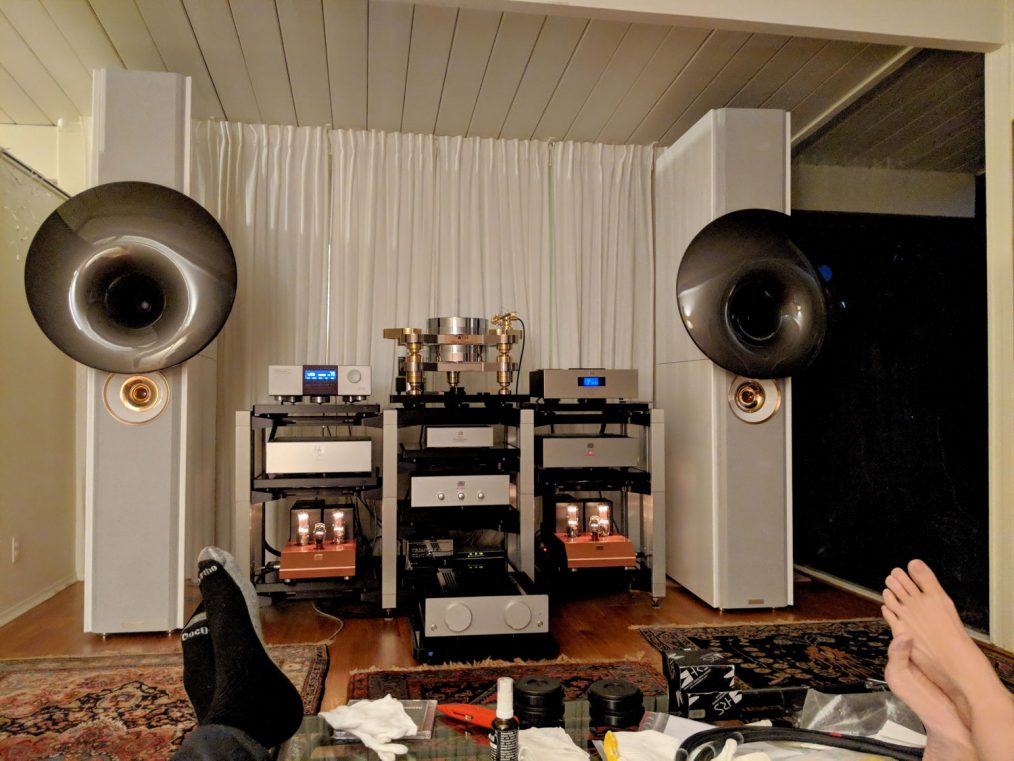
That is the CDSA on the bottom shelf. It is running, using the Shunyata (P)ython Helix Vx power cord into the never-before-used-as-far-as-we-can-remember analog inputs on the DCC2, connected to each other with an Audio Note SPX interconnect.

[After losing my post a second time, it has become obvious that the word p-y-t-h-o-n causes Wordpress fits, as it is also the name of a computer language that WP must be screening out. Stupid BDS.].

All this is run into the Audio Note Ongaku integrated amplifier, bypassing the DCC2 built-in preamp. The wonderful sound of this amp is probably helping a bit with the breakin blues… :-)

If I were to describe the sound at this point, it would be that the sound of the CDSA, in this un-optimized setup, is slightly more dynamic and controlled, and a little less smooth, than its bigger brother, although at this point the decay is too aggressive. Still with the purity and truth of the Meitner company-sound. And once again, although the sound of the CDSA appears in this Silly Setup ™ to have quite a bit of detail - any comparision with the competition would leave egg on their components from the perspective of anyone who values Real over Impressive Deluges of Detail.

The CDSA appears to be definitively NOT inferior to the DCC2 SE and CDSD SE combo - and can be thought of as more like the combo minus the built-in Switchman-quality preamp and analog and digital inputs. In a single-box.At half the price.

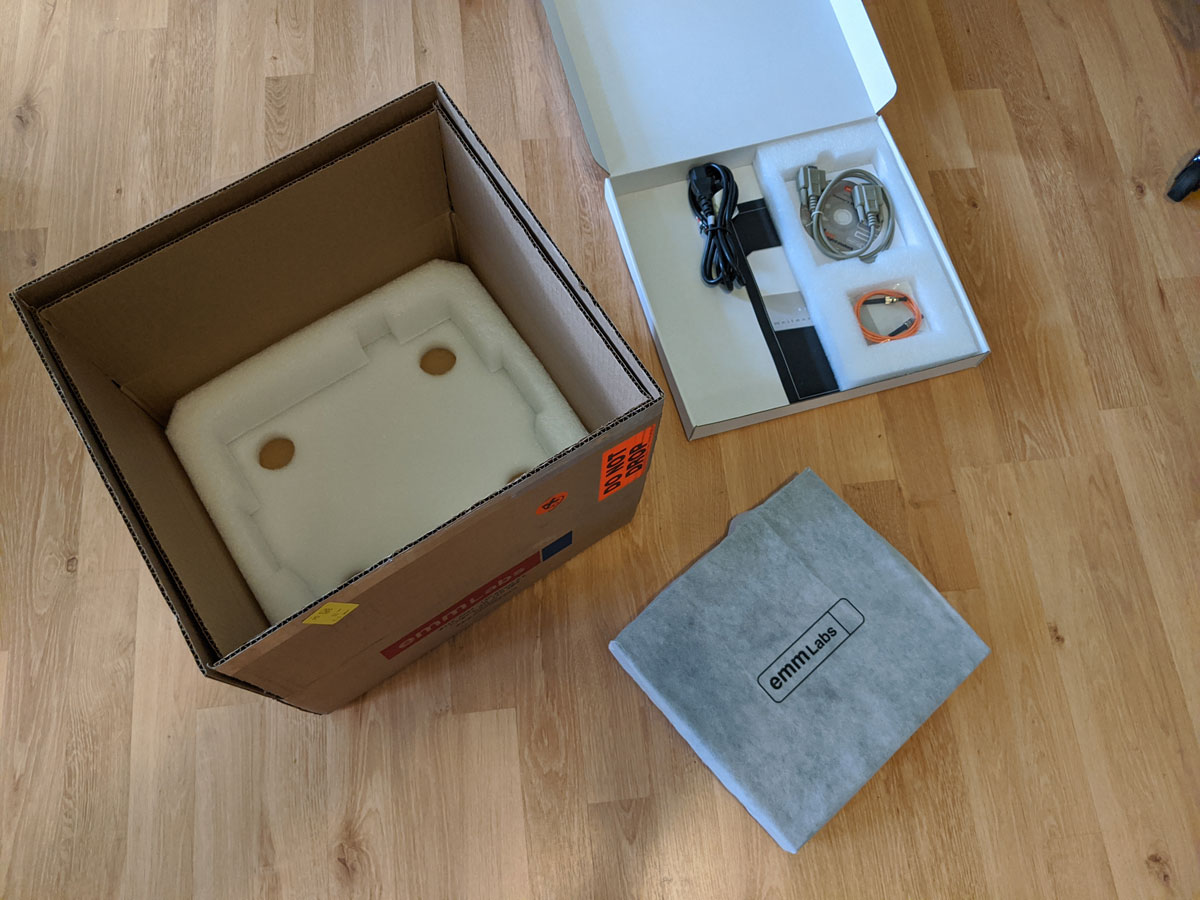
EMM Labs CDSA Photos

Monday, March 5th, 2007 by Mike

Well, here we are.

We actually got the player two days ago, but since Mike & Neli BOTH wanted to be at the unveiling, and we being quite busy lately, it took us until this afternoon to unwrap the player and connect it into the system….

First impressions, at the 5 minute mark, are quite favorable.


Same nice badge as its bigger brothers CDSD SE and DCC2 SE


Front panel comes covered with a blue plastic protector….


We took the protector off. Its easier to push the buttons and open the tray that way….


There is a new remote, with larger buttons. The buttons are seriously back-lit (no photo, oops) and larger than the previous remote, which is ncie for those of us who find it hard to read 6 pt font text.


The rear of the remote. Nice heft, good feel in the hands…


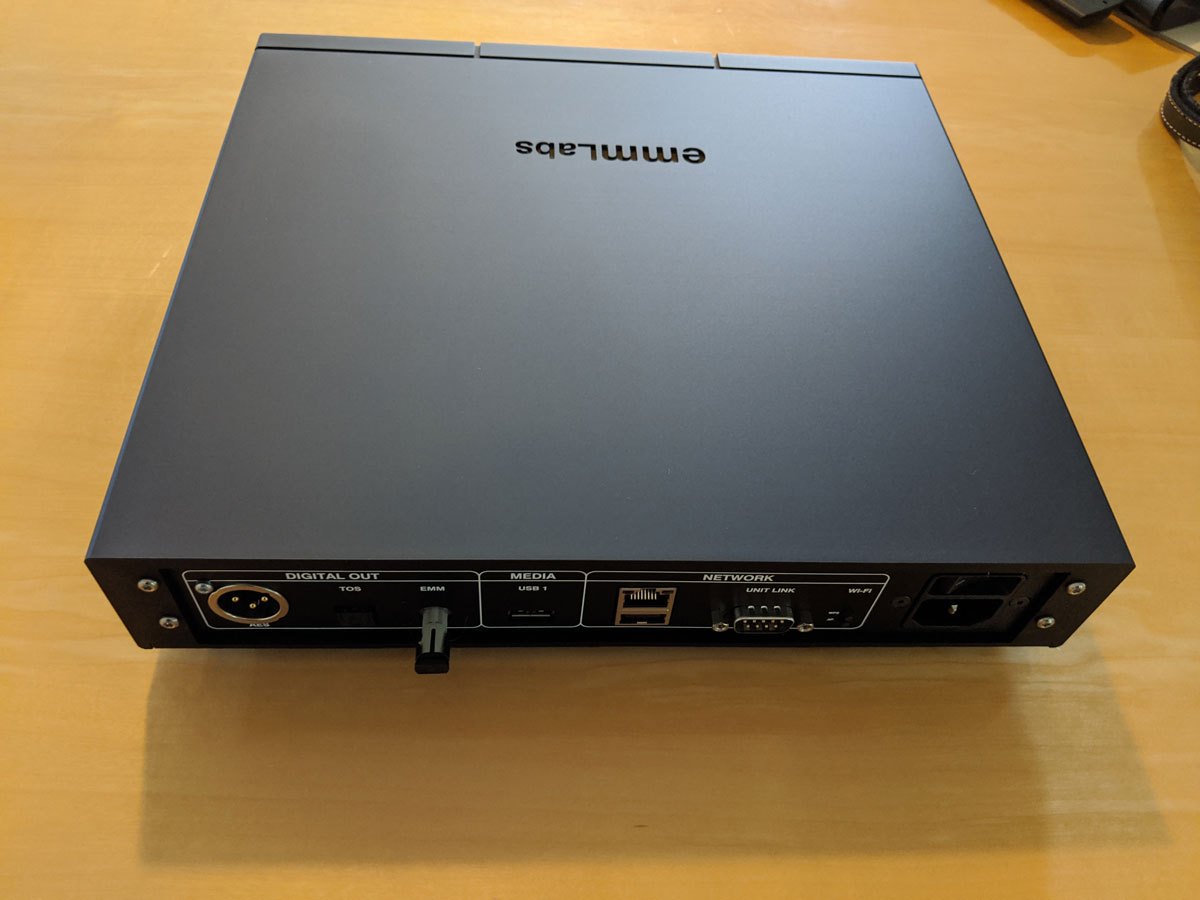
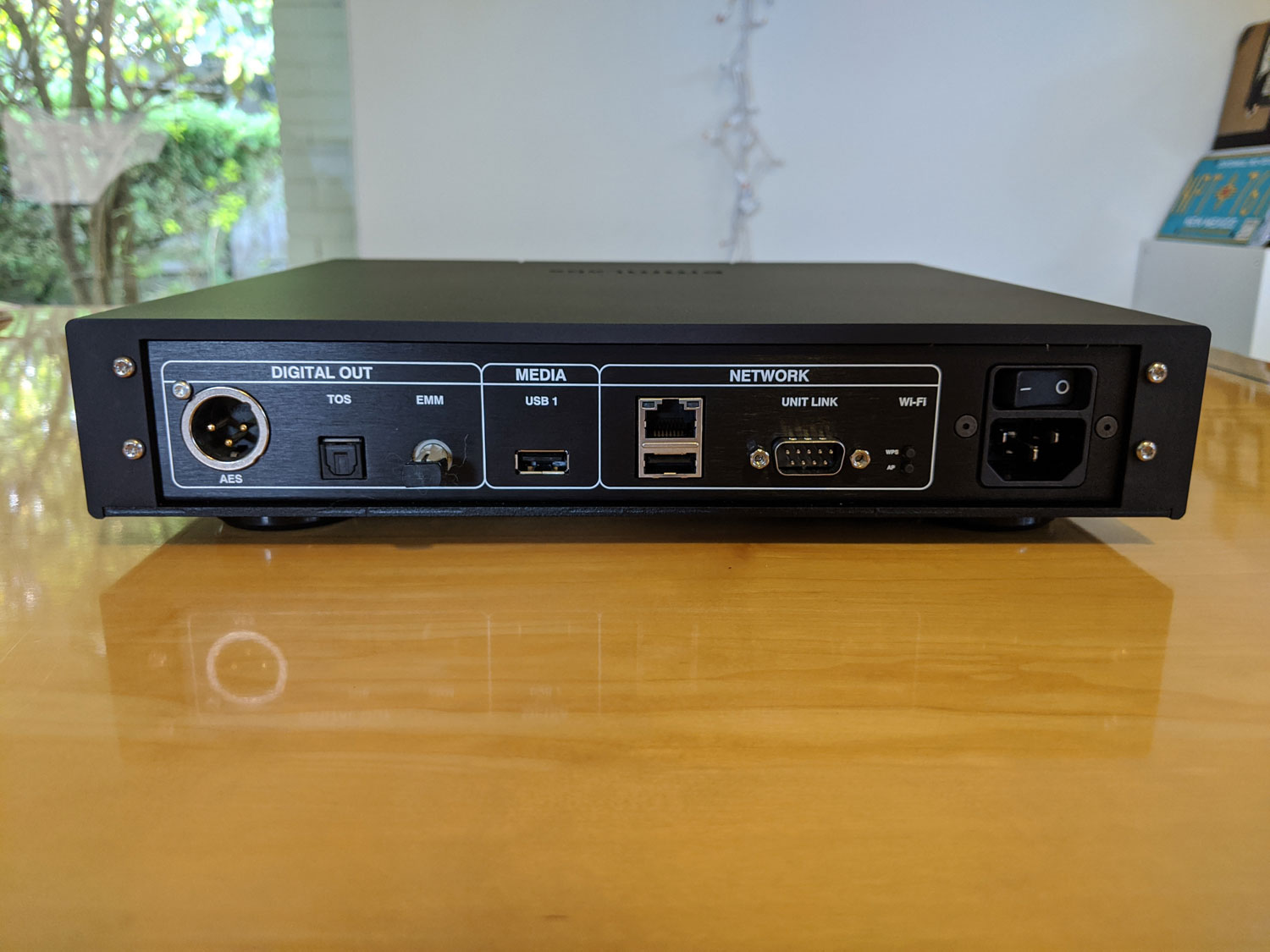
The rear panel of the CDSA.


A larger photo of the rear panel of the CDSA. Much less going on than the DCC2 - no preamp, no connectors to communicate with the CDSD transport….


The push buttons are now metal instead of plastic, and are firmer, and have a shorter ‘throw’ to them.

Comparing and Contrasting Digital at Audio Federation

Thursday, March 1st, 2007 by Mike

In this post, we will not talk about sonic characteristcs, per se, but just the differences in functionality of the higher-end players we currently have available.

Just by itself, the difference in what these players do, and their basic approach to sound, is enough to differentiate them - enough to help many people choose which one they are most likely interested in.

*** Audio Note U.K. DAC / Transport combinations. $[varies]

Tube. If you want a musical, very customizable sound (through tube-rolling), do not need another preamp, do not want to run your PC or video system into the DAC. , and have space for a two component player.

*** Audio Aero Capitole Reference CD player with linestage: $9,580.00.

Tube. If you want a very musical yet unveiled sound, need a good linestage, and do not care about SACD.

*** EMM Labs CDSA CD / SACD player $9,995.00

Solid-state. If you want a very pure yet musical sound, want SACD, do not need another preamp, do not want to run your PC or video system into the DAC, and/or only have rack space for one component.

*** Audio Aero Prestige CD /SACD player with linestage: $12,990.00.

Tube. If you want a very musical, detailed and solid sound, want SACD, need a good linestage, need a front loading CD player and/or only have rack space for one component.

*** EMM Labs CDSD SE and DCC2 SE: $21,900.00

Solid-state. If you want a very pure yet musical sound, want SACD, need a good line-stage, and/or want to run your PC or video system into the DAC, and have space for a two component player.

*** Audio Note U.K. CDT3 and DAC 4.1x Balanced: $22,600.00

Tube. If you want lots of detail with each note rendered in an analog-like fashion, do not need a preamp, and have space for a two component player.

————-

A FEW THINGS

First, these really are some of the, if not THE, best digital today.

Second, the built-in preamp are really quite good. Not spectacular, but really, REALLY good for the price paid.

Third, given your current system, and where you want to take it, you probably have a good idea about going for a tube versus a solid-state solution. The solid-state here is very, very good, very un-solid-state-like, but it will not ‘add musicality’, but neither will it take away musicality [unlike most other solid-state digital]. . It just ‘is’.

Fourth, given a budget, it may be best to allocate a larger portion of the overall budget to a player with a built-in pre, rather than get both a lesser CD player and a separate pre. Not only from a potential shelf space (and extra power cord and cable!) issue, but because it will be find to find a preamp that does what THESE built-in preamps do for anywhere near the money.

Audio Note is coming out with several single-box players, so this will make some choices harder. But for people on a budget, who have a system that they want to keep most of, who know whether or not they like their current preamp, have a preference for a specific-sound, who have limited rack space, the choosing process is really going to be very similar to the list above.

EMM Labs CDSA single-box CD / SACD player

Thursday, March 1st, 2007 by Mike

We should be getting our own EMM Labs CDSA player in here in a few days.

Can’t wait! :-)

It has a lot of the same technology that its bigger brother, the CDSD Signature Edition (SE) transport and DCC2 Signature Edition (SE) DAC pair, have but in a single chassis.

Sonically they are supposed to be very, very close. We’ll see, but it makes sense. There are advantages and disadvantages, again sonically, to having everything in the same box.

At around $10K, this is a great deal. Doesn’t have the built-in preamplifier or support for the myriad of inputs that the big DCC2 has, so it is not for everybody. We, for example, love the built-in pre of the DCC2, and use it most of the time - just not when we are running into the Audio Note Ongaku integrated amp or M10 linestage :-) . Or the Lamm L2 linestage for that matter.

We, of course, will have photos when we get it here, and reports about how it sounds during break-in. It looks just like you would think it would look (as seen in our RMAF show report last fall)… like the CDSD but with buttons on the front panel like the DCC2.

As far as we can see, this player puts to shame all solid-state competitors anywhere near this price range. Maybe, MAYBE you can get more sound by going with the $40K+ DCS or Esoteric digital combos… one might hope so, and they certainly have our respect.

But it would sure be nice to do a shootout between all these on a decent system (for a change), by people who care about subtle differences (ditto), who let the components warm up for a day or so (*sigh*), and who give the components the can-I-live-with-it-long-term-or-do-I-just-end-up-playing-vinyl-all-the-time-cause-I-think-all-digital-sucks-anyway test (which rules out the efficacy of the rest of the digital shootouts out there).

Blow-by-Blow: The Latest Marathon Audition

Tuesday, November 28th, 2006 by Mike

Thought this might be interesting …

As we mentioned previously, we setup a number of systems for the guy who is purchasing our Triolon speakers. This audition occured over a three day period.

The different sounds of the different setups are somewhat illustrative of our approach here to High-End Audio System Optmization [sorry, it looks so much more highfalutin when it is capitalized :-) ]. We started with a very good system, and slowly optimized it until it was, well, see below.

The first day I think we just played system 1 (below) and our Soundlab system, our Marten Coltrane system and our Marten Coltrane Supreme system. He had already heard Kharma speakers many times at shows, and our Audio Note system at this recent RMAF show.

He was very impressed by all the systems even though he had some (valid) concerns about the Soundlab system which was having some imaging problems on this new side of the room that we have recently put it on (we had the Adagios over there until a day earlier). Its always something that goes wrong… the walls went wrong in this case… Luckily everything else went very well.

System 1 [sorry, somehow we only got photos of about half the system setups]:

We started with the Audio Aero Prestige CD / SACD player with internal linestage running direct (no preamp) into the well-warmed up $140K Edge Electronics NL Reference ‘pyramid’ 800 watt solid-state amplifiers.We were using Nordost Valhalla interconnect and Valhalla speaker cable, Shunyata Anaconda power cords of all 4 kinds, with the Prestige sitting on a Fondato Silenzio platform and the amps sitting on Rix Rax ‘Outpost’ amp stands.

The Audio Aero adds a touch of warmth and drama and character to the tube-like big open sound of the Reference amps. The sound was big, juicy, with a very wide and very deep soundstage. All notes and dynamic swings were generated effortlessly. The downsides, if you can call it that, were that the imaging was fairly indistinct, the dynamics somewhat soft, from micro to mini to macro, and the overall resolution was good, but not great. This was as if the sound was painted with a big, gloriously colorful and fairly wet paint brush.

System 2:

A ‘minor’ change, we put the Prestige on the HRS M3 Isolation Base and Nimbuses. This is a reference system for us here on these speakers. The dynamics snapped into place and the imaging firmed up compared to the previous system setup. This system strikes a nice balance between naturalness and resolution, between a gargantuan soundstage and pin-point imaging. It is this balance that kind of keeps a listener off balance, never really believing that the system is going to continue to manage to paint such large pictures with such finness.

System 3:

System 3

Next the Edge NL Reference amps were replaced with Lamm ML1.1 90 watt push-pull amps sitting on HRS Isolation Bases with Nimbuses. We probably should have moved the big Ref amps out of the way, but they are a heavy 220 lbs, and we didn’t want to (aka plain forgot) move them then - and then later they were trapped as more and more equipment was brought up from downstairs. BTW, we do all the heavy lifting ourselves, even though every single one of our very courteous guests always offer to help - we are the hosts, they are the guests. And anyway, we need the workout… because guess who gets to carry all this stuff back downstairs? :-)

We do not run the Audio Aero directly into the Lamm very often - thinking it might be too ‘tubey’ of a sound. But it was not all that tubey at all. There was good resolution, still a nice large soundstage, good depth. It was, however, the slightest bit soft on the top and bottom. In many ways, it was very much like the Edge NL Reference amps, the Lamm ML1.1 being most like the ‘Refs of any of the demo amps here - and probably of most amps out there as well. A very good balance of resolution and naturalness and dynamics.

System 4:

As planned, we swapped in Emm Labs SE CDSD / DCC2 transport and DAC pair for the Audio Aero Prestige. The Emm labs (Meitner) was run direct into the amps using its internal linestage. Now this system is starting to do things that are hard to explain. The solid-state digital source is a natural balance to the push-pull tube amps - and it works. All the truth, the unexpurgated yet unenhanced details and resolution are provided to the Lamm ML1.1, and it is up to the amp to decide what to do with it. We trust this amp to do the right thing with that information stream - and our trust is rewarded. Now we have big, open, with enough resolution to tighten up the imaging and define the toplogoies of the soundstage, added micro-dynamics that communicates more of the subtle characteristics of the music.

System 5:

System 5

As we were talking about the sound of the Edge Electronics Signature One 400 watt monoblocks compared to the big ‘pyramids’, we just said, hey, you can hear for yourself. So the Edge amps were swapped in for the Lamm ML1.1. The amps were cold so we played a CD or two in the background as we waited the hour or so for these amps to get to 95% or so of their optimal sound [actually, a number of components were added to the system cold - and this got to be a pattern: Isert component into system. Listen casually. Wait. Listen carefully. Rinse and Repeat.]. Now, this is not a system that we play too often - the Edge Signature One amps are a very smooth and detailed sound - very much like the Meitner / Emmlabs CD / SACD player we had in the system. So the balance was likely to be, and was, a little on the very detailed but somewhat uninvolving side. The soundstage was smaller, the images more pinpoint but not as 3D-like, much more resolution and micro-dynamics, but less midi- and macro-dynamics.

At this point the Favorite was the Audio Aero Prestige CD / SACD player with internal linestasge running direct to the Edge NL Reference amps. Second was the Meitner CD / SACD transport / DAC pair running direct to the Lamm ML1.1 amps.

System 6:

System 6

Now we start bringing in the big boys, so to speak. We keep a straight face as we hook up the Lamm ML2.1 18 watt SET amps in place of the Edge Signature Ones. ‘They have to warm up’ we say (they were warm but cooled off during the Edge Sig One stopover). Hee hee hee. Bamm, the sound-stage width and depth expands to equal, if not better, that with the Edge NL Reference. Solidity, presense, dexterity, integrity, naturalness, purity - the midi-dynamics in the midrange are memorable. Note envelopes are as smooth and hypnotizingly fluid as ocean waves, as Pulitzer-prize winning as the notes coming from the Meitner.

We let this system stay up for awhile - wanting to establish this system as a milestone as we traverse further into the audition. It was now the favorite at this point. There is always this certainty that our visitors have that we do this to, I mean ‘with’ :-) , that, after this kind of Rush caused by hearing what was previously thought impossible, there is this deep subconscious questioning about why would anyone want anything better than this? Nothing can be significantly better than this, can it?

[Oops, somewhere in here we replaced the Valhalla interconnect that was running between the Meitner and the amps with Jorma Design ‘Prime’. This added another quantum step up in sound-stage definition and harmonic purity and resolution].

System 7:

The (very warm) 20 watt Audio Note Kegon SET amps are rushed upstairs to replace the Lamm ML2.1. This system, with the Meitner running direct to the Kegons, with INDRA interconnects instead of the Jorma Prime, was our primary reference system with these speakers. It is hard to describe all the things it does well, because we are SO familiar with it and we have described it so many times in the past. But, one of the most obvious differences now was the bass. It was VERY natural yet Impressive yet well-defined. These amps grip the speaker with an iron (make that Silver) fist at all frequencies, but it is most noticable in the bass, where other amps have the most difficulty.

This system was starting to pick up some ground loop hum, and so we replaced the Jorma ‘Prime’ with INDRA interconnect, correctly predicting that the WBT connectors on the Prime were picking up some nasties. The INDRA reduces the resolution and clarity and imaging somewhat, but has a purity that, in my opinion, works very well with the extreme purity of the sound of the Meitner.

At this point, there is an understanding now why we rave about these amps all the time. But, to get this sound, let us not forget the other players: the Meitner, the HRS bases, the Shunyata power cords, the INDRA and Jorma Design Prime and the Valhalla speaker cable.

But we rush to set up the next systems. Time is running out, it is the last day, and we want to spend the most amount of time with the system we think is the Most Optimized of them all…and we have a few more iterations to go…

System 8:

We add the Audio Note M10 linestage which replaces the internal linestage of the Emm Labs DAC. NOW we really have controlled bass. Never heard these speakers do this before. But before we enjoy it we have to deal with our ground loop hum, which is back again.

Do to the occasional (we hope) people who are very confused about electrical things yet get hired to do electrical inspections here in Wonderful Boulder County - the grounding of our dedicated lines are messed up. Yes, we can fix them sometime (it won’t be easy) but until then… Until then, Mike and Neli get to have a nice family discussion about cheatering (that would be me) and why not to cheat (that would be Neli) in front of our guest, and after messing some with groundwire we finally cheated and lifted the ground on the entire system.

We’ve said it before, the M10 is like having another Kegon, or maybe more like a Kegon with 40 watts instead of 20, or perahps like ‘no need to Bi-amp it, M10 it’. Everything is much more controlled, accurate, dynamic, well-formed, solid….

System 9:

Oh, wait, now we want to add back in the Jorma Design ‘Prime’ interconnect [I swear, I started getting blisters on the tip of my Switch-turning-off-and-on finger :-) ]. It goes in and replaces the Valhalla. How can the Valhalla be called muddy? It can’t. But it was, in comparision!

Bamm, off everything goes again and another Prime goes in to replace the INDRA. Another increase in resolution and harmonic integrity - but not as much, leading us to put another checkmark in the box supporting the proposition that it is the first Prime that makes the most difference.

System 10:

System 10

Bamm, Neli tells me that they all want to replace the Valhalla speaker cable now with Jorma Prime and Jorma No. 1 speaker cable (this is a tri-wired system and we only have one bi-wire Jorma Prime at this time). OK. Fine. But it is getting dark quick, so flashlight in hand, Neli and I change the speaker cables to Jorma. Not quite fast enough, we have to move a lamp over to shed some light to tell which are the red and which are the black connectors… important things like that.

Before we headed out to load up on Indian food, to let the system warm up and settle in some, it was apparent (to me, anyway, but I think I was much more interested than they were in hearing this particular change, as I have been thinking a lot about the difference in the impact on a system’s sound of the Prime interconnect versus the speaker cable) - that the sound-stage and imaging RELAXED. It felt like there was an easier and much smoother transition as the musicans, or their sound-engineers, moved things around on the stage. That, before, the soundstage was blotchy, that images jerked from place to place and clung to certain spots. Now, the soundstage was no longer constipated.Now it flowed…

This increased sense of continuity was also somewhat apparent in the dynamics as well: whereas before it seemed like there were maybe, say, 100 different ways a note could go from soft to loud (and back again) now there were 1000.

There were other improvements as well - the resultant being that the system felt whole now, having everything be wired with 100% Jorma Prime (except for the Jorma No. 1 speaker cable on the bass towers) seemed to allow the Prime’s capabilities to shine through, all the way from source to speaker.

After Indian buffet dinner (the food was kind of bland,.. how can they make bland Indian food??? How embarrasing, since we picked the place. Seems like Mike and Neli need to catch up on where the good Indian food restaurants are again.. and add a few pounds in the process I bet :-) ) we played a few songs from each of about a dozen CDs. Played it fairly loud, since it was our last night (volume set at ‘7′ for those who grok Audio Note volume controls, driving a high-gain amp on 97dB speakers :-) ). It was kick ass.

Classical music was so much more realistically laid out, both dynamics and imaging - such separation and definition, not quite at Real, of course, but there was a lot of stuff now that we didn’t know that we were missing before this [we never had the Jorma Prime combined with the M10 here before].

Played some of Lady in Satin as well, the 3D nature of her voice and the way she moved - it was much more like being in a cabaret than sitting in a livingroom.

And…

We heard this same system for a few more days after our guest left and then performed the swapping out of the front end for the Audio Note digital to see what THAT would do [see previous post].

No, we did NOT try adding analog to system 10 - creating system 11. Have to save something for next time, right? :-)

By then the M10 will be broken in (it is only 5 weeks old at this point).

And it will be the Marten Design Coltrane Supreme loudspeakers that we will use to navigate even further out into the Audiophile Gulf Stream, ….

Audio Note digital versus Emm Labs digital

Saturday, November 25th, 2006 by Mike

We took a highly optimized system this week and compared the Meitner CDSD transport / DCC2 DAC, both Signature Editions

against the

Audio Note CDT3 transport and DAC 4.1x Balanced

The price of these two combos is approximately the same, about $22K.

This is the test system:

The test system
Acapella Triolon Excalibur, Audio Note Kegon 300B SET amplifiers, Audio Note M10 linestage, Jorma Design Prime single-ended interconnects and Jorma Design Prime bi-wire speaker cable on the midrange horns, Jorma Design No. 1 speaker cable on the bass towers / plasma tweeters. All platforms and power supplies on HRS M3 Isolation Bases. Power cords all Shunyata Anaconda, either Alpha or Vx or Helix alpha or Helix Vx.

Just for grins, I added it up and this is about a $350K system [without the Edge NL Reference amps].

Sounds like it too.

The Emm Labs-based system
The Emm Labs-based system.

The Audio Note-based system

In the Emm Labs corner the advantages were that they had been on two or three days - so they were wamred up and settled in.

The disadvantages during this test were that the M10 linestage is not yet broken-in, and the M10’s stiffness and inability to relax at its current age (about 5 weeks) plays against the weakness of any solid-state digital source: that is being a little too analytical.

In the Audio Note corner the advantages were that the rest of the components were Audio Note components, and this is one of the few product lines in the world where components from a single manufacturer actually enhance each-others performance.

The disadvantages of the Audio Note in this test were that they had only been on between one and two hours. Also the transport was by necessity nearly in front of one of the bass towers (the big, HEAVYYYY Edge Reference amps got trapped behind all the components early on during the recent marathon audition performaed on this system, which kind of pushed all the other components out into the room farther than is normally the case).

The Audio Note DAC 4.1x Balanced is a stock piece of equipment - no tubes were rolled to enhance performance.

OK. There really weren’t any surprises during this shootout.

I know, BOR-ing.

But I think it was still interesting because it was illustrative of the struggle that occurs in all systems: between organic sound and resolution, between Naturalness and Realness.

The Emm Labs-based system

This system with the Emm Labs, and with the assorted ontourage, was HIGHLY resolving, both in spaced and in time. After a number of experiments, I am willing to conjecture in public :-) that it is the Jorma Prime that added the ability to resolve things in space to such a high degree, and the M10 handled the resolution in Time.

VERY highly resolving - note envelopes started, stopped, rose, fell, pulsated, swelled, burped and groaned just like they should - EXACTLY like they should.

Notes were placed in 3D exactly where the engineer wanted them to be placed - and new insight was gained about how these guys, and hopefully gals, often play with the knobs on sound boards just a bit too casually, let’s say - often distracting the mind of the listener a little too much like people who use too many fonts on a single page [hey, we really TRY to keep it to two or three fonts around here. Really].

The bass was amazingly tight compared to what we are used to on these speakers (the addition of the M10 added the ability to milk everything from the Meitner in this respect).

[Just to be clear - this is a big sound, resolving on a relative basis and in proportion to all of the frequencies from say 28Hz to 50K Hz. It does NOT mean resolution in the sense of the pyrotechnic wonders that shove unwanted details of the leading edges of notes from 1K Hz to 3KHz eschewing true resolution in either space or time for a quick slamm-bamm-thank-you Impressiveness.]

Any weaknesses to this system, which was probably one of the crowning achievements in home audio at this time?

This is more of a psychological thing, and a system is not usually all one of the other, having to do with how much a person has to focus, and some might say even concentrate, on the sound before they are sucked in. Of course, a system has to be at least pretty darn good if it can suck a person in at all with any kind of reliability.

In your home, late at night, with the lights low and a glass (or bottle :-) ) of wine, if you do not get sucked in, then your system has Problems. Conversely, if you are at an audition at a high-end audio dealership, somewhat uncomfortable, hearing unfamilair music and trying NOT to forget that you have an appointment with a dentist in a few hours - then if you get sucked in - that system has to be Mighty Fine!

Anyway, the only weakness that this system had, in either conventional or unconventional sense, was that it took a little more relaxation and focus to get ’sucked in’ and absorbed by the music than one might hope. Once ‘Absorbed’ , it was a heck of a ride, often resulting in mouths hanging open in a kind of slow motion ‘ooooooh, THIS is what it was like to be there when this song was recorded’.

The Audio Note-based system

OK. Switching to the Audio Note digital.

Well, this took care of the Absorbtion Factor. Very natural sounding and engaging.

Perhaps even better solidity in the soundstage. Striking even.

But, as you all probably expect - there was less resolution - the leading and trailing edges of the notes were not as well defined - although the bass notes were noticably tighter after two hours of warm up playing a a few CDs.

OK, here is where I am going with this.

We, and I presume most of you, want something right SMACK inbetween these two sounds. We want the best of both worlds (hey, why not? :-) )

We want the sound to sound Real, or actually Realer than Real, since Real has problems and why bring THAT baggage into our system if we do not have to. And we want it to be so engaging, so absorbing - so much magnetism that it physically stops us in our tracks and we must struggle to find our way to the closest chair so we can not have to waste brain cycles with standing up - having to be reminded every once in a while to BREATHE [I am sure we have all been struck breathless by our systems - who says audiophiles don;t live on the edge?]

And, what I want to say here, is that I think BOTH of these digital sources, on this system, can walk this line between Ultimate Resolution and Ultimate Absorption (or Magnetism).

As the M10 breaks in the Meitner-based system will evolve to be more Absorptive - it is already like a bear trap, ready to spring upon the unwary listener if they give it a seconds notice.

And as the Audio Note-based system warms up, moving the transport away from in front of the bass towers :-( and perhaps even rolling a tube or two - the resolution will match that of the solid-state solution. Why do I beleive this? Because the Kegon and M10 both have the resolution of, if not more in many senses, of solid-state gear.

OK, so with some work they can sound alike? If that were true (and I predict it is true to a high degree, to the point where one must carefully define ‘alike’ to tell them apart) then how to choose between them if one must have one or the other for their system?

It is by knowing one’s preferences - that when one of these solutions is NOT optimized, is the sound still going to be acceptible? Can one live with a little less resolution or is it better to have a little less ‘Reach Out and Grab Ya’ (and this may very well be system dependent - especially if the rest of the system is not well-balanced in this respect).

Well, that was long. Hopefully it was helpful, or interesting, or…at least illuminating of the real dilemnas one faces when optimizing systems - we are always striving for that balance, that knife edge, where Everything Wonderful Happens At Once, during Each Note, Every Song, Every Album, Every Day.

Meitner on the Rocks

Friday, November 24th, 2006 by Mike

or… “Emm Labs on the Edge”.

or… “DCC2 on the hearth”.

Emm Labs DCC2 on the granite fireplace hearth

The DCC2 was sitting here because we swapped out the Emm Labs CDSD and DCC2 front end for the Audio Note CDT3 and DAC 4,1x Balanced front end on the Triolons with the Audio Note M10 pre and Kegon amps… to see what it would sound like, of course - and it looked so cool with the brushed aluminum against the granite rock - just had to take some photos.

Emm Labs DCC2 on the granite fireplace hearth

Oh, so YOU want to know what it sounded like?

Emm Labs DCC2 on the granite fireplace hearth

More later…

… but it wasn’t a clear win for either. Very much a matter of taste and trade-offs - and very much expecting both systems to converge, by themsleves, over time to sound much more like each other than they did here in this quick test.

New Emmlabs CDSA single-box CD - SACD player

Saturday, October 21st, 2006 by Mike

One thing that may be of interest is that the new Emmlabs sinlge-box CD / SACD player, the CDSA, was shown for the first time yesterday. It will be $10K but it will not have a variable output stage (i.e. no built-in linestage).

At this time, Decemeber 1st is the expected release date.

Emmlabs CDSA CD / SACD player
Emmlabs’ CDSA CD / SACD player

Emmlabs CDSA CD / SACD player

Emmlabs CDSA CD / SACD player
In the final version only a couple of LEDs will be glowing like this.

It looks remarkably like an ordinary CDSD does it not? Sounded like one too, but I only had a wee bit of a listen… really less than a wee bit when I think back to it….

So much to hear, so little time.

Giant pictures on the daily photos…

… and they would be here:

RMAF 2006 Day 1

Emm Labs Signature editions - interim update

Sunday, May 28th, 2006 by Mike

It wil be two weeks this coming Monday since we started breaking in the Meitner pair - about 300 hours.

We figure about one month, or 600 hours, is about the minimum breakin period for these puppies.

After the first week, with all of the improvements over the previous, non-signature editions, the sound was still somewhat lean.

Now, at about two weeks, the sound is already at, oh, at about 90-95% of the full weight of our previous pair. One can still tell they are not completely broken in during really quick percussion transients in the upper midrange which still sound a little brittle.

Our impresions of the overall improvements of the CDSD Signature and DCC2 Signature editions are the same as that after the first few days:

An evolutionary improvement on just about all fronts with no negative side-effects (thank goodness, as sometimes ‘improvements’ are often a very mixed blesing - think ‘Adobe Photoshop’ - but not in this case) with primarily a darker background feeding more detail, especially in the bass, better midi- and micro-dymamics, and in general more clarity feeding the awesome ’signature’ transparency which is the real revolutionary impact of Meitner ’s consumer-targetted digital equipment, from our point of view.

We are playing CDs on the Emm Labs pair 24 hours a day, 7 days a week.

At night, and when we have guests auditioning other equipment, we ‘play waves’:

Echoes of Nature: Ocean Waves
This CD is mostly ‘white noise’, with some amount of bass when the waves crash on the beach and some diminutive bird calls in the background. Very easy on the ears and one can listen to it as background ‘music’ over and over and over and….

… without going… batty.

Unfortunately, our 3-week update on the breaking-in process will be a little late… because we plan on attending the Stereophile HE 2006 show!

The Emm Labs ‘Meitner’ DCC2 Signature and CDSD Signature

Friday, May 5th, 2006 by Mike

DCC2 Signature and CDSD signature and remote on kitchen countertop
The updated Meitner DAC and transport arrived today.

For those of you unfamiliar with the digital equipment from Emm Labs, these are the widely acknowledged current state-of-the-art in CD and SACD players. They are so well-respected among the cognesceti that you can read many places about this component and that component, at every price point imaginable, which are defintiely better than the Meitner. Not because they are better, but because they all wish they were better. It has become ‘The One to Beat’.

Our previous pair, with the gloss finish and the transport with the fancy metal drawer, are headed out the door, so we won’t be able to compare the pre-signature and signature versions side by side… you know, play a CD track on one then the same track on the other - but those types of shootouts don’t tell the whole story anyway.

Besides, the Meitner takes a good month to break-in. A good lonnnnng month.

And this includes playing lots of ordinary everyday redbook CDs and not just SACDs.

Why?

To break-in the upconversion hardware and who knows what else that is unique to the redbook playback hardware. Otherwise redbook CDs sound harsh and bright just like….like the player hadn’t been broken in yet….This is why some people on the net talk about ordinary CDs not sounding as good as SACDs. On our older Meitner it was very hard to tell the difference between redbook and SACDs - usually we had to look at the box or the front of the transport to see which it was. SACDs have a little more detail and resolution, a little more separation. In fact, it is my experience that redbook CDs sound less harsh and less digital when compared to SACD.

DCC2 Signature and remote on kitchen countertop
This also includes using the analog output stage during the entire break-in process.

Why?

Because the Meitner output stage is amazingly pure - but it doesn’t sound amazingly pure until it is broken in. I often feel that people who prefer to use a preamplifier with the Meitner (or Prestige for that matter) either have not broken in the output stage or are looking for a little tube warmth in their overall system configuration - which is fine, but does not have anything to do with the Meitner per se, but the system temperature as a whole.

Of course, before any break in happens we need to plug the things in and find somewhere to put them (or the other way around…). Hopefully we will get that going tonight…

Then we can talk about first impressions - but that is all they will be until we get some solid playing time on these puppies…

There are some pictures, of course, in the meantime :-)

Emm Labs CDSD Signature CD / SACD Transport

Emm Labs DCC2 Signature DAC

Enjoy!