
'Emm Labs'

Emm Labs CDSA + Nordost ODIN versus Emm Labs TSD1 and DAC2

Saturday, November 15th, 2008 by Mike

The question: Does an ODIN power cord on the back of a CDSA make it the equal of Emm Lab’s new ‘black badge’ TSD1 transport and DAC2 pair?

[Thanks Steve G. for the idea for this shootout.]

Starting off with a question like that makes me think of Carrie in ‘Sex and the City’ writing her column [just got done watching the movie. Liked it but it should have been called Spoiled Women and Wimpy Men in the City. Am I right or am I right? :-) ].

The question is especially relevant because the price of an ODIN + CDSA combo is about equal to the price of the TSD1/DAC2.

We decided to do a slightly different shootout, perhaps unfortunately, that compares the CDSA + ODIN against the TSD1/DAC2 using fairly decent power cords [Valhalla and ELROD]. At the time this seemed to make more sense - most people would put a decent PC on the ‘Black Badge’ pair [the ‘Silver Badge’ pair being the CDSD/DCC2]. And the Kimber PC that comes with the Emm Labs gear had not been broken in at all - otherwise we should have used that power cord.

Anyway, we learned a lot from the shootout - or at least confirmed what out other - very lengthy shootouts [appearing soon in the Magazine] told us about the two players.

For this shootout, we were able to just switch back and forth between the two players. They were both run into the Audio Note Ongaku integrated using Nordost ODIN interconnects. The Ongaku was connected to the Marten ‘Coltrane’ loudspeakers using ODIN speaker cable. Every thing was sitting on Acoustic Dream’s amp stands.

Since we were eagerly anticipating the luxury of being able to switch back and forth between the two players in real time [usually we have to do a lot of disconnecting and connecting between listening to one component and other - trying to do it as fast as possible to keep as much aural information in short term memory as possible], we needed to find discs that we had two of. We did and they were: red book Radiohead’s Amnesiac, SACD Santanna’s Abraxus, and SACD Janis’ Rachmaninoff.

Radiohead:

The CDSA sounded a little ‘dirtier’, with a little more ’spit’. Perhaps a little more romantic - but we later decided that the reduced separation here was more familiar, more comfortable, and more accessible. We talked about this before - how as a system gets better and we leave the old familiar problems behind - we miss them. Many people think those problems are part and parcel of the way music is supposed to sound and they [and their poor roommates] get stuck in a sonic rut, a backwater, a musical ‘hell on earth’ [but I probably exaggerate a little].

The Pair had way more separation, a much deeper [spooky] blacker background, and better purity. By purity here I mean that the notes were not more harmonically pure - they are about the same on both players - but that the black background and separation allowed notes to be heard, that they were allowed to live out there lives the way they were meant to, that - well that is what I am calling purity until I can think of a better name [I would say ‘clean’ but that is taken by people describing the lack of note attack aggressiveness. Maybe ’spotlessness’?? Integrity??].

Anyway, I hope people can begin to see that these 3 things: separation, an incredibly black background, and purity/cleanliness/spotlessness/integrity are all related and are a major factor in the difference between the two players on this particular system. [Previously, the Pair also seemed more linear, more well-balanced, than the CDSA but the ODIN PC helped out a lot on this. It also increased resolution, separation and the ‘romantic/engaging’ aspect of the CDSA as well].

Neli: CDSA fuzzier, not quite as crystalline.

Abraxus:

The Pair: The ability for greater separation between the notes helps out a lot here. The first track is actually quite complicated - and the pair was able to separate out separate strains of the music much better than the CDSA. [there was a feeling of… wow, I didn’t even know that those were separate instruments before…]

The CDSA: Again, somewhat more accessible, but in comparison with the Pair, it sounded like things were mixed up, much more the familiar amorphous mass of cool sounds we usually hear when we listen to Abraxus.

Rachmaninoff:

The Pair: the spatial connectedness is better. The rhythm is much more life like.

The CDSA: A little harsher.

PRaT and Presence/Solidity were ….different between the two.

—————-

OK. It is time fasten seatbelts and leave the standard digital player shootout and discuss just what I think this Pair does to the digital playback universe.

First, I think that finally, digital, THIS digital pair, is now perhaps the equal of analog playback. Before you all click the back button on your browser, let me say what I mean by that.

First, it is OK, for me, that digital be *different* than analog. Why make it sound like analog, we already got analog and it does quite fine, thank you.

Second, what are the ways that analog is better than digital? Separation, midi-dynamics, and sense of rhythm [not PRaT]. It also has a harmonic distortion that many of us enjoy.

OK, in what ways does the TSD1/DAC2 pair excel? Separation. Black background [revealing the midi-dynamics in a way much like analog]. And a sense of rhythm that is not like PRaT.

So, let us talk about PRaT - which in general we can describe as a strong emphasis on the main beat of the song - resulting in an urge to perhaps do some toe-tapping. The idea here is that perhaps it is the lack of separation, causing things to collapse, both spatially and timewise, so that too many things happen at once, and too many things in one amorphous image, causing:

1. an abnormal emphasis on the main beat, and deemphasizing the natural delays between the actual notes and the interplay amongst musicians as they play off one another and which, in reality, are not exactly 100% on the beat each and every beat.

2. an abnormal collapse of the spacial image, in the soundstage, into a solid mass, that makes it seem like there is a solidity and presence there that doesn’t really exist. That in reality there is actually a guitar body, and a guitar neck, and a voice,and the voice reflecting from the microphone…. which makes ‘presence’ and ’solidity’ more real, and more 3D. And less of a ‘lump’.

So rhythm should be what it should be: and notes should happen on the beat when they were recorded that way, and a little before or after if they were recorded that way. When the notes are smeared the least little bit - it is perhaps made up for in the mind of the listener by assigning them to the nearest ‘beat’. But when they are clearly off of the beat, they are interpreted as the natural interplay between musicians, the natural human failing of not being perfectly on time [and this is a good thing - it is how things sound like, live].

So what the pair did, on this system [and make no mistake, this is a *system*. We’ve done so many, many shootouts here lately, everything contributes: the speakers, the ODIN - the decay of the notes are unbelievably beautiful, on both players - and the Ongaku is not chopped meat either :-) ], was to allow us to experience, to enjoy, the music in more ways than we have before using digital playback.

A lot of people [who have lived with audio for awhile and graduated from the impressive], say they want a richer warmer sound. That they want more PRaT. That their system is not involving enough and that adding warmth and toe-tapping PRaT is the way to fix that.

Well, that would certainly help. For awhile.

But what people really want, deep down, beyond this or that tweak or enhancement - if I can be so bold as to say it in print - is to have a convenient playback that evokes the real - that allows them to hear the wonderful interplay amongst the singers and musicians, to hear the beautiful tones and decay and care that went into every single darn note in every single darn piece of music in their music library.

Neli thinks the TSD1/DAC2 Pair is evolutionary. I think it is revolutionary. But maybe she is right. The way way black background [not like stupid power conditioners that strip away detail at the same time], and the ability to keep the different notes from collapsing into each other - is probably just evolutionary.

But there is a tipping point to things. And I think this is one of those ‘tipping point things’. [Boy, and I thought this was going to be a short post].

In this idea, suggesting that the Pair is like analog - different but equal - is the idea that it must be the depth and variety of the ways we can enjoy the two mediums that we need to compare and contrast. It is my sense that the Pair adds more ways to enjoy music - that some of these ways are similar to analog - and unlike the digital of the past - as described above, but that they get there a different way [lower noise floor versus greater dynamic response to notes at ordinary loudnesses, etc.].

More later on all that…


Neli with the Audio Note, Kharma and Acoustic Zen speakers in background, and Jorma Design PRIME interconnects on floor at left.

So, :-) we went upstairs and played the same Rachmaninoff music, but on LP on the Brinkmann turntable, Audio Note M9 Phono preamplifier, Kegon Balanced amps and Coltrane Supremes. With the low-gain Lyra cartridge and a problem with noise on the line getting into the sound - it wasn’t an optimal setup by any means.

OK, OK…. But when the massed strings played over on the left, on both systems I enjoyed them, and in similar ways. I could pick out this or that guy a little louder than the others or a little too long with the note… [in some ways, it is the ability to hear the mistakes in the music that make it seem much more real :-) ]. I got the same feeling of ‘wow’ that the music was trying to invoke in the audience.

I got the same feeling at being present at a concert - the conscious and subconscious cues each medium was giving me that this was REAL were different but equal.

More about THAT later too. This is all just supposition - that the TSD1/DAC2 pair can offer as convincing an experience as analog - it seems like this is something that will come to pass someday - and it seems like that is today, to me, now - but it will take a long time to verify.

Personally, we do not differentiate here between SACD and red book CDs on the Emm Labs gear. The differences between them has more to do with the recording and mastering than the medium. But lately, and maybe it is just me being lazy [and heaven knows I would love to be less of a perfectionist, it would certainly reduce our high-end audio expenses - Oh, wait, Neli would have to get lazy too] - I did not feel I had to care if we were playing CDs on the TSD1/DAC2 pair and LPs at RMAF, and that has been true here as well. Sure they are different. But all the dimensions in which I enjoy LPs I now can enjoy CDs. This was not the case with previous digital gear.

————–

So, do we still like the CDSA? :-) We had to send our TSD1/DAC2 pair back - it was just loaned to us for the RMAF show - we had previous commitments and were not able to buy this demo pair :-( . Big unhappy frown for Neli. Big unhappy frown for me, too, but I am an optimist - or maybe just a masochist :-) - we’ll have our own soon. And then we can think about what it will sound like putting a pair of ODIN powercords on the TSD1/DAC2 instead of the CDSA….

YES we still like the CDSA - it does almost everything as well as the Pair, and we still have the ’silver badge’ Pair, too. But………………….. stay tuned :-)

HP reference to EMM Labs in TAS

Monday, November 10th, 2008 by Mike

Specifically, the reference to the, I quote “Meitner’s new Special Edition SDCD and DAE components (which had newly arrived and are his ’statement’ versions of multichannel DSD playback gear)” in this months TAS [November 2008] ….. is actually a CDSD SE transport and DAC6e SE.

It is NOT the new TSD1 and DAC2 and it is NOT some mystical, mythical pre-release super-powered unannounced digital gear either.

We got a number of questions about these quotes in TAS over the last few months.

Also glad to read in the same paragraph that a blu-ray disc in the $239.48 Sony BDP-S300 DVD player [which is the cheap knockoff of my BDP-S1, which doesn’t image as well as the little DAC in my DELL PC - but does have fuller bass], doesn’t sound as good as SACD in the SE Meitner pair. [hopefully I do not have to say all the catty things I know all of YOU are thinking… ;-) ]

Shootouts and more shootouts

Tuesday, November 4th, 2008 by Mike

We’ve had a lot of shootouts lately. Many power cord shootouts. And we’ve started several EMM Labs shootouts.

More later, but here are the upshots:

*** ODIN power cord. Simply put we have a new favorite cable.

*** ODIN power cord versus ODIN interconnect - which is the biggest bang for the buck as your first cable? The short and sweet: In this case, on this system of EMM Labs CDSA, Audio Note Ongaku and Marten Coltranes] it was [kind of] the PC that was the biggest bang - but there is an explanation why the $11K PC beat the $16K IC.

First, the SOUND was better with the IC. But the MUSIC was better with the PC and we didn’t care that the sound wasn’t as good. The explanation? My hypothesis is that the Ongaku, the amp we put the PC on, is the great contributor to the musicality of the system and costs about 8X times what the CDSA player costs. So adding the ODIN PC to it just made that more musical. The ODIN IC, as expected, let way more sound from the CDSA get to the integrated amp - and the sound had more body, more information, etc. But, again, we didn’t care. On a different system, with perhaps a less dominating amp, the IC will likely dominate the PC even more and we would elect a different winner.

*** EMM Labs CDSA versus CDSD/DCC2 versus TSD1/DAC2 [versus red badge CDSD/DCC2]. In progress [but in this system, with the ODIN and the TDS1/DAC2, we heard revolutionary amounts of separation. Each instrument was clearly defined and you could easily follow just one instrument’s sound and its decay. Just like in reality. No, really. We have NEVER heard anything quite like it. It is addicting. This whole system has become addicting. It is so pleasing to the mind [so deep, so many complex musical passages revealed], and so pleasing to the heart [so pure and the decays last exactly as long as they are supposed to and the harmonics are so lovely]. Rarely has anything excelled at both - especially on such a small scale.].

Emm Labs: The TSD1 and DAC2

Friday, September 26th, 2008 by Mike

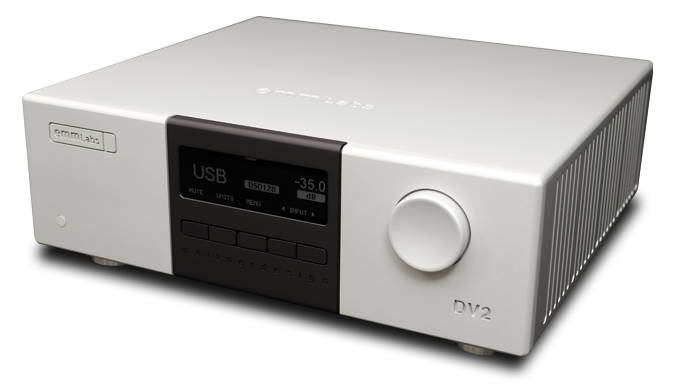
Here are some photos of the new EMM Labs TSD1 transport and DAC2 DAC we are taking to RMAF 2008 in a few weeks.

Here is the blurb sent to us which will fill you in on some of the particulars:

“The chassis is completely machined thick aluminum in gorgeous brushed silver with matching metal remote when bought as a set completely redone and retooled from the CES units so they look and feel a lot better and seamless.

The DAC2 is our next generation converter with a host of digital inputs and can be used EASILY with ANY digital source. It has Ed’s MFAST technology that allows it to completely get rid of source jitter and phase distortion inherent in all 2 or multibox systems and acquire audio seamlessly in milliseconds even from the most difficult sources like Satellite Radio, DVB, Computer systems, portable media players etc. It also has all of Ed’s prior technologies, MDAT up-conversion technology where incoming audio is up-sampled to 2X SACD (5.6Mhz) and Ed’s discrete custom built DA converters all built on composite aerospace EMMbed PCB circuit boards. Along with the regular I/O like AES, SPDIF, TOSLINK etc. it also has USB Audio port for connection directly to computers and music servers.

The TSD1 is has the built in MDAT up-converter and 2008 German drive plus it sports the new transport software and LCD screen. It also has the new single fiber EMM Link for interconnection between it and the DAC2.”

DAC2 MSRP is $9,500 US
TSD1 MSRP is $11,000 US

We can testify that when you look at them [and especially when you pick them up :-) ] you can see that they are made with a thick aluminum chassis that feels very solid and robust.

First impressions, after about 3 whole hours(!) of playing [with :-) ] them is that they are very lively like the CDSA but more so [through-out the entire note], that the notes are very well controlled throughout the entire note - something that neither analog nor digital has really contributed to in my experience [instead, we rely on uber amplifiers to do the best that can be done with the signal they are given], and a very black background [the honorable competition, and even the Emm Lab’s own CDSD/DCC2 pair to some lesser extent, seems to try and fill in the background with a lot of extra information - amplifying the quiet sounds so they do not get lost, or to please the listener with a sense of higher resolution - similar to the tipped up midrange on showroom speakers and tipped up contrast on showroom TVs? I don’t know but the digital revolution is still advancing at a rapid pace and this sounds like this will be de’rigeur in a few years. The feeling is that there is a lot more separation between the subtle notes].

But it has only been THREE HOURS. Right now we have to listen around the Cold New Player Effect - things will likely get even better if past experience [with new players] is any predictor of the future experience [improvements associated with broken-in players]. Already I think both Neli and I prefer this pair over the previous Emm Labs digital [and we preferred THAT over other digital we have heard - with the POSSIBLE exception of the Esoteric P-01/D-01/G-0s, which is much more expensive [at $60K+] and we would have to hear much more closely to get a feeling which is ‘better’, or just ‘different’. But this *is* the league EMM Labs is playing in - the best in the world.].

More in a few hundred hours or so. Or come to the show and hear for yourself :-)


The TSD1 transport


The TSD1 transport turned on


The TSD1 rear panel


The DAC2


The DAC2 rear panel


The new remote


The new remote next to the remote that comes with the CDSD/DCC2. Not as wide, same thickness, and without volume controls… Both feel great in the hand

[unlike Sony XBR remotes - boy, my mute button is already squished in after 2 weeks of use. What a POS remote - and these are their top-of-the-line LCDs too].

Meitner versus Meitner: the CDSA and the DCC2/CDSD pair

Thursday, September 25th, 2008 by Mike

We had a chance to compare these two players recently as we were swapping in the DCC2 DAC’s linestage for the Lamm L2 reference linestage [which was getting refreshed for RMAF].

We ran the warm CDSA SE [with broken-in new transport] and then the cold CDSD SE [with the older transport] + DCC2 SE DAC, both through the L2.

We are most familiar with the CDSA on this system, as we have used it quite a bit up here on the Coltrane Supremes loudspeakers these last few months.

Even though the CDSA at $11.5K costs about exactly half as much as the CDSD/DCC2 pair [with its added linestage = inputs for the turntable, for example] it has received such affection from everybody, everywhere, that even we were wondering about the real differences between the two digital front ends.

Well, even completely cold the CDSD/DCC2 pair had greater presence, PRaT, detail, image solidity and soundstage realism, dynamic solidity… you name it. There wasn’t any area in which the pair was not better than the CDSA [if one figures that the linestage in the DCC2 is about a $5K preamp - and it is at least of that quality compared to stand-alone preamps out there, then the pair is only about 50% more expensive than the CDSA - and it’s quality is indeed about 50% better, given the expected diminishing returns at this level of high-fidelity]…

… except…


The CDSD transport

When thinking about WHY the CDSA is so charming - I think [besides the killer price] that it is a little more enthusiastic at the leading edge of each note - or has just a little bit less detail there, which makes it seem a little more dynamic right there at the leading edge. This makes the CDSA seem to sound a little more youthful, and at the same time a little more like other devices in the galaxy of solid-state equipment - a little less analog, but a little more familiar to people used to solid-state or who prefer a little more youthful presentation.


The CDSD transport close-up


The DCC2


The DCC2 close-up


The CDSA


The CDSA close-up

The CDSA is now downstairs on the $90K Audio Note Ongaku integrated amp and $60K Marten Coltrane and it sounds killer. We love this 3-piece system and in fact would like to take this exact system to the RMAF 2009 for one of our small rooms. Sounds great, looks great, … and is a lot easier to move than some of our other systems here… :-)

The CDSD/DCC2 pair is on $300K Marten Coltrane Supreme system and connected to the $90K Audio Note Kegon Balanced monoblocks, no wait, it is now - this morning, connected to the Lamm ML2.1 amps, … no… wait… ;-)

Emm Labs DAC2 and TSD1 at RMAF 2008

Saturday, September 13th, 2008 by Mike

I do not know why it is, but around here we seem to have a hard time agreeing on what to take to a show - and especially our ‘home town’ show the Rocky Mountain Audio Fest.

But we do know that we are taking the new Emm Labs DAC2 [a DAC … but you probably guessed that :-) But it has no preamp; unlike the DCC2, which does] and TSD1 transport.

Here are some factory photos [we hope to get the pair here and post some more shortly]:


There are some new buttons :-) Particularly the one for PC Audio kind of stands out. We will have a laptop at RMAF to demonstrate this capability…


The remote looks more like the DCC2 / CDSD remote than the newer CDSA remote - but I like them both [I just don’t like heavy metal ones that get really cold in the Winter - we think we already have enough c-o-l-d things here in the Rocky Mountains]. There are also a few new buttons there… can’t wait to try them out :-)

Playback Designs MPS-5 versus the EMMLabs CDSA SE

Saturday, August 23rd, 2008 by Mike

This was a rather hurried back and forth shootout that lasted about an hour to an hour and a half. Neli and I were somewhat at an advantage, because we are very familiar with the system - and a very high-resolution system at that.

The system consisted of the Marten ‘Coltrane Supreme’ loudspeakers, Lamm ML2.1 amps, and Lamm L2 linestage. Cables were a mix of Nordost ODIN, Valhalla and Jorma Design PRIME. Powercords were Elrod and AcroLink. All components were on HRS platforms (and the front end on the HRS SXR equipment rack) except the Marten speaker crossover [Hmmm… we got to get this boy a M3 too].


[More photos of the PD in the previous post]

The Playback Designs MPS-5 (PD) only had about 300-400 hours on it so far, so we assumed that it was enough like the CDSA that its break-in process would be go through likewise phases of dynamic compression before opening up at around 700 to 1000 hours.

In some large sense the fact that the PD is still breaking in invalidates some of what we heard. But, considering how many of the reviews out there are of unbroken-in equipment - we thought we’d at least publish a few impressions to add a little sanity to the mix.

The short and sweet is that the PD is a very good player but I don’t think it beats the CDSA SE with the latest transport and software updates.

That doesn’t mean EMMLabs can rest easy - this player has a lot going for it - and it is similar enough to the CDSA [at this point] that it will cause confusion in the marketplace [though at $15K versus the CDSA’s 11.5K, there is a price difference - though the PD does offer additional functionality for the higher price tag by providing digital inputs on the back of the unit).

OK. Details…

The PD had very good PRaT which I thought was slightly better than the CDSA.

The PD had a slightly more colorful tone - which is not to say warm, tho it might be thought of that way - but more like the Kharma kind of exuberance - or that of analog. The Meitner is also known for its pureness of tone - and the PD was like that, only tipped up a little. I did not find it to be out of proportion to reality, necessarily, but it was a definite difference from way the CDSA was interpreting the CD.

Another difference was that either the soft notes were made more prominent - or the midrange and highs were made more prominent - which I think resulted in several more sonic differences [according to my mental model of what is happening]:

1. The soundstage was more forward. This was neither more or less pleasant than the CDSA - it just WAS.

2. There was more ‘perceived’ resolution - a lot of the subtleties of the music were more evident [note that this differs from Dave’s interpretation - by I think I have an explanation for this further on]

3. There was a higher noise floor

4. Because lots of very soft sounds were now more in evidence there wasn’t a clear demarcation between images in the soundstage.

5. This lead to a feeling that there was a larger presence, more of a oneness or wholeness to the stage - perhaps even more ‘continuousness’ where notes flowed well into each other.

All this elevation of low-level detail also to a feeling that there was [is? have to remember - this player isn’t broken in yet, and although the CDSA doesn’t sound like this when it is breaking in - this is not the CDSA] an innate lack of dynamic range between the quietest note and the loudest - and that there was ‘fuzz’ between the musicians. I felt that there were too many ‘cues’ [very low level subtle sounds like the sound bouncing off the guitar] telling the ear where everything was and concluded that there was some information that really shouldn’t be there - that things were moving around too much and too large - and that it also tended to make the notes rounder - even though the notes were great there were just a lot of other sounds around the note that was filling in around it - perhaps making it *seem* rounder.

So, in conclusion, this is a very nice player but CDSA SE owners do not have anything to worry about, …yet. However, if they look in the ’solid-state players less than $50K rear view mirror’, they will see a new player has appeared out of nowhere where before there was none in sight.

Emm Labs is a company with equipment in most pro studios in the world. This is Playback Design’s first product.

I am hoping that Playback Designs and EMM Labs continue to diverge with respect to the sound of their equipment - both to reduce the potential of litigation [the head engineer at PD is from EMM Labs] and to offer the audiophile more choices.

Our heartfelt thanks go to Dave for lugging his player up all those stairs :-)

—-

[Whew! Hard review to write, trying to be fair to both players and to both manufacturers who we like and respect - and one of which, Emm Labs, we represent in the marketplace. Also, people get so passionate about their latest high-end audio toy - one of the reasons magazines only publish positive, non-comparative reviews is just to avoid the poop storms :-) ].

Playback Designs MPS-5 CD/SACD player

Thursday, August 21st, 2008 by Mike

Thanks so much to Dave for bringing up his new Playback Designs player yesterday so we could hear it back to back with the Emmlabs CDSA SE.

More later about what Neli and I heard, but Dave wrote up his impressions which is available on the Asylum and Audiogon.

Here are some photos…. [still learning to wrangle this fullframe Canon 5D…]

Meitner versus Meitner - The CDSA SE ‘metal tray’ upgrade

Monday, June 16th, 2008 by Mike

Well, we finally got around to doing the shootout between the CDSA with the old plastic tray and the latest with the metal tray.

Both players were on HRS nimbus couplers which coupled the players to the HRS M3 Isolation Bases they were sitting on [so we did not use either of their feet, neither the old nor the new].

Both were connected to the Lamm L2 Reference linestage on its L1, L2 symmetrical inputs [its direct input by passes a few things and sounds a little better] using Stealth INDRA cables.

Both players were broken in - though the older one has been played a lot more. Both cables were also well broken in… Both players were powered by ELROD EPS-2 Signature power cords.

We used Radiohead Amnesiac, Rachmaninoff, and Dire Straits - of which we had two copies each - to switch back and forth between players.

The short and sweet - the older player seemed to be a bit louder, a bit more dynamic, the sounds were more clustered together and was slightly ‘edgier’ than the newer player.

The newer player was more transparent, more naturally spread out in the soundstage, and a little less dynamic [but it may need a little more breaking in? The player has been off a lot during the last month with all the thunderstorms we have been having - us being a little lightning-shy after being hit last year.]

The weird thing is that the Meitner CDSA was at the top of the list of un-edgy, un-digital, un-harsh sounding solid-state players. But the newer CDSA clearly beats it. This greater listenabilty was the largest difference between these two - and made us not want to listen to the older player knowing what we now know.

That is the problem with these shootouts. A person LEARNS things - and can’t go back to the sweet naivete of ‘about the same’ and ‘good enough’.

How Much Fun

Thursday, March 27th, 2008 by Mike

We have so many things in the queue … so many things lined up to try, that it gets a little overwhelming. The exact sequence of things gets a lot of discussion and seems to be updated on an almost hourly basis.

We have:

1. Compare the charged ELROD powercord that has been on the Nordost ViDar cable burner to a charged ELROD that has not been on the burner - i.e. How does the ViDar affect performance? We already did the cold (uncharged) Vidar’ed ELROD compared to the hot (charged) un-ViDar’ed ELROD. [Note, ELRODs take about 3 days or so to charge up their capacitors]. While this was ijntersting, and we will report on it, not being the brightest bears in the woods, we finally realized that this was kind of confusing [I bet you are confused, too, by now :-) ], overloading the charged versus uncharged test with the Vidar’ed versus un-Vidar’ed test.

I said it was fun. But it also requires a degree in Research Methods… apparently.

2. Compare the Kegon Balanced with the old high-gain Kegons. We can do this on the Kharma Mini Exquisites - which we anticipate will show that 1) … well, let’s not make any predictions [see, I’m getting smarter. Maybe there is hope…]. But the Kharma is actually quite hard to drive, especially the bass - especially if you want that big open Kharma sound [Kharmas always sound exciting and delicious and big, but not always that room pressurizing wrap-around that many people crave like hot butter on potatoes].

3. Compare the Nordost ODIN speaker cable to the Jorma Design PRIME speaker cable on the Marten Coltrane Supremes. This will be… well, there may not be a winner. I expect the ODIN to be more dynamic, which the Supremes love, and the PRIME to be more detailed, which the Supremes love. But for all I know I am getting it exactly backwards. That’s what shootouts are for. Proving it one way or another [at least with respect to the equipment we have here - we do try to perform part of a shootout on a completely different system to make sure that out results more or less reflect the general case].

4. Compare the Kharma Mini Exquisites to the Audio Note SEC High Efficiency Signature speakers. OK, yes, completely different… but both are 2-ways and, well they were the same price but now the Minis are $60K [seen the dollar lately?] and, well the AN speakers are… we’ll know when Neli gets the price list out [uh, oh, she’s gonna smack me when she reads this… I am already bracing for the impact… hurry up and finish this so I can delete it before she sees it :-) ]. I expect the Kharmas to be more detailed and the AN more dynamic. Duh. AN is almost horn-like and Kharma has that legendary midrange resolution. But what else will we hear?

5. Compare the M1 phono stage to the Lamm LP2 phono preamplifier. OK, Neli thinks this test is stupid too… but I want to hear the difference in character between the two. We’ve had a number of other inexpensive and expensive phono stages in here, so this is not all THAT outrageous.

6. Compare the old EMM Labs CDSA to the new one with the upgraded transport and feet. We should be getting close to getting 700 hours on the new CDSA soon now, one would think [I don;t have a little 700 hours cooking timer on it or anything].

7. Oh yeah, we still have to do the interconnect shootout where the signal is quite large, between the preamp and the amp. We actually point to a system periodically and say ‘oh, this would be a convenient time and configuration to perform the aforementioned test’ [well, we don’t use the word ‘aforementioned’ in casual conversation, sorry]. But do we sit down and do the shootout? Noooooooo. It does take about 6 or 7 hours of focused concentrated listening, so it is hard to find the time. But soon….

8. We want to compare the high-power ELROD powercords to the low-powered ones on the Lamm ML2.1. At what point to low-powered amps draw high-power? Just what IS the difference in sound between the two?

9. I am sure there is a 9. And 10….