'Audio Aero'

System Two now has two racks

Monday, March 24th, 2008 by Mike

… and system Three has none.

Both RixRax equipment racks are now over on the second system. We wanted the added capability to compare two turntables, two phono stages, and the Audio Note Ongaku to the Kegon Balanced to the Kegon.


We put the Kehon Balanced amps on the Kharma Mini Exquisites.


The tops have been off so we can stare at the internal electronics for awhile :-) But the tops will be back on soon enough… 1) they take up a lot of room just laying around, 2) the safest place for the tops of the chassis is on the chassis, and 3) just to get the aesthetic effect of a system that does not have exposed tubes.


Since our Audio Note M9 Phono preamp is still to arrive, we are using the Audio Note M1 phono preamplifier to drive the Kegon Balanced. We also had the M1 on the Ongaku integrated for awhile, to get a feel for the sound of the M1 in the system that we are so very familiar with.

The M1 is a very nice pre and I, personally, want to keep it here forever. At the price it sells for on Audiogon sometimes, $700, it sounds more like a $5K to 10K pre - and it always surprises me.

All the low-end AN gear surprises me - I keep expecting a more discordant and harsh sound - like the low end of every other line of equipment. But nooooo, this has more harmonics and warmth than the top-of-the-line, which is more neutral and detailed and transparent and realistic.


The end of the rack is now ALFULLY close to the speaker. But we figure the trade-off is worth it - that we can configure some great sounding systems that we wouldn’t otherwise be able to hear.


The Audio Note Kegon Balanced on the Kharma loudspeakers.


The Audio Note Kegon Balanced. On first blush, the M1 pre + Kegon Balanced amps is very, very competitive with the Ongaku integrated amp.

I would say more neutral [OK, nothing has that 211 sound except 211-based tube amps and the Kegons are 300B-based amps] and more transparent - more separation …and solidity?

We’re still listening…


The Soundlab system without a rack looks pretty darn cool itself. The Audio Aero Prestige is sitting on a Rix Rax amp stand.


Yes, that is a Nordost ODIN between the Prestige and Edge Signature One amps.


The Ongaku is now in System Four in Listening Room Three (L3). We haven’t hooked it up yet - this is still a AN Oto integrated-driven system.

Acoustic Zen Adagio loudspeaker on Kharma amp and Audio Aero Prestige player

Saturday, September 1st, 2007 by Mike

After going through several system configurations, this one was perhaps our favorite, especially of those with speakers driven by solid-state amplifiers.

Adagio speakers on Kharma amps

The Adagios, in this configuration, in this room (that wall behind the speakers is not symmetrical and not flat…) seemed to prefer the more aggressive Kharma digital amp than the more powerful, more laid back, and more expensive EDGE amps. It helped wake them up, so to speak.

Adagio speakers on Kharma amps

All Nordost Valhalla cabling. Yeah, each cable cost more than the speakers… but we save money using the Office Depot power strip, see? :-)

But in the end, this is a fairly reasonably priced system at about $25K + cables.

Adagio speakers on Kharma amps

No, these speakers don’t sound as tight and controlled and have the finesse of the $45-$50K Kharma Mini Exquisite and Marten Coltrane speakers… which just seems to depress our visitors who are auditioning the Adagios.

Maybe we should just hide them next time?

We already go through the ‘You really don’t want to hear these. You’ll be spoiled and will never be able to go back”. Doesn’t work, though.

And we really LIKE the Adagios… what other speaker can you play (successfully) rock & roll AND opera on in this price range? Like none, man.

Comparing and Contrasting Digital at Audio Federation

Thursday, March 1st, 2007 by Mike

In this post, we will not talk about sonic characteristcs, per se, but just the differences in functionality of the higher-end players we currently have available.

Just by itself, the difference in what these players do, and their basic approach to sound, is enough to differentiate them - enough to help many people choose which one they are most likely interested in.

*** Audio Note U.K. DAC / Transport combinations. $[varies]

Tube. If you want a musical, very customizable sound (through tube-rolling), do not need another preamp, do not want to run your PC or video system into the DAC. , and have space for a two component player.

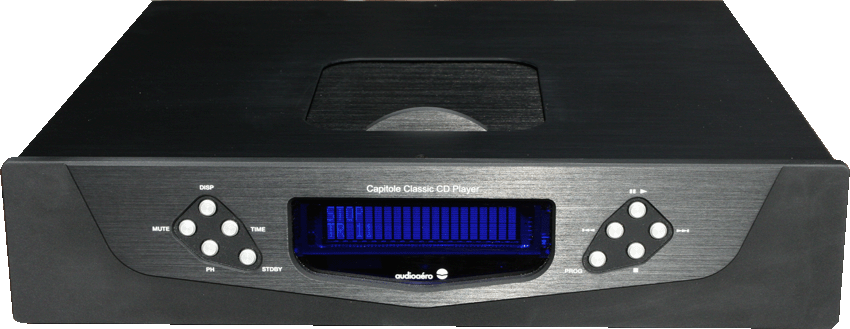
*** Audio Aero Capitole Reference CD player with linestage: $9,580.00.

Tube. If you want a very musical yet unveiled sound, need a good linestage, and do not care about SACD.

*** EMM Labs CDSA CD / SACD player $9,995.00

Solid-state. If you want a very pure yet musical sound, want SACD, do not need another preamp, do not want to run your PC or video system into the DAC, and/or only have rack space for one component.

*** Audio Aero Prestige CD /SACD player with linestage: $12,990.00.

Tube. If you want a very musical, detailed and solid sound, want SACD, need a good linestage, need a front loading CD player and/or only have rack space for one component.

*** EMM Labs CDSD SE and DCC2 SE: $21,900.00

Solid-state. If you want a very pure yet musical sound, want SACD, need a good line-stage, and/or want to run your PC or video system into the DAC, and have space for a two component player.

*** Audio Note U.K. CDT3 and DAC 4.1x Balanced: $22,600.00

Tube. If you want lots of detail with each note rendered in an analog-like fashion, do not need a preamp, and have space for a two component player.

————-

A FEW THINGS

First, these really are some of the, if not THE, best digital today.

Second, the built-in preamp are really quite good. Not spectacular, but really, REALLY good for the price paid.

Third, given your current system, and where you want to take it, you probably have a good idea about going for a tube versus a solid-state solution. The solid-state here is very, very good, very un-solid-state-like, but it will not ‘add musicality’, but neither will it take away musicality [unlike most other solid-state digital]. . It just ‘is’.

Fourth, given a budget, it may be best to allocate a larger portion of the overall budget to a player with a built-in pre, rather than get both a lesser CD player and a separate pre. Not only from a potential shelf space (and extra power cord and cable!) issue, but because it will be find to find a preamp that does what THESE built-in preamps do for anywhere near the money.

Audio Note is coming out with several single-box players, so this will make some choices harder. But for people on a budget, who have a system that they want to keep most of, who know whether or not they like their current preamp, have a preference for a specific-sound, who have limited rack space, the choosing process is really going to be very similar to the list above.

Amplifier Shootout - Audio Note vrs. Lamm vrs. Audio Aero vrs. Audio Note

Friday, February 9th, 2007 by Mike

We held a shootout here a few days ago - $85K Audio Note Ongaku versus $22K Lamm ML1.1 versus $10K Audio Aero Capitole versus $9K Audio Note Conquest Silver. Prices rounded, so don’t quote me to Neli :-) .

The Audio Aero Prestige as serving as CD / SACD player, and sometimes as linestage as well. The Audio Note AN/E Signature loudspekaers were serving as… speakers.

So, with the disparity in pricing - it wasn’t really a shootout. More an investigation into different sounds - how the different amps sounded, given that they are indeed so very different from each other.


We finished up with the Audio Note Conquest Silver 300B amps.

We will try to describe the *differences* between the sounds, as opposed to the sounds themselves.

Going from the Audio Note U.K. Ongaku to the Lamm ML1.1.


The Ongaku and ML1.1 amps resting behind the couch after their workout during the shootout.

The sound was not as big with the Lamm, somewhat more compressed - but perhaps more even-handed because the somewhat rolled-off deep bass [which lends the deep bass a compression-like signature], because of where the speakers were located [in front of the horns, which are out of here as soon as the snow melts. If it melts.].

The Lamm sound was more laid back, the soundstage receeding somewhat, which allows one to better appreciate the music in measured doses when desired, as opposed to being transfixed unable to move for whole CDs at a time [from this description I hope people see that we like both types of soundstaging - really depends on our mood at the time].

The Lamm harmonic color was a little grayer, and the dynamics, as mentioned above, a little less exuberant. This goes in keeping with our general interpretation of the Lamm sound as being stately and sophisticated, natural and self-consistant.

This is not to say that the Ongaku is an exuberant amp either - it is actually quite balanced, unexpectedly so from my point of view, with just a little flavor from the use of the 211 tube. We still have a lot to learn about Audio Note, but it is my current impression that as you move up in the Audio Note line, things become less colored and more accurate and therefore much more revealing of the color and subtleties of the music itself, quite unlike anything else out there. This seems different to me from the brands that, as you go up their line, you get more and more improved versions of their ‘house sound’. ‘Course, you can always tube roll the amp and get just about any sound you want - but I think the point has been made.

Going from the Lamm ML1.1 to the Audio Aero Captitole amp

The Capitole was sweet in comparison with the ML1.1. More euphonic, rounder, less resolution and transparency. For some reason, about half of the people we talk to these days are conscously steering away from high-resolution sound - so this amp, with ‘just enough’ resolution, should really be on everyone’s short list. No one really knows about it, but, especially teemed with the Capitole or Prestige CD player, you can get a really wonderful, Enjoyable and slightly Sweet, sound.

Going from the Audio Aero Capitole amp to the Audio Note Conquest Silver amps


The Audio Note Conquest Silver amps in play. The Audio Aero Capitole amp behind, resting.

Easiest to compare these to the Ongaku.

Less density. By which we mean less resolution, less micro-dynamics, less macro-dynamics, less color. Just less going on. But at the same time, note by note, it was the same: the notes were where they were supposed to be, the rose and fell like they are supposed to, they were just a little thinner sounding. OK, a lot thinner sounding.

Thinner sounding isn’t exactly ‘bad’, though, There is a lightness to the music, very similar to the experience of the $11K Kharma 3.1c versus the $45K Kharma Mini Exquisite, which I think is largely a psychological, not electro-mechanical, experience that is quite pleasant and refreshing. That sometimes a ‘lighter fare’ is as enjoyable, to a listener, as the full-featured experience.

Kind of like comparing the Simpsons [the old shows which had content] with a James Bond movie. One can enjoy both. But one generally prefers, and will actually pay more money for, the Bond movie.

Well, depends on the particular Bond movie :-)

Globe Audio Marketing and Brinkmann North America at CES

Friday, December 29th, 2006 by Mike

A Very Special CES Invitation

Globe Audio Marketing and Brinkmann North America cordially invite you to a very special presentation during the Las Vegas Consumer Electronics Show 8-11 January 2007.

This invitation only demonstration will take place in a private estate with an audio listening room similar in scope and size to what might be found in a normal listening environment. Comprising a WLM active loudspeaker system, Audio Aero Capitole CD player and the Brinkmann Audio Balance and LaGrange turntables, the Brinkmann 10.5 and 12.0 tone arms, the Brinkmann/EMT Titanium phono cartridge, the Brinkmann Mono amplifiers and Marconi line stage and the world debut of the Brinkmann Edison vacuum tube driven phono stage, as well as the Breuer Dynamic tone arm and Nirvana Audio cables. Demonstrations will take place in the afternoon and evening hours during the CES Show and will include a light dinner and product discussion.

This demonstration is in addition to the exhibition at Consumer Electronics Show in the Venetian Resort Hotel Casino suite 29-320 where the WLM loudspeakers Diva, Audio Aero Capitole CD player, a Brinkmann LaGrange turntable, Brinkmann 12.0 tone arm, the Breuer Dynamic tone arm and the North American debut of the RCM Bonasus vacuum tube integrated amplifier will be shown.

Contact Information:

Jody Hickson, Globe Audio Marketing
Email: info@globeaudiomkt.com

Lawrence Blair, Brinkmann North America
Email: information@brinkmann-usa.com

Acoustic Zen Adagio and Audio Aero

Wednesday, December 20th, 2006 by Mike

Acoustic Zen Agagio loudspeakers powered by Audio Aero Capitole 50 watt amplifier in main listening room

We wanted to test a theory of ours - that the Acoustic Zen Adagio speaker worked better with amplifiers that were more ’round’ and less detailed sounding.

We also wanted to see if the Adagios could fill a room that is 15 feet by 35 feet by 24 feet tall, which is more or less open on one side, with sound.

Not to mention whether the 50 watt Audio Aero amplifier at 50 push-pull KT88 into EL34-based amp could drive the speakers…

Acoustic Zen Agagio loudspeakers powered by Audio Aero Capitole 50 watt amplifier in main listening room

Finally, almost finally, we are looking at building some lower cost systems out of the Audio Note and Adagio / Audio Aero lines and this system, at roughly $24K + cables and rack, is definitely on the inexpensive side here at Audio Federation. Whether we continue in this direction or not depends on the response from our customers - but eventually we would like to have a system, in some as yet imaginary showroom, that is based on, say, Audio Aero Prima CD player and intergrated amplifier and Adagio which comes in at say $10K + cables and rack, tuned by Mike and Neli with special cables and isolation gear. Similary for a comparably-priced Audio Note system.

And, besides all that, we are running out of room and so why not put the Adagios in the least likely place? :-)

Audio Aero Capitole Reference CD player on Rix Rax equipment rack
Audio Aero Capitole Reference CD player on Rix Rax equipment rack.

Hey, it sounded pretty darn good!

Technically, and I have not listened all that critically yet but, it did not sound as accomplished as the system with the $70K Audio Note M10 and Emm labs CDSD / DCC2 driving Edge Signature One amplifiers, coming in at $130K, but this less expensive system captured more of the character of what these speakers do well: which is to create a satisfying, room-filling sound in a musical and very competant, balanced fashion. No tipped up mids and bass here, no collapse into mush at the first sign of complexity… not that we are point fingers at the, oh, I don’t know… perhaps the five most popular speaker brand’s speakers that cost less than, say, $40K? Nahhhhhh….

Yeah, there is a hump at the port frequency and a dip above it, like most ported speakers. But it is not overly prominent or distracting.

Listening from my office, which is off of the main listening room, it sounded different, but as enjoyable and nearly as emotional, as the much larger, soon to be shipped, system looming behind there in the photos. Considering the difference in cost and pain-in-the-ass factors, for casual listening one can’t help wondering why someone would want something more than this. But we are a store, so we do not wonder too awfully long. :-)

Which brings us to in-room, critical listening.

Acoustic Zen Agagio loudspeakers powered by Audio Aero Capitole 50 watt amplifier in main listening room
Nordost Tyr speaker cable.

Next step is to put some vibration mitigation underneath the Capitole Amplifier, which is just sitting on its BDR cones on the carpet: most of the notes from, say, 1600Hz on down are muddied on the decay as their deliterious effects feedback upon themselves. I would like to go with a full out HRS Isolation Base and Nimbus Couplers - just to be able to get rid of these effects and be able to start probing for other weaknesses - but they are all on active duty here, so it would pain us to have to steal one from another system….We’ll see.

There is also a question about whether the less expensive Acoustic Zen cables would mate better with these speakers than the Nordost Tyr. If so, that will be a clear win in improving overall price performance.

Anyway…. This system is kind of fun to have up in this listening room, a room which is usually reserved for the big mutha systems we have here. Kind of nice to ‘travel light’ for a change.

Blow-by-Blow: The Latest Marathon Audition

Tuesday, November 28th, 2006 by Mike

Thought this might be interesting …

As we mentioned previously, we setup a number of systems for the guy who is purchasing our Triolon speakers. This audition occured over a three day period.

The different sounds of the different setups are somewhat illustrative of our approach here to High-End Audio System Optmization [sorry, it looks so much more highfalutin when it is capitalized :-) ]. We started with a very good system, and slowly optimized it until it was, well, see below.

The first day I think we just played system 1 (below) and our Soundlab system, our Marten Coltrane system and our Marten Coltrane Supreme system. He had already heard Kharma speakers many times at shows, and our Audio Note system at this recent RMAF show.

He was very impressed by all the systems even though he had some (valid) concerns about the Soundlab system which was having some imaging problems on this new side of the room that we have recently put it on (we had the Adagios over there until a day earlier). Its always something that goes wrong… the walls went wrong in this case… Luckily everything else went very well.

System 1 [sorry, somehow we only got photos of about half the system setups]:

We started with the Audio Aero Prestige CD / SACD player with internal linestage running direct (no preamp) into the well-warmed up $140K Edge Electronics NL Reference ‘pyramid’ 800 watt solid-state amplifiers.We were using Nordost Valhalla interconnect and Valhalla speaker cable, Shunyata Anaconda power cords of all 4 kinds, with the Prestige sitting on a Fondato Silenzio platform and the amps sitting on Rix Rax ‘Outpost’ amp stands.

The Audio Aero adds a touch of warmth and drama and character to the tube-like big open sound of the Reference amps. The sound was big, juicy, with a very wide and very deep soundstage. All notes and dynamic swings were generated effortlessly. The downsides, if you can call it that, were that the imaging was fairly indistinct, the dynamics somewhat soft, from micro to mini to macro, and the overall resolution was good, but not great. This was as if the sound was painted with a big, gloriously colorful and fairly wet paint brush.

System 2:

A ‘minor’ change, we put the Prestige on the HRS M3 Isolation Base and Nimbuses. This is a reference system for us here on these speakers. The dynamics snapped into place and the imaging firmed up compared to the previous system setup. This system strikes a nice balance between naturalness and resolution, between a gargantuan soundstage and pin-point imaging. It is this balance that kind of keeps a listener off balance, never really believing that the system is going to continue to manage to paint such large pictures with such finness.

System 3:

System 3

Next the Edge NL Reference amps were replaced with Lamm ML1.1 90 watt push-pull amps sitting on HRS Isolation Bases with Nimbuses. We probably should have moved the big Ref amps out of the way, but they are a heavy 220 lbs, and we didn’t want to (aka plain forgot) move them then - and then later they were trapped as more and more equipment was brought up from downstairs. BTW, we do all the heavy lifting ourselves, even though every single one of our very courteous guests always offer to help - we are the hosts, they are the guests. And anyway, we need the workout… because guess who gets to carry all this stuff back downstairs? :-)

We do not run the Audio Aero directly into the Lamm very often - thinking it might be too ‘tubey’ of a sound. But it was not all that tubey at all. There was good resolution, still a nice large soundstage, good depth. It was, however, the slightest bit soft on the top and bottom. In many ways, it was very much like the Edge NL Reference amps, the Lamm ML1.1 being most like the ‘Refs of any of the demo amps here - and probably of most amps out there as well. A very good balance of resolution and naturalness and dynamics.

System 4:

As planned, we swapped in Emm Labs SE CDSD / DCC2 transport and DAC pair for the Audio Aero Prestige. The Emm labs (Meitner) was run direct into the amps using its internal linestage. Now this system is starting to do things that are hard to explain. The solid-state digital source is a natural balance to the push-pull tube amps - and it works. All the truth, the unexpurgated yet unenhanced details and resolution are provided to the Lamm ML1.1, and it is up to the amp to decide what to do with it. We trust this amp to do the right thing with that information stream - and our trust is rewarded. Now we have big, open, with enough resolution to tighten up the imaging and define the toplogoies of the soundstage, added micro-dynamics that communicates more of the subtle characteristics of the music.

System 5:

System 5

As we were talking about the sound of the Edge Electronics Signature One 400 watt monoblocks compared to the big ‘pyramids’, we just said, hey, you can hear for yourself. So the Edge amps were swapped in for the Lamm ML1.1. The amps were cold so we played a CD or two in the background as we waited the hour or so for these amps to get to 95% or so of their optimal sound [actually, a number of components were added to the system cold - and this got to be a pattern: Isert component into system. Listen casually. Wait. Listen carefully. Rinse and Repeat.]. Now, this is not a system that we play too often - the Edge Signature One amps are a very smooth and detailed sound - very much like the Meitner / Emmlabs CD / SACD player we had in the system. So the balance was likely to be, and was, a little on the very detailed but somewhat uninvolving side. The soundstage was smaller, the images more pinpoint but not as 3D-like, much more resolution and micro-dynamics, but less midi- and macro-dynamics.

At this point the Favorite was the Audio Aero Prestige CD / SACD player with internal linestasge running direct to the Edge NL Reference amps. Second was the Meitner CD / SACD transport / DAC pair running direct to the Lamm ML1.1 amps.

System 6:

System 6

Now we start bringing in the big boys, so to speak. We keep a straight face as we hook up the Lamm ML2.1 18 watt SET amps in place of the Edge Signature Ones. ‘They have to warm up’ we say (they were warm but cooled off during the Edge Sig One stopover). Hee hee hee. Bamm, the sound-stage width and depth expands to equal, if not better, that with the Edge NL Reference. Solidity, presense, dexterity, integrity, naturalness, purity - the midi-dynamics in the midrange are memorable. Note envelopes are as smooth and hypnotizingly fluid as ocean waves, as Pulitzer-prize winning as the notes coming from the Meitner.

We let this system stay up for awhile - wanting to establish this system as a milestone as we traverse further into the audition. It was now the favorite at this point. There is always this certainty that our visitors have that we do this to, I mean ‘with’ :-) , that, after this kind of Rush caused by hearing what was previously thought impossible, there is this deep subconscious questioning about why would anyone want anything better than this? Nothing can be significantly better than this, can it?

[Oops, somewhere in here we replaced the Valhalla interconnect that was running between the Meitner and the amps with Jorma Design ‘Prime’. This added another quantum step up in sound-stage definition and harmonic purity and resolution].

System 7:

The (very warm) 20 watt Audio Note Kegon SET amps are rushed upstairs to replace the Lamm ML2.1. This system, with the Meitner running direct to the Kegons, with INDRA interconnects instead of the Jorma Prime, was our primary reference system with these speakers. It is hard to describe all the things it does well, because we are SO familiar with it and we have described it so many times in the past. But, one of the most obvious differences now was the bass. It was VERY natural yet Impressive yet well-defined. These amps grip the speaker with an iron (make that Silver) fist at all frequencies, but it is most noticable in the bass, where other amps have the most difficulty.

This system was starting to pick up some ground loop hum, and so we replaced the Jorma ‘Prime’ with INDRA interconnect, correctly predicting that the WBT connectors on the Prime were picking up some nasties. The INDRA reduces the resolution and clarity and imaging somewhat, but has a purity that, in my opinion, works very well with the extreme purity of the sound of the Meitner.

At this point, there is an understanding now why we rave about these amps all the time. But, to get this sound, let us not forget the other players: the Meitner, the HRS bases, the Shunyata power cords, the INDRA and Jorma Design Prime and the Valhalla speaker cable.

But we rush to set up the next systems. Time is running out, it is the last day, and we want to spend the most amount of time with the system we think is the Most Optimized of them all…and we have a few more iterations to go…

System 8:

We add the Audio Note M10 linestage which replaces the internal linestage of the Emm Labs DAC. NOW we really have controlled bass. Never heard these speakers do this before. But before we enjoy it we have to deal with our ground loop hum, which is back again.

Do to the occasional (we hope) people who are very confused about electrical things yet get hired to do electrical inspections here in Wonderful Boulder County - the grounding of our dedicated lines are messed up. Yes, we can fix them sometime (it won’t be easy) but until then… Until then, Mike and Neli get to have a nice family discussion about cheatering (that would be me) and why not to cheat (that would be Neli) in front of our guest, and after messing some with groundwire we finally cheated and lifted the ground on the entire system.

We’ve said it before, the M10 is like having another Kegon, or maybe more like a Kegon with 40 watts instead of 20, or perahps like ‘no need to Bi-amp it, M10 it’. Everything is much more controlled, accurate, dynamic, well-formed, solid….

System 9:

Oh, wait, now we want to add back in the Jorma Design ‘Prime’ interconnect [I swear, I started getting blisters on the tip of my Switch-turning-off-and-on finger :-) ]. It goes in and replaces the Valhalla. How can the Valhalla be called muddy? It can’t. But it was, in comparision!

Bamm, off everything goes again and another Prime goes in to replace the INDRA. Another increase in resolution and harmonic integrity - but not as much, leading us to put another checkmark in the box supporting the proposition that it is the first Prime that makes the most difference.

System 10:

System 10

Bamm, Neli tells me that they all want to replace the Valhalla speaker cable now with Jorma Prime and Jorma No. 1 speaker cable (this is a tri-wired system and we only have one bi-wire Jorma Prime at this time). OK. Fine. But it is getting dark quick, so flashlight in hand, Neli and I change the speaker cables to Jorma. Not quite fast enough, we have to move a lamp over to shed some light to tell which are the red and which are the black connectors… important things like that.

Before we headed out to load up on Indian food, to let the system warm up and settle in some, it was apparent (to me, anyway, but I think I was much more interested than they were in hearing this particular change, as I have been thinking a lot about the difference in the impact on a system’s sound of the Prime interconnect versus the speaker cable) - that the sound-stage and imaging RELAXED. It felt like there was an easier and much smoother transition as the musicans, or their sound-engineers, moved things around on the stage. That, before, the soundstage was blotchy, that images jerked from place to place and clung to certain spots. Now, the soundstage was no longer constipated.Now it flowed…

This increased sense of continuity was also somewhat apparent in the dynamics as well: whereas before it seemed like there were maybe, say, 100 different ways a note could go from soft to loud (and back again) now there were 1000.

There were other improvements as well - the resultant being that the system felt whole now, having everything be wired with 100% Jorma Prime (except for the Jorma No. 1 speaker cable on the bass towers) seemed to allow the Prime’s capabilities to shine through, all the way from source to speaker.

After Indian buffet dinner (the food was kind of bland,.. how can they make bland Indian food??? How embarrasing, since we picked the place. Seems like Mike and Neli need to catch up on where the good Indian food restaurants are again.. and add a few pounds in the process I bet :-) ) we played a few songs from each of about a dozen CDs. Played it fairly loud, since it was our last night (volume set at ‘7′ for those who grok Audio Note volume controls, driving a high-gain amp on 97dB speakers :-) ). It was kick ass.

Classical music was so much more realistically laid out, both dynamics and imaging - such separation and definition, not quite at Real, of course, but there was a lot of stuff now that we didn’t know that we were missing before this [we never had the Jorma Prime combined with the M10 here before].

Played some of Lady in Satin as well, the 3D nature of her voice and the way she moved - it was much more like being in a cabaret than sitting in a livingroom.

And…

We heard this same system for a few more days after our guest left and then performed the swapping out of the front end for the Audio Note digital to see what THAT would do [see previous post].

No, we did NOT try adding analog to system 10 - creating system 11. Have to save something for next time, right? :-)

By then the M10 will be broken in (it is only 5 weeks old at this point).

And it will be the Marten Design Coltrane Supreme loudspeakers that we will use to navigate even further out into the Audiophile Gulf Stream, ….

Showroom 4 - the Marten Coltrane loudspeakers…

Tuesday, November 7th, 2006 by Mike

… in a small room.

Showroom 3
The Marten Design Coltrane loudspeakers, Audio Note Kegon amplifiers and Audio Aero Capitole CD player.

This room is 10.5 x 20 x 9 feet tall.

The sound very much reflects the sound of the Capitole, ultimately musical, a little sweet, a touch of raspberry and tobacco - oh, wait, I mean a little round and luscious.

It sounds quite good - though the room can be overloaded at about, I would guess to be 90dB or so, unlike our larger rooms. In other respects the system interacts very little with the room, so little in fact that it was a little surprising.

We know that the Coltranes were designed to be able to work well in small spaces - but were still unprepared for the results. Very much like the Audio Note speakers, which were designed to use the room’s acoustical properties to best advantage.

I mean, most of us play our systems, our speakers, in a room, right? And most if not all speaker manufacturers know this, right? And only some manufacturers expect audiophiles to live in a padded cell… [unlike society at large :-) which is probably quite happy yet mystified to see us building our own padded cells. Self-incarcerating lunatics. How conveeeeenient.]

We are currently running with Nordost Tyr speaker cable, which is very good but not quite as good as Valhalla - lacking some finesse and truth in comparison. We hope to optimize this system quite a bit before we are through.

Showroom 3 equipment rack
The Acoustic Dreams equipment rack with… yes, the Kharma MP150 amps.

We were only able to try the Kharma amps for a few minutes, while a pair of balanced interconnects flew in and out of here.

You see, the MP150 only come with Single-ended OR Balanced connections. This one has balanced. We do not have any balanced cables here (long story, suffice it to say that very little of the equipment here is balanced).

So, when our 2m Valhalla balanced interconnects arrive (we sell a lot of Nordost here - might as well have a balanced cable around) we will get to hear these little big amps again.

Two questions:

1. Is it improper for us to put these amps on the Marten Coltrane loudspeakers (there is something of a friendly rivelry between Kharma and Marten)

2. How many people besides us and Steve want to see pictures of the Elrod Statement power cords - the LARGE Elrod statement power cords hooked up to these guys? Power cords that are about the same width as the amplifiers?

Thought so.

Kharma MP150 amp with smaller Elrod power cord and Nordost Valkryja speaker cable

This last picture was hastily taken with the smaller, one might even say reasonably sized, Elrod power cable attached to the amplifier.

Finally, this system will have the Audio Note M8 phono on it for a few days this week, and with the Brinkmann Balance turntable running through it. THAT should be interesting. Hopefully we will get time to put the Audio Note cartridge on the Brinkmann, and with the Audio Note S4 stepup transformer, see what THAT sounds like.

This is what they call F-U-N.

Updated Our On-site Equipment List found in the Tour

Monday, November 6th, 2006 by Mike

Still need to update the Tour photos…

But it was time to update the Equipment List.

Much of the text that we had there (and some of it still is there) was written in the first year of our store, some 4 years ago.

I had included stuff like This Magazines Award and That Magazines Award.

I thought I was sceptical at that time of the Reviewer community… hah! Now it is all but ludicrous.

I can just see the budding reviewer as a child on career day…

Politician? Reviewer? Politician? Reviewer?

Hey, at least it keeps them away from the nukes.

We try hard to ignore that part of the industry… really we do.

The equipment page was fun to redo - we have some cool stuff here - and some cool pics:

Audio Aero Capitole amplifier
Audio Aero Capitole amplifier. The colors! More larger pics

The text describng our equipment here has a ways to go - to sort of migrate from the advertising copy approach which we kind of cut and pasted from various manufacturer’s copy to the “What Neli and Mike Think” approach.

For example:


Our Kharma Mini Exquisite loudspeaker. More larger pics.

What we say now is:

“The best 2-way speaker technically and perhaps the most magical 2-way as well.

Ours here, pictured at left, are in aubergine - which is kind of like an eggplant purple. Subtly hallucinogenic - just like the way they sound.

That 1.0 inch diamond tweeter provides an amazing amount of resolution, seemingly much more than the 3/4 inch, and it just seems to be able to project the music from the speaker into the listener’s head.”

This is all to say that the speaker functions excellently in a technical sense from the perspective of a listener compared to all other 2-way loudspeakers (for the sake of argument please ignore the ’stone knives and bearskins’ that J.A. et. al. use to measure sound quality).

It also is trying to say that there is something going on that is hard to describe, but revelatory and pleasurable - that the mind, while focused on and enjoying the very high resolution of the one inch diamond tweeter, is penetrated on other levels which at this time there are no words for.

So we call it magic. Or hallucinogenic. Or “don’t know what it is but I like it”.

It would be easy to kind of cop out and borrow lots of terminology from some religion or another, or Terrence McKenna, or New Age Hermetics, or…. .or Cheech and Chong.

But, although once in awhile borrowing phases from Star Trek TOS (which is simultaneously both tongue in cheek and strangely technically relevent), we try to avoid letting the ‘magic’ of muscial experience be drowned by the hyperbole, nomenclature, stifling hierarchical bureaucracy or consensual irrelevancies of these other pursuits.

We have our own hyperbole and consensual irrelevancies, thank you.

Oops, got side-tracked.

So, trying to explain each component we have here in a few words to someone checking out the list to see if we have something worthwhile listening to… What to say. What to say.

If they are just looking around at various dealers to hear what has received rave reviews - well, that is not going to narrow the list at all. Everything sounds great, haven’t you heard?

So, hopefully just putting down what we think is going on, in halting English, putting it out there - exposing our stumbling around in the dark, for everyone to see, as we try to figure out just WHAT this speaker, and a few other components here and there, do that is so darn AMAZING - that this will tempt people into comimg here to hear and experience the whatever-the-heck-it-is for themselves.

[Oh, and now I see in the TAS we just got that Wayne Garcia just raved the Mini Exquisites. Don’t know whether to giggle or scream. So I guess I’ll just go to bed. G’night everybody.]

[P.S. Hope everyone had a peaceful night. The problem with a rave reviews from most reviewers is that it puts a potentially really great speaker or component on the same level as all the mediocre speakers and components that the reviewer also gave rave reviews to.

Yes, many dealers just point to the recommended lists in Stereophile and TAS and grunt a little - and so random raves do spread the sales around to a wide variety of products - but it does a disservice to the consumer interested in the sound of their equipment. Why must this industry treat audiophiles like ‘marks’ at a carnival - like they were just wallets and purses with credit cards for arms, industry sanctioned ‘recommeded lists’ for eyes, and without any ears? We can do better.]

The Kharmas, the ML2.1 too, the Audio Aero Prestige, the HRS racks and their bases, the Elrod, Shunyata and Jorma Design and the rest, all here on …

Thursday, August 24th, 2006 by Mike

Picture of entire system
Picture of entire system with Kharma Mini Exquisite speakers, Lamm ML2.1 amplifiers and Audio Aero Prestige CD/SACD player on HRS M3 isolation bases and MXR equipment rack. Cabled by Nordost Valhalla and either Elrod Statement power cords or Shunyata Anaconda Alpha Helix power cords.

Picture of entire system with one Kharma Mini Exquisite in foreground

Kharma Mini Exquisite from above
Kharma Mini Exquisite from above.

Sonically, this isn’t a blow-us-away system compared to the same system with the Marten Design Coltrane speakers. It is very nice and enjoyable - but not surprisingly so. Maybe our expectations were too high. Is it wrong to be so spoiled? At what point does our addiction get so out of hand that we no longer represent the average guy or gal? Oh, you are saying we passed that point a long, long time ago? Oops.

We still have to work on the positioning - and we are planning on moving the EDGE solid-state amps over on this side of the room - they being so successful on the other side on these Mini Exquisites, and switching back and forth.

Speaking of switching back and forth….

The power cords powering the ML2.1
The power cords powering the ML2.1.

The power cords powering the ML2.1

The power cords powering the ML2.1
The power cords are the Elrod Statement III (the big ones) and the Shunyata Anadonda Helix Alpha (the red ones). The speaker cables are the Nordost Valhalla. This could be abstract art if it wasn’t so functional.

The Shunyata lends the system detail. The Elrod body and bass. If we are being picky we switch them for each song, depending on what we think will sound best. Though waiting for the Lamm amps to restart after switching power cords - waiting through their 90 second power-on cycle - is long enough for husband and wife to get a chance to talk to each other……

MXR equipment rack
TheHRS MXR equipment rack is looking a little empty. And missing the top shelf. That Audio Aero is doing source and premaplification duties - what used to take four shelves now just takes one.

Close up of MXR equipment rack top shelf missing
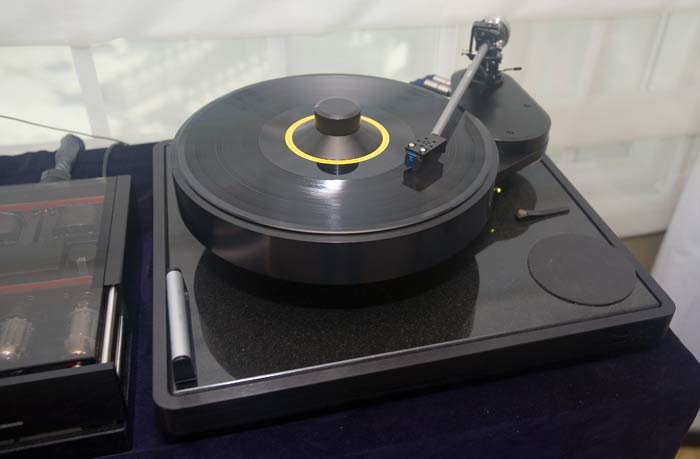
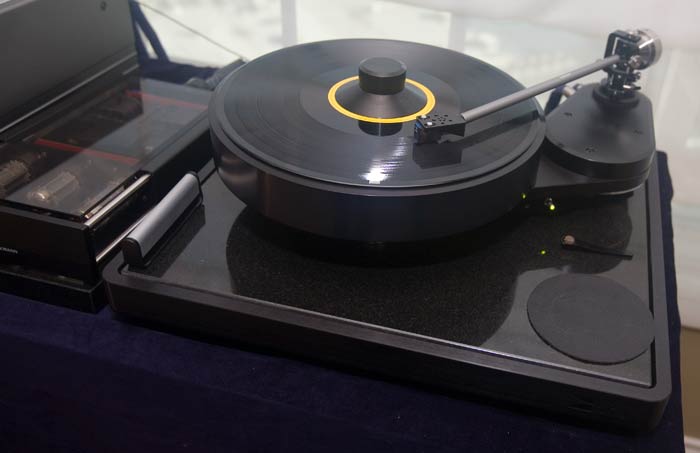
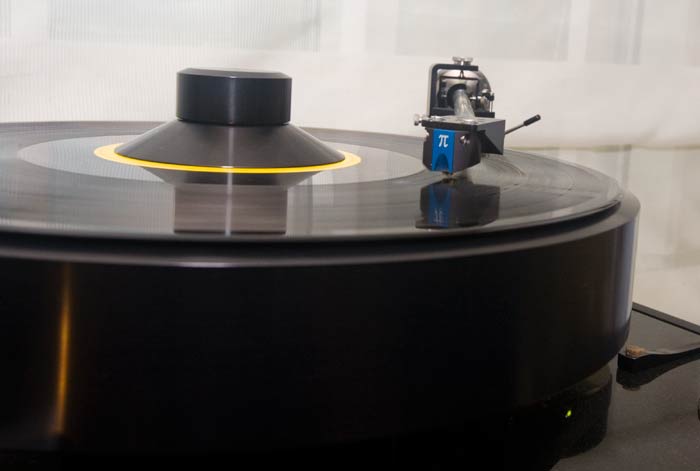
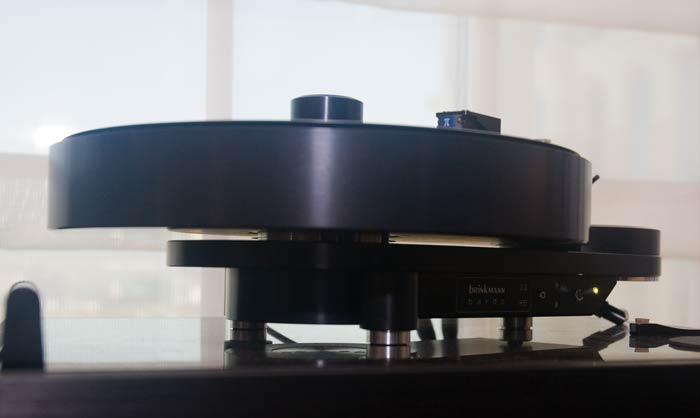
The top isolation base was out on loan - and now that it is back it is being repurposed elsewhere we are going to move the Brinkmann Balance turntable over on to the MXR equipment rack…. leaving just the Walker Proscenium Gold Signature TT on the RixRax / SoundLab system.

Jorma Prime interconnect burning in on Nordost Vidar burner
Finally, we are anxiously awaiting the conclusion of our Jorma Prime interconnect burning in on the Nordost Vidar burner.

Tick tock tick tock….